Priceless
How much is the purse––how much the papaya per kilo or the platanos? It seems as though in Mexico, we are always asking or being told the price of something. It is strange how rarely we had to ask this in the U.S., for everything there carries a price tag. Try some time to purchase a dress when there is only one like it on the rack and the price tag has fallen off. It is impossible. There is an established price that no one knows except some elusive price person perhaps filed away in a closet between pricing sessions. When the price tag falls off, the garment goes in a pile, perhaps to be reduced or sent to some limbo especially established for tagless garments, but not on your back, where you would prefer it to be.
In the U.S., the only comparison to Mexico is perhaps the garage sale, where pricing is often a matter of bargaining. Both seller and buyer establish a worth in their own mind and they each move toward that goal from a different direction. “Five dollars,” “Two dollars,” “Four Dollars,”Three,” “Sold!”
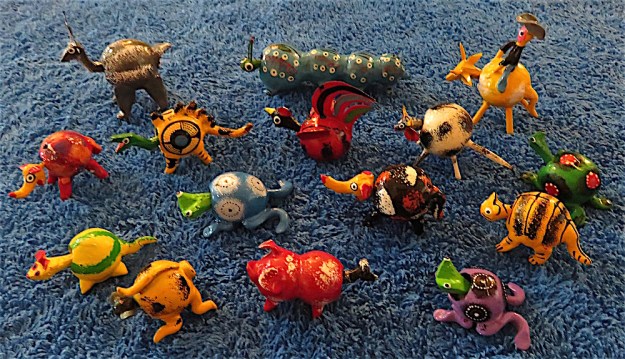
On the beach in La Manzanilla, where I just spent two months, I bought 32 bobbleheads over the time I was there. I didn’t really need even one bobblehead animal, but the children I bought them from a few at a time were so cute and funny in a natural uncalculated way. The little boy was so kind and protective toward his little sister, and she was so nonassuming and innocent. If this was all sales technique, it certainly worked, but I am a pretty close observer of minutiae and everything about these children seemed unplanned and fun. To them, “selling” was involving you in their play as they lined up cowboys on the backs of cows to face off with a rotund moose or bobblehead monkeys.
“Cuánto cuesta?” I had inquired when they first held out his large box, her smaller one full of bobbleheads to me. “Veinte,” they replied in unison, and then “Twenty pesos.” Although I’d always paid ten pesos for these little treasures in the past, I didn’t question the price, knowing that the U.S. dollar had soared to be worth nineteen pesos. These silly little toys––intricate and well-crafted, were certainly worth a dollar, which is what I’d been paying for them when the exchange rate was closer to ten to one. Like the price of everything else, it had probably been raised to reflect inflation. And so I paid the price without bargaining, and encouraged friends to buy from my favorite beach duo as well, even after I found them in both the weekly market and souvenir stores for ten pesos each.
As my time to leave approached, I spent less time on the beach or on my porch and since I’d already purchased at least one of every species that appealed to me, as well as duplicates as gifts, Edgar and Flo, sensing the inevitable, reduced their visits to my porch.
During their last visit to me, “This is a family,” Edgar explained as he lined up three zebras–one fatter and taller than the two others that stood either side. “A mama and two babies,” he said and then, quickly, “No, a papa and two babies.”
“No mama?”
“No.”
“Will they get a new mama?”
“No.”
I know Edgar and Flo have a mother and two older brothers, so this little story is purely imaginary and, like his flute playing and their little songs and arrangements of animals on the steps of my house for the many afternoons they’ve visited––priceless.
To read and see more about Edgar and Flo, go to
https://judydykstrabrown.com/2016/02/26/tower-of-bobble/
(The daily prompt word was “Price.”)
 lifelessons - a blog by Judy Dykstra-Brown
I think here, in the US, they would rather not sell it at all than sell it without knowing the “official” price. Everywhere else on earth, this is weird.
LikeLike