Too much heartbreaking news lately. Go Here to hear and see this wonderful video that will heal your heart a bit.
For the past year or so, only the top 1/3 of the string light that illuminates the spiral lamp in this picturd has been lit. I have put off changing it because to do so I would have to remove each of the tiny squares of my handmade paper that I had to apply to the frame one-by-one to create the covering for the lamp. But suddenly, just now it came fully on. And guess what had just happened? After months of struggling to finish a book about events 50 years ago that I dreaded reliving to reveal the sad ending to, I had an insight and began writing the piece below that may or may not be the beginning of a new book about the present for a change. I wrote for a half hour or so before noticing that this lamp had come fully alive again! Classier than a light bulb in a thought bubble coming out of my head. Do you think something is trying to send me a message? Two weeks later, it is still fully lit whenever I turn it on. Below is the short piece I had written, purely on impulse, in lieu of returning to the dreaded task at hand:
Now
Who am I when I am with only me? Certainly, never one person, but rather that person inside of me along with the outside me. I am not often, if ever, aware of any struggle or debate between the two of them. It is rather that they fulfill certain roles for each other as well as for me. It is like we are all teaching each other, and the results come out in art or a poem and/or some changed behavior on my part. Don’t ask me to explain because I am teaching myself as I write this and so I don’t know the ending, either, or even the other steps to the ending. I am just here writing this instead of something else. In making this decision, I am making other decisions concerning other projects. Some will, perhaps, be cancelled. Others delayed, because a part of me wants to tell the rest of me some truth about all of us, and it can’t easily be told or revealed through all that other busyness. I need to choose what I am writing now, that wants to be written so badly that it has taken over my consciousness, at least for the amount of time it will take for whatever it wants to be said to be said.
Where is the best place to start? I guess just wherever that pilot steering the ship of me for the moment decides to take us. I am home alone, with the exception of three dogs in their beds in the doggie domain I added on to the house a number of years ago or on cushioned chairs on the terrace under the overhangs where Xmas lights from two Xmases ago blink in strings in the Virginia Creeper that forms a two to three foot curtain over the edge of the terrace roof. . . .
(It is at this point, as I looked out through the window at the Xmas lights, that I noticed the reflection in the glass of the spiral light behind me that had become fully lit, as though applauding my new inspiration. Has living in the painful past for so long as I struggle to complete the book kept me from living in the present? I guess whatever I choose to believe will determine my present as well as my future.)
Beach Art
The salty beast of tides slides in with silver on its edges.
It is a vault that leaves its treasures on the beach’s ledges.
Bones of fish and brittle shells and by-the-wind sailors
with wings trimmed off by tide and sand—those best of the sea’s tailors.
The jawbone of a shark or ray lies tilted on the sand.
Debris spread out like stitches by nature’s tidal hand
that slathers daily riches that an early walker saves,
collecting them while listening to the voices of the waves,
then sorts them into stories as she gives them a new life
with scissors and with fingers––with glue pot and with knife.
Click on photos to enlarge to see details.

This little piece of driftwood looked exactly like a bear. I didn’t touch it. Just mounted it on a piece of driftwood. It sold immediately.
For the Sunday Whirl, prompt words are: jaw debris stitch slather voices beasts tides salty vault edges silver tilt
Beloved
Each morning when I wake
to shrill alarm or sweet bird song,
depending upon the requirements of my day,
you are the first to greet my opening eyes.
You rest there on the pillow next to me
in the bed where first I, then you,
have fallen to sleep the night before
too soon, too soon,
before half our words were said.
It is the first stroke of my fingers
that brings you finally to life.
Your countenance lights up
and the same love words
I revealed to you last night
are returned to me.
My hands caress
and new words come easily
first to me, then to you.
I touch gently all
your fine smoothness,
getting back
everything that I give
equal measure,
continuing our long love story
of give and take
as I shift your light frame onto my lap
to stroke your separate parts
from question mark to exclamation point.
Could a PC ever rouse this passion in me?
No way, MacBook Air. Thou art my love!
The SOCS prompt is “Love” of course. Happy Valentine’s Day !!!!

For Fibbing Friday, the task at hand is to define these words:
1. lowkenuinely: A lowest ranking in one’s range of knowledge or insight
2. gruzz: Those scruffy short whiskers it is the fashion for men to leave on cheeks and neck, as though they haven’t bothered to shave for a day or two.
3. nerf: A nerd with gruzz.
4. 41: A steak sauce created from mixing Worcestershire Sauce and 57 Sauce.
5. AFAIK: Someone who is not genuine.
6. agentic: Able to grant wishes.
7. aura farming: A lightbulb factory.
8. bed rotting: An untended flower patch.
9. blep: A softly rolled terrycloth washcloth specifically used for erasing ink errors.
10. bloatware: Photographic filming equipment specifically engineered to make a character look fatter than they really are.
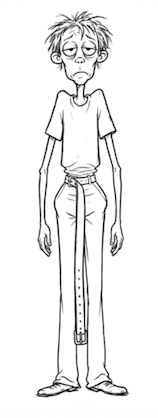
Illustration created with the help of AI.
Home Traveler
Alone, or with the teeming throng,
I go on journeys short or long.
Walking by choice in foreign places,
I study unfamiliar faces.
But when I finally go to bed,
I journey farther within my head,
those trips to town forgotten while
I journey mile after mile.
Eschewing trips to foreign places,
I journey into inner spaces.
For dVerse poets
Blackbirds Over Lake Chapala
I no longer have to look away from the sunset
to know the birds are flying over.
I’ve come to recognize the sound,
like water rushing against the banks of a stream,

of thousands of wings pumping then gliding then pumping.
The ribbon of their combined mass
twists for miles like a giant ghost snake in the sky,
its molecules dividing, joining,
undulating from the green marsh grass
into eye blue sky.
Birds silhouette against
an edge of tangerine cloud
that is a scribble of glue in the sky.
Below them,
the smell of dirt, smoke from the burning mountain,
drum beats from the heart of the hazed city.
A canoe shaped like a Nile barge bumps against the reeds.
Sounds of a new flock flying over whip the air
above the night heron
who stands on short legs
on a post surrounded by low water.
The whole mass of birds is blown by the wind forth and back,
forth and back.
Some separate and circle back to marsh grass
where another mass lifts to fly east,
away from the setting sun.
The scene is ripped by
the rapid raucous staccato of two small boys
lofting rocks toward the soaring banks of birds,
violence feisty in their harsh raised voices.
Again and again they throw their stones,
a futile gesture,
as above them the sun turns angry orange
over the purple mountains,
then sinks to radiate like something sacred
from behind dark clouds.
Watching two egrets open the air with pencil points, then vanish into it,
I only hear the diving pelican cut the water behind the tall reeds.
And, like a sudden wind over my head,
a new rush of blackbirds.
In Defense of Poetry
“I like the sound of poetry, but I don’t get it.” “What does it mean?” “If it means more than it seems to say, why not come right out and say it clearly?” “It sounds phony. The language isn’t real.” “It sounds good but it isn’t about anything significant. Why don’t you turn your talents towards something significant?”
All of these statements have been made time and time again about poetry, some of them about my own poetry. It’s true that there is much bad poetry, as there is much bad prose, but there is also the wonderful poetry of Sharon Olds, Carolyn Kaiser, Carolyn Forche or Robert Frost. The poetry is not written in the stilted poetic style of centuries past that most people associate with poetry, but rather in clear, concise everyday language. For it is not the language of good poetry which divides it from good prose, but rather the language that is left out, the type of detail focused on, and even the part of the brain that instigates it. Poetry gives those of us with not much patience for the news another way to think about politics. And because it is more an activity of the right than the left brain, it gives us another slant on the matter. So, let me try to persuade you to give poetry one more chance. Read his essay, read the above poem one more time, and perhaps your tolerance for poetry might expand a bit.
First of all, poetry is always about something more than is stated. Take the first stanza of “Blackbirds Over Lake Chapala.” The poem starts out simply, talking about a giant flock of birds. The senses of sight, hearing and touch are appealed to as the poet describes standing under a flock of thousands of birds as they lift from the lake.
In the second stanza, the sense of smell is added to the sensory experience and the theme expands into more than a nature study. The edge of the cloud, caught by the light, becomes a “scribble of glue.” The image not only conveys information about the appearance of the cloud, but also brings in the new theme of technology–something functional and man made. The city is “hazed.” It is ironic that just as the natural beauty of the cloud edge is described in imagery that links it to a man-made accident (a scribble of glue) that the sunset is made more beautiful by the smog and smoke issuing from the town. What appears to be beauty is actually what is killing the lake. Man draws off more water than can be replaced and the lake shrinks. Pollution from irrigation runoff is killing the birds and fish.
But the beauty of the lake remains, as though nature continues to assert her dominance. In stanza three, a new flock flies over. A heron appears. The wind buffets the flock. It is both the wind of nature and the wind of change in society. For the language of poetry has levels. What is said, what is implied. The birds fly away, but more birds always emerge. Is this how it really is in nature? Will it always adapt and change to accommodate the horrors that we inflict upon it? In stanza three, it appears that this is so. But then, in stanza four,
The scene is ripped by
The rapid raucous staccato of two small boys
lofting rocks toward the soaring banks of birds……
Again and again they throw their stones. Senselessly, like shooters on a kangaroo hunt or like buffalo hunters, they seek to kill for the sport of it. Everything in their world is theirs to do with as they please. For the small boys, it is a futile effort as the birds soar away, but bigger boys (and nations) yield bigger weapons, and it is just possible––more possible within the past few years––hat they will finally win in their selfish efforts to bend the world to their needs.
The sun turns angry orange, personifying nature. Would that nature could protect itself. But sometimes its only defense is to destroy that which is destroying it. Some would say we are the hands of nature, destroying the infidel. Some might say that the infidel is the hand of nature, destroying us, who have wreaked so much havoc in the world. But what does the poem say?
In the last stanza of the poem,
…two egrets open the air with pencil points, then vanish into it.
I only hear the diving pelican cut the water behind the tall reeds.
And, like a sudden wind over my head,
a new rush of blackbirds.”
There is more to nature than we can ever understand. Our meddling with it has proven it to be true. The poet only hears the pelican. She cannot keep her eye on both the egrets and the pelican at the same time. So it is with us. We can never understand the total interconnectedness of nature. We are a part of it, as is the bomb, the oil tanker, and politicians. It is the way of nature that one thing dies to feed the other. We are not placing ourselves above nature in fulfilling this drive. But what we are doing is placing ourselves upon the chessboard of nature. Seeing ourselves to be the knight, we may find ourselves the pawn. We may find ourselves both the agents and the victims of the world as it seeks to rid itself of harmful elements. Most people, no matter what their religious or scientific beliefs, recognize that our world of animals, man, televisions, SUVs and rocket ships has evolved from something far different. . .from gas, dust, spirit. This world, so changed over the eons of its creation, will go on restoring itself, replacing one form of life with another. Is it our turn, like the great dinosaurs, to be replaced? Are Trump and Musk the twin comets who will bring about our demise?
And if so, what of the world? In the last stanza, after the sudden wind, there is a new rush of blackbirds, And so it is with the world. Nature, more innocent in scope if not in intention, will go on in one form or another. Whether we continue to be a part of it is, for the present, up to us.
Author’s note: This poem was written at a time when the lake was at an all-time low. Presently experts have declared the lake’s water to be 70 percent above U.S. minimum standards. The fish are not polluted and the lake is swimmable–in spite of what is often said. And although in the essay after the poem I mention the “poet,” as though it were someone else, the poem is, in fact, my own.
Creation
I chop my life up into bits, incongruous and varied:
struggles, victories, tragic loves, the day that I got married.
Clashes create beauty as pains mix up with cheers,
making a lovely pattern as each new piece appears.
In stories as in patchwork quilts, all bits are not roses.
Part of the beauty comes from the pain that it exposes.
We put our art together, fragment after patch
and no pattern emerges if all the pieces match.
A convenient truth of works of art as well as that of life:
beauty’s found in perfection, but also found in strife.
Sweet berries come with brambles and each rose has its thorn.
Both great passion and great pain predate the time we’re born.
Perhaps pain is the awful price that we have to pay
to experience the pleasure of when it goes away.
So with the ugly fabric that finds a place to fit
when contrasting beauty is stitched in next to it.
Life is a lovely story, but not all of it is writ.
Why were we created if not to add to it?
In taking all the pieces we’re provided with,
We take part in creation by adding to the myth.
The What’s Going On prompt is Creation