The Willow Cutters.
They gather in circles as the day ends.
Men sit in one circle, closer to the lake.
Women, still standing, cluster laughing around a ribald tale.
They’ve been cutting old willow, then burning it for weeks to clear the mud flats.
Now new willow, red-veined with opalescent skin, springs up from the graves of the old.
The teeth of slender leaves cup up to catch the far-off whirr of rain bugs in the hills.
Every night louder, their repetitious whirr is as annoying
as the temperature, which grows hotter every day.
The birds all seek their evening perches—
night heron on the fence post in the water,
blackbirds in orderly evening strings,
swallows in frenzied swooping snarls.
A young girl lies on her back in the short cool grass
that in the past few weeks has sprung from the cracked mud.
With her baby in arms, she rolls over to face the red sun and in her journey,
sees the ones from her pueblo who burn off last year’s growth.
Sees also the gringa who cuts the tender willow.
She is an interloper who watches birds, and as she watches,
is watched—the bright colors of her clothes drawing eyes.
She is the one for whom being a foreigner isn’t enough—
an ibis among herons, a cuckoo among blackbirds,
Now and then, all flock here.
As mother with child stands to go,
the willow cutter, too, straightens her back
and trudges heavy, arms filled with willow,
toward her car far up the beach.
As sun like a cauldron steams into the hill,
horses stream smoothly back to claim their turf,
and the other willow cutters circle longer, telling stories, moving slow.
Children run races with the night as sure as new willows
grow stubbornly from the ground of parents
uprooted, but victorious.
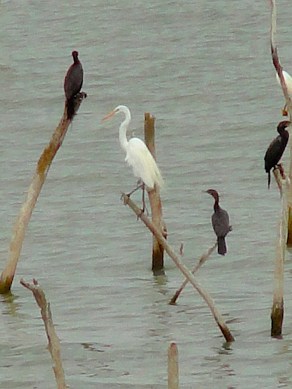
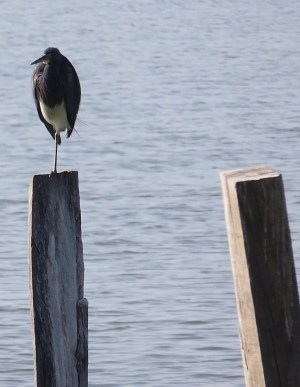
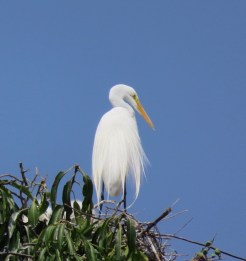
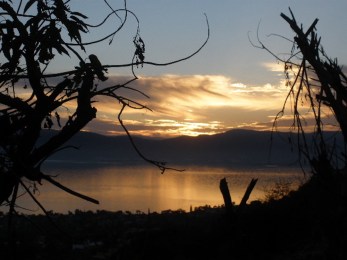
This is a poem written the year I moved to Lake Chapala, eighteen years ago. Every day for two years, I walked on land that had formerly been lake. There were acres of willow that I later learned townspeople were hired to clear before Semana Santa, when hordes of tourists from Guadalajara always descended. I was there to cut willow to make lamps. When the lake came up to its former banks a few years later, all of those willows, that grew back yearly, were destroyed. Only their bones now stick up when the lake recedes a bit again every year. They make perfect roosting places for birds. I rarely walk on the lakeside anymore. The lake has remained high enough so all of my former walking places are under water. Instead, I stay home and write poems and post blogs. As usual, click on any photo to enlarge all.
 lifelessons - a blog by Judy Dykstra-Brown
I read your poem in the same way I would view a painting, Judy. The title reminded me famous paintings, for example ‘The Potato Eaters’ by van Gogh, ‘Washerwomen’ by Millet or ‘The Laundresses, by Edelfelt. However, yours is not only a human study but also a landscape. I love the way you describe the new willow: ‘red-veined with opalescent skin, springs up from the graves of the old’; and the various birds seeking their evening perches, and the lines:
‘As sun like a cauldron steams into the hill,
horses stream smoothly back to claim their turf…
Children run races with the night as sure as new willows
grow stubbornly from the ground of parents
uprooted, but victorious’.
LikeLike
Thanks, Kim, for both your reading and your perceptive comments..The lake has now come up and all that area has been underwater for years. So glad I spent those years walking it every day and that I have these fond memories.
LikeLiked by 1 person
A wonderful poem, descriptive of the scene, but also of the customs and activities of the people and your place among them. Was the lake low because of drought? And are rain bugs like locusts or crickets?
LikeLiked by 1 person
Rain bugs are actually called Rainbirds, but they are bugs and I new if used that term that people would think I was really talking about birds. They are the local name for chicharras or cicadas. The lake was low because of less rainfall but mainly because they were drawing all the water off further up river..including to fill two massive dams. Local action, assistance from the Living Lake Society and national legislation saved the lake which is now up to capacity again.
LikeLiked by 1 person
I’m glad to hear that activism had such a positive result for a change! Thanks for the explanation about the bugs — I just wasn’t sure!
LikeLike
The Living Lakes Society worked to save important lakes in the world that were threatened and needed to be preserved. It wasn’t only luck that Lake Chapala was chosen . A number of people worked very hard to present the reason why it deserved the distinction, raising money and encouraging legislators to enact legislation. Aurora Michel was one of the leaders of that movement, but there were many others as well. Plaudits to them.
LikeLike
Thanks for sharing this!
LikeLiked by 1 person
AH! This is beautiful, in its scope and exploration which covers both the natural surroundings as well as the way of living and in a way coexisting as well. Every image stands out in its depth of field, with something focused and something blurred of these vistas. A wonderful read!
I love this bit in particular: “The teeth of slender leaves cup up to catch the far-off whirr of rain bugs in the hills.”
LikeLike
Thanks so much for your lovely comment, Anmol.
LikeLike
I enjoyed the cultural aspects of this poem as much as the depictions of nature. Good story about how they got the water back into the lake, too.
LikeLiked by 1 person
Thanks, Eilene. When I moved here 18 years ago, they said the lake would be totally dried up in 5 years. That is actually how we could afford our house as property values had fallen incredibly. Then, it started to fill up again. Proof that sometimes the worst things can bring about good as well.
LikeLiked by 1 person
A picture in words, enhanced by evocative images – great post, Judy!
LikeLike
Thanks, Dolly. That was an incredible period.
LikeLiked by 1 person
You have conveyed the feeling perfectly.
LikeLike