Category Archives: Stories

Innocents in Mexico, Chapter 17

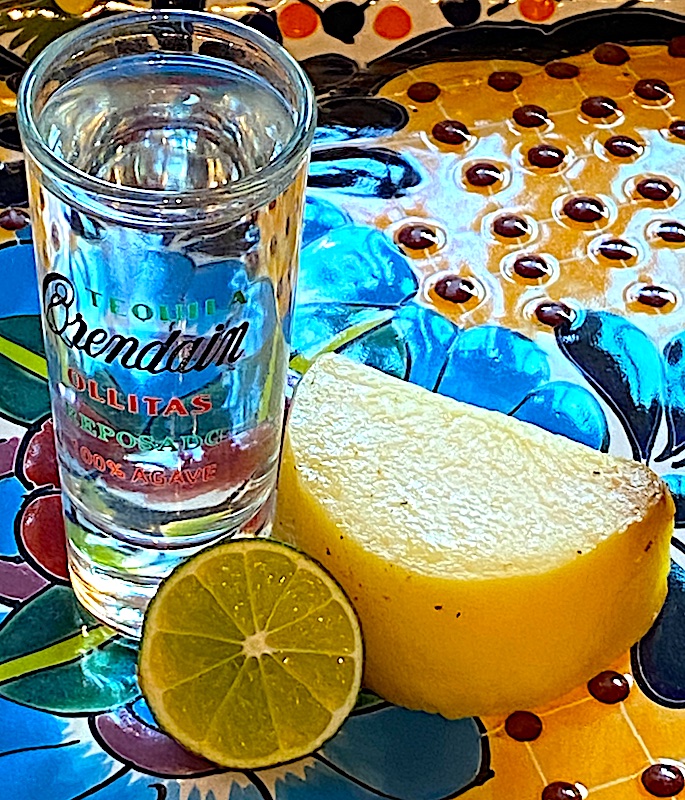
Tequila with Lime and Potato?

Innocents in Mexico

Chapter 17


For the next two days, there were almost gale force winds followed by torrential rains.  Pots in the compound blew over, their tall plants having been blown like sails by the wind.  The streamers which hung across the road came detached at one end and tangled around the telephone wires.  We had invited our first guests over for dinner on the first day of strong winds.  As the hour approached for their coming, I kept hoping that the winds would stop.  Our dining room table and chairs were on the roofed but unwalled patio off the kitchen.  I put out candles, but they blew out.  Any time I moved out to clean or rearrange chairs, the heavy glass and metal door was caught by the wind and slammed shut.  By five o’clock, Bob had agreed that the weather was not going to cooperate and we moved the furniture to the sides of the living room and moved the table and chairs into its center.  I collected bougainvillea from the lush plants in the patio, a few branches of each color.  I arranged them around the hors de ouvres and made bundles of forks, spoons and knives which I wrapped in napkins and tied with waxed linen, slipping a sprig of bougainvillea in each one.  The day before, I had disinfected the fruit and vegetables, made the spaghetti sauce.  That day, we had shopped for bread, driven out to the hacienda to check on the progress of the remodel of the house Ernesto wanted us to rent.  We had checked out other areas as well.  I still didn’t feel like it was my place.  It was too cut off.

            Ernesto was slated to arrive at our house at 7 p.m.  Dirk, who had to pick up Maria at work, thought they’d be there by 7 p.m.  At 6:55, Bob said, “You know, in one of our books about Mexico, it says that Mexicans are too polite to turn down your invitations to dinner, but that sometimes they just don’t show up.”

            “It’s not even seven,” I told him.  “Besides, Ernesto wouldn’t do that.  And Dirk’s American––he wouldn’t either.”

            Ernesto was almost on the dot, walking in the door with a bottle of tequila.  “I want you to taste this, “ he said.  I poured a shot glass full.  “No, no.  You have to drink it with a little grapefruit juice or orange juice. “

            I poured mango juice on top of the tequila and drank it like a shot. 

            “See what it says on the label?”  said Ernesto, “By appointment to the king.  It just doesn’t say which king.  Do you know how much it costs? 

            At the present rate, it was about $2 per bottle. 

            “If you want it to taste smooth, put a slice of potato in it and let it set.  Then remove the potato and the tequila will be smooth.”

            Dirk and Maria arrived a half hour or so later, Dirk hurried and flustered and apologizing.  He had driven down our street before going to get Maria so he’d know where to go, but he couldn’t find the house.  Either I’d not given him the address or he’d forgotten to write it down.  He brought a bottle of red wine, but I gave him a rum and coke to tame him down. 

            “Is this it––are we the only guests?”  he asked, surprised.

            “You’re it.  And we expected you to be late.  We know about Mexican time.”

            Dirk was aghast.  They didn’t operate that way.  Maria Antoinette was calm as usual.  She had simply insisted they stop each person they saw on the road and ask where the foreigners were.  They kept pointing them onward and saying, “Jim, Senor Jim,” which was the name of our landlord.  Eventually, they’d found it.  We’d taped a small note to the door and left the gate ajar. 

            The party was loose and fun.  Dirk admitted that it was the first time they’d been invited out to dinner in someone’s home the entire time they’d lived there.  They’d been invited to one fiesta with many people, but not to a private home.  He seemed thrilled.  Ernesto was warm and charming.  He told us some of his stories over again.  Everyone ate heartily, commenting on the food and taking seconds.  “Do you have any more of those long vegetables?”  asked Ernesto, and I went to the side table to get the asparagus. 

            Wine, tequila, rum and Corona were paid proper attention to by Ernesto, Dirk and me.  Bob drank Coke light and Maria drank fruit juice.  After dessert, Ernesto brought out his guitar and played trickily fingered Mexican and Spanish love ballads. “I took the crystal glass and broke it.  With the shard, I opened my vein.  I thought of my loved one, now vanished.  I will never love again.”  He mouthed the words in English as he strummed and picked, first slow, then fast in the Latin manner.  Then he sang them in Spanish.

            All of the songs were love songs––lush and full and romantic.  Earlier, he’d mentioned his girlfriend and, horrified, I said that he should have brought her.  I didn’t think to ask if he had someone he wanted to bring.  “No, on Tuesday night it is her night to go out with friends,”  he answered.  “So I just didn’t tell her.  She’s not beautiful or anything,” he explained. 

            We didn’t know what to make of this comment from Ernesto, who was always courteous and polite.  He said it as though it was just another fact, but it revealed the other side of the coin from the romantic music––the practicality of having a girlfriend, even though she wasn’t beautiful as opposed to the second song he sang, “Into each life, there comes one love.  Now that she’s left, I’ll never love again.” 

            Dirk told lots of jokes about breasts.  I told them about Bob greeting strangers on the street with “Buenos nachos.”  Ernesto laughed especially long, then told us that if he ever had said “Buenos nachas,” he was telling them that they had nice butts.  I told them about the time in Minneapolis in the July heat when we had been leaving a restaurant.  Bob had on shorts and as he walked out, a woman in her sixties was coming in.  “Nice legs,” she commented to Bob as he held the door for her.  Her husband, horrified, said, “Why would you say such a thing?”

            “Because he has nice legs.  He does,” she said, standing her ground.

            She was right, he did have the nicely muscled legs of a bicycle racer which lived on long after his bicycle racing days were over.

            When they left at 11:30, Dirk again mentioned that this was a highlight in their life in Mexico.  “I’m going to e-mail Richard and tell him all about it,” he said.  He told Richard, an old friend and fellow dentist, everything.  Richard had been the link between Ernesto and Dirk, having corresponded via e-mail with Ernesto for a year.  Although they’d never met, they felt like old friends.  Then Richard had sent a picture of Dirk and said he and Ernesto should meet.  The second day when I’d met Ernesto in the library, he’d been slated to meet Dirk a half hour later.  I’d stayed on and so witnessed their meeting.  Richard, they told me, had a half million dollars he wanted to invest in Mexico.  When he came, they would throw a huge fiesta and we would come. 

            “Do you know enough people to throw a huge fiesta?”  I asked Ernesto.

            He laughed, “If you throw a fiesta, the people will come.”

For Chapter 18, go HERE.
Innocents in Mexico, Chapter 16

Innocents in Mexico

Chapter 16

We decided to go into the city both to shop for more retablo material for me and to see if the fiesta extended into the downtown areas of San Miguel.  Determined not to drive the van through the tiny streets—especially on a weekend—we locked our compound gate and set off down our street to the main road, where we could catch a taxi or bus.  One of the ever-present loiterers in the field across from our house called out to us in English—a first for anyone from our neighborhood, although we had taken care to greet each child, man or woman we passed in the street.  “Hola,” we’d say, or “Buenos  tardes.” 

            “Buenos nachos,” Bob had said several times, and no one had laughed except me.  I could imagine the food imagery floating into their consciousness, wondering why this stranger would be commenting on his upcoming dinner to them, utter strangers.  The thought tickled me so much, but I wasn’t about to share it with Bob, who needed every encouragement to speak Spanish.  Later, when he had said it a third time, he asked me, “Is that right?”  And I finally told him the truth. 

            But no one in this neighborhood had ever spoken to us first––let alone in English. 

            “The fiesta will be today,”  said the tall thin man who leaned against the mesquite tree.

            “Again?”  I asked.

            “We will go to the church.  You should come.”

            “When?”

            “Very soon.”

            “Gracias,“ I said.  That happened often.  Someone speaking to me in English while I spoke to them in Spanish.  It was easier to speak Spanish to someone who spoke English.  Your confidence was bolstered by the fact that you knew you could switch to your mother tongue if you needed to. 

            But we moved off instead down the road to catch a taxi.

            In town, the streets were full.  For the first time, we went into a restaurant and could not find a table.  We walked around doing our errands.  The air was very hot––almost humid.  Then we heard music very nearby.  A police car approached us.  Behind it, a hoard of twisting, writhing creatures.  They were dressed in costumes with masks or large papier-mâché heads.  Men were dressed as women, women as wolves or kittens or pigs.  Masks took the shape of grotesques or beautiful women or animals.  Some of the dancing paraders were tiny—merely babies held in the arms of their mothers or fathers.  Others were massive men dressed up as sexy women.  There were hundreds of them gyrating, calling out, dancing.  Into the crowd they flung hands full of candies.  Some threw oranges.  Children and adults scrambled for the prizes.  I caught sight of a female gorilla with made-up face, blond wig, curled eyelashes, huge breasts.  In front, where her stomach should have been, was an exposed womb with an unborn child curled up inside—as though skin and fur had been removed to show the inner reality.  When I ran after the parade to get a picture, the gorilla whirled and posed.  Then, after I’d snapped a picture, it pulled its skirts up over its head, stuck its butt up in the air, and instead of a female gorilla, it was a male gorilla, snarling and crouched to spring.  I was so surprised that I may have snapped the picture too late, for the crowd quickly filled in around it.  I was later to learn that it was the “Dia de los Locos,” the day of the crazies.

            By the time we returned home, most of the activity on our street was over.  The next day there were no firecrackers, no bells.  The day seemed plain and lackluster without them.  That night we went to sleep early with no disturbances.  Although the banners and streamers still hung in the street, the revelers had gone home. 

            That morning, as went out to open the compound gate to move the van out, the same English-speaking loiterer accosted us. 

            “It was a good fiesta,” he said. 

            “Yes, we went in to San Miguel.  It was good there, too.”

            “Tomorrow, in the house three houses down, there will be another fiesta,” he said. 

            “And they will go to the church again?”  I asked, sorry that we hadn’t followed the last time.

            “No, that is finished.  This time it is a fiesta in the house only.”

            When we returned from our shopping and hours of driving around San Miguel, becoming acquainted with the various neighborhoods, the fireworks had begun.


For Chapter 17, go HERE.


Innocents in Mexico, Chapter 14

Innocents in Mexico

Chapter 14


            It was early morning, two days later.  That morning when I awoke and saw the sunset, I got up and climbed the circular staircase to the roof to photograph it.  Around us, roosters competed, yodeling their hoarse cries to the still cool air.  Even after the sun had been up for an hour, their calls clashed against each other in the blue morning.  A fine haze obscured my view of the hills behind Gigante to the south, the city to the northwest.  Behind us was another metal shop, where workers worked late.  Last night the sounds of grinders and metal striking metal did not stop until about 9:30. This morning for the first time I noticed that the very tall antennae that we had seen from our hotel and had at first thought to be a palm tree was practically in our back yard!  I didn’t know whether it was a TV antenna or some other sort of tower, but we already knew that TV had definitely hit San Miguel. 

            Twenty years ago, I had vacationed in Mexico with a man who claimed to be the first to bring TV’s into Mexican hotels.  Now they were everywhere.

            The day before, after buying vegetables and fruit in the covered mercado, we had walked through the open-air artisans’ market.  Accustomed to the feverish attention of stall minders as we passed their stalls in other parts of Mexico, it was surprising that here we were barely noticed.  Upon entering a few of the stalls, I saw why.  Most of the stalls contained small TV’s.  We heard the staccato of Spanish as they watched soap operas or cartoons.  In other booths the TV’s were on but silent, and we peeked in to see the Spanish subtitles of American movies which they were watching with the sound turned down low.  Spellbound, they barely noticed us as we passed by. 

            I knew too well the allure of television.  After going twelve years without TV, we had finally subscribed to cable two years before.  We had told ourselves it was so we could get better radio reception, then decided to expand the subscription to include the independent film channel.  From the first day, we were hooked.  Part of the reason we’d left the U.S. was to get away from it

            We hadn’t turned on the small TV in Jim’s office.  I think Bob didn’t even know it was there.  Its dark screen stood behind my back as I sat at my laptop, staring blankly over my shoulder as I put TV on my “no” list next to pastry. 

            It was 8:15 a.m., our third morning in the new house, when the grinders started again in the shop next door.  We had wondered if Bob’s tools would bother anyone if he decided to do large pieces, but here, they would barely notice.  With our back wall also their back wall, it sounded as though the noise was in the house with us.

            Both Bear and Bob seemed to be falling into the habit of multiple siestas during the day.  Bob awoke for breakfast, then slept again well into the afternoon, when he awoke again and stretched and attached his canvas to a frame.  It was a pattern with him to take some time to get inspired, while I had that Dutch urge to be busy.  The office balcony where I wrote was the most pleasant area in the house to work, while we had not yet figured out where to set up our art studios.  The roof and top balconies were too sunny, the bottom balconies filled with tables and chairs and washing machines, but we would figure it out.  The day before I had purchased some small retablo boxes which I hoped to fill as gifts for friends back home, and I had laid them out on the living room cots , hoping they would collect inspiration from the house’s atmosphere. 

            The night before, we had gone to the viewing of the video.  The crowd in Pablo’s cafe, where the premiere was held, was very small.  As we approached the cafe, we met three women making their way down the street.  They and we were the sum total of the crowd, along with Susan’s children, who were first told to clear out, then furnished with sandwiches.  The woman who had told us about the video came in a few minutes after they started the film.  The waiter asked what we wanted, and I ordered white wine.  They had red wine, he told me, so I had red wine.  We ordered from the menu, but both of our choices were unavailable.  In spite of the rather long posted menu, what they had was leg of lamb, beef sandwich or pasta with chicken, which we ordered. 

            The video, for the first half, was mainly about the churches––a subject which I found less interesting than more human subjects, but the information, what of it I could hear over the cooks in the kitchen, the waiters and the kids, was interesting.  Several times, someone at the Jessica Tandy lady’s table was heard to remark, “It’s really good.  I’m surprised.” 

            It must have been one of the other ladies at her table saying it, I thought.  How rude.  Do they know that she was involved in making it? 

            When the video was over, before the credits had run, Gilberto, the waiter, had put on another video.  “Also about San Miguel,” he said.

            This video was composed of still shots only, but was more interesting than the first.  After it was over, we talked to Jessica Tandy.

            “It’s really good,” she said for the fourth time.  “I’m really surprised.”

In turned out that she had had nothing to do with the making of the video.

             “I must admit,” she said, “I set up this viewing so I could see the video to see if it was any good before I bought it.”

            We walked to the Jardin, where we viewed the parroquia with renewed interest.  Sitting on one of the benches which faced out from the jardin, we watched two pretty young Mexican teenagers flirt outrageously with whichever one of the four boys they were standing with who paid them the most immediate attention.  They seemed to be competing.  When one caught the attention of the young man both seemed to find the most attractive, the other one would fawn outrageously over whatever boy was nearby.  Now and then one girl would walk off with one of the boys, but she always returned.  Then the two young men who seemed to be the ones they were most interested in walked away.  One girl sat down on a bench with a sketch pad.  The other walked away with a heavy young man who seemed to be a fill-in object for her flirtation.  I had forgotten how much fun it was to flirt.  Surely, I had never been as self-confident in my flirtations as these girls, but I begrudged them none of their fun.  They formed part of the entertainment for us all.

            Here, people went out at night.  They stood in groups on the street or around a food wagon, their elbows on the counter as they ate a hamburger or burrito.  They sat gossiping on park benches, played with children or, as we did, sat watching the parade.  One person in fifty was a foreigner, and the foreigners were as intriguing to watch as the natives.  Amazing that most of us came from the same continent.  The variety from foreigner to foreigner was so great.  The great preponderance of people we had met, be they residents or tourists, had been Canadian or Texan.  Then there were the art or language students––young, old, Mexican, North American, European.  We heard of Swiss and Germans, but had met none.  We had heard of the American woman who, answering the door expecting a package, had been stabbed multiple times. 

            “And the man is still free in her neighborhood,” our informant told us.  “They put him in jail for a while but they let him out and she has to live there because everyone knows and now no one will buy her house.”

            We went for ice cream, then moved to a bench facing south on the opposite side of the jardin. We had noticed the birds, which were plentiful, on its other side, but here their cries were almost deafening.  A thousand or more birds nested, perched, flew up, fluttered, glided down to, glided up from the  50 or so trees in the jardin.  They were all black with widely fanned, very long tails.  When we had asked Maria Antoinette what they were, she had said crows,  but we later discovered them to be grackles––much more fragile and slim and exotic than any North American crows.  Their songs were varied, atonal and loud.  They would have furnished great sound effects for  Alfred Hitchcock’s “The Birds”.  We couldn’t imagine what was attracting them.  There were always lots of birds in the jardin, but not this many.  We couldn’t believe that no one else seemed to notice them.  Nor could we believe that neither sidewalk nor people were being splattered.  Now and then a dry leaf fluttered down as a bird alit or took off, but there was no evidence of any bird splatterings anywhere.  The trees were dense, it was true, and seemed to be serving as our umbrellas. 

            Well-behaved Mexican children played with their grandmothers.  Older children entertained their younger siblings.  Elderly women greeted neighbors, young women sat talking to each other, eating ice cream delicately, small spoonful by small spoonful.  The toy vendor stood in one place for an hour, talking to a young woman on the bench near to where he stood.  One arm was pulled upwards by the combined lifting effect of 50 or more inflated mylar balloons held on short strings.  With the other, now and then he would move a horse with spinning sculpted Coke can wheels around him in an arc, but he seemed to be more interested in conversation than in sales.

            A small boy whizzed by on a skateboard/scooter––the first we’d seen in San Miguel.  Then another boy rode by, cautiously, on the same scooter.  He next offered it to a small girl in a pale, loose dress.  I was impressed by his generosity, but the girl seemed reluctant to try it out.  Then she glided a short distance, pumping the courtyard with her free foot.  Eventually, she wheeled by, cautiously, three or four times.  The boys having left, I realized it was her skateboard.  Another small girl craned her neck to follow her progress as she passed her.  A skateboard/scooter was indeed a novelty in San Miguel.

            We had yet to see a misbehaving, pouting or crying child in Mexico.  Everywhere, they seem to be flooded with attention and love.  They were well-dressed, cheerful, playful, outgoing.  Older children played with younger children.  Strangers in the street or on park benches squeezed their cheeks or patted their hair.  Young fathers slung blankets under the arms and across the chests of their toddlers and followed them patiently, around and around the jardin.

             We had met Susan’s three children, aged two, six and eight.  They were tow-headed clones of the black-haired Susan.  “This isn’t really my color,” she had told us, but we were unable to tell if she was kidding or not.  The three kids rattled around, seat beltless, in the back of Susan’s van as she took us to see an apartment, another woman to see a storage space.  They had acquired a magnifying glass which fascinated them all.  They were catching the sunlight and directing it onto paper, their arms.  “You can start a fire with that,” I told them. 

            “We’re going to use it to burn ants,” the eldest told me.

            Then their interest in lenses spread to me.  Theresa, the smallest, wanted to try on my glasses.  The other two wanted to try them on, too.  As we reached our destination, they spilled out of the van.  The boys hit the dirt, in search of ants.  When the lady at the storage space moved up the stairs to show the storage unit, Theresa went with her.  We went into the two-story apartment we were here to see.  Susan came with us.  The kids were free to do what they would in this free place, whether I agreed with their antics or not.

For Chapter 15, gp  HERE.

  All photos unless otherwise noted are my me.

Innocents in Mexico, Chapter 12

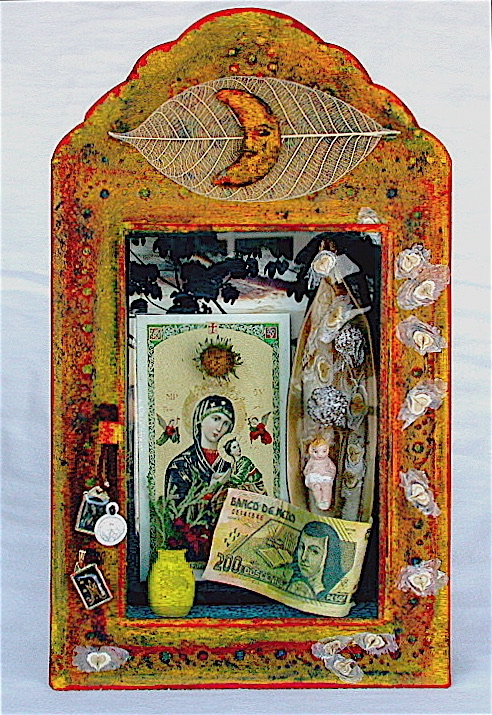
Although I can’t find any of the photos I took in San Miguel, the background of this retablo I made while living there shows a shot of the courtyard of the hacienda where Ernesto wanted us to live.

Innocents in Mexico

Chapter 12


  The next day, I awakened early.  We were unsure whether Theresa, the housekeeper, came at 8 or 11.  Susan had told us one time, Steve the other.  I sat in the office in the balcony across from the master bedroom, watching Bob sleep as I started my laptop.  The sounds of the neighborhood flew in over the tall wall that I could just see over there on the second story of the house.

            When Theresa did not come by 11, we decided she was not coming, but we left one door ajar for her, just in case.  She had the key to the compound, but not the house.  We walked to the main road and caught a taxi to the Biblioteca, where we were to meet Ernesto and Dirk to go on a tour of the hacienda and Ernesto’s new school.  Everyone was on time and in fact, everyone had arrived early and gone somewhere to wait, mistakably expecting everyone else to be on Mexican time.  When I told Ernesto we had rented a house, he seemed crestfallen. 

            “Why would you want to rent a house for a month?”  he asked.  “You could be staying at the hacienda for $16 a night.” 

            We explained that we loved the house and that we needed space and privacy to work. 

            “At the hacienda, you could ride horses and use the kitchen,” he answered, still looking disappointed. 

            The tour took much longer than either we or Dirk had anticipated.  Dirk had brought his wife, Maria Antoinette, who was with us as we started out viewing the hacienda.  Everything seemed to be in a state of flux there.  In one large library , a computer stood on a table  and paintings were stacked ten deep against the walls.  They had been taken from the walls, said Ernesto, and replaced by other paintings.  The pool table had been taken from one room and sat, covered, in another.  Piles of mattresses lay in corridors or the corners of rooms.  In the kitchen, something bubbled on the stove:  a pot of beans and a succulent smelling joint that Ernesto insisted was being cooked as dogfood for the dogs.  A large room adjoining the kitchen was available for fiestas, explained  Ernesto.  We saw no one.  Eventually, a distinguished looking older man walked into one of the bedrooms we were inspecting.  He was introduced to us as the Don and he shook our hands politely, but did not seem too pleased to have us there.  In a rapid exchange, Ernesto seemed to be asking him how much it was to stay there.  It turned out that it was $16 per person, so at $960 a month,  it would have been more expensive for us to stay there than in the house we were in.  The Don left and we moved  through arched courtyards and gardens, and ruins partially intact left for atmosphere.  We saw a huge pool, apparently long drained, which Ernesto insisted was still functional, but too expensive to maintain.  They would convert it to solar and then refill it, he said.  But come.  This was the small pool.  Come see the large one.  I started  to feel like we were wandering on a private unauthorized tour through San Simeon prior to its restoration.  Below the “large” pool was a two-story house presently going through restoration.  The views from the patio––of rolling hills and green fields–– were breathtaking.  At one time the hacienda spread as far as the eye could see.  This was before the revolution.  Ernesto’s school was situated in the Armory, where troops used to guard gold and silver shipments, but first we must see this house.  We might want to rent it, he told us. 

            The house seemed to be partially occupied.  There were clothes and toiletries in the bathroom, food and pans in the kitchen.  Half-packed boxes lined the stairway.  Ernesto told us that the people had moved out, but it looked more like they were in the process of moving out.  As usual, there were many mysteries in the world as presented by Ernesto.

            Dirk, worried now that he would not get Maria Antoinette to work on time, asked when we would see the school.  He had expected this to take two hours, he said, and it had been that long already without seeing the school.  We must drive to the school, said Ernesto.  Slowly, since the road is bad.  We would drive most of the way and then walk, but first we must have some refreshment. 

            We pulled over in front of a tiny adobe casa by the side of the main road.  A bus drew up, disgorging schoolchildren home from school.  They scattered like wild kittens.  One small girl entered the courtyard we were entering.  We tried to crowd into a tiny shop, but there was not room for more than three.  Bob and Dirk went in to order Coronas for Dirk, Ernesto and me, juice for Maria Antoinette, Coke Light for Bob.  The Senora who lived in the small house behind the shop and who was the shopkeeper found chairs for all of us and we pulled them into a circle in the bare dirt courtyard.  A huge mesquite tree cast shade over half the yard.  The small girl picked a flower from it and handed it to Maria Antoinette.  If unfurled, it would resemble an hibiscus flower, but its petals were pulled down into a bell.  It was variegated tangerine, gold and orange––the exact colors of Maria Antoinette’s blouse and hair and skin.  We sat in the courtyard and told stories.  Bob, who was given to introspection before speaking, did not fare well against the talkative Dirk and Ernesto.  Maria Antoinette, who was originally from Mexico City but who could, she told us, now pass for a native of San Miguel, entered the house and fell into conversation with the Senora, who eventually pulled up a chair and joined us.  Dirk speculated on what Bob might be thinking, and Bob admitted he was anxious to see the schoo––what we all came here for.  Dirk again expressed worry that Maria would be late to work, teaching English at a private school, but Ernesto insisted we all have a second Corona.  In the end, he and Dirk had another Corona.  I  was already feeling the need for a siesta after one beer.  The hot sun and the lulling effect of far off echoes from the broad landscape had  made me content but sleepy. 

            We were very lucky, said Dirk, to be seeing the real life of Mexico.  Not many tourists saw  what we had seen today, he told us.  Not feeling like a tourist, and feeling like this is how I always traveled or lived in the countries where I have visited, nonetheless, I agreed.  Eventually, we drove on a bit, then parked under a tree after removing several large rocks from the road.  Ernesto unlocked the gate in the tall compound wall.  Towers rose above us––where armed soldiers once guarded the shipments of precious metal.  To our left was a huge bank of blue, glittering in the sunlight.  Next to it was a mound of goldish red, another of white.  They were like a rubbish dump where all of the refuse had been sorted by color.  As we got closer, I saw  that they were mountains of glass.  One was deep cobalt blue––like the color of Mexican blown glass tumblers.  The next drift was broken Pepsi bottles––clear for the most part, but here and there we could see the blue and red of the logo.  Mounds on the other side of the compound were of raw semiprecious stones still in their matrix.  One was of opals, the other chalcedony––what Bob and I knew as poppy and picture jasper.

             We went  first into the room where Ernesto had set up lapidary equipment.  The good equipment was in Texas, he said.  Most of this equipment was used or gerrymandered, but 20 or more stations had been set up. 

            Maria Antoinette sat down on a couch at the entrance and promptly fell asleep.  Ernesto  turned on a fan and directed it toward her and we left her to dream.  He showed us the faceting  tool and the opal grinder.  He showed us the ghastly clay fountain which he sought to mass produce.  It was a wet bar, a fountain and a lamp.  He could sell it very cheap, he said.  He showed us several wax sculptures that they would cast in bronze.  One was by a Swiss lady who wanted to study there, he told us.  His plan was to set up a mobile home park in the center of the compound, where people could come from the States for lapidary and casting workshops much cheaper than those in the States.  They would have school for poor and crippled children, as well.  They would feed them lunch, Ernesto explained.  We moved into another building.  In it were mounds of pot metal molded trinkets––cats, dogs, women, crosses, flowers, every conceivable shape.  Piles of circular molds covered a table.  He pressed the “on” switch on the machine used to melt pot metal. He wanted show us how quickly  this could be done.  He pounded talc onto the molds, fit the two pieces together, and put them up against the snout of the pot where the metal was being heated.  Poof, that quickly the mold was filled and placed to cool.  Then another and another.  You could do twenty in one minute if they were all prepared, he told us.  When he peeled the mold apart, we saw a circular chain of trinkets––perhaps thirty or more––ready to be separated, tumbled and gilt or silver plated. 

            Hanging from the ceiling was a large toy plane––perhaps five or six feet long.  It looked like it had been constructed from old soda cans or recycled tin siding, but Ernesto said it was very expensive.  Strapped to its bottom was an infrared camera.  It was a remote-controlled plane  (the predecessor to the now-ubiquitous drone) which he could send up to locate water and minerals, he told us. 

            Next, we moved to a side compound filled with slab cutters and diamond saws.  Most were rusty, but all functioned, he told us.  Earlier, there was a flood and all were underwater, but they may all be made to work. 

            Bob suggested that more than a resident artist, Ernesto perhaps needed a production manager.  Whereas Ernesto insisted the school would be open in two weeks, it looked more like two years to us, and it looked more like a sweatshop than a school, although Ernesto insisted the money would go to the kids with only enough going to the “school” to keep it functional.  When I questioned Ernesto about the artistic side of things––most of these designs were just being mass produced and were less than esthetically pleasing––at their best pure kitsch––Ernesto insisted they would also do their own designs.  That would be where Bob came into the picture, he insisted, but I could feel Bob’s interest fading.  Years ago, before he himself had built diamond saws and slabbers and drills and worked with stone, perhaps it would have been challenging, but at this stage it felt like going backwards, not forward.

            I asked Ernesto what his goal was.  He said that the metal and gem crafts of Mexico for generations had been centered elsewhere, in towns where they had been passed down in families, from father to son.  He wanted to open up the crafts to everyone and to establish San Miguel as a center where people could set up their own studios and establish their own crafts.  This was the beginning part only.  The school had first to support itself to enable the students to go on and become independent.

            When Ernesto talked like this, I believed him.  He told us he had sold his Mother’s house in New Orleans to enable him to buy two factories and  two mines.  This was where the tools and the raw minerals had come from.  The glass was from a glass factory which he rented out space to here in the armory, but they hadn’t paid rent for a year, so he had locked them out .  That is where the glass came from.  They would use it to make enamel. 

            “How many people have been working on this school?”  I asked him. 

            “One,” he told me, and pointed to himself.  “Sometimes two.” 

            Although the don had offered him lodgings in the hacienda, Ernesto said, he had a very nice apartment and girlfriend in San Miguel, where he preferred to stay, but when I went in search of a bathroom, I saw in a back secluded corner of the workshop a cot covered by a tarpaulin.  On the tarp were several piles of neatly folded clothes.  By the side of the bed was a refrigerator wrapped in chain with a padlock. 

            Later, I confided to Bob that I wondered if Ernesto was indeed living in the armory.  Bob admitted  that he wondered the same thing.

            Dirk, who was a retired dentist and lapidarist, confided to me that he was tempted to stay in Mexico and get involved in Ernesto’s project.  It was the first thing that had peaked his interest and made him want to get active again in years, he said.

            Sweat shop or school?  Mass production or art studio?  Visionary or Con Artist?  Who could know?  But Ernesto continued to intrigue us with his tall dreams and his big stories.  How did people discover the truth about each other?  One part of me wanted to believe in his dream, but intuition told me we were being gently conned.  Well, manana.  We would wait and see.

See Chapter 13 HERE.

Chapters 1-11 can be found in earlier blogs published in the past two weeks.

Innocents in Mexico, Chapter 11


Innocents in Mexico


Chapter 11

            That night, we moved in.  At $600 a month, it was twice the price of the other apartment we liked, but it was worth it.  The rent included the three times weekly services of Theresa, who lived only two doors away.  She was gentle and Susan said she was shy, but we did not find her to be so.  Did she speak English?  No.  Good.  We needed to be encouraged to learn Spanish more quickly. 

            When we arrived at “our” house, Stucco Steve Kelsoe, the friend who had been housesitting the house, was still there.  He understood we were coming tomorrow, he told Susan, but she assured him she told him today.  She left and we talked to Steve about the house, which he designed and built for Jim, the owner, who was  visiting  Disneyland with his girlfriend.  We raved about the house and he told us more about it over a Corona.  How he reduced costs by building the sides of the house right at the property line, so the exterior walls were also the back and part of the side compound walls.  (We later grew to regret this fact.)  He had also done the planting.  He pointed out the ruins we had passed as we entered the lot and that they had preserved, he told us.  A few hours later, he ran up to check his e-mail and to send a letter, then switched off the computer.  The phone rang immediately.  It was our credit card phone provider, who had been trying to call for two hours, but the phone was busy thanks to Stucco Steve.  Robert, our agent, explained to me the intricacies of how to make phone calls so they appeared on our credit card and not Jim’s phone bill.

            Eventually, he left, and we went out to sit on our patio.  The garden was beautiful––the plants exactly the ones I would have chosen.  Bearcat moved easily and inquisitively around the courtyard, padded upstairs one stairway, around the U of the loft and back down the other stairway.  We could hear the click of his claws on the polished wood of the stairway.  He was completely peaceful for the first  time since leaving home two weeks earlier.  He knew we were home for awhile. 

            “Are you pleased with the house?”  I asked Bob as we rocked in the twin wooden rocking chairs which were the sole furniture in the sala (other than two twin beds covered with Guatemalan throws and pillows which served as twin sofas against the walls)

            “I’m pleased with everything.”  He answered. 

            Earlier, we had gone to Gigante and purchased basic necessities.  When I awakened  from a deep sleep after a late afternoon nap, the air was still hot, but the fans blew cool air down onto the bed.  Bob was below, still in the rocking chair. 

            “We missed the sunset,” I said.  “Have you eaten?”

            He had had a peanut butter sandwich.  I had an avocado and onion and cheese sandwich made on wonderful  Mexican bread.  Then I had another.  We sat up late, just  looking out at the courtyard.  Bob read the English phonebook and the San Miguel guide while I read  a book from the large box of books I’d brought along.  When we turned off the lights to go upstairs to bed, moonlight streamed down from glass bricks in the ceiling.  As we fell asleep, the dog who lived on the roof next to us joined a choir of roof dogs.  Bearcat stirred by our feet, but did not run under the bed.  We all felt contented here, relaxed and safe.

(Look at previous days’ blogs for Chapters 1-10. See Chapter 12 HERE.

Bravados: An Anthology on Life, Love and Aging

Soon available on Amazon. I’ll let you know when!!!

Innocents in Mexico, Chapter 7 Posada de las Monjas


Find Chapter 1 HERE  Chapter 2 HERE   Chapter 3 HERE  Chapter 4 HERE  Chapter 5  HERE  Chapter 6 HERE

Innocents in Mexico

Chapter 7: Posada de las Monjas

It was Sunday, May 13, at 1:30 a.m. It was our first night in our new room, and someone was setting off fireworks.  They soared up into the air and exploded with ear-splitting booms.  Dogs barked from half the rooftops of San Miguel.  There were too many lights in town, even at this late hour, for the stars to be visible.  It was a shame as our room was so high that we had a panoramic view of the city and the sky.  Below us, tin roofs broke the spell, but we had occasional glimpses into courtyards full of plants and trees.  A cat yowled below and Bearcat stood and stretched but did not scoot under the bed as he had that afternoon when he heard the same caterwauling.  He was getting braver every day, but a car backfiring a block away or a door slamming across the courtyard could still send him into hiding.  We had no yard now for our midnight walks.  All of the courtyards  and terraces in this hotel were of cobblestone or cement.  He was an illegal alien here.  When we sneaked him out on his leash at night for a walk through the deserted outside corridors, he was calmer, walking as close to the curtained windows of each room as though eavesdropping for any possible news of his new environs. Although the management didn’t know we had a cat, some of the staff knew but they never told. This first night, we settled to bed, finally, by 2 a.m.  and  I penned this poem  a mere four and a half hours later:

San Miguel Morning

The sounds of rooting cats
like infanticide
accompany
tuba music
in 4/4 time.

Fireworks.
Roosters.
Donkey brays.
6:29 in the morning.

All’s right with the world.

Today was Mother’s Day.  It was the first in my life where I had no mother to send flowers to.  The same was true of Bob.  On our way through Tucson, we had stopped to see my mother’s crypt for the first time.  I had meant to bring flowers, but I could see that they didn’t allow fresh flowers, and I couldn’t bring myself to leave plastic ones.  Some of the crypts had metal flowers attached, and I decided to try to have something special made in Mexico.  Those would be the flowers I sent this year.

On this day, we took the van out of the courtyard of the hotel to go look at an apartment.  It was a bother to do so, because it meant getting a man to open the portal––not only the one that could be reached from ground level, but also the high one 8 or more feet off the ground.  Today, the guard used a tall metal pipe to pry the hatches open, Yesterday he had attempted to climb up on the lower lock to reach the top one, but it was a tricky maneuver and he had fallen off..  Then we scraped the bumper of a new yellow pickup trying to back out.

The apartment we saw was a depressing empty house in an extremely poor neighborhood.  On the floor of the bare living room was a pair of men’s slacks, rumpled as though he had climbed out of them and left them as they were.  Half-full bags of grout  lay abandoned.  In the shed, there was the overpowering smell of oil paints.  What had been described as a garden was hard baked earth with a few abandoned flower pots.  Even the weeds were dried and skeletal.  The house described as furnished in the newspaper ad was dark, in poor repair and completely empty.  The woman told us she had no money to buy furnishings, but maybe they could get one bed and a refrigerator.

That afternoon, we had been looking  at  pictures  of rentals in a rental office near our hotel.  The apartments and houses were all picture perfect––decorated, furnished with art and gardens complete with gardeners.  The contrast was so depressing that it made me again question whether I wanted to stay here.

The disparity between the gringo sections of town and the local sections was so great.  And yet in the restaurants and galleries, I saw the majority of people were Mexican––well-groomed and prosperous looking––eating the same food and drinking the same drinks we were drinking.  Our hotel, too, was filled with Mexican travelers, so the difference was not so much one of nationality as of level of prosperity.  The same economic differences existed in the United States, but there, as here, we were shielded by the distances between our living areas.

Even in the U.S, there were places we never went.  Why would we?  In those places there were no restaurants, theaters, gyms.  In those places, there were none of our friends to visit.  Our kids didn’t go to school in those neighborhoods, so for us, they didn’t exist.  Every American we talked to said not to have a car here––to depend on public transport or walking,  but public transport did not take them through these neighborhoods, so for most, I am sure they did not exist.

By the time we got home again, we were exhausted from trying to negotiate the maze of unmarked streets. To compound our frustration, we found that  the lot that had been  nearly empty when we left was now completely packed––with all cars double parked.  The guard fit us diagonally into one corner of the large courtyard in a place where we blocked four cars instead of two.  He refused to take our car keys, so we imagined an early knock on our door to get us to come move it. We had already made the decision to keep the van in the compound for the rest of our stay, but this cinched it! On Monday, we would take a taxi to immigration and the real estate office.  Already, our new van had rattles in every part of its chassis from two days of bumping over cobblestones.  The side was scraped and the running board dented in.  If we had to count the number of streets backed down or tight spaces we had turned around in, it would reconfirm our decision.  A car in this town was crazy.  A full-sized van was lunatic.  People drove vans the size of ours as buses here.

It was a moral struggle to sit in the Plaza Principal.  Every time I sat down, an old woman came to sit next to me to tell me she was hungry.  When I told her I didn’t understand, she sighed.  She sat for fifteen minutes, sighing every few minutes or so.  Finally, she asked me the time.  At first, I didn’t understand.  I thought she was pointing out the dark freckles on my arms.  Then I understood the word “Hora.”

Seis?”  she asked.

Siete,” I answered.  I knew some Spanish.  Now she would suspect I really understood her.  Well, I guess I did, even without words.  On our first day, Bob and I gave money out to most who asked.  When the same people approached us later on their next round, we realized that it was endless.  To encourage the woman and children selling cloth dolls meant no time ever in the jardin when we would be free to read a book or watch the strollers or the church facade changing colors as the sun moved across its face.  It meant constant interruptions to the peace and tranquility we had come here to find.

It was a major conflict that all of us face in this world.  Were we here to enjoy the world or to confront and deal with its miseries?  Was it fair to choose the ways in which we tried to make the world a better place?  Was it making the world a better place to encourage begging?  Was there any alternative to begging for those who did so?  I remembered the old woman who fell down in a faint in front of the church in Oaxaca.  Kind tourists  helped her into a sitting position,  fanned her, pressed coins upon her.  Then one of the locals laughed and told us that she was one of the richest women in town––so good at her daily act that she made more than most wage earners.

I remember the children in Bombay whose parents had cut off their arms or legs to make them more successful at their begging.  Where were the easy answers?  There were none.  If we taught at the free art school, would it make a difference?  It would make a difference for us, ease our guilt.  But would it do enough to ease the suffering in the world?  The answer was clear.  We would do what we could do:  try to be kinder, try to notice instead of reacting the same to every person who asked for our help.  We would live here not quite adequately, as we had lived in every place.  We were not Mother Teresa, nor were we Hitler.  We were fugitive Americans trying to find a better way.  We were trying.  Looking.  Tomorrow we would see what happened.

Again, the old woman sat by me in the Plaza Principal.  I was no longer sure that she remembered me as the same person every time she sat down.  This time she asked me if I lived here and when I said no, she asked me where I lived.

“El Norte,” I told her.  Bob and I were sitting on extreme ends of the same bench because each end had a tree which sheltered us from the brief afternoon rain.  She crowded with me under my arboreal umbrella.

“You have beautiful hair,” she told me, which I did not understand until she pulled at her own hair and said, “Amarillo.  Bella.”

When I pulled out a bottle of water.  “Ah, Agua” she sighed, and pulled out a plastic bottle of Pepsi from her string bag to take a drink.

Ese es su esposo?” she asked, pointing at Bob.

“Si.”

For the next ten minutes or so, she sighed, now and then, asking me for money for food under her breath, but I could feel that her enthusiasm had waned.  Occasionally, she commented on those who passed us.

Buenos tardes, senora,” I said, when we got up to leave, but she was already moving to another bench.

For Chapter 8, go HERE.

Innocents in Mexico: Chapter 6: A Rude Awakening and a Savior


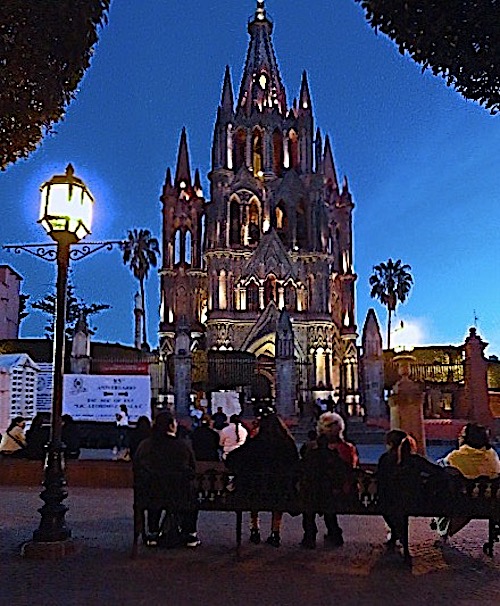
The Parroquia de San Miguel Arcángel

Find Chapter 1 HERE  Chapter 2 HERE   Chapter 3 HERE  Chapter 4 HERE  Chapter 5  HERE.

Chapter 6: A Rude Awakening and a Savior

            The next morning, we were awakened by the tooting of a horn outside our window.  I opened the door and looked out.  Resolutely and with a fine sense of rhythm, a woman was honking her horn for someone in the room next to us.  Undaunted by my stares, she continued to honk.  Bob slept on as I fastened Bearcat’s leash and attempted to take him for a walk.  I had forgotten that walks are a nighttime thing for cats––the later the better.  He resisted and I gave in.  By eleven, we were off to find a bank, a real estate agent and a really good map of San Miguel.  Unfortunately, all of these items proved to be easier to find than was a parking spot.  As we traversed still another circuitous route trying to find a parking space, Bob questioned whether we wanted to rent an apartment here, even for a week or a month.  He cursed the tiny cobblestone streets, the lack of signs.  The jardin area seemed to be all there was to San Miguel, he complained, and there wasn’t much to it.  “Did you like Oaxaca for the first few days we were there?” I asked. “Or Bali?” He admitted that he hadn’t, yet he had ended up wanting to live both places after a week or so of getting to know them.

Bob finally left me off at the tourist office, promising to join me there.  After 15 minutes, when he still hadn’t appeared, I moved off to a bench in the park, where I could sit in the shade while keeping an eye peeled on the door of the tourist agency.  On the bench sat an American woman who shared her experiences of living in both San Miguel and Guanajuato.  Fresh from a three-month course in Spanish, she chatted with the senor who sat down on my right.  Did he live in San Miguel?  Did he prefer it over Guanajuato?  Why?  Because it was warmer in San Miguel.  Because there was more to do.  I was thrilled that I understood most of what they were saying.

Bob joined us, still not too excited to be sitting on a park bench in such a difficult town.  We went to the bank.  Our time to pay for our tourist visas had nearly run out.  The custom at the El Paso crossing seemed to be to go to any bank in Mexico to pay for the visa which was issued by immigration in Juarez.  Since we had never managed to get to any banks while they were open for the three days it took us to drive to San Miguel, it was a pressing need for us to pay the fee and thereby amend our status as illegal aliens.  Unfortunately, when Bob had presented his visa to apply for the car permit at the customshouse south of Juarez, the woman had detached the carbon copy of his visa application and now, without it, the bank could not accept payment.  But the carbon copy was at the customs office south of Juarez, I argued, to no avail.  A Xerox copy would not do.  I paid for my visa, whose papers were intact, and went back to the waiting area where customers waited for the numbers on their pop-out tags to be called, like customers at a bakery or ice cream store.  Bob was deep in conversation with Lisa, a tanned woman who gave him advice on rental houses, classes and the arts community.  As her number was called, we moved to the front of the bank and I told him the bad news.  In front of the bank was another tanned American lady in straw brimmed hat and a stylish tan linen dress.“No,” she said firmly to the small girl who proffered a brightly dressed cloth doll for sale.

Bob and I were trying to figure out the route to Gigante––a huge market situated somewhere off our limited tourist map.  The bank manager had insisted that we must go to immigration and that this was where it was––in an office over Gigante.  A pelting monsoon rain had descended while we were in the bank and we stood under a broad overhang, waiting for it to calm down.  “Do you live in San Miguel?” I asked the stylish lady.  Yes, she did, and yes, she knew the way to Gigante.  To illustrate, she pulled out a vastly superior map to ours, then told us where the biblioteca was where we could purchase both this map and the definitive guide to San Miguel.  Her name was Kim, she was from Alameda, just an hour and a half from our California home, and she now lived in San Miguel.  “Well, here, have my map,” she said, after a few minutes of talking.  When I protested, she insisted.  When I offered to pay, she refused.  It was her gift.  She handed us a card, then moved off into the now abating rain.

At the Biblioteca, we bought books and guides and maps and cards and chatted to the man running the gift shop––another expatriate American who gave advice on apartments, cars (don’t keep them) concerts (go to them) and all of the glories of San Miguel.  Although the library itself was closed, its restaurant had been recommended to us by Kim, and we ate a nice lunch while eavesdropping on the other expatriate Americans who sat at the tables around us.  Small children skipped into the restaurant from the library singing “Happy Birthday to you” in Spanish-inflected English.  Someone shushed them, to no avail, and they ran out giggling loudly.        Outside the door of the restaurant, in the hall to the library, was a pay phone, where I stood trying to figure out the intricacies of a phone with a card slot and four buttons with indecipherable pictographs.  I finally called the number given on the first rental ad on my list.  The woman spoke English but didn’t know if she wanted an artist renting her house, which was immaculate, she said.  Maybe he could paint in the garage.  Would he spill paint on the floor?  A meticulous house sounded as uninviting as the $1,000 rent, so I explained we were perhaps not the right renters for her.  As I hung up the phone and prepared to make my next call, I saw a man sitting very near by with a phone card in his hand.  Was he waiting to make a call?  Yes.  Would he like to go in front of me?  He protested that he could wait, but when I said I was going to make a number of calls, he agreed that he’d like to make just one fast one.

He in fact made one very long call.  I stood shamelessly near, trying to encourage him to hurry, but he chatted on.  He was talking to a man that his friend Richard had told him he must meet.  Yes, he would meet him in the library on Monday.  He had a picture of him, so he would recognize him.  This phone call came to have all the ear markings of a blind date.  After five or ten minutes, he ambled his call to a close and handed over the phone, then stood talking to Bob, as unabashedly listening to my call as I had his.  “Are you looking for a house to rent?” he asked Bob.  He knew of a house, which he seemed to be describing to Bob as I tried out my laughable Spanish on yet another homeowner.

“Are they speaking Spanish?” He asked, as he heard my garbled string of Spanish tape phrases.

“Yes,” I admitted. “Do you speak Spanish?”

He did, and offered to interpret.  I happily handed over the phone.

Toward the end of the phone call, my telephone card ran out and he was cut off.  When I tried to call back with another card, he discouraged me.  “You don’t want to live there,” he said.  “It’s at the end of a very dusty road.  It’s too far from the center.  What you need to do is find a room near the center so you can park your car and answer all the ads in the newspapers for a week to find the right house.“

He told us his name, which was Ernesto.  He told us about the art school where he taught art to poor kids.  He told us about art happenings and poetry happenings and music.  He told us of a different hotel where we should stay and of a house nearby that was coming up to rent.  In the end, he took us himself to the Posada de los Monjes, an historic  hotel that was a converted convent, and translated with the front desk, insisting on the room with the best view.  As we moved through the front of the building through wooden doors hundreds of years old, the full glory of four floors of terraced stone opening onto a cobbled courtyard where we could park our van was revealed.  Broad terraces with crenelated walls jutted out from some of the rooms and wide outside corridors joined them.

We climbed higher and higher until we came to the room chosen for us––a bit small but with a beautiful tiled bathroom with stone shower.  Coming out of the room, we moved out to the private patio bigger than the room.  Below us stretched the entire panorama of San Miguel.  Breathtaking.  The church, the tile roofs, the jagged skyline and yellow hills.  The rooftop gardens and trees jutting up from courtyards.  We were so high that little rose higher above us than our own roof.  We had a 300-degree view and all of it was beautiful.  Never mind the steps.  We could have all of this for barely more than our motel room which was nice and roomy but viewless and near traffic noise.

Do you want to see the room with two beds, asked Ernesto?  It’s bigger, but also $10 more a night.  We’d see it, we said, but the cheaper room would probably do.  I must admit, I dreaded the confinement of the smaller room, but knew we’d probably not spend much time there anyway, and could just spend that time on the most glorious patio on earth.  But, we went to see the room, which was bigger, with its own living room, better views from the room itself, but no patio.  Or at least we thought so until we ascended the stairs outside the room to the patio on top of the room that had even a better view than the room before it––this one a full 360-degrees!

The view was well worth the extra ten dollars a night.  In ten years, we would not miss the money, but we’d never forget the view.  We took the room. We would move in the next day! Ernesto took us to the art institute––not his, but the one near the center.  In the end, he offered Bob a job at his art school.  No salary, but a job just the same.  He could use the facilities free in return for any amount of time he wanted to teach.  Then, meeting a friend he knew on the street, he faded back into the life of San Miguel.  He had made a date with Bob to meet Monday to see about showing us the house that his friend had just built.

The importance of meeting Ernesto?  Bob had gone from wanting to move on to wanting to rent a house in just hours.

“How do you like that?” he said.  “In San Miguel less than 24 hours and I’ve already been offered a job teaching art.”

Right then and there, we went to Mailboxes Etc. and rented a mailbox for three months.  The proprietor of this establishment introduced herself as Annie and she told us the intricacies of sending mail and packages into and out of Mexico.  What to do.  What not to do.  How to send tax papers, magazines, bills, packages.  Another stranger popping up to solve our severest problems.  Like magic.

That night, we peeked into courtyard after courtyard looking for the right restaurant.  Bob, who had formerly hated Mexican food, picked a Mexican restaurant, pronounced his meal delicious  and paid the musician to serenade us with a rendition of “Rancho Grande” that rivaled any Oaxacan version we’d ever heard.

“The thing about San Miguel,” he explained, “is that a good deal of it is hidden.  You don’t see it by casual observation.  You have to look farther,”  That night he stayed up hours later than usual, poring over guide books and maps.  Bearcat curled on my bed as I sat at my laptop.

“Tomorrow you get to go to your new home,” Bob told him.  “You get to go from being an under-bed cat to a roof cat.”

See Chapter 7 HERE.

Innocents in Mexico, Chapter 1, Leaving the Familiar

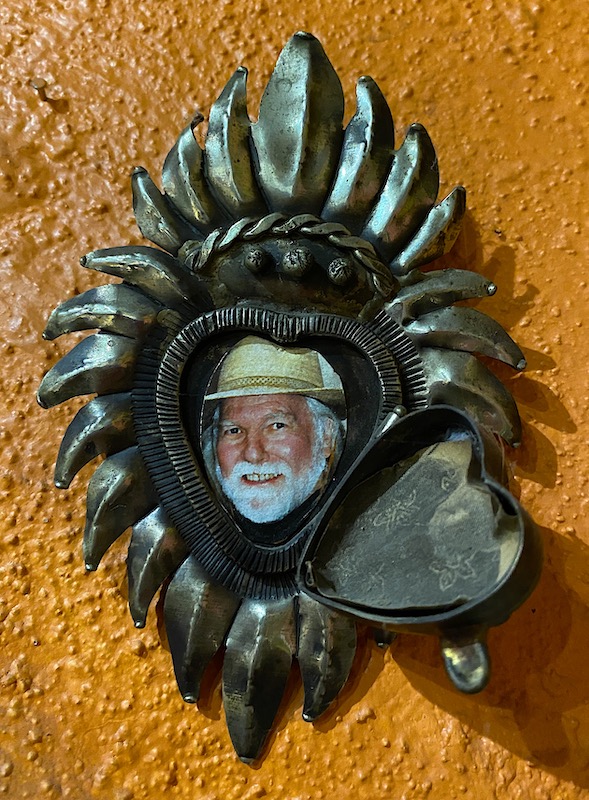
Bob, 2001

At the moment, every surface in my office/living room/dining room is covered with stacks of papers.  I’ve been plowing through files and old folders looking for additional stories to include in a book about my first few years of living in Mexico, but in doing so, I unearthed an earlier book, also unpublished, about our initial trip down to San Miguel to investigate it as a possible place to live for a year. So, I spent most of the morning and afternoon reading the entire book with the result that I’ve decided that maybe it makes sense to publish that book first, since it will better introduce readers to Bob and to the background of my move to Mexico.  With that in mind, I’d like your help in reading two or three of the beginning chapters to see if they hold your interest. They are a bit longer than earlier “possibles” that I’ve shared with you over the past week or so, but I guess that will be a test of whether this book is going to hold your interest.  Remember, as this story begins, the year is 2001 and so the information about our Mexican experience is 22 years old.  Please let me know whether you feel it is still relevant and interesting. That said, here is the possible first chapter of:

Innocents in Mexico

Chapter 1,  Leaving the Familiar

(Jan1-May 3, 2001)

How we came to decide to move to Mexico is unclear.  Bob claims I tricked him into it by first suggesting a two-week trip.  By the time he had agreed, the trip had grown to two months.  Then, the next thing he knew, I was telling people that we were renting out our house and moving to Mexico for a year, where we would live off the rent we were collecting from our house. But it was Bob, in fact, who suggested that if we left for a year we’d be coming home during the worst weather of the year––which led to our decision to move to Mexico for a year and a half.

The transition from the redwoods of central California to the central mountains of Mexico was not as simple as the decision to move there.  We had intended to return from Christmas with my 91-year -old mother in Wyoming, to spend a month packing our personal stuff out of the house and getting it rented out, then to leave by February 1. But a week or so prior to leaving for Wyoming, I found that I needed major surgery.  Since the recovery period was six weeks, that would delay our leaving by a month if we scheduled the surgery as soon as we got home in January, so we put off our leaving day to March 1.  If I packed just one thing at a time and left Bob to lift the boxes once they were filled, I should be able to do the packing even with stitches in.

The day I got home from surgery, my mother went into the hospital in Wyoming.  I’d been told not to ride in cars, climb stairs or lift for a week, then to take it easy for another month at the least.  My mother and sister insisted I not come, my mother even saying that it was too hard to visit over the phone when I called, due to the oxygen.  She liked to be left alone when she was sick, even had them put a “no visiting” sign on her door.  She would be going home soon, they all said.  But within a week, my mother had passed away.  Since she had known no one in the Wyoming town where she had moved a few years before to be near my sister, we decided to hold her memorial service in July in South Dakota, where an all-town reunion would be going on in the town where we all grew up.  My brother-in-law accompanied my mother’s body to Tucson, where she would be buried with my dad.  Both of my folks were not big on funerals.  My mom would have approved.  I put all of my efforts into planning her memorial long-distance.  Bob and I would drive up from San Miguel the last weekend in June for the memorial.

Now, along with healing, I mourned the loss of my Mother. For days, I worked on art projects which reflected her life story, and after my second day home from the hospital, I worked for two hours at a time packing books, then rested two hours, watching every video movie my friends could dig up to encourage me to get the rest I needed.  I began to get a bit agoraphobic, which was helped along by the fact that I wasn’t supposed to ride in cars.  On the night that my Mom died, Bob and I went for our first walk since my surgery.  It was nine o’clock at night as we walked up the road near our house to the top of the mountain.  The stars were vivid in this sky away from city lights as we discussed the afterlife.  There was something about the irrevocable ending of a life which pushed us in our resolve to put off no longer the next stage of changes in our lives.

Even though we planned to rent the house fully furnished, the packing proved to be a much larger job than we’d expected.  My mother had left us her car and any furniture or art we wanted.  My sister insisted that to send it would incur no loss to her or my other sister, since it would come out of the part of the estate the majority of which would go for taxes, anyway, so we decided to store our own furniture and rent our house with my mother’s.  This meant also changing all the art and decorations in the house, since her color scheme was different.  For a month, I’d packed books, which Bob would then carry to one studio or another to store.  Then I tackled the kitchen, leaving what I considered to be bare bones.  We were beginning to feel like we’d make our new departure date of April 1, but the date should have been a tip-off.  When they heard we’d be leaving, we suddenly had friends and relatives popping in with great regularity.  With each group of friends, we took the time to talk and play, to go to the beach and out to dinner.

One of the reasons we were moving to Mexico was to get our life back and to reprioritize after 14 years of running our lives around the demands of a business. We had felt rushed, pressured, buried under the minutiae of the details of bookkeeping, scheduling, mailing, travelling to art shows, setting up our booth, tearing it down, keeping track of the thousands of details involved in not only making art but selling it through craft shows. Every vacation we’d taken to visit family had been scheduled to coincide with our show schedule.  Most of our friends were artists, which was great, but we spent more time discussing the business of art than art itself.  We wanted off the bandwagon.  We wanted the time to talk and experience life without pressure. But now the business of moving was taking over our lives.  How to get all the loose ends taken care of.  How would we pay our bills?  Collect outstanding debts?  We had lamps to mail off to customers and galleries, files to sort out.  What to take, what to store, what to throw away?  I had twenty-five years of writing files:  poetry, stories, unfinished novels, movie scripts.  Bob had the same.  We had business files, tax files, personal correspondence files.  All of this needed to be sorted and dealt with.  One studio rapidly filled up to the ceiling with boxes of books, extra kitchen supplies, clothes and art. Then another one filled up with furniture, extra studio supplies from my jewelry studio, which we’d reconverted into a bedroom, writing files, tools and more tchotchkes.

When a woman who came to see if she wanted to be our property manager saw what we considered to be our stripped-down house, she said, “I’d clear out all this clutter.  Get it down to the minimum.”  That was what we thought we’d done!

Into this chaos drove my friend Patty, who’d volunteered to drive my mom’s car from Wyoming to California for us.  She stayed a few days and we took time off from packing to see the sights and talk.  Then came other friends.  We did the same.  When people heard we were leaving, they called to schedule dinners.  We went.  We were now worried about the April 1 leaving date.  With our departure date just two weeks off, Bob received a call from his sister.  His mom had gone into the hospital and wasn’t expected to live.  He flew to Michigan. After ten days, less than two months after we’d lost my mom, his mom passed away.

The day he flew off to Michigan, the first of our ads to sell vehicles appeared. We were selling a Blazer, a Mazda MX3, an ancient motor home, a trailer and a fork lift.  For the entire time Bob was gone, every bit of my time was spent jump-starting them, cleaning them, having them smog-checked, answering phone calls, showing vehicles and placing new ads.  Finally, when Bob got home, we parked the cars one at a time on the street.  The first time we did this, we got a ticket for parking a for sale vehicle on a county road.  Then we found a wide place that was evidently private land, but visible from the highway.  Within the month, we’d sold all of the vehicles but the travel trailer we had converted into a trailer to move our our big lamps, jewelry, ikebana vases, tents, cases and other display items to shows in. This we kept to store our unsold display items in.

With May fast approaching, Bob finally said he was beginning to feel we’d never leave.  In addition, he was starting to have reservations about whether he wanted to leave all his tools and studios.  What if we got to Mexico and didn’t like it?  We’d have rented our house out and would have no place to go.  In the end, we sealed up the house, paid a friend to deal with our bills and mail, packed up our cat that we had been unable to find a new temporary home for, packed up a few clothes, a lot of books and art supplies, and headed out for Mexico on May 3, 2001—only 4 months later than we had initially planned on starting out, but we were finally on the road. On the way, we would visit Bob’s son, daughter and grandkids in Flagstaff Arizona, his friend Carey in Tucson and my friend Judy in Alamogordo.  Then we would be free, unscheduled, with no timeline.  On our way to Mexico.

Go HERE to read Chapter 2


Lighting a Candle for San Antonio (Possibles, May 9, 2023)

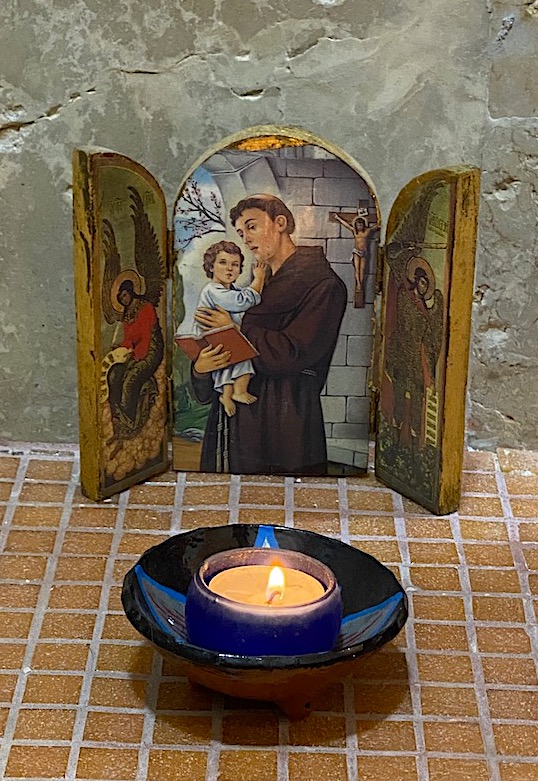
Lighting a Candle for San Antonio

When I arrived home and found the candle burning next to the Virgin of Guadalupe on the counter between my kitchen and dining room, I took a fast survey.  It wasn’t Mother’s Day as there was no photo of my mother next to it.  The celebration of the Virgin of Guadalupe was months away.  It wasn’t Dia de los Muertos.  What could this new conflagration represent?

I had left soon after Yolanda arrived in the morning. She had run out to the car with coffee in my go mug and a bottle of water.  Sweet Yolanda, who was half mother, half sister.  She had been helping me since I moved to Mexico fourteen years before: cleaning my house, bringing a local healer to my house when I was ill to “cure” me via massage, now and then bringing her babies for me to dance around my house as she cleaned or ironed or washed clothes.

We had a wonderful symbiotic relationship.  She made my house a home and relieved me from tedious tasks so I could write.  I was her chief bank and no-interest loan officer—loaning the money for their new house, more land, a new used car when theirs was totaled by a drunk with no insurance. She always paid me back, either via installments deducted from her salary or in lump sums sometime down the line.

Yolanda, Pasiano my gardener, their families and I went on short vacations together to the Guadalajara zoo or to see the wildflowers in Tapalpa, loading up my full-sized van to capacity. This happens in Mexico.  Your gardener and housekeeper become your extended family and you become theirs.

So it is that Yolanda occasionally sets me right in the world as well.  The first year I didn’t build a Day of the Dead altar for my husband, she queried.  “Oh, so you no longer miss your husband?”  I built a shrine.  On Mother’s Day, she was the one who moved my mother’s picture from the guest bedroom onto the counter next to the virgin and lit a candle.

What was the candle for this time?  I asked her on Wednesday, when she arrived for one of her three-times-weekly three-hour sessions.  This time, senora, it was for San Antonio.  He was the finder of lost things, and we had been searching in vain for weeks for the lost cord and microphone for my amplifier.  The bowl of water under the glass with the candle in it was to cool the glass so it didn’t shatter.

I had let the candle burn all day until I went to bed.  When Yolanda arrived two days later, she lit it again.  Then hours after her arrival as I still sat at my computer blogging my blog, she came into the room carrying a large Ziploc plastic bag.  It was the cord and mike!

“Where did you find it?”  I asked.

“It was in with the sheets,” she answered.

“We’ve been losing a lot of things lately,” I said.  “Remember when we looked for weeks for my bag of lost keys and I found them in the drawer with the light bulbs?”

“Yes,” she answered.  “And do you remember that I lit a candle that day as well?”

Let me say right now that I am not a religious person.  I don’t pray, although now and then in a really stressful situation, I will address the God of my youth.  But, I am coming to have faith in Yolanda.  When she tells me to light a candle, I do so. And I’ve never missed a Day of the Dead Shrine since her last reminder.

I actually blogged this little vignette in 2015 but that is so long ago that even I’d forgotten it. I’m not sure how much of the past 22 years I’ll include in the book, so just in case, here it is again. By the time I finish this book, we’ll all probably have forgotten it again. And yes, this is “the” San Antonio from my tale above. When I was in Greece a few years ago, I found a little shop that dealt entirely with little shrines of saints and brought Yolanda back her very own new San Antonio as well.