Tag Archives: Innocents in Mexico

Innocents in Mexico, Chapter 14

Innocents in Mexico

Chapter 14


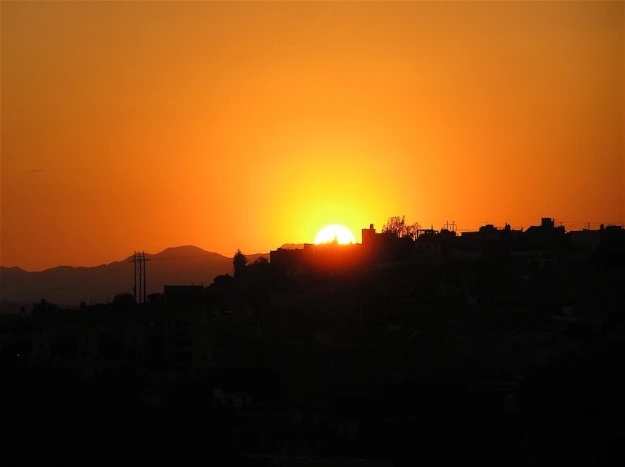
            It was early morning, two days later.  That morning when I awoke and saw the sunset, I got up and climbed the circular staircase to the roof to photograph it.  Around us, roosters competed, yodeling their hoarse cries to the still cool air.  Even after the sun had been up for an hour, their calls clashed against each other in the blue morning.  A fine haze obscured my view of the hills behind Gigante to the south, the city to the northwest.  Behind us was another metal shop, where workers worked late.  Last night the sounds of grinders and metal striking metal did not stop until about 9:30. This morning for the first time I noticed that the very tall antennae that we had seen from our hotel and had at first thought to be a palm tree was practically in our back yard!  I didn’t know whether it was a TV antenna or some other sort of tower, but we already knew that TV had definitely hit San Miguel. 

            Twenty years ago, I had vacationed in Mexico with a man who claimed to be the first to bring TV’s into Mexican hotels.  Now they were everywhere.

            The day before, after buying vegetables and fruit in the covered mercado, we had walked through the open-air artisans’ market.  Accustomed to the feverish attention of stall minders as we passed their stalls in other parts of Mexico, it was surprising that here we were barely noticed.  Upon entering a few of the stalls, I saw why.  Most of the stalls contained small TV’s.  We heard the staccato of Spanish as they watched soap operas or cartoons.  In other booths the TV’s were on but silent, and we peeked in to see the Spanish subtitles of American movies which they were watching with the sound turned down low.  Spellbound, they barely noticed us as we passed by. 

            I knew too well the allure of television.  After going twelve years without TV, we had finally subscribed to cable two years before.  We had told ourselves it was so we could get better radio reception, then decided to expand the subscription to include the independent film channel.  From the first day, we were hooked.  Part of the reason we’d left the U.S. was to get away from it

            We hadn’t turned on the small TV in Jim’s office.  I think Bob didn’t even know it was there.  Its dark screen stood behind my back as I sat at my laptop, staring blankly over my shoulder as I put TV on my “no” list next to pastry. 

            It was 8:15 a.m., our third morning in the new house, when the grinders started again in the shop next door.  We had wondered if Bob’s tools would bother anyone if he decided to do large pieces, but here, they would barely notice.  With our back wall also their back wall, it sounded as though the noise was in the house with us.

            Both Bear and Bob seemed to be falling into the habit of multiple siestas during the day.  Bob awoke for breakfast, then slept again well into the afternoon, when he awoke again and stretched and attached his canvas to a frame.  It was a pattern with him to take some time to get inspired, while I had that Dutch urge to be busy.  The office balcony where I wrote was the most pleasant area in the house to work, while we had not yet figured out where to set up our art studios.  The roof and top balconies were too sunny, the bottom balconies filled with tables and chairs and washing machines, but we would figure it out.  The day before I had purchased some small retablo boxes which I hoped to fill as gifts for friends back home, and I had laid them out on the living room cots , hoping they would collect inspiration from the house’s atmosphere. 

            The night before, we had gone to the viewing of the video.  The crowd in Pablo’s cafe, where the premiere was held, was very small.  As we approached the cafe, we met three women making their way down the street.  They and we were the sum total of the crowd, along with Susan’s children, who were first told to clear out, then furnished with sandwiches.  The woman who had told us about the video came in a few minutes after they started the film.  The waiter asked what we wanted, and I ordered white wine.  They had red wine, he told me, so I had red wine.  We ordered from the menu, but both of our choices were unavailable.  In spite of the rather long posted menu, what they had was leg of lamb, beef sandwich or pasta with chicken, which we ordered. 

            The video, for the first half, was mainly about the churches––a subject which I found less interesting than more human subjects, but the information, what of it I could hear over the cooks in the kitchen, the waiters and the kids, was interesting.  Several times, someone at the Jessica Tandy lady’s table was heard to remark, “It’s really good.  I’m surprised.” 

            It must have been one of the other ladies at her table saying it, I thought.  How rude.  Do they know that she was involved in making it? 

            When the video was over, before the credits had run, Gilberto, the waiter, had put on another video.  “Also about San Miguel,” he said.

            This video was composed of still shots only, but was more interesting than the first.  After it was over, we talked to Jessica Tandy.

            “It’s really good,” she said for the fourth time.  “I’m really surprised.”

In turned out that she had had nothing to do with the making of the video.

             “I must admit,” she said, “I set up this viewing so I could see the video to see if it was any good before I bought it.”

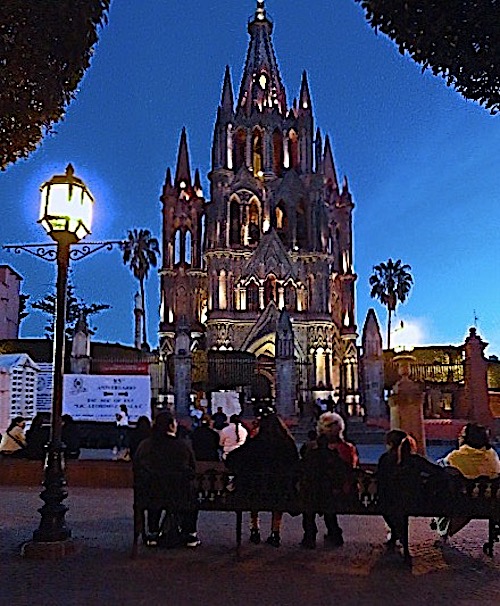
            We walked to the Jardin, where we viewed the parroquia with renewed interest.  Sitting on one of the benches which faced out from the jardin, we watched two pretty young Mexican teenagers flirt outrageously with whichever one of the four boys they were standing with who paid them the most immediate attention.  They seemed to be competing.  When one caught the attention of the young man both seemed to find the most attractive, the other one would fawn outrageously over whatever boy was nearby.  Now and then one girl would walk off with one of the boys, but she always returned.  Then the two young men who seemed to be the ones they were most interested in walked away.  One girl sat down on a bench with a sketch pad.  The other walked away with a heavy young man who seemed to be a fill-in object for her flirtation.  I had forgotten how much fun it was to flirt.  Surely, I had never been as self-confident in my flirtations as these girls, but I begrudged them none of their fun.  They formed part of the entertainment for us all.

            Here, people went out at night.  They stood in groups on the street or around a food wagon, their elbows on the counter as they ate a hamburger or burrito.  They sat gossiping on park benches, played with children or, as we did, sat watching the parade.  One person in fifty was a foreigner, and the foreigners were as intriguing to watch as the natives.  Amazing that most of us came from the same continent.  The variety from foreigner to foreigner was so great.  The great preponderance of people we had met, be they residents or tourists, had been Canadian or Texan.  Then there were the art or language students––young, old, Mexican, North American, European.  We heard of Swiss and Germans, but had met none.  We had heard of the American woman who, answering the door expecting a package, had been stabbed multiple times. 

            “And the man is still free in her neighborhood,” our informant told us.  “They put him in jail for a while but they let him out and she has to live there because everyone knows and now no one will buy her house.”

            We went for ice cream, then moved to a bench facing south on the opposite side of the jardin. We had noticed the birds, which were plentiful, on its other side, but here their cries were almost deafening.  A thousand or more birds nested, perched, flew up, fluttered, glided down to, glided up from the  50 or so trees in the jardin.  They were all black with widely fanned, very long tails.  When we had asked Maria Antoinette what they were, she had said crows,  but we later discovered them to be grackles––much more fragile and slim and exotic than any North American crows.  Their songs were varied, atonal and loud.  They would have furnished great sound effects for  Alfred Hitchcock’s “The Birds”.  We couldn’t imagine what was attracting them.  There were always lots of birds in the jardin, but not this many.  We couldn’t believe that no one else seemed to notice them.  Nor could we believe that neither sidewalk nor people were being splattered.  Now and then a dry leaf fluttered down as a bird alit or took off, but there was no evidence of any bird splatterings anywhere.  The trees were dense, it was true, and seemed to be serving as our umbrellas. 

            Well-behaved Mexican children played with their grandmothers.  Older children entertained their younger siblings.  Elderly women greeted neighbors, young women sat talking to each other, eating ice cream delicately, small spoonful by small spoonful.  The toy vendor stood in one place for an hour, talking to a young woman on the bench near to where he stood.  One arm was pulled upwards by the combined lifting effect of 50 or more inflated mylar balloons held on short strings.  With the other, now and then he would move a horse with spinning sculpted Coke can wheels around him in an arc, but he seemed to be more interested in conversation than in sales.

            A small boy whizzed by on a skateboard/scooter––the first we’d seen in San Miguel.  Then another boy rode by, cautiously, on the same scooter.  He next offered it to a small girl in a pale, loose dress.  I was impressed by his generosity, but the girl seemed reluctant to try it out.  Then she glided a short distance, pumping the courtyard with her free foot.  Eventually, she wheeled by, cautiously, three or four times.  The boys having left, I realized it was her skateboard.  Another small girl craned her neck to follow her progress as she passed her.  A skateboard/scooter was indeed a novelty in San Miguel.

            We had yet to see a misbehaving, pouting or crying child in Mexico.  Everywhere, they seem to be flooded with attention and love.  They were well-dressed, cheerful, playful, outgoing.  Older children played with younger children.  Strangers in the street or on park benches squeezed their cheeks or patted their hair.  Young fathers slung blankets under the arms and across the chests of their toddlers and followed them patiently, around and around the jardin.

             We had met Susan’s three children, aged two, six and eight.  They were tow-headed clones of the black-haired Susan.  “This isn’t really my color,” she had told us, but we were unable to tell if she was kidding or not.  The three kids rattled around, seat beltless, in the back of Susan’s van as she took us to see an apartment, another woman to see a storage space.  They had acquired a magnifying glass which fascinated them all.  They were catching the sunlight and directing it onto paper, their arms.  “You can start a fire with that,” I told them. 

            “We’re going to use it to burn ants,” the eldest told me.

            Then their interest in lenses spread to me.  Theresa, the smallest, wanted to try on my glasses.  The other two wanted to try them on, too.  As we reached our destination, they spilled out of the van.  The boys hit the dirt, in search of ants.  When the lady at the storage space moved up the stairs to show the storage unit, Theresa went with her.  We went into the two-story apartment we were here to see.  Susan came with us.  The kids were free to do what they would in this free place, whether I agreed with their antics or not.

For Chapter 15, gp  HERE.

  All photos unless otherwise noted are my me.

Innocents in Mexico, Chapter 13

Innocents in Mexico

Chapter 13

            That night, I sliced chicken breasts and sauteed them with green, yellow and red peppers, garlic, onion and carrots.  I sliced potatoes and boiled them, then added them to the pan.  While they browned, I made a salsa of the mangoes and sweet onions I’d bought in the market. 

            No bread tonight.  We remained firm in our resolve. We had been very bad about bread and pastries, which were so cheap and good in the town shops and markets and even cheaper and better in the large bakery at Gigante.  Here bread, rolls, pastries, donuts and cakes were piled in bins or displayed on large trays.  Customers walked around with tongs and pizza trays, choosing what they wished, then stood in line to have them bagged and tagged at the cash register. The first time we had visited, we had filled up two bags and the total came to about $2.  The store was so close that we couldn’t even walk off the calories by walking to get them. 

            We tried to eat by candlelight on the unwalled patio off the kitchen.  I kept lighting candles, but the wind kept blowing them out.  We had begun to notice a pattern in the weather.  Hot days gave way to cool windy evenings.  At 9, all the doors in the house blew shut, the trees were swaying, and I pulled on a long-sleeved t-shirt against the chill. Then by 9:30 it had warmed up again and the wind had died down.  By 10, it was dead still and I had discarded the long-sleeved shirt.                       

            Today, Bob went to town to replace the large stretched and framed canvas we had lost off the top of our car in the desert.  Then we went back to town in the afternoon to look at a possible long-term rental and to shop in the market. As we waited for Susan at La Conexion, a continual stream of people ducked in and quickly out again, having grabbed their mail from their boxes. There were several of these mail delivery places in town.  Your address was a mailbox in Texas.  Then they bulk shipped the mail UPS to San Miguel so the mail never went through the unreliable Mexican postal system.  They would also accept faxes and would print out three pages of e-mails a day for customers. 

            Bob pointed out a stack of videos of San Miguel piled on the counter.  We hadn’t noticed them before.  A few minutes later, a small neatly dressed woman came in.  She left and came in again, smiling at us both times and talking to a woman in the computer section of the room.  She had a genteel air, and when she smiled and talked, she resembled Jessica Tandy.  When she came back in our direction, she spoke.  “Have you noticed the video?” she asked. 

            When we told her we were just commenting on it, she said, “We’re having a viewing here tomorrow night at 6.  It’s the first viewing.  You should come.”  She then told us of an earlier video about San Miguel. 

            ‘”Were you in film production before you came to San Miguel?”  I asked her.  Something she had said had given me the idea that this was her video.

            “Oh, no, I’m just a woman who knows how to talk and has a lot of money, so I get things done!”  she told us, giving  me the impression that she had bankrolled or produced the video.

            In the Jardin, we ran into Lisa, the girl we met in the bank our first day.  We told her we’d rented a temporary house, thanks to her, and showed her the pictures we’d taken of it that we’d just picked up from the photo store.  Lisa lived in a motorhome parked at a friend’s house and was preparing for a showing of her works which would occur while we were back in the States.  She breezed away from us through the Jardin, on her way to her daily errands.


***Note: If you are still reading these daily chapters, would you please leave a brief note in comments to tell me so? I am wondering if I should keep posting them or retire them for the time being. If enough people are interested, I’ll keep posting them. 

See Chapter 14 HERE.


Innocents in Mexico, Chapter 12

Although I can’t find any of the photos I took in San Miguel, the background of this retablo I made while living there shows a shot of the courtyard of the hacienda where Ernesto wanted us to live.
Innocents in Mexico

Chapter 12


  The next day, I awakened early.  We were unsure whether Theresa, the housekeeper, came at 8 or 11.  Susan had told us one time, Steve the other.  I sat in the office in the balcony across from the master bedroom, watching Bob sleep as I started my laptop.  The sounds of the neighborhood flew in over the tall wall that I could just see over there on the second story of the house.

            When Theresa did not come by 11, we decided she was not coming, but we left one door ajar for her, just in case.  She had the key to the compound, but not the house.  We walked to the main road and caught a taxi to the Biblioteca, where we were to meet Ernesto and Dirk to go on a tour of the hacienda and Ernesto’s new school.  Everyone was on time and in fact, everyone had arrived early and gone somewhere to wait, mistakably expecting everyone else to be on Mexican time.  When I told Ernesto we had rented a house, he seemed crestfallen. 

            “Why would you want to rent a house for a month?”  he asked.  “You could be staying at the hacienda for $16 a night.” 

            We explained that we loved the house and that we needed space and privacy to work. 

            “At the hacienda, you could ride horses and use the kitchen,” he answered, still looking disappointed. 

            The tour took much longer than either we or Dirk had anticipated.  Dirk had brought his wife, Maria Antoinette, who was with us as we started out viewing the hacienda.  Everything seemed to be in a state of flux there.  In one large library , a computer stood on a table  and paintings were stacked ten deep against the walls.  They had been taken from the walls, said Ernesto, and replaced by other paintings.  The pool table had been taken from one room and sat, covered, in another.  Piles of mattresses lay in corridors or the corners of rooms.  In the kitchen, something bubbled on the stove:  a pot of beans and a succulent smelling joint that Ernesto insisted was being cooked as dogfood for the dogs.  A large room adjoining the kitchen was available for fiestas, explained  Ernesto.  We saw no one.  Eventually, a distinguished looking older man walked into one of the bedrooms we were inspecting.  He was introduced to us as the Don and he shook our hands politely, but did not seem too pleased to have us there.  In a rapid exchange, Ernesto seemed to be asking him how much it was to stay there.  It turned out that it was $16 per person, so at $960 a month,  it would have been more expensive for us to stay there than in the house we were in.  The Don left and we moved  through arched courtyards and gardens, and ruins partially intact left for atmosphere.  We saw a huge pool, apparently long drained, which Ernesto insisted was still functional, but too expensive to maintain.  They would convert it to solar and then refill it, he said.  But come.  This was the small pool.  Come see the large one.  I started  to feel like we were wandering on a private unauthorized tour through San Simeon prior to its restoration.  Below the “large” pool was a two-story house presently going through restoration.  The views from the patio––of rolling hills and green fields–– were breathtaking.  At one time the hacienda spread as far as the eye could see.  This was before the revolution.  Ernesto’s school was situated in the Armory, where troops used to guard gold and silver shipments, but first we must see this house.  We might want to rent it, he told us. 

            The house seemed to be partially occupied.  There were clothes and toiletries in the bathroom, food and pans in the kitchen.  Half-packed boxes lined the stairway.  Ernesto told us that the people had moved out, but it looked more like they were in the process of moving out.  As usual, there were many mysteries in the world as presented by Ernesto.

            Dirk, worried now that he would not get Maria Antoinette to work on time, asked when we would see the school.  He had expected this to take two hours, he said, and it had been that long already without seeing the school.  We must drive to the school, said Ernesto.  Slowly, since the road is bad.  We would drive most of the way and then walk, but first we must have some refreshment. 

            We pulled over in front of a tiny adobe casa by the side of the main road.  A bus drew up, disgorging schoolchildren home from school.  They scattered like wild kittens.  One small girl entered the courtyard we were entering.  We tried to crowd into a tiny shop, but there was not room for more than three.  Bob and Dirk went in to order Coronas for Dirk, Ernesto and me, juice for Maria Antoinette, Coke Light for Bob.  The Senora who lived in the small house behind the shop and who was the shopkeeper found chairs for all of us and we pulled them into a circle in the bare dirt courtyard.  A huge mesquite tree cast shade over half the yard.  The small girl picked a flower from it and handed it to Maria Antoinette.  If unfurled, it would resemble an hibiscus flower, but its petals were pulled down into a bell.  It was variegated tangerine, gold and orange––the exact colors of Maria Antoinette’s blouse and hair and skin.  We sat in the courtyard and told stories.  Bob, who was given to introspection before speaking, did not fare well against the talkative Dirk and Ernesto.  Maria Antoinette, who was originally from Mexico City but who could, she told us, now pass for a native of San Miguel, entered the house and fell into conversation with the Senora, who eventually pulled up a chair and joined us.  Dirk speculated on what Bob might be thinking, and Bob admitted he was anxious to see the schoo––what we all came here for.  Dirk again expressed worry that Maria would be late to work, teaching English at a private school, but Ernesto insisted we all have a second Corona.  In the end, he and Dirk had another Corona.  I  was already feeling the need for a siesta after one beer.  The hot sun and the lulling effect of far off echoes from the broad landscape had  made me content but sleepy. 

            We were very lucky, said Dirk, to be seeing the real life of Mexico.  Not many tourists saw  what we had seen today, he told us.  Not feeling like a tourist, and feeling like this is how I always traveled or lived in the countries where I have visited, nonetheless, I agreed.  Eventually, we drove on a bit, then parked under a tree after removing several large rocks from the road.  Ernesto unlocked the gate in the tall compound wall.  Towers rose above us––where armed soldiers once guarded the shipments of precious metal.  To our left was a huge bank of blue, glittering in the sunlight.  Next to it was a mound of goldish red, another of white.  They were like a rubbish dump where all of the refuse had been sorted by color.  As we got closer, I saw  that they were mountains of glass.  One was deep cobalt blue––like the color of Mexican blown glass tumblers.  The next drift was broken Pepsi bottles––clear for the most part, but here and there we could see the blue and red of the logo.  Mounds on the other side of the compound were of raw semiprecious stones still in their matrix.  One was of opals, the other chalcedony––what Bob and I knew as poppy and picture jasper.

             We went  first into the room where Ernesto had set up lapidary equipment.  The good equipment was in Texas, he said.  Most of this equipment was used or gerrymandered, but 20 or more stations had been set up. 

            Maria Antoinette sat down on a couch at the entrance and promptly fell asleep.  Ernesto  turned on a fan and directed it toward her and we left her to dream.  He showed us the faceting  tool and the opal grinder.  He showed us the ghastly clay fountain which he sought to mass produce.  It was a wet bar, a fountain and a lamp.  He could sell it very cheap, he said.  He showed us several wax sculptures that they would cast in bronze.  One was by a Swiss lady who wanted to study there, he told us.  His plan was to set up a mobile home park in the center of the compound, where people could come from the States for lapidary and casting workshops much cheaper than those in the States.  They would have school for poor and crippled children, as well.  They would feed them lunch, Ernesto explained.  We moved into another building.  In it were mounds of pot metal molded trinkets––cats, dogs, women, crosses, flowers, every conceivable shape.  Piles of circular molds covered a table.  He pressed the “on” switch on the machine used to melt pot metal. He wanted show us how quickly  this could be done.  He pounded talc onto the molds, fit the two pieces together, and put them up against the snout of the pot where the metal was being heated.  Poof, that quickly the mold was filled and placed to cool.  Then another and another.  You could do twenty in one minute if they were all prepared, he told us.  When he peeled the mold apart, we saw a circular chain of trinkets––perhaps thirty or more––ready to be separated, tumbled and gilt or silver plated. 

            Hanging from the ceiling was a large toy plane––perhaps five or six feet long.  It looked like it had been constructed from old soda cans or recycled tin siding, but Ernesto said it was very expensive.  Strapped to its bottom was an infrared camera.  It was a remote-controlled plane  (the predecessor to the now-ubiquitous drone) which he could send up to locate water and minerals, he told us. 

            Next, we moved to a side compound filled with slab cutters and diamond saws.  Most were rusty, but all functioned, he told us.  Earlier, there was a flood and all were underwater, but they may all be made to work. 

            Bob suggested that more than a resident artist, Ernesto perhaps needed a production manager.  Whereas Ernesto insisted the school would be open in two weeks, it looked more like two years to us, and it looked more like a sweatshop than a school, although Ernesto insisted the money would go to the kids with only enough going to the “school” to keep it functional.  When I questioned Ernesto about the artistic side of things––most of these designs were just being mass produced and were less than esthetically pleasing––at their best pure kitsch––Ernesto insisted they would also do their own designs.  That would be where Bob came into the picture, he insisted, but I could feel Bob’s interest fading.  Years ago, before he himself had built diamond saws and slabbers and drills and worked with stone, perhaps it would have been challenging, but at this stage it felt like going backwards, not forward.

            I asked Ernesto what his goal was.  He said that the metal and gem crafts of Mexico for generations had been centered elsewhere, in towns where they had been passed down in families, from father to son.  He wanted to open up the crafts to everyone and to establish San Miguel as a center where people could set up their own studios and establish their own crafts.  This was the beginning part only.  The school had first to support itself to enable the students to go on and become independent.

            When Ernesto talked like this, I believed him.  He told us he had sold his Mother’s house in New Orleans to enable him to buy two factories and  two mines.  This was where the tools and the raw minerals had come from.  The glass was from a glass factory which he rented out space to here in the armory, but they hadn’t paid rent for a year, so he had locked them out .  That is where the glass came from.  They would use it to make enamel. 

            “How many people have been working on this school?”  I asked him. 

            “One,” he told me, and pointed to himself.  “Sometimes two.” 

            Although the don had offered him lodgings in the hacienda, Ernesto said, he had a very nice apartment and girlfriend in San Miguel, where he preferred to stay, but when I went in search of a bathroom, I saw in a back secluded corner of the workshop a cot covered by a tarpaulin.  On the tarp were several piles of neatly folded clothes.  By the side of the bed was a refrigerator wrapped in chain with a padlock. 

            Later, I confided to Bob that I wondered if Ernesto was indeed living in the armory.  Bob admitted  that he wondered the same thing.

            Dirk, who was a retired dentist and lapidarist, confided to me that he was tempted to stay in Mexico and get involved in Ernesto’s project.  It was the first thing that had peaked his interest and made him want to get active again in years, he said.

            Sweat shop or school?  Mass production or art studio?  Visionary or Con Artist?  Who could know?  But Ernesto continued to intrigue us with his tall dreams and his big stories.  How did people discover the truth about each other?  One part of me wanted to believe in his dream, but intuition told me we were being gently conned.  Well, manana.  We would wait and see.

See Chapter 13 HERE.

Chapters 1-11 can be found in earlier blogs published in the past two weeks.

Innocents in Mexico, Chapter 11


Innocents in Mexico


Chapter 11

            That night, we moved in.  At $600 a month, it was twice the price of the other apartment we liked, but it was worth it.  The rent included the three times weekly services of Theresa, who lived only two doors away.  She was gentle and Susan said she was shy, but we did not find her to be so.  Did she speak English?  No.  Good.  We needed to be encouraged to learn Spanish more quickly. 

            When we arrived at “our” house, Stucco Steve Kelsoe, the friend who had been housesitting the house, was still there.  He understood we were coming tomorrow, he told Susan, but she assured him she told him today.  She left and we talked to Steve about the house, which he designed and built for Jim, the owner, who was  visiting  Disneyland with his girlfriend.  We raved about the house and he told us more about it over a Corona.  How he reduced costs by building the sides of the house right at the property line, so the exterior walls were also the back and part of the side compound walls.  (We later grew to regret this fact.)  He had also done the planting.  He pointed out the ruins we had passed as we entered the lot and that they had preserved, he told us.  A few hours later, he ran up to check his e-mail and to send a letter, then switched off the computer.  The phone rang immediately.  It was our credit card phone provider, who had been trying to call for two hours, but the phone was busy thanks to Stucco Steve.  Robert, our agent, explained to me the intricacies of how to make phone calls so they appeared on our credit card and not Jim’s phone bill.

            Eventually, he left, and we went out to sit on our patio.  The garden was beautiful––the plants exactly the ones I would have chosen.  Bearcat moved easily and inquisitively around the courtyard, padded upstairs one stairway, around the U of the loft and back down the other stairway.  We could hear the click of his claws on the polished wood of the stairway.  He was completely peaceful for the first  time since leaving home two weeks earlier.  He knew we were home for awhile. 

            “Are you pleased with the house?”  I asked Bob as we rocked in the twin wooden rocking chairs which were the sole furniture in the sala (other than two twin beds covered with Guatemalan throws and pillows which served as twin sofas against the walls)

            “I’m pleased with everything.”  He answered. 

            Earlier, we had gone to Gigante and purchased basic necessities.  When I awakened  from a deep sleep after a late afternoon nap, the air was still hot, but the fans blew cool air down onto the bed.  Bob was below, still in the rocking chair. 

            “We missed the sunset,” I said.  “Have you eaten?”

            He had had a peanut butter sandwich.  I had an avocado and onion and cheese sandwich made on wonderful  Mexican bread.  Then I had another.  We sat up late, just  looking out at the courtyard.  Bob read the English phonebook and the San Miguel guide while I read  a book from the large box of books I’d brought along.  When we turned off the lights to go upstairs to bed, moonlight streamed down from glass bricks in the ceiling.  As we fell asleep, the dog who lived on the roof next to us joined a choir of roof dogs.  Bearcat stirred by our feet, but did not run under the bed.  We all felt contented here, relaxed and safe.

(Look at previous days’ blogs for Chapters 1-10. See Chapter 12 HERE.

Innocents in Mexico, Chapter 10


San Miguel Sunset from the Roof of the House We Chose to Rent

Innocents in Mexico

Find Chapter 1 HERE  Chapter 2 HERE   Chapter 3 HERE
Chapter 4 HERE
  Chapter 5  HERE  Chapter 6 HERE Chapter 7 HERE  Chapter 8 HERE  and Chapter 9 HERE,

Chapter 10

            On our sixth day of searching, we found three houses we wanted to rent.  One had the advantage of being blocks from the jardin and a block from the market.  It was stark and small, but we could fix it up.  There were many patios, but I would have to supply the plants.  If we were renting for a year or two, it would be worth fixing up, but not for a month.  As we left, Bob toed aside a large, dead cockroach. 

            The second apartment was in an area above the Biblioteca which we had not seen before.  The man who owned the house was a large-scale metalsmith and would share his tools and space with Bob.  The apartment was charming––decorated with flair.  It had one bedroom, kitchen and bath with a small sitting room on the ground floor.  He, his wife and children and assorted art students lived above.  We were free to use any of his studio space as well.  He was so anxious to rent to us that he said he would do anything to please us.  He came down $200 from his original offer when we had done nothing but ask him the price again.  The $300 a month covered utilities, and he would pay half of our parking nearby.  We were sure we would take this place, but we had first, as a courtesy to Susan, to go see the house she had been trying to get us in to see for three days.  We went back to see Clello’s house by the mercado, found yet another dead cockroach under the sink, then returned the key and told her we had decided to take a different house. 

            We then remembered that we had forgotten to tell the metalsmith that we had a cat.  It was no problem, he told us, when we called to tell him.  He would do anything to get us to take the apartment. 

            “But first” we said, “we must go to see one other house.”

            We went to La Conexion, Susan’s internet business, and she loaded us into her van.  On the passenger side door were vivid purple scribbles.

            “My kids did that.  It’s not graffiti,” she told us. 

            Her van looked like ours––lived in.  Crayons littered the backseat floorboards, a Eudora instruction booklet lay on the dashboard.  I piled my San Miguel guidebook, book of notes and phone numbers, Spanish dictionary and town map on top of it. 

            We went a different route to the house than the first time––when we had seen the neighborhood but couldn’t get in to see the house.  It was in a Mexican neighborhood a short way out of town.  From the road in front of the house, we could see the half-unoccupied shopping mall whose only prosperous inhabitant seemed to be the huge grocery/notions store named Gigante.  The road was dirt, the field to its right littered with plastic bottles and paper bags.  At first, I thought it was a dump, but it was just the refuse which was the normal byproduct of being so close to a market.  The neighborhood looked less bleak this time.  On the  long road that ran past the house were two metalworking shops, which interested us both.  Susan opened the gate to the courtyard and we stepped in.  It was a beautiful modern stucco house constructed in the Mexican style, using Mexican methods and materials––two stories with a rooftop patio.  Two second story patios served as roofs for two ground floor patios which  flanked the house.  A brick pathway vee’d and then joined as it approached the house.  Around us were bougainvilleas in various shades of purple, burgundy, wine, rose, orange and gold.  A 15’ long wall of organpipe cacti stretched far up into the air, running parallel to the side wall, but well out from it.  A mesquite tree spread over the central courtyard and the walls of a small ruin which they had left intact and which contained a quirky artist’s shrine.  As we stepped into the house, we saw  first of all a huge picture of the Virgin of Guadalupe which dominated the 30’ high back wall .  On closer inspection, we saw  that it was a beaded curtain meant to hang in a doorway.  Ceiling fans above it sent air currents which caused it to gently sway in minute waves out from the wall and back.  The effect was an underwater effect––or one of heat waves in the road in front of you when driving through a desert.  The house was spectacular.  One large central room opened to the 30’ high ceiling.  To the right was an open kitchen which led to the right front patio, where the glass top dining room table and chairs were.  To the left were the guest bedroom and bath, which sported the only inner door in the house.  In front of us, two open stairways formed a V leading up to the office on the right and the master bedroom/bath on the left.  Both were bounded by just an open balcony railing overlooking the main living space.  Most walls were whitewashed adobe brick, but a few walls were kept unpainted.  The vent over the stove was covered with vivid yellow tile and the cement floors were painted an aged terracotta, blue or yellow, then waxed.  Rugs added warmth to the floors.  As we moved through the house, the image of the Virgin de Guadalupe was repeated over and over on glasses in the kitchen, in small shrines and in a tiled tray on the patio.  An autographed picture of Beaver and Wally Cleaver sat on the stand beside the desk.  To its left was a small shrine to the Rolling Stones.  Elsewhere in the house were pictures of the Swami Yogananda, a print of Remedios Varo, whose work we had earlier seen in Ziwok, a wall devoted to Bob Dylan (We had included all of Bob Dylan’s tapes in our limited cache of tapes brought along to Mexico.)  On the open clothes rod at the end of the master bathroom were sedate Hawaiian and batik shirts that could have been Bob’s.  On the shelves were shorts and loose pants that look like the ones packed in his bag back at the hotel.  When we saw a picture of Jim, the owner, he had long light hair, like Bob, and was of a similar stature and size. 

            I loved the house.  I looked at Bob.  He loved the house.  Prior to this we had looked at no fewer than 10 houses and apartments, and had only agreed about these last two.  We took the house.  Sadly, I called the metalsmith to break the bad news about not taking his apartment.  He was very disappointed, I could tell.  I promised to tell anyone I met about his place.


See Chapter 11 HERE.

Innocents in Mexico, Chapter 8

We passed under this arch to get from the Plaza Principal to our hotel.

ind Chapter 1 HERE  Chapter 2 HERE   Chapter 3 HERE  Chapter 4 HERE  Chapter 5  HERE  Chapter 6 HERE Chapter 7 HERE


Innocents in Mexico

Chapter 8

          Today we met several interesting people and reconnected with the young woman we’d met our first morning in the bank.  All of these connections led to houses to look at. Clello, the woman who owned the shop where we posted an ad for a house, sent us first to look at an apartment, which was nice but much too small.  Then she sent us to a house.  Its entrance proved to be too low for the van, but she assured us we could park at her sister’s hotel a half block away.  We went to the hotel and found what the fee would be, then ambled through the artisan’s market and the food market, which were a stone’s throw from the house we considered renting.
            It was interesting that all of the homes of foreigners seem to be decorated in the best colonial or traditional Mexican style with massive furniture and folk art, whereas the Mexican owned houses and apartments were furnished with western furniture.  Having looked at pictures in the windows of several (closed) real estate offices, we found this house plain in comparison with the pictures of houses that resembled movie sets with lush gardens, art, rugs and furniture.  Today Bob was off to immigration and I was to meet Ernesto to look at still another house.  Then I would make more calls and visit hopefully open real estate offices, renew our car insurance, collect our e-mail, send e-mail.  Bob thought we could get out of our present hotel (which in the states would have been called a motel) by tonight, but I didn’t think so.  He also thought he was going to meet me back there at noon, but I thought he was naive about the length of lines he would encounter at immigration.
            The night before, we had eaten at Ziwok, a delightful restaurant operated by Juan Pablo, a half Mexican/Spanish, half Swedish man with a passion for Frida Kahlo and Remedios Varo.  The front room of his perfectly decorated cafe was devoted to Frida––her self-portraits, photographs and a massive shrine assembled in a niche along one wall.  Basket chandeliers and neatly potted plants accented  the walls, which were beautifully faux painted in light and dark terracotta.  Tablecloths, cloth napkins and napkin rings were all in yellow and green.  The back room was a dark green and was totally devoted to the work of Remedios Varo, a French surrealist who moved to Mexico during the second world war.  Frida, who thought one female surrealist was enough in Mexico, saw her as a rival and hated her,  Juan Pablo told us.  Along with Varo’s exquisite bizarre prints he had displayed his own work: elaborate constructions of parts of animal skeletons, plants, sea life, seeds––any natural object he could find––which he had assembled into fantasy animals and covered with sand cemented in place with cyanoacrylate glue.  The effect was surreal, but although the assemblage animals seemed to come out of a nightmare  (a winged frog, a blowfish with snout, legs and an armadillo tail) they were curiously believable, thanks to his meticulous craftsmanship.
            After a close inspection of the art in both rooms, we went back to our table and watched him in his small open kitchen, cooking our meal in four woks.  Bob had tempura shrimp and vegetables, I had vegetables and rice.  Our plates arrived, along with a cruet of mango sauce and another of ginger.  The food was as different and delicious as the decor.  Prior to leaving, we had spent a half hour or so poring over his book of the work of Remedios Varo and listened to the story of first her life, then his. Every detail here was perfect and immaculate, down to the decoupaged menus and the hand-fashioned box of matches he gave me as we left.
            This night at Ziwok was another flower plucked from the bouquet of San Miguel.  We had found a new favorite restaurant––our most recent favorite having been the outside terrace where we had breakfasted that morning on frittata of eggs, potato and bacon with black bean sauce, fresh baked rolls with butter and jam or a delicious white cheese, pepper and avocado sauce in oil.  Every restaurant  we had  been to here we had wanted to go back to, but there was always a new one to try and we always liked it better than the last.  I had been amazed that in our hour in the restaurant, we were the only customers, but someone had told us that in San Miguel, there were 7,000 restaurant seats and on any given night, an average of 500 diners to fill them.  With odds like this, the restaurant market was a competitive one.  We didn’t think we would find one we liked better than Ziwok, but part of the pleasure was variety, so we would try others on our list before returning.  As we left, a young couple and child made their way to the back room.  “More customers,” I said.  “No, they are my friends,” he said.  “She plays the accordion in Mama Mia’s.”  It was another restaurant that would come to be a favorite.
            Apartment hunting continued to fill our days.  Meanwhile, we were piling up hotel bills at the rate of $100 every two days.  We began to think we might be ahead just getting a $1000 apartment.  At this rate, our hotel bills would mount up to the difference, anyway.  A few days before, we had run into Lisa, our former acquaintance from the bank, while checking out a bulletin board in a small cafe.  She was sitting with the owner of the cafe.
            “Wine?”  he urged, “Something to eat?”  When we said no, we had just eaten, he insisted, “It’s free.”  A large table in the back room was spread with food.  People moved around it, filling their plates.  A few more people moved around the small room, examining paintings on the wall.
            “It’s an opening.  See the woman with the large flower in her hair?  She is the painter.”
            When he urged wine on us once more, I asked for white and we sat down to talk.  Bob, impatient to read the bulletin board and be on to apartment hunting, seemed a bit exasperated.  At this rate we would never find an apartment, he insisted, but in the end, this is how we found one.  Lisa’s friend Pancho, the owner of the bar attached to the gallery, insisted that we must see Susan, the woman who ran a mail agency and internet service, at the front of the cafe and gallery.  “She knows many good apartments.  She knows everyone,” he told us. We sat and talked for a short time while I finished my wine.  The waiter urged more wine on Lisa.  “He’s trying to get me drunk so I’ll be a bad girl,” she laughed.
            The next day, we called Susan and made an appointment to meet her later in the day.  She took us in her car to see the house of a friend, but the inhabitant did not answer the door.  Then we went on to see a house which she assured us was a steal at $85,000.  Although we were not in the market to buy a house, Bob was sold by the huge studio.  I didn’t like the location or the house.  The owner had built it in an area quite far from town––an area chosen because it was far from the foreign enclave, where people might find objection to the large jewelry production studio which was attached.  Here, 15 employees made jewelry which she wholesaled in the States.  Because she had built her house in a poorer neighborhood, she had no problem finding workers who could actually walk to her studio to work for four dollars a day.  As we went into her patio, a huge Doberman rushed up.  All of the doors and windows were locked, even though the house was surrounded by a tall wall.  I didn’t think I would like to live in a house this luxurious in comparison with the neighborhood around it.  If real estate was location, location, location, then this seemed to be a poor choice for real estate investment.  Susan assured us that in 5 years this house will have tripled in value, but the spirit of the house seemed wrong to me.
            Later in the day, we went to see the house of Dirk, the man I’d met through Ernesto.  He had plans to spend a year in the States, and wanted to rent us his house.  It was in an enclave of extremely large and expensive homes, but it was equally as far out from the center.  I liked the house, which was esthetically more pleasant than the last house, with arched brick ceilings and tile more to my taste.  It was surrounded by patios and plants and had a large rooftop patio where Bob could work, but now that he had seen the house with the large studio, nothing could rival it.  He found this house too small.
            When we had moved to Central California from L.A. fourteen years ago, it had taken us a year of driving back and forth each weekend to find the right house;  but we had neither the time nor the energy to do so now.  The double task of finding a place to live for a month and a place to return to for a year was wearing us down.  I just wanted to try to get into the swing of life here––to see what it would be like to live and work in San Miguel.  But all we were doing was business–– like at home.  Visas, permits, money changing, setting up accounts, looking for houses, finding internet servers, finding personal mailboxes––these details ate up our days.  Bob had predicted that the annoying minutiae of dealing with the details of living would follow us here, and he was right, but I hoped that after this interim period we could settle into a simpler life.

See Chapter 9 HERE.


Innocents in Mexico, Chapter 7 Posada de las Monjas


Find Chapter 1 HERE  Chapter 2 HERE   Chapter 3 HERE  Chapter 4 HERE  Chapter 5  HERE  Chapter 6 HERE

Innocents in Mexico

Chapter 7: Posada de las Monjas

It was Sunday, May 13, at 1:30 a.m. It was our first night in our new room, and someone was setting off fireworks.  They soared up into the air and exploded with ear-splitting booms.  Dogs barked from half the rooftops of San Miguel.  There were too many lights in town, even at this late hour, for the stars to be visible.  It was a shame as our room was so high that we had a panoramic view of the city and the sky.  Below us, tin roofs broke the spell, but we had occasional glimpses into courtyards full of plants and trees.  A cat yowled below and Bearcat stood and stretched but did not scoot under the bed as he had that afternoon when he heard the same caterwauling.  He was getting braver every day, but a car backfiring a block away or a door slamming across the courtyard could still send him into hiding.  We had no yard now for our midnight walks.  All of the courtyards  and terraces in this hotel were of cobblestone or cement.  He was an illegal alien here.  When we sneaked him out on his leash at night for a walk through the deserted outside corridors, he was calmer, walking as close to the curtained windows of each room as though eavesdropping for any possible news of his new environs. Although the management didn’t know we had a cat, some of the staff knew but they never told. This first night, we settled to bed, finally, by 2 a.m.  and  I penned this poem  a mere four and a half hours later:

San Miguel Morning

The sounds of rooting cats
like infanticide
accompany
tuba music
in 4/4 time.

Fireworks.
Roosters.
Donkey brays.
6:29 in the morning.

All’s right with the world.

Today was Mother’s Day.  It was the first in my life where I had no mother to send flowers to.  The same was true of Bob.  On our way through Tucson, we had stopped to see my mother’s crypt for the first time.  I had meant to bring flowers, but I could see that they didn’t allow fresh flowers, and I couldn’t bring myself to leave plastic ones.  Some of the crypts had metal flowers attached, and I decided to try to have something special made in Mexico.  Those would be the flowers I sent this year.

On this day, we took the van out of the courtyard of the hotel to go look at an apartment.  It was a bother to do so, because it meant getting a man to open the portal––not only the one that could be reached from ground level, but also the high one 8 or more feet off the ground.  Today, the guard used a tall metal pipe to pry the hatches open, Yesterday he had attempted to climb up on the lower lock to reach the top one, but it was a tricky maneuver and he had fallen off..  Then we scraped the bumper of a new yellow pickup trying to back out.

The apartment we saw was a depressing empty house in an extremely poor neighborhood.  On the floor of the bare living room was a pair of men’s slacks, rumpled as though he had climbed out of them and left them as they were.  Half-full bags of grout  lay abandoned.  In the shed, there was the overpowering smell of oil paints.  What had been described as a garden was hard baked earth with a few abandoned flower pots.  Even the weeds were dried and skeletal.  The house described as furnished in the newspaper ad was dark, in poor repair and completely empty.  The woman told us she had no money to buy furnishings, but maybe they could get one bed and a refrigerator.

That afternoon, we had been looking  at  pictures  of rentals in a rental office near our hotel.  The apartments and houses were all picture perfect––decorated, furnished with art and gardens complete with gardeners.  The contrast was so depressing that it made me again question whether I wanted to stay here.

The disparity between the gringo sections of town and the local sections was so great.  And yet in the restaurants and galleries, I saw the majority of people were Mexican––well-groomed and prosperous looking––eating the same food and drinking the same drinks we were drinking.  Our hotel, too, was filled with Mexican travelers, so the difference was not so much one of nationality as of level of prosperity.  The same economic differences existed in the United States, but there, as here, we were shielded by the distances between our living areas.

Even in the U.S, there were places we never went.  Why would we?  In those places there were no restaurants, theaters, gyms.  In those places, there were none of our friends to visit.  Our kids didn’t go to school in those neighborhoods, so for us, they didn’t exist.  Every American we talked to said not to have a car here––to depend on public transport or walking,  but public transport did not take them through these neighborhoods, so for most, I am sure they did not exist.

By the time we got home again, we were exhausted from trying to negotiate the maze of unmarked streets. To compound our frustration, we found that  the lot that had been  nearly empty when we left was now completely packed––with all cars double parked.  The guard fit us diagonally into one corner of the large courtyard in a place where we blocked four cars instead of two.  He refused to take our car keys, so we imagined an early knock on our door to get us to come move it. We had already made the decision to keep the van in the compound for the rest of our stay, but this cinched it! On Monday, we would take a taxi to immigration and the real estate office.  Already, our new van had rattles in every part of its chassis from two days of bumping over cobblestones.  The side was scraped and the running board dented in.  If we had to count the number of streets backed down or tight spaces we had turned around in, it would reconfirm our decision.  A car in this town was crazy.  A full-sized van was lunatic.  People drove vans the size of ours as buses here.

It was a moral struggle to sit in the Plaza Principal.  Every time I sat down, an old woman came to sit next to me to tell me she was hungry.  When I told her I didn’t understand, she sighed.  She sat for fifteen minutes, sighing every few minutes or so.  Finally, she asked me the time.  At first, I didn’t understand.  I thought she was pointing out the dark freckles on my arms.  Then I understood the word “Hora.”

Seis?”  she asked.

Siete,” I answered.  I knew some Spanish.  Now she would suspect I really understood her.  Well, I guess I did, even without words.  On our first day, Bob and I gave money out to most who asked.  When the same people approached us later on their next round, we realized that it was endless.  To encourage the woman and children selling cloth dolls meant no time ever in the jardin when we would be free to read a book or watch the strollers or the church facade changing colors as the sun moved across its face.  It meant constant interruptions to the peace and tranquility we had come here to find.

It was a major conflict that all of us face in this world.  Were we here to enjoy the world or to confront and deal with its miseries?  Was it fair to choose the ways in which we tried to make the world a better place?  Was it making the world a better place to encourage begging?  Was there any alternative to begging for those who did so?  I remembered the old woman who fell down in a faint in front of the church in Oaxaca.  Kind tourists  helped her into a sitting position,  fanned her, pressed coins upon her.  Then one of the locals laughed and told us that she was one of the richest women in town––so good at her daily act that she made more than most wage earners.

I remember the children in Bombay whose parents had cut off their arms or legs to make them more successful at their begging.  Where were the easy answers?  There were none.  If we taught at the free art school, would it make a difference?  It would make a difference for us, ease our guilt.  But would it do enough to ease the suffering in the world?  The answer was clear.  We would do what we could do:  try to be kinder, try to notice instead of reacting the same to every person who asked for our help.  We would live here not quite adequately, as we had lived in every place.  We were not Mother Teresa, nor were we Hitler.  We were fugitive Americans trying to find a better way.  We were trying.  Looking.  Tomorrow we would see what happened.

Again, the old woman sat by me in the Plaza Principal.  I was no longer sure that she remembered me as the same person every time she sat down.  This time she asked me if I lived here and when I said no, she asked me where I lived.

“El Norte,” I told her.  Bob and I were sitting on extreme ends of the same bench because each end had a tree which sheltered us from the brief afternoon rain.  She crowded with me under my arboreal umbrella.

“You have beautiful hair,” she told me, which I did not understand until she pulled at her own hair and said, “Amarillo.  Bella.”

When I pulled out a bottle of water.  “Ah, Agua” she sighed, and pulled out a plastic bottle of Pepsi from her string bag to take a drink.

Ese es su esposo?” she asked, pointing at Bob.

“Si.”

For the next ten minutes or so, she sighed, now and then, asking me for money for food under her breath, but I could feel that her enthusiasm had waned.  Occasionally, she commented on those who passed us.

Buenos tardes, senora,” I said, when we got up to leave, but she was already moving to another bench.

For Chapter 8, go HERE.

Innocents in Mexico: Chapter 6: A Rude Awakening and a Savior


The Parroquia de San Miguel Arcángel

Find Chapter 1 HERE  Chapter 2 HERE   Chapter 3 HERE  Chapter 4 HERE  Chapter 5  HERE.

Chapter 6: A Rude Awakening and a Savior

            The next morning, we were awakened by the tooting of a horn outside our window.  I opened the door and looked out.  Resolutely and with a fine sense of rhythm, a woman was honking her horn for someone in the room next to us.  Undaunted by my stares, she continued to honk.  Bob slept on as I fastened Bearcat’s leash and attempted to take him for a walk.  I had forgotten that walks are a nighttime thing for cats––the later the better.  He resisted and I gave in.  By eleven, we were off to find a bank, a real estate agent and a really good map of San Miguel.  Unfortunately, all of these items proved to be easier to find than was a parking spot.  As we traversed still another circuitous route trying to find a parking space, Bob questioned whether we wanted to rent an apartment here, even for a week or a month.  He cursed the tiny cobblestone streets, the lack of signs.  The jardin area seemed to be all there was to San Miguel, he complained, and there wasn’t much to it.  “Did you like Oaxaca for the first few days we were there?” I asked. “Or Bali?” He admitted that he hadn’t, yet he had ended up wanting to live both places after a week or so of getting to know them.

Bob finally left me off at the tourist office, promising to join me there.  After 15 minutes, when he still hadn’t appeared, I moved off to a bench in the park, where I could sit in the shade while keeping an eye peeled on the door of the tourist agency.  On the bench sat an American woman who shared her experiences of living in both San Miguel and Guanajuato.  Fresh from a three-month course in Spanish, she chatted with the senor who sat down on my right.  Did he live in San Miguel?  Did he prefer it over Guanajuato?  Why?  Because it was warmer in San Miguel.  Because there was more to do.  I was thrilled that I understood most of what they were saying.

Bob joined us, still not too excited to be sitting on a park bench in such a difficult town.  We went to the bank.  Our time to pay for our tourist visas had nearly run out.  The custom at the El Paso crossing seemed to be to go to any bank in Mexico to pay for the visa which was issued by immigration in Juarez.  Since we had never managed to get to any banks while they were open for the three days it took us to drive to San Miguel, it was a pressing need for us to pay the fee and thereby amend our status as illegal aliens.  Unfortunately, when Bob had presented his visa to apply for the car permit at the customshouse south of Juarez, the woman had detached the carbon copy of his visa application and now, without it, the bank could not accept payment.  But the carbon copy was at the customs office south of Juarez, I argued, to no avail.  A Xerox copy would not do.  I paid for my visa, whose papers were intact, and went back to the waiting area where customers waited for the numbers on their pop-out tags to be called, like customers at a bakery or ice cream store.  Bob was deep in conversation with Lisa, a tanned woman who gave him advice on rental houses, classes and the arts community.  As her number was called, we moved to the front of the bank and I told him the bad news.  In front of the bank was another tanned American lady in straw brimmed hat and a stylish tan linen dress.“No,” she said firmly to the small girl who proffered a brightly dressed cloth doll for sale.

Bob and I were trying to figure out the route to Gigante––a huge market situated somewhere off our limited tourist map.  The bank manager had insisted that we must go to immigration and that this was where it was––in an office over Gigante.  A pelting monsoon rain had descended while we were in the bank and we stood under a broad overhang, waiting for it to calm down.  “Do you live in San Miguel?” I asked the stylish lady.  Yes, she did, and yes, she knew the way to Gigante.  To illustrate, she pulled out a vastly superior map to ours, then told us where the biblioteca was where we could purchase both this map and the definitive guide to San Miguel.  Her name was Kim, she was from Alameda, just an hour and a half from our California home, and she now lived in San Miguel.  “Well, here, have my map,” she said, after a few minutes of talking.  When I protested, she insisted.  When I offered to pay, she refused.  It was her gift.  She handed us a card, then moved off into the now abating rain.

At the Biblioteca, we bought books and guides and maps and cards and chatted to the man running the gift shop––another expatriate American who gave advice on apartments, cars (don’t keep them) concerts (go to them) and all of the glories of San Miguel.  Although the library itself was closed, its restaurant had been recommended to us by Kim, and we ate a nice lunch while eavesdropping on the other expatriate Americans who sat at the tables around us.  Small children skipped into the restaurant from the library singing “Happy Birthday to you” in Spanish-inflected English.  Someone shushed them, to no avail, and they ran out giggling loudly.        Outside the door of the restaurant, in the hall to the library, was a pay phone, where I stood trying to figure out the intricacies of a phone with a card slot and four buttons with indecipherable pictographs.  I finally called the number given on the first rental ad on my list.  The woman spoke English but didn’t know if she wanted an artist renting her house, which was immaculate, she said.  Maybe he could paint in the garage.  Would he spill paint on the floor?  A meticulous house sounded as uninviting as the $1,000 rent, so I explained we were perhaps not the right renters for her.  As I hung up the phone and prepared to make my next call, I saw a man sitting very near by with a phone card in his hand.  Was he waiting to make a call?  Yes.  Would he like to go in front of me?  He protested that he could wait, but when I said I was going to make a number of calls, he agreed that he’d like to make just one fast one.

He in fact made one very long call.  I stood shamelessly near, trying to encourage him to hurry, but he chatted on.  He was talking to a man that his friend Richard had told him he must meet.  Yes, he would meet him in the library on Monday.  He had a picture of him, so he would recognize him.  This phone call came to have all the ear markings of a blind date.  After five or ten minutes, he ambled his call to a close and handed over the phone, then stood talking to Bob, as unabashedly listening to my call as I had his.  “Are you looking for a house to rent?” he asked Bob.  He knew of a house, which he seemed to be describing to Bob as I tried out my laughable Spanish on yet another homeowner.

“Are they speaking Spanish?” He asked, as he heard my garbled string of Spanish tape phrases.

“Yes,” I admitted. “Do you speak Spanish?”

He did, and offered to interpret.  I happily handed over the phone.

Toward the end of the phone call, my telephone card ran out and he was cut off.  When I tried to call back with another card, he discouraged me.  “You don’t want to live there,” he said.  “It’s at the end of a very dusty road.  It’s too far from the center.  What you need to do is find a room near the center so you can park your car and answer all the ads in the newspapers for a week to find the right house.“

He told us his name, which was Ernesto.  He told us about the art school where he taught art to poor kids.  He told us about art happenings and poetry happenings and music.  He told us of a different hotel where we should stay and of a house nearby that was coming up to rent.  In the end, he took us himself to the Posada de los Monjes, an historic  hotel that was a converted convent, and translated with the front desk, insisting on the room with the best view.  As we moved through the front of the building through wooden doors hundreds of years old, the full glory of four floors of terraced stone opening onto a cobbled courtyard where we could park our van was revealed.  Broad terraces with crenelated walls jutted out from some of the rooms and wide outside corridors joined them.

We climbed higher and higher until we came to the room chosen for us––a bit small but with a beautiful tiled bathroom with stone shower.  Coming out of the room, we moved out to the private patio bigger than the room.  Below us stretched the entire panorama of San Miguel.  Breathtaking.  The church, the tile roofs, the jagged skyline and yellow hills.  The rooftop gardens and trees jutting up from courtyards.  We were so high that little rose higher above us than our own roof.  We had a 300-degree view and all of it was beautiful.  Never mind the steps.  We could have all of this for barely more than our motel room which was nice and roomy but viewless and near traffic noise.

Do you want to see the room with two beds, asked Ernesto?  It’s bigger, but also $10 more a night.  We’d see it, we said, but the cheaper room would probably do.  I must admit, I dreaded the confinement of the smaller room, but knew we’d probably not spend much time there anyway, and could just spend that time on the most glorious patio on earth.  But, we went to see the room, which was bigger, with its own living room, better views from the room itself, but no patio.  Or at least we thought so until we ascended the stairs outside the room to the patio on top of the room that had even a better view than the room before it––this one a full 360-degrees!

The view was well worth the extra ten dollars a night.  In ten years, we would not miss the money, but we’d never forget the view.  We took the room. We would move in the next day! Ernesto took us to the art institute––not his, but the one near the center.  In the end, he offered Bob a job at his art school.  No salary, but a job just the same.  He could use the facilities free in return for any amount of time he wanted to teach.  Then, meeting a friend he knew on the street, he faded back into the life of San Miguel.  He had made a date with Bob to meet Monday to see about showing us the house that his friend had just built.

The importance of meeting Ernesto?  Bob had gone from wanting to move on to wanting to rent a house in just hours.

“How do you like that?” he said.  “In San Miguel less than 24 hours and I’ve already been offered a job teaching art.”

Right then and there, we went to Mailboxes Etc. and rented a mailbox for three months.  The proprietor of this establishment introduced herself as Annie and she told us the intricacies of sending mail and packages into and out of Mexico.  What to do.  What not to do.  How to send tax papers, magazines, bills, packages.  Another stranger popping up to solve our severest problems.  Like magic.

That night, we peeked into courtyard after courtyard looking for the right restaurant.  Bob, who had formerly hated Mexican food, picked a Mexican restaurant, pronounced his meal delicious  and paid the musician to serenade us with a rendition of “Rancho Grande” that rivaled any Oaxacan version we’d ever heard.

“The thing about San Miguel,” he explained, “is that a good deal of it is hidden.  You don’t see it by casual observation.  You have to look farther,”  That night he stayed up hours later than usual, poring over guide books and maps.  Bearcat curled on my bed as I sat at my laptop.

“Tomorrow you get to go to your new home,” Bob told him.  “You get to go from being an under-bed cat to a roof cat.”

See Chapter 7 HERE.

Innocents in Mexico, Chapter 5: Zacatecas, Aguascalientes and Finally, San Miguel!!!!!

Street Scene, Guanajuato

Find Chapter 1 HERE  Chapter 2 HERE   Chapter 3 HERE  Chapter 4 HERE

Innocents in Mexico

Chapter 5: Zacatecas, Aguascalientes and Finally, San Miguel!!!!

            The next morning, a few more hours of driving through the desert brought us to Zacatecas.  There everything began to look more prosperous, with trees in evidence and large trucks bringing more to plant, their roots balled in white canvas.  Square adobe houses rose up in diagonal terraces, some painted bright basic colors.  Here, as in other towns we’d passed, bright and huge modern sculptures sprouted out of cement plazas with lights installed at the base for night viewing.  Hundreds of black plastic water reservoirs on the tops of houses appeared to be some new Christo installation.  New buildings in all stages of completion were everywhere.  There was a sense of style here, but no imitation of any North American, Italian, Spanish or any other style.  It was a style all their own––clean, adventurous, purely modern Mexico.  We were in too much of a hurry to stop to see who was responsible for any of the large sculptures.  Perhaps on our next trip.
            Between Zacatecas and Aguascalientes, the desert gave way to grasslands and crops.  Long white irrigation tubes paralleled the highway.  We made out corn, grapes, some white-flowered crops–– onions, garlic, or perhaps just flowers.  We passed a truck fluffy with kale.
            In Aguascalientes, we seemed to drive in circles following the “Mexico” signs.  When they gave out, we drove on in what seemed to be a logical direction.  A taxi driver told us to turn left and we again seemed to be going in a circle before finding the signs.  They again deserted us, but after a half hour or so of driving hopefully toward Leon, we again found the signs and made our way out of Aguascalientes past yet another colossal orange geometric sculpture.
            The country once more turned to sand, this time interspersed with low trees and some crops.  In the distance, a colossal black bull stood silhouetted against the clouds.  Billboard or sculpture?  To our left, the fields were verdant green, to our right, pale tan, as though it were a different season on each side of the road.  We passed the bull.  It was a billboard advertising Magno Osborne in vivid orange and white letters.  We passed a Green Angel truck––about the fifth one we’d seen since entering Mexico.  A sort of governmental AAA, they patrolled the roads to help vehicles in distress.  You paid for the gas, tires or parts, but not the repairs.  A sign told us we were 445 miles from Mexico City––a place we had no plans to ever drive to.
            Nearing Leon, everything became more prosperous.  Guardrails and trees lined the toll road.  Corrugated metal sheds replaced the adobe corrals, and cement fenceposts stretched for miles along the road, strung together by three neatly spaced strands of barbed wire.  Red and white antennas rose like stelae high into the sky.  High line wires, like modern installation sculpture, passed electricity along fourteen thick cables strung high up in the sky on the most modern of poles.  More large factories appeared, as did numerous monstrous billboards.  A man and two small girls in bright handwoven skirts waited in the median to cross the southbound two lanes which were solid with cars.  Green fields stood out against the fall colors predominant on the landscape, though it was only May.
            On the road through Silao, we somehow got diverted through the town.  Streets became narrower and narrower, signs vanished, and we went in circles, trying to avoid dead ends.  Finally, I resorted to asking directions from the window of our car.
            “Donde Esta Guanajuato?” I asked, then failed to understand any of the directions given by men on street corners.  Finally, a patient man with his family in the car motioned for us to follow him and led us out of town onto the Guanajuato road. “Muchas Gracias!” I repeated twice as we pulled up beside him in the double lane.  What was lacking in road sign efficiency was made up for by the extreme courtesy of the citizens of Mexico.
            We passed a huge GM plant surrounded by acres of cars and trucks ready to head north.  The plant was the size of a shopping mall––vivid yellow and blue.  We passed jacaranda trees, palms, cypress and willow.  For the first time, I noticed eucalyptus.  There was a lushness here not experienced farther north, where vegetation was of the desert variety.  We passed a large metal sculpture––the facial outlines of a man who resembled Groucho Marx, with leaves for eyebrows.
            Reluctantly, we drove through Guanajuato without stopping.  Bright blue and orange houses climbed the hills.  By the roadside, vendors sold coconuts with holes chopped in their tops and a lime plugging the opening. The country was more interesting, with mesas and small jagged mountains jutting up against the skyline.  Stone, brick and adobe casas sprinkled the landscape.  They were larger than the houses farther north, with distance between them.  There were pigs in the road, then cattle.  Horses were tethered very close to the road, eating the grass growing out of the side of the blacktop.  We passed a donkey lying dead, half on the road, half off.  Her colt stood by her, trying to nudge her over to nurse.
            Our van climbed up the road to San Miguel de Allende, bringing us  to our final destination in plenty of time to hit the oficina de turismo , which our guide book assured us stayed open until seven.  With only the vague and limited map in our Berkeley Budget Travel Guide, however, we got hopelessly lost in the winding, hilly, cobblestone streets.  Time and time again we wound into areas that had become too narrow, steep or circuitous for our Dodge Van.  Bob got frustrated and said he was glad we hadn’t rented out our house in Boulder Creek yet.  He was already sick of San Miguel.
            We finally parked on a narrow street on a very high hill and walked down to what we hoped was the Plaza Principal.  The tourist office did not seem to be where they had said it would be on the map, and we wandered aimlessly, guide book in hand.  By the time we finally found it, it was closed.  Seasoned residents observed us kindly, but with some humor, I think.  Finally, we found a travel agent and threw ourselves on her mercy.  She suggested a motel which was, she said, moderate in price, where we could park our car––an oddity in this city of narrow, winding cobblestone alleys.  An hour later, having circled the whole town twice, small street by small street, I again threw myself on the mercy of a man behind the counter of a small shop, and he and his wife drew me a map.  “Estoy perdida,” (I am lost) I explained, to their complete delight.  Our Spanish tapes had finally paid off.
            With a good deal of more unnecessary winding, we found the hotel, which turned out to cost $98 a night.  Since we considered this amount to be more than moderate, we started checking out hotels at random.  The next, which appeared modest to us, was $109 a night.
            When I asked his advice, the manager of the $109 hotel got on the phone and located a motel with parking space for $38 a night.  An hour or so later, after much searching, we found it more or less where he had promised it would be.  It was lovely, with fireplace, tiled bath, TV, bottled water––all the amenities.  We unloaded our luggage and installed Bearcat under yet another strange bed.
            Finding the Plaza Principal again proved to be another hair-raising experience, as we wound higher and higher on smaller and smaller roads––finally ending up at a castle-like casa with barely enough room to turn around in a space bounded by the castle walls on one side, a sheer drop-off on the other.  We finally found the plaza, and an Italian restaurant with Peruvian music.  Bob was happy.  When we returned to our room, Bear was eventually coerced out from under the bed with tinned salmon and was happy once we’d turned out the lights and flipped on the tube.  “The Effect of Gamma Rays on Man-In-The-Moon Marigolds” was on in English with Spanish subtitles––a movie I’d been wanting to see again complete with Spanish lessons.  Now I was happy, too.

Find Chapter 6 HERE.

And… for FOWC prompt of destination!!!

Innocents in Mexico, Chapter 4: On the Road to Rio Grande

Find Chapter 1 HERE  Chapter 2 HERE   Chapter 3 HERE


Innocents in Mexico

Chapter 4: On the Road to Rio Grande

        The next morning, we were finally on the road after driving back into central Chihuahua to cash dollars for pesos and to gas up and buy ice.  It was easier than yesterday, in rush hour traffic.  A night’s rest later, we were finally visaed, permitted, pesoed, petroled, iced up  and on the road to San Miguel.
        We drove hundreds of kilometers through desert scrub. Men with scarves tied over their hats to shield them from the relentless sun waved orange flags to slow us down as they oiled the other side of the toll road.  It was almost as expensive to drive here as in Europe, with all the frequent tolls.  On the second day of driving, we spent more on tolls than we had on our room the night before.  Now and then I would see some interesting sight I would have loved to have investigated, but Bob preferred to travel fast and  promised trips to the Copper Canyon and other off-road excursions on some future trip.  It had been such an ordeal getting away for this expedition that I decided not to make side trips yet another obstacle keeping us from San Miguel de Allende.  This time, we would do it his way, and perhaps the next time, too, but one day I would see Copper Canyon.
        After being stopped twice by the policia federal, Bob finally believed that he had to slow down in areas where slow speeds were posted.  In both cases, the officers spoke no English and our attempts at Spanish out of a dictionary encouraged them to give up.  The first policia saved face by escorting us back to the toll road he insisted we should take, although I was fairly sure that the camino libre (free road) led to the same place. The second time we were stopped, it was by policemen in two separate police cars going in the opposite direction, who first waved  us down  and then  turned in the road to follow us and wave us over.  Bob told me to get out the bribes which we had been told were the best way to deal with the police in a system where the collecting of the mordida  was taken into account when figuring the salary of policemen,  but in both cases of dealing with la policia  we were too inept to know how to offer them and they eventually gave up gracefully, pointing us once again in the direction of the correct road.  (We have since changed our minds about the offering of mordidas, but at the time we were innocents in Mexico, just following the advice of friends.)
        Hours later, we were on the free road which was two-way, bumpy and under construction. For the past 20 kilometers, we had been driving through deeply-rutted dirt while oncoming traffic maneuvered over a narrow strip of raised but even tarmac.  Sandwiched between 18 wheelers, our van slowed to a speed where I could actually make out the leaf patterns on shrubs and low trees.  I thought I made out manzanita, mimosa and perhaps a variety of pinion.  One delicate poppy-like flower appeared to be cotton. 
            The brilliant red sand on either side of the road drifted in places into small dunes. It was densely covered with rabbit brush and the other trees I thought I’d identified.  In the distance, the sky was dark and I made out three separate funnel clouds, all of which seem to be moving toward us. I watched the funnels uneasily, remembering the last time I saw such a sight.  Eventually, they united and broadened and seemed to break their cord with the higher heavens, but they continued to blow toward us.  At our slow pace, I wondered if they would catch us.  Then another funnel cloud––taller and thinner––formed farther ahead of us and to the right.  I forgot to watch it, concentrating on a more immediate danger as Bob got competitive with the bus trying to pass us and swung out in front of the semi we had been following.  I closed my eyes, then returned to the desert plant guide, knowing that all of the backseat driving comments I’d made earlier had done no more good than this one would have.  When I thought to look back to where the funnel had been, it had dispersed.  We had passed the semi, the bus had passed us, and the blacktop surface had been regained. 
        When we got to the next town, dozens of speed bumps did what neither a nagging wife nor la policia could do, and Bob proceeded on for a while at the correct speed limit through town, in search of a casa de cambio. Gas and tolls had eaten up the entire $150 I had cashed into pesos that morning.  It may have been cheap to retire in Mexico, but it sure wasn’t cheap to drive there!
        Here and there along our route, huge factories or assembly plants lined the road, finished or in stages of completion––Wrangler, Coca-Cola, car plants.  Now and then a huge modern sculpture dwarfed us, but we didn’t stop to read the inscription.  Next to these gigantic modern buildings were the near ruins of lines of conjoined adobe motel-like dwellings.  Then, across the street, were lines of similar dwellings, but brand new and two-storied in a faux Tyrolean half-timbered style most bizarre in this setting.
        KFC, Burger King and Dairy Queen competed with but did not in any way outnumber the burrito and tamale carts which stood beside the road.  In one small town, men in white shirts stood in the road and flagged us down, then motioned us over.  We noticed before actually leaving the road that they were trying to lure us into a lot filled with cart vendors.  We were hurrying to try to cash dollars for pesos, and we drove on without sampling their wares.          
        This deep into Mexico, I could no longer remember what I expected it to be like. It was surprising to me that not once in over 1,000 miles did we pass any car with North Americans in it.  Nor did we encounter any Americans or other foreigners in any of the towns we passed through.  Few people spoke English, even in banks, but in spite of this, no one looked upon us as an oddity.  We just were.  Like the funnel clouds and the circling white plastic bag in the middle of the street, we passed through but affected them little.  This was exactly the way I wanted it to be, now that I thought about it.  It was what I was looking for––some place that was purely itself, different from what I knew.  I longed again to be a stranger and to have the unexpected around every corner. 
        The terrain in the northwestern region I found to be not so different from the Mohave:  rabbit brush, mesquite, willows, cholla, prickly pear and willow trees.  But unlike the litter-conscious United States and because the dumps tended to be located near the main road, here there was lots of refuse outside every town.  As we drew near each dumping ground, thousands of plastic bags snagged on every fence, shrub and stone, littering the desert like some exotic flower display. Everywhere, huge chunks of concrete lay piled alongside the road––destroyed buildings or landfill––who knew?
        Frequent signs warned of livestock in the roads; and occasionally, livestock actually did appear there, as if to validate the signs.  As we drove farther south, there were fewer signs but more livestock on the roads––even the broadest and fanciest toll road between Aguascalientes and Leon.  On this road, for the first time, the four-lane divided highways came complete with median boundaries, curbs, gutters, shoulders, and a woman who hurried to herd her goats off the left-hand lane of the road as semis, cars and pickups whizzed by. 
        Our last toll having wiped us out of pesos, We drove into Rio Grande to find a casa de cambio. Since a parking place seemed to be an impossibility, Bob let me off in the crowded streets, promising to try to find me again.  When I came out of the cubicle, the sidewalks were crowded and a small parade was making its way down the street.  A policeman stopped traffic in all directions as high-school-aged students waved flags from cars.  They seemed to be celebrating some sports victory, or an election.  Banners on cars announced names.  On one car, a young girl rode on the hood, an older woman running out to position a folded blanket under her.  As she moved to adjust it, the girl cringed, as though her legs crossed out to the side of her were sore, or burned or maybe just cramped.  She wore a shiny halter and tight metallic spandex bell bottoms––hardly the clothes of a homecoming queen.  Other teenagers threw candy from car windows and one piece sailed right toward me.  I picked it up, and it seemed to me that it was a sign, welcoming me to Mexico.  It was Tomy’s––my favorite Mexican hard candy.  In ten minutes or so, the parade had passed and in ten more I spotted the tall rack on top of our van coming toward me in the line of cars making its way down the street.
        We drove on to the outskirts of Rio Grande, where we found a motel nicer and cheaper than the one the night before.  This night it was monsoon rains rather than windstorms that greeted us, settling the dust and raising the fresh smell of wet earth.  We had rejected our first room in favor of one where we could park next to the window of our room.  Once we got in bed, we could see why they had tried to put us in the room toward the back.  All night long, the huge trucks whizzed by twenty feet from our open window.  Nearer at hand was the sound of Bearcat beginning his frenzied cat box scratchings.  Half way through the night, I got up and searched through my bag to find ear plugs, which I was sure I’d packed.  I finally found them. 
        Hours later, I awoke to the glare of lights switched on by Bob, who stood at the window inspecting our van.  I glanced at my watch.  4 am.  Even through earplugs, I could hear that the car alarm was going off, so I slipped on jeans under my nightshirt and went out with Bob to see what was going on.  The boy in the office was coming out to investigate, but all was well.  I switched off the alarm.
        Feeling brave, Bearcat left the room as we did, stepping out into the rain-freshened cool night air with his ears and tail up, his nose twitching inquisitively.  I fastened his leash to the ring on his halter and we went for a stroll.  We walked for some time in the direction he wanted to go, at the speed he wanted to go, but I censored his movements when he jumped to the top of a small wall and tugged on the leash to jump over.  Taking him in my arms, I carried him back to bed.  This time, I put the litter box in the shower before inserting my ear plugs, and so both Bob and I got a few more hours of sleep. 


Judy’s Note: It’s maddening that I know I have photos of this entire trip and our period in San Miguel. I’ve been through three big boxes of letters and photos and memorabilia looking for them, to no avail. I’m afraid they are on some obsolete computer or media storage disk or tape or electronic device and that I’ll never be able to retrieve them. The result is that I will probably eventually run out of solutions for showing a photo with each chapter. 

Chapter 5 is HERE.