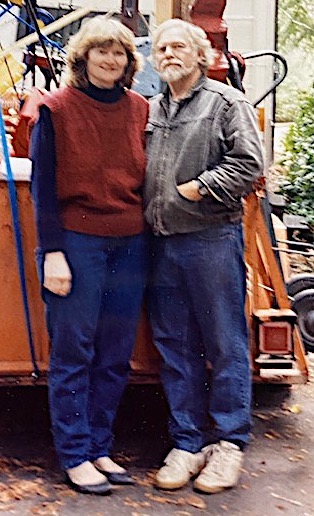
This is the only photo I can find of Bob and me. Taken in our driveway in Boulder Creek, CA
(If you haven’t read Chapter 1, Go HERE.)
Innocents in Mexico
Chapter 2: El Paso, Juarez, Chihuahua
(May, 2001)
As soon as we drove into El Paso, it felt like we were in Mexico. The dirt roads climbing the hills covered with tiers of tin-roofed tiny adobe houses looked like the outskirts of any of the large Mexican towns we had been in in the past––Nogales, Oaxaca, Tijuana.
As we passed through Juarez and into the countryside, the dust devils appeared. Ever since I’d experienced a real tornado twenty-four years ago, I could never witness their smaller brothers with the same delight they aroused in me as a child. Here, they seemed a symbol of the panic and lack of organization which had plagued our day so far. Everything had happened too quickly, and not in the way I’d planned it. Bob plowed through El Paso, passing each place I wanted to stop, saying we’d stop at the next one. He was always in a hurry. To me, this was finally the part of our lives where we could take our time. I wanted to do and see things–– to experience it all. There were no real schedules now that we were out of the States––no friends or relatives waiting to see us, no certain places to reach each night. But for Bob, it was a matter of quotas––getting there in as few days as possible.
What he would do once we got there was probably to try to find a place as soon as possible when I hadn’t even made up my mind whether this was the place where I wanted to be, then worry about not feeling inspired, then sleep, a lot, before finally trying his hand at something. I preferred to travel a bit first, to get my bearings, and to compare places before we made a commitment.
And the cat, Bearcat, who accompanied us? What did he want? We had not intended to bring him. He was a cat who had been born and lived all of his fourteen years in the same remote house in the Redwoods. The menaces he recognized and knew how to deal with were mountain lions, raccoons, coyotes, feral cats, owls. With his talent for survival, he’d outlived his entire clan of mom and two sister cats. He’d been king of his own domain back at home in the redwoods of central California, but now he was out in the real world. Like the man emerging from Plato’s cave, he was seeing the full reality for the first time, and the light was blinding. As we drove, we kept trying to coax him out to view the scenery or at least for a pat and a rub, but he preferred to stay under the air mattress in our van, his green eyes peering down it’s long cave, his red leash sticking out like a guide rope for him to be pulled out by at night. I liked to imagine him as a brave cat, stalking the world, but for the moment, even the scenery rushing by was too much for him. He preferred to stay low, grounded, hidden. He preferred not to know the full measure of this new world he had been so abruptly pushed into.
Our first day in Mexico had been a fiasco. We were through El Paso and to the border before we realized it. We had passed no exchange places or insurance vendors and suddenly we were there––at the border with no pesos, no tourist visas, no car insurance or permit. The official had insisted that we needed to drive 30 more km to the airport to get our visas. What about car insurance, I asked? Yes, yes, insurance too, he promised. So, there we were––driving in Mexico with no car insurance––that one thing warned against by every living in Mexico book, by every guide book, by every friend who had ever traveled there. At the airport, we obtained visas, but were told we’d have to drive 30 more kilometers to get an automobile permit and car insurance.
My heart was in my throat the whole way as Bob sped down roads with no shoulders, past signs warning of cattle in the road, around orange cones that grew like mushrooms down one lane or the other for the entire 30 kilometers. Cars turned left from the right lane, signaled left but turned right, or stopped. I stewed and fretted, which made Bob drive faster. Finally, by promising to make him a sandwich only if he slowed down by 10 mph, I got him to slow down. Until he’d finished the sandwich. Then he sped on. Finally, we saw the Aduana sign that signaled the customs house. There, after a long wait, Bob obtained the car permit and after much haggling, I got a week’s worth of Mexican insurance. We’d try for a better deal in San Miguel. There was, however, no money changer at the Aduana, so we had only the few pesos I’d saved from our last trip to Mexico two years ago in addition to some I’d pilfered from my childhood coin collection. They were not enough to cover even the first toll, but, thankfully, they took our American dollars.
Through each tiny town, we searched for a banco, but it was nearing 7 o’clock when we finally pulled into Chihuahua to search for a money exchange in rush hour traffic. Trying to maneuver through streets which, too narrow for oncoming traffic, still allowed it, Bob scraped the side of our new van on a pole.
When we finally found el centro, only casas de cambio were open, not any banks, and the credit card I’d taken with me when Bob let me off was one I didn’t have a pin number for, so I hadn’t been able to get any pesos. Forty-five minutes later, when he’d finally been able to get back to me through the rush hour traffic, we headed out of town, still peso-less, wondering where we’d find a place to spend the night.
It had been our intention to sleep in the van, both to save money and to guard the art supplies we carried on the roof rack and the tools we carried inside. Bob had taken out all but the two front seats and had built and carpeted a platform in the van so we could put an air mattress for sleeping on top of it and still have cargo space for clothes, tools and books underneath. We had a porta-potty for us and a cat box for Bearcat. In a cooler were meat, cheese and greens for sandwiches, ice to cool drinks, and a few other perishables. This would both keep us on our diets for a few more days and enable Bob to set the speed record he had full intention of setting for time between El Paso and San Miguel. We had not, however, taken into account the possibility that camping areas or even areas suitable for just pulling off the road for the night might not be as readily available in Mexico as they were in the U.S.
It had taken us only one day to firmly slip into our roles of ” Innocents in Mexico!”
. . . .
As before, I would appreciate any comments. Are you still along on the ride with us? Is there anything you are missing? Anything unclear? I’m really not going to duplicate the entire book here, but just seeing if I’m off to the right start. It is perfectly okay to give suggestions and critiques! And thanks for the comments so far…..Judy
Go HERE to read Chapter 3

 lifelessons - a blog by Judy Dykstra-Brown