Ceiba Speciosa–Silk Floss Tree
When I first published pictures of the flowers of this tree, I didn’t know its name, so I identified it as a Mexican Orchid Tree.


 I later published pictures of its thorny trunk. These photos of the trunk are new, as are all of these photos, except for the ones that show flowers, since the tree is no longer blooming. (An explanation of supposed reasons for the thorns is given below in the comments section.)


At first, when the fruit appeared, I thought it must be a breadfruit tree:

but later, when its very large pods started to burst open, revealing huge clumps of what looked like kapok–the material that was once used for packing material and to pad envelopes–I told a friend that it was a kapok tree.
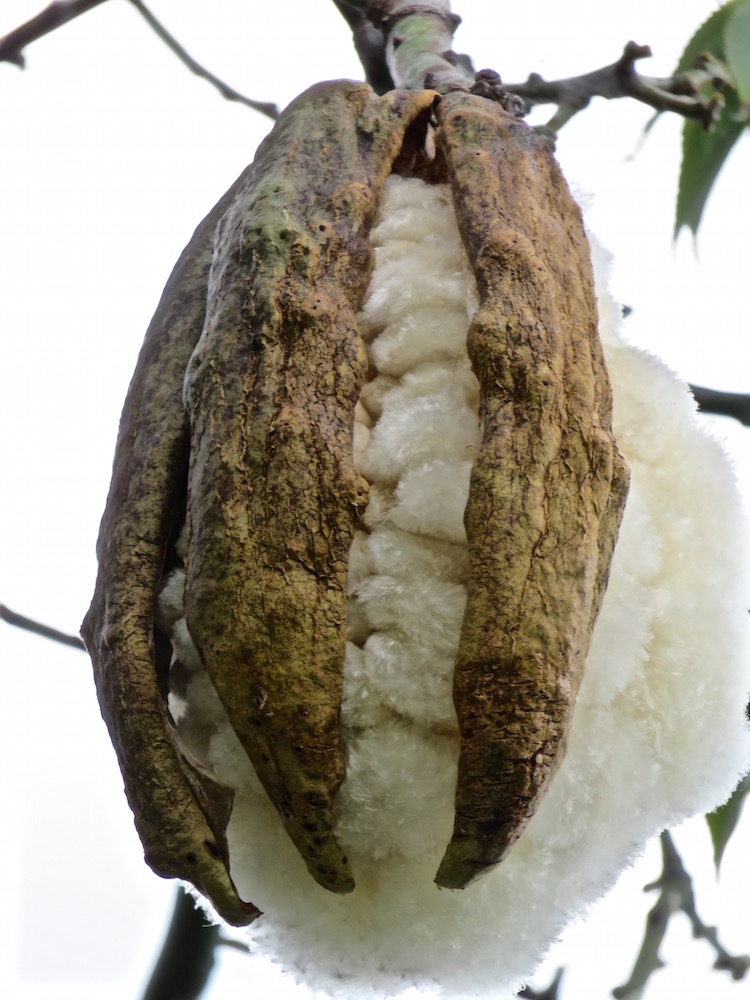
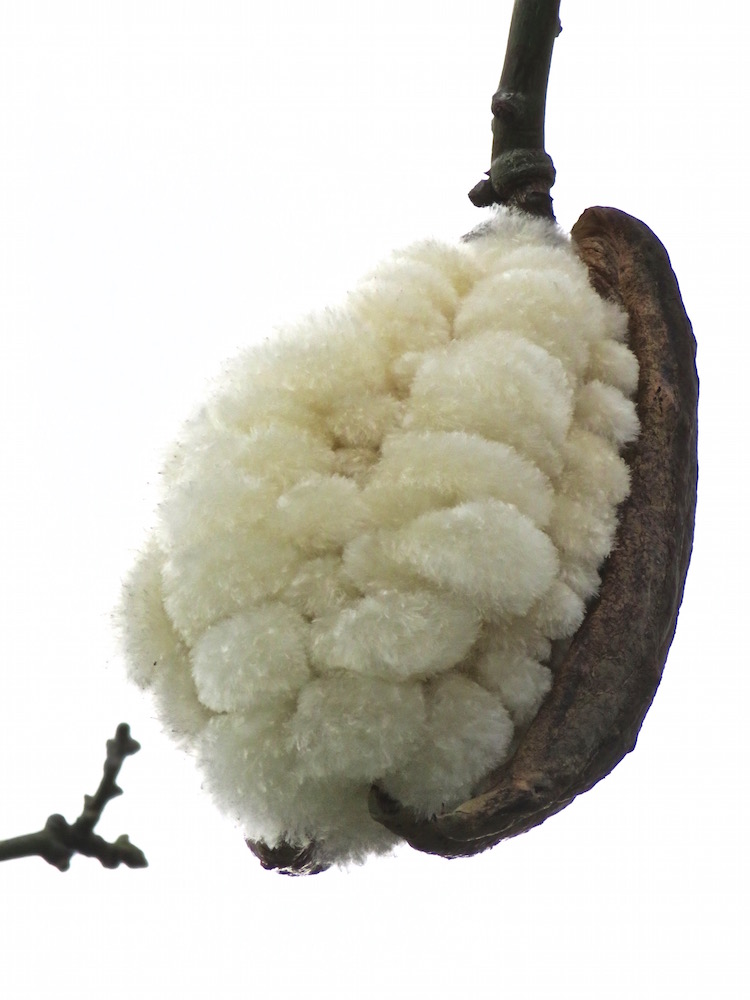
Today for some reason I was reminded that I’d meant to see if this was true and an hour’s research online finally earned me an answer. Although it is not a kapok tree, it is related to it and the stuffing inside the large pods is often used as packing material as well as in the production of canoes, wood pulp and ropes.
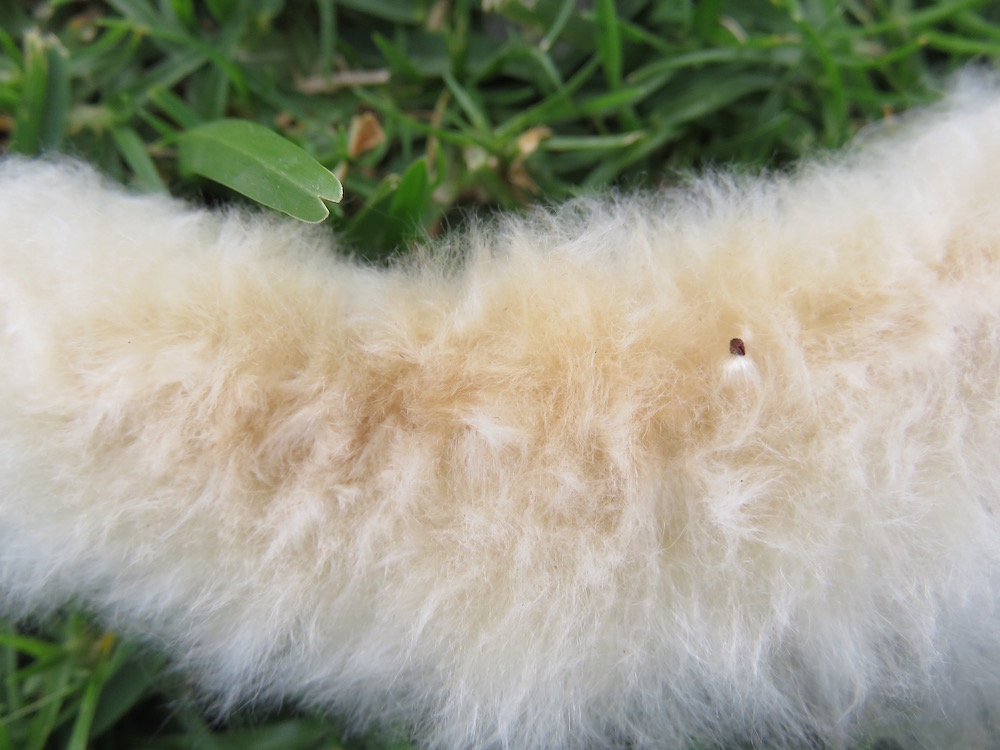
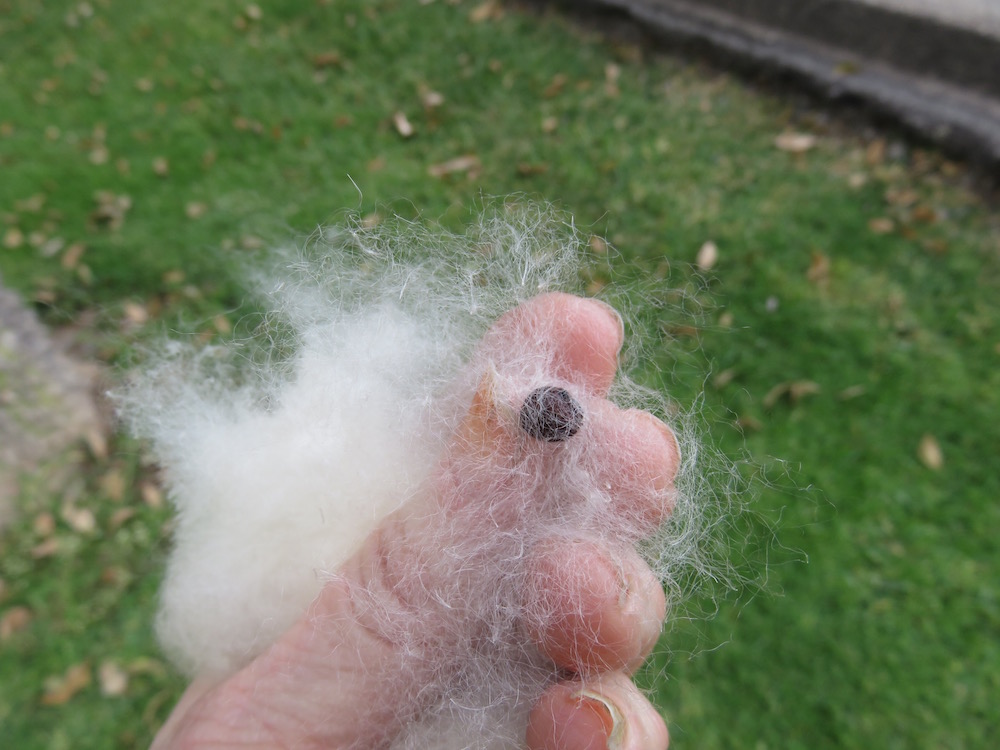
In addition, oil from its seeds may be used for both commercial and cooking purposes.
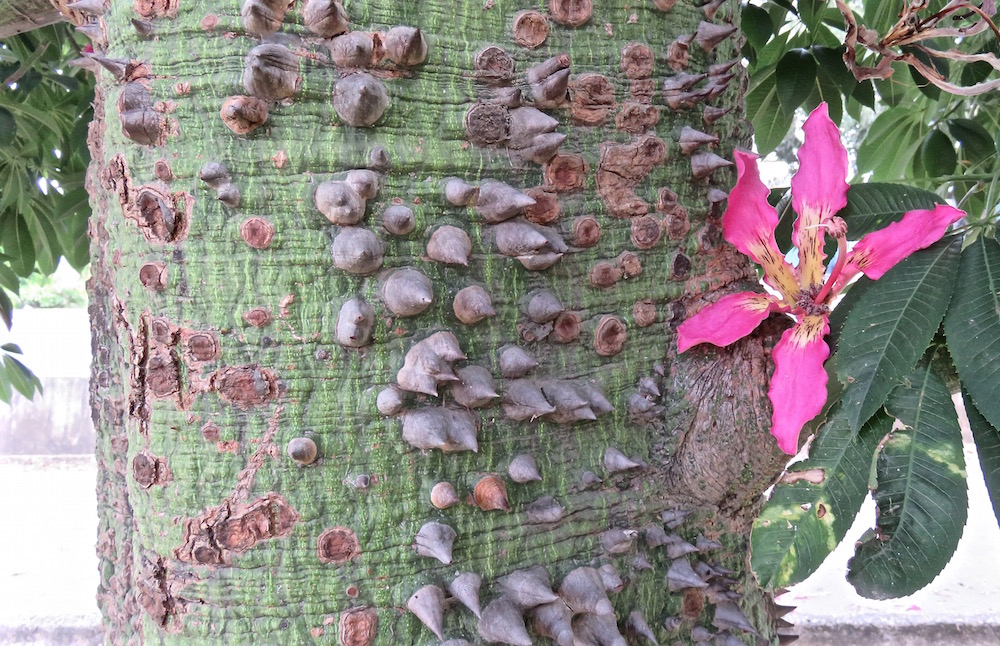
All in all, a most intriguing tree. I was so happy to have identified it that I drove through stop and go bumper-to-bumper weekend traffic to get these additional shots to thrill you all with my new knowledge. You are thrilled, right???
What is the name of this tree and flower???? Ceiba Speciosa–Silk Floss Tree
To pingback your flower picture to the prompt or to see Cee’s or other flowers, go here: http://ceenphotography.com/2016/01/02/flower-of-the-day-january-3-2016-amaryllis-bud-flower-day-8/
 lifelessons - a blog by Judy Dykstra-Brown
Thrilled! Looked like gnarled fingers holding the open pod.
LikeLike
I know. What a difference between the smooth green “fruit” and the gnarled dry pod it turns into.
LikeLiked by 1 person
Makes you wonder why mother nature has designed the tree trunk with such lethal-looking thorns. In nature, everything is about pro-creation, so it must be to protect the seeds.
LikeLike
Some trees were smooth and some thorny but all had pods on them. Must be a male/female thing, but why would they both have pods and flowers? Mysteries of nature.
LikeLike
Jennifer…Why do floss-silk trees have thorns? The usual answer is that, in their native South America, monkeys (and probably other animals as well) found the flower buds and young fruits of these trees quite tasty. The large thorns served to discourage animals from climbing the trees, especially when the trees are young and more vulnerable to damage. Since most monkeys in South America are arboreal with prehensile tails, they would likely not climb the trunks but would swing from neighboring trees to reach the fruit, making the thorns unnecessary. Yet, most structures such as thorns do have some evolutionary purpose. Perhaps, we should merely conclude that the thorns discourage some sort of activity that would be damaging to the trunk and thin bark of these glorious trees.
(Adapted from Ornamental Trees of San Diego, published in 2003 by the San Diego Horticultural Society.)
LikeLiked by 1 person
What an interesting tree. I would love to see its flowers, spikes, pods. I never knew anything like this exited.
LikeLiked by 1 person
I know. There is always a new variety of astonishing flowers or trees. They have probably all been here the whole while I have, but I think we notice different things at different times.
LikeLike
This tree is very common in the South South of Nigeria.
we often use the leaves for making local soup.
LikeLike
How interesting. Every part of the tree seems to be usable.
LikeLike
That is a very, very cool tree. I enjoyed all the pics.
LikeLiked by 1 person
Thanks, Chris…I’ve been looking at these trees for 14 years and just yesterday discovered what they were. Since they look so different at different stages, I don’t think I realized the “orchid” tree was the same one as the “breadfruit” and the “kapok.” Glad to bring them all together.
LikeLike
Yes, I was thrilled. . . . just saying
LikeLike
Tom Robbins, in his book “Fierce Invalids Home From Hot Climates” has his protagonist grumbling about how @#$%%! *vivid* the tropics are. Every time you post these wild, colorful photos, I can’t help but flash onto the word “vivid” and smile.
LikeLiked by 2 people
We’ll keep my presence here a secret from Tom. Don’t want to get on his bad side!
LikeLiked by 1 person
Pingback: Silk Floss Tree | lifelessons – a blog by Judy Dykstra-Brown
I have never seen any tree or anything like it. Strangely amazing!
LikeLiked by 1 person
Wow. That is quite a thorny array on trunk. Love the photos.
LikeLiked by 1 person
I FOR one never seen a tree with thorns and. Yet have such beautiful flowers..thank for showing this …keep up the good work…
LikeLiked by 1 person
There is something satisfying about finally identifying somethings, even years after you first saw it. This summer I got an ID on a plant I saw 35 years ago. Now I can learn more about it.
LikeLiked by 1 person
Hi, Annie. Thanks for your comment. Yes, I do love finding out what a tree or flower or plant is. Easier to do now with the internet. I’m curious about how you found this post as it is 7 years old. It is my second most viewed post in 13 years and I’m wondering how people continue to find it. Can you solve the mystery? Hope to see you again! Judy
LikeLiked by 1 person
I think I was looking at one of your ‘FOTD’ posts and this came up as a ‘related post’ at the end of it. I don’t know how wordpress ‘chooses’ the items to list there. On my own blogs, I often can’t see how they are ‘related’ at all.
LikeLike
Thanks. That’s what I thought probably happened as three other people viewed it on the same day.
LikeLike
Thank you for this post. I spent years thinking a friend had a variety of orchid tree in the yard of her old house. I still recall picking up fluff off the ground and thinking it was the dogs tearing up their beds. Googling orchid tree + spike took me here and now I know the tree’s true name.
LikeLiked by 1 person
I like knowing the names of trees, too. But don’t know your name! It just says “Someone.”
LikeLike
This is so interesting because I just saw one of these trees out toward Padre Island not far from where I live in Corpus Christi TX and I’m thinking possibly seeds from one might have washed up during a hurricane and transplanted itself as I’ve never seen one before – It has yellow flowers but the same green trunk and thorns.
LikeLike
Beautiful. tree.
LikeLike