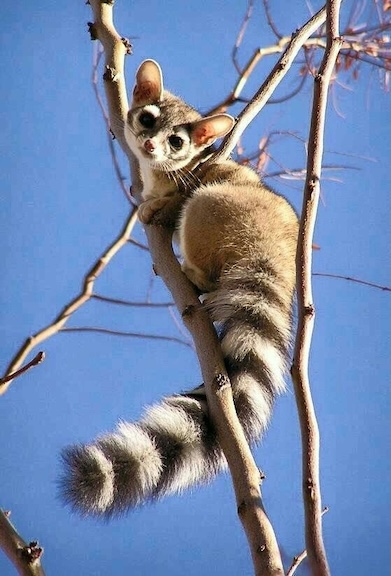
 I figured out what my strange night visitor was. It was a cacomistle!!! This is exactly what it sounded like and if you hear it, you’ll see why i was so mistified!!!! Go HERE to hear it. Isn’t this the oddest animal sound you’ve ever heard? It is also called a Mexican ring-tailed cat, but it is related to a raccoon, not a cat. I found a web discussion from 2018 where a resident of Chapala had seen and photographed a cacomistle in a tree near their home, so I guess they have been seen here, albeit rarely as they are more common to Central America. Fascinating. I hope the one I heard stays safe and high up in the tree away from the dogs. Perhaps it will move on. I’ll continue to put them in for a few nights until I hear no nore midnight clicks and squeals.
To see my original post leading up to this one, go HERE.
But…now a further solution to the mystery. It seems coatimundis make similar sounds. Go HERE to hear them.
Procyonidae – cacomistle, coatis, raccoons, ringtails
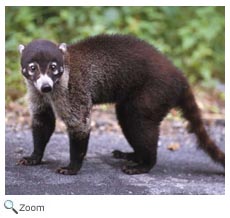 There are 18 species of small to medium-sized species in this family. They are found in North, Central, and South America. They have medium to long tails, brown to gray fur, pointed noses, and rounded or pointed ears. Many species have masked faces and ringed tails. The species in this order are omnivores. They eat a fruit, berries, seeds, small mammals, birds, eggs, fish, insects, reptiles, and amphibians. All of the species in this family can climb trees. Some species are social and live in groups, other species are solitary and live alone.
 lifelessons - a blog by Judy Dykstra-Brown
So cool!
LikeLike
Wow 😮 that’s a new one on me.
LikeLike
Pingback: Life With Dogs | lifelessons – a blog by Judy Dykstra-Brown
Wow, that was very interesting. I think the first one is cuter and would consider its call more distinctive than the other. Its also so adorable, id want one for a pet, lol!
LikeLike
Wow, I’d never heard of that one before. Fascinating!
LikeLike
What a beautiful creature!
LikeLiked by 1 person
Beautiful markings!
LikeLiked by 1 person
Actually, I used to own one of those guys — an inheritance from someone who had “tamed” him, though he was only slightly tame and he never made any noise but a low warning growl and a good deal of hissing.
LikeLiked by 1 person
Now that is an exotic pet. I had a pet raccoon raised from a baby.
LikeLike
I eventually gave him to a small zoo in Connecticut. He wasn’t tame enough to live in a house with people, though he ADORED the cats. It was people he growled at. That was also my end of “exotic pets.”
LikeLike
Ours, too. He went to live with friends on a ranch and eventually returned to the wild.
LikeLike
I was just 18 and didn’t realize how badly we were disrupting nature by adopting “wild” creatures and trying to tame them. Many of them wound of semi-tame or unmanageable. I was glad to find a zoo to keep him. They were also fragile in our human environment and almost any minor ailment would kill them. I wish I’d understood more back then.
LikeLike
Did you go visit him? I never saw Zippy again. I kept wanting to but my folks always had an excuse not to go.
LikeLike
We tried to visit, but he was dead by then. Those animals do not adapt well to human environments. It was depressing because we had hoped the zoo would be able to keep him alive. He lasted less than a year.
LikeLike
Amazing looking and sounding animal. One wonders where it came from
LikeLike
I live just across the street from mountainous terrain so easy for wild animals to stray onto my property..so long as they can dig or climb or fly.
LikeLiked by 1 person
That’s great to have a natural area close by Judy
LikeLiked by 1 person
That is where they come from. Mexico and southward into most of at least the northern part of So. America. They belong there. I’m surprised that a live, untamed one showed up. They are vanishing and have been for more than 20 years. Maybe they are making a comeback?
LikeLiked by 1 person
The world is full of strange creatures
LikeLiked by 1 person
Just amazingly so.
LikeLiked by 1 person
That’s cool. Google to the rescue
LikeLike