Tag Archives: Advice on writing poetry

Let There be Light

Sometimes, to get to that authentic part of ourselves where poetry resides, we have to illuminate some dark corners.
IMG_4662 (1)

Let There Be Light


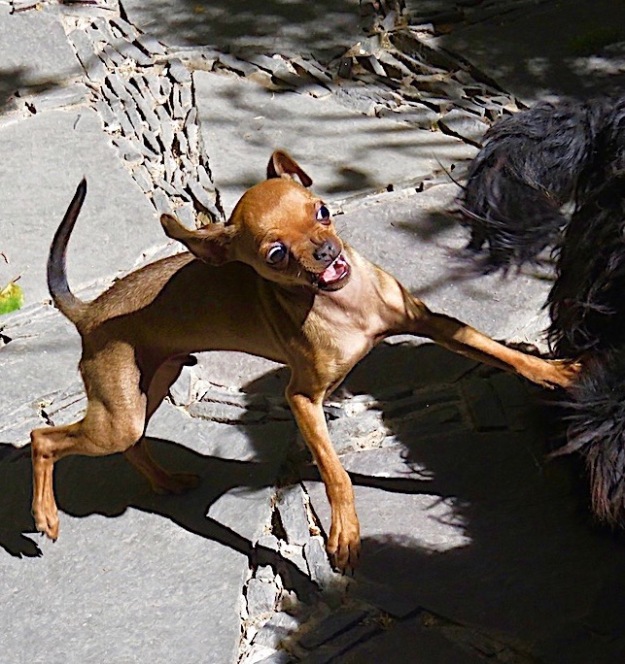
My mind is a growling dog.
While I stew and fuss,
fulfilling lists,
she jumps the screen door,
beckoning.
Rude me, to turn my back
on the only playmate
who wants to play
the same games I do
every day, every hour,
because I fear that initial
plodding through silt
page after page
in search of the stream
of words.

Sometimes boredom
yawns so wide
that I have to enter it,
to wander its inner closet
where for decades
only cobwebs
have stirred.
In some dark corner
where I spank the dog
or search the bedside table drawers
of a lover called out at midnight,
I find the river’s source,
but then
the phone
rings and I’m off
gathering crumbs from a forest path,
leaving lost children
stranded in their own story.

Stray puppies—I collect every one,
wild orange funnel flowers
and guava
washed in an afternoon kitchen
just before the invasion
of five o’clock sunlight.
All of them I carry back
to hidden places
to rub against each other
and ignite
into the language of this place
where life goes in,
plays dress-up,
but emerges
nude,
like poetry.


If you’ve been following me for four years, you’ve seen this one before. The prompt word today was authentic.

This Poem is a Sort of Street

(Click first photo to enlarge, then click on arrows.)

This Poem is a Sort of Street

This poem is a sort of street.
I wonder who I’m going to meet
as I walk down the dust of it––
plod along the “must” of it.
I do not know where I am going.
I follow it while never knowing
what’s around the next blind bend.
I do not know how it will end.

Each line is a new adventure
leading to acclaim or censure.
The GPS that’s guiding me––
determining what I will see––
is lodged so deep and far inside
a road stretched out so long and wide
that it must guide or I’ll get lost
in ruts of words and pay the cost

of trying to control by mind––
a street that’s meant to twist and wind
guided by a force within
that is intuitive and yin.
It is a guide that’s mostly lost
in this world so tempest-tossed.
The drop of it that I infuse
in rhymes that others then may choose

to read and ponder is the way
that I have chosen to try to pay
the toll for this tremendous gift
of life where I have learned too well
the lessons of the school bell.
I’ve learned to turn a deaf ear to
what pedants say I need to do
and take each day a road that’s new.

I’m led by dreams and intuition
down streets with no thought of fruition
but instead careen and ramble
without an outline or preamble
into places I’d never go
if I just reported what I know.
Then I record all that I see
so you can learn along with me.


https://dailypost.wordpress.com/prompts/street/

Mutability

IMG_1775 (1)

Mutability

Farthingale and flour glue,
catamaran and kangaroo,
lamplit lizard, croquet pie,
tyrant’s glare and jam on rye––
there is nothing I can do
when words come marching two-by-two
but grab a pen to herd them in,
then quiet down their awful din
by separating them with commas.
Sitting here in my pajamas,
I refuse to start my day
in any other sort of way
than stacking words into neat piles,
sorting them by usage styles.

Verbs in rows where they might jostle
nouns like cupcake and apostle.
Adjectives like proud and pretty
aggravating, stuffy, petty––
have to line up in a row
and go where I tell them to go!
Sometimes I feel it is absurd,
how I imprison every word,
take it from its family
to serve me here on bended knee.
Do my bidding, tell my tale,
imprisoned here in each poem’s jail
’til other writers come along
to use that word in book or song.

Then once more the word’s set free
to go where it wants to be.
We pass each word—a bouncing ball––
to be exchanged between us all.
The words that Ogden Nash has used?
The very ones that I’ve abused.
Walt Whitman owned not one word more
than the pile in my store
of wordy possibilities,
to use however I may please.
I gather words from here and there––
words stark and silly, profound, bare.
The order that I put them in,
how often they appear and when
is the power I execute––
the sword I wield, the horn I toot.

I crack the whip and words line up.
“Naughty” shoulders “new” and “pup.”
“Sand” drifts over “bird” and “sea”
as words flow in to be with me.
New words invade my memory,
augmenting “seen” with what I see,
so old stories change a bit
accordingly, as I see fit.
History is made and changed,
altered, prettified, deranged
by new words slipping in to alter
facts where memory might falter.
The gore of war is changed to glory
as time steps in to tell the story.

The power of words might then be seen
to coat facts with nostalgia’s sheen.
A simple word like “maybe” might
distill the impact and the plight
of those whose suffering and pain
should be remembered as a stain
on the world’s humanity.
“May have been” should never be
confused with “was” in history.
Those of us who bandy letters,
using words to joust with betters
sometimes with hilarity,
need also heed their verity.
For words I fear are spoken in vain
if truth is altered to entertain.

The Prompt: Not Lemonade. When life gives you lemons… make something else. Tell us about a time you used an object or resolved a tricky situation in an unorthodox way.

https://dailypost.wordpress.com/prompts/not-lemonade/

If A Poem Could Speak for Itself: NaPoWriMo Day 15 and “Mentor Me” WordPress Prompt

DSCF9509

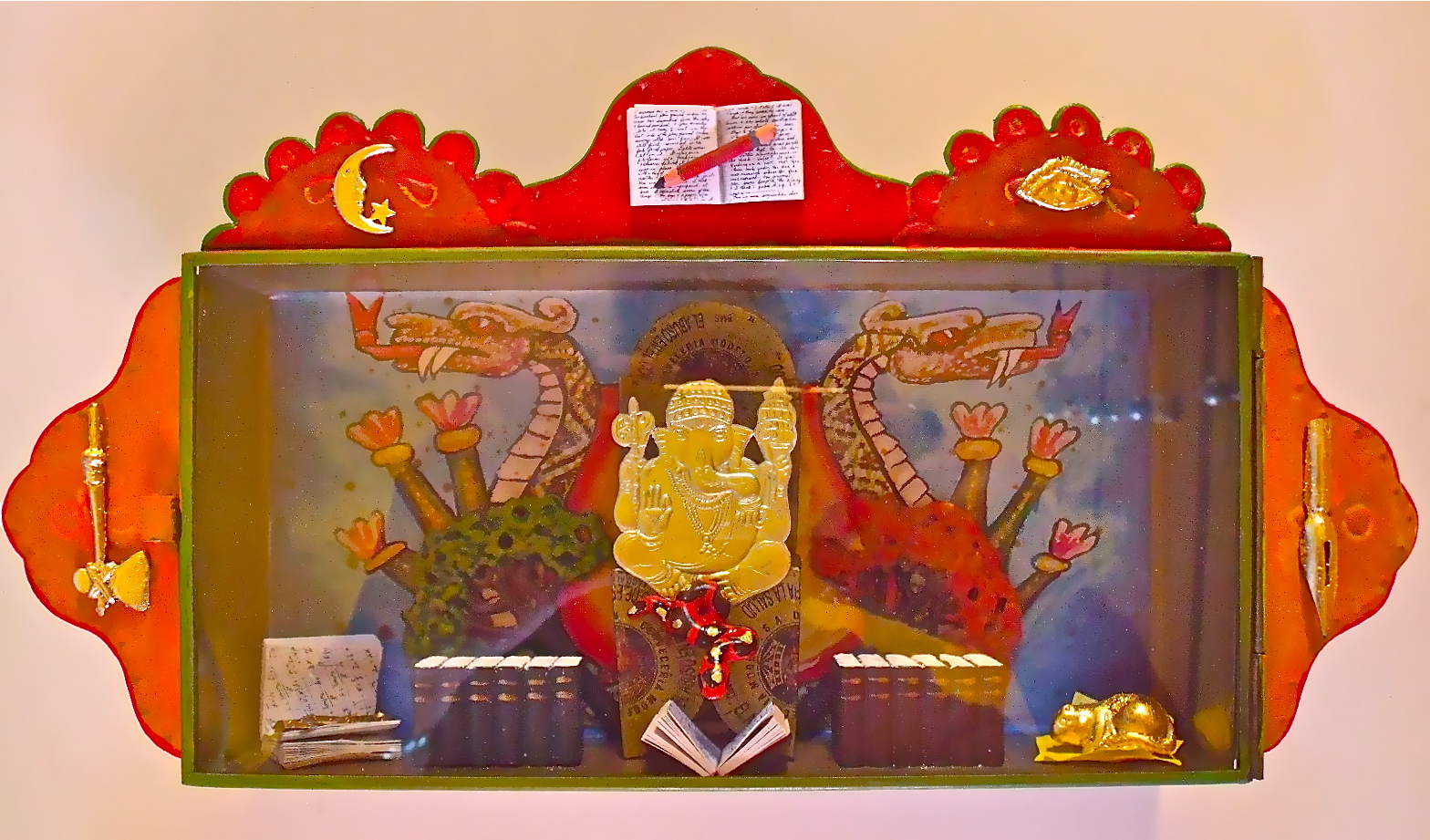
“Ganesha” by Judy Dykstra-Brown, 11″ X 5″ Ganesha is the Hindu god who watches over writers and intellectuals and makes things go smoothly in life–something we could all use a bit of. The open books all contain real stories and poems or mathematical formulas.

The WordPress and NaPoWriMo prompts worked well together today. The Prompt from one was to write a poem that addresses itself or some aspect of its self, and the other prompt was to write on the subject of mentoring, so this poem fulfills both prompts.

If a Poem Could Speak for Itself

In me, your thoughts are broken into lines—
the cadences as vital as breathing.
At my best, June never rhymes with moon
and if there are flowers, they are never roses.
Peonies, perhaps or ranunculi.
No daisies, ever, and no bluebirds or honey wine.

Being in love is as common as work boots
or stilettos with one heel broken off.
Hearts in good poetry do not ache, pine, yearn or pound.
They are not worn on the sleeve but remain
inside. Alone. Running the same maze
hearts everywhere run every day.

What makes a good poem?
Avoiding tired words and familiar phrases.
Rhyme, if you use it,
must be impeccable.
Words should follow their natural order
and not be inverted just to force a rhyme.
And remember that just because it rhymes
doesn’t mean it is poetry.
Never take the easy way out.
Never settle.

Use one-tenth of the words
that it is your impulse to use.
No pretty language, flashy language, trite language
or language plagiarized from Valentines
or song lyrics  or others of my ilk.

And most of all, remember that
the thing you are really talking about
is rarely mentioned.
Do not over-explain.
Let me have my mysteries,
and have faith in your reader
to try to solve them.

https://dailypost.wordpress.com/dp_prompt/mentor-me/