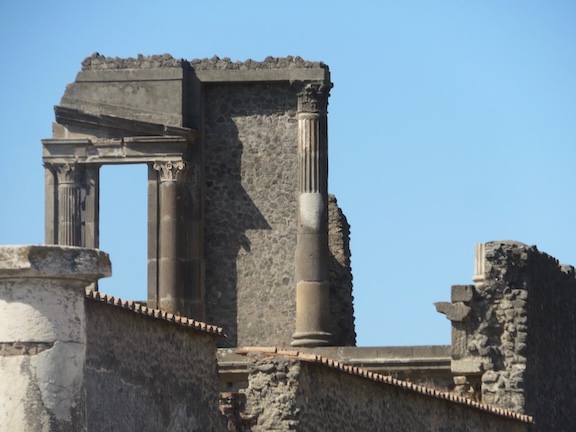
Yesterday was hot and filled with a lot of walking, but as you can see from these shots of the ancient city of Pompeii, well worth it.
Here is a description of the destruction of Pompeii. Strangely enough, there was no lava flow. This is what caused the destruction:
The last days (of Pompeii) began on Aug. 24, 79 AD, the day after the Roman holiday of Volcanalia, dedicated to the god of fire. At noon Mount Vesuvius roared to life, spewing ash hundreds of feet into the air for 18 hours straight. The choking ash rained down on the cities in the surrounding countryside, filling courtyards, blocking doors, and collapsing roofs. In the only known eyewitness account to the eruption, Pliny the Younger reported on his uncle’s ill-fated foray into the thick of the ash from Misenum, on the north end of the bay:
… the buildings were now shaking with violent shocks, and seemed to be swaying to and fro as if they were torn from their foundations. Outside, on the other hand, there was the danger of failing pumice stones, even though these were light and porous; however, after comparing the risks they chose the latter. In my uncle’s case one reason outweighed the other, but for the others it was a choice of fears. As a protection against falling objects they put pillows on their heads tied down with cloths.
The next morning the cone of the volcano collapsed, triggering a hundred-mile-an-hour avalanche of mud and ash that flooded Pompeii, just a little over 5 miles away, destroying everything in its path. Pompeii and its smaller neighboring village of Herculaneum disappeared, and were only discovered by accident during the construction of Charles of Bourbon’s palace in 1738. Miraculously, the two cities were nearly perfectly preserved under layers of ash.
(Below are some of the photos I took yesterday. Click on first photo to enlarge all. There are a lot of photos, so If any photo is a bit fuzzy, please give it a few seconds to focus.)

Pompeii forum with Vesuvius in the background.

Remains of paint and plaster that once covered all of the walls

Streets

remains of painted plaster.

The remains of intricate patterns carvedand painted into the plaster.

Reliefs carved onto the walls of the bath house.

Locker spaces in the baths

Underflooring of the baths.

Vesuvius looming over the city she destroyed.

Cast remains of an unfortunate victim of the hot ash of Vesuvius.

Mt. Vesuvius


 lifelessons - a blog by Judy Dykstra-Brown