“Regret for the things we did can be tempered by time;
It is regret for the things we did not do that is inconsolable”
––Sydney J. Harris
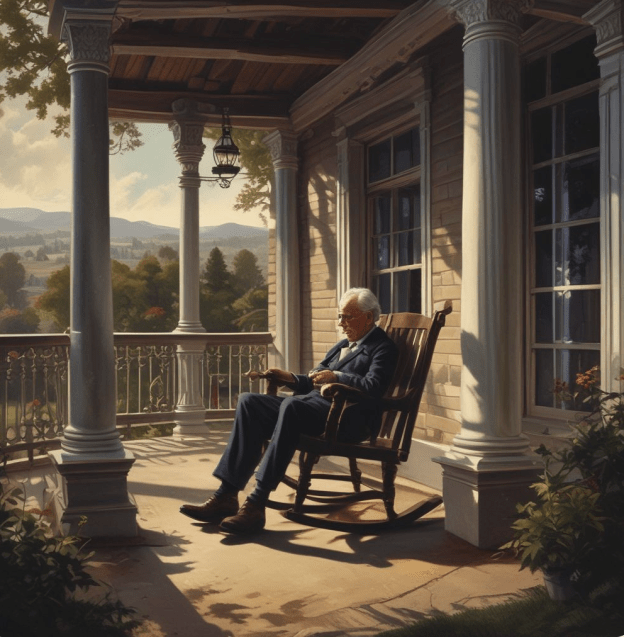
He Sits
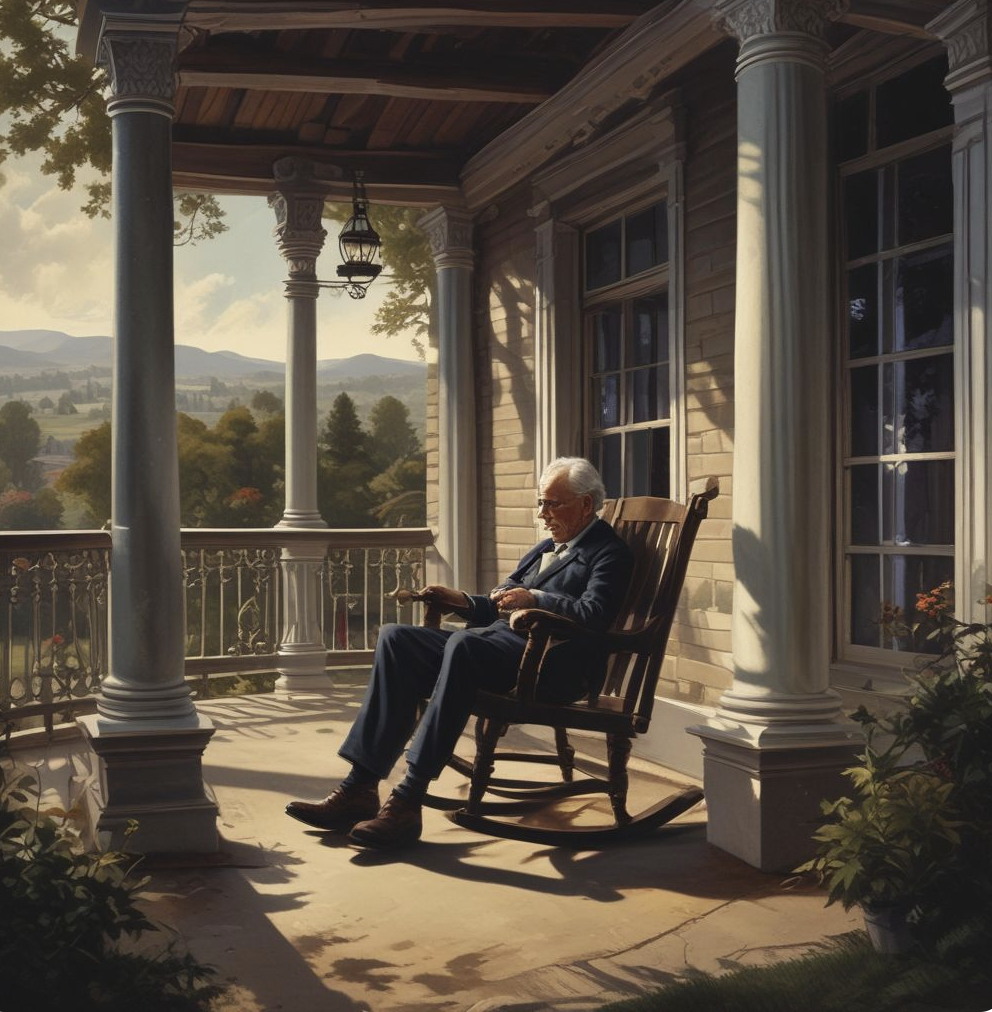
He sits, nearly invisible, in shadowed recesses
of his mansion’s broad front porch, picking at the tresses
of a well-worn antique doll, its dress once rich, now tattered,
its fine-textured porcelain now age-checkered and shattered.
Watch how his rumpled holiness now shifts his ancient bones
to shuffle off to wander through his mansion’s inner zones.
To trail his amber fingernails over collected treasures,
weeping over memories of his rich life’s past pleasures.
Up a spiral staircase, down its upper hall,
measuring his footsteps, careful not to fall,
the skin of memory remains to guide him on this path
toward that inner sanctum that’s become its aftermath.
Passing long-unopened chambers, he cracks open a door
to see a trail of building blocks scattered across the floor.
A blackboard with last lessons chalked across its slate––
a question and an answer whose two sides don’t equate.
Seeds of contrition start to sprout in his guilt-plowed brain.
If a past could be repurchased, he would do it all again
differently, replacing all his hard-won treasures
with time spent more rewardingly in familial pleasures.
Prompt words for The Sunday Whirl are: amber rumpled holiness skin ancient bones invisible weep chambers three seeds spiral Image by AI (I will not do this often.)
If you are wondering about the quote I used to introduce my poem, here is a brief biography of Sydney J. Harris from Wikipedia:
Sydney Justin Harris was born in London, but his family moved to the United States when he was five years old. Harris grew up in Chicago, where he spent the rest of his life. He attended high school with Saul Bellow, who was his lifelong friend. In 1934, at age 17, Harris began his newspaper career with the Chicago Herald and Examiner. He became a drama critic (1941) and a columnist for the Chicago Daily News (1944). He held those positions until the paper’s demise in 1978 and continued to write his column for its sister paper, the Chicago Sun-Times, until his death in 1986.[3]
Harris’s politics were considered liberal and his work landed him on the master list of Nixon political opponents. He spoke in favor of women’s rights and civil rights.[4] His last column was an essay against capital punishment.[5]
Harris often used aphorisms in his writings, such as this excerpt from Pieces of Eight (1982): “Superior people are only those who let it be discovered by others; the need to make it evident forfeits the very virtue they aspire to.”[6] And this from Clearing the Ground (1986): “Terrorism is what we call the violence of the weak, and we condemn it; war is what we call the violence of the strong, and we glorify it.”[7]
He was also a drama critic, teacher, and lecturer, and he received numerous honorary doctorates during his career, including from Villa Maria College, Shimer College, and Lenoir Rhyne College.[8] In 1980–1982 he was the visiting scholar at Lenoir-Rhyne College in North Carolina. For many years he was a member of the Usage Panel of the American Heritage Dictionary. He was recognized with awards from organizations including the American Civil Liberties Union, the National Conference of Christians and Jews, and the Chicago Newspaper Guild. In later years, he divided his time between Chicago and Door County, Wisconsin. Harris was married twice, and fathered five children. He died at age 69 of complications following heart bypass surgery.[9]

 lifelessons - a blog by Judy Dykstra-Brown