Tag Archives: wheat harvest

Wheat

(To get a larger view of photos and to read captions, please click on first photo and arrows. To get back to read the essay, click on X at upper left of photo screen.)

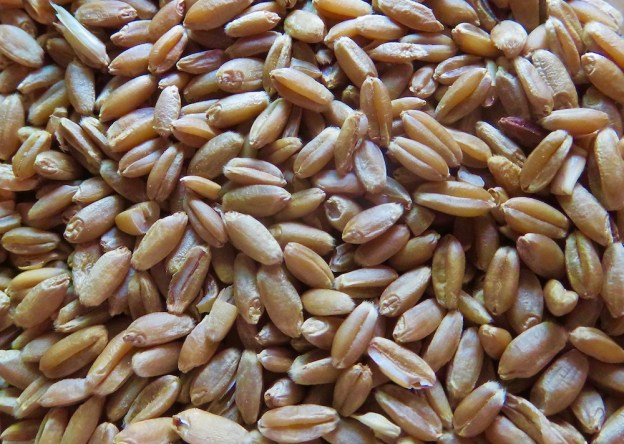
Wheat

A stalk of it usually extended from between his teeth when he was out inspecting a field come June or July. It collected in his pants cuffs and in the hat band of his broad-brimmed work hat.  Bags of it wintered in a huge pile that filled our garage one year when there had been a good crop and all the barns and silos were full to bursting. The cars stood outside in the gravel driveway just off the alley and behind the garage that winter and our house was strangely empty of mice as they took shelter in the garage instead. Our outside cat grew fat even though he rarely came to the back door to be fed.

Ours was a little ecological system all its own.  Mice feasted on  grain spilled from burst seams in the garage. The cat feasted on the mice and we feasted on the steaks of Black Angus cattle who had eaten the ensilage from wheat stripped of its grains.

If I have always worked hard to furnish the bread and butter of my life, it is wheat that has furnished the dessert–my college education, my first car and, after my dad died and I inherited 1/6 interest in the farm and ranch, my first house.

Our lives were run by wheat and cattle.  During the summer, no time for family vacations. Wheat and cattle were my dad’s alarm clock. He rose before sunrise every morning and was often asleep in his chair before sunset, wheat spilling out of his pants cuffs or high top boots or stuck by the hooked spines of its beards to the fabric footstool in front of his rocker.

He slept hard, my father, and rose early to insure everything worked to the cycle of the nature that had surrounded him from the time, as a three-year-old boy, he had stepped off the Union Pacific train that had brought him and his mother to the little South Dakota town both he and later I grew up in. As they descended the metal steps, my grandmother had held one hand down to grasp the hand of my three-year-old father. The other was extended upward, holding a cage with two canaries. My grandfather and teenaged aunts were there to greet him and my grandmother, who, even though she had been the one who decreed that they should leave their safe security in Iowa to claim a homestead on the Dakota prairie,  had not traveled by wagon, but instead had sent her young girls and husband on ahead to prepare a way for her and her youngest.

My grandfather––a Dutch immigrant who was not a farmer, but rather a baker better suited for working with wheat in its miled state––did what most people did when my grandmother issued demands.  He complied.  It made for a hard life for them all–fighting the harsh South Dakota winters out on the plains as well as prairie fires, plagues of grasshoppers and schizophrenic weather that could furnish either drought, unseasonal rain or hail–all of which could ruin a wheat crop. So that later, when I asked my dad why he never frequented the games parlor where the other men played poker and lofted a beer or two, he said that he had no need for games of chance. His whole life as a rancher and farmer had been the biggest gamble of all.

My grandparents never did learn the correct formula, but my father, surrounded by the prairie from age three to seventy, learned its secrets well. Enough to buy out his parents as well as others who tried and failed. Enough to ensure the comfort of his wife and children and his grandchildren. Enough to die at what, now that I am nearly  69,  seems like the young age of 70.

Year after year, as he tilled the rich South Dakota soil to plant the grains of wheat he’d saved to seed a new crop––he seeded my life as well, along with that of my mother, my sisters, my nieces and nephews–all of our lives growing and prospering from those millions of shafts of grain that he planted and watched over and harvested and stored and replanted over a period  of fifty years.

The WordPress prompt today was “Grain.”
The Combiners (Entire Poem)

At Irene’s request, I am publishing the poem that I published the ending to yesterday in its entirety today.  Audrey and Betty–you may not want to read this one!

Combine (1)

The Combiners

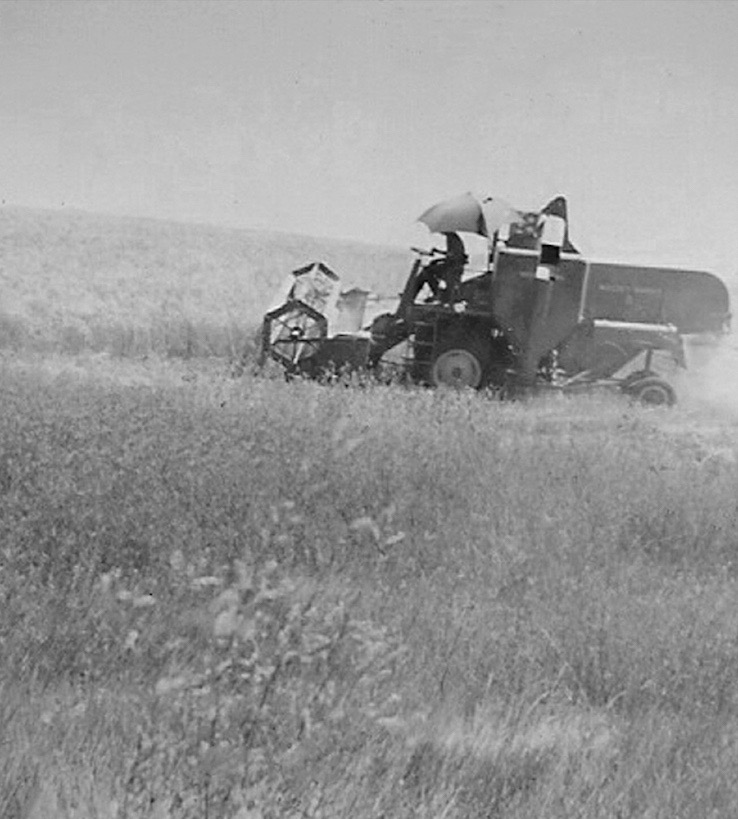
They used to roll in mile-long parades
down the two-lane highway that led to our town–
big trucks carrying bigger combines,
like mothers still carrying their much-too-large sons.

Once we followed a string of twenty combines
for fifty miles—
Passing them all an impossibility,
as much for their sheer numbers
as for the almost constant tourist traffic
in the oncoming lane.
When the caravan pulled off the road at last,
sixty cars squealed by, accelerating.
From opened windows, fists were raised,
and not in solidarity.

They ringed the football field,
parking far out against the fence
like floats after a homecoming parade.
In an inner ring, camping trailers, cars and pickups
With license plates from Kansas or from Oklahoma,
drew into a not-much-smaller circle,
like wagons protecting themselves
from a too-easy invasion of natives.

The next morning, the combines
and most of the cars and trucks
pulled out,
leaving the trailers like war brides behind them
as men and machines moved out to the land
to bring in the harvest
before the hail or rain hit.

These machine monsters
Were not the air-conditioned luxury cruisers
of today, but the dusty, scratched, hot,
wheat chaff-blanketed, insect-filled,
open-to-the-one-hundred-degree air
combines of the fifties.

Each summer in July,
when these droves of men and boys
came northwest
from Kansas and Oklahoma,
we were told by our mothers to
stay away from the school football field
for the weeks of the harvest,
to stay away from the boys
in the downtown cafes
and the movie theaters
and the weekend dances.
Especially, to stay away from boys
in pickups or in cars
with out-of-state license plates
as they “U’d” main on Saturday night.
To stay away from their soft southern drawling voices
and their sun-baked work-hardened hands
and the tanned sinews of their arms.
Away from their breath
and their eyes,
their slow smiles
and their syrup voices.

These same boys we came to know
as shy farm boys
or college students
earning tuition with a summer job,
were dangerous in the minds of our mothers,
who either remembered
magnetic strangers of their own
or knew the dangers in the way of small towns:
by watching the lives of others.

Our fathers’ memories
of teenage yearnings
or present urges, fulfilled or unfulfilled,
swelled their minds with possibilities as well;
but fathers didn’t talk to daughters about such things.
The mothers were their buffers and their adjutants,
and so the fathers watched and mothers warned
the day the combiners came to town, plague or gift,
to camp in their Airstreams in the high school football field.

What better gift could be brought to a teenaged girl
In a prairie town of 700 people?
It was a treeless, riverless, lakeless town
sixty miles from nowhere.
A town where most of the boys went home
right after football practice
or basketball practice
or track.
Where on weekends they shot rats at the city dump.
Where in the summers, they worked
on their dads’ farms
And barely came to town at all.
A town where my particular age group of boys–
five of them in a class of fifteen–
were all late bloomers when it came to girls
and who even when they did bloom in their senior year,
didn’t date us,
but dated, instead,
freshman girls who made them feel secure.
What better gift, then, could be brought to us
than Oklahoma boys, soft-speaking, tanned and dangerous?

There were three restaurants in our town–
two for locals, one
for tourists and special occasions–
And in all three,
the majority of waitresses
were high school girls.
It was here that we came to know their
soft-drawl voices as they ordered,
sly-shy smiles when we filled their tea glasses,
the bump of their tanned knuckles against our wrists
as they took the ketchup bottle.
Here, our mothers could not insulate us from
the clean smell of their after-work showers
and the scent of wheat chaff lingering under it,
their tanned arms and their tanned faces,
their foreignness and their taboo charm.

The dances in Vivian, 40 miles away,
started at 10, when the shows let out,
and ended at 1:30.
There were kids from all the high schools
for 60 miles around.
The drinking dads of some of my school friends went there,
and college kids,
guys from Pierre–the biggest town we knew–
as well as from Presho and Kennebec and Chamberlain.
These dances in the town gym were famous.
Only sodapop or coffee were sold at the concession stand,
but drinking went on in cars
and in the bar down the street,
before, during and after.

The summer I was sixteen,
sneaking a smoke in the parking lot before the dance,
we noticed the pickups with the out-of-state license plates.
This was a first for us–
an extension of the neutral ground of restaurants.
Later, inside, we saw them dancing with the Vivian girls.
Each of us felt like we owned a particular combiner
that we’d noticed on the street or,
more likely, in some cafe,
so that their dancing with Vivian girls
seemed to us an infidelity
that we might or might not forgive them for.

I saw him first on the bleachers
on the other side of the floor.
As dancers came together and parted,
I saw him and then didn’t see him.
After the music stopped, I craned my neck
around the legs that stood in front of me,
trying to see him across the cleared dance floor.

Then the voice at the top of the legs
asked me to dance, and I looked up–at him.
Feeling uncertain, wicked and wild,
I answered yes.

I’d served him once or twice
at Restaurant 16–
that highway-fronting restaurant
as exotic as its name.
I knew he was working the Weston place
with an outfit my dad had never used.
He liked his steak well-done,
French dressing, no tomatoes.
Butterscotch sundaes made him cough.
Over the water pitcher and order pad,
we had traded a look or two.
I knew he wore Old Spice
and drank Cokes with breakfast,
but I didn’t know his name.

When we got to the dance floor,
he took my hand,
put his other hand on my damp waist.
It was a slow dance and the night was hot.
The dance was work.
I was awkward–too inhibited to get as intimate
as following in dancing requires.
Over the music, we tried to shout our names,
tried to find a mutual rhythm,
finally giving up both endeavors
to dance the slow song, untouching,
moving our arms in fast song 60’s style
to the slow song rhythms.

When the music stopped,
he walked me back again
to the bleacher
he had plucked me from,
reinserted me into the correct space in the line of girls,
smiled, and walked away.

My friends closed around me
like a sensitive plant
to hear the news.
I watched his back,
blue short-sleeved shirt,
his pressed Levis
and his cowboy boots.
I watched the Oklahoma swing of his hips–
danger on the hoof.
He wouldn’t ask me to dance again,
yet, his sun-blackened arms,so finely muscled,
had held me for a minute or two.
His bleached blue eyes
had seen something of worth in me.
He had asked my name, touched my waist,
and walked me off the dance floor.
And, since this was as spicy
as any of our stories would likely be
all summer long,
I turned to my friends to tell the tale.

I definitely think this suits today’s prompt:  https://dailypost.wordpress.com/dp_prompt/take-a-chance-on-me/