Tag Archives: White Owl

White Owl (Sijo for NaPoWriMo 2021, Day 20)

White Owl

All these years I ‘ve done without your heavy breath and gentle touch.
My mind turned to other things. Sounds in the night, the call of birds.
But it’s time. The owl asks “Who? Who?” Leaves me to find the answer.


The NaPoWriMo prompt is to write a sijo.

The sijo (Korean 시조, pronounced SHEE-jo) is a traditional three-line Korean poetic form typically exploring cosmological, metaphysical, or pastoral themes. Organized both technically and thematically by line and syllable count, sijo are expected to be phrasal and lyrical, as they are first and foremost meant to be songs.

Sijo are written in three lines, each averaging 14-16 syllables for a total of 44-46 syllables. Each line is written in four groups of syllables that should be clearly differentiated from the other groups, yet still flow together as a single line. The first line is usually written in a 3-4-4-4 grouping pattern and states the theme of the poem, where a situation is generally introduced.The second line is usually written in a 3-4-4-4 pattern (similar to the first) and is an elaboration of the first line’s theme or situation (development).The third line is divided into two sections. The first section, the counter-theme, is grouped as 3-5, while the second part, considered the conclusion of the poem, is written as 4-3. The counter-theme is called the ‘twist,’ which is usually a surprise in meaning, sound, or other device.

The sijo may tell a story (as the ballad does), examine an idea (as the sonnet does), or express an emotion (as the lyric does). Whatever the purpose may be, the structure is the same: line 1 of the 3-line pattern introduces a situation or problem; line 2 develops or “turns” the idea in a different direction; and line 3 provides climax and closure. Think of the traditional 3-part structure of a narrative (conflict, complication, climax) or the 3-part division of the sonnet, and you’ll see the same thing happening.
 

White Owl

White Owl

In the plaza,
or lifting over the hot pool at midnight,
the white owl carries a message.
Life or death?
Joy or pain?
Perhaps the white owl knows.

Its dropped feather,
on pavement or the surface of water,
may be a hint of what’s to come.

Once I flew,
a white owl
frozen in place in the winter air.
Once I roasted, too warmly dressed,
more accustomed to fir tree than palm.

The white owl
may know its place or may not.

We are the ones
who bring him here,
out of his climate,
off his familiar branch.

Who?
Who has brought him?
What, what is the message?

I Heard the Owl Call Your Name: Serendipity Photo Prompt Chai (Life)

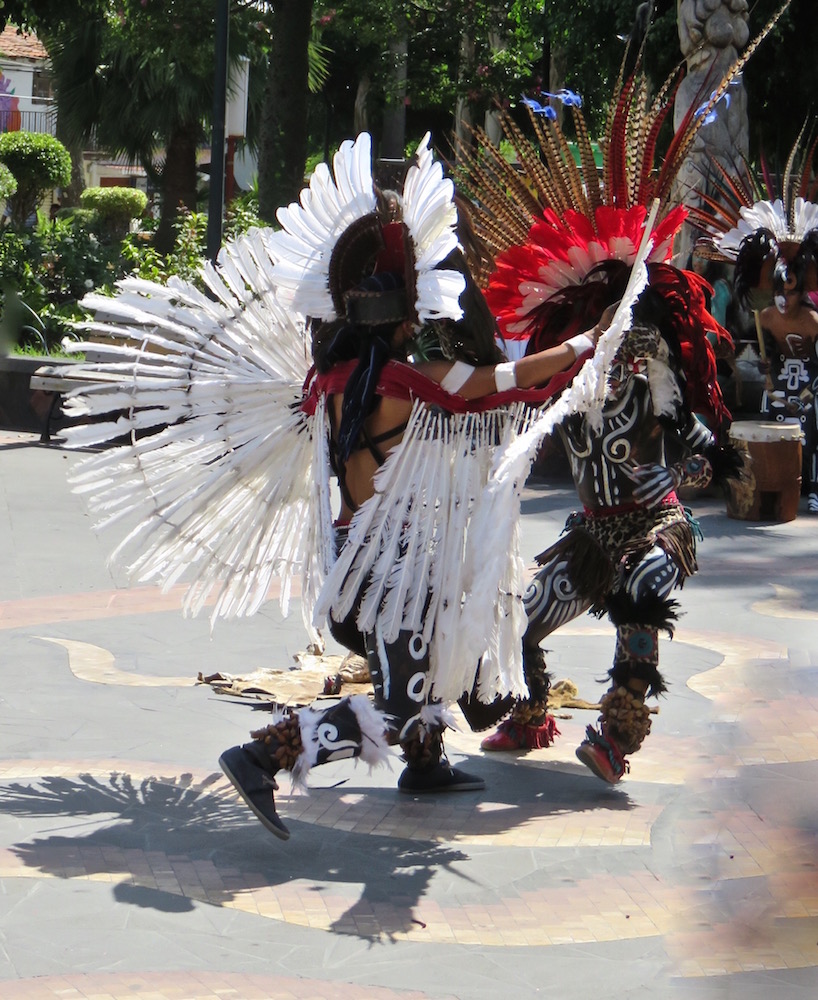
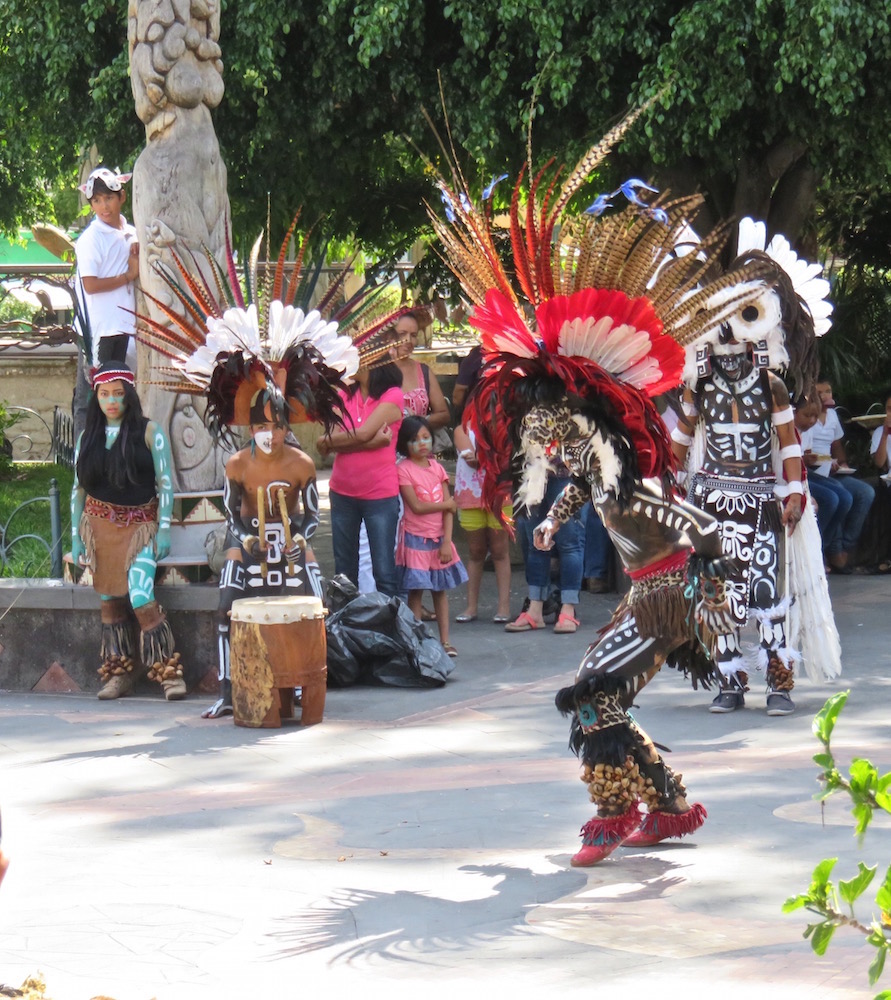
Looking through my photos to try to find something appropriate for the Chai (Life) prompt, and yet also thinking I wanted to find something for Nan, I came upon these pictures of Aztec dancers who were dancing in the Ajiic plaza right outside the cultural center where we had the dance performance for the second Camp Estrella group.  At the end of their performance, I heard the loud drumming and went out to find what I judged to be a thunderbird dance.  Certainly, this dancer looked like a thunderbird.  Growing up in South Dakota, I was very familiar with this Sioux symbol of thunder and lightning and rain, but I was a bit confused about why they would be executing a North American indigenous dance.

IMG_3134

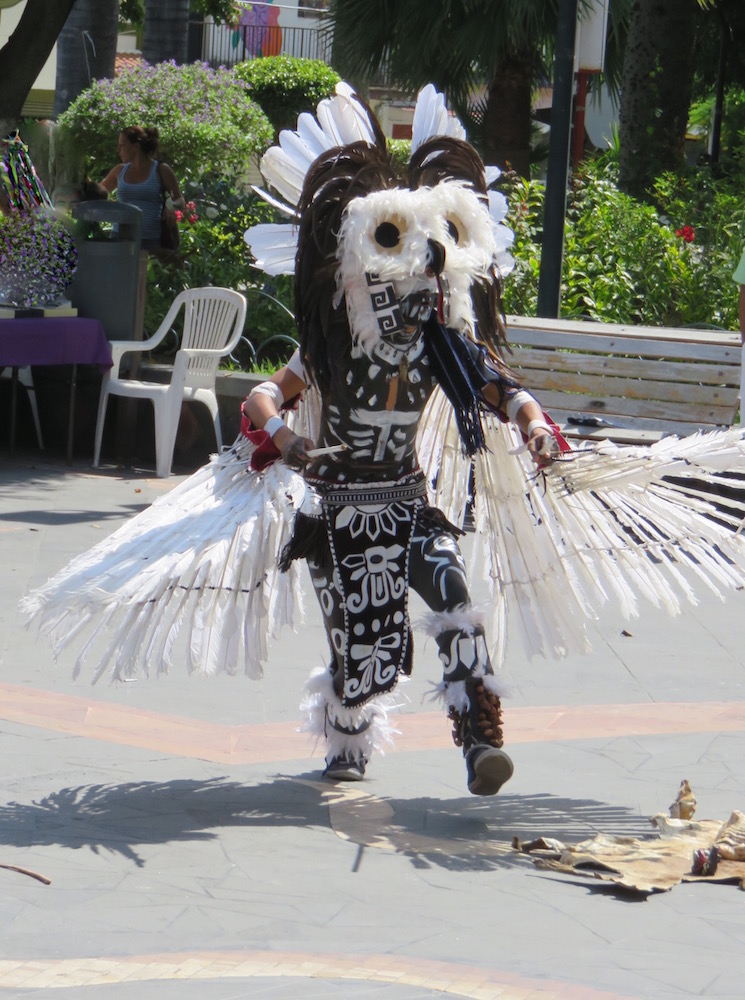
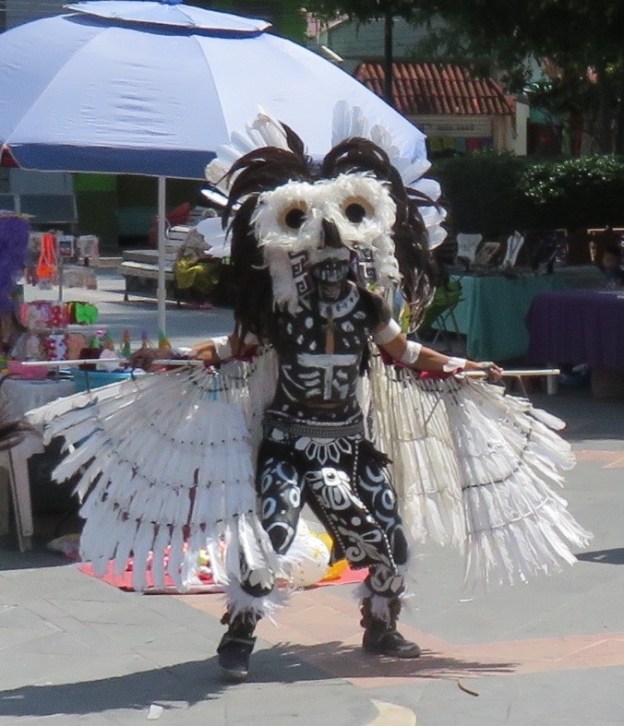
It was only later, while editing, that I realized that it was not in fact a thunderbird, but rather a white owl, which can be seen very clearly from this front view.

IMG_3133

I then remembered how I was kept awake last night by the very loud hooting of an owl, which reminded me of the white owl who had swooped down over my yard on three different occasions the last time my friend Patty visited me.  She had seen it twice at night and was afraid I wouldn’t believe her until finally, one night, he appeared while I was outside as well. Then, the entire theme finally came together for me.  Legend has it that when you hear an owl call, someone near to you will be leaving this plane.

IMG_3151

I also love it that in the above picture, one of our camp participants is standing above the dancers in his own mask, made in the camp.  It is on top of his head.

And so Marilyn and Garry, here for you is the white owl that called Nan’s name. I hope you soon find peace in remembering what a wonderful life you shared with each other and in remembering what the owl teaches us: that death is just a part of life and that without it there could in fact be no life. Somehow the only way we ever seem to be able to try to comfort each other is in stating the obvious.

http://teepee12.com/2015/08/12/serendipity-photo-prompt-2015-18-chai-081215/