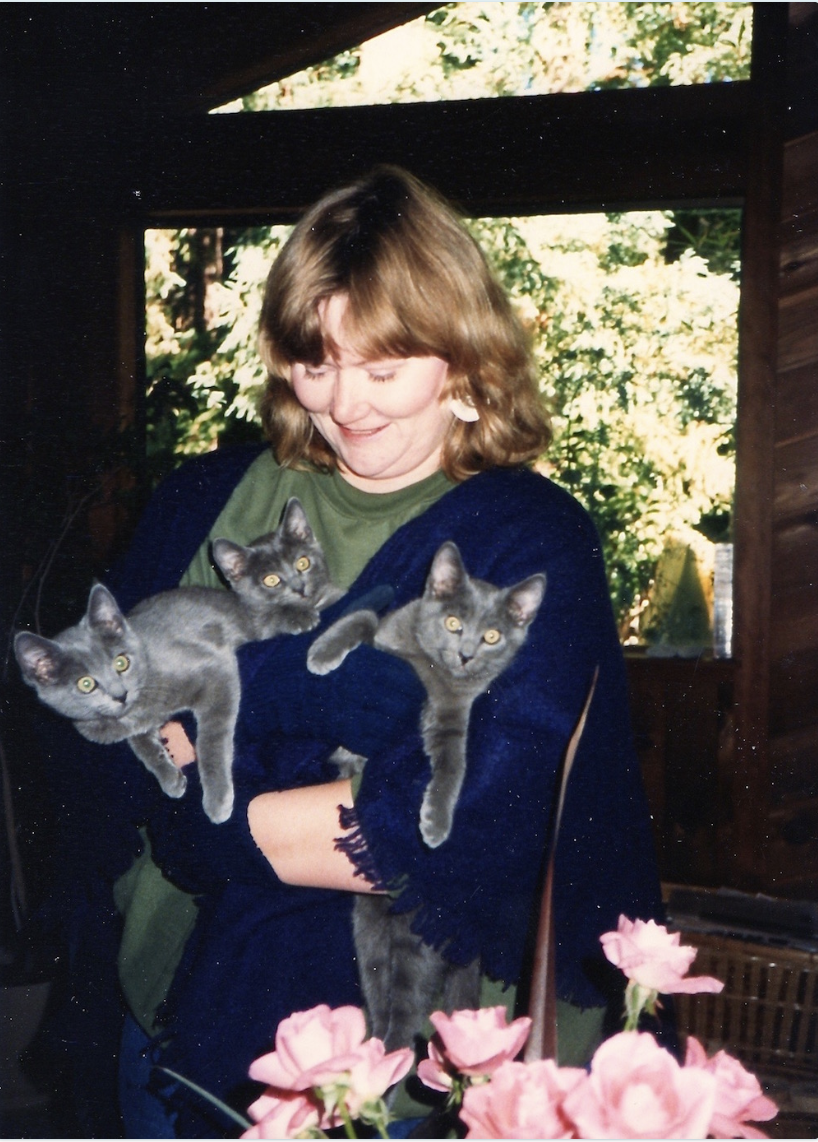
Kissy Cat and the Wicker Stepmother
Once there was a house built up on stilts on the side of a mountain covered with redwood trees. There were so many redwood trees that squirrels used them like freeways, running along their long branches to jump from tree to tree. There were so many redwood trees, that when the deck for the house was built, they just built it around the redwood trees, so that three large trunks rose right through the deck. There were so many trees that no other houses could be seen from the house–just forest and sky and the mountains across the valley.
In the forest lived racoons and possums and deer. In the forest there were squirrels and blue jays. And also in the forest, there lived an unusual cat with long legs and a tail that was crooked into the shape of a “y”. Although her face and body shape were those of a Siamese cat, she was gray all over: coat , whiskers, nose. There was not a color on the cat that was not a shade of gray except for the eyes, which were chartreuse with a black inner lid. In the city, she would have been an alley cat, but here in the redwoods she was a wild cat who wanted the company of people but didn’t know it yet.
For years, this cat had given wide berth to the house because she knew that a fierce and loud dog lived there. From her hiding places in the woods, she could hear him growling and barking from the end of his very long chain. Like the deer and the racoons, she moved in a large circle around the house, never entering the domain of the dog. Then one day weeks before, she had stopped hearing the dog. Since then, she had watched the house, moving closer each day, still expecting the dog to lunge out at her if she moved too close, but for many days she had seen no sign of him.
Slowly, day by day, she moved closer to the house. Still, no dog appeared. Until finally, she could curl on the deck in the sun or sharpen her claws on the redwoods rising through the deck with no fear of a snarling, barking surprise.
The first time she saw the human unpacking boxes in the house the dog had left, she maiouwed like a high-pitched dial tone until the woman slid open the door and followed her a little way into the bushes. When she got to the hill, the woman stopped following.
On her second day in the house in the forest, the woman was working in the garden when she saw a flash of gray streaking between two trees. A short time later, she saw the cat sitting on the garden bench. When she approached, it darted away. But an hour later it was again sitting on the bench.
The cat was very thin. The woman fed her canned tuna for three days in a row and on the fourth day fed her potted shrimp so rich the cat had to come back twice to finish it. First, she had gently lapped up the thin salted liquid around the shrimp. Then she ate the shrimp one by one, very slowly––not because she didn’t like them as much as the tuna or because she wasn’t as hungry as before, but because she carefully examined each shrimp before eating it as though it were a new animal.
By the end of the first week, the cat had moved into the house. She was a muscular cat who stood on her hind legs and bucked her body up for a rub. She was a talkative cat who maiouwed frequently in a conversational manner. At night she sang.
Now, although only the woman lived in the house when the cat first decided to join her, she had a husband working in a city far away whom she missed very much. One day soon he would join her, but for now she was alone. And so by the time the husband came to live in the forest, the cat was sleeping at the foot of the bed at night, or curled up on the chest of the woman. The husband would shake the cat off when it lay on top of him; but the cat could count on remaining upon the woman, who had named the cat “Kissy Cat” because of her soft and fragrant fur, which invited burrowing and kissing.
Now, although the woman had no children of her own, when she married her husband she had acquired three stepchildren. She told them that they were called stepchildren because they were like stair steps–eight, seven and four. When they moved to the house in the forest, the children didn’t move with them, for they were living with their mother, but they would come visit on all the school vacations, for weeks at a time, and it was during one of these visits that the youngest child gave her her name. He was trying to kid her, but instead of calling her his “Wicked Stepmother,” he had called her his “Wicker Stepmother.” Since she loved baskets and wicker furniture, the house was full of both. And so the name stuck. And that is how she came to be called “The Wicker Stepmother.”
The husband of the Wicker Stepmother was called Bertie. All day long he worked in his garage studio carving wood. All day long his wife worked in her basement studio making jewelry. Kissy Cat didn’t like the sawdust or the loud machines in the garage, but she liked the warmth and quietness of the basement, where she spent most of her days curled up between the Wicker Stepmother’s back and the back of her chair. When the woman insisted on settling further into the chair, she would hop out and go to sleep in the corner, under the rod that held their spare clothes. And so a month passed.
One day the Wicker Stepmother and Bertie were eating lunch on the patio. It was mid-June and the sun was bright, the air was warm. Kissy Cat came up the stairs which led downstairs to the studio. When she jumped onto the chair between them, the Wicker Stepmother noticed that she was getting heavy. A few weeks later, they were both watching the cat, who now spent most of her time indoors. “I’ve figured it out,” said the Wicker Stepmother. “That cat isn’t just getting fat. She is going to have kittens!”
A few days later, the Wicker Stepmother entered her studio to find Kissy Cat on her chair. “You are going to be a Mama soon,”she said to the gray cat, “and you need a cozy place in which to have your kittens.” She ran up the stairs and returned with an armload of clean towels. These she formed into a nest on the floor under the hanging clothes. Just as she had gathered Kissy Cat into her arms, Bertie came clumping down the outside stairs and slid the sliding glass door open. And so he heard her tell Kissy Cat that this was the place she had made for her to have her kittens. And he had seen her take Kissy Cat over to show her the nest.
“That cat is not going to have her kittens in a place you pick out for her!” said Bertie, laughing. “She’s going to have them in my sock drawer–or more likely in a place hidden away where you’ll never see them until they’re weeks old.”
“Well, we’ll see,” said the Wicker Stepmother. Kissy Cat got up from the warm nest, stretched, and then sauntered out the open door.
As the days grew warmer, the cat grew eccentric. Once they found her curled up on the top shelf of the bookcase–up near the ceiling where it seemed impossible for her to climb. Once they found her asleep in the abandoned rabbit hutch on the trail near the garden. Another day they found her rolled up like a very large sock in Bertie’s sock drawer. In spite of the heat of July, she sought warm places–the trunk where they stored blankets–the sleeping loft made sauna-like by the sun beating on the roof above it. Once, when the Wicker Stepmother was taking clothes from the dryer and left to answer the phone, she returned to find the cat curled contentedly among the still-warm clothes in the dryer.
It was weeks later and they were again eating lunch on the deck when Kissy Cat came up the steps. “Miaouw, miaouw,miaoooouw,” crooned the cat, in a loud and insistent voice.
“Are you hungry?” asked the Wicker Stepmother, pouring cat food in her bowl. But Kissy Cat ignored the food.
“Miaooooouw,” repeated the cat, in a yet louder voice.
“Do you need water?” asked the Wicker Stepmother, pouring water in a bowl. But Kissy Cat ignored the water.
“Are you ready to have your kittens?” said the Wicker Stepmother.
“Miaoooooouw,” confided Kissy Cat, and when the Wicker Stepmother opened the sliding glass doors, the cat ran past her. Her gray coat a blur, she ran across the living room and into the hall. She ran past the bookcase and the door to the bedroom and the sock drawer. She ran past the blanket trunk and the ladder to the loft. She ran down the basement stairs, past the cat door that led out to the garden and the rabbit hutch, into the studio, and directly to the nest the Wicker Stepmother had prepared for her.
“Well I’ll be,” said Bertie, arriving downstairs a minute after the cat and the Wicker Stepmother.
During the next hour, Kissy Cat gave birth to three tiny gray kittens who looked just like her. Except, their eyes were closed, their fur was matted and wet, and each had a different tail. One was crooked like her mother’s, but crooked in the opposite direction. The other had a zigzag tail–like a road with many sharp corner turns or a chain with lots of kinks in it. And the third had a tail that was very long and very straight, with no kinks at all.
The whole time that Kissy Cat was giving birth, she insisted that the Wicker Stepmother stay right by her side. When she tried to leave to go get a drink of water, Kissy Cat tried to follow her–so Bertie had to go get the drink and bring it down to her. Not that the Wicker Stepmother wanted to miss a moment of the births, for she had never seen anything being born before,and she thought it was a wonderful miracle.
After the kittens were born, the Wicker Stepmother lay on the floor near them for three hours––watching the mother cat lick them dry,watching the kittens find the teats for their first drinks of milk,watching them wriggle and writhe over each other.
For a week, if she wasn’t working in her studio, she still went to their nest to see them at least once every hour. She carried food and water down to the mother cat so she wouldn’t have to leave her kittens, and when the mother cat left them and went outside via the cat door, the Wicker Stepmother went over to the nest and watched over the kittens until she returned.
When the kittens’ eyes opened, they became more vocal and more active. Now they would venture a short distance away from the nest. Now the Wicker Stepmother could hold and caress the kittens without the mother cat becoming distressed. Soon they were becoming so adventurous that the Wicker Stepmother decided to take them all upstairs. Very carefully, she carried them one at a time to a nest she’d prepared in the living room. As she was carrying up the last kitten, she met the mother cat on the stairs, carrying one of the kittens down again. Soon,the mother cat had seized each of the kittens by the ruff of its neck and carried it back down to its birth nest.
The next day, the Wicker Stepmother again tried to carry the kittens upstairs. With the same results.
On the third day, when the Wicker Stepmother went down to try to move the kittens upstairs, she discovered them all missing. She looked for them in the laundry room. In the hall. She looked in Bertie’s sock drawer. She looked behind the sofa. She looked in the lofts. But nowhere were the kittens to be found. With Bertie, she looked in the studios. She looked behind the television. She looked in all the closets. But nowhere were the kittens to be found.
Finally, she decided to go work in the garden. Grabbing her rake and her trowel, she descended the three flights of wooden stairs to the garden, far below. As her foot hit the landing that separated the porch steps and the last short flight of stairs down to the garden, she heard a small squeak. Then she heard another small squeak. They sounded like tiny high-pitched miaous. Getting down on her knees, she peeked through the boards beneath the porch. And there she saw the three wriggling shapes of the tiny kittens. In the background were Kissy Cat’s beautiful chartreuse eyes, shining out from the darkness.
“Okay, you win,” said the Wicker Stepmother. “You are the mother. You are the boss.” And she left them alone for the rest of the day.
The next morning, the Wicker Stepmother woke early and went out to peep beneath the porch for the kittens. But the space was empty. “Okay, you need your privacy,” she thought. And she climbed the stairs to the back of the house, entered her bedroom and put on her work clothes. She would have some breakfast and then work hard all day on a new jewelry order. But first, she would have some breakfast.
Pulling on her shoes, she left the bedroom and headed for the kitchen. But on the way to the kitchen, she found a big surprise, for as she entered the room that contained living room, dining room and kitchen all in one large space, she could see the mother cat sitting on her haunches staring out the dining room sliding glass doors. Outside was a huge gray stray cat with very long bushy hair. And, as she drew nearer, she could see between them, lined up in perfect order along the inside of the glass–the three kittens. When the large gray cat outside saw her, it ran quickly away. Then Kissy Cat turned and calmly walked away.
“So you brought them up to see their Poppa, did you?” said the Wicker Stepmother.
“Miaouuuw,” purred the mother cat contentedly, moving over to turn on her side to allow her kittens to nurse.
And from that day onward, the kittens roved throughout the living room and kitchen and t.v. room. They continued their explorations into the bedrooms and soon were large enough to crawl up and down the stairs on their own.
In the years to come, Kissy Cat and the kittens and the Wicker Stepmother would have many adventures. And never again did Kissy Cat hide them away.
Judy’s note: I just found this story tucked away in a corner of my computer. Bob’s youngest son, Dylan, really did call me his “Wicker Stepmother,” a pretty cute joke for a little boy. The details of this story are all true, although the names have been changed to protect the guilty. The wild cat I call Kissy Cat in the story did slowly move in with me in our “new” house in the redwoods of the San Lorenzo Valley while Bob was still completing the school year teaching in Canyon Country, 300 miles away. He came on weekends, but during the week, Kissy Cat and I made do. All the other details happened as described.
I am wondering if the story could make a children’s book, as-is, or if it is too adult-oriented. I’d appreciate your views on the matter.
As a further note, the mother cat I named Kiddo disappeared again shortly after the kittens were weaned and I never saw her again. Perhaps the neighborhood jaguar (really) got her, but I’m hoping she ran away to rejoin the father of the kittens, who was the Russian Blue who visited them from the other side of the sliding glass door that day when the mother finally moved them back into the house.
 lifelessons - a blog by Judy Dykstra-Brown
What a sweet story Judy. I think it’ll make a great story for kids with illustrations.
LikeLiked by 1 person
Hi Judy, I think the basics of this cute story could make a strong children’s book. You might streamline some of the details and possibly reveal more of the remaining aspects through dialogue and/or direct thoughts.
LikeLiked by 1 person
Judy, thanks so much for sharing this wonderful story!
LikeLike
I think this would make a lovely children’s story Judy.
LikeLike
Thanks. I wonder if it isn’t more appropriate to adults, though.
LikeLike
You could always tweak it a bit, but I think most kids would enjoy it.
LikeLike
Thank you for this sweet story, Judy, kittens are the best!❤
LikeLike
And the mom, Kiddo, was just what I needed living in that isolated spot at the end of a mountainous road in the redwoods while waiting for Bob to come each weekend….company!!!
LikeLiked by 1 person
This is a most engaging story which should be published. All the best tales for children are also pleasing to adults. This has fine touches which appeal to children, e.g. the repetition in the cat’s running to lead the Wicker Mother and that lady’s searching. It is also educational (for adults who don’t know cats) and for children (and adults) who don’t know words like “chartreuse”. Your header picture is perfect, but maybe an illustrative artist should provide the pictures.
LikeLiked by 1 person
Thanks, Derrick. I always appreciate your literary advice as I know you have the best taste in reading! Perhaps I will have Isidro illustrate this book.. It’s always fun to see what he comes up with. every book he’s done is so different from the others. I think perhaps Sock Talk is my favorite. We are working on Fish Feet now!
LikeLiked by 1 person
I think it would make a wonderful children’s book.
LikeLiked by 1 person
We are presently working on a different Children’s book but when we finish, I’ll give Isidro this one to begin working on. I’ve divided it into pages. Thanks for the advice.
LikeLiked by 1 person
My pleasure, dear Judy, and good luck!
LikeLike