Category Archives: Prose

Innocents in Mexico: Chapter 6: A Rude Awakening and a Savior


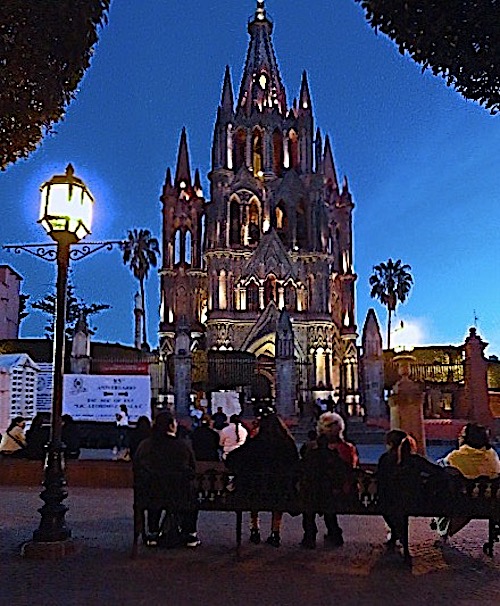
The Parroquia de San Miguel Arcángel

Find Chapter 1 HERE  Chapter 2 HERE   Chapter 3 HERE  Chapter 4 HERE  Chapter 5  HERE.

Chapter 6: A Rude Awakening and a Savior

            The next morning, we were awakened by the tooting of a horn outside our window.  I opened the door and looked out.  Resolutely and with a fine sense of rhythm, a woman was honking her horn for someone in the room next to us.  Undaunted by my stares, she continued to honk.  Bob slept on as I fastened Bearcat’s leash and attempted to take him for a walk.  I had forgotten that walks are a nighttime thing for cats––the later the better.  He resisted and I gave in.  By eleven, we were off to find a bank, a real estate agent and a really good map of San Miguel.  Unfortunately, all of these items proved to be easier to find than was a parking spot.  As we traversed still another circuitous route trying to find a parking space, Bob questioned whether we wanted to rent an apartment here, even for a week or a month.  He cursed the tiny cobblestone streets, the lack of signs.  The jardin area seemed to be all there was to San Miguel, he complained, and there wasn’t much to it.  “Did you like Oaxaca for the first few days we were there?” I asked. “Or Bali?” He admitted that he hadn’t, yet he had ended up wanting to live both places after a week or so of getting to know them.

Bob finally left me off at the tourist office, promising to join me there.  After 15 minutes, when he still hadn’t appeared, I moved off to a bench in the park, where I could sit in the shade while keeping an eye peeled on the door of the tourist agency.  On the bench sat an American woman who shared her experiences of living in both San Miguel and Guanajuato.  Fresh from a three-month course in Spanish, she chatted with the senor who sat down on my right.  Did he live in San Miguel?  Did he prefer it over Guanajuato?  Why?  Because it was warmer in San Miguel.  Because there was more to do.  I was thrilled that I understood most of what they were saying.

Bob joined us, still not too excited to be sitting on a park bench in such a difficult town.  We went to the bank.  Our time to pay for our tourist visas had nearly run out.  The custom at the El Paso crossing seemed to be to go to any bank in Mexico to pay for the visa which was issued by immigration in Juarez.  Since we had never managed to get to any banks while they were open for the three days it took us to drive to San Miguel, it was a pressing need for us to pay the fee and thereby amend our status as illegal aliens.  Unfortunately, when Bob had presented his visa to apply for the car permit at the customshouse south of Juarez, the woman had detached the carbon copy of his visa application and now, without it, the bank could not accept payment.  But the carbon copy was at the customs office south of Juarez, I argued, to no avail.  A Xerox copy would not do.  I paid for my visa, whose papers were intact, and went back to the waiting area where customers waited for the numbers on their pop-out tags to be called, like customers at a bakery or ice cream store.  Bob was deep in conversation with Lisa, a tanned woman who gave him advice on rental houses, classes and the arts community.  As her number was called, we moved to the front of the bank and I told him the bad news.  In front of the bank was another tanned American lady in straw brimmed hat and a stylish tan linen dress.“No,” she said firmly to the small girl who proffered a brightly dressed cloth doll for sale.

Bob and I were trying to figure out the route to Gigante––a huge market situated somewhere off our limited tourist map.  The bank manager had insisted that we must go to immigration and that this was where it was––in an office over Gigante.  A pelting monsoon rain had descended while we were in the bank and we stood under a broad overhang, waiting for it to calm down.  “Do you live in San Miguel?” I asked the stylish lady.  Yes, she did, and yes, she knew the way to Gigante.  To illustrate, she pulled out a vastly superior map to ours, then told us where the biblioteca was where we could purchase both this map and the definitive guide to San Miguel.  Her name was Kim, she was from Alameda, just an hour and a half from our California home, and she now lived in San Miguel.  “Well, here, have my map,” she said, after a few minutes of talking.  When I protested, she insisted.  When I offered to pay, she refused.  It was her gift.  She handed us a card, then moved off into the now abating rain.

At the Biblioteca, we bought books and guides and maps and cards and chatted to the man running the gift shop––another expatriate American who gave advice on apartments, cars (don’t keep them) concerts (go to them) and all of the glories of San Miguel.  Although the library itself was closed, its restaurant had been recommended to us by Kim, and we ate a nice lunch while eavesdropping on the other expatriate Americans who sat at the tables around us.  Small children skipped into the restaurant from the library singing “Happy Birthday to you” in Spanish-inflected English.  Someone shushed them, to no avail, and they ran out giggling loudly.        Outside the door of the restaurant, in the hall to the library, was a pay phone, where I stood trying to figure out the intricacies of a phone with a card slot and four buttons with indecipherable pictographs.  I finally called the number given on the first rental ad on my list.  The woman spoke English but didn’t know if she wanted an artist renting her house, which was immaculate, she said.  Maybe he could paint in the garage.  Would he spill paint on the floor?  A meticulous house sounded as uninviting as the $1,000 rent, so I explained we were perhaps not the right renters for her.  As I hung up the phone and prepared to make my next call, I saw a man sitting very near by with a phone card in his hand.  Was he waiting to make a call?  Yes.  Would he like to go in front of me?  He protested that he could wait, but when I said I was going to make a number of calls, he agreed that he’d like to make just one fast one.

He in fact made one very long call.  I stood shamelessly near, trying to encourage him to hurry, but he chatted on.  He was talking to a man that his friend Richard had told him he must meet.  Yes, he would meet him in the library on Monday.  He had a picture of him, so he would recognize him.  This phone call came to have all the ear markings of a blind date.  After five or ten minutes, he ambled his call to a close and handed over the phone, then stood talking to Bob, as unabashedly listening to my call as I had his.  “Are you looking for a house to rent?” he asked Bob.  He knew of a house, which he seemed to be describing to Bob as I tried out my laughable Spanish on yet another homeowner.

“Are they speaking Spanish?” He asked, as he heard my garbled string of Spanish tape phrases.

“Yes,” I admitted. “Do you speak Spanish?”

He did, and offered to interpret.  I happily handed over the phone.

Toward the end of the phone call, my telephone card ran out and he was cut off.  When I tried to call back with another card, he discouraged me.  “You don’t want to live there,” he said.  “It’s at the end of a very dusty road.  It’s too far from the center.  What you need to do is find a room near the center so you can park your car and answer all the ads in the newspapers for a week to find the right house.“

He told us his name, which was Ernesto.  He told us about the art school where he taught art to poor kids.  He told us about art happenings and poetry happenings and music.  He told us of a different hotel where we should stay and of a house nearby that was coming up to rent.  In the end, he took us himself to the Posada de los Monjes, an historic  hotel that was a converted convent, and translated with the front desk, insisting on the room with the best view.  As we moved through the front of the building through wooden doors hundreds of years old, the full glory of four floors of terraced stone opening onto a cobbled courtyard where we could park our van was revealed.  Broad terraces with crenelated walls jutted out from some of the rooms and wide outside corridors joined them.

We climbed higher and higher until we came to the room chosen for us––a bit small but with a beautiful tiled bathroom with stone shower.  Coming out of the room, we moved out to the private patio bigger than the room.  Below us stretched the entire panorama of San Miguel.  Breathtaking.  The church, the tile roofs, the jagged skyline and yellow hills.  The rooftop gardens and trees jutting up from courtyards.  We were so high that little rose higher above us than our own roof.  We had a 300-degree view and all of it was beautiful.  Never mind the steps.  We could have all of this for barely more than our motel room which was nice and roomy but viewless and near traffic noise.

Do you want to see the room with two beds, asked Ernesto?  It’s bigger, but also $10 more a night.  We’d see it, we said, but the cheaper room would probably do.  I must admit, I dreaded the confinement of the smaller room, but knew we’d probably not spend much time there anyway, and could just spend that time on the most glorious patio on earth.  But, we went to see the room, which was bigger, with its own living room, better views from the room itself, but no patio.  Or at least we thought so until we ascended the stairs outside the room to the patio on top of the room that had even a better view than the room before it––this one a full 360-degrees!

The view was well worth the extra ten dollars a night.  In ten years, we would not miss the money, but we’d never forget the view.  We took the room. We would move in the next day! Ernesto took us to the art institute––not his, but the one near the center.  In the end, he offered Bob a job at his art school.  No salary, but a job just the same.  He could use the facilities free in return for any amount of time he wanted to teach.  Then, meeting a friend he knew on the street, he faded back into the life of San Miguel.  He had made a date with Bob to meet Monday to see about showing us the house that his friend had just built.

The importance of meeting Ernesto?  Bob had gone from wanting to move on to wanting to rent a house in just hours.

“How do you like that?” he said.  “In San Miguel less than 24 hours and I’ve already been offered a job teaching art.”

Right then and there, we went to Mailboxes Etc. and rented a mailbox for three months.  The proprietor of this establishment introduced herself as Annie and she told us the intricacies of sending mail and packages into and out of Mexico.  What to do.  What not to do.  How to send tax papers, magazines, bills, packages.  Another stranger popping up to solve our severest problems.  Like magic.

That night, we peeked into courtyard after courtyard looking for the right restaurant.  Bob, who had formerly hated Mexican food, picked a Mexican restaurant, pronounced his meal delicious  and paid the musician to serenade us with a rendition of “Rancho Grande” that rivaled any Oaxacan version we’d ever heard.

“The thing about San Miguel,” he explained, “is that a good deal of it is hidden.  You don’t see it by casual observation.  You have to look farther,”  That night he stayed up hours later than usual, poring over guide books and maps.  Bearcat curled on my bed as I sat at my laptop.

“Tomorrow you get to go to your new home,” Bob told him.  “You get to go from being an under-bed cat to a roof cat.”

See Chapter 7 HERE.

Innocents in Mexico, Chapter 4: On the Road to Rio Grande

Find Chapter 1 HERE  Chapter 2 HERE   Chapter 3 HERE


Innocents in Mexico

Chapter 4: On the Road to Rio Grande

        The next morning, we were finally on the road after driving back into central Chihuahua to cash dollars for pesos and to gas up and buy ice.  It was easier than yesterday, in rush hour traffic.  A night’s rest later, we were finally visaed, permitted, pesoed, petroled, iced up  and on the road to San Miguel.
        We drove hundreds of kilometers through desert scrub. Men with scarves tied over their hats to shield them from the relentless sun waved orange flags to slow us down as they oiled the other side of the toll road.  It was almost as expensive to drive here as in Europe, with all the frequent tolls.  On the second day of driving, we spent more on tolls than we had on our room the night before.  Now and then I would see some interesting sight I would have loved to have investigated, but Bob preferred to travel fast and  promised trips to the Copper Canyon and other off-road excursions on some future trip.  It had been such an ordeal getting away for this expedition that I decided not to make side trips yet another obstacle keeping us from San Miguel de Allende.  This time, we would do it his way, and perhaps the next time, too, but one day I would see Copper Canyon.
        After being stopped twice by the policia federal, Bob finally believed that he had to slow down in areas where slow speeds were posted.  In both cases, the officers spoke no English and our attempts at Spanish out of a dictionary encouraged them to give up.  The first policia saved face by escorting us back to the toll road he insisted we should take, although I was fairly sure that the camino libre (free road) led to the same place. The second time we were stopped, it was by policemen in two separate police cars going in the opposite direction, who first waved  us down  and then  turned in the road to follow us and wave us over.  Bob told me to get out the bribes which we had been told were the best way to deal with the police in a system where the collecting of the mordida  was taken into account when figuring the salary of policemen,  but in both cases of dealing with la policia  we were too inept to know how to offer them and they eventually gave up gracefully, pointing us once again in the direction of the correct road.  (We have since changed our minds about the offering of mordidas, but at the time we were innocents in Mexico, just following the advice of friends.)
        Hours later, we were on the free road which was two-way, bumpy and under construction. For the past 20 kilometers, we had been driving through deeply-rutted dirt while oncoming traffic maneuvered over a narrow strip of raised but even tarmac.  Sandwiched between 18 wheelers, our van slowed to a speed where I could actually make out the leaf patterns on shrubs and low trees.  I thought I made out manzanita, mimosa and perhaps a variety of pinion.  One delicate poppy-like flower appeared to be cotton. 
            The brilliant red sand on either side of the road drifted in places into small dunes. It was densely covered with rabbit brush and the other trees I thought I’d identified.  In the distance, the sky was dark and I made out three separate funnel clouds, all of which seem to be moving toward us. I watched the funnels uneasily, remembering the last time I saw such a sight.  Eventually, they united and broadened and seemed to break their cord with the higher heavens, but they continued to blow toward us.  At our slow pace, I wondered if they would catch us.  Then another funnel cloud––taller and thinner––formed farther ahead of us and to the right.  I forgot to watch it, concentrating on a more immediate danger as Bob got competitive with the bus trying to pass us and swung out in front of the semi we had been following.  I closed my eyes, then returned to the desert plant guide, knowing that all of the backseat driving comments I’d made earlier had done no more good than this one would have.  When I thought to look back to where the funnel had been, it had dispersed.  We had passed the semi, the bus had passed us, and the blacktop surface had been regained. 
        When we got to the next town, dozens of speed bumps did what neither a nagging wife nor la policia could do, and Bob proceeded on for a while at the correct speed limit through town, in search of a casa de cambio. Gas and tolls had eaten up the entire $150 I had cashed into pesos that morning.  It may have been cheap to retire in Mexico, but it sure wasn’t cheap to drive there!
        Here and there along our route, huge factories or assembly plants lined the road, finished or in stages of completion––Wrangler, Coca-Cola, car plants.  Now and then a huge modern sculpture dwarfed us, but we didn’t stop to read the inscription.  Next to these gigantic modern buildings were the near ruins of lines of conjoined adobe motel-like dwellings.  Then, across the street, were lines of similar dwellings, but brand new and two-storied in a faux Tyrolean half-timbered style most bizarre in this setting.
        KFC, Burger King and Dairy Queen competed with but did not in any way outnumber the burrito and tamale carts which stood beside the road.  In one small town, men in white shirts stood in the road and flagged us down, then motioned us over.  We noticed before actually leaving the road that they were trying to lure us into a lot filled with cart vendors.  We were hurrying to try to cash dollars for pesos, and we drove on without sampling their wares.          
        This deep into Mexico, I could no longer remember what I expected it to be like. It was surprising to me that not once in over 1,000 miles did we pass any car with North Americans in it.  Nor did we encounter any Americans or other foreigners in any of the towns we passed through.  Few people spoke English, even in banks, but in spite of this, no one looked upon us as an oddity.  We just were.  Like the funnel clouds and the circling white plastic bag in the middle of the street, we passed through but affected them little.  This was exactly the way I wanted it to be, now that I thought about it.  It was what I was looking for––some place that was purely itself, different from what I knew.  I longed again to be a stranger and to have the unexpected around every corner. 
        The terrain in the northwestern region I found to be not so different from the Mohave:  rabbit brush, mesquite, willows, cholla, prickly pear and willow trees.  But unlike the litter-conscious United States and because the dumps tended to be located near the main road, here there was lots of refuse outside every town.  As we drew near each dumping ground, thousands of plastic bags snagged on every fence, shrub and stone, littering the desert like some exotic flower display. Everywhere, huge chunks of concrete lay piled alongside the road––destroyed buildings or landfill––who knew?
        Frequent signs warned of livestock in the roads; and occasionally, livestock actually did appear there, as if to validate the signs.  As we drove farther south, there were fewer signs but more livestock on the roads––even the broadest and fanciest toll road between Aguascalientes and Leon.  On this road, for the first time, the four-lane divided highways came complete with median boundaries, curbs, gutters, shoulders, and a woman who hurried to herd her goats off the left-hand lane of the road as semis, cars and pickups whizzed by. 
        Our last toll having wiped us out of pesos, We drove into Rio Grande to find a casa de cambio. Since a parking place seemed to be an impossibility, Bob let me off in the crowded streets, promising to try to find me again.  When I came out of the cubicle, the sidewalks were crowded and a small parade was making its way down the street.  A policeman stopped traffic in all directions as high-school-aged students waved flags from cars.  They seemed to be celebrating some sports victory, or an election.  Banners on cars announced names.  On one car, a young girl rode on the hood, an older woman running out to position a folded blanket under her.  As she moved to adjust it, the girl cringed, as though her legs crossed out to the side of her were sore, or burned or maybe just cramped.  She wore a shiny halter and tight metallic spandex bell bottoms––hardly the clothes of a homecoming queen.  Other teenagers threw candy from car windows and one piece sailed right toward me.  I picked it up, and it seemed to me that it was a sign, welcoming me to Mexico.  It was Tomy’s––my favorite Mexican hard candy.  In ten minutes or so, the parade had passed and in ten more I spotted the tall rack on top of our van coming toward me in the line of cars making its way down the street.
        We drove on to the outskirts of Rio Grande, where we found a motel nicer and cheaper than the one the night before.  This night it was monsoon rains rather than windstorms that greeted us, settling the dust and raising the fresh smell of wet earth.  We had rejected our first room in favor of one where we could park next to the window of our room.  Once we got in bed, we could see why they had tried to put us in the room toward the back.  All night long, the huge trucks whizzed by twenty feet from our open window.  Nearer at hand was the sound of Bearcat beginning his frenzied cat box scratchings.  Half way through the night, I got up and searched through my bag to find ear plugs, which I was sure I’d packed.  I finally found them. 
        Hours later, I awoke to the glare of lights switched on by Bob, who stood at the window inspecting our van.  I glanced at my watch.  4 am.  Even through earplugs, I could hear that the car alarm was going off, so I slipped on jeans under my nightshirt and went out with Bob to see what was going on.  The boy in the office was coming out to investigate, but all was well.  I switched off the alarm.
        Feeling brave, Bearcat left the room as we did, stepping out into the rain-freshened cool night air with his ears and tail up, his nose twitching inquisitively.  I fastened his leash to the ring on his halter and we went for a stroll.  We walked for some time in the direction he wanted to go, at the speed he wanted to go, but I censored his movements when he jumped to the top of a small wall and tugged on the leash to jump over.  Taking him in my arms, I carried him back to bed.  This time, I put the litter box in the shower before inserting my ear plugs, and so both Bob and I got a few more hours of sleep. 


Judy’s Note: It’s maddening that I know I have photos of this entire trip and our period in San Miguel. I’ve been through three big boxes of letters and photos and memorabilia looking for them, to no avail. I’m afraid they are on some obsolete computer or media storage disk or tape or electronic device and that I’ll never be able to retrieve them. The result is that I will probably eventually run out of solutions for showing a photo with each chapter. 

Chapter 5 is HERE.

Innocents in Mexico, Chapter 3: Night 1 in Mexico: Chihuahua

Find Chapter 1 HERE and Chapter 2 HERE

Innocents in Mexico

Chapter 3: Night 1 in Mexico: Chihuahua

           Heading out of Chihuahua in the twilight, a bit worried about where to safely park for the night, we suddenly saw a dark curtain in front of us.  It was dust being raised from gale-force winds blowing perpendicular to the road, almost obscuring sight and making me worry for the duffel bags full of art supplies on the roof.  We’d already lost Bob’s big stretched canvas somewhere in the Mohave Desert, and replacing all those oil paints in Mexico would be expensive, I imagined.  The wind got fiercer and the sky got darker.  At one intersection, a small dog ran circles, chasing scurrying plastic bags.  The oncoming traffic was stopped for the light, as we were, and few cars were passing through the intersection.  He executed his ballet oblivious to the danger.  A begging couple stood as their two small daughters crouched on the median strip, watching the dog with no apparent concern.  Then the lights changed and we drove carefully past the still circling dog, off into the rushing gray maelstrom.
             Finally, on the outskirts of town, Bob spotted a motel sign and we gave up our plans to sleep in the van.  For $17 American, we had compound walls to park our fully loaded van in, a tile-floored room, slightly smelly but relatively clean.  Dirt had blown in under the door to make small dunes on the floor and the room was so hot and evil smelling that we had to open windows to let in more sand and dust.  Working all night, the small air conditioner failed to cool anything that wasn’t standing directly in front of it.  Bob pulled the van up so we could see it from the window.  We put Bob Dylan on the tape player and pulled out the ice chest to make our own cold dinner.  Spiced brandy and 7-Up for me, early bed for Bob.
            Bearcat, however, had other plans.  He was a handsome cat––steel gray with short hair, chartreuse eyes and both the physical prowess and vocal abilities of his Blue Burmese mom.  All of this trip, however, he had spent silent and quiet under the air mattress.  At night we’d pull him out, his claws attaching firmly to carpet all the way out.  Then we’d take him off to some strange room or house where he’d relax only after we were in bed, when he could jump up with us and snuggle into the blankets.  This trip had been like an alien abduction for him.
            In Flagstaff, he’d spent two days hiding in our daughter’s closet, coming out only at night to explore the house after their 5 dogs, two cats and monkey had been moved to various rooms behind shut doors.
           When we visited our friend Carey in Tucson, we’d tied Bearcat up in a yard with shade but had forgotten about the hawks circling overhead, until Carey had mentioned them.  When we went hurriedly out to investigate, Bear had managed to slip under a tarp that covered the air conditioner and seemed happier there than in the garage where we locked him in for the night.  He’d sulked all day the next day as we drove on to Alamogordo, never once coming out from under the air mattress to talk to us for a bit. He’d been happiest at the house of a friend in Alamogordo where he got the run of the house with no other animals to compete with.  When I took him out in the yard on a leash at night, he had explored with both interest and caution.  I’d followed him around––the only successful way to walk with a cat on a leash.
            Now he was experiencing his first night in Mexico.  All night long, the cat scratched feverishly in his litter tray, then would jump up and rub against me, biting my toes, waking me up no fewer than six times during the night.  Then he’d jump down from the bed and I’d hear feverish scratching from the direction of the litter box. The next morning, there were only two tiny gray turds buried in the box, but litter confettied the bathroom floor, competing in mass with the sand grit on the bedroom floor.  The plastic liner was completely shredded and pulled away from under the elastic brace which held in tight at the top of the tray.  Only then did it occur to me that they had put catnip in the litter to attract cats to it.  Our cat had been high all night after resting all day.  Unfortunately, our schedule had to be the reverse.  After just one night of trying to sleep through his herbal ecstasies, we decided we might have to find a substitute litter at the soonest opportunity.

Find Chapter 4 HERE.

Innocents in Mexico, Chapter 2: El Paso, Juarez, Chihuahua

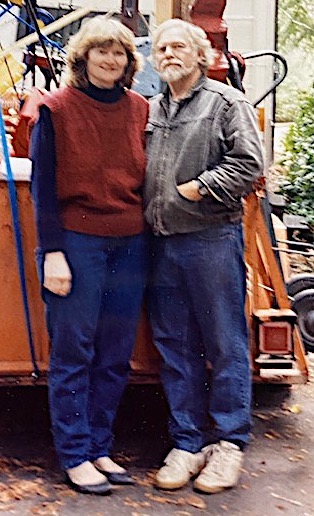
This is the only photo I can find of Bob and me. Taken in our driveway in Boulder Creek, CA

(If you haven’t read Chapter 1, Go HERE.)

Innocents in Mexico

Chapter 2: El Paso, Juarez, Chihuahua

(May, 2001)

            As soon as we drove into El Paso, it felt like we were in Mexico.  The dirt roads climbing the hills covered with tiers of tin-roofed tiny adobe houses looked like the outskirts of any of the large Mexican towns we had been in in the past––Nogales, Oaxaca, Tijuana.
             As we passed through Juarez and into the countryside, the dust devils appeared. Ever since I’d experienced a real tornado twenty-four years ago, I could never witness their smaller brothers with the same delight they aroused in me as a child.  Here, they seemed a symbol of the panic and lack of organization which had plagued our day so far.  Everything had happened too quickly, and not in the way I’d planned it.  Bob plowed through El Paso, passing each place I wanted to stop, saying we’d stop at the next one.  He was always in a hurry. To me, this was finally the part of our lives where we could take our time. I wanted to do and see things–– to experience it all.  There were no real schedules now that we were out of the States­­––no friends or relatives waiting to see us, no certain places to reach each night.  But for Bob, it was a matter of quotas––getting there in as few days as possible.
            What he would do once we got there was probably to try to find a place as soon as possible when I hadn’t even made up my mind whether this was the place where I wanted to be, then worry about not feeling inspired, then sleep, a lot, before finally trying his hand at something.  I preferred to travel a bit first, to get my bearings, and to compare places before we made a commitment.
            And the cat, Bearcat, who accompanied us?  What did he want? We had not intended to bring him.  He was a cat who had been born and lived all of his fourteen years in the same remote house in the Redwoods. The menaces he recognized and knew how to deal with were mountain lions, raccoons, coyotes, feral cats, owls.  With his talent for survival, he’d outlived his entire clan of mom and two sister cats.  He’d been king of his own domain back at home in the redwoods of central California, but now he was out in the real world.  Like the man emerging from Plato’s cave, he was seeing the full reality for the first time, and the light was blinding.  As we drove, we kept trying to coax him out to view the scenery or at least for a pat and a rub, but he preferred to stay under the air mattress in our van, his green eyes peering down it’s long cave, his red leash sticking out like a guide rope for him to be pulled out by at night. I liked to imagine him as a brave cat, stalking the world, but for the moment, even the scenery rushing by was too much for him.  He preferred to stay low, grounded, hidden.  He preferred not to know the full measure of this new world he had been so abruptly pushed into.
          Our first day in Mexico had been a fiasco.  We were through El Paso and to the border before we realized it.  We had passed no exchange places or insurance vendors and suddenly we were there––at the border with no pesos, no tourist visas, no car insurance or permit.  The official had insisted that we needed to drive 30 more km to the airport to get our visas.  What about car insurance, I asked?  Yes, yes, insurance too, he promised.  So, there we were––driving in Mexico with no car insurance––that one thing warned against by every living in Mexico book, by every guide book, by every friend who had ever traveled there.  At the airport, we obtained visas, but were told we’d have to drive 30 more kilometers to get an automobile permit and car insurance.
          My heart was in my throat the whole way as Bob sped down roads with no shoulders, past signs warning of cattle in the road, around orange cones that grew like mushrooms down one lane or the other for the entire 30 kilometers.  Cars turned left from the right lane, signaled left but turned right, or stopped.  I stewed and fretted, which made Bob drive faster.  Finally, by promising to make him a sandwich only if he slowed down by 10 mph, I got him to slow down.  Until he’d finished the sandwich.  Then he sped on.  Finally, we saw the Aduana sign that signaled the customs house.  There, after a long wait, Bob obtained the car permit and after much haggling, I got a week’s worth of Mexican insurance.  We’d try for a better deal in San Miguel.  There was, however, no money changer at the Aduana, so we had only the few pesos I’d saved from our last trip to Mexico two years ago in addition to some I’d pilfered from my childhood coin collection.  They were not enough to cover even the first toll, but, thankfully, they took our American dollars.
          Through each tiny town, we searched for a banco, but it was nearing 7 o’clock when we finally pulled into Chihuahua to search for a money exchange in rush hour traffic. Trying to maneuver through streets which, too narrow for oncoming traffic, still allowed it, Bob scraped the side of our new van on a pole.
            When we finally found el centro, only casas de cambio were open, not any banks, and the credit card I’d taken with me when Bob let me off was one I didn’t have a pin number for, so I hadn’t been able to get any pesos. Forty-five minutes later, when he’d finally been able to get back to me through the rush hour traffic, we headed out of town, still peso-less, wondering where we’d find a place to spend the night.
          It had been our intention to sleep in the van, both to save money and to guard the art supplies we carried on the roof rack and the tools we carried inside. Bob had taken out all but the two front seats and had built and carpeted a platform in the van so we could put an air mattress for sleeping on top of it and still have cargo space for clothes, tools and books underneath. We had a porta-potty for us and a cat box for Bearcat.  In a cooler were meat, cheese and greens for sandwiches, ice to cool drinks, and a few other perishables.  This would both keep us on our diets for a few more days and enable Bob to set the speed record he had full intention of setting for time between El Paso and San Miguel. We had not, however, taken into account the possibility that camping areas or even areas suitable for just pulling off the road for the night might not be as readily available in Mexico as they were in the U.S. 

It had taken us only one day to firmly slip into our roles of ” Innocents in Mexico!”

.  .  .  .  

As before, I would appreciate any comments. Are you still along on the ride with us? Is there anything you are missing? Anything unclear? I’m really not going to duplicate the entire book here, but just seeing if I’m off to the right start. It is perfectly okay to give suggestions and critiques!  And thanks for the comments so far…..Judy

Go HERE to read Chapter 3


Eclipses and Visions: Letters from Mexico (Possibles, May 8, 2023)

This is a short piece I found in a file marked “Possible Add-ons” for the Mexico book. What do you think? The essays and chapters I’m sharing with you here are all out of order but all take place within my first two years of being in Mexico. I’m still trying to find my original first chapter which I have a printed copy of but can’t locate so far in my computer files.  Since then I’ve written two others but find I prefer the first so I’ll keep looking. In the meantime, I’m going to publish assorted possible add-ons for your perusal and vote. If possible, I’m putting the date I originally wrote it after the name of the segment. Although “Letters from Mexico” is my working title, I’m still looking for a better one. 


Eclipses and Visions 5/16/03 (19th month in Mexico)

     Gussie’s mouth was frothy with the insides of cattails after our tug-of-war over the long stalk of the cat tail.  I cleared out her mouth and we started again, most of the lighter-than-air tendrils clotting in her mouth but others erupting to drift out into the air until we were both covered.  Ana laughed.  Diane laughed.  Gussie barked, but it was a bark muffled by cat tail fluff, so it came out “warf, warf.”  We were an unlikely threesome:  two Americanas in their fifties, a thirteen year old Mexican girl and a beach puppy, but we had found a tremendous lot in common during our past month of beach walks.
      We had not started out as a threesome. I had been walking on the beach of the lakefront by myself for over a year.  These walks had been spasmodic, and always in the late afternoon to sunset.  But when I met Diane, who had newly moved to a house near the back entrance of the Raquet Club, we decided to try walking every morning at sunrise.  After Daylight Savings intervened, out 6 a.m. walks shifted to 7 a.m. and within a few weeks, Ana had asked to join us.  It was a brassy move on her part, and I was much relieved to find her standing up and asking for what she wished.  I’d been tutoring her for over a year now and although her vocabulary seemed to be growing, I hadn’t been very successful in getting her to actually talk.  She would answer questions  with “Yes,” ”No,” or the the fewest words possible, but she would never start conversations or return questions.  Yet now, just one month later, she chatted casually in English, with frequent pauses and Spanish words filling in the gaps in her English vocabulary.  We’d arrived at a good compromise.  On our beach walks, I spoke Spanish and Ana spoke English.  Diane, who was behind me in her Spanish mastery,  listened and asked questions if she needed to.  Gussie ignored both languages with equal regularity as she drank from rancid pools, ingested cowpies, chased and was chased by colts and baby burros and reached up to snatch pelican feathers from my fist as she raced by.
     Today, Ana was going on at great length about the eclipse the night before.  I had missed it, going out to sit in the jacuzzi at 8 to find only mist and no moon.  There was intriguing music wafting up from the plaza of the pueblo far below.  The drum beats were of the native variety, and I was considering driving down to investigate when a phone call pulled me out of the jacuzzi and into the house.  Once dressed, however,  I found that the couch and a good book won out over a sleuthing trip to the village.   I’d check every 15 minutes or so to see if the moon was up yet and in eclipse, but in fact I awoke three and a half hours later to find the full moon glowing clearly above me.   I had missed the entire event.
     Now Ana filled me in on the details.  During an eclipse, it was customary that everyone dress in red.  Her father wore a red sombrero and her mother a red blouse.  Then it was necessary to tie a cord around the wrist of each family member.  Even your cats and your dog, she insisted.  You must tie a cord around their necks for good health.  Within minutes after saying this, we passed a pasture.  Inside was a cow with a red bandana tied around her neck. “It is for salud,”  said Ana, who did not remember the word for health.  “. . . and for good milk as well as many other things.”
    The drumbeats the night before had been for the eclipse ceremony in the church and plaza. There had been many people, she told me, and many races between chayote fields,  but at this point the description grew vague.  I decided these were details I needed to check out in the future, but I already regretted sleeping through the eclipse, which by her description sounded like a grand event.  Not to mention the costuming and the cryptic racing between fields of vegetables.  I had grown jaded about fiestas and loud music emanating from the town, but I could see that in this case I’d missed an authentic event.   Ana assured me, however, that this was a four times a year event, and that next year she’d keep me better informed.
     There is so much going on in Mexico that I’ve found that I have to ignore some of it to manage to have a life of my own.  I’d been putting off writing for what seemed like months, and sooner or later I’d have to seal myself into my house and get on with it or just give up to a life of sloth.  But in the meantime, I’ve found that all I want to do is sleep.  Maybe it’s my new schedule of arising at 6 to walk, but I find that by 3 p.m., I need a nap.
     The other morning, I fell into bed as soon as I got back from our walk at 9 and stayed there until midafternoon.  I suddenly remembered that I was the age Bob was when I first met him and I remembered also what he said right after we’d had the diagnosis of his pancreatic cancer.
      “I hope they find out I’ve had it for a long time so I’ll finally have an excuse for how tired I’ve been feeling,”  he said.
      “For the past five years?”  I asked.
     “No, for the past fifteen years.”  That was the entire time I’d known him, and I suddenly felt guilty for all the times I’d prodded him on to finish a task.
    Now today, I lie in the jacuzzi with no strength to even get out of the water.  I wonder if this was the type of exhaustion Bob felt for so long. The jacuzzi  is only 1/2 full so I can float and use the step in the jacuzzi as a pillow holding up my head as I stare straight up at the clouds.   It’s a mackerel sky, but as a wind rises, the scales begin to group together to  form a beautiful avant-garde sculpture of a bird.  Its wings are partially folded in,  and as the clouds change, they keep drawing closer together, like the bird is making a hugging motion.
     It reminds me of Bob’s self-sculpture of the angel with the broken wings,  and I suddenly think that the cloud image also looks like a sculpture Bob would make.  Immediately, the clouds below the bird form a perfect image of Bob’s face.   Am I imagining this?  Less than 30 seconds later, it starts to rain big drops, straight down, and the face vanishes.  Invigorated by the rain, I go into the house and begin to write.

Other People’s Children, May 7, 2023 (Journal Peek Dec. 6, 2004)

Other People’s Children

     I’m 57 years old and I’ve never had a child. No one would have predicted this.  I’ve always been absolutely gaga about babies.  When I was five, when my mother went to her Progressive Study Club, I’d spend the whole afternoon watching the babies laid out on the bed in the middle of a pile of coats.  I would barely take my eyes off them.  They seemed precious, beautiful and endlessly fascinating.  In any crowd, my eyes fell on the babies.  Whenever my much older sister had a child, I’d go to visit and the baby would sleep in my room.
     So why did I never have a child and do I regret it?   I never had a child because I was too busy living my life and somehow it always seemed that a child would interfere.  I was selfish, yes, and last night I had a dream that adequately depicted that selfishness.  In the dream, I was going to a concert.  I went next door to my neighbors, who had many children, and asked if I could take one of them to the concert. 
     “Take me, take me!” each indicated by raising his arms or coming into my view.  I took one of the smallest.  It wasn’t until after the concert when I was again home that I realized that I’d left the child at the concert and worse to tell, I couldn’t even remember which one I’d taken!  It was as though the minute I’d picked the child up that I’d forgotten it.  The guilt was crushing but I seemed more worried about how I’d admit it to the parent than what might have happened to the child. I wondered whether to return to the concert or to go to the parent, which I dreaded. In the end, I went to see the parent and the child was there with her so I didn’t even mention that I’d lost her child. Afterwards I thought that I should go to the child and apologize, but I never did. 
     This dream ties in to a lifetime of dreams where I forget to feed and put more water in the tank of my fish and go down to find them transformed into fake fish lying on the bottom of a waterless tank, or have kittens or babies I forget to feed.  It’s perfectly clear that this dream comes from some part of me that has always feared that I wouldn’t be an adequate caretaker over the long run.  And so in the past, I always confined my caretaking to a few weeks in the summer, when I have my niece and nephews to visit, or Saturday visits from neighborhood kids for painting or singing or games.
     Now at 57, I prefer to feed the child in the adults I find.  To nourish their missing parts, care for the untended places in their souls. It’s like I’m a delayed parent, making up for the lacks in their pasts.
     Twenty years ago, when I’d first met the man who was to become my husband, I went to a psychic to discover why he looked so familiar to me from the start, why I saw dozens of faces  when I looked at him, all of those faces familiar.  She took me back in a supposed past life progression, During that time, a little girl spoke to me.  She said she was meant to be my child in this lifetime, but that since I’d been a mother in so many of my more recent past lives that she understood why I might want to spend this present life entirely on my self.  “If you decide not to have me,” she said.  “I’ll come to you some other way.  So don’t worry.  Just enjoy this life for yourself.” 
     So every time I meet a little girl or see the little girl or boy in an adult who has never resolved past issues, I wonder if that is the little girl trying to find me.  And I try to respond.
     This is the full extent of my mothering, and I must say that I’ve really never regretted not having a child.  When I see a friend focusing her full attention and enjoyment on her daughter, I realize that I have that same relationship with my friends, and when I think of the friend whose son gambled away their retirement or the other friend who is raising her second grandchild, I know that life has turned out just right for me.  Yes, I have children, but I get to decide when I see and care for them.  And I get to continue to feed my own inner child.  Selfish, perhaps, but somehow I think I’m just filling the exact niche I was born to fill.
                                                                                                                      —Dec. 6, 2004

Note: In lieu of the rhymed and metered poems to prompts that I’ve written and put on my blog daily over the past ten years, I’ve decided to start publishing excerpts from the journals I’ve been keeping for the past 22 years, hoping this will prompt me to transform them into a book. I welcome your comments about whether you find these peeks into my past interesting enough to warrant that effort. 

A Speck of Dust


A Speck of Dust

When it is over, said and done, it was a time and there was never enough of it, but now is the only time we have and there is as little of it as there was then, so it is time to live in the now, suspending worry for the time being, as well as regrets. Leave the groceries on the counter and the cats unfed and let the kids gorge on peanut butter and jelly for once and go out the back door into your own world and notice what is around you. What you have been blessed with. First of all, you are alive. Do you realize the miracle of that? The miracle of the evolution of your brain and your sexuality and your heart?. The existence of birdsong, a fingernail, a laugh–the simplest and most varied of things, all grown out of a speck of dust–less than a speck of dust. All of these things, good and bad, such miracles that we let the self-enthused politicians and rulers and directors of our world cause us to overlook. Seize your power. Force attention to that in life that is to be enjoyed. It is what you can do. Events in the world that you cannot change, even though you try? Do not let them change you. Look at the minuscule that you overlook each day. A petal, a beetle, light on a hummingbird’s wings. Their dart and hover. Notice details. That is where the beauty you may be overlooking resides. Take it in and take it with you when you reenter the life you have stepped out of for a brief while. Take it with you and share it with your children. It is the power you have in the world.


For dVerse Poets Prosery. (We were to write a prose piece starting with the first line as quoted above.)


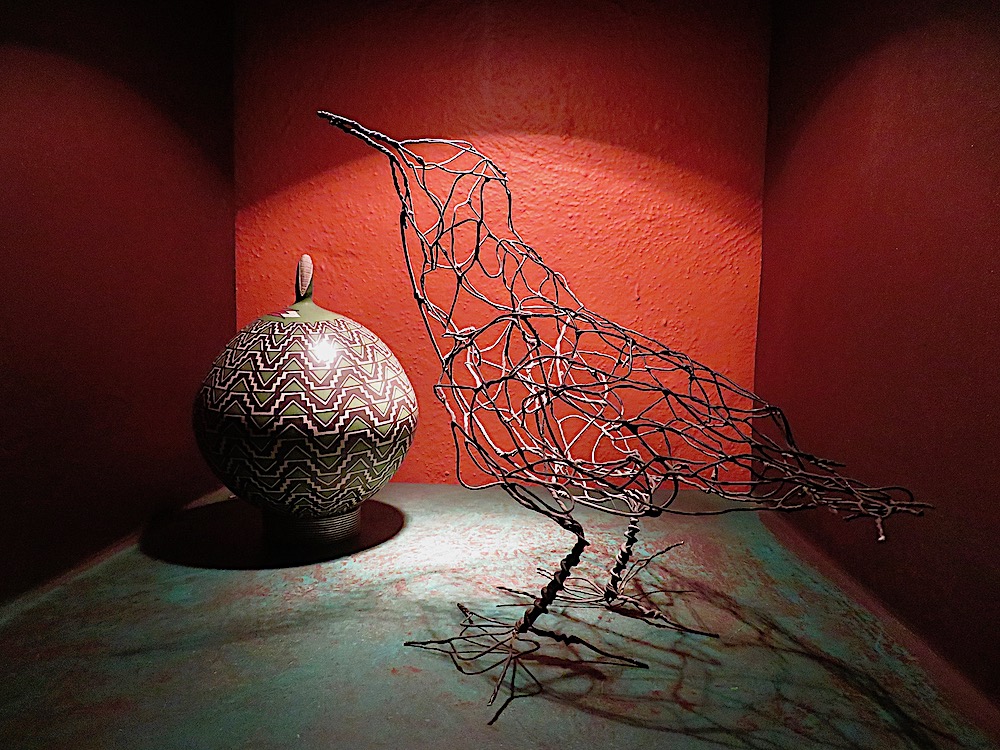
Wire Crow

IMG_7812

Wire Crow

A black crow formed of bent wire, specific in its detail, with the look of chicken wire, yet intricately twisted by hand. You had seen me come back to it again and again at the art show and had taken note. You, who usually harangued me about how hard I was to buy for, asking what I wanted, making me responsible for my own gift. How I hated Xmases and Birthdays for this reason. Hard enough finding the perfect gift for you and your 8 children and my family, but to have to pick my own gift? Unfair.

Yet this gift, a surprise on my 42nd birthday, so perfect. A reminder of that black crow poem you had written about the end of your first marriage and the decline of your second that poem that ranged so far and wide that it included even me, gathering your children and taking them to safety when we broke down on the freeway. That first poem not about past loves, but casting me as heroine––a part of your official biography.

This crow, however, has seen beyond you. Seen your death and my relocation. It sits on the highest shelf of my sala, bent over a Mata Ortiz lidded bowl that has an ear of corn rising up from its lid, as though the crow is about to feast on it. It is one of the objects that gathers you around me, even now, 18 years after your death: the wooden statue you carved in Bali, your giant spirit sled of copper and hide, your Tie Siding sculpture that fills the corner near my desk, the spiral lamp–one of our favorite collaborations.

My whole life seems a continuation of that collaboration—your pulling out of me the art and words that surround me now on my walls, my tables and swirling through my head, disconnected or connected. Metered in rhyme or collecting into paragraphs—all parts of my life. Art we inspired in each other, pulling the world in around us with wood and stone and metal and paper and ideas and words. That metal crow a part of all of it that I have overlooked for so many years now. Of the few objects brought the long miles from California to Mexico, this crow was selected innocently, perhaps more by intuition than by conscious thought, and yet it stands, highest of all, to project its message.

No one who has formed us ever dies. New loves do not cancel out the old. Like one glorious recipe, our lives accumulate ingredients. Sweet and salty, tart and crusty, effervescent and meaty. Like your presence. Ironically represented by that crow that is mainly emptiness, really. Or perhaps unseen mass. Like thought. Like poetry. Like love. Like a forgotten important detail suddenly remembered.

Mary asked to see some of the results of the timed writing exercises we did during our retreat. This is one I did where the prompt was to write about an object. I believe it was a 15 or 20 minute writing.

Uprooted

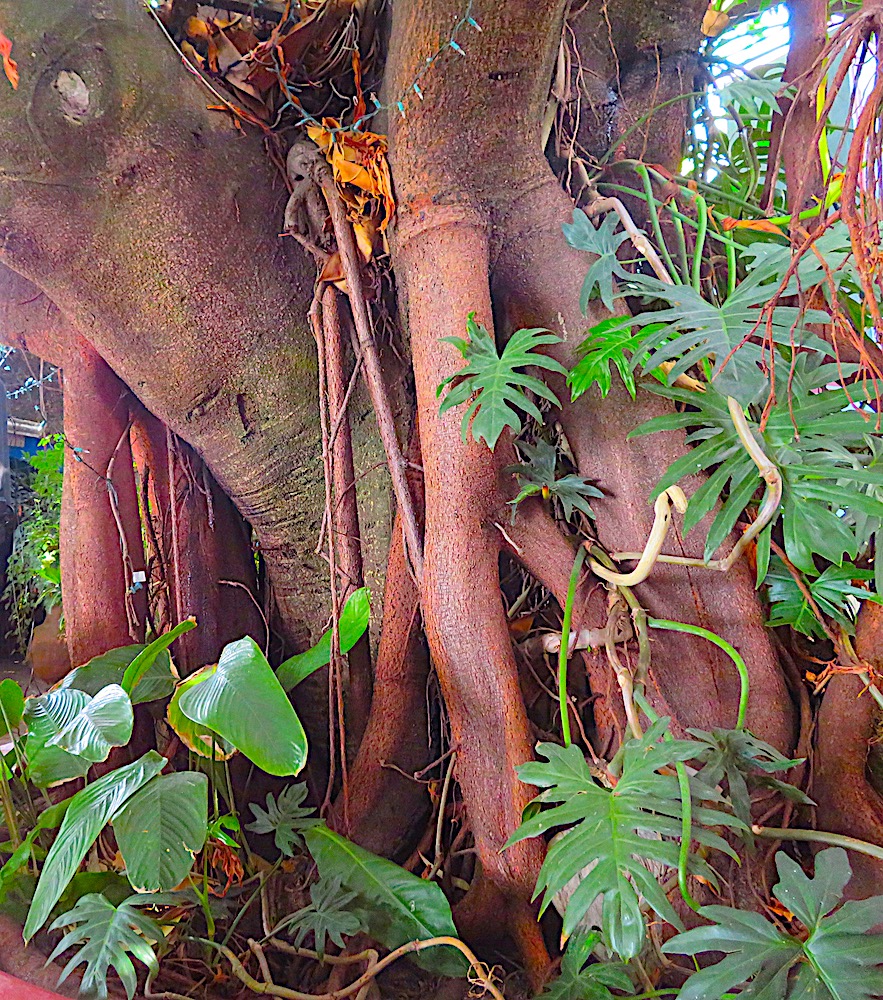
Uprooted

“Can you get even closer to the tree?” he said—so I went inches from the trunk of the tallest of the trees, crowding the fern that reached tentative tentacles from the tree’s shade into a ray of sun that escaped the fast-collecting clouds. “I’ll protect you,” he had said years ago, when we declared our union. But now, in this time of the approaching storm, I wondered about both tree and one who over the years had been in turn protector and threat. In times of gentle rain, a shield. In times more volatile, that sudden bolt that left bruised places easily hidden. I saw the tree’s scar, devoid of bark, burned at the edges––that place now easily overlooked in the shadows. And I moved away from the tree, walking with new confidence to the car. Uprooted, finally, after so many years.


Italicized line is from Sharon Olds’ poem, “Pine Tree Ode.” For the dVerse Poets Pub prompt–to develop a prose piece of 144 words making use of a line from another poet’s poem about a tree. Go HERE to read what other writers did with this prompt or to participate yourself.


Dream Journeys

He woke up agitated and sweating, turned over to face in her direction. She lay on the adjacent pillow, staring at him with a haze of dreaming still over her eyes.
“I dreamt I got the job,” he said, his mind swarming with the details of discarding, packing, arranging for the move.  Then, his mind switched quickly to the alternative. What if he didn’t get the job? He had been in this state of agony for weeks. Either result contained grounds for worry.
She stirred.  Reached out for him. “I had a dream,” she said.
“Oh, yeah?” he said, intent on his own quandry, barely aware of his own mechanical response. “Anything pertinent? I’m looking for signs.”
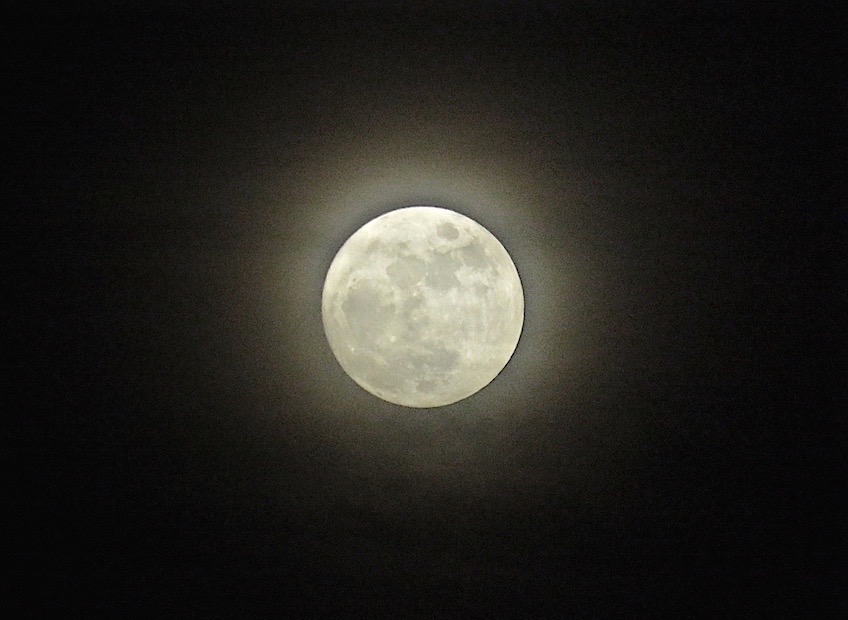
“I dreamt I was the moon.”

img_0557

For the dVerse Poets prosery prompt: The Prosery prompt starts with a line taken from a poem, and asks you to write a piece of flash fiction incorporating that line, in full, somewhere in the piece of prose. To make it a little more challenging there’s a word limit of 144 words. The line they chose was “I dreamt I was the moon.”