Tag Archives: Dangerous situations

Memories Decoded

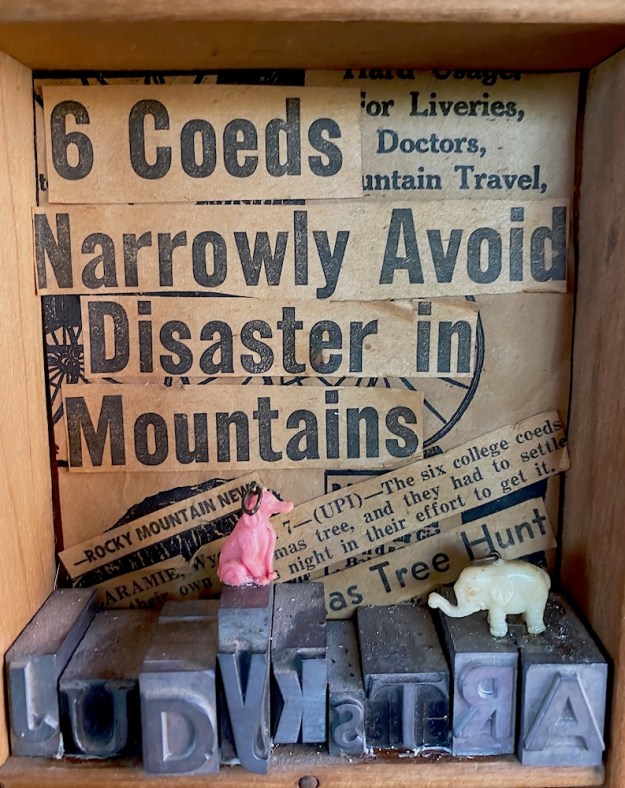
IMG_9013This square actually contains two stories, both of which have been requested. I’ll tell the story of the other one tomorrow.

When I published the photo of my memory box, I promised to tell the story of any square in it that someone requested I tell. Two people have requested I tell the story of this one, so I’ll tell it first. If you’ve requested other stories, they will be coming up in the near future, one a day.

The year was 1966 and Christmas was fast approaching. That year, my sophomore year at the University of Wyoming, my folks had let me bring to college the little red Ford Galaxie that my dad traded a combine, two horses and a bit of cash for my junior year in high school. The way my sister and I learned my dad was buying us a car was that he told us to get in his pickup, we were going to White River. What for? A surprise. When we got almost to White River, 23 miles away, he pulled off the road into a lot filled with a number of machines, cars and farm equipment and pulled up to a little red Galaxie, told us to get out of the car and tossed us the keys. My sister and I soon got the message that this was our car. I was 16 and had just gotten my driver’s license. My sister Patti was 20. We got in the car, stared at the stick shift and revealed to my dad that neither of us knew how to drive a stick shift. Well, he guessed we’d learn on the way home, he said, and took off in his pickup. He was right, we learned on the way home.

The thing about stories is that every story has so many stories attached to it and so it is with this one. At any rate, with no further digressions. Since I was one of the few girls in the sorority house who had a car and since I was always up for adventure, shortly before Thanksgiving, I decided I would take friends up to the Snowy Mountains to cut a Christmas tree for the Chi Omega house where I lived. With a bit of squeezing, the back seat could accommodate four; the front seat, with its gear stick on the floor, could accommodate two. So, six of us piled into my car in the early afternoon, sure that we could get to the Snowy Range, cut a tree and be back by our ten-o’clock curfew that night. Included in the group were three of my best friends since my freshman year and two new pledges, both from California.

Our troubles didn’t actually start until we had arrived in the mountains. Because the dirt road was very narrow and steep, there was really no place to pull off, so all I could do was to pull as far over to the side as possible and hope no traffic came along. We knew the chances were remote, as it was a timbering road meant for the trucks that went back and forth to the lumber camp at the top of the mountain, the road being too small and rough for regular traffic. We set off scouting out a tree and soon found one the right size and proceeded to chop it down, not too skillfully, I might add. It had started to snow as we set out from the car but we were so intent on finding and chopping down the tree that we didn’t pay much attention to the fact that the snow was falling more and more heavily.

It was as we were dragging the tree back to the car that we heard the loud beeping of a horn, which in the muffled air of what was now a snow storm sounded more like a fog horn than a car horn. As the other 5 dealt with the tree, I ran out to the road to discover a huge lumber truck pulled up behind the car. My friends wrestled the tree into the trunk and I tied the lid down with the top few feet of the tree sticking out behind the trunk. We piled into the car and since I could not get past the truck to head back down the mountain, I was forced to drive further up the mountain—up the deep ruts of the frozen dirt road that were quickly filling up with snow, the lumber truck close on my heels, now and then sounding its horn if I slowed down too much.

As the snowfall got heavier and heavier, I found it harder and harder to see, the windshield wipers barely keeping up with the accumulating slush at their corners as well as the newly fallen snow. It seemed like an eternity as we drove farther and farther up the mountain. On one side was a sheer drop-off. On the other side, a steep mountain bank and trees. The mood was tense in the car as we searched each side for a possible place where we could turn around to go back down the mountain. As I type this, I can again feel the tension—a feeling of fullness in my chest—a panicked sensation of something gathering and swelling in my throat. It was panic, a growing fear that there was no way we were going to get back down that road, even if we were able to reach the lumber camp.

“I think we’re going to be spending the night at the lumber camp,” I remember thinking—and perhaps saying. The one good thing about our situation was that truck behind us, which could help us if we got stuck and which could also lead us to shelter in the lumber camp. But when we finally did get to the top of the mountain and a dirt space large enough to turn the car around, whoever was driving the lumber truck just parked the rig, jumped out and headed down through the trees. Not knowing where he was going or how to find the camp, we turned the car around and headed back down the mountain.

By then it was so dark and snowing so hard that the only way we could see to stay on the road was to open all the windows and hang our heads out, shining flashlights out of each window to see where the edge of the road was. We drove slowly for what seemed like hours, the tires sliding on the icy road until finally, the car went into a skid and started to go over the side of road. Knowing that it was a sheer drop off on the side we were skidding toward, I pumped the brakes, then as it seemed sure we were going to plunge off the side, I jammed down on the brakes and pulled the emergency brake as well. As the car went over the edge, however, the banked snow and frozen dirt stopped us. With the two passenger-side wheels hanging out into the air and the rear driver’s side wheel barely making contact, the only thing keeping us from going down the side of the cliff was the wheel and undercarriage under me. I knew it was necessary to get as much weight as possible out of the other side of the car, and yelled at the passengers in the back seat to slide as far over to my side as possible and to jump out of the back window–the side nearest the road. Then I told the person in front with me to climb into the back seat and to exit by the same means. As she did, I opened the glove box and emptied its contents into my purse. A package of chewing gum, five packets of ketchup, an extra flashlight, matches, a lighter–I don’t remember what else–but I knew we might have to survive for awhile on whatever was there. When all of my friends were out of the car, I opened my door and jumped out into the snow, fearing that without my weight the car would go on over the side.

It didn’t, but we knew it was not safe to stay in the car as it could go over at any minute. But what to do? We were all dressed warmly except for one girl from California, who had no socks and no gloves. I had earlier taken off mine and given them to her when they had gotten out of the car to push at one point. We were not equipped to survive in a mountain snowstorm, however, and I knew we needed to find shelter. In spite of the fact that we had noticed no cabins on our way up the mountain, finding one would be our only hope of survival. We had, as I recall, four flashlights, and since it seemed important to stay in contact with the car, I devised a system whereby I would stand as far from the car as I could so I could still see the car and shine a flashlight in front of me. The others would walk together shining one of the three remaining flashlights in front of them, fanning the area around them looking for shelter. They would walk as far as they could so long as they could still see my flashlight. When they had walked the furthest possible still seeing my light, one person would stand and turn on her flashlight, fanning the surroundings as they had before. If they saw nothing, that person would again shine the flashlight in a forward direction into the woods parallel to the road and the other three would walk forward together, fanning their flashlights to look for a cabin for so long as they could see the light being held by the second person. When they got to the furthest spot that they could see her light, one more would stop and shine her light for the remaining two. In this way, it would always be possible to find their way back to the car. And luckily, when they were almost to the furthest place where they could still make out the third light, they discovered a cabin, tightly boarded up for the winter. They blinked their flashlight twice, the girl above them turned and blinked her light at the one closest to me, who turned and blinked her flashlight at me and I blinked my light twice to let them know I had seen them, then grabbed the axe, thinking we might need to chop some firewood, and headed down the mountain toward lights number two, three and four!

Little did I know that I’d be using the ax to chop down the door to the cabin, which was nailed tightly shut, as were all the window shutters—a precaution against bears! Luckily we hadn’t considered the possibility of bears. The cabin was as cold as the outside air, however, and we knew we needed to get a fire started as soon as possible. The prospect of cutting down a tree and getting wet wood to burn did not appeal to us. Luckily, there were wooden chairs which we chopped up—but what to use to start the fire? Finally, we stripped insulation from the walls to stuff under the pieces of the chair and lit a fire in the cookstove. What we had not taken into account, however, was that the owners had put a coffee can over the smokestack before closing up for the winter to keep it free of critters and snow, so the cabin quickly filled with smoke.

As a result, we could just spend a few minutes in the cabin before going outside to breathe the clear air, and this was how we spent our time for I know not how many hours, taking turns standing outside to watch for any possible light coming up the road. Could there possibly be another lumber truck? Who else would be out on a night like this in such a remote spot? It was past midnight when one of the girls came running into the cabin to say she had seen a light. We all ran out, waving our flashlights as a pair of headlights made its way up the mountain. As the rangers’ four wheel drive vehicle pulled up on the road above us, we all went running up the hill, screaming, waving our arms as three men piled out of their vehicle.

Long story short, they were park rangers, who winched our car out from its precarious position, put out the fire in the cabin and wedged the door shut, then loaded three of us into the park rangers’ vehicle and the other four into my car, insisting that one of them would drive my car. We made our way down the mountain to the entrance of the park, at which point we were met by highway patrol cars. Those of us in the park rangers’ vehicle were transferred to a highway patrol car. “I can drive my car, now,” I protested, but a highway patrolman slid into the driver’s seat and we proceeded to the Laramie city limits.

At that point, we were transferred to a city police car for a brief ride to the University of Wyoming campus, where the campus cops assumed responsibility for us, driving us up to our sorority house where every light in the house was blazing and every girl in the house was waiting inside the entrance to the house, along with our house mother. By then it was 3 in the morning and they had been waiting up for us all night. When we hadn’t shown up for curfew, friends had admitted that we’d gone up to the Snowies to cut down a Christmas tree. Our house mother had called the dean, who had called the police who had called park rangers. Search parties had been sent out both from the University of Wyoming and the park headquarters. It had been 1 in the morning when they had received word we’d been found, but by then the story had been picked up by A.P. and U.P.I. and broadcast nationwide.

The next morning, we did not go to class, but slept in. We’d be seeing the Dean of Women in the early afternoon to face the music. When I woke up the next morning, the phones had already starting ringing—the press, wanting to hear the story first hand. Unfortunately, the person who answered the phone calls was Kathy Mulcare, the California girl who was the one I’d loaned my gloves and socks and boots to. Were we warmly dressed? The reported asked, “Yes, everyone but Judy Dykstra from Murdo, South Dakota. She was in low-cut shoes with no gloves!” And that was how the story went out nationwide.

When I called my parents the next morning, wondering how I was going to break the news, I said, “Hi, Mom. Guess what?” She said, “You mean how you were stranded in the mountains while cutting a Christmas tree last night?” My heart sank. It turns out that they had been up all night listening to the radio, knowing only that six girls from the U. of Wyoming were missing in the mountains after going up to cut a Christmas tree. No names had been given, but my mother said, “Ben, I just know one of them is Judy!” My dad said “Don’t be ridiculous. There are thousands of girls in the University–what are the odds that one would be Judy?” But he, too, waited up until they learned they had been found. No names, though, until I had been the one to tell them that alas, it was their daughter.

Yes, we were campused for the next semester. In addition, once the names had been announced, my dad came in for a lot of ribbing from his coffee buddies in Mack’s Cafe. “Can’t you afford to buy that daughter of yours boots and socks and gloves, Ben?” they teased. My mother advised that I not come home for Thanksgiving that year. “If you do, your Dad is going to take your car away.” And that is how I came to spend Thanksgiving in Thermopolis, Wyoming, with two of my friends who had shared the great Christmas Tree Adventure, and yes, there was another big adventure awaiting us in Thermopolis. But that is a story for another time and place and this is the story for that particular square in my memory box. Why the elephant and dog? That, too, is another story entirely.

Postscript: The strange thing was, no one ever asked us to pay for the damage to the cabin, and, although the news story ended with the quote “the little Christmas tree they had risked so much to get was left behind in the mountain blizzard,” in fact, they didn’t confiscate it. Nor did they ask if we had a permit to cut it, which we didn’t.

Although the original post was made in June, and I started this post then, I evidently got distracted. Forgottenman just found it in my drafts. So here it is, three months late. You can see the entire memory box HERE.

Toxic Hand Sanitizer can Cause Blindness or Death.


Please read the article the link below is connected to and check your hand sanitizer against the list given.

https://arstechnica.com/science/2020/06/toxic-methanol-that-causes-blindness-found-in-hand-sanitizers-fda-warns/

In the Soup

DSC00068

In the Soup

Definition: in trouble, as in “I’m in the soup with the boss.”

Without fear, we’d be in traction with braces head to toe––
Each day a speed infraction from refusing to go slow.
We’d fall off tipping ladders and land upon our heads
or go to sleep with adders sleeping in our beds.

We wouldn’t have good sense about where we ought to go.
Our decisions would be faulty––our thought processes slow.
We’d wind up in the jungle sleeping on the ground
hoping for each bungle a solution might be found.

An expert on this topic, I’ve been in many a stew.
But luckily, I chose to act, so “done to” turned to “do”
as in the past I came too near to kidnapping and rape,
and luckily by conquering fear, I found means of escape.

After graduating college, I became a bum;
but now I can acknowledge that I was often dumb,
with fearlessness  often what got me into trouble—
need for adventure softening the rub of danger’s stubble.

Traveling to foreign regions, I was so naive
that my mistakes were legion, so now I do believe
it’s crazy to be fearless. Now even I succumb.
In caution I am peerless––finding fearlessness is dumb!


This is a rewrite of an earlier poem. The prompt today was succumb.


Cornered

Cornered

When on some strange and lonely night
the choice is whether to take flight
or stand and face off for a fight,
I hope your soul turns still and white
and that you gather strength and might

to try to find that inner light
and conquer elements of fright.
Muster all your inner sight
and draw you to your furthest height.
All your inner truths recite.

Feel the solution’s tender bite,
your inner armies to incite.
Cast off the threat that holds you tight,
and lift off, soaring like a kite––
free once more for life’s delight.

https://dailypost.wordpress.com/prompts/fight/

Leaves in a Dry Wind

Version 2
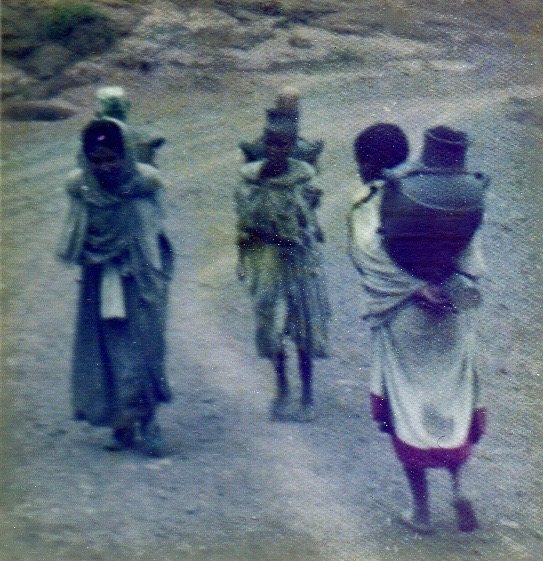
The essay I am reproducing below is a reply to a comment made in my blog by OromianEconomist regarding the pictures and short essay on my blog  (You can find them HERE.) in which I referred to the Ethiopian drought of the early 1970’s. This was his comment:

“The same is going on right now in Ethiopia. Authorities are either hiding the presence of famine or stealing the food aid.”

He included the below link to an article written about the current drought which I suggest you read.  https://oromianeconomist.wordpress.com/2015/08/27/the-cause-of-ethiopias-recurrent-famine-is-not-drought-it-is-authoritarianism/      My comments follow below.

                                                           Leaves in a Dry Wind

I wrote this initially short reply to the Oromian Economist’s comment on my blog, but then I seemed to just keep writing and writing until it turned into an essay of sorts.  The facts are from memory and I realize I need to do some further research and I’d be open to any comments by people more in the know than I was at the time, but this is a short view of what I observed in Ethiopia when I traveled and lived there in 1973 and 1974:

I was in Ethiopia in the drought years of 1973 and 74. I saw the sacks of grain for sale in the market in Addis Ababa that said, “Gift of the people of the United States of America.” The grain was being sold and the money pocketed by government ministers. One month the teachers in my school (Medehane Alem T’mhrtebet) elected to forego our salaries and use the money to buy food and hire trucks to take it to the drought areas. I was on the committee set up to deal with this transfer, but the government said it could not allow private citizens (or expats such as myself) to handle the money or the distribution. What actually happened was that the government did hold back the money, but they merely used it to pay our next month’s salary. Not a penny of that money was ever used for drought relief.

Many people at that time were not even aware of the drought because the starving people were not allowed to migrate into the cities but were held back by military. We were only aware because we traveled out in the country via bus. Dead cattle dotted the countryside and in places people formed human chains across the road to stop the buses. This was in Wollo Province, enroute from Addis to Dessie. We threw all the food and money we had out of the windows of the bus, but then traveled on. There didn’t seem to be anything being done at that time nor any means for anyone to deal with the problem.

There was one relief agency and I can’t remember whether it was Swiss or Swedish, where the aid was brought to Africa and distributed by the country it was being sent from. I had a friend who was employed by this organization and I traveled with him at one point. He told me that this was the only aid that was actually getting to the people and that no other country actually sent people to insure that the aid was being distributed to the people who needed it. This was a long time ago and my memory is spotty, but I am thinking that they were setting up schools that he was inspecting, but it may have been other agencies.

We traveled from Addis past Bahir Dar and Lake Tana (source of the Blue Nile) and Gondar, up to Asmara. This was through the Semian mountains, noted for shiftas (robbers) and we traveled by caravan with armed guards as actually I had earlier when I had come out of the Lalibela region and back into Addis. Other trips were to the Awash Valley and then later to Gambela, to camps where Sudanese refugee camps had formerly been set up. My friends were Ethiopian nurses there.

When we traveled to Harrar, it was because all of the schools in Addis had been closed down due to student demonstrations and strikes. They had started stoning buses. The rumors were that the buses were all owned by members of the royal family, but I don’t know if this was true. In spite of the fact that almost no students were still attending school, we teachers were told that so long as one student showed up for class that we needed to show up. On my last day of school, I was on a bus that was stoned. A large stone shattered the glass near the window where I was standing, as the bus was full. The next stone whistled past just grazing my ear. After that, the buses all stopped running and they closed down my school. We had been wanting to go to Harrar, so we traveled by train. The trains were totally full with people standing and sleeping in the aisles as well. At times we would see people standing by the side of the tracks with camels. Someone from the train would open one of the doors and throw huge sacks of smuggled goods out to these desert nomads who were contraband runners.

After a few days in Harrar, we rode the train back into Addis and as we rode into the city, we saw the students swarming over the tracks behind us. I think we were on the last train back into Addis. The revolution had been going on for some time but we were just seeing it as student protest. The military later took over the airport and the night of my birthday and good-bye celebration, (my sister and I were due to leave the next day to travel further in Africa and then to go back to the states to see my father who was very ill) the coup was staged. The military had used the students to start the revolution but in the coming years, most of the young people I knew were killed by one wave of revolutionaries after another. They had more or less been used by the military for their own purposes and my only friends who made it through that period alive were ones who came to the U.S. or Canada.

My boyfriend who was shot defending me the first day after the coup miraculously survived a bullet that went all the way through his body and out the other side. I stayed for another month until he was out of hospital, then came back to the United States and have never returned to Ethiopia. My boyfriend became involved in politics and two years later, he was warned to leave Ethiopia by yet another wave of revolutionaries espousing a different branch of communism. When he refused, he was assassinated in the road right outside the hospital where we had spent our last month together.

I blindly stumbled through this very sad and violent slice of Ethiopian history not fully understanding all that was going on. My efforts to write about it since have always been stopped by my realization that I really didn’t fully comprehend the magnitude of everything that was happening and probably still don’t. But, for sure, I realize that my experiences in no way equalled those of Ethiopian citizens caught within those circumstances. They could not just travel blithely through them as I did. And few of them lived to tell the story I am telling only sketchily, according to my own experience and probably faulty memory.

I was there for that lavish celebration staged for Haile Selassie’s birthday. When members of the royal family were arrested after the coup, they were put in the prison that was on the other side of the garden wall of my house near Mexico Square. When Haile Selassie was removed from the Royal Palace after my return to the states, he was arrested by my boyfriend’s father, who was a Colonel in the military and put into a little blue Volkswagon that was the car Andy and I used while I was in Addis. I saw Selassie say something to Colonel Getachew as he got into the car and I asked Andy what he had said. What he said was, “Am I reduced to this–riding in a Volkswagen?” In reply, Col. Getachew said, “Your majesty, most of your subjects walk.”

In my years in Ethiopia, I had seen Selassie riding around the countryside in the backseat of his Rolls Royce, sitting on a jumper seat to raise him up enough to see and be seen through the windows, his Chihuahuas running back and forth in the back window. Everyone along the roads bowed as he passed and Andy tried to pull me down into a bow. “It is for respect for our emperor,” he told me, but I told him I refused to bow to this man who lived in a palace and rode through his country in a Rolls and walked through the marketplace dispensing birr notes to the people when other subjects were starving. If he saw us, and if he saw the little blue Volkswagen parked at the side of the road, little did he know that one day he would be driven away in that very car. History can be chilling and its stories full of ironies that, known by few, blow away like leaves in the winds of the next event and the next and the next.

https://dailypost.wordpress.com/dp_prompt/worlds-colliding/  (This prompt called for taking two fictional characters from different books and having them meet and interact. I have chosen to depict events that occurred when a real person chose to enter a different world. Truth can be much more interesting than fiction.  I found this to be true during my years in Ethiopia.)

DSC00994 - Version 2

Devil # 3

In response to The Daily Post’s writing prompt: “Helpless.” Helplessness: that dull, sick feeling of not being the one at the reins. When did you last feel like that –- and what did you do about it?

Okay, I was going to give this prompt a “miss” and went to the new prompt generator I’ve been using for the past few days.  I hit the button and was served up the two-word prompt: “Ill Devil”.  At first I read this as #3 Devil, and I must admit, I got a chill, because what I immediately thought about when I read the prompt was the third time I was in a near-death situation where I felt totally helpless.  What are the chances, I thought, that these two prompts would line up?  This must be something I’m meant to write about.  But then reason stepped in and I realized this prompt always gave an adjective and a noun.  What they probably meant by the prompt was ill Devil. (Changing the capital to a small “i” clarified the prompt.) But then I realized that ill devil described the occurrence I am trying not to talk about as much as #3 devil did, so I guess, prodded on twice by fate or coincidence or synchronicity, I will try.

I have written to a similar prompt twice in 2015, so probably most of you who read my blog have chanced upon one of those posts, but when I wrote to a similar prompt in June of 2014, I wrote a different piece and since I had few of my present-day readers then, I’ll mention that THIS is what I wrote.  It may not be obvious that the topic given in today’s prompt was what I was really talking about then, however, because it was a poem where I actually stood to one side of what I was really remembering and wrote about the subject as an onlooker rather than a participant.  I only alluded to the real subject, which is what I’m going to attempt to write about today. That real subject is Ted Bundy and how otherwise respectable women sometimes fall prey to such predators.  Okay, deep breath. I’m going to tell to the world something I have actually told to very few people. Yes, this is a true story.

Devil # 3

Nineteen seventy-something. In the bar with friends.
When you are in your twenties, the partying never ends.
It was rodeo season  and the big one was in town.
As one by one they ordered drinks, I couldn’t turn them down.
We were a rather rowdy bunch of teachers in our prime
Devoted in the classroom, but wild on our own time.

The bar was crowded hip to hip, the music barely heard
over the loud cacophony of laugh and shouted word.
It was my turn to buy a round. I struggled towards the bar.
My polite “Excuse me’s!” really hadn’t gotten me too far
when a guy appeared in front of me and moved the crowd aside
as though he had appointed himself to be my guide.

As I returned with eight full drinks, again he stemmed the tide
by walking close in front of  me and spreading elbows wide.
He smiled and then departed, back to the teeming mass.
Impressive that he had not even tried to make a pass!
My friends all wondered who he was. I said I had no clue.
Tall and dark and ivy-league, he vanished from our view.

This story happened long ago. Some details I’ve forgotten,
and any memories he retains, you’ll learn were ill-begotten.
I think we danced a dance or two. I know we talked awhile.
I liked his fine intelligence, his low-key polite style.
At three o’clock the barman’s bell commenced it’s clanging chime
and I made off to find my friends, for it was closing time.

Two lines of men had split the bar, lined up back to back.
Their hands locked and their arms spread wide–they moved into the pack.
One line moved east, the other west, forcing one and all
Either out the front door or towards the back door hall.
I was forced out the back way–out into the alley.
My friends and I had made no plans of where we were to rally

and so I walked around the block, sure that was where they waited,
but there was no one there at all–the crowd had soon abated.
I went back to the alleyway to see if they were there.
but all was dark and still, and soon I began to fear
that both carloads of friends had thought I was with the other.
I had no recourse but to walk, though I prayed for another.

I combed my mind to try to think of anyone at all
living in this part of town where I could go to call
a friend to come and get me and furnish me a ride
for 3 a.m. was not a time to be alone outside.
There were no outside phone booths and I lived so far away
I simply had to rouse someone, but what was I to say?

But since I had no other choice I thought I’d check once more
if any single soul was waiting at the bar’s front door.
And as I left the alley to be off to see,
I saw a new familiar face looking back at me.
It was my dancing partner, his face split in a grin.
It seems that he was going to save me once again.

He had asked me earlier if needed a ride,
but I had told him wisely that I had friends inside
and so I thought he’d left, but I could see he was still there.
Yet, ride home with a stranger?  Did I really dare?
And yet I had no other choice, abandoned as I was.
And so I said I guess that yes, I would, simply because

I knew there was just one of him and I was young and strong.
And he seemed kind, polite and gentle.  What could go so wrong?
His car was just a block away. Our walk was short and brief.
And when he pointed out his car, I felt a great relief.
For it was a convertible–and easy to escape
If I detected the first signs of robbery or rape!

He opened up the door for me. I got in the front seat.
But as he started up the car, my heart skipped a beat.
For from the bushes, two more men emerged and jumped inside–
one man in the backseat, the other at my side!
He pulled out into the street, though I protested so.
I didn’t really want a ride, so please, just let me go!

(And here I have to beg off and say I’ll finish this story tomorrow.  Right now my heart is pumping and my head throbbing as though I’m re-enacting this whole tale physically as well as mentally.  I’m totally exhausted.  Why I decided to write this in rhyme I don’t know. Perhaps I thought it would be easier, or more fun or more lighthearted, but there is simply no way to write this from any other frame of mind but the terror I felt that night. So, sorry, but I will resume tomorrow. You all know that I’m here telling the story, so be assured that the worst didn’t happen…but the story is by no means over, so join me tomorrow for the rest.  I, for one, could really use a drink, but it is only 1:40 in the afternoon so I’ll find some other means of escape.)

To see the conclusion of this poem, go HERE.

If you’d like to try out Jennifer’s new prompt generator, go HERE.