Tag Archives: Judy Dykstra-Brown stories

Mr. Cole

Mr. Cole

He lurked out in the hall as we all took our seats and came to order.  He took a drink from the water fountain, putting down what looked like a new briefcase as he did so.  He picked up the briefcase and made for the door, then turned and walked back to the fountain, putting his briefcase down as he took another drink.  He started for the door again.  Changed his mind and returned for another drink.  Then he squared his shoulders, picked up his case, re-rounded his shoulders and entered the room.

He was a little mole of a man—sniffy and hunched with scrunched-up eyes behind thick glasses.  When he entered the classroom, he looked straight down at the floor, as though he wasn’t sure one foot would follow the other without great attention.  He maneuvered his way to his desk and stood with his back to us.  He slammed his briefcase onto the desk, then removed it again, as though in indecision over whether he really wanted to stay at all.  Then he slammed it down again.  Removed it.  Slammed it down.

Finally, he moved around to face us and assumed a more teacherly demeanor.  He actually looked at someone in the front row for two seconds, before retreating back around to the back side of the desk, perhaps seeking some protection.

It was the first day of my freshman year in college. Next to me was a very new friend who not only lived in the same dorm but who also had just pledged the same sorority. We sported our bug-like black pledge pins on the fronts of our sweaters, a hand’s distance above the nipple, as we’d been instructed to wear them.  It was a bit like being in enemy territory, for we had already learned that the English department and the dormitories were not the best places to display our new status as Greeks so openly.  Our sitting together was a bit like circling the wagons on a westward journey.  We had each others’ backs.

“My name is Mr. Cole,” the dwarf said. “This is the honors section of Freshman English 101.”  He had facial ticks and a way of floating off into dreams.  Sometimes the end of a sentence just sort of wandered off, as though some other matter of greater importance had intruded upon his thoughts.  We did not disturb him in these reveries.  My new friend Linda and I would exchange looks and she would giggle the sexy little laugh that was her only laugh.  We both admitted, finally, to having a bit of a crush on him.

It was my first of many crushes on “different” men.  Men who had facial ticks or personality disorders that made others look on in horror or disgust just seemed to intrigue me, and my new friend was someone who gave validity to my strange behavior.  She, too, thought he was intriguing.  When we invited him to be a faculty chaperone for our pledge dance, he asked if he would be expected to function in the capacity of a bouncer and I assured him that no, it was more of an honorary position. To our surprise, he accepted, showing up with a tall willowy English department assistant who seemed herself to be of a literary bent.  I don’t remember if they danced, but I believe they dated for the rest of my college career.

You can see by my relation of these details how little I really knew about this man. On that first day in Freshman English, I remember being frightened and feeling inferior to the big town kids in the class.  If the truth were told, most of them were probably small town kids themselves, but coming from a town of 700, I thought of a town of 6,000 as a city , and I was sure that my own excellent academic record was more a result of comparison (there were 15 in my graduating class) than of true prowess.  Mr. Cole explained that instead of studying grammar, sentence and paragraph construction, that as honors students we would be expected to write an essay or story a week which would then be read in class and commented upon.

The night before our first writing assignment was due, my insecurity had kept me from committing a single mark to paper.  We had been given no topic and no direction.  This paper was to function as a sample of where we were on the continuum of writing skills.  This was to be my introduction to the strange gnomish man who had studied under Roethke.  Although I had no idea who Theodore Roethke was and no easy way of determining who he was in this pre-computer, pre-Google age, I had made one of my rare forays into the college library and found a whole section dedicated to his books in the poetry section.  So, I was about to be read by the student of a very important American poet.  And, I didn’t know what I was doing, really.  Our composition efforts in high school had been for the most part limited to essays and term papers.  I’d once written a humorous sonnet about Goldwater and Johnson and that was about it.  How did one go about writing a vignette, which as I recall was our assignment?  Midnight, one a.m., two a.m. ticked away on the smoking room wall as I sat looking at the blank page.

A fly, brought back to action by the hot light of my study lamp, worried my ear before buzzing off to pin itself to the wall. The smoke of my cigarette curled between us, and suddenly, in a sort of astral projection, I was that fly on the wall getting high on the fumes of a doobie that smoked in the ashtray beneath it.  The room was filled with the imaginary bodies of stoned kids splayed out on the floor or with headphones on their heads.  I started to write.  Forget that I had never smelled or seen marijuana, let alone smoked a joint. It was easier for me to imagine that fly getting high than to imagine myself doing so, but within a half hour, I’d completed the essay, set my alarm clock and had joined the fly in its herbally-induced sleep.

The next day, I placed my own sheet on the pile of papers on his desk.  Mr. Cole entered as usual, slamming the briefcase, removing it, slamming, slamming.  I had never been introduced to the term “Tourette’s Syndrome,” but many years later I wondered if perhaps this accounted for some of his oddness.  He would stand at the desk and crane his neck upwards, roll his eyes.  Sometimes he would look at one back corner of the room and then at the other, as though he were privy to some world and audience we had no access to. Seeing a film on Roethke, I wondered if he had patterned some of his odd behavior on his former teacher. This is just a scrap of a remembrance, so perhaps I dreamed it.  In this era of YouTube it would not be hard to check out.

Three days later, he was ready to discuss our vignettes.  There were many in this class, he revealed, who were able to put words down on paper but who were not writers.  There was one student, however, who had portrayed the truth in a way that the others had failed. This student had displayed courage in telling about a part of themselves that no one else had been willing to be vulnerable enough to display. He then read my essay as an example of superior writing to the entire class.

What I felt? Relief, certainly.  Pride?  Sorry, but yes.  I enjoyed being singled out.  After the class, other students came up to me saying they would not have had the courage to write the truth like that or to admit they’d smoked pot and applauded my success in exactly expressing what it was like to be stoned.  On the way back to the sorority house to do our pledge duties, my friend giggled and admitted she had never smoked pot.  “Neither have I,” I confessed, with a sideways grin at her.

I took three classes from Mr. Cole. In Honors Freshman English, I earned an A.  When I took creative writing from him a year later, he seemed to have me completely confused with another student who had taken a class from him the semester before.  He kept calling me Jenny and commenting on how my writing had improved.  The next semester, I took another class from him and in the margin of one of the first poems I wrote for him, he said, “Not quite up to the sudden fine standards you set for yourself last semester!”  I knew then that he was still thinking of me as Jenny and was disappointed that I’d returned to my former standards of mediocrity.  He’d given me a B+ on the poem.  I tried harder for the remainder of my last semester in his class, earned another A and would like to believe I lived up to his expectations. Of Jenny.

We do not always stand out in the memories of those we admire with the same clarity that they stand out in ours. What happened to Mr. Cole, I do not know.  As with many in our lives, when his importance in my own life ended, so did his existence.  I tried Googling his name once and found nothing, which may mean his own poetry books were published in a pre-computer era.  When I Google my own name, there are 209,000  entries listed, probably most having to do with some other combinations of my name, but most of the ones really referring to me have to do with writing. Probably all of those entries deserve a footnote of thanks to Mr. Cole, who was the first to find merit in my words and also the first to be deceived by them.

(You can see a 25-minutes YouTube video on Theodore Roethke here. Other than his reading style, he really doesn’t have much in common with Mr. Cole at all.)

The Prompt: Teacher’s Pet—Write about a teacher who influenced you.

Sunset Story

The Prompt: A Moment in Time–What was the last picture you took? Tell us the story behind it.

DSC02574
Sunset Story

A year ago, friends from our old neighborhood in Boulder Creek, CA, had come to visit me.  I hadn’t seen them in the twenty or so years since they had decided to retire early, sell their house and take off to sail around the world in their boat.  They’d asked us several times to come visit them on the boat, but we’d put it off for too long.  By the time we, too, retired and bought a house in Mexico, thinking we’d meet up there, they had sailed on to more southern climes and then very quickly, Bob took the biggest journey of all and I ended up moving to Mexico alone.  Twelve years later, Lach and Becky had moved back to land, to her old home town in Washington.

When they emailed to say they’d like to come visit me, I was happy to renew the old bonds, happier still when they liked my new home town so much that they decided to buy a house in a nearby small town, and did—on that first visit.  They had returned to the U.S. to wrap up old business and now they had returned.  As they awaited the arrival of boxes of necessities, they were once again staying with me, newly arrived home after two months at the beach, where I’d watched 60 magnificent beach sunsets in a row—each uniquely beautiful.

But home sunsets had their own glory: the magnificent Mt. Garcia with Colima Volcano peeking over its side, the lake below reflecting the colors of the sunset, the domes of houses down below giving foreground interest.  As I glanced up from my dinner preparations, I knew this was yet another of a thousand unique sunsets I had previously captured.  I even knew where my camera was—a wonder after days of unpacking and putting away piles of the car full of home necessities I’d lugged with me to the beach.

I snapped dozens of pictures from three different levels of the terrace and garden. Then, spying the hammock in the gazebo on the lowest level, I decided to swing for awhile and watch the progress of the sunset.  Since my house is on a mountainside, I was still far above the lake with lots of sky to view as well.  As I neared the hammock, I saw Diego—my youngest and blackest and most mischievous dog—gnawing on something that sounded like a bone.

I tried to see what it was, but he moved off quickly.  I knew the crunch of bones, however, and was sure one of the friends who used my house while I was gone had supplied him with a bone which he had promptly buried.  Then I remembered that the dogs hadn’t been there while I was gone, but had stayed with a friend in his house.  But occasional uprooted flowers or succulents give testimony that my yard is in fact a graveyard for buried and un-resurrected bones.  Diego had probably just unearthed one he’d been dreaming of for the two months he’d been separated from it.

I had my swings in the hammock, a little shut-eye if not sleep, supervised the sunset, and then decided Lach and Becky would soon be back from a foray to their house, a few miles away in Chapala.  It was to be our farewell dinner tonight as they were moving to their own digs tomorrow.  I climbed the short pathway up to the house, noting as I approached it, that both the grillwork and screen  between the terrace and living room were open, even though I remembered very distinctly having shut them on my way out of the house.  I slid both shut behind me as I moved to the kitchen to finish dinner preparations.  Two pans of veggies stood in their steamers on top of the stove, mashed potatoes were covered and ready to heat up in the microwave, apple cake covered on the counter, six pork chops —(not) nestled in the skillet ready to be browned.

It became immediately clear what Diego had been munching down below.  As I snapped photos (including these) he had slid open the slider and deftly purloined six raw pork chops without even moving the skillet, which stood in exactly the same position on the stove where I had left it.  Bad dog!  I shouted off into empty space, as he probably lay on the dome of the house—both dogs’ favorite spot in the house—accessible by first a set of stairs that ran up the side of the house and then a small leap to to ledge around the dome and a fast scramble up its smooth sides.  I imagined him up there, licking his chops (literally, in two regards,) enjoying the sunset.

That night, we dined on chicken.
DSC02575

Lucky Man

The Prompt: Tight Corner—Have you ever managed to paint yourself into the proverbial corner because of your words? What did you do while waiting for them “to dry”?

While I was looking for a personal tale that works for this prompt, (never did find it, but it was perfect for the prompt) I found this beginning to a story or novel that I’ve long forgotten. I’m going to print it here for suggestions and advice. Should I abandon it? Continue? I know there are problems, so any suggestions would be appreciated. Oh, what we find in the bowels of our backup drives! And it even loosely meets the prompt.

Lucky Man

The doorbell was answered by a tiny redheaded girl resplendent in conical Pokemon party hat. She grabbed the present that Dick held out to her and immediately whirled and ran back into the yaws of the party, which was in full swing. His daughter Nell surrendered his hand after one tight squeeze and chased after her hostess.

“Hi Dick.” It was Shirley Hudson who next emerged from the cacophonous din in the living room. “You can stay if you want to, or you can pick Nell up at six.” She held his right hand in her own, while her other hand stroked the black thatch of his forearm. It was something Jane had always done, and he hated it. He wasn’t a cat, for God’s sake.

Dick put his arm around the shoulders of his wife’s friend as an excuse to withdraw his arm from her stroking grasp. “I guess I’ll go home and take a catnap, Shirl. I’ll see you in three hours.”

“Dick? Have you heard from Jane?”

“Shirley, I don’t want to go through any of this now.”

“Hey, I’m not going to give you any trouble over this. She’s my best friend, but I know you’re in the right. I don’t blame you. I just want to know how she is.”

“There are visiting hours at the city jail, Shirley. I’m certainly not using them up. Go see her.”

Now he sat in the car for a minute, letting the wipers remove an accumulation of mist off the outside of the windshield as he wiped the inside condensation off with the arm of an old sweater that was stuffed down beside the seat.

He started the car up and pulled into midafternoon traffic. Not too bad. His thumb worried a spot below the knuckle of his left-hand ring finger where an ingrown hair had grown infected. It was so swollen now that he hadn’t been able to remove his ring, even with Jane gone and no one to blame him if he removed this mark of the chosen.

Bored of the rings. This is what a friend had said just before asking his wife for a divorce, but marriage to Jane, although anything but ideal, had never been boring.

In college, her possessiveness and jealousy had been sort of flattering. He had been amazed that this ravishing sorority girl, cheerleader, beauty queen, straight A student had marked him as her own. She had been known to haul other women who monopolized his company for too long at a frat kegger away from him by the hair. Everyone knew that he was Jane’s property. She was so beautiful and so soothingly cute when they were alone. He had been a lucky man. All of the guys said so. In Jane Clark’s pants. Lucky man. Lucky man.

They had been married right out of college. He had been fortunate to find the job in New York. Well, actually, he had been lucky to have been found by the job. After months of sending out resumes, checking and being checked via the web, pulling any and all strings that were within his grasp, he had finally been recruited by the friend of a friend of an acquaintance. And he had taken the job. It had always been his dream to live in New York and six months after graduation, six days after his marriage to Jane, there they had been.

He couldn’t deny that Jane’s looks had had something to do with his being the darling of the firm. After the first office party, when everyone had seen her in the backless silver sliver of a dress, they had been invited everywhere–to the houses of all the mucky mucks, whose wives were as taken with Jane as the men were. Jane was smart about that. Jealous herself, she never let another wife see her moving in on her man. No. She never let her moves be seen. By wives.

They’d been married about a year when he caught her in the designer bathroom of his boss. With his boss. She hadn’t even pretended to have an explanation. “Shit, we’re caught!” she had said, zipping up her dress, grabbing her panty hose and moving behind the shower curtain to get herself straight.

“Dick, I hope you don’t. . . .” He’d been gone before his boss could finish the line.

They’d moved to Denver two weeks later. He’d taken a job in the ad agency where his best friend from college worked and Jane, contrite, had been the model wife for a year after that. She’d met Dick so young. She’d just never had the chance to sow any wild oats. And she’d had so much to drink. But she loved him, really loved him.

He’d actually preferred his job in Denver to his job in New York. Denver was a more sophisticated town than he had guessed it would be, and Jane had scared up several old sorority sisters living in the area. She had worked for a few years as a talent coordinator that provided entertainment for big conventions–a job with a lot of variety in it, a chance to use her charm and looks and brains. But she’d quit when Nell was born. And that was when the real problems started.

Dick pulled the car into his own driveway, flicked the switch for the garage door opener. Flicked it again. The damn thing usually worked every fourth or fifth time he pushed the button, but sometimes it would take a rest for a few days and if it was in a snowless season, they’d just park in the driveway, which he did now. The garage door was on his long list, somewhere down near the middle.

They’d put money down on this house when they first moved to Denver. He had the money from his Dad, who had died his junior year in college, and they’d seen no sense in pouring money down the drain by paying rent when they could be making house payments. The house was on two acres of land and behind its own high walls. Privacy. More than they needed, really. It had come cheap because the house was old and in need of a lot of repairs, but Dick’s dad and granddad had both been handymen, and he had spent most of his time with them as their assistant. So the idea of a house that needed lots of repairs was inviting to him. He associated open walls with plastic tacked up over them and paint cans in the corner as homey.

Jane, on the other hand, liked projects in the planning stages and when they were over. She hated the mess and bother of the actual repairs. But they had discovered this only after they bought the house.

When Jane had first seen the house, she had wanted it immediately. Its size, style and the extent of the grounds had sold her. She had not realized that it would take more than a coat of paint and a few flats of flowers to make the house livable. When the whole first year of repairs involved practicalities such as wiring, plumbing (they actually had ended up pouring money down the drain after all) and the jacking up and reinforcement of walls–projects that did not even show cosmetically–she had grown frustrated.

By the second year, they had proceeded to painting and landscaping, and Jane grew happier. She had a great sense of style and color and soon the house looked great superficially. They started to have parties and soon grew famous in their own world. Jane seemed to entertain effortlessly and they collected around them a mixture of old friends and new.

Work, work on the house, play, work on the house, sex, work on the house. Their lives were pretty full.

If, occasionally, Dick went in search of Jane at parties, testing the bathroom and bedroom doors and if locked, loitering in the halls a bit, it was something that did not totally dominate his thoughts or his time. And, indeed, never again in that first two years in Denver did he ever catch her with another man.

Now and then he’d see vestiges of Jane’s earlier jealous inclinations. When he got a new partner at work, an attractive girl just out of college named Julie, Jane started dropping in at the office at odd hours. A couple of times when he’d had business lunches, she had coincidentally shown up at the same restaurant with a friend. Denver was a pretty big town and their house was across town from his office, so after awhile, these meetings seemed to be more than coincidence. When he asked the office secretary, she confirmed that his wife had called and she’d given her the name of the restaurant where he’d be.

But when he’d asked Jane about it, she’d been offhand. “Oh, yeah. I called to tell you where I’d be and then when Lucy said you were going to be at the same restaurant, I thought I’d surprise you. Don’t you remember my telling you about that restaurant? You strayed into my territory, dear, not the other way around.”

It hadn’t been important. He had let it drop. His life was so busy that he didn’t seem to have time to worry about anything that wasn’t immediately pressing.

He slammed the car door, fingering the keys in search of the front door key as he moved up the front walk. Too many keys. No matter how many times he weeded them out, he always had a fistful on his key ring. As he swung the keys over his hand, searching for the right key, one of the keys caught on his sore finger. “Shit.” it was starting to fester up like a felon.

He put the key in the front lock. The aroma of the house came at him full force as he opened the front door. Dry wall, scented candles, a little mildew–in spite of Jane’s best efforts to Lysol all of the fungi away–plastic sheeting, rug shampoo, something else. He couldn’t quite fix on the smell that was turning all these familiar smells sinister. The house, once exciting and welcoming, seemed somehow frightening to him. He didn’t think he could go on living in this house, he suddenly realized.

This was the house they’d fussed and bothered over and primped over like a prom queen. No, more like their queen bee. This house had been their queen bee. He’d been the drone. Jane, he guessed, had been the warrior and defender of the hive or hill or whatever he was comparing their busy, involved, convoluted lives to. Let’s see. How had it happened? In what order? Had Jane started getting strange, really strange, before or after Nell was born? When had her accusations begun? Before or after he’d caught her with the first of a long succession of men? When had the craziness begun?

The first sign he’d noticed had been when Nell was about ten months old and he’d opened his tool chest and found all the fingers of his work gloves cut off. There had been no accounting for it. Jane had been as mystified as he was. A week later, he’d come home and found a note from her on the kitchen counter. She’d be home late, she said. Nell was at Polly’s, she’d pick her up on her way home.

He heard her drive up at ten o’clock and went to the door to meet her. When he took the sleeping baby from her arms, he could smell cigarette smoke and aftershave. She’d met Shirley for drinks. Jake had joined them later, she said. She moved into the bathroom to shower. Later, in bed, she’d turned away from him. She was too tired, she said. He’d thought little of it. He was tired, too.

But several days later, when Shirley had called to propose meeting them for drinks and Dick had teased her about hitting the bar scene pretty heavily lately, she hadn’t known what he was talking about. It had been months since she’d been out on the town, she insisted.

A week later, Jane had again left a note. She was again meeting Shirley, who was having some problems at home. She’d tell Dick about it later. Again, she came home around ten with cigarette smoke and aftershave clinging to her skin, clothes and hair.

“Jane, are you seeing another man?” he had asked.

She had spun on him, livid, her eyes accusing, little specks of spittle flying from her mouth as she spit out the words at him, “You fucker! You are accusing me of infidelity? You with your cute little chickie partner and your business dinners and your cushy office with the door that locks? You are asking me if I’m seeing another man?” She was holding Nell who, half asleep, came fully awake now and started to cry. Jane thrust the baby at him angrily. He took the baby, so astounded that he couldn’t even think of words to refute her charges.

She slammed into the bathroom, locked the door. Later, after all her usual night sounds–the shower, the opening and closing of the medicine chest, the creaking and spinning of the bathroom scales, the flushing of the toilet–she entered the bedroom. He was in bed. She walked past him.

“I’m sleeping in the goddamn guest room!” She left the bedroom door open so he could plainly hear the sound of the guest room door slamming and locking behind her. From the crib near their bed, Nell whimpered and again started to cry. Dick was flummoxed. He rocked the baby, not knowing which of them needed the comfort more.

The next morning, Jane refused to talk to him. His breakfast was on the table as usual. The baby, seated in her highchair, prattled and rubbed food in her hair, but Jane was silent, doing the crossword puzzle at the kitchen counter with her back to them both.

When he got home from work, she was at the kitchen table. She greeted him as though nothing had happened. “I invited guests for dinner Friday night.”

“Great, Jane. Listen, we have to talk”

“I am talking. I’m talking about inviting company for dinner on Friday. Aren’t you going to ask whom I invited? “

“Jane, I don’t really care a whole lot whom you invited to dinner. I want to talk about last night–and last week. Are you seeing another man, Jane?”

“Are you seeing another woman, Dick?”

“No, Jane, I’m not.”

“Are you sure of that?”

“What in the hell are you saying, Jane. Am I sure of that? As though I could forget something like that–overlook it? Oh, yeah, Jane, come to think of it, I forgot. I am seeing another woman?”

“Are you evading the question, Dick?”

“Are you evading the question, Jane?”

She didn’t answer him, just took the baby out of the highchair and walked out of the room. “Everyone will be here at seven on Friday, Dick.”

That night after dinner, when he went into the present room in progress to cut some sheetrock, he couldn’t find his saber saw. He searched for a good fifteen minutes in every conceivable place before asking Jane if she had seen it.

He found her in the baby’s room, folding clothes fresh from the dryer.

“I don’t know where your saw is, Dick. I’m not responsible for your toys.”

“I’m not saying you are responsible, Jane. I just wondered if you knew where it was! “ He kissed Nell, who was murmuring and making sucking motions with her mouth. Jane continued to fold clothes as he stood there a moment, saying not a word until he finally gave up and went to watch a little TV before bed.

When he woke up, there was a buzzing sound that indicated that the station had gone off air. He got up groggily to switch off the set, but the buzzing didn’t seem to be ending. He went to each of the bedrooms that were being used to see if it was an alarm clock. He checked out the kitchen and both bathrooms. But the buzzing always seemed to be coming from a place other than where he was. Each time he shifted rooms, the sound seemed to be coming from a different direction.

Finally, he moved to the basement door, which opened off the kitchen. The buzzing got louder. He opened the door and could definitely hear that the source of the buzzing was the basement. But when he went to switch on the light, nothing happened. Switching on the kitchen light, he searched through the utility drawer to find a flashlight. He found three, all minus batteries. Finally, he found a box of matches. That would have to do.

The light from the kitchen lit the stairs half way down. Then, he could see only black. He lit the first match, which lasted until the bottom of the stairs. Then it went out. Another match took him through the large room that had formerly housed the washer and dryer. Preferring easier access, Jane had had him move the utility room up to the second floor, between their room and the room that would be the baby’s, so that it could be accessed by the three rooms in the house that generated the most laundry: the baby’s room, their room and the main bathroom. Since he already had a great tool room/workroom off the garage, this basement room was unused, except for storage.

As he lit another match, the shadows loomed up: the extra crib given them by his folks after Jane’s folks had already given them one, the youth bed that was in storage until it was needed. Jane’s Stairmaster and electric bicycle exerciser. Two bikes with flat tires, and boxes of assorted stuff they’d probably never look at until the next move. These things registered fast, as he moved through the room swiftly, trying to keep the match lit while trying to also get as much mileage from it as possible as he fumbled for the next match.

In a small room off this main room was the room where the people who lived in the house before them had left a large coffin-shaped freezer. They had never even plugged it in to see if it worked. He remembered thinking that they needed to get rid of it before Nell was old enough to start exploring. It was a potential hazard. A kid could get locked in it and suffocate. Now, he could hear the buzzing coming from that room.

Could someone have plugged in the freezer? Was it defective and thus causing the humming? But why would anyone have plugged it in? He moved to the door, which was shut. Lighting a new match, he tugged on the door. It seemed to be locked from the other side. He held the match closer to the doorknob, but it didn’t have a keyhole. He tugged harder, and the door gave way. As it did, he felt a rush of water around his feet, a jolt, a flash. The match went out. He dropped the box of matches. The buzzing sound was loud now, coming from inside the room. Meanwhile, he could feel water rushing around his ankles, splashing up his legs. What in the hell was going on?

By force of habit, his hand searched the wall in the proximity of the door frame, first outside the small room and then inside. Maybe there was a light here. If so, it might work. Finally, he found a switch and flipped it. The room was flooded with light. The water he could feel gushing around his ankles was coming from a one inch hole in the front of the freezer. On the floor of the room, half submerged in water, was his skill saw, turned on, dancing a sideways jerking dance across the floor. He immediately jumped back from the door, heading for a dry portion of floor that was in a raised corner of the room.

From this safe place, raised above the water, he watched the water stream out of the freezer. What in the world was going on here? He could see a five foot length of one inch tubing tied to the inner door handle, the other end flopping back and forth in the stream of water. What was that about? Then it occurred to him that the tubing must have formed a plug for the hole in the freezer. When he opened the door, he must have opened the door wide enough to pull the plug out from the freezer. This enabled the water to rush out and come in contact with the saber saw, which had been left on.

This is what had been causing the buzzing. The heating ducts that led up from the basement had disseminated the noise throughout the house, which was why it was so hard to locate. Why he hadn’t been electrocuted, he didn’t know. Perhaps the saber saw had some safety seal which protected the electrical current from moisture. Maybe it was his rubber soles on his tennis shoes. Ordinarily, he would have been barefoot–just out of bed or the bath. But he had fallen asleep in front of the TV without removing his shoes for once and maybe that had saved him.

The bigger question was, who had done this? Who had reason to kill him and access to the house? His first thought was Jane. She’d been acting so crazy lately. What was going on? Surely Jane wasn’t crazy enough to try to kill him. The water by now was slowing down to a trickle. It occurred to him that the best thing to do would be to turn off the electricity at the breaker box before unplugging the saw. Luckily, the breaker box was in the basement. He found the dry box of matches tucked behind the pipe that ran up from the box, lit a match, then turned off all the electrical switches. Lighting a match, he moved to the freezer room and unplugged the saber saw.


Six Gifts for My Sister

The Prompt: The Language of Things—You have to write a message to someone dear to you, telling that person how much he/she means to you. However — instead of words, you can only use 5-10 objects to convey your emotions.  Which objects do you choose, and what do they mean?

First of all, I have to say that this is my all-time-favorite prompt, so kudos to its creator. It is original, thought-provoking and fun.

DSC00595

Six Gifts for my Sister

 Older sisters are our teachers, our critics, our cruelest enemies and our best friends. When we were younger, my sister was no exception. With age, however, some of these roles have fallen away. The others I often take for granted even though I know they are still there.

This year I will be, as I have been for most years in my life, far away from my four-year-older sister, Patti, for Christmas. Betty, my 11-year-older sister, unfortunately started to leave us four years ago and now lives in a world we are not a part of. Both Patti and I fear the same thing happening to us and we’ve made some Thelma and Louise pacts to that end. Hopefully, we’ll never have to use them and will fade peacefully away in our dreams when we are well over 100.

If this sounds excessive, you are right. I am a glutton for life and probably part of the reason is the capacity for play taught to me by my sister, who was always my most imaginative playmate. Even when I’m sad, I love living and want for life to go on for as long as possible, so long as I remain relatively pain-free and retain my mind, my sense of humor and my girlish good figure. One of these things does not belong. You can probably guess which one.

Since I live in Mexico and my sister will be in her home near Phoenix this year, we have sent gifts early. Mine sits on top of the armoire in my beach rental in its blue wrapping bag with curly ribbon. I have added a pelican feather and gaudy ribbon streamers. Since I’ve chosen to spend this Christmas far from friends and other relatives, it is my only gift and I am hoarding its mystery until the last possible minute. Perhaps I’ll open it at 11:55 P.M. on December 25! I’m sure my sister has not opened hers, either.

A usual tradition in our family was to do Christmas stockings to which we all contributed. (Well, except for my dad, who instead donated the cash we all used to purchase our stocking stuffers.) With that in mind and feeling sentimental, I’d like to assemble an imaginary Christmas stocking for my sister to open right now—as soon as she sees this. It’s a not such a large stocking, but as in all things imaginary, anything is possible; so I’m sure all the gifts will fit.

I need to start at the top, with the lightest most crushable items, and so the first gift she will find sticking out of the top of the stocking will be something flat, rolled into a cylinder before wrapping. When she rips off the paper in her usual unceremonial fashion, she will know exactly why I have given it to her.

It is a folder of Debra Paget paper dolls with snub-nosed scissors taped to the front to encourage her to actually cut them out. I have visions of them decorating her tree for the remainder of its life this year, or even better, my sister on her stomach on the living room rug, cutting them out while she listens to “Our Miss Brooks” or “The Shadow” on the radio, then assembles the material for a paper doll house: Kleenex box beds and sofas, tuna can tables covered in tissue tablecloths. Since she taught me these imaginary games, she’ll figure out the rest. Then I want her to imagine me there playing with her. She can be Debra Paget. I’ll be anyone she wants me to be, as was the norm way back then when we constructed our first paper worlds.

The next box she pulls from the stocking will be long, narrow and flattish. It will weigh practically nothing. There will be instructions on the front to open it more carefully than usual, for it is fragile. When she folds back the paper, she’ll find a box of the old aluminum tinsel—the extra long and extra skinny type that only she knew how to put on perfectly. It was an art, this distribution of tinsel on the tree. One had to be sure to spread it out evenly in bunches of only three or four strands. For maximum beauty, it had to be hung on the ends of branches so it hung just to the top of the next branch without lapping over. In our house, it was never thrown! I am absolutely sure that now, as then, Patti and I are the only ones with patience enough to do the job right, so she will have to do it for both of us.

I’m sure that what the next gift is will be obvious. It is a Christmas tradition started by my mother, who would tuck a small box of Russell Stover Chocolates in each stocking. At times, she would succumb to temptation and all of the boxes would be empty as she generously absorbed all of their calories herself. I am making one small change in tradition and tucking in a box of See’s Chocolates in lieu of Mother’s poor taste in chocolate. Helen Grace would be even better, if I knew where to buy them.

The next box is small and may have slid a bit further down in the stocking when the others were removed, so I’ve attached a streamer that extends well out of the top of the sock. Pull the streamer and the little box will pop out. Inside is a key. Looks like the key to a car. Actually, it is the key to a little tan Scout whose top can be taken off to make it a convertible. Here are the instructions I’ve written for Patti and wrapped around the key:

There is room for the driver (that’s you) and one more friend in front. (That’s me.) I am sitting there in honor of friends no longer able to: Patty Peck, Diane Looby, Mary Jo Kuckleberg. I think Karen Bossart is so slim that she could also squeeze in front with us. In the back, along the side benches and on the floor, if you really pack them in, there is room for at least eight others and I have written them all to be expecting your call. Billy Francis, Clarence Rea, Mick Penticoff and Bobby Brost are all must-rides. Since the male friends of your youth have outlasted most of your female friends, Billy and C.J. and Mick can bring their wives to sit in for Patty, Diane and Mary Jo. If my buddy Rita North were going to be in Arizona for Christmas (she isn’t) she could tag along as both of us always longed to do—and sometimes we were actually asked! Jim, I don’t think a Scout is your style, but be a sport and ride along in the back with the guys! You’ll discover formerly undiscovered levels of fun bumping along in this replica of Patti’s and my first wheels. And there is always room for one more in the back of a Scout!

The next gift is merely an envelope. Inside are two tickets to Africa. The accompanying note reads:

—To complete our journey that was once curtailed by a revolution and shooting that sent you off to bravely face the rest of the trip alone. It’s about time we tried it again, hopefully with happier endings. Since then, you’ve been back so many times that you can probably pick the agenda better than I could, so it’s an open ticket. You fill in the blanks.

So, we’ve finally come to the bottom of the stocking, but anyone who has plunged into the depths of a Christmas stocking knows there is always something left in the stocking’s toe. In this case it is a small but substantial box wrapped in rich gold paper with a shiny silver cord. Inside is a slide with a large diamond set in gold. Although I know that gold and diamonds are no longer my sister’s “style,” this one is a wonderful modern design with an emerald-cut stone set in a flat gold setting. It is this gift that I’ve chosen to show her worth to me and for that, nothing but the best will do!

Merry Christmas to all. Especially to that sister who has been there for me every single time and who need never worry again about being mean to me in our youth. That, too, is what older sisters are meant to do. It gets us ready for the world, which will not always be paper dolls and U’ing main in a Scout chock full of friends.


Fruit Salad

Fruit Salad

It was 1973. I’d been in Australia since September of 1971 and was ready to travel again. You’ve heard part of the story—the hard and adventurous part through Timor— but I was now in Bali, which was an undiscovered paradise at that time. I spent over a month there, sipping “magic ice juice” and trying to avoid durian. We were living well on $1 a day. 25 cents for bed and breakfast, a quarter for lunch and 50 cents for a lobster dinner at night. Pot and magic mushrooms were available by the grocery bag full and were not yet a hanging offense. Everyone was high all the time!

We stayed in a house with a man who had 4 wives, but was the loneliest man in Bali, afraid to spend time with his beautiful new wife lest his oldest wife find out and demand equal attention. If he bought one wife a gift, it was the law (of both his religion and his house) that he buy an equal gift for all of the others, and feeling financially challenged, the result was that he stayed away from home and his “crony wives” as much as possible. He took us to the rice paddies to see where the village bathed and was disappointed, I think, when we didn’t remove our clothes and join them.

We toured temples where signs said, “It is forbidden to enter women during menstruation” and visited elephant caves, the homes of famous artists, had massages and avoided bare-breasted old women who kept trying to raise our blouses to see what our breasts looked like. Certainly there must be something wrong with them that we kept them covered all the time. One of our fellow-travelers, a very large-breasted woman who was a practical nurse from New Zealand, posed nude for a Balinese batik artist, but we never saw the fruits of his labor.

On certain evenings, the entire town of Kuta turned into one huge gamelan orchestra with the floors of entire small buildings covered with kneeling players, mallets in hand. Processions would wind through the street toward temples, the women with high stacks of baskets and floral offerings, the priests making animal sacrifices of small chickens—everyone in the trance of the music and the occasion, some of us still under the trance of the magic mushrooms we’d consumed in an omelet 3 days before.

You couldn’t eat the salad, but the fruit, the music, the rice paddies, the temples, the sacred monkey forest, the art, the people and the price—you couldn’t beat.

The Prompt: Salad Days—Is there a period in your own personal life that you think of as the good old days? Tell us a story about those innocent and/or exciting times (or lack thereof).

Daily Post: Play Date

Image

Play Date


My sister’s house has sold and they are cleaning out her attic. My niece and I make one trip more and I find my old dollhouse, collapsed, in the garbage can. I take the pieces out—some of them—and stash them in her trunk. I’d thought them gone forty years ago when the tornado took the roof off my parents’ house, but now, here they are like the leaves of memory blown miraculously back to me.

When she sees I’ve taken them, my niece asks what she should do with the dolls she found in the back recesses of her mother’s attic storage room—the one I hadn’t got to on my last visit—perhaps because of the roofing nails sticking through the wood which made reaching back behind the eaves a physical danger.

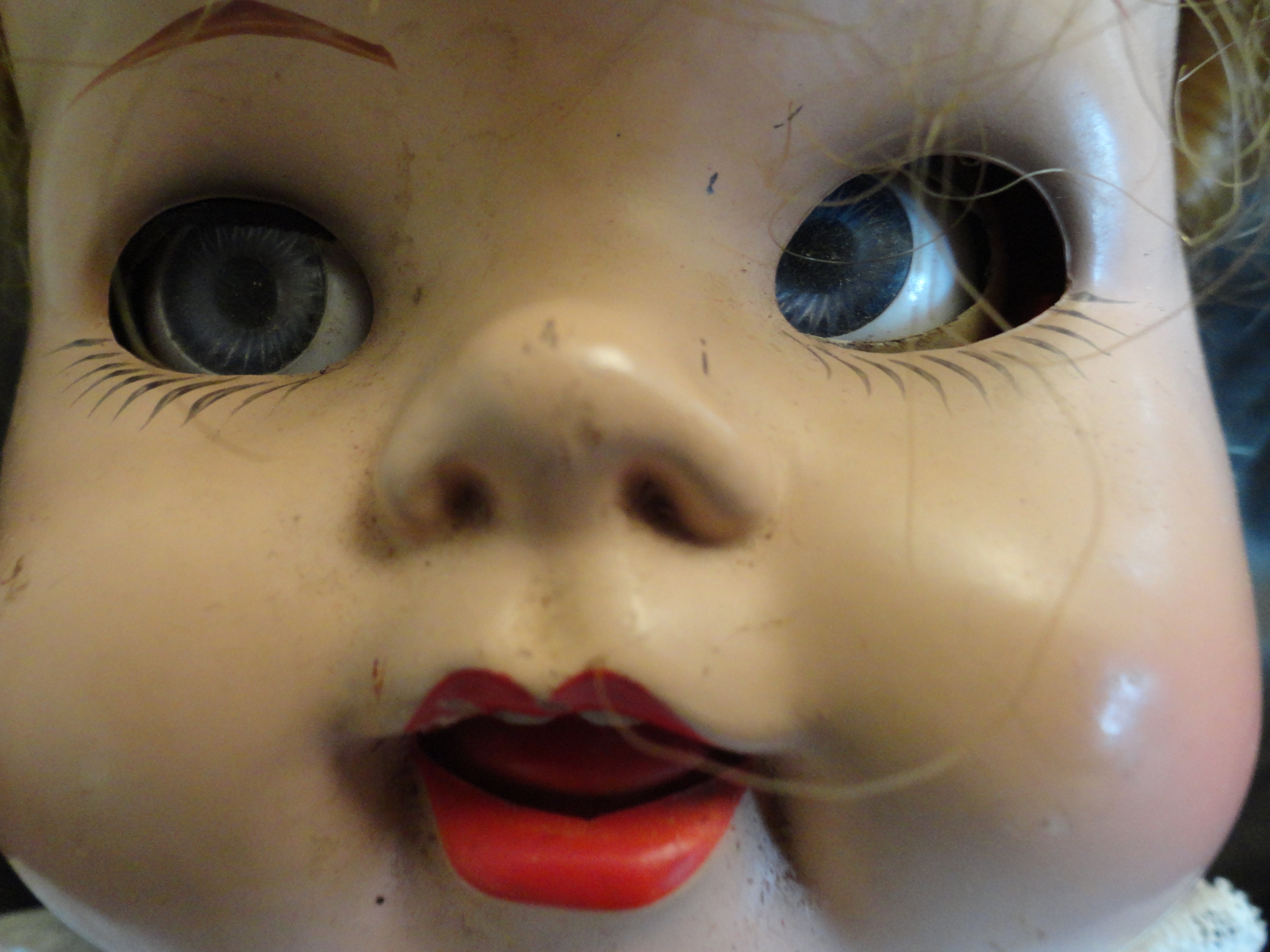
I find them where she has stashed them In a suitcase in her garage, and when I open the case and see the first doll staring up at me, I think it is a “find” from some antique store, like the dishes in my sister’s China cabinet or the tiny figures on her shelves. One rubber arm, sticky with age, has burst open and streams kapok like a froth of bleached and fermented blood. Other limbs have decayed to nothing but empty puddles of congealed rubber. Only the torso, held in place by a sagging pink fancy gown; and the face, stained red in places from some surface it’s been pressed against for too long, are still intact. As I lift the first doll from the suitcase, the other doll—the size of a toddler—stares up at me, one eye unhinged, her hair in pigtails sealed with rubber bands. When I lift her by one arm, her head turns, her legs pump and I realize this is my Ideal walking doll. When you raise her arms, one at a time, she walks toward you and her head swings, side-to-side. Hard and beautiful, she was not a doll to cuddle and she would not sit. She stood propped up against one corner of my room, rarely played with. What, I wonder, has happened to the bright blue dress she wore? Then I look closer and see that she’s still wearing it—faded to paleness even in the dark. What is here is original—her hair, her limbs, her dress, her petticoat—but her shoes and socks have been lost to another little girl, perhaps, or have jiggled off in some trunk and been left behind.

I’m 1500 miles away from home, yet I load the child-sized dollies into my boyfriend’s trunk: my sister’s doll in it’s fancy pink floor-length formal, my doll with her eye gone wild in its socket. They won’t make it home to Mexico in my suitcase this time, but it is impossible to leave them there in the suitcase to be thrown away by someone who has no memory of them. They are not collector’s items. They have been too neglected in their lives since they stood propped up in the corners of our rooms, then in the corners of our closets, the basement, my sister’s trunk and then her attic 800 miles from where they called us their owners and stimulated our imaginations to the extent they were able.

They’ll now reside in my boyfriend’s garage in Missouri until the time comes when I can carry them back in an extra suitcase or he can mule them down for me. If they were miniatures, I could include them in a retablo or a memory box, but each head is larger than the largest assemblage I’ve ever made. The closets of my house are full and overflowing, as are the wall-to-ceiling cabinets in my garage and studio and every area of my house where I’ve had room to build a closet. But I must use them. Give them some purpose for still existing other than to fill up room in some box on some cupboard shelf.

I imagine a memory box of gigantic proportions and suddenly, I have to make it, even if it takes up all the work room of my studio, and I start to plan how I could take my own doll back with me and what I’ll have to leave: the case of books that I’ve just had printed or my clothes or all the cartridges for my laser printer? If I wear a baby carrier, will they believe it is my baby, sound asleep? And what sensation will I cause when I try to stuff her into the overhead rack?

When I start to plan what else will go in the memory box with her, I remember the metal dollhouse sides and suddenly, I’m planning another trip back to Missouri, where I will make the mother of memory boxes—four feet square—and I wonder how my boyfriend will react to this and what I’ll do with it when it is finished. But somehow all these practicalities do not matter, because this dolly, relegated to corners for its whole life, is finally going to get played with!!!


The Prompt: Antique Antics: What’s the oldest thing you own? (Toys, clothing, twinkies, Grecian urns: anything’s fair game.) Recount its history — from the object’s point of view.


Image