Tag Archives: language difficulties

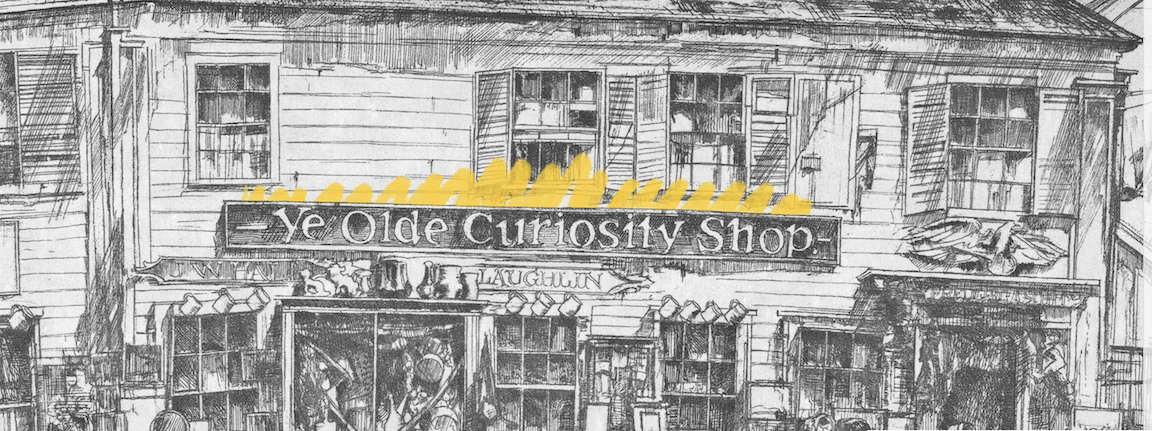
Ye Olde Curiosity Shoppe and Other Mispronunciations…

“Ye olde” is pronounced “the old.”

  • Ye Olde Curiosity Shop, Nantucket
    The next time you visit Ye Olde Shoppe or Ye Olde Taverne, you should know that the pronunciation of “ye” is actually just the boring, modern “the.” Way back in ye days of Old English — the earliest form of English, spoken from 450 CE to 1100 CE — the alphabet had some letters unfamiliar to us today. Starting in the seventh century CE, Christian missionaries began bringing the Latin alphabet with them to the British Isles, which slowly started to replace the runic script used before then. But a few of the older runes were integrated into what became a hybrid alphabet, including thorn (þ), which was pronounced “th.”

Until the Late Middle English period (beginning around 1450 CE), one common spelling of the word “the” was “þe,” particularly when the word was used at the beginning of a sentence. Over time, Middle English speakers began writing “þ” in a way that looked a little more like a “Y,” and once the printing press was invented, printers started just using “Y” to represent the character, especially when converting older written documents to typed ones. By then, “th” was also being used to represent the sound (the letter combination dates all the way back to ancient Rome), and it eventually took over the letter “Y” in the spelling of the word.

“Ye,” meaning “the,” reentered the popular lexicon with its modern pronunciation around 1850 as a gimmick for businesses that were trying to appear old, a usage that still persists today in business names such as Ye Olde Curiosity Shoppe. Soon after, “ye olde” also became a figure of speech for describing anything as archaic; one of the earliest uses referenced in the Oxford English Dictionary is a magazine article that describes a character as “ye olde fogie.”

………………….

I was just looking through my inbox and found two emails from my sister that I had never read before. This one was especially interesting:The source for this interesting artical is: https://historyfacts.com/arts-culture/fact/ye-olde-is-pronounced-the-old/

Lucky at Languages, Unlucky at Love

Image from freeimages.com            

This poem is pretty silly, but I like the challenge of using only one rhyme for an entire poem. More of a puzzle than anything else.

Lucky at Languages, Unlucky at Love

The night was warm and balmy and he was a man in uniform.
She was adept at languages from French to Greek to Cuneiform.
They met one balmy evening on the Eiffel Tower.
He aided her in climbing, then offered her a flower.
She thanked him first in French and when it drew a puzzled glance,
she surmised he must be from a place other than France.
She tried again in English, in Spanish and in Greek.
She would have tried her Chinese, but her Mandarin was weak.
She pointed to his medals, his ribbons and his bars—
all his decorations. She counted all his stars,
but could not find the language to express admiration.
And thus the evening ended, I fear in consternation.
The moral of the story? Put your horse before the cart. 
It’s best to know love’s language before you give your heart.


The prompts today were uniform and balmy. Here are the links:

https://ragtagcommunity.wordpress.com/2018/12/03/rdp-monday-uniform/
https://wordofthedaychallenge.wordpress.com/2018/12/03/balmy/

Coffee with No Ceremony!!

daily life  color014
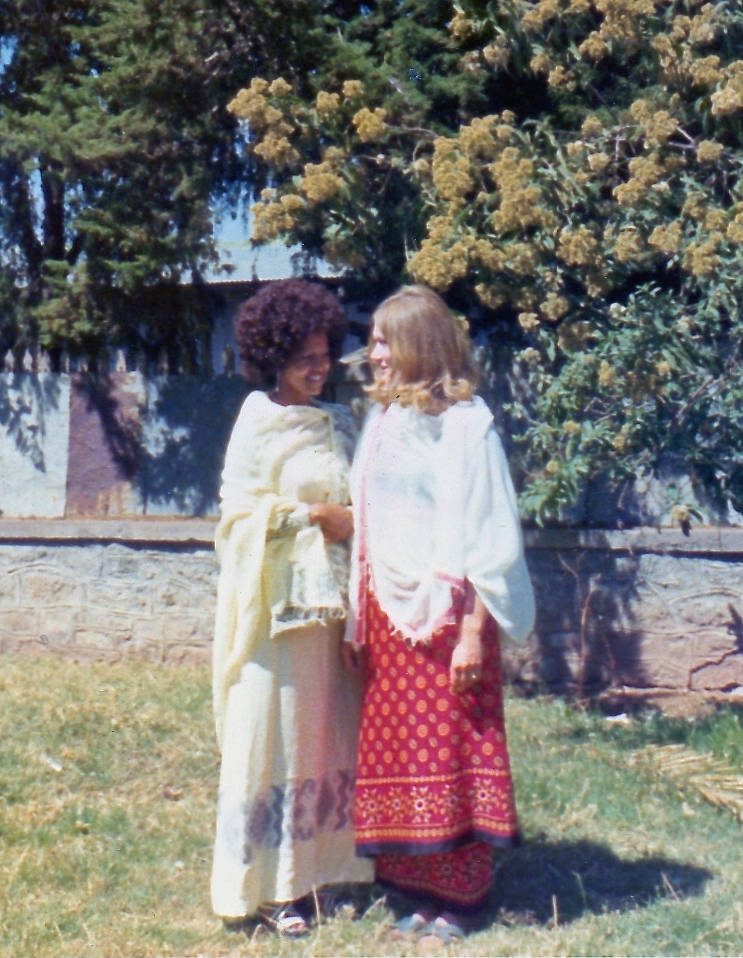
All dressed up for the coffee ceremony, but what is missing?

The Prompt: Dictionary, Shmictionary—Time to confess: tell us about a time when you used a word whose meaning you didn’t actually know (or were very wrong about, in retrospect).

Coffee With No Ceremony

I lived in Addis Ababa adjoining Mexico Square.
I ate injera every day. Had cornrows in my hair.
I thought I knew it all, and though my language skills were poor,
I knew enough Amharic to get by in any store.

Seated in a circle, on low stools around a flame,
We watched Demekech fan the fire—this ritual the same
in every house and every village all throughout the land.
The thick and sludgy coffee was always ground by hand.

Boiled in a clay carafe, then set aside to brew
as in another little pot, some corn kernels she threw.
The popcorn taken from the flame, the colo nuts were next.
Except—we found that we had none, and we were sorely vexed.

The coffee jug was sealed up with a fresh-wound plug of grass
ready for the pouring, but one aspect of our mass
was missing, so I said I’d go to buy some at the souk,
lest our hospitality give reason for rebuke.

These little shops were many, lining both sides of the street;
and at each one, I knew the custom—always did I greet
the owner with proper respect, and always, he said, “Yes!”
when I asked if he had colo, but I couldn’t guess

why no one ever seemed to want to sell any to me.
Always the same reaction—first the shock and then the glee.
So, finally, I walked back home. My failure I admitted.
Departing, I had felt so smart, but now I felt half-witted.

What had I done wrong? I knew that every shop had colo.
The problem must have been that I had gone to get them solo!
Returning empty-handed, I felt I was to blame.
Coffee without colo was a pity and a shame.

But my roommate and our guests and cook were really most surprised.
I must have asked for something else than colo, they surmised.
What did I ask for? When I told them, they dissolved in laughter.
They said that I was lucky not to get what I asked after.

For colo had two meanings, depending on the stress
put on the first syllable, and I had made a mess.
Instead of nuts, they told me (and this was just between us,)
­I had asked each souk owner—if he had a penis!

(This is a true story of only one of the gaffes I became famous for in the year and a half I taught and traveled in Ethiopia in the period leading up to the revolution that deposed Haile Selassie.)