Tag Archives: San Miguel de Allende

Innocents in Mexico: Chapter 6: A Rude Awakening and a Savior


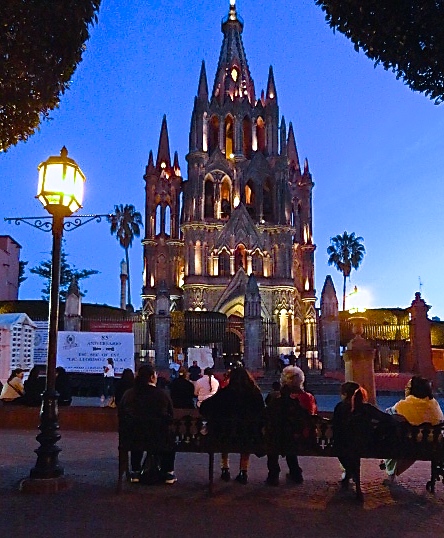
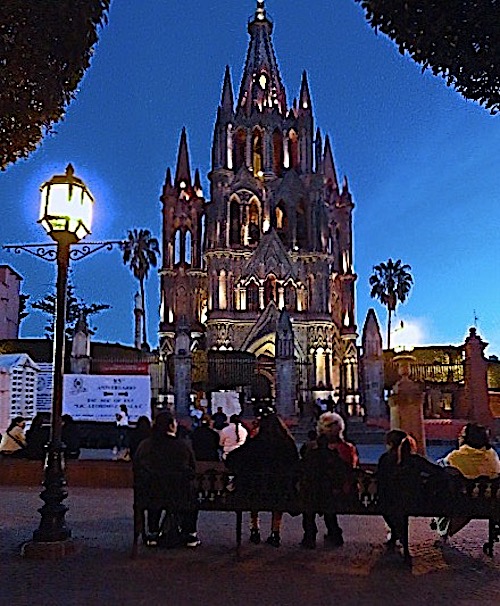
The Parroquia de San Miguel Arcángel

Find Chapter 1 HERE  Chapter 2 HERE   Chapter 3 HERE  Chapter 4 HERE  Chapter 5  HERE.

Chapter 6: A Rude Awakening and a Savior

            The next morning, we were awakened by the tooting of a horn outside our window.  I opened the door and looked out.  Resolutely and with a fine sense of rhythm, a woman was honking her horn for someone in the room next to us.  Undaunted by my stares, she continued to honk.  Bob slept on as I fastened Bearcat’s leash and attempted to take him for a walk.  I had forgotten that walks are a nighttime thing for cats––the later the better.  He resisted and I gave in.  By eleven, we were off to find a bank, a real estate agent and a really good map of San Miguel.  Unfortunately, all of these items proved to be easier to find than was a parking spot.  As we traversed still another circuitous route trying to find a parking space, Bob questioned whether we wanted to rent an apartment here, even for a week or a month.  He cursed the tiny cobblestone streets, the lack of signs.  The jardin area seemed to be all there was to San Miguel, he complained, and there wasn’t much to it.  “Did you like Oaxaca for the first few days we were there?” I asked. “Or Bali?” He admitted that he hadn’t, yet he had ended up wanting to live both places after a week or so of getting to know them.

Bob finally left me off at the tourist office, promising to join me there.  After 15 minutes, when he still hadn’t appeared, I moved off to a bench in the park, where I could sit in the shade while keeping an eye peeled on the door of the tourist agency.  On the bench sat an American woman who shared her experiences of living in both San Miguel and Guanajuato.  Fresh from a three-month course in Spanish, she chatted with the senor who sat down on my right.  Did he live in San Miguel?  Did he prefer it over Guanajuato?  Why?  Because it was warmer in San Miguel.  Because there was more to do.  I was thrilled that I understood most of what they were saying.

Bob joined us, still not too excited to be sitting on a park bench in such a difficult town.  We went to the bank.  Our time to pay for our tourist visas had nearly run out.  The custom at the El Paso crossing seemed to be to go to any bank in Mexico to pay for the visa which was issued by immigration in Juarez.  Since we had never managed to get to any banks while they were open for the three days it took us to drive to San Miguel, it was a pressing need for us to pay the fee and thereby amend our status as illegal aliens.  Unfortunately, when Bob had presented his visa to apply for the car permit at the customshouse south of Juarez, the woman had detached the carbon copy of his visa application and now, without it, the bank could not accept payment.  But the carbon copy was at the customs office south of Juarez, I argued, to no avail.  A Xerox copy would not do.  I paid for my visa, whose papers were intact, and went back to the waiting area where customers waited for the numbers on their pop-out tags to be called, like customers at a bakery or ice cream store.  Bob was deep in conversation with Lisa, a tanned woman who gave him advice on rental houses, classes and the arts community.  As her number was called, we moved to the front of the bank and I told him the bad news.  In front of the bank was another tanned American lady in straw brimmed hat and a stylish tan linen dress.“No,” she said firmly to the small girl who proffered a brightly dressed cloth doll for sale.

Bob and I were trying to figure out the route to Gigante––a huge market situated somewhere off our limited tourist map.  The bank manager had insisted that we must go to immigration and that this was where it was––in an office over Gigante.  A pelting monsoon rain had descended while we were in the bank and we stood under a broad overhang, waiting for it to calm down.  “Do you live in San Miguel?” I asked the stylish lady.  Yes, she did, and yes, she knew the way to Gigante.  To illustrate, she pulled out a vastly superior map to ours, then told us where the biblioteca was where we could purchase both this map and the definitive guide to San Miguel.  Her name was Kim, she was from Alameda, just an hour and a half from our California home, and she now lived in San Miguel.  “Well, here, have my map,” she said, after a few minutes of talking.  When I protested, she insisted.  When I offered to pay, she refused.  It was her gift.  She handed us a card, then moved off into the now abating rain.

At the Biblioteca, we bought books and guides and maps and cards and chatted to the man running the gift shop––another expatriate American who gave advice on apartments, cars (don’t keep them) concerts (go to them) and all of the glories of San Miguel.  Although the library itself was closed, its restaurant had been recommended to us by Kim, and we ate a nice lunch while eavesdropping on the other expatriate Americans who sat at the tables around us.  Small children skipped into the restaurant from the library singing “Happy Birthday to you” in Spanish-inflected English.  Someone shushed them, to no avail, and they ran out giggling loudly.        Outside the door of the restaurant, in the hall to the library, was a pay phone, where I stood trying to figure out the intricacies of a phone with a card slot and four buttons with indecipherable pictographs.  I finally called the number given on the first rental ad on my list.  The woman spoke English but didn’t know if she wanted an artist renting her house, which was immaculate, she said.  Maybe he could paint in the garage.  Would he spill paint on the floor?  A meticulous house sounded as uninviting as the $1,000 rent, so I explained we were perhaps not the right renters for her.  As I hung up the phone and prepared to make my next call, I saw a man sitting very near by with a phone card in his hand.  Was he waiting to make a call?  Yes.  Would he like to go in front of me?  He protested that he could wait, but when I said I was going to make a number of calls, he agreed that he’d like to make just one fast one.

He in fact made one very long call.  I stood shamelessly near, trying to encourage him to hurry, but he chatted on.  He was talking to a man that his friend Richard had told him he must meet.  Yes, he would meet him in the library on Monday.  He had a picture of him, so he would recognize him.  This phone call came to have all the ear markings of a blind date.  After five or ten minutes, he ambled his call to a close and handed over the phone, then stood talking to Bob, as unabashedly listening to my call as I had his.  “Are you looking for a house to rent?” he asked Bob.  He knew of a house, which he seemed to be describing to Bob as I tried out my laughable Spanish on yet another homeowner.

“Are they speaking Spanish?” He asked, as he heard my garbled string of Spanish tape phrases.

“Yes,” I admitted. “Do you speak Spanish?”

He did, and offered to interpret.  I happily handed over the phone.

Toward the end of the phone call, my telephone card ran out and he was cut off.  When I tried to call back with another card, he discouraged me.  “You don’t want to live there,” he said.  “It’s at the end of a very dusty road.  It’s too far from the center.  What you need to do is find a room near the center so you can park your car and answer all the ads in the newspapers for a week to find the right house.“

He told us his name, which was Ernesto.  He told us about the art school where he taught art to poor kids.  He told us about art happenings and poetry happenings and music.  He told us of a different hotel where we should stay and of a house nearby that was coming up to rent.  In the end, he took us himself to the Posada de los Monjes, an historic  hotel that was a converted convent, and translated with the front desk, insisting on the room with the best view.  As we moved through the front of the building through wooden doors hundreds of years old, the full glory of four floors of terraced stone opening onto a cobbled courtyard where we could park our van was revealed.  Broad terraces with crenelated walls jutted out from some of the rooms and wide outside corridors joined them.

We climbed higher and higher until we came to the room chosen for us––a bit small but with a beautiful tiled bathroom with stone shower.  Coming out of the room, we moved out to the private patio bigger than the room.  Below us stretched the entire panorama of San Miguel.  Breathtaking.  The church, the tile roofs, the jagged skyline and yellow hills.  The rooftop gardens and trees jutting up from courtyards.  We were so high that little rose higher above us than our own roof.  We had a 300-degree view and all of it was beautiful.  Never mind the steps.  We could have all of this for barely more than our motel room which was nice and roomy but viewless and near traffic noise.

Do you want to see the room with two beds, asked Ernesto?  It’s bigger, but also $10 more a night.  We’d see it, we said, but the cheaper room would probably do.  I must admit, I dreaded the confinement of the smaller room, but knew we’d probably not spend much time there anyway, and could just spend that time on the most glorious patio on earth.  But, we went to see the room, which was bigger, with its own living room, better views from the room itself, but no patio.  Or at least we thought so until we ascended the stairs outside the room to the patio on top of the room that had even a better view than the room before it––this one a full 360-degrees!

The view was well worth the extra ten dollars a night.  In ten years, we would not miss the money, but we’d never forget the view.  We took the room. We would move in the next day! Ernesto took us to the art institute––not his, but the one near the center.  In the end, he offered Bob a job at his art school.  No salary, but a job just the same.  He could use the facilities free in return for any amount of time he wanted to teach.  Then, meeting a friend he knew on the street, he faded back into the life of San Miguel.  He had made a date with Bob to meet Monday to see about showing us the house that his friend had just built.

The importance of meeting Ernesto?  Bob had gone from wanting to move on to wanting to rent a house in just hours.

“How do you like that?” he said.  “In San Miguel less than 24 hours and I’ve already been offered a job teaching art.”

Right then and there, we went to Mailboxes Etc. and rented a mailbox for three months.  The proprietor of this establishment introduced herself as Annie and she told us the intricacies of sending mail and packages into and out of Mexico.  What to do.  What not to do.  How to send tax papers, magazines, bills, packages.  Another stranger popping up to solve our severest problems.  Like magic.

That night, we peeked into courtyard after courtyard looking for the right restaurant.  Bob, who had formerly hated Mexican food, picked a Mexican restaurant, pronounced his meal delicious  and paid the musician to serenade us with a rendition of “Rancho Grande” that rivaled any Oaxacan version we’d ever heard.

“The thing about San Miguel,” he explained, “is that a good deal of it is hidden.  You don’t see it by casual observation.  You have to look farther,”  That night he stayed up hours later than usual, poring over guide books and maps.  Bearcat curled on my bed as I sat at my laptop.

“Tomorrow you get to go to your new home,” Bob told him.  “You get to go from being an under-bed cat to a roof cat.”

See Chapter 7 HERE.

Innocents in Mexico, Chapter 5: Zacatecas, Aguascalientes and Finally, San Miguel!!!!!

Street Scene, Guanajuato

Find Chapter 1 HERE  Chapter 2 HERE   Chapter 3 HERE  Chapter 4 HERE

Innocents in Mexico

Chapter 5: Zacatecas, Aguascalientes and Finally, San Miguel!!!!

            The next morning, a few more hours of driving through the desert brought us to Zacatecas.  There everything began to look more prosperous, with trees in evidence and large trucks bringing more to plant, their roots balled in white canvas.  Square adobe houses rose up in diagonal terraces, some painted bright basic colors.  Here, as in other towns we’d passed, bright and huge modern sculptures sprouted out of cement plazas with lights installed at the base for night viewing.  Hundreds of black plastic water reservoirs on the tops of houses appeared to be some new Christo installation.  New buildings in all stages of completion were everywhere.  There was a sense of style here, but no imitation of any North American, Italian, Spanish or any other style.  It was a style all their own––clean, adventurous, purely modern Mexico.  We were in too much of a hurry to stop to see who was responsible for any of the large sculptures.  Perhaps on our next trip.
            Between Zacatecas and Aguascalientes, the desert gave way to grasslands and crops.  Long white irrigation tubes paralleled the highway.  We made out corn, grapes, some white-flowered crops–– onions, garlic, or perhaps just flowers.  We passed a truck fluffy with kale.
            In Aguascalientes, we seemed to drive in circles following the “Mexico” signs.  When they gave out, we drove on in what seemed to be a logical direction.  A taxi driver told us to turn left and we again seemed to be going in a circle before finding the signs.  They again deserted us, but after a half hour or so of driving hopefully toward Leon, we again found the signs and made our way out of Aguascalientes past yet another colossal orange geometric sculpture.
            The country once more turned to sand, this time interspersed with low trees and some crops.  In the distance, a colossal black bull stood silhouetted against the clouds.  Billboard or sculpture?  To our left, the fields were verdant green, to our right, pale tan, as though it were a different season on each side of the road.  We passed the bull.  It was a billboard advertising Magno Osborne in vivid orange and white letters.  We passed a Green Angel truck––about the fifth one we’d seen since entering Mexico.  A sort of governmental AAA, they patrolled the roads to help vehicles in distress.  You paid for the gas, tires or parts, but not the repairs.  A sign told us we were 445 miles from Mexico City––a place we had no plans to ever drive to.
            Nearing Leon, everything became more prosperous.  Guardrails and trees lined the toll road.  Corrugated metal sheds replaced the adobe corrals, and cement fenceposts stretched for miles along the road, strung together by three neatly spaced strands of barbed wire.  Red and white antennas rose like stelae high into the sky.  High line wires, like modern installation sculpture, passed electricity along fourteen thick cables strung high up in the sky on the most modern of poles.  More large factories appeared, as did numerous monstrous billboards.  A man and two small girls in bright handwoven skirts waited in the median to cross the southbound two lanes which were solid with cars.  Green fields stood out against the fall colors predominant on the landscape, though it was only May.
            On the road through Silao, we somehow got diverted through the town.  Streets became narrower and narrower, signs vanished, and we went in circles, trying to avoid dead ends.  Finally, I resorted to asking directions from the window of our car.
            “Donde Esta Guanajuato?” I asked, then failed to understand any of the directions given by men on street corners.  Finally, a patient man with his family in the car motioned for us to follow him and led us out of town onto the Guanajuato road. “Muchas Gracias!” I repeated twice as we pulled up beside him in the double lane.  What was lacking in road sign efficiency was made up for by the extreme courtesy of the citizens of Mexico.
            We passed a huge GM plant surrounded by acres of cars and trucks ready to head north.  The plant was the size of a shopping mall––vivid yellow and blue.  We passed jacaranda trees, palms, cypress and willow.  For the first time, I noticed eucalyptus.  There was a lushness here not experienced farther north, where vegetation was of the desert variety.  We passed a large metal sculpture––the facial outlines of a man who resembled Groucho Marx, with leaves for eyebrows.
            Reluctantly, we drove through Guanajuato without stopping.  Bright blue and orange houses climbed the hills.  By the roadside, vendors sold coconuts with holes chopped in their tops and a lime plugging the opening. The country was more interesting, with mesas and small jagged mountains jutting up against the skyline.  Stone, brick and adobe casas sprinkled the landscape.  They were larger than the houses farther north, with distance between them.  There were pigs in the road, then cattle.  Horses were tethered very close to the road, eating the grass growing out of the side of the blacktop.  We passed a donkey lying dead, half on the road, half off.  Her colt stood by her, trying to nudge her over to nurse.
            Our van climbed up the road to San Miguel de Allende, bringing us  to our final destination in plenty of time to hit the oficina de turismo , which our guide book assured us stayed open until seven.  With only the vague and limited map in our Berkeley Budget Travel Guide, however, we got hopelessly lost in the winding, hilly, cobblestone streets.  Time and time again we wound into areas that had become too narrow, steep or circuitous for our Dodge Van.  Bob got frustrated and said he was glad we hadn’t rented out our house in Boulder Creek yet.  He was already sick of San Miguel.
            We finally parked on a narrow street on a very high hill and walked down to what we hoped was the Plaza Principal.  The tourist office did not seem to be where they had said it would be on the map, and we wandered aimlessly, guide book in hand.  By the time we finally found it, it was closed.  Seasoned residents observed us kindly, but with some humor, I think.  Finally, we found a travel agent and threw ourselves on her mercy.  She suggested a motel which was, she said, moderate in price, where we could park our car––an oddity in this city of narrow, winding cobblestone alleys.  An hour later, having circled the whole town twice, small street by small street, I again threw myself on the mercy of a man behind the counter of a small shop, and he and his wife drew me a map.  “Estoy perdida,” (I am lost) I explained, to their complete delight.  Our Spanish tapes had finally paid off.
            With a good deal of more unnecessary winding, we found the hotel, which turned out to cost $98 a night.  Since we considered this amount to be more than moderate, we started checking out hotels at random.  The next, which appeared modest to us, was $109 a night.
            When I asked his advice, the manager of the $109 hotel got on the phone and located a motel with parking space for $38 a night.  An hour or so later, after much searching, we found it more or less where he had promised it would be.  It was lovely, with fireplace, tiled bath, TV, bottled water––all the amenities.  We unloaded our luggage and installed Bearcat under yet another strange bed.
            Finding the Plaza Principal again proved to be another hair-raising experience, as we wound higher and higher on smaller and smaller roads––finally ending up at a castle-like casa with barely enough room to turn around in a space bounded by the castle walls on one side, a sheer drop-off on the other.  We finally found the plaza, and an Italian restaurant with Peruvian music.  Bob was happy.  When we returned to our room, Bear was eventually coerced out from under the bed with tinned salmon and was happy once we’d turned out the lights and flipped on the tube.  “The Effect of Gamma Rays on Man-In-The-Moon Marigolds” was on in English with Spanish subtitles––a movie I’d been wanting to see again complete with Spanish lessons.  Now I was happy, too.

Find Chapter 6 HERE.

And… for FOWC prompt of destination!!!

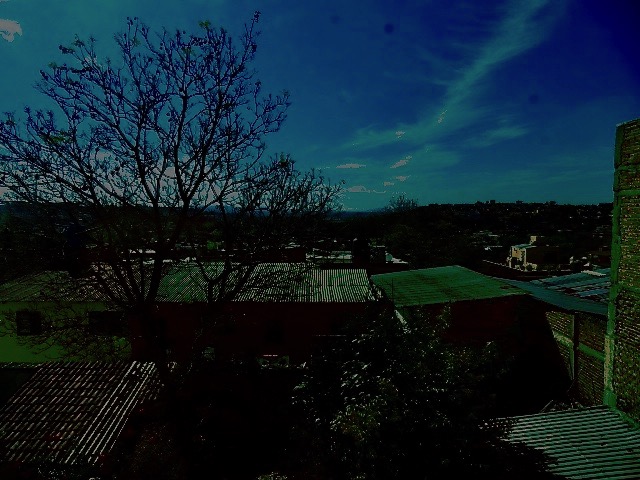
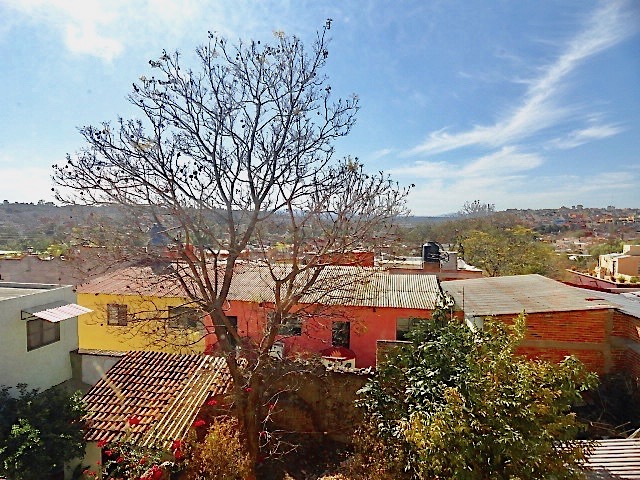
Travel Challenge Day 10, Treking up to the Aqueduct

Someone who reads my blog should recognize these photos. Nice trek up to the aqueduct. This is my last day doing this challenge and I invite anyone who wishes to to publish ten travel photos–one a day for ten days. You may either post just the photo or include whatever information you wish to.

Here is a link to day 1 of the challenge.

San Miguel Nocturn


San Miguel Nocturn.

It’s two in the morning.
Dogs call out greetings or warnings,
the near dogs hoarse in their excitement,
the far dogs mellow and rounded
in the echoing distance.

What are they saying?
Bright moon like a bowl,
new bitch in the territory,
a whole leg bone today?

All night long they bark and bay
until 4 am when the first
then the second and the third rooster crows.

Someone throws a handful of grain
and the chickens cluck like popcorn
in a finally hot pan,
waking the city which only
seemed to sleep.

The lobby steward, waiting
for the last guest to enter,
nods at his post,
t.v. static charging the air around him.
The guard by the gate waits
for the honk of a horn.

A woman crouches
over a pad of paper in the bathroom
so as not to awaken her friend.
Her pen scratches as hens  scratch
in the dirt of the yard below her window.
The friend’s almost imperceptible
snores are a counterpoint to the music
of the first cars
accelerating up the cobbled hills.

New sounds build the symphony:
the slam of a car door,
footsteps on the stairs,
water in the pipes.

A city’s wide morning yawns
clash and reverberate
in the  still darkness
as dogs bark like a hammer
pounding repetitiously,
building the new day.

San Miguel de Allende, 2002. Click on any of the last 5 photos to enlarge all.

This old convent, converted into a hotel, is where I have always stayed when I go to San Miguel.  Bob and I stayed there just months before his death. This poem was written a few months later when I revisited our favorite places in San Miguel with a friend. That is what this poem was written. To see the poem that I wrote that night, go HERE.

Egrets in Benito Juarez Park


Click on any photo to enlarge all.

Egrets in Benito Juarez Park

By threes and fours, they soar in and alight
on sparse branches of the bent, high-spreading trees.
Below them the steady beat of dribbling basket balls
whose rhythms they punctuate with high-pitched squawks.

A hundred or more now bark like gulls,
protesting each new arrival perched too near
and settle invisible against a sky that’s glazed so pale
by torn white clouds,
that it’s barely a different color
From clouds and egrets.

A feather floats down, soars sideways
to rest under the green bench.
and I retrieve it, like a message from a saint.

More birds soar in,
their legs like two black straws held parallel and horizontal.
On limb after limb, they stand exposed, flapping wings,
with neck first fragile,
then settled into a dowager’s hump.
Once motionless, they, too, become
invisible above the shouts of children,
rebound of a ball against a backboard,
hum of generator, blast of horn, peal of church bell.

Thirty more birds attempt the impossible—
to fill gaps in a tree where no gaps exist—
like a Christmas tree with not one single limb left to ornament.
Birds lift, sift to a different tree.
Now that the stronger limbs are taken,
they perch on swinging branches,
then move to safer perches,
displacing other birds
that drift in turn until more trees fill.
Wave after wave,
on tree after tallest tree,
they settle again to silence.

This happened before we came,
will continue after I leave.
These trees alive with birds that were,
scant hours ago,
solitary waders.

Returning to the posada where I last stayed with you,
I climb staircase after staircase
past the stone room that was ours.
This is the trip I dreaded–
thought I’d never make.
I remember everything:
all the places where we’d been—
the park, the hotel and the plaza,
each favorite cafe made holy from past associations.

Yet I hold only
one feather from the egret,
see only
crenellations of the room across the courtyard where we stayed.
Hear only
the saxophonist, improved since I was here with you,
filling in the intervals between
one dog barking from a rooftop down below
and far off dogs, his accompaniment.

The saxophone spins out lines
through darkness,
the staffs of music a communication
between then and now and what remains
after the birds have flown,
after the saxophone is laid to rest
mute in its coffin, wooden tongue dried stiff.

What remains after the barking dog,
after the stairway crumbles, and the stars have cycled into another sky.
What remains as my life soars away from you,
your stillness framing my flight,
as you stretch invisible,
yet as solid around me
as clouds.


San Miguel de Allende, 2001. Click on any photo to enlarge all.

To see a companion poem and photos, go HERE.

Cees Fun Photo Challenge: Churches (San Miguel Church)

DSC09846 DSC09840 DSC09874
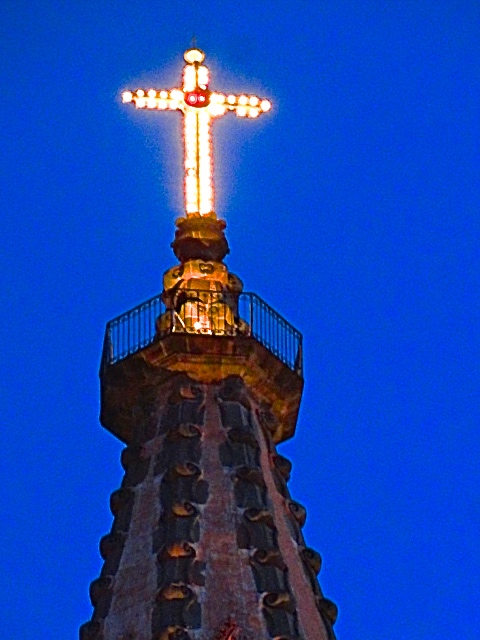
San Miguel’s church in the Plaza Principal is noted for the change of color in different light. It had a cleaning about 14 years ago and I need to try to find some of my old pictures to show the difference..
http://ceenphotography.com/2015/04/07/cees-fun-foto-challenge-churches-or-any-religious-building-2/