The Silence of the Iambs
Anapests sing lullabies while dactyls gallop on.
Trochees beat a drum beat that’s heard hither and yon,
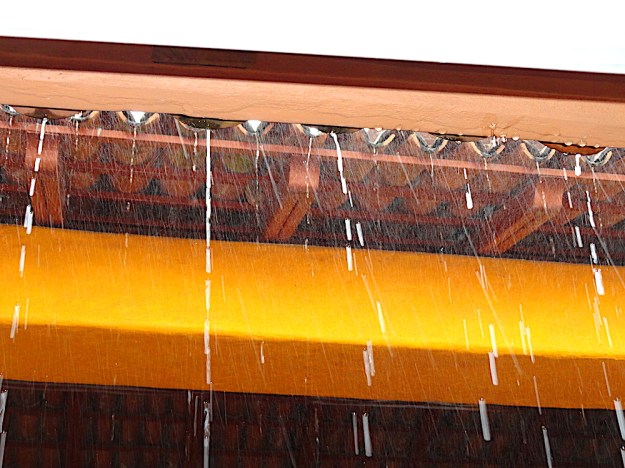
but raindrops speak in iambs, dripping from the eaves
as the torrent lessens and cups itself in leaves.
All the small feet hushed now, we can fall asleep.
We can find our dreams inside a silence that’s so deep.
The title, by the way, is talking about iambs, not lambs. Hard to tell when it is capitalized.
The loud rhythms of the unseasonal rain that awakened me so early this morning have ceased, leaving only the faint drip of water off the eaves. This poem may be one that only another poet could appreciate, but for those of you who aren’t poets and who didn’t pay attention in your lit class, it is about metrical feet—the syllable rhythms within a poem and even within our everyday speech and nature itself. A trochee (the rhythm of a native American drumbeat replicated in the poem “Hiawatha”) is an accented or long syllable followed by a short one. An iamb is the rhythm in the English we speak every day––a short syllable followed by a long one. An anapest is the rhythm of a lullaby. (short short long) whereas a dactyl (the rhythm of a horse’s gallop) is its opposite (long short short).
The prompt today is silent.
 lifelessons - a blog by Judy Dykstra-Brown
I never got the difference between the various feet. I always need someone else to tell me what that beat is … but at least I know what they are, even if I can’t instantly identify them 😀
LikeLiked by 1 person
Your name is a dactyl followed by a trochee or spondee, depending on whether you say “Armstrong” with stress on both syllables or just the first. In case you were wondering. ;o)
LikeLike
iambs to me are the most elegant, a confident walk… just like raindrops.
LikeLiked by 2 people
I have always been fond on anapests. They move the words and thoughts right along.
LikeLike
I’m a iamb man through and through
LikeLike
I appreciate a man faithful to his convictions!
LikeLike
I knew feet and iamb but it’s the first I’ve heard of trochee, anapest, and dactyl. That made me instantly think of pterodactyl and found dactyl came from the Greek word for daktulos for finger. Who knew poetry and dinosaurs came from the same roots?
LikeLiked by 2 people
Ha..I love your spirit of inquiry and now you’ve taught me something, too. Now we have fingers and feet!!! I think this is the stuff of a poem. You or me???
LikeLiked by 2 people
laughing, fingers and feet. Indeed we do. I love the paths words make until they stumble into poems.
LikeLiked by 2 people
I love why the poetic term is called a dactyl! From Merriam-Webster:
Origin and Etymology of dactyl: Middle English dactile, from Latin dactylus, from Greek daktylos, literally, finger; from the fact that the first of three syllables is the longest, like the joints of the finger
LikeLiked by 2 people
Great way to remember. I always need to double check between dactylic and trochaic. Now I never will!
LikeLike
Fabulous, clever poem, Judy!
LikeLiked by 1 person
Thanks, Jennifer.
LikeLike
I like the “small feet hushed now.” Clever!
LikeLike
Thanks, revivedwriter. I think this is a poem for a very limited audience.
LikeLike
Delightful!
LikeLike
The terms are all challenging to me stil but I admire the poet who can master them ~ Happy Holidays to you ~
LikeLiked by 1 person
Thanks, Grace. I was an English teacher so all part of the job. I have to look them up to make sure I’m right, though!!!
LikeLike
I like the interplay of poetry tropes and nature, Judy. Well done! Merry Christmas!
LikeLiked by 1 person
Thanks, Sarah. Merry Xmas to you as well.
LikeLike
The minute I saw the prompt, “The silence of the iambs” popped into my mind. Had to follow it, wherever it led.
LikeLike
Thank you for the great explanation! You had me going for a while! I was expecting Hannibal Lecter!! I learned something today. Thank you.
Dwight
LikeLiked by 1 person
Ha. I knew that title would cause confusion. I considered not capitalizing it, hoping it would help, but then the misdirection was also fun. I like my iambs with a few fava beans, don’t you????
LikeLiked by 1 person
Yes, LOL, it worked very well!
LikeLike
Nice praise to the iamb leading to dreams and deep sleep.
LikeLiked by 1 person
Thanks for the lit lesson…without your notes I would have been trying to conflate your poem with Hannibal Lecter.
LikeLiked by 1 person
Generally, I feel it is cheating to explain a poem, but when it is terms, it can be necessary. Even lit. teachers need reminders!
LikeLike
❤️
LikeLike
Pingback: Two Poems of Silence for WQWWC 94 | lifelessons – a blog by Judy Dykstra-Brown
Judy, thank you for the wonderful lesson in English as well as the creative poem about poetry. Wow. I self studied poetry especially about 20 years ago when I started writing different form poems. But I’ve never been immersed so as to learn all the terminology. Thanks for joining in WQWWC this week. It’s great to have you. 🙂
LikeLike
Thanks for letting me wax pedantic, Marsha! ;o)
LikeLiked by 1 person
I rather like pedantic. That’s what I am – a life-long pedantic. 🙂 My husband gets a little tired of it, so I try to pull in the reigns most of the time.
LikeLike
Thanks for linking this poem, Judy. It’s perfect for this challenge! 🙂
LikeLike