Tag Archives: poem about metrical feet

“Some Poetic Feet” for dVerse Poets Open Link Night

Malina Rose photo

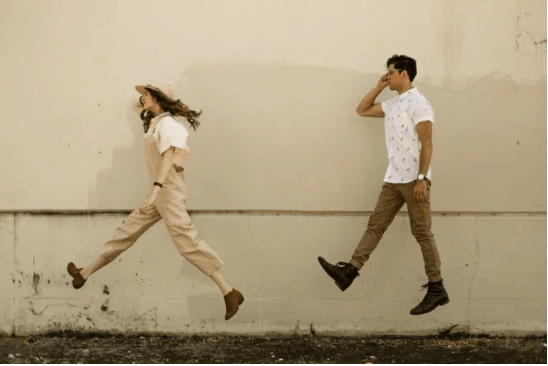
Four Feet off the Ground

He loved her khaki overalls, her hiking boots and hat,
so altered his agenda to be where she was at.
He knew she was the girl for him, and though he’d never met her,
he knew at once he was in love and that he’d not forget her.
He tracked her to the lunch room, sneaking down the hall,
keeping so far behind she didn’t notice him at all.
He followed her to English class, then slipped into his own.
If it had been left up to him, she never would have known
the strength of his affection. Nor would she have met him.
She would have had no choice to remember or forget him.
From the start, he thought that she clearly walked on air
and one day without knowing it, he followed her up there.
She was two feet off the ground, and with him, it made four.
All across the campus, they were seen to soar.
But when she stopped abruptly, he simply could not miss her.
He forged ahead, bumped into her, and when she turned, he kissed her!
And though at first it seemed that she merely was astounded,
in time, they formed a pair and then they were more firmly grounded.


For Photo Challenge #269

For dVerse Poets Open Link Night..Some Poetic Fet!
Syncopated Poesy


Syncopated Poesy

An iamb becomes a trochee and an anapest a dactyl.
Spondees get less pointed and  the pyrrhics turn more tactile.
Syncopated Poetry turns everything around.
Loud words get hushed down and the quiet words pick up sound.
“By the shores of Gitcheegoomie” loses all its zing.
That’s what comes from meddling with a verse’s swing.


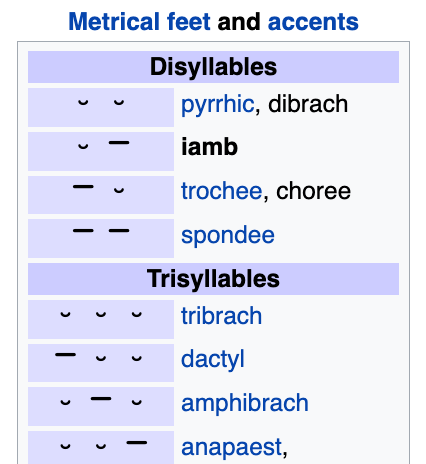
The Daily Spur post for the day is syncopate. In case you’ve forgotten, below are the metrical feet of poetry: iamb ul, trochee lu, dactyl luu, anapest uul, spondee //, pyrrhic uu

Syn·co·pate:to displace the beats or accents in (music or a rhythm) so that strong beats become weak and vice versa. Or, to shorten (a word) by dropping sounds or letters in the middle, as in symbology for symbolology, or Gloster for Gloucester.

The Silence of the Iambs

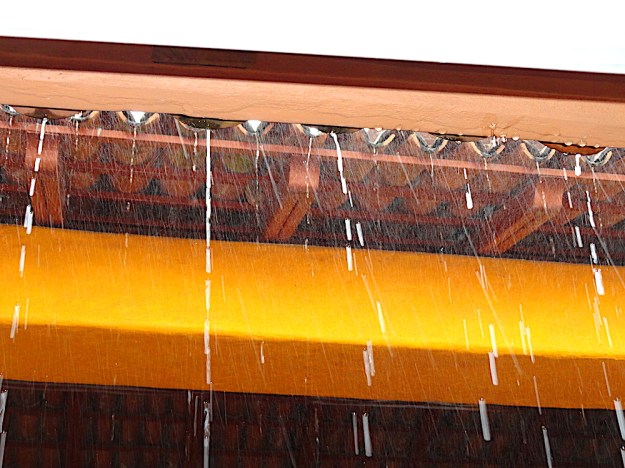
DSC07116


The Silence of the Iambs

Anapests sing lullabies while dactyls gallop on.
Trochees beat a drum beat that’s heard hither and yon,
but raindrops speak in iambs, dripping from the eaves
as the torrent lessens and cups itself in leaves.
All the small feet hushed now, we can fall asleep.
We can find our dreams inside a silence that’s so deep.


The title, by the way, is talking about iambs, not lambs.  Hard to tell when it is capitalized.

The loud rhythms of the unseasonal rain that awakened me so early this morning have ceased, leaving only the faint drip of water off the eaves. This poem may be one that only another poet could appreciate, but for those of you who aren’t poets and who didn’t pay attention in your lit class, it is about metrical feet—the syllable rhythms within a poem and even within our everyday speech and nature itself.  A trochee (the rhythm of a native American drumbeat replicated in the poem “Hiawatha”) is an accented or long syllable followed by a short one. An iamb is the rhythm in the English we speak every day––a short syllable followed by a long one. An anapest is the rhythm of a lullaby. (short short long) whereas a dactyl (the rhythm of a horse’s gallop) is its opposite (long short short).


The prompt today is silent.