 My mother, Eunice King, in goat cart with sister Edith, shortly before their father and sister died in the flu epidemic.
I had been told by my mother that the first deaths from that flu were in Ft. Riley, Kansas—brought home by soldiers to the fort where my maternal grandfather worked. I’d always been told that he died in that epidemic, as did his daughter Pearl, who was my mother’s sister, but looking through family records while looking for these photos, I have discovered that they seem to have died two years before the flu epidemic, so I am digging urther. The account of that period below is an excerpt from the family chronicle of the friend of a friend of my sister, who sent it to her and she sent it on to me. I am sharing it here because I think this account has some relevance to our present situation. My mother’s family lived in Junction City Kansas, near Ft. Riley. The story told below took place in Wyoming and describes what a different family went through during the time of the epidemic.
An Unknown Enemy
In 1873, Dr. William A. Hocker, was on his way to California to begin his career as a physician. During a stopover in the frontier town of Evanston, Wyoming he was beckoned to the bedside of a young woman with pneumonia fighting for her life. Unwilling to abandon a sick patient, Dr. Hocker let the train go on without him. So began his lifelong commitment to the development of medical care in Wyoming. He practiced in Evanston, Frontier and Kemmerer; served in the Wyoming Territorial Legislature; and was instrumental in founding the Wyoming State Hospital where he also served as the first superintendent.
Here, (as described by his daughter, Woods Hocker Manley) in 1918, Dr. Hocker faces the infamous Spanish Flu epidemic.
During the long winter that followed his operation Papa had little time to think about himself. He was city and county health officer, and a dreadful wave of influenza was sweeping the nation that fall and winter of 1918. However weak he might be physically, he was still in command of the community’s health regulations.
With the coming of the flu he established a general quarantine. He ordered that the town be closed, and he put out guards on all roads and at the railroad station. It was a drastic step, but he felt sure that it would save lives. He gave the order that no one was to enter the town.
The ways of influenza were mysterious, and no one knew for a certainty how it could be brought under control. But this was evident in Papa’s quarantined community: as long as the order was in force, about three weeks, no flu cases occurred. It was a well-known fact that people were dying daily in other towns. But in Papa’s town the quarantine was working.
Then the impatient merchants rebelled. Business was nearing a standstill, and they were greatly concerned. They demanded that he lift the order. Papa counseled with them. They were insistent. Then he called a public meeting so that the issue could be put to a vote. In his wheelchair, he sat with the other town officials on the platform. There was compassion in his voice as he spoke. His hands trembled a little, yet he fought his fight with a calmness and a strength that belied his real condition. But he was dealing with an unknown enemy, the flu itself. He could assert that he believed the quarantine was wise, but there were no scientific proofs. His whole argument was a plea for common-sense precautions, all manner of precautions, no matter
if the community erred on the side of safety. Business might suffer temporarily – yes; but who knew how many precious lives were in the balance?
In the end he was outvoted. The merchants had come to the meeting determined to break the quarantine, and they were backed by a solid majority of those present. The quarantine was lifted. Within a week or ten days the tragic death wave that had already swept through surrounding towns had come to Papa’s community as well; and before the winter had passed the results were appalling.
Manley, Woods Hocker. The Doctor’s Wyoming Children: A Family Chronicle. New York, NY: Exposition Press, 1953.
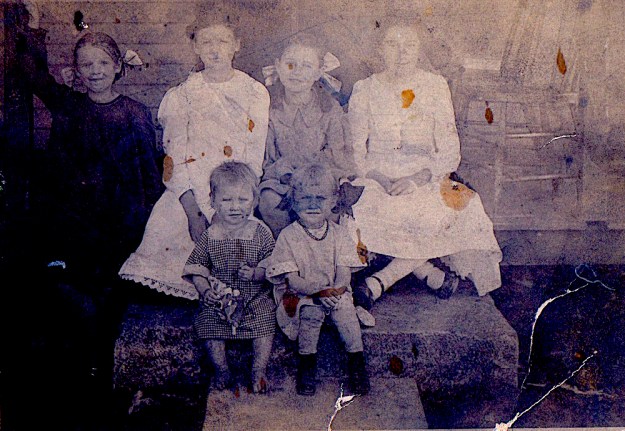
My mother Eunice (Pat), bottom left, with her sisters. Edith is next to her in the front row with the hair bow. Second row is Bessie (Betty), Myrtle, Alpha (Peggy), and Pearl.. They had two brothers, Hiram and Wayne, who are not pictured. The traveling photographer just dropped by and asked if they wanted their photo taken. All the older girls ran up to fix themselves up in their finest, but didn’t bother to dress up mother, who is photographed in her little sack play dress with messed-up hair and dirty bare feet, toes wiggling and holding her doll.
 lifelessons - a blog by Judy Dykstra-Brown
I’m glad you share as this is very relevant to today’s virus. Thanks for sharing. 🙂
LikeLike
You are welcome, Debbie. I think it is, too.
LikeLike
Very sad.
LikeLike
I thank you for sharing the tragic story and the family photos, Judy. Being a grammar freak, I couldn’t help but notice the ambiguous “she died” in the caption to the first picture. I hope I haven’t offended you!
LikeLike
You mean you couldn’t tell whether my aunt or my mother died? If it had been my mother, she would have given birth to me at an extremely early age.. ha. But I did wonder about, that, too, but since Forgottenman didn’t pick up on it I figured I’d squeak by…
LikeLiked by 1 person
That’s what took me for a shock when I first read it. Nothing squeaks by a college professor who’s been reading student papers for 40 years!
LikeLiked by 1 person
Okay, Ms. Fussybritches, it is fixed. I’ve spent as much time repairing this post as writing it. Forgottenman insisted I take out all references to the Spanish Flu, saying people now took occasion to such regional naming of diseases. Then I had to clarify whose family the article was about.. do some spacing and italic changes…but I think, finally, it is perfection…and I was an English teacher also, you know!!! Guess I should know better than to think I could squeak by.
LikeLiked by 2 people
Did you see that the man who won Top Chef this past year just died of the Coronavirus?
LikeLike
Fussibritches! Never heard this expression! I could agree with Forgottenman about Spanish Flu, but then what do we do about Thomas Mann’s Death in Venice? Transfer it into outer space? There is a fish here in the bay called Jewfish. It has a long nose. Should we start lobbying to rename it as a racial slur? I think at some point political correctness borders on absurdity.
LikeLiked by 1 person
I actually made up that name just in your honor.
I had a very close friend who was Jewish when I lived in L.A. and once I asked her if she was trying to Jew me down on the price of something. She took occasion to my statement as she well should have and I was mortified. It had somehow never occurred to me that that was a derisive term. We get so accustomed to saying things with no malice intended that we lose sight of what we are really saying. Needless to say I have never ever used the term again..nor the term “Indian giver” which was used when someone gave you something and then wanted it back. It actually came about out of ignorance of the custom within some tribes of having a cyclic gift that was passed from hand-to-hand. It was a sort of sharing and in fact a beautiful practice–not at all the selfish act it came to describe when the phrase was adopted by the white man’s culture. At any rate, fussybritches was meant as a teasing term of endearment and is not meant as a comment on any manner on your actual attire!!!
;o)
LikeLiked by 2 people
I wasn’t offended, don’t worry; on the contrary, I loved it!
We have a term here “standard Jamaican time,” which originates not only in Jamaica, but most of the Caribbean cultures where they make appointments by saying “Catch you later,” Somehow they do manage to get things done, but I would never use this expression around Jamaicans. Altogether, I despise ethnic jokes, but political correctness, in my opinion, goes overboard sometimes.
LikeLike
Here it is called Mexican time and the Mexicans use the phrase as well.
LikeLiked by 1 person
I have never heard this phrase in Spanish, even though we also have standard Cuban time, AKA Mañana time.
LikeLike
The first book I read before I came down to investigate Mexico as a place to retire was
On Mexican Time: A New Life in San Miguel
by Tony Cohan.
LikeLiked by 1 person
Ah, a book. But do they really have an expression in Spanish?
LikeLike
Yes.. it is common usage.. that’s why he used it in his title.
LikeLiked by 1 person
But what do they actually say in Spanish?
LikeLike
Didn’t take much to figure that one out~! This was so interesting and related both to you, your family and the current situation. Happy that I do have anyone editing what I say, at least I do not know of any so far~! One question, on the (goat picture) is that your mom on the right~? She looks a lot like you. Now as to the “goat picture” I am sure to get feed back….
LikeLike
My mother was in the wagon. Her sister was standing beside her. I am now in a dialogue with my sister about which aunt died in the earlier flu epidemic. My sister thinks it was Pearl. I am equally sure it was Edith. I am going through old old-written notes and types accounts of distant relatives visiting gravesites to try to figure out the puzzle. Why didn’t I ask more questions when my mother was alive? I don’t know who you are, by the way. You are just labeled as “Someone” on your comment.. Thanks so much for that comment…
LikeLike
the 1920 census may tell you which one was still living,,,,
LikeLike
How would I see the 1920 census?
LikeLike
Thank you Judy. Great thought for today.
LikeLike
Wow — I just had a conversation last night about what would happen if everything was to open up within the next week — we decided it would create a wave of illness similar to what you describe above!
LikeLiked by 1 person
I know. And the president of Mexico is still denying that anything should close down.
LikeLiked by 1 person
Oooh — I was wondering how it’s going in Mexico! I did hear a report that Mexico is screening (or considering screening) incoming travelers from the US. I also learned yesterday that the Spanish Flu didn’t come from Spain at all — they think now that it began in Oklahoma with a group of soldiers turning mulch or manure in the fields. I guess we don’t yet know very much about the dynamics of disease! I hadn’t heard that before, but there was apparently a documentary recently in which that was explained. Stay safe, stay well!
LikeLike
What we do know is that epidemics pop up regularly. Some of very lethal like the Black Plague in the 14th century. I’m going to call it the Spanish Flu because that’s what it’s called in history books and it gets very hard to deal with history if you alter the names of events because 100 years later someone is offended. That was both very lethal and extremely contagious. THIS little plague is not extremely lethal, but it is extremely contagious. It is probably doing a lot more damage than it would have because a lot of moronic national leaders didn’t want to believe it could do so much damage.
Lord only knows how much damage it will do in many poorer nations that have effectively little or no medical infrastructure. For that matter, they don’t even have clean water or enough to eat. We don’t know how they are doing because they don’t have tests and sick people just stay home when they are too sick to function.
LikeLiked by 1 person
I find it really interesting that he had the wisdom to completely shut the town down. Of pm;y they’d listened to him!
During the Black Plague the mayor of some European town did the same. The town gates were closed and no one allowed in for a whole year. Survival rate was 98%, compared to the over 90% mortality rate in some other towns and 33% mortality overall.
LikeLike
Wonder how he kept the rats and fleas out, though, as they were spreading it.
LikeLike
Whatever system he might have used, it worked. My guess is: a lot of “visitor” rats would have come in on farm produce & other shipments, rather than migrating for miles overland. So if he blocked the shipments from coming in… The rats were a big problem in crowded, squalid city conditions. Maybe these folks were neat-niks?
LikeLike
Very relevant story. Hopefully during this pandemic people will make the right choices, even if our elected officials don’t. I love that goat cart photo!
LikeLiked by 1 person
I love it, too. It was actually sent as a post card, I believe by their mother to her parents. It says, ” Edith and Eunice (To our?) garandpa and grandma. I will write in a few days. Lizzie
The spelling was Lizzie’s (she was their mother, Nancy Elizabeth.) and the “to our” was a guess as I can’t for the life of me make out what looks like one
word written in pencil was. The postmark was covered over with a piece of paper that had been glued on.. like maybe the postcard had been glued up on the wall. I gently wet it and worked it off with my thumbnail and eventually made out a date of Sept. 10 1913, so my mom must have been 5 and Edith 6. Ah such sleuthery.
LikeLiked by 3 people
Yes, quite the detective, you are!😉 “To our” sounds plausible since it went to the girls’ grandparents, not Lizzie’s.
LikeLike
But the word actually looks like Feror or Teror or To ror Lcrar. No amount of detectivery has worked to decipher it. Her handwriting was terrible, plus it was written in very faint pencil and the card is over 100 years old and very discolored with age, so…
LikeLiked by 1 person
How awful for your mother.
LikeLike
I’ve been looking at the stats for that epidemic and it is staggering. Also looking at some of the family records and childhood mortality seemed to be the norm back then. My great grandfather (and his father) each had three wives and one of them lost two of her 4 children at ages 3 and 5.
LikeLike
Very timely. I fear we are about to repeat the error of those merchants’ ways –not here in NYC, but in many other places. It makes me so sad.
LikeLike
I know. Heartbreaking. Just an indication of how we’ve put money ahead of everything in this society.. or at least the powermongers have.
LikeLike
Aargh!!
LikeLike
Pingback: An Unknown Enemy — lifelessons – a blog by Judy Dykstra-Brown – Truth Troubles