Monthly Archives: May 2023

Canna Lily: FOTD May 27, 2023


For Cee’s FOTD

Bougainvillea: FOTD May 26, 2023

For Cee’s FOTD

Photo Potpourri

Click on photos to enlarge.

Sorting and clearing out and found these recent favorites that haven’t fallen into any posting categories, so here they are, all jumbled up!

FOTD May 25, 2023


For Cee’s FOTD

Innocents in Mexico, Chapter 16

Innocents in Mexico

Chapter 16

We decided to go into the city both to shop for more retablo material for me and to see if the fiesta extended into the downtown areas of San Miguel.  Determined not to drive the van through the tiny streets—especially on a weekend—we locked our compound gate and set off down our street to the main road, where we could catch a taxi or bus.  One of the ever-present loiterers in the field across from our house called out to us in English—a first for anyone from our neighborhood, although we had taken care to greet each child, man or woman we passed in the street.  “Hola,” we’d say, or “Buenos  tardes.” 

            “Buenos nachos,” Bob had said several times, and no one had laughed except me.  I could imagine the food imagery floating into their consciousness, wondering why this stranger would be commenting on his upcoming dinner to them, utter strangers.  The thought tickled me so much, but I wasn’t about to share it with Bob, who needed every encouragement to speak Spanish.  Later, when he had said it a third time, he asked me, “Is that right?”  And I finally told him the truth. 

            But no one in this neighborhood had ever spoken to us first––let alone in English. 

            “The fiesta will be today,”  said the tall thin man who leaned against the mesquite tree.

            “Again?”  I asked.

            “We will go to the church.  You should come.”

            “When?”

            “Very soon.”

            “Gracias,“ I said.  That happened often.  Someone speaking to me in English while I spoke to them in Spanish.  It was easier to speak Spanish to someone who spoke English.  Your confidence was bolstered by the fact that you knew you could switch to your mother tongue if you needed to. 

            But we moved off instead down the road to catch a taxi.

            In town, the streets were full.  For the first time, we went into a restaurant and could not find a table.  We walked around doing our errands.  The air was very hot––almost humid.  Then we heard music very nearby.  A police car approached us.  Behind it, a hoard of twisting, writhing creatures.  They were dressed in costumes with masks or large papier-mâché heads.  Men were dressed as women, women as wolves or kittens or pigs.  Masks took the shape of grotesques or beautiful women or animals.  Some of the dancing paraders were tiny—merely babies held in the arms of their mothers or fathers.  Others were massive men dressed up as sexy women.  There were hundreds of them gyrating, calling out, dancing.  Into the crowd they flung hands full of candies.  Some threw oranges.  Children and adults scrambled for the prizes.  I caught sight of a female gorilla with made-up face, blond wig, curled eyelashes, huge breasts.  In front, where her stomach should have been, was an exposed womb with an unborn child curled up inside—as though skin and fur had been removed to show the inner reality.  When I ran after the parade to get a picture, the gorilla whirled and posed.  Then, after I’d snapped a picture, it pulled its skirts up over its head, stuck its butt up in the air, and instead of a female gorilla, it was a male gorilla, snarling and crouched to spring.  I was so surprised that I may have snapped the picture too late, for the crowd quickly filled in around it.  I was later to learn that it was the “Dia de los Locos,” the day of the crazies.

            By the time we returned home, most of the activity on our street was over.  The next day there were no firecrackers, no bells.  The day seemed plain and lackluster without them.  That night we went to sleep early with no disturbances.  Although the banners and streamers still hung in the street, the revelers had gone home. 

            That morning, as went out to open the compound gate to move the van out, the same English-speaking loiterer accosted us. 

            “It was a good fiesta,” he said. 

            “Yes, we went in to San Miguel.  It was good there, too.”

            “Tomorrow, in the house three houses down, there will be another fiesta,” he said. 

            “And they will go to the church again?”  I asked, sorry that we hadn’t followed the last time.

            “No, that is finished.  This time it is a fiesta in the house only.”

            When we returned from our shopping and hours of driving around San Miguel, becoming acquainted with the various neighborhoods, the fireworks had begun.


For Chapter 17, go HERE.


Beach Bougainvillea: FOTD May 24, 2023

Chapala Pier, May 23, 2023

For Cee’s FOTD

Innocents in Mexico, Chapter 15

Innocents in Mexico

Chapter 15

            Mexico was a libertarian’s dream.  Although major roads were maintained when the potholes got big enough to cause accidents,  government maintenance of lesser roads were rarely dealt with promptly, if at all.  Here, if a neighborhood wanted a paved road, they got together to buy the cobblestones and hired someone to lay them, or pitched in to build it together.  Rules were few.  Although there were stop signs, few stopped at them.  Not even the police.  Here whole families rode in the backs of pickups, perched on the sides or on the floor with grandma on a folding chair.  Here people lit up in restaurants. (Although smoking laws twenty years later have been changed.)  Fireworks went off every night at all hours––the sign of a fiesta, the death of a child, or any public or private celebration.  Downtown, church bells rang loudly throughout the night.  There was a rule that no one could construct a window that overlooked their neighbor’s property, so all windows were on the fronts of the houses, but there were no rules for noise.  Our neighbors pounded anvils, operated buzz saws and set bricks with a mallet far into the night. 

            Last night, there had seemed to be a fiesta complete with music and firecrackers going on into the early hours right by our front gate.  When we returned from the video premiere,  the number of people who were sitting on the curb in front of our house had surprised us, but we had no clue that  the purpose for their being there went beyond a Friday night stroll and gossip session.  Perhaps they were conducting ceremonies to expel the new foreigners.  We had no way of knowing.  When we told Steve about it, he said, “Oh yes, two fiestas a week.”  His meaning was cryptic.  We would, no doubt, find out what he meant. 

            In the mid-afternoon, Bob motioned for me to look out of the second story window.  From our neighbor’s rooftop, strings of flags and fringed streamers descended across the street to light poles opposite.  Perhaps there would be yet another fiesta tonight.  This time, I would go to see what was happening.  

            It began in the afternoon, when I could hear a band some distance away.  It sounded like a group of first year band students who had assembled to practice both their marching and their music with many false starts and stops.  As it got nearer I went out to the street, but saw nothing.  Then I saw them––a strung out bunch in white shirts wending their way through the field that crossed to the Gigante.  A few men sat on the curb to my left as I left our compound, a few women to my right.  A woman passed and I said, “Buenos tardes.”  She answered me, but I could see her glance at my bare legs.  My Sausalito Art Festival T-shirt was extra-large and extra-long, and covered my shorts.  Just as well, as they were covered with smiling skulls, more appropriate for Day of the Dead, no doubt, than whatever festival was going on.  To her, it probably appeared that I had on nothing under the T-shirt.  More streamers with banners had    gone up in the street.  They were strung from the houses on either side of us out to a wire that someone had strung from light pole to light pole.  It was a few feet lower than the electrical wires and seemed to have been strung for just this purpose.  Now several houses up and down the street sported streamers.  As the day progressed, I could hear the band practicing from some direction far to our right––along the main road that led from town, perhaps. 

            In the very late afternoon, the true activities began.  At first, we heard the music––this time louder and more in unison.  We drew chairs out to the sidewalk in front of our compound.  Along the street, a number of our neighbors were assembled.  In the distance, to our right, we heard wild drums, cries and shouts.  The beat was primitive––more Native American or African than Mexican.  Then around the bend in the road they came––young men and old men in pre-Columbian Aztec dress.  Bare chests, leather loin flaps.  The drummer had so much white face paint on that I thought he was Anglo.  Their heels held high, they executed three leaps to the left, then three leaps to the right, then twirled and twisted and yelped.  In the front were the best dancers.  We tapped our feet and moved our shoulders to their rhythms.  Impossible not to.  At the back of the troupe came the young dancers––one so young that his mother marched along at the side to keep watch over him.  She called out to him as one man veered too close to him.  Behind these modern day reminders of the old religions came the new:  six pre-adolescent girls in white dresses carrying a flower-heaped platform.  Rising up from its middle was a cross.  As they passed us, one girl handed over her rear position on the carrying pole to another girl and rubbed her shoulder.  An older woman supervised the hand-over and kept the girls carrying the cross and their relief squadron, who marched behind them, in line and in sync.  When one girl lowered the pole, the woman reached out to raise the platform to even it out. 

            Behind the girls came the band I had been hearing all day.  They were still not perfect in harmony or rhythm, but they were much louder, which did a lot to improve their sound.  The procession moved by our house and down the street.  As we carried our chairs into our compound, Bearcat dashed out into the cobblestoned street––a daring move for a cat who a week ago wouldn’t come out from under the bed. I called him back in and he minded. 

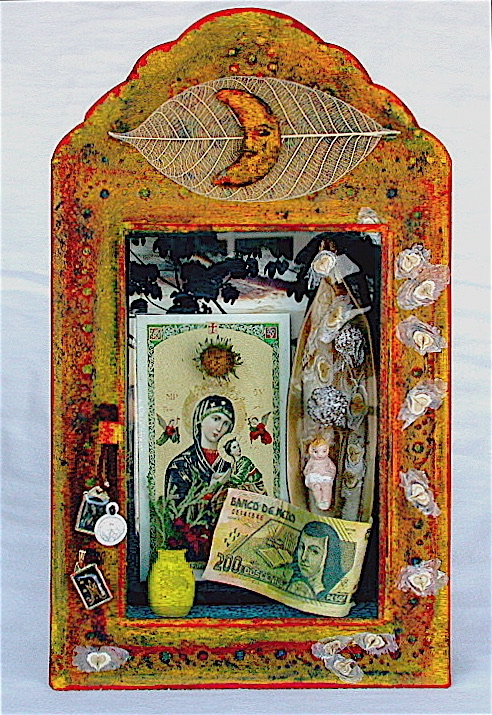
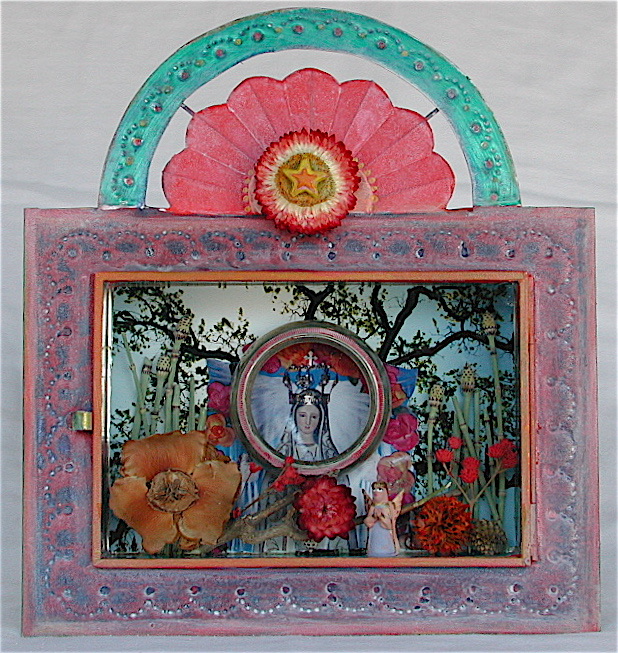
             I spent the day making retablos.  I had purchased the tin and glass boxes in the artisans’ market a few days before, intending to give them as gifts when I returned home.  But after they lay on the living room cot for a few days, I couldn’t resist opening them to see what I’d bought.  The afternoon was hot and I set up my “studio” on the small table of the patio which held the clothes washer.  My tool boxes and cases full of art supplies sat on the patio around me.  By late afternoon, I was surrounded by strips from cut up photographs, cloth, beads, snips of waxed linen.  Each glass fronted box was some degree of its way toward being a retablo.  One was dedicated to Bearcat, another to the Virgin of Guadalupe,  the third a tribute to life in general––seeds, greenery, birth.  With my limited supplies, it became necessary to search the household for things we’d brought that could contribute to the shrines.  A container of popcorn contributed fertility and life bursting forth to the Madonna shrine.  An old peso brought to me by neighbors who visited Mexico in the 50’s, now worthless, was beautiful when the raised parts were buffed with fine sandpaper.  Feathers, beads, charms, seeds, bits of cloth, cut up bits of the photos I’d taken so far in Mexico.  Bob awoke from his siesta in the late afternoon and set up his easel––a tall ladder––in the courtyard.  He assembled his paints, prepared his palette––and the rain started.  Moving his materials quickly to the patio where I sat surrounded by my midden of art supplies, he propped his canvas against the table.  Restful large blobs of color covered the canvas.  They reminded me of the bougainvillea.  His usual bright primary colors had been abandoned for the more subtle colors of the garden and house that surrounded us. 

            By 9:30, we sat on the deck eating our dinner when the band started in again––coming from a direction about half a block away to the rear of our house.  Kids’ voices called out excitedly.  I imagined a pinata being broken.  Then the fireworks started.  They were the spectacular chrysanthemums and huge falling fountain fireworks of  a fourth of July celebration.  At first we went out to the compound to see them.  Then Bob said we should go up on the roof, but by the time we had climbed up the circular staircase with our plates, the fireworks had stopped.  We stood at the edge of our roof, our plates balanced on the adobe pillars on the sides of the patio.  Up here it was cool, and the food lost its heat quickly.  Although it was too dark to see our food, in the moonlight, we could see puffs of smoke ––the ghosts of the earlier fireworks.  We could hear a loud “thwack, thwack, thwack” and children screamed and laughed.  The band started up, died down, started up––like long spaced hiccups. 

            An hour or so later, when we were about to go to bed, the activity again moved to the street in front of our house.  The band, much improved, came marching firmly down the street from our left.  They seemed to have been replaced by another band, for now their music was sure and robust.  They seem to have swelled in numbers, as well.  They came more quickly than before down the street and stopped two doors away from us.  Some of them carried bottles, which they took fast swigs out of before raising their instruments.  They played a rousing song before one of the men pulled a man from the house and brought him out to dance with him.  He encircled his body with his arms and they danced like lovers to the music.  Then the music stopped and the entire band––maybe 15 or 20 strong––streamed into the house.  Earlier, as I stood on the roof, I had seen women in that compound making tortillas in the back yard.  I had wondered why they would choose early evening to do so, then figured it was to escape the heat of the day.  Now I wondered if they were for the musicians, who did, indeed, stay in the compound for the rest of the night, playing music which echoed up the brick walls of their compound directly in through our windows.  It was then that the really loud fireworks started and continued for an hour or so.  We drifted off to sleep.  Was it midnight or 1 a.m.?  It made no difference.  The fiesta was over and we slept.

            Boom!  An explosion like a land mine ripped through our open window.  Then another and another.  Some streamed up into the air, some exploded on the ground.  These explosions were cherry bomb sized, then hand grenade sized, then, to our very early morning ears, \ground-to-air missile-sized.  Amazing that the cat only stirred slightly in the bed.  Just a week ago he would start and run at the rustle of the cat food bag.  Explosion after explosion went off. 

            “What time is it?” I asked Bob, but he couldn’t see his watch.  By this time, at least a couple dozen explosions had gone off.  Since it was still dark, perhaps the purpose was to bring out the sun.  By now the roosters were crowing, so the  fireworks had done their job.  But they didn’t stop.  After one ear-splitting retort, our car alarm went off, adding to the festivites.  Bob rolled out of bed and fumbled in his shorts pocket for the keys.  I moved to the bathroom and by the time I got back, the car alarm had gone off again. 

            “Just turn it off.  I think this is going to go on all day.”  I flipped on the light.  6:15 a.m.  Church bells began to toll. 

            By eight o’clock, all was quiet.  The sounds I could hear seemed muffled––either in comparison with the fireworks or due to them.  Roosters crowing, the acetylene torch sound of the water heater coming on, trucks and buses on the road, the beautiful cries of grackles.  Ceiling fans whirred.  Bob slept on in the huge bed on the balcony across from where I sat in the office.  This bed was the largest either of us had every seen.  It had to be bigger than king-sized.  I could stretch out my arm fully from where I slept and still not find him.  The cat could sleep sideways between us and not touch either of us. 

            “We need another person for this bed,” Bob had said as we slipped into bed the night before. I suggested that we could both just roll over to the middle, so we did.

For Chapter 16, go HERE.

Chapters 1-14 are availble in daily blogs for the past two weeks. 

Red Hibiscus: FOTD, May 23, 2023

For Cee’s FOTD


ASA Show: Water


Here are some photos I took at the Ajijic Society of the Arts show. It will be hanging at the Casa del Sol Inn until June 4, Javier Mina 7 off Constitution.

Innocents in Mexico, Chapter 14

Innocents in Mexico

Chapter 14


            It was early morning, two days later.  That morning when I awoke and saw the sunset, I got up and climbed the circular staircase to the roof to photograph it.  Around us, roosters competed, yodeling their hoarse cries to the still cool air.  Even after the sun had been up for an hour, their calls clashed against each other in the blue morning.  A fine haze obscured my view of the hills behind Gigante to the south, the city to the northwest.  Behind us was another metal shop, where workers worked late.  Last night the sounds of grinders and metal striking metal did not stop until about 9:30. This morning for the first time I noticed that the very tall antennae that we had seen from our hotel and had at first thought to be a palm tree was practically in our back yard!  I didn’t know whether it was a TV antenna or some other sort of tower, but we already knew that TV had definitely hit San Miguel. 

            Twenty years ago, I had vacationed in Mexico with a man who claimed to be the first to bring TV’s into Mexican hotels.  Now they were everywhere.

            The day before, after buying vegetables and fruit in the covered mercado, we had walked through the open-air artisans’ market.  Accustomed to the feverish attention of stall minders as we passed their stalls in other parts of Mexico, it was surprising that here we were barely noticed.  Upon entering a few of the stalls, I saw why.  Most of the stalls contained small TV’s.  We heard the staccato of Spanish as they watched soap operas or cartoons.  In other booths the TV’s were on but silent, and we peeked in to see the Spanish subtitles of American movies which they were watching with the sound turned down low.  Spellbound, they barely noticed us as we passed by. 

            I knew too well the allure of television.  After going twelve years without TV, we had finally subscribed to cable two years before.  We had told ourselves it was so we could get better radio reception, then decided to expand the subscription to include the independent film channel.  From the first day, we were hooked.  Part of the reason we’d left the U.S. was to get away from it

            We hadn’t turned on the small TV in Jim’s office.  I think Bob didn’t even know it was there.  Its dark screen stood behind my back as I sat at my laptop, staring blankly over my shoulder as I put TV on my “no” list next to pastry. 

            It was 8:15 a.m., our third morning in the new house, when the grinders started again in the shop next door.  We had wondered if Bob’s tools would bother anyone if he decided to do large pieces, but here, they would barely notice.  With our back wall also their back wall, it sounded as though the noise was in the house with us.

            Both Bear and Bob seemed to be falling into the habit of multiple siestas during the day.  Bob awoke for breakfast, then slept again well into the afternoon, when he awoke again and stretched and attached his canvas to a frame.  It was a pattern with him to take some time to get inspired, while I had that Dutch urge to be busy.  The office balcony where I wrote was the most pleasant area in the house to work, while we had not yet figured out where to set up our art studios.  The roof and top balconies were too sunny, the bottom balconies filled with tables and chairs and washing machines, but we would figure it out.  The day before I had purchased some small retablo boxes which I hoped to fill as gifts for friends back home, and I had laid them out on the living room cots , hoping they would collect inspiration from the house’s atmosphere. 

            The night before, we had gone to the viewing of the video.  The crowd in Pablo’s cafe, where the premiere was held, was very small.  As we approached the cafe, we met three women making their way down the street.  They and we were the sum total of the crowd, along with Susan’s children, who were first told to clear out, then furnished with sandwiches.  The woman who had told us about the video came in a few minutes after they started the film.  The waiter asked what we wanted, and I ordered white wine.  They had red wine, he told me, so I had red wine.  We ordered from the menu, but both of our choices were unavailable.  In spite of the rather long posted menu, what they had was leg of lamb, beef sandwich or pasta with chicken, which we ordered. 

            The video, for the first half, was mainly about the churches––a subject which I found less interesting than more human subjects, but the information, what of it I could hear over the cooks in the kitchen, the waiters and the kids, was interesting.  Several times, someone at the Jessica Tandy lady’s table was heard to remark, “It’s really good.  I’m surprised.” 

            It must have been one of the other ladies at her table saying it, I thought.  How rude.  Do they know that she was involved in making it? 

            When the video was over, before the credits had run, Gilberto, the waiter, had put on another video.  “Also about San Miguel,” he said.

            This video was composed of still shots only, but was more interesting than the first.  After it was over, we talked to Jessica Tandy.

            “It’s really good,” she said for the fourth time.  “I’m really surprised.”

In turned out that she had had nothing to do with the making of the video.

             “I must admit,” she said, “I set up this viewing so I could see the video to see if it was any good before I bought it.”

            We walked to the Jardin, where we viewed the parroquia with renewed interest.  Sitting on one of the benches which faced out from the jardin, we watched two pretty young Mexican teenagers flirt outrageously with whichever one of the four boys they were standing with who paid them the most immediate attention.  They seemed to be competing.  When one caught the attention of the young man both seemed to find the most attractive, the other one would fawn outrageously over whatever boy was nearby.  Now and then one girl would walk off with one of the boys, but she always returned.  Then the two young men who seemed to be the ones they were most interested in walked away.  One girl sat down on a bench with a sketch pad.  The other walked away with a heavy young man who seemed to be a fill-in object for her flirtation.  I had forgotten how much fun it was to flirt.  Surely, I had never been as self-confident in my flirtations as these girls, but I begrudged them none of their fun.  They formed part of the entertainment for us all.

            Here, people went out at night.  They stood in groups on the street or around a food wagon, their elbows on the counter as they ate a hamburger or burrito.  They sat gossiping on park benches, played with children or, as we did, sat watching the parade.  One person in fifty was a foreigner, and the foreigners were as intriguing to watch as the natives.  Amazing that most of us came from the same continent.  The variety from foreigner to foreigner was so great.  The great preponderance of people we had met, be they residents or tourists, had been Canadian or Texan.  Then there were the art or language students––young, old, Mexican, North American, European.  We heard of Swiss and Germans, but had met none.  We had heard of the American woman who, answering the door expecting a package, had been stabbed multiple times. 

            “And the man is still free in her neighborhood,” our informant told us.  “They put him in jail for a while but they let him out and she has to live there because everyone knows and now no one will buy her house.”

            We went for ice cream, then moved to a bench facing south on the opposite side of the jardin. We had noticed the birds, which were plentiful, on its other side, but here their cries were almost deafening.  A thousand or more birds nested, perched, flew up, fluttered, glided down to, glided up from the  50 or so trees in the jardin.  They were all black with widely fanned, very long tails.  When we had asked Maria Antoinette what they were, she had said crows,  but we later discovered them to be grackles––much more fragile and slim and exotic than any North American crows.  Their songs were varied, atonal and loud.  They would have furnished great sound effects for  Alfred Hitchcock’s “The Birds”.  We couldn’t imagine what was attracting them.  There were always lots of birds in the jardin, but not this many.  We couldn’t believe that no one else seemed to notice them.  Nor could we believe that neither sidewalk nor people were being splattered.  Now and then a dry leaf fluttered down as a bird alit or took off, but there was no evidence of any bird splatterings anywhere.  The trees were dense, it was true, and seemed to be serving as our umbrellas. 

            Well-behaved Mexican children played with their grandmothers.  Older children entertained their younger siblings.  Elderly women greeted neighbors, young women sat talking to each other, eating ice cream delicately, small spoonful by small spoonful.  The toy vendor stood in one place for an hour, talking to a young woman on the bench near to where he stood.  One arm was pulled upwards by the combined lifting effect of 50 or more inflated mylar balloons held on short strings.  With the other, now and then he would move a horse with spinning sculpted Coke can wheels around him in an arc, but he seemed to be more interested in conversation than in sales.

            A small boy whizzed by on a skateboard/scooter––the first we’d seen in San Miguel.  Then another boy rode by, cautiously, on the same scooter.  He next offered it to a small girl in a pale, loose dress.  I was impressed by his generosity, but the girl seemed reluctant to try it out.  Then she glided a short distance, pumping the courtyard with her free foot.  Eventually, she wheeled by, cautiously, three or four times.  The boys having left, I realized it was her skateboard.  Another small girl craned her neck to follow her progress as she passed her.  A skateboard/scooter was indeed a novelty in San Miguel.

            We had yet to see a misbehaving, pouting or crying child in Mexico.  Everywhere, they seem to be flooded with attention and love.  They were well-dressed, cheerful, playful, outgoing.  Older children played with younger children.  Strangers in the street or on park benches squeezed their cheeks or patted their hair.  Young fathers slung blankets under the arms and across the chests of their toddlers and followed them patiently, around and around the jardin.

             We had met Susan’s three children, aged two, six and eight.  They were tow-headed clones of the black-haired Susan.  “This isn’t really my color,” she had told us, but we were unable to tell if she was kidding or not.  The three kids rattled around, seat beltless, in the back of Susan’s van as she took us to see an apartment, another woman to see a storage space.  They had acquired a magnifying glass which fascinated them all.  They were catching the sunlight and directing it onto paper, their arms.  “You can start a fire with that,” I told them. 

            “We’re going to use it to burn ants,” the eldest told me.

            Then their interest in lenses spread to me.  Theresa, the smallest, wanted to try on my glasses.  The other two wanted to try them on, too.  As we reached our destination, they spilled out of the van.  The boys hit the dirt, in search of ants.  When the lady at the storage space moved up the stairs to show the storage unit, Theresa went with her.  We went into the two-story apartment we were here to see.  Susan came with us.  The kids were free to do what they would in this free place, whether I agreed with their antics or not.

For Chapter 15, gp  HERE.

  All photos unless otherwise noted are my me.