Monthly Archives: May 2023

No Stone Unturned: Three Things Challenge

No Stone Unturned

Turning over stones can be overly unpleasant
due to all the denizens likely to be present.
Yet I profess it’s cowardly to just let them lie,
I’m sure you’ll prove your manliness and flip them by and by!

For Pensitivity’s Three Things Challenge, the words are: STONE UNPLEASANT COWARDLY.

Bravados: An Anthology on Life, Love and Aging

Soon available on Amazon. I’ll let you know when!!!

Goofy Answers for Fibbing Friday

For Fibbing Friday, May 19, 2023  we are asked to provide definitions for the following:

Philatelist: Mr. Silver’s “do not re-invite” record of guests who do not arrive in a timely fashion to parties.

2. Botanist: Someone who creates programs that fulfill tasks without human intervention.

3. Naturalist: The characteristic veering off the vertical that occurs in the human spine due to aging.

4. Taxidermist: A doctor who specializes in dermatological problems associated with passengers’ sensitivity  and resultant toxic reactions to the inside surfaces of public conveyances.

5. Anthropologist: Someone who studies aging insects

6. Scientist: A doctor who specializes in the study of exhalation due to disappointment or sadness.

7. Strategist: Someone canonized for their kind treatment of rodents.

8. Protagonist: Someone in favor of graffiti.

9. Pharmacist: Someone terrible at spelling who is very good at raising cows and pigs and corn.

10. Biologist: A scientist who is equally attracted to women and men.


Image by LydianTurner on Unsplash.

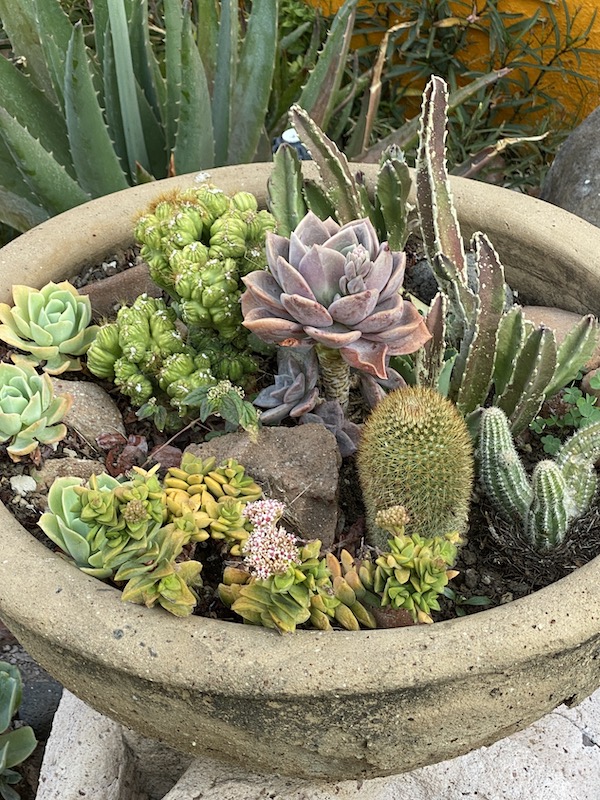
FOTD Cacti and Succulents: May 19, 2023


For Cee’s FOTD

Innocents in Mexico, Chapter 10


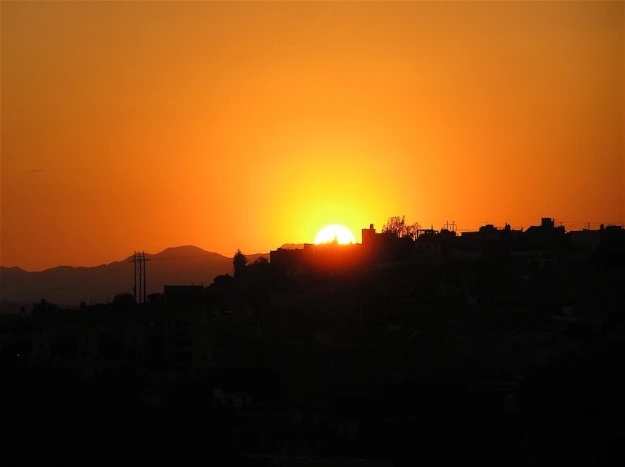
San Miguel Sunset from the Roof of the House We Chose to Rent

Innocents in Mexico

Find Chapter 1 HERE  Chapter 2 HERE   Chapter 3 HERE
Chapter 4 HERE
  Chapter 5  HERE  Chapter 6 HERE Chapter 7 HERE  Chapter 8 HERE  and Chapter 9 HERE,

Chapter 10

            On our sixth day of searching, we found three houses we wanted to rent.  One had the advantage of being blocks from the jardin and a block from the market.  It was stark and small, but we could fix it up.  There were many patios, but I would have to supply the plants.  If we were renting for a year or two, it would be worth fixing up, but not for a month.  As we left, Bob toed aside a large, dead cockroach. 

            The second apartment was in an area above the Biblioteca which we had not seen before.  The man who owned the house was a large-scale metalsmith and would share his tools and space with Bob.  The apartment was charming––decorated with flair.  It had one bedroom, kitchen and bath with a small sitting room on the ground floor.  He, his wife and children and assorted art students lived above.  We were free to use any of his studio space as well.  He was so anxious to rent to us that he said he would do anything to please us.  He came down $200 from his original offer when we had done nothing but ask him the price again.  The $300 a month covered utilities, and he would pay half of our parking nearby.  We were sure we would take this place, but we had first, as a courtesy to Susan, to go see the house she had been trying to get us in to see for three days.  We went back to see Clello’s house by the mercado, found yet another dead cockroach under the sink, then returned the key and told her we had decided to take a different house. 

            We then remembered that we had forgotten to tell the metalsmith that we had a cat.  It was no problem, he told us, when we called to tell him.  He would do anything to get us to take the apartment. 

            “But first” we said, “we must go to see one other house.”

            We went to La Conexion, Susan’s internet business, and she loaded us into her van.  On the passenger side door were vivid purple scribbles.

            “My kids did that.  It’s not graffiti,” she told us. 

            Her van looked like ours––lived in.  Crayons littered the backseat floorboards, a Eudora instruction booklet lay on the dashboard.  I piled my San Miguel guidebook, book of notes and phone numbers, Spanish dictionary and town map on top of it. 

            We went a different route to the house than the first time––when we had seen the neighborhood but couldn’t get in to see the house.  It was in a Mexican neighborhood a short way out of town.  From the road in front of the house, we could see the half-unoccupied shopping mall whose only prosperous inhabitant seemed to be the huge grocery/notions store named Gigante.  The road was dirt, the field to its right littered with plastic bottles and paper bags.  At first, I thought it was a dump, but it was just the refuse which was the normal byproduct of being so close to a market.  The neighborhood looked less bleak this time.  On the  long road that ran past the house were two metalworking shops, which interested us both.  Susan opened the gate to the courtyard and we stepped in.  It was a beautiful modern stucco house constructed in the Mexican style, using Mexican methods and materials––two stories with a rooftop patio.  Two second story patios served as roofs for two ground floor patios which  flanked the house.  A brick pathway vee’d and then joined as it approached the house.  Around us were bougainvilleas in various shades of purple, burgundy, wine, rose, orange and gold.  A 15’ long wall of organpipe cacti stretched far up into the air, running parallel to the side wall, but well out from it.  A mesquite tree spread over the central courtyard and the walls of a small ruin which they had left intact and which contained a quirky artist’s shrine.  As we stepped into the house, we saw  first of all a huge picture of the Virgin of Guadalupe which dominated the 30’ high back wall .  On closer inspection, we saw  that it was a beaded curtain meant to hang in a doorway.  Ceiling fans above it sent air currents which caused it to gently sway in minute waves out from the wall and back.  The effect was an underwater effect––or one of heat waves in the road in front of you when driving through a desert.  The house was spectacular.  One large central room opened to the 30’ high ceiling.  To the right was an open kitchen which led to the right front patio, where the glass top dining room table and chairs were.  To the left were the guest bedroom and bath, which sported the only inner door in the house.  In front of us, two open stairways formed a V leading up to the office on the right and the master bedroom/bath on the left.  Both were bounded by just an open balcony railing overlooking the main living space.  Most walls were whitewashed adobe brick, but a few walls were kept unpainted.  The vent over the stove was covered with vivid yellow tile and the cement floors were painted an aged terracotta, blue or yellow, then waxed.  Rugs added warmth to the floors.  As we moved through the house, the image of the Virgin de Guadalupe was repeated over and over on glasses in the kitchen, in small shrines and in a tiled tray on the patio.  An autographed picture of Beaver and Wally Cleaver sat on the stand beside the desk.  To its left was a small shrine to the Rolling Stones.  Elsewhere in the house were pictures of the Swami Yogananda, a print of Remedios Varo, whose work we had earlier seen in Ziwok, a wall devoted to Bob Dylan (We had included all of Bob Dylan’s tapes in our limited cache of tapes brought along to Mexico.)  On the open clothes rod at the end of the master bathroom were sedate Hawaiian and batik shirts that could have been Bob’s.  On the shelves were shorts and loose pants that look like the ones packed in his bag back at the hotel.  When we saw a picture of Jim, the owner, he had long light hair, like Bob, and was of a similar stature and size. 

            I loved the house.  I looked at Bob.  He loved the house.  Prior to this we had looked at no fewer than 10 houses and apartments, and had only agreed about these last two.  We took the house.  Sadly, I called the metalsmith to break the bad news about not taking his apartment.  He was very disappointed, I could tell.  I promised to tell anyone I met about his place.


See Chapter 11 HERE.

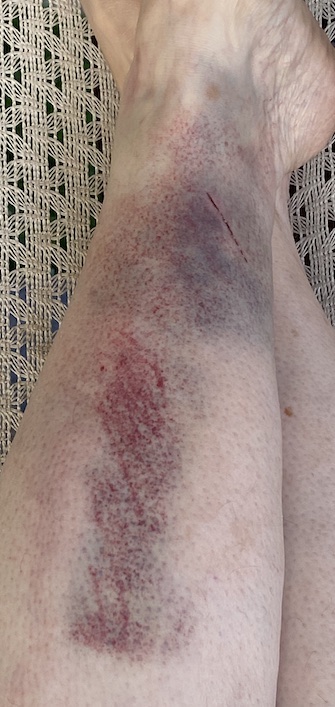
State of the Leg

For those who asked, here is the state of the leg 24 hours later. Swelling down. Doesn’t hurt except when my masseur forgot a couple of times this morning and touched it. Then, Ouch!!! That said, I promise no more photos of sore subjects…

Society Garlic Bloom: FOTD, May 18, 2023


Society Garlic

Is this an ironic name or not? What makes one less welcome in society than a garlic breath?

For Cee’s FOTD

Innocents in Mexico, Chapter 9

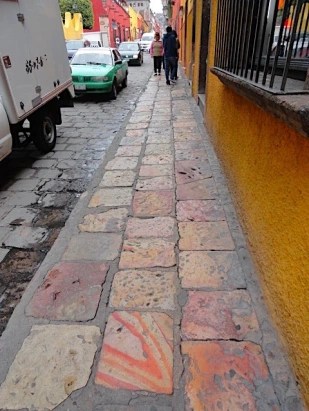
Treading the Sidewalks of San Miguel

Find Chapter 1 HERE  Chapter 2 HERE   Chapter 3 HERE
Chapter 4 HERE
  Chapter 5  HERE  Chapter 6 HERE Chapter 7 HERE  Chapter 8 HERE.                                                                                         

Innocents in Mexico

Chapter 9


            I was trying to write a letter home for our friends to circulate among themselves. I knew that many had already traveled to Mexico and so they would be most interested in the people we had met. Who were the people we had met in San Miguel?  I began to list them. The first was the woman who gave us her map, but who severely dealt with each child who tried to sell her a cloth doll or old woman who held out her hand for coins.  There was the man who explained to me that I must sign my name to the list of people waiting to see the insurance officer at Lloyd’s, then return at 1 to wait for her.  There was Yvonne, the receptionist at Lloyd’s who spoke flawless Spanish and equally flawless English.  When I asked her whether she was Mexican or North American, it turned out  that like me, she was born and raised in South Dakota. 

            The morning of our first day in San Miguel, we met Ernesto, the Mexican gentleman who told us he had 5,000 acres in Baja near Bahia de Concepcion , who split his life between Key West and San Miguel and who spent his life, it seemed, meeting people at the Biblioteca or in the Jardin. Most importantly, so far, he was the one who introduced us to the Posada de los Monjes.

            We met him at various times for an hour or so and during these times he brought a tray of small cut stones and asked us to choose one as a gift, then showed us an opal from the mine he said he has outside of town.  “I am not trying to sell you this,” he said, but I wondered.  “One day I will take you to the mine. I will show you.”

            Later, over margaritas and Coronas, he told us fantastic stories of the millionaire who had given over part of his hacienda for a school where Ernesto would teach lapidary to poor children, of the man who offered him full use of his yacht to use, charter or live in if he would just arrange for permits to berth it in Mexico and let him use it a few weeks a year.  But when he had approached a friend in government to ask him to expedite the permission to berth the yacht in Mexico, the friend had been disdainful.  “Are you a yachtsman? “ he asked.  “What do you know about boats?  You are a man of the city.  What do you want of a boat?”  So Ernesto had regretfully turned down his other friend’s offer.  As we walked down the street with Ernesto, he begged our pardon and crossed the street to talk to an old man.  When he returned to us, he told us that the old man had 7 ranchos and no sons.  He wanted to give one rancho to Ernesto. 

            “Every time I see him, he asks me if I will have one of his ranchos.” 

            “Why don’t you take it?” I asked him.

            “I am no rancher,” sighed Ernesto.  “Do you want a ranch?”

            “I am no rancher either,” I told him.  “I just got rid of a ranch.” 

            I started to explain to him that I was a rancher’s daughter who had inherited part of his ranch, but Ernesto was not the least interested in who I was or in my stories.  He wanted to tell me his. 

            He wanted to tell me about the time in Bahia de Concepcion when a young man came to him and asked to buy $1,000 worth of land.  Ernesto didn’t want to sell his land, so he asked an elderly friend, who had beach property adjoining his, if he wanted to sell the young man beach property. 

            “Have him choose his land,” said the old man.  So Ernesto took the young man to the beach and he chose a small piece of land. 

            “But I have only $l,000,” said the young man. 

            When they took the old man the money, he said, “This young man wants my land? “

            “Yes,” said Ernesto.

            “And he is a friend of yours?”

            “Yes,“ said Ernesto.

            “Then the land is a gift.  I do not want his money.”

            Then, as Ernesto told it, the young man spent the $1,000 to put up palapas and buy hammocks.  The people who came with boats stayed in the palapas while they fished and then another man started flying in fishermen to fish.  In two years, the young man owned a boat and an airplane and to this day was a wealthy man.  Every time he saw Ernesto, he stood on the table and shouted his praise and thanked him for contributing to his great wealth.

            Ernesto was full of such stories.  He had inherited a mansion from his Mother in New Orleans, but he hated New Orleans. He once had owned 15,000 beach front acres in Baja, near Mulege, but the government had nationalized all but 5,000 acres, which he still owned.  Later, he admitted he had given the land to his daughter and ex-wife.

            “All of it,” he told us, making outward brushing movements with his hands. 

            Ernesto was a pilot, a lapidarist, an opal mine owner.  He brought us a “Town and Country” magazine which sported an article on the homes of Canadian expatriate artists  in San Miguel.  The woman artist with the horses and the huge house and the art collection was his friend, he said.

            Once he was married, but his wife just wanted him as a chauffeur, he told us.  And he cooked for her.  He did all the cooking.  Finally, when she became an alcoholic, he divorced her.  Then he had a girlfriend who dreamed of driving across Canada. 

            “Take me to Canada,” she said to Ernesto.

            “And I almost did,” said Ernesto.  “Then I thought, I had one wife who wanted me to drive her.  I don’t want to drive anymore.”  So he said no and sold the car.

            “Do you still have the same girlfriend?” I asked.

            “No,” huffed Ernesto, making the same brush-away movements with his hands.

            In two days he would take us to the hacienda, he said, and introduce us to his patron, who had given over a part of the hacienda for an art school for the poor.  He had said that we might rent a room in the hacienda, said Ernesto, for not very much.  For $18 a night, he said.  We would take Dirk with us. 

            Dirk was the man with the house that Ernesto wanted us to see.  He had had open heart surgery just two months before, and we feared for his health as he rushed around, moving as fast as he talked.  Dirk had as many stories as Ernesto.  At eighty, he had a Mexican wife who appeared to be in her forties.  He had children in their fifties and a stepson in high school in Miami. Like Ernesto, he was a pilot and a lapidarist.  He rushed to our hotel to pick us up to come see his house.  He parked a block away and ran uphill to get us, then back down to the car.  Panting, he told us about the points of interest along the way as we circumnavigated the roads around the city.  That hotel belonged to Cantinflas, he told us.  This house on 15 acres belonged to a rich Swiss couple.  See how their property was like a park?  This studio was of a Canadian painter.  See how large her studio was?  Behind that wall was a swimming pool and tennis court.  Here was the shortcut to Gigante, the huge shopping mall.  Here was his route to the bus.  We hurried into the house for a quick run-through before rushing back to town to pick up his wife.  He had gotten the times wrong.  He should have told us he would pick us up at 7:15 instead of 6:15. Then he could have picked up his wife on the way.  She insisted on working to give meaning to her life.  He should have put his foot down because it was really a bother to take her and pick her up, but it made her happy.  She was a big town girl.  To her, San Miguel was a village. 

            He rushed us into his house, through the rooms.  This computer he would take with him to Miami, but we could use the computer table.  This cat came with the house, but must stay outside as it was not declawed.  It ate one scoop of dry cat food in the morning and one at seven at night.  He always placed the food here, on this bench.  But the cat stayed always outside.  This was their patio.  Here were the orchids he told us about.  They had a gardener, which we might keep for $4 a week, but they had fired the maid.  His wife was Mexican, and liked to do things herself. I rather liked the house, but Bob told me privately that he found it too small. We decided, however, to tell this to Ernesto instead of Dirk, hoping to let him down easier as he seemed to have such hopes that we would like it.

            Then we rushed back to the car and back to town.  This was the mirador  (scenic overlook) he said, but we didn’t stop.  This was the other mirador, he said, a few minutes later.  As we sped by, I caught a glimpse of a beautiful panoramic view of the city.  Again, he grew short of breath and I asked if this was healthy for him to rush so much.  “Oh, that was eighteen months ago,” he said.  “I’m all right, now.”  Earlier, he had shown me his identification card, for some reason, but covered his picture with his thumb.  “The picture was taken right after my surgery.” he said.  “I looked awful.”  “I’ve lost 14 kilos since the surgery, but I’ve gained some of it back again.” 

            We met Susan, a Colorado girl with a Texas accent.  The married mother of three small children, she ran an internet exchange and mailbox business as well as a real estate business on the side.  She told us of the rich German woman who had set up a maternity hospital in a poor section of San Miguel––of how she was now so famous that her story was on the front page of the Wall Street Journal.

            When I asked Susan about the fantastic sculptures we had seen along the road between El Paso and San Miguel, she told us that the government had built them.  She was disapproving.  There were so many in poverty, and they built sculpture.  It made me regret my shallowness in delighting at their beauty, yet I couldn’t help it.  I loved the beauty of Mexico and sought it out while people who were undoubtedly my betters dealt with the pregnant mothers and worried about the poor.

            Did art serve a purpose in the world?  Bob thought so, and I did, too, in the abstract.  But did art feed the soul enough to atone for the hunger of the poor?  Philosophers more able than I had dealt with the matter, but I knew I would have to deal with it on a more personal level in order to live with myself.  Once all of this business of moving was over, I would need to consider this.

Find Chapter 10 HERE.

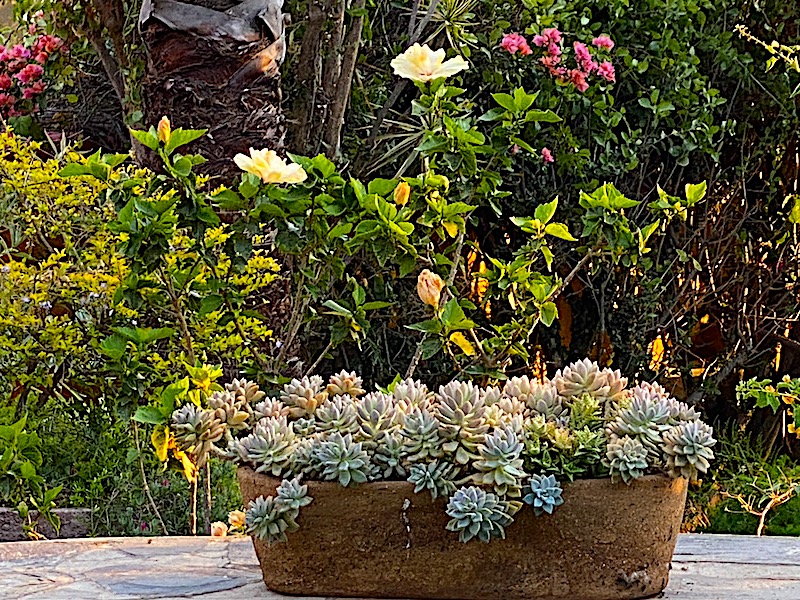
Potpourri: FOTD May 17, 2023


Succulents, Hibiscus, Bougainvillea and Assorted Greenery. Life in the Jungle!!!

For Cee’s FOTD

Innocents in Mexico, Chapter 8

We passed under this arch to get from the Plaza Principal to our hotel.

ind Chapter 1 HERE  Chapter 2 HERE   Chapter 3 HERE  Chapter 4 HERE  Chapter 5  HERE  Chapter 6 HERE Chapter 7 HERE


Innocents in Mexico

Chapter 8

          Today we met several interesting people and reconnected with the young woman we’d met our first morning in the bank.  All of these connections led to houses to look at. Clello, the woman who owned the shop where we posted an ad for a house, sent us first to look at an apartment, which was nice but much too small.  Then she sent us to a house.  Its entrance proved to be too low for the van, but she assured us we could park at her sister’s hotel a half block away.  We went to the hotel and found what the fee would be, then ambled through the artisan’s market and the food market, which were a stone’s throw from the house we considered renting.
            It was interesting that all of the homes of foreigners seem to be decorated in the best colonial or traditional Mexican style with massive furniture and folk art, whereas the Mexican owned houses and apartments were furnished with western furniture.  Having looked at pictures in the windows of several (closed) real estate offices, we found this house plain in comparison with the pictures of houses that resembled movie sets with lush gardens, art, rugs and furniture.  Today Bob was off to immigration and I was to meet Ernesto to look at still another house.  Then I would make more calls and visit hopefully open real estate offices, renew our car insurance, collect our e-mail, send e-mail.  Bob thought we could get out of our present hotel (which in the states would have been called a motel) by tonight, but I didn’t think so.  He also thought he was going to meet me back there at noon, but I thought he was naive about the length of lines he would encounter at immigration.
            The night before, we had eaten at Ziwok, a delightful restaurant operated by Juan Pablo, a half Mexican/Spanish, half Swedish man with a passion for Frida Kahlo and Remedios Varo.  The front room of his perfectly decorated cafe was devoted to Frida––her self-portraits, photographs and a massive shrine assembled in a niche along one wall.  Basket chandeliers and neatly potted plants accented  the walls, which were beautifully faux painted in light and dark terracotta.  Tablecloths, cloth napkins and napkin rings were all in yellow and green.  The back room was a dark green and was totally devoted to the work of Remedios Varo, a French surrealist who moved to Mexico during the second world war.  Frida, who thought one female surrealist was enough in Mexico, saw her as a rival and hated her,  Juan Pablo told us.  Along with Varo’s exquisite bizarre prints he had displayed his own work: elaborate constructions of parts of animal skeletons, plants, sea life, seeds––any natural object he could find––which he had assembled into fantasy animals and covered with sand cemented in place with cyanoacrylate glue.  The effect was surreal, but although the assemblage animals seemed to come out of a nightmare  (a winged frog, a blowfish with snout, legs and an armadillo tail) they were curiously believable, thanks to his meticulous craftsmanship.
            After a close inspection of the art in both rooms, we went back to our table and watched him in his small open kitchen, cooking our meal in four woks.  Bob had tempura shrimp and vegetables, I had vegetables and rice.  Our plates arrived, along with a cruet of mango sauce and another of ginger.  The food was as different and delicious as the decor.  Prior to leaving, we had spent a half hour or so poring over his book of the work of Remedios Varo and listened to the story of first her life, then his. Every detail here was perfect and immaculate, down to the decoupaged menus and the hand-fashioned box of matches he gave me as we left.
            This night at Ziwok was another flower plucked from the bouquet of San Miguel.  We had found a new favorite restaurant––our most recent favorite having been the outside terrace where we had breakfasted that morning on frittata of eggs, potato and bacon with black bean sauce, fresh baked rolls with butter and jam or a delicious white cheese, pepper and avocado sauce in oil.  Every restaurant  we had  been to here we had wanted to go back to, but there was always a new one to try and we always liked it better than the last.  I had been amazed that in our hour in the restaurant, we were the only customers, but someone had told us that in San Miguel, there were 7,000 restaurant seats and on any given night, an average of 500 diners to fill them.  With odds like this, the restaurant market was a competitive one.  We didn’t think we would find one we liked better than Ziwok, but part of the pleasure was variety, so we would try others on our list before returning.  As we left, a young couple and child made their way to the back room.  “More customers,” I said.  “No, they are my friends,” he said.  “She plays the accordion in Mama Mia’s.”  It was another restaurant that would come to be a favorite.
            Apartment hunting continued to fill our days.  Meanwhile, we were piling up hotel bills at the rate of $100 every two days.  We began to think we might be ahead just getting a $1000 apartment.  At this rate, our hotel bills would mount up to the difference, anyway.  A few days before, we had run into Lisa, our former acquaintance from the bank, while checking out a bulletin board in a small cafe.  She was sitting with the owner of the cafe.
            “Wine?”  he urged, “Something to eat?”  When we said no, we had just eaten, he insisted, “It’s free.”  A large table in the back room was spread with food.  People moved around it, filling their plates.  A few more people moved around the small room, examining paintings on the wall.
            “It’s an opening.  See the woman with the large flower in her hair?  She is the painter.”
            When he urged wine on us once more, I asked for white and we sat down to talk.  Bob, impatient to read the bulletin board and be on to apartment hunting, seemed a bit exasperated.  At this rate we would never find an apartment, he insisted, but in the end, this is how we found one.  Lisa’s friend Pancho, the owner of the bar attached to the gallery, insisted that we must see Susan, the woman who ran a mail agency and internet service, at the front of the cafe and gallery.  “She knows many good apartments.  She knows everyone,” he told us. We sat and talked for a short time while I finished my wine.  The waiter urged more wine on Lisa.  “He’s trying to get me drunk so I’ll be a bad girl,” she laughed.
            The next day, we called Susan and made an appointment to meet her later in the day.  She took us in her car to see the house of a friend, but the inhabitant did not answer the door.  Then we went on to see a house which she assured us was a steal at $85,000.  Although we were not in the market to buy a house, Bob was sold by the huge studio.  I didn’t like the location or the house.  The owner had built it in an area quite far from town––an area chosen because it was far from the foreign enclave, where people might find objection to the large jewelry production studio which was attached.  Here, 15 employees made jewelry which she wholesaled in the States.  Because she had built her house in a poorer neighborhood, she had no problem finding workers who could actually walk to her studio to work for four dollars a day.  As we went into her patio, a huge Doberman rushed up.  All of the doors and windows were locked, even though the house was surrounded by a tall wall.  I didn’t think I would like to live in a house this luxurious in comparison with the neighborhood around it.  If real estate was location, location, location, then this seemed to be a poor choice for real estate investment.  Susan assured us that in 5 years this house will have tripled in value, but the spirit of the house seemed wrong to me.
            Later in the day, we went to see the house of Dirk, the man I’d met through Ernesto.  He had plans to spend a year in the States, and wanted to rent us his house.  It was in an enclave of extremely large and expensive homes, but it was equally as far out from the center.  I liked the house, which was esthetically more pleasant than the last house, with arched brick ceilings and tile more to my taste.  It was surrounded by patios and plants and had a large rooftop patio where Bob could work, but now that he had seen the house with the large studio, nothing could rival it.  He found this house too small.
            When we had moved to Central California from L.A. fourteen years ago, it had taken us a year of driving back and forth each weekend to find the right house;  but we had neither the time nor the energy to do so now.  The double task of finding a place to live for a month and a place to return to for a year was wearing us down.  I just wanted to try to get into the swing of life here––to see what it would be like to live and work in San Miguel.  But all we were doing was business–– like at home.  Visas, permits, money changing, setting up accounts, looking for houses, finding internet servers, finding personal mailboxes––these details ate up our days.  Bob had predicted that the annoying minutiae of dealing with the details of living would follow us here, and he was right, but I hoped that after this interim period we could settle into a simpler life.

See Chapter 9 HERE.