Category Archives: Books

Innocents in Mexico, Chapter 5: Zacatecas, Aguascalientes and Finally, San Miguel!!!!!

Street Scene, Guanajuato

Find Chapter 1 HERE  Chapter 2 HERE   Chapter 3 HERE  Chapter 4 HERE

Innocents in Mexico

Chapter 5: Zacatecas, Aguascalientes and Finally, San Miguel!!!!

            The next morning, a few more hours of driving through the desert brought us to Zacatecas.  There everything began to look more prosperous, with trees in evidence and large trucks bringing more to plant, their roots balled in white canvas.  Square adobe houses rose up in diagonal terraces, some painted bright basic colors.  Here, as in other towns we’d passed, bright and huge modern sculptures sprouted out of cement plazas with lights installed at the base for night viewing.  Hundreds of black plastic water reservoirs on the tops of houses appeared to be some new Christo installation.  New buildings in all stages of completion were everywhere.  There was a sense of style here, but no imitation of any North American, Italian, Spanish or any other style.  It was a style all their own––clean, adventurous, purely modern Mexico.  We were in too much of a hurry to stop to see who was responsible for any of the large sculptures.  Perhaps on our next trip.
            Between Zacatecas and Aguascalientes, the desert gave way to grasslands and crops.  Long white irrigation tubes paralleled the highway.  We made out corn, grapes, some white-flowered crops–– onions, garlic, or perhaps just flowers.  We passed a truck fluffy with kale.
            In Aguascalientes, we seemed to drive in circles following the “Mexico” signs.  When they gave out, we drove on in what seemed to be a logical direction.  A taxi driver told us to turn left and we again seemed to be going in a circle before finding the signs.  They again deserted us, but after a half hour or so of driving hopefully toward Leon, we again found the signs and made our way out of Aguascalientes past yet another colossal orange geometric sculpture.
            The country once more turned to sand, this time interspersed with low trees and some crops.  In the distance, a colossal black bull stood silhouetted against the clouds.  Billboard or sculpture?  To our left, the fields were verdant green, to our right, pale tan, as though it were a different season on each side of the road.  We passed the bull.  It was a billboard advertising Magno Osborne in vivid orange and white letters.  We passed a Green Angel truck––about the fifth one we’d seen since entering Mexico.  A sort of governmental AAA, they patrolled the roads to help vehicles in distress.  You paid for the gas, tires or parts, but not the repairs.  A sign told us we were 445 miles from Mexico City––a place we had no plans to ever drive to.
            Nearing Leon, everything became more prosperous.  Guardrails and trees lined the toll road.  Corrugated metal sheds replaced the adobe corrals, and cement fenceposts stretched for miles along the road, strung together by three neatly spaced strands of barbed wire.  Red and white antennas rose like stelae high into the sky.  High line wires, like modern installation sculpture, passed electricity along fourteen thick cables strung high up in the sky on the most modern of poles.  More large factories appeared, as did numerous monstrous billboards.  A man and two small girls in bright handwoven skirts waited in the median to cross the southbound two lanes which were solid with cars.  Green fields stood out against the fall colors predominant on the landscape, though it was only May.
            On the road through Silao, we somehow got diverted through the town.  Streets became narrower and narrower, signs vanished, and we went in circles, trying to avoid dead ends.  Finally, I resorted to asking directions from the window of our car.
            “Donde Esta Guanajuato?” I asked, then failed to understand any of the directions given by men on street corners.  Finally, a patient man with his family in the car motioned for us to follow him and led us out of town onto the Guanajuato road. “Muchas Gracias!” I repeated twice as we pulled up beside him in the double lane.  What was lacking in road sign efficiency was made up for by the extreme courtesy of the citizens of Mexico.
            We passed a huge GM plant surrounded by acres of cars and trucks ready to head north.  The plant was the size of a shopping mall––vivid yellow and blue.  We passed jacaranda trees, palms, cypress and willow.  For the first time, I noticed eucalyptus.  There was a lushness here not experienced farther north, where vegetation was of the desert variety.  We passed a large metal sculpture––the facial outlines of a man who resembled Groucho Marx, with leaves for eyebrows.
            Reluctantly, we drove through Guanajuato without stopping.  Bright blue and orange houses climbed the hills.  By the roadside, vendors sold coconuts with holes chopped in their tops and a lime plugging the opening. The country was more interesting, with mesas and small jagged mountains jutting up against the skyline.  Stone, brick and adobe casas sprinkled the landscape.  They were larger than the houses farther north, with distance between them.  There were pigs in the road, then cattle.  Horses were tethered very close to the road, eating the grass growing out of the side of the blacktop.  We passed a donkey lying dead, half on the road, half off.  Her colt stood by her, trying to nudge her over to nurse.
            Our van climbed up the road to San Miguel de Allende, bringing us  to our final destination in plenty of time to hit the oficina de turismo , which our guide book assured us stayed open until seven.  With only the vague and limited map in our Berkeley Budget Travel Guide, however, we got hopelessly lost in the winding, hilly, cobblestone streets.  Time and time again we wound into areas that had become too narrow, steep or circuitous for our Dodge Van.  Bob got frustrated and said he was glad we hadn’t rented out our house in Boulder Creek yet.  He was already sick of San Miguel.
            We finally parked on a narrow street on a very high hill and walked down to what we hoped was the Plaza Principal.  The tourist office did not seem to be where they had said it would be on the map, and we wandered aimlessly, guide book in hand.  By the time we finally found it, it was closed.  Seasoned residents observed us kindly, but with some humor, I think.  Finally, we found a travel agent and threw ourselves on her mercy.  She suggested a motel which was, she said, moderate in price, where we could park our car––an oddity in this city of narrow, winding cobblestone alleys.  An hour later, having circled the whole town twice, small street by small street, I again threw myself on the mercy of a man behind the counter of a small shop, and he and his wife drew me a map.  “Estoy perdida,” (I am lost) I explained, to their complete delight.  Our Spanish tapes had finally paid off.
            With a good deal of more unnecessary winding, we found the hotel, which turned out to cost $98 a night.  Since we considered this amount to be more than moderate, we started checking out hotels at random.  The next, which appeared modest to us, was $109 a night.
            When I asked his advice, the manager of the $109 hotel got on the phone and located a motel with parking space for $38 a night.  An hour or so later, after much searching, we found it more or less where he had promised it would be.  It was lovely, with fireplace, tiled bath, TV, bottled water––all the amenities.  We unloaded our luggage and installed Bearcat under yet another strange bed.
            Finding the Plaza Principal again proved to be another hair-raising experience, as we wound higher and higher on smaller and smaller roads––finally ending up at a castle-like casa with barely enough room to turn around in a space bounded by the castle walls on one side, a sheer drop-off on the other.  We finally found the plaza, and an Italian restaurant with Peruvian music.  Bob was happy.  When we returned to our room, Bear was eventually coerced out from under the bed with tinned salmon and was happy once we’d turned out the lights and flipped on the tube.  “The Effect of Gamma Rays on Man-In-The-Moon Marigolds” was on in English with Spanish subtitles––a movie I’d been wanting to see again complete with Spanish lessons.  Now I was happy, too.

Find Chapter 6 HERE.

And… for FOWC prompt of destination!!!

Innocents in Mexico, Chapter 4: On the Road to Rio Grande

Find Chapter 1 HERE  Chapter 2 HERE   Chapter 3 HERE


Innocents in Mexico

Chapter 4: On the Road to Rio Grande

        The next morning, we were finally on the road after driving back into central Chihuahua to cash dollars for pesos and to gas up and buy ice.  It was easier than yesterday, in rush hour traffic.  A night’s rest later, we were finally visaed, permitted, pesoed, petroled, iced up  and on the road to San Miguel.
        We drove hundreds of kilometers through desert scrub. Men with scarves tied over their hats to shield them from the relentless sun waved orange flags to slow us down as they oiled the other side of the toll road.  It was almost as expensive to drive here as in Europe, with all the frequent tolls.  On the second day of driving, we spent more on tolls than we had on our room the night before.  Now and then I would see some interesting sight I would have loved to have investigated, but Bob preferred to travel fast and  promised trips to the Copper Canyon and other off-road excursions on some future trip.  It had been such an ordeal getting away for this expedition that I decided not to make side trips yet another obstacle keeping us from San Miguel de Allende.  This time, we would do it his way, and perhaps the next time, too, but one day I would see Copper Canyon.
        After being stopped twice by the policia federal, Bob finally believed that he had to slow down in areas where slow speeds were posted.  In both cases, the officers spoke no English and our attempts at Spanish out of a dictionary encouraged them to give up.  The first policia saved face by escorting us back to the toll road he insisted we should take, although I was fairly sure that the camino libre (free road) led to the same place. The second time we were stopped, it was by policemen in two separate police cars going in the opposite direction, who first waved  us down  and then  turned in the road to follow us and wave us over.  Bob told me to get out the bribes which we had been told were the best way to deal with the police in a system where the collecting of the mordida  was taken into account when figuring the salary of policemen,  but in both cases of dealing with la policia  we were too inept to know how to offer them and they eventually gave up gracefully, pointing us once again in the direction of the correct road.  (We have since changed our minds about the offering of mordidas, but at the time we were innocents in Mexico, just following the advice of friends.)
        Hours later, we were on the free road which was two-way, bumpy and under construction. For the past 20 kilometers, we had been driving through deeply-rutted dirt while oncoming traffic maneuvered over a narrow strip of raised but even tarmac.  Sandwiched between 18 wheelers, our van slowed to a speed where I could actually make out the leaf patterns on shrubs and low trees.  I thought I made out manzanita, mimosa and perhaps a variety of pinion.  One delicate poppy-like flower appeared to be cotton. 
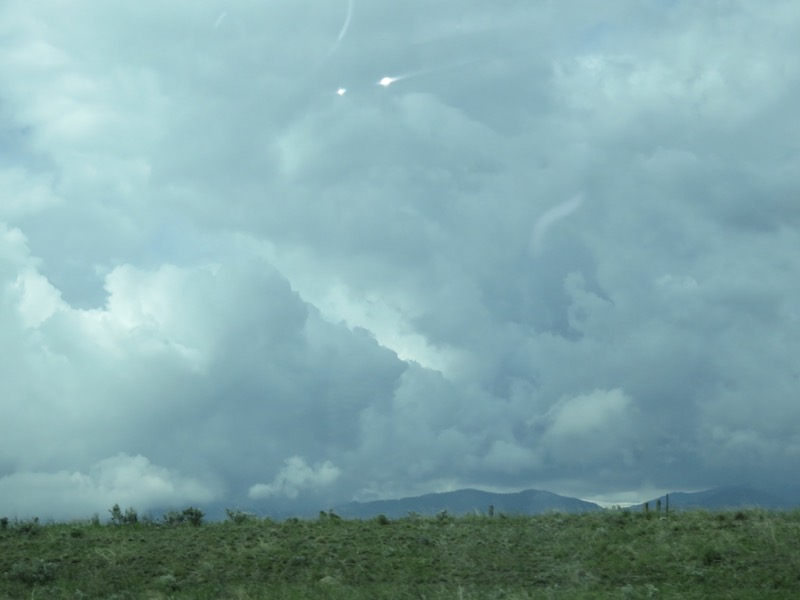
            The brilliant red sand on either side of the road drifted in places into small dunes. It was densely covered with rabbit brush and the other trees I thought I’d identified.  In the distance, the sky was dark and I made out three separate funnel clouds, all of which seem to be moving toward us. I watched the funnels uneasily, remembering the last time I saw such a sight.  Eventually, they united and broadened and seemed to break their cord with the higher heavens, but they continued to blow toward us.  At our slow pace, I wondered if they would catch us.  Then another funnel cloud––taller and thinner––formed farther ahead of us and to the right.  I forgot to watch it, concentrating on a more immediate danger as Bob got competitive with the bus trying to pass us and swung out in front of the semi we had been following.  I closed my eyes, then returned to the desert plant guide, knowing that all of the backseat driving comments I’d made earlier had done no more good than this one would have.  When I thought to look back to where the funnel had been, it had dispersed.  We had passed the semi, the bus had passed us, and the blacktop surface had been regained. 
        When we got to the next town, dozens of speed bumps did what neither a nagging wife nor la policia could do, and Bob proceeded on for a while at the correct speed limit through town, in search of a casa de cambio. Gas and tolls had eaten up the entire $150 I had cashed into pesos that morning.  It may have been cheap to retire in Mexico, but it sure wasn’t cheap to drive there!
        Here and there along our route, huge factories or assembly plants lined the road, finished or in stages of completion––Wrangler, Coca-Cola, car plants.  Now and then a huge modern sculpture dwarfed us, but we didn’t stop to read the inscription.  Next to these gigantic modern buildings were the near ruins of lines of conjoined adobe motel-like dwellings.  Then, across the street, were lines of similar dwellings, but brand new and two-storied in a faux Tyrolean half-timbered style most bizarre in this setting.
        KFC, Burger King and Dairy Queen competed with but did not in any way outnumber the burrito and tamale carts which stood beside the road.  In one small town, men in white shirts stood in the road and flagged us down, then motioned us over.  We noticed before actually leaving the road that they were trying to lure us into a lot filled with cart vendors.  We were hurrying to try to cash dollars for pesos, and we drove on without sampling their wares.          
        This deep into Mexico, I could no longer remember what I expected it to be like. It was surprising to me that not once in over 1,000 miles did we pass any car with North Americans in it.  Nor did we encounter any Americans or other foreigners in any of the towns we passed through.  Few people spoke English, even in banks, but in spite of this, no one looked upon us as an oddity.  We just were.  Like the funnel clouds and the circling white plastic bag in the middle of the street, we passed through but affected them little.  This was exactly the way I wanted it to be, now that I thought about it.  It was what I was looking for––some place that was purely itself, different from what I knew.  I longed again to be a stranger and to have the unexpected around every corner. 
        The terrain in the northwestern region I found to be not so different from the Mohave:  rabbit brush, mesquite, willows, cholla, prickly pear and willow trees.  But unlike the litter-conscious United States and because the dumps tended to be located near the main road, here there was lots of refuse outside every town.  As we drew near each dumping ground, thousands of plastic bags snagged on every fence, shrub and stone, littering the desert like some exotic flower display. Everywhere, huge chunks of concrete lay piled alongside the road––destroyed buildings or landfill––who knew?
        Frequent signs warned of livestock in the roads; and occasionally, livestock actually did appear there, as if to validate the signs.  As we drove farther south, there were fewer signs but more livestock on the roads––even the broadest and fanciest toll road between Aguascalientes and Leon.  On this road, for the first time, the four-lane divided highways came complete with median boundaries, curbs, gutters, shoulders, and a woman who hurried to herd her goats off the left-hand lane of the road as semis, cars and pickups whizzed by. 
        Our last toll having wiped us out of pesos, We drove into Rio Grande to find a casa de cambio. Since a parking place seemed to be an impossibility, Bob let me off in the crowded streets, promising to try to find me again.  When I came out of the cubicle, the sidewalks were crowded and a small parade was making its way down the street.  A policeman stopped traffic in all directions as high-school-aged students waved flags from cars.  They seemed to be celebrating some sports victory, or an election.  Banners on cars announced names.  On one car, a young girl rode on the hood, an older woman running out to position a folded blanket under her.  As she moved to adjust it, the girl cringed, as though her legs crossed out to the side of her were sore, or burned or maybe just cramped.  She wore a shiny halter and tight metallic spandex bell bottoms––hardly the clothes of a homecoming queen.  Other teenagers threw candy from car windows and one piece sailed right toward me.  I picked it up, and it seemed to me that it was a sign, welcoming me to Mexico.  It was Tomy’s––my favorite Mexican hard candy.  In ten minutes or so, the parade had passed and in ten more I spotted the tall rack on top of our van coming toward me in the line of cars making its way down the street.
        We drove on to the outskirts of Rio Grande, where we found a motel nicer and cheaper than the one the night before.  This night it was monsoon rains rather than windstorms that greeted us, settling the dust and raising the fresh smell of wet earth.  We had rejected our first room in favor of one where we could park next to the window of our room.  Once we got in bed, we could see why they had tried to put us in the room toward the back.  All night long, the huge trucks whizzed by twenty feet from our open window.  Nearer at hand was the sound of Bearcat beginning his frenzied cat box scratchings.  Half way through the night, I got up and searched through my bag to find ear plugs, which I was sure I’d packed.  I finally found them. 
        Hours later, I awoke to the glare of lights switched on by Bob, who stood at the window inspecting our van.  I glanced at my watch.  4 am.  Even through earplugs, I could hear that the car alarm was going off, so I slipped on jeans under my nightshirt and went out with Bob to see what was going on.  The boy in the office was coming out to investigate, but all was well.  I switched off the alarm.
        Feeling brave, Bearcat left the room as we did, stepping out into the rain-freshened cool night air with his ears and tail up, his nose twitching inquisitively.  I fastened his leash to the ring on his halter and we went for a stroll.  We walked for some time in the direction he wanted to go, at the speed he wanted to go, but I censored his movements when he jumped to the top of a small wall and tugged on the leash to jump over.  Taking him in my arms, I carried him back to bed.  This time, I put the litter box in the shower before inserting my ear plugs, and so both Bob and I got a few more hours of sleep. 


Judy’s Note: It’s maddening that I know I have photos of this entire trip and our period in San Miguel. I’ve been through three big boxes of letters and photos and memorabilia looking for them, to no avail. I’m afraid they are on some obsolete computer or media storage disk or tape or electronic device and that I’ll never be able to retrieve them. The result is that I will probably eventually run out of solutions for showing a photo with each chapter. 

Chapter 5 is HERE.

Innocents in Mexico, Chapter 3: Night 1 in Mexico: Chihuahua

Find Chapter 1 HERE and Chapter 2 HERE

Innocents in Mexico

Chapter 3: Night 1 in Mexico: Chihuahua

           Heading out of Chihuahua in the twilight, a bit worried about where to safely park for the night, we suddenly saw a dark curtain in front of us.  It was dust being raised from gale-force winds blowing perpendicular to the road, almost obscuring sight and making me worry for the duffel bags full of art supplies on the roof.  We’d already lost Bob’s big stretched canvas somewhere in the Mohave Desert, and replacing all those oil paints in Mexico would be expensive, I imagined.  The wind got fiercer and the sky got darker.  At one intersection, a small dog ran circles, chasing scurrying plastic bags.  The oncoming traffic was stopped for the light, as we were, and few cars were passing through the intersection.  He executed his ballet oblivious to the danger.  A begging couple stood as their two small daughters crouched on the median strip, watching the dog with no apparent concern.  Then the lights changed and we drove carefully past the still circling dog, off into the rushing gray maelstrom.
             Finally, on the outskirts of town, Bob spotted a motel sign and we gave up our plans to sleep in the van.  For $17 American, we had compound walls to park our fully loaded van in, a tile-floored room, slightly smelly but relatively clean.  Dirt had blown in under the door to make small dunes on the floor and the room was so hot and evil smelling that we had to open windows to let in more sand and dust.  Working all night, the small air conditioner failed to cool anything that wasn’t standing directly in front of it.  Bob pulled the van up so we could see it from the window.  We put Bob Dylan on the tape player and pulled out the ice chest to make our own cold dinner.  Spiced brandy and 7-Up for me, early bed for Bob.
            Bearcat, however, had other plans.  He was a handsome cat––steel gray with short hair, chartreuse eyes and both the physical prowess and vocal abilities of his Blue Burmese mom.  All of this trip, however, he had spent silent and quiet under the air mattress.  At night we’d pull him out, his claws attaching firmly to carpet all the way out.  Then we’d take him off to some strange room or house where he’d relax only after we were in bed, when he could jump up with us and snuggle into the blankets.  This trip had been like an alien abduction for him.
            In Flagstaff, he’d spent two days hiding in our daughter’s closet, coming out only at night to explore the house after their 5 dogs, two cats and monkey had been moved to various rooms behind shut doors.
           When we visited our friend Carey in Tucson, we’d tied Bearcat up in a yard with shade but had forgotten about the hawks circling overhead, until Carey had mentioned them.  When we went hurriedly out to investigate, Bear had managed to slip under a tarp that covered the air conditioner and seemed happier there than in the garage where we locked him in for the night.  He’d sulked all day the next day as we drove on to Alamogordo, never once coming out from under the air mattress to talk to us for a bit. He’d been happiest at the house of a friend in Alamogordo where he got the run of the house with no other animals to compete with.  When I took him out in the yard on a leash at night, he had explored with both interest and caution.  I’d followed him around––the only successful way to walk with a cat on a leash.
            Now he was experiencing his first night in Mexico.  All night long, the cat scratched feverishly in his litter tray, then would jump up and rub against me, biting my toes, waking me up no fewer than six times during the night.  Then he’d jump down from the bed and I’d hear feverish scratching from the direction of the litter box. The next morning, there were only two tiny gray turds buried in the box, but litter confettied the bathroom floor, competing in mass with the sand grit on the bedroom floor.  The plastic liner was completely shredded and pulled away from under the elastic brace which held in tight at the top of the tray.  Only then did it occur to me that they had put catnip in the litter to attract cats to it.  Our cat had been high all night after resting all day.  Unfortunately, our schedule had to be the reverse.  After just one night of trying to sleep through his herbal ecstasies, we decided we might have to find a substitute litter at the soonest opportunity.

Find Chapter 4 HERE.

Innocents in Mexico, Chapter 1, Leaving the Familiar

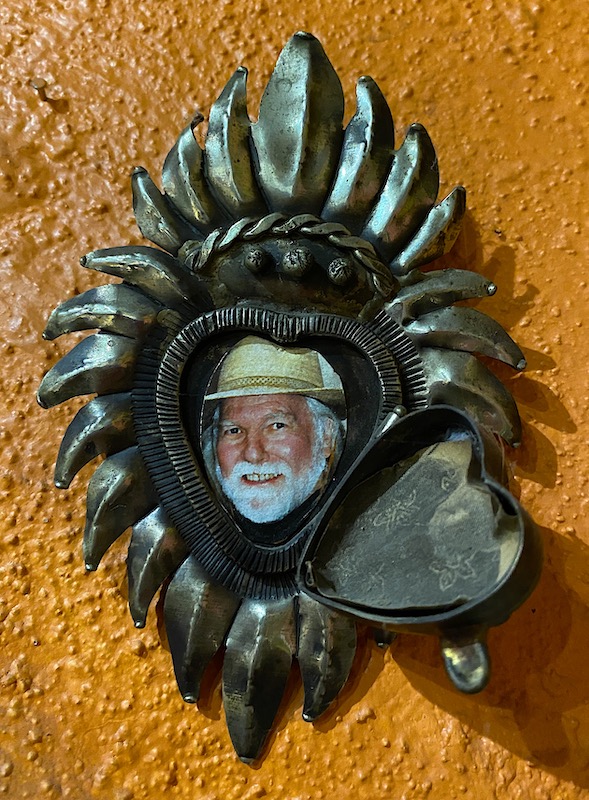
Bob, 2001

At the moment, every surface in my office/living room/dining room is covered with stacks of papers.  I’ve been plowing through files and old folders looking for additional stories to include in a book about my first few years of living in Mexico, but in doing so, I unearthed an earlier book, also unpublished, about our initial trip down to San Miguel to investigate it as a possible place to live for a year. So, I spent most of the morning and afternoon reading the entire book with the result that I’ve decided that maybe it makes sense to publish that book first, since it will better introduce readers to Bob and to the background of my move to Mexico.  With that in mind, I’d like your help in reading two or three of the beginning chapters to see if they hold your interest. They are a bit longer than earlier “possibles” that I’ve shared with you over the past week or so, but I guess that will be a test of whether this book is going to hold your interest.  Remember, as this story begins, the year is 2001 and so the information about our Mexican experience is 22 years old.  Please let me know whether you feel it is still relevant and interesting. That said, here is the possible first chapter of:

Innocents in Mexico

Chapter 1,  Leaving the Familiar

(Jan1-May 3, 2001)

How we came to decide to move to Mexico is unclear.  Bob claims I tricked him into it by first suggesting a two-week trip.  By the time he had agreed, the trip had grown to two months.  Then, the next thing he knew, I was telling people that we were renting out our house and moving to Mexico for a year, where we would live off the rent we were collecting from our house. But it was Bob, in fact, who suggested that if we left for a year we’d be coming home during the worst weather of the year––which led to our decision to move to Mexico for a year and a half.

The transition from the redwoods of central California to the central mountains of Mexico was not as simple as the decision to move there.  We had intended to return from Christmas with my 91-year -old mother in Wyoming, to spend a month packing our personal stuff out of the house and getting it rented out, then to leave by February 1. But a week or so prior to leaving for Wyoming, I found that I needed major surgery.  Since the recovery period was six weeks, that would delay our leaving by a month if we scheduled the surgery as soon as we got home in January, so we put off our leaving day to March 1.  If I packed just one thing at a time and left Bob to lift the boxes once they were filled, I should be able to do the packing even with stitches in.

The day I got home from surgery, my mother went into the hospital in Wyoming.  I’d been told not to ride in cars, climb stairs or lift for a week, then to take it easy for another month at the least.  My mother and sister insisted I not come, my mother even saying that it was too hard to visit over the phone when I called, due to the oxygen.  She liked to be left alone when she was sick, even had them put a “no visiting” sign on her door.  She would be going home soon, they all said.  But within a week, my mother had passed away.  Since she had known no one in the Wyoming town where she had moved a few years before to be near my sister, we decided to hold her memorial service in July in South Dakota, where an all-town reunion would be going on in the town where we all grew up.  My brother-in-law accompanied my mother’s body to Tucson, where she would be buried with my dad.  Both of my folks were not big on funerals.  My mom would have approved.  I put all of my efforts into planning her memorial long-distance.  Bob and I would drive up from San Miguel the last weekend in June for the memorial.

Now, along with healing, I mourned the loss of my Mother. For days, I worked on art projects which reflected her life story, and after my second day home from the hospital, I worked for two hours at a time packing books, then rested two hours, watching every video movie my friends could dig up to encourage me to get the rest I needed.  I began to get a bit agoraphobic, which was helped along by the fact that I wasn’t supposed to ride in cars.  On the night that my Mom died, Bob and I went for our first walk since my surgery.  It was nine o’clock at night as we walked up the road near our house to the top of the mountain.  The stars were vivid in this sky away from city lights as we discussed the afterlife.  There was something about the irrevocable ending of a life which pushed us in our resolve to put off no longer the next stage of changes in our lives.

Even though we planned to rent the house fully furnished, the packing proved to be a much larger job than we’d expected.  My mother had left us her car and any furniture or art we wanted.  My sister insisted that to send it would incur no loss to her or my other sister, since it would come out of the part of the estate the majority of which would go for taxes, anyway, so we decided to store our own furniture and rent our house with my mother’s.  This meant also changing all the art and decorations in the house, since her color scheme was different.  For a month, I’d packed books, which Bob would then carry to one studio or another to store.  Then I tackled the kitchen, leaving what I considered to be bare bones.  We were beginning to feel like we’d make our new departure date of April 1, but the date should have been a tip-off.  When they heard we’d be leaving, we suddenly had friends and relatives popping in with great regularity.  With each group of friends, we took the time to talk and play, to go to the beach and out to dinner.

One of the reasons we were moving to Mexico was to get our life back and to reprioritize after 14 years of running our lives around the demands of a business. We had felt rushed, pressured, buried under the minutiae of the details of bookkeeping, scheduling, mailing, travelling to art shows, setting up our booth, tearing it down, keeping track of the thousands of details involved in not only making art but selling it through craft shows. Every vacation we’d taken to visit family had been scheduled to coincide with our show schedule.  Most of our friends were artists, which was great, but we spent more time discussing the business of art than art itself.  We wanted off the bandwagon.  We wanted the time to talk and experience life without pressure. But now the business of moving was taking over our lives.  How to get all the loose ends taken care of.  How would we pay our bills?  Collect outstanding debts?  We had lamps to mail off to customers and galleries, files to sort out.  What to take, what to store, what to throw away?  I had twenty-five years of writing files:  poetry, stories, unfinished novels, movie scripts.  Bob had the same.  We had business files, tax files, personal correspondence files.  All of this needed to be sorted and dealt with.  One studio rapidly filled up to the ceiling with boxes of books, extra kitchen supplies, clothes and art. Then another one filled up with furniture, extra studio supplies from my jewelry studio, which we’d reconverted into a bedroom, writing files, tools and more tchotchkes.

When a woman who came to see if she wanted to be our property manager saw what we considered to be our stripped-down house, she said, “I’d clear out all this clutter.  Get it down to the minimum.”  That was what we thought we’d done!

Into this chaos drove my friend Patty, who’d volunteered to drive my mom’s car from Wyoming to California for us.  She stayed a few days and we took time off from packing to see the sights and talk.  Then came other friends.  We did the same.  When people heard we were leaving, they called to schedule dinners.  We went.  We were now worried about the April 1 leaving date.  With our departure date just two weeks off, Bob received a call from his sister.  His mom had gone into the hospital and wasn’t expected to live.  He flew to Michigan. After ten days, less than two months after we’d lost my mom, his mom passed away.

The day he flew off to Michigan, the first of our ads to sell vehicles appeared. We were selling a Blazer, a Mazda MX3, an ancient motor home, a trailer and a fork lift.  For the entire time Bob was gone, every bit of my time was spent jump-starting them, cleaning them, having them smog-checked, answering phone calls, showing vehicles and placing new ads.  Finally, when Bob got home, we parked the cars one at a time on the street.  The first time we did this, we got a ticket for parking a for sale vehicle on a county road.  Then we found a wide place that was evidently private land, but visible from the highway.  Within the month, we’d sold all of the vehicles but the travel trailer we had converted into a trailer to move our our big lamps, jewelry, ikebana vases, tents, cases and other display items to shows in. This we kept to store our unsold display items in.

With May fast approaching, Bob finally said he was beginning to feel we’d never leave.  In addition, he was starting to have reservations about whether he wanted to leave all his tools and studios.  What if we got to Mexico and didn’t like it?  We’d have rented our house out and would have no place to go.  In the end, we sealed up the house, paid a friend to deal with our bills and mail, packed up our cat that we had been unable to find a new temporary home for, packed up a few clothes, a lot of books and art supplies, and headed out for Mexico on May 3, 2001—only 4 months later than we had initially planned on starting out, but we were finally on the road. On the way, we would visit Bob’s son, daughter and grandkids in Flagstaff Arizona, his friend Carey in Tucson and my friend Judy in Alamogordo.  Then we would be free, unscheduled, with no timeline.  On our way to Mexico.

Go HERE to read Chapter 2


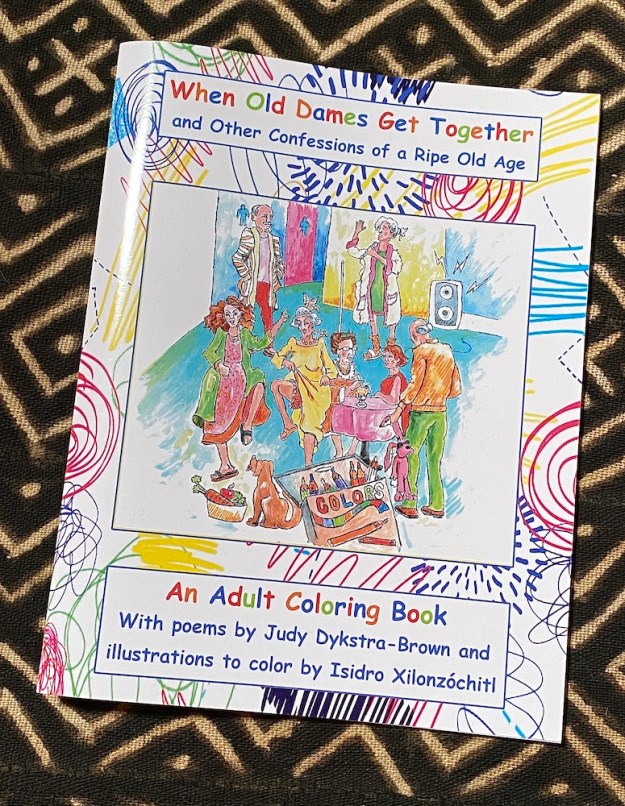
“When Old Dames Get Together” Now Available on Amazon

The book is now available on Amazon at https://www.amazon.com/gp/product/B0BSJBWX37/Y

Also available Lakeside at Diane Pearl’s Gallery, Viva Mexico, Jesus Lopez Vega’s Gallery
and from me at jubob2@hotmail.com.

You saw it here first! The book inspired by poems I wrote for prompts on my blog is now available on Amazon. It is an adult coloring book with poems by me and illustrations to color by Isidro.  Above and below are the front and back cover.

Here is a sample of the title poem and its illustration. Get out your colored pencils!  I wouldn’t recommend felt tip markers as they bleed through. Don’t try to color it on your computer screen or phone, though. The book is now available on Amazon!!!! You can find it HERE.
Also available at Diane Pearl’s Gallery, Viva Mexico, Jesus Lopez Vega’s Gallery and from me at jubob2@hotmail.com.

Kiddie Lit

Kiddie Lit

Kids’ writers should not share advice or issue proclamations,
give retorts to news reports or deal with exclamations.
Pervasive thoughts that they promote should be more of the soul.
Promoting  thoughts of mermaids should rather be their goal.

Reality will find us no matter where we look,
in news stands or on Twitter or in every printed book.
It’s fantasy that needs support in this day and age
when bad news is what we get on every written page.

Early on, a kid is taught to exercise and hustle,
but it’s equally important to develop other muscle.
A brain needs exercising, too, and after its gestation
is best served by means of an active imagination.


Prompts today are mermaid, writer, pervasive, retort, advice and proclamation.

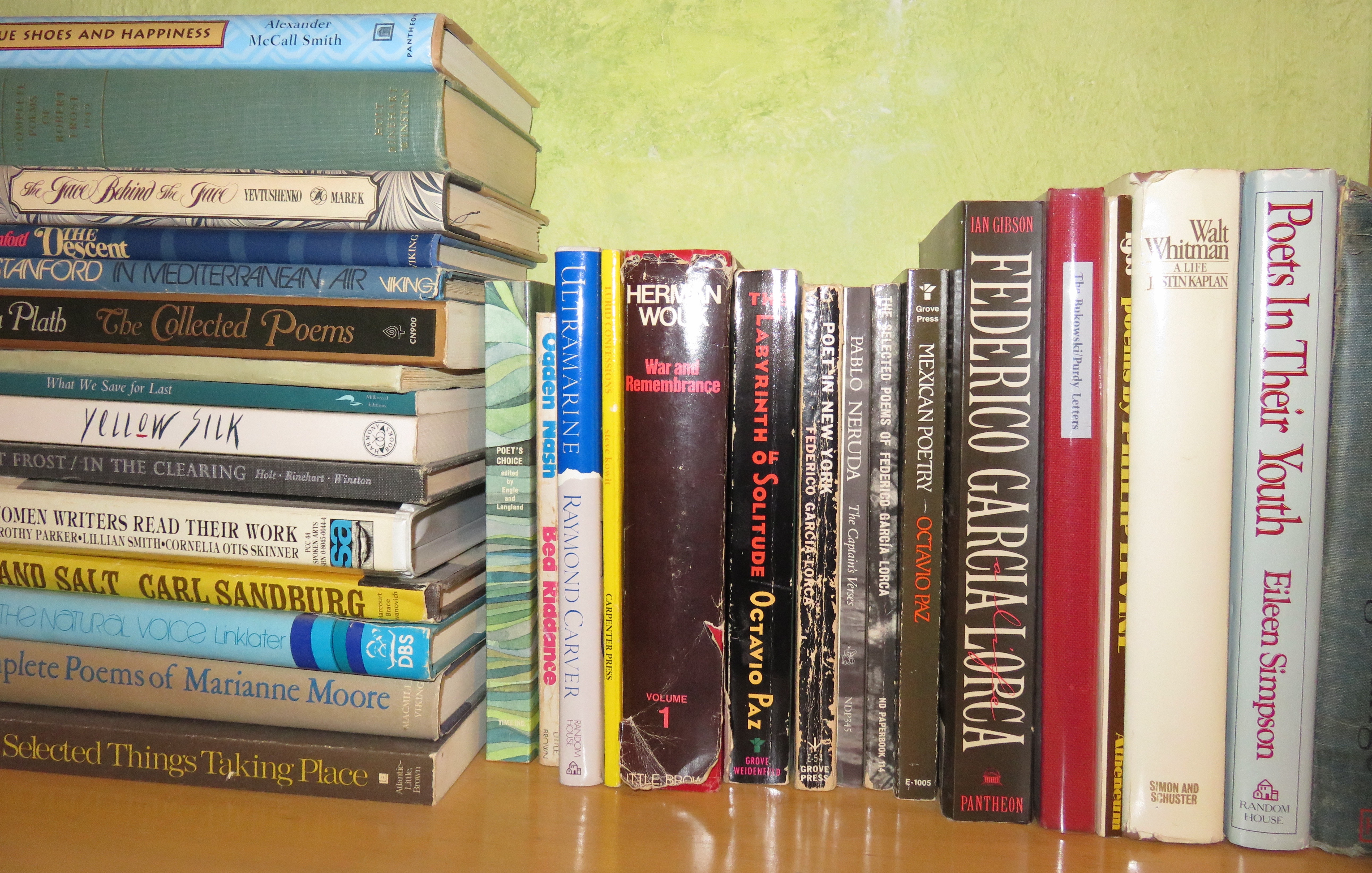
Bookbound

IMG_1310

Even the most intriguing book can become a dungeon of our own choosing. Comfortable as it is to read the stories of others, we only truly satisfy life by moving out into it and creating our own.


The prompts today are book, intriguing, dungeon and satisfy. Here are the links:
https://ragtagcommunity.wordpress.com/2019/03/22/rdp-friday-book/
https://fivedotoh.com/2019/03/22/fowc-with-fandango-intriguing/
https://onedailyprompt.wordpress.com/2019/03/22/your-daily-word-prompt-dungeon-march-22-2019/
https://wordofthedaychallenge.wordpress.com/2019/03/22/satisfy/

Sunup Sundown Song: My New Book!!! Now in Print

My newest children’s book is now available on Amazon. Go HERE to order.

sunup cover final (Judy)

“Wake up, wake up, my buttercup, my flutterdown and flutterup, my painter and my cutterup, your sleepy time is done.” So begins this silly rhymed storybook by Judy Dykstra-Brown that takes a child from waking up to a go-to-sleep-lullaby, chronicling in between a day full of activities and then the bedding down of the child along with a recap of all the creatures they have encountered during the day at their grandparents’ farm, the zoo and in storybooks. “Humpa, humpa, haravan, the camels in their caravan and puppies on the spare divan are falling fast asleep . . . like the foxes in their lairs, with the fleas down in their hairs. . . . Like your playmates, your teacher, and every living creature.” Sunup Sundown Song takes a child through the entire busy day and lulls them to sleep. Charmingly illustrated with fine details by artist Isidro Xilonzochitl. Meant to be read to children of all ages.

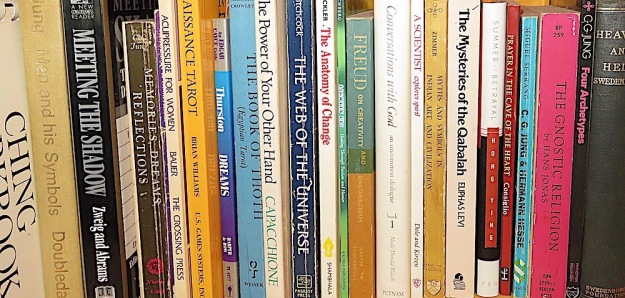
Books (For Daily Addictions July 21, 2018 prompt of Obsolete)

IMG_1316

Books

The fresh bookstore smell of them,
bending the pages to crack the spine,
notes scribbled in the margins,
underlines,
hearts with initials on the flyleaf,
something to loan or to wrap for a gift,
something propped up on the bathtub edge,
its paper sprinkled with drops-—
pages wrinkled into a Braille memory—
that rainstorm run through,
how he put it in his back pocket.

Poetry touched by fingers.
Single words met by lips.
Words pored over by candlelight or flashlight
in a sleeping bag or in a hut with no electricity.
Books pushed into backpacks
and under table legs for leveling.

Paper that soaked up
the oil from fingers
of the reader
consuming popcorn
or chocolate chip cookies
in lieu of the romance on the pages—
finger food served with brain food.
Passions wrapped in paper and ink—
the allure of a book and the tactile comfort.
The soul of a book you could touch, fold, bend.

Books are the gravestones of trees
but also the journals of our hearts.
Cities of words,
boards and bricks of letters,
insulated by hard covers or the curling skins
of paperbacks.
Something solid to transfer the dreams
of one person to another in a concrete telepathy
of fingers and eyes.
Books are the roads we build between us,
solid and substantial—
their paper the roadbed,
the words the center lines directing us.

What will fill the bookcases of a modern world?
Wikipedia replacing dictionaries,
Google already an invisible bank of Encyclopaedia Britannicas.
What will we use our boards and bricks for,
if not to hold up whole tenements of books?
How will we furnish our walls?
What will boys carry to school for girls?
What will we balance on heads
to practice walking with perfect posture?
What will we throw in the direction of the horrible pun?

Will there be graveyards for books, or cities built of them?
Quaint materials for easy chairs or headboards for beds?
Will we hollow them out for cigar boxes
or grind them up for packing material?
Where do books belong in the era of Kindle and Audible?
These dinosaurs that soon will not produce more eggs.
Perhaps they’ll grow as precious as antiques.
Perhaps the grandchildren of our grandchildren
will ponder how to open them. Will wonder at their quaintness,
collecting them like mustache cups or carnival glass,
wondering about the use of them—as unfathomable as hieroglyphics.
That last book closing its pages—one more obsolete mystery
fueling the curiosity of a bygone era that has vanished
into a wireless universe.

search
search-1Yes, you are right.  These are chairs made out of books.

In response to The Daily Addictions prompt of obsolete  Of all the technologies that have gone extinct in your lifetime, which one do you miss the most?

The Daily Addictions prompt is obsolete.

This poem written over two years ago and edited a bit today seems to fulfill the requirements of today’s prompt word. As I look at those who have already read it, I see only a few familiar faces. (Hi, Marilyn) so I’ll risk running it by again. (The prompt word today was mystery.)

lifelessons's avatarlifelessons - a blog by Judy Dykstra-Brown

IMG_1316

Books

The fresh bookstore smell of them,
bending the pages to crack the spine,
notes scribbled in the margins,
underlines,
hearts with initials on the flyleaf,
something to loan or to wrap for a gift,
something propped up on the bathtub edge,
it’s paper sprinkled with drops–
pages wrinkled into a Braille memory–
that rainstorm run through,
how he put it in his back pocket.

Poetry touched by fingers.
Single words met by lips.
Words pored over by candlelight or flashlight
in a sleeping bag or in a hut with no electricity.
Books pushed into backpacks
and under table legs for leveling.

Paper that soaked up
the oil from fingers
of the reader
consuming popcorn
or chocolate chip cookies
in lieu of the romance on the pages–
finger food served with brain food.
Passions wrapped in paper and ink–
the allure of a book and the tactile comfort.
The soul of a…

View original post 311 more words