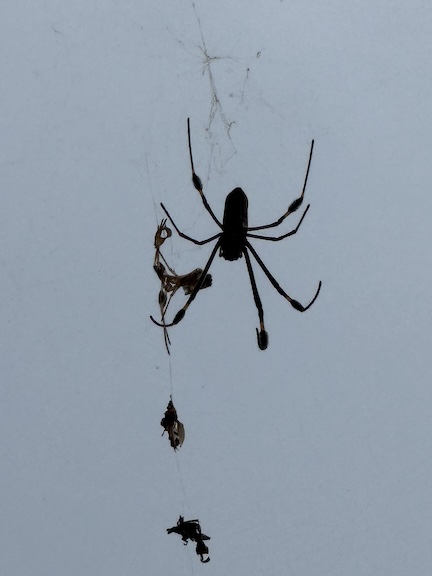
This guy (or gal) or their progeny has been hanging around the front of my carport for years, welcoming me home every time I open the garage doors and park my car.
Images for Bushboy’s Last on the Card
This guy (or gal) or their progeny has been hanging around the front of my carport for years, welcoming me home every time I open the garage doors and park my car.
Images for Bushboy’s Last on the Card
Soon it will be that time of year when flying termites descend by the thousands, chew off their wings and go in search of delicious wood to munch. I took these photos 8 years ago when these fellas got caught in a huge rainstorm that lasted for hours, pinning them by their wings. I woke up to drifts of them in places like these steps up to the garage.


The SOCS prompt for May 24 is “That Time.”
Please Click on photos to enlarge.
I am so happy that it is “Last on the Card” time again. I took these three photos and could not figure out what category they’d fit into…until Forgottenman reminded me it was time for Bushboy’s Last on the Card prompt.
I had never seen this butterfly before. It was sitting on the ledge above Morrie’s cage and I saw it when I was giving them their morning meal. It seemed not to be able to fly. I tried gently moving it to make sure the feet weren’t stuck to the ledge and also carefully spread its wings a bit to make sure they weren’t stuck together by cobwebs or some other environmental danger. I then took it out and put it on a plant and never saw it again. I hope it flew away. It is a Smyrna blomfildia, The Blomfild’s beauty, a species of butterfly in the family Nymphalidae and among other locales, is found from Mexico down to Panama. Beautiful markings.
As for the other photos, if you look carefully, you’ll see what has captured Morrie’s interest. They remained like this for some minutes. No barking, only occasional meowing. I had already fed them both so don’t know what other than curiosity caused Ollie to come and observe us from the roofline.
The silhouette of the trees and bougainvillea was actually the last on the card, so had to include it. The others were second and third to last.
For Bushboy’s Last on the Card
For Lens-Artists Challenge #312: A Sense of Scale
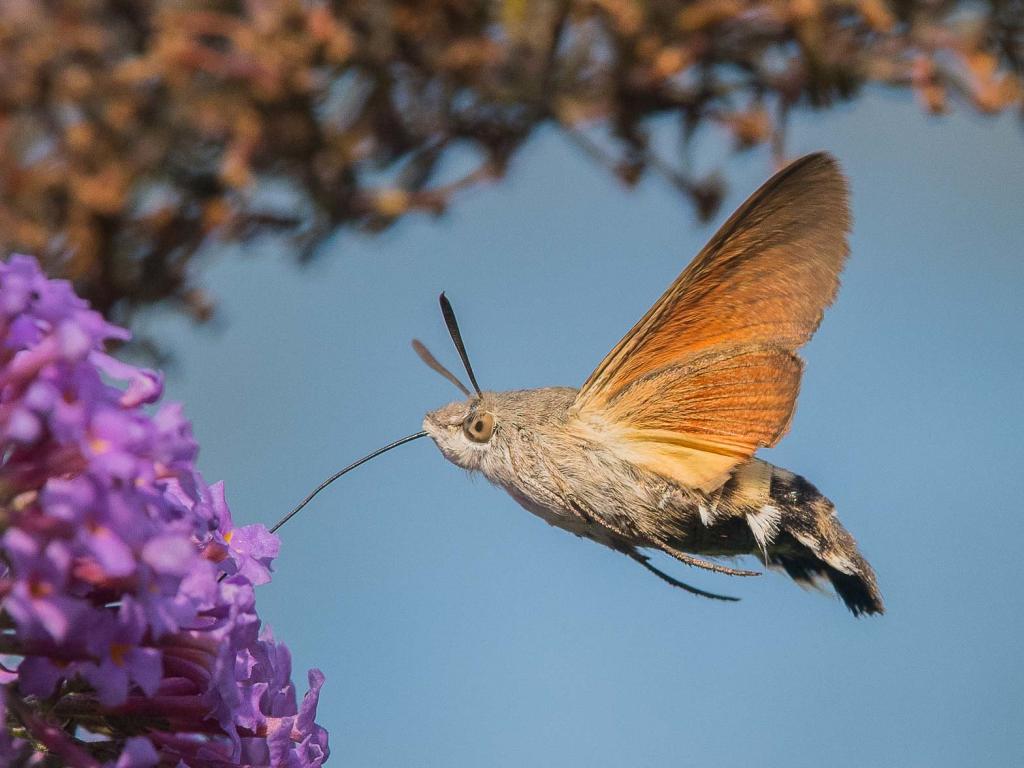
Virginia Creeper is one one of my favorite plants as it quickly provides a complete cover over my terrace, and although it doesn’t flower, once a year for a month or so it does provide creepers of its own—these huge caterpillars that eventually turn into large moths that resemble hummingbirds so closely that I’ve only really ever identified one in the 23 years I’ve been relocating the larvae to my downhill lot. The caterpillars are so fascinating that I can’t bear to kill them, but in their larvae stage, they also produce bee bee-sized black poop pellets that cover the terrace and table and chairs below. If you want to see (and read) more about the caterpillars, go HERE.
Here is an image of hummingbird moth by Graehem Mountenay. I’ve never been able to capture one and have seen only one in 23 years. They must be present, though, judging by the dozens of their caterpillars that we remove from my Virginia creeper each year.For Cee’s FOTD
The rainstorm hit just as I drove up to the house. Running from the garage to the kitchen door, a distance of no more than 30 feet, I was as drenched as I would have been if I had jumped into the pool. I created a river as I ran across the kitchen, dining room and living room, shedding clothes the entire way. Once dried off (except for my hair) and in my nightgown, I wasn’t about to carry the cats’ food bowls out to the garage, and how could I expect the cats to eat their dinner in the driving rain? So they dined in the kitchen and quickly afterwards, chose their beds for the night. Kukla on the back of the living room sofa and Ollie on my freshly laundered, ironed and folded sheet. I think they are in for the night. Earlier, I had foolishly kept the kitchen door open, thinking they might wander outside once the rain ended. Instead, I entered the kitchhen a few hours later to find it filled with large red flying termites! I quickly turned off the light and many of them swarmed to the hall, where I had left a floor lamp on. For some reason, they were all on the floor, where I quickly stamped them to death. I hate to kill any creature, but these same termites used to invade our house in the Redwoods in California, chew off their wings and burrow their ways into the redwood walls of the house. It was them or my wooden African carvings and cupboards and furniture!
Go HERE and HERE and HERE to see and read more about these termites.
Misnomer
Red dragon of my garden, ascending walls and rocks,
seeking out a birth chamber on your extensive walks.
Your strategy is lethal, for the shelter you find best
proves you as an enemy—a thief of life and nest
of bee or wasp or other insect where you’ll lay
your eggs where larvae of your host will become the prey
of your eggs when they have hatched into larvae too,
long after you have left to resume adventures new.
Wingless wasp, you never soar aloft in air,
but your vivid color hints at the despair
of any who receive your sting, so painful that you’ve earned
the title of “Cow Killer Ant” as victims have soon learned.
Cool water will not stem the pain, nor will anything
soothe the throbbing torture of your defensive sting,
but unlike your insect victims, humans will not face
a fate more dire than pain that is extensive as you race,
channeling your power into a new direction,
tunneling into the ground to escape detection.
Prompt words for The Sunday Whirl Wordle 658 are: strategy enemy thieves red dragon air hint water rock nest face channel
Although commonly referred to as the cow killer ant or red velvet ant, this insect is actually a wasp. They get the “velvet” part of their name from the fuzziness of the females, which are wingless and often brightly colored, appearing like a red and black ant. The powerful red velvet ant sting is what has led them to be nicknamed “cow killers”. The female will enter the ground nest of a host species, typically a wasp or bee species, and lay her eggs near the host’s larvae. As D. occidentalis’ larvae develop, the species’ true parasitoid nature is shown. The larvae grow and develop by feeding on and killing the larvae of the host species. [13] Velvet ant larvae will continue to feed until they enter the pupal stage. In this stage, larvae continue to grow into adults. Pupation typically takes 23 days, and most velvet ants are mature and ready to reproduce themselves after this. [15] Velvet ants have an interesting mating style compared to other Hymenopteran species. The male has no parental care responsibilities and the female leaves as soon as she lays her eggs. This is not out of the ordinary for a Hymenopteran species, but velvet ants are though to be monogamous and semelparous. This means females mate just once in their lifetime with only one male. Many entomological organizations suspect velvet ants to mate only once in their lifetime.[16]
(Thanks, Wikipedia, for furnishing research on these insects. I think I’ve seen three in the past 23 years and did an earlier post on the orange and black variety I discovered on my wall many years ago. This one I found near my kitchen door just a few years ago.)
This morning I noticed these leaves on the pedestals on either side of the door that leads from the street to my front garden, but it wasn’t until Paciano arrived that I noticed the 3 inch wide trail of leaf parts that extended almost the entire distance across my lot from the pedestals to the kitchen door and then mysteriously stopped! It was solid stone the entire way and there was no hole in site that might have led into their underground abode. Why would they have stopped there and why so many different segments–so many that they formed a solid carpet? If it had been a rain, it would have washed the leaves away or at least disarranged them. These tiny segments, much smalled than the leaves pictured above, formed an absolutely straight and orderly pathway almmost entired covered with green. It indicated that thousands of ants had set down their burdens at exactly the same time and left. What could have caused this? In my 23 years of observing leafcutter ant behavior, I had never seen it before.
But, an equal mystery is why in the world didn’t I take a photo?
And..how strange. As I was getting ready to post this blog, I saw a movement on my arm and you guessed it…it was an ant! Not a leafcutter, however.
Two other posts on leafcutter ants:
For Bushboy’s Last on the Card Prompt
Click on photos to enlarge and view as slideshow.
Click on photos to enlarge.
Welcome to “The Numbers Game #6” Today’s number is 127. To play along, go to your photos file and type that number into the search bar. Then post a selection of the photos you find under that number and include a link to your blog in my Numbers Game blog of the day. If instead of numbers, you have changed the identifiers of all your photos into words, pick a word or words to use instead, and show us a variety of photos that contain that word in the title.
This prompt will repeat each Monday with a new number. If you want to play along, please put a link to your blog in comments below.