Category Archives: Writing

Nesting (May 3, 2014)

                                                                           Nesting
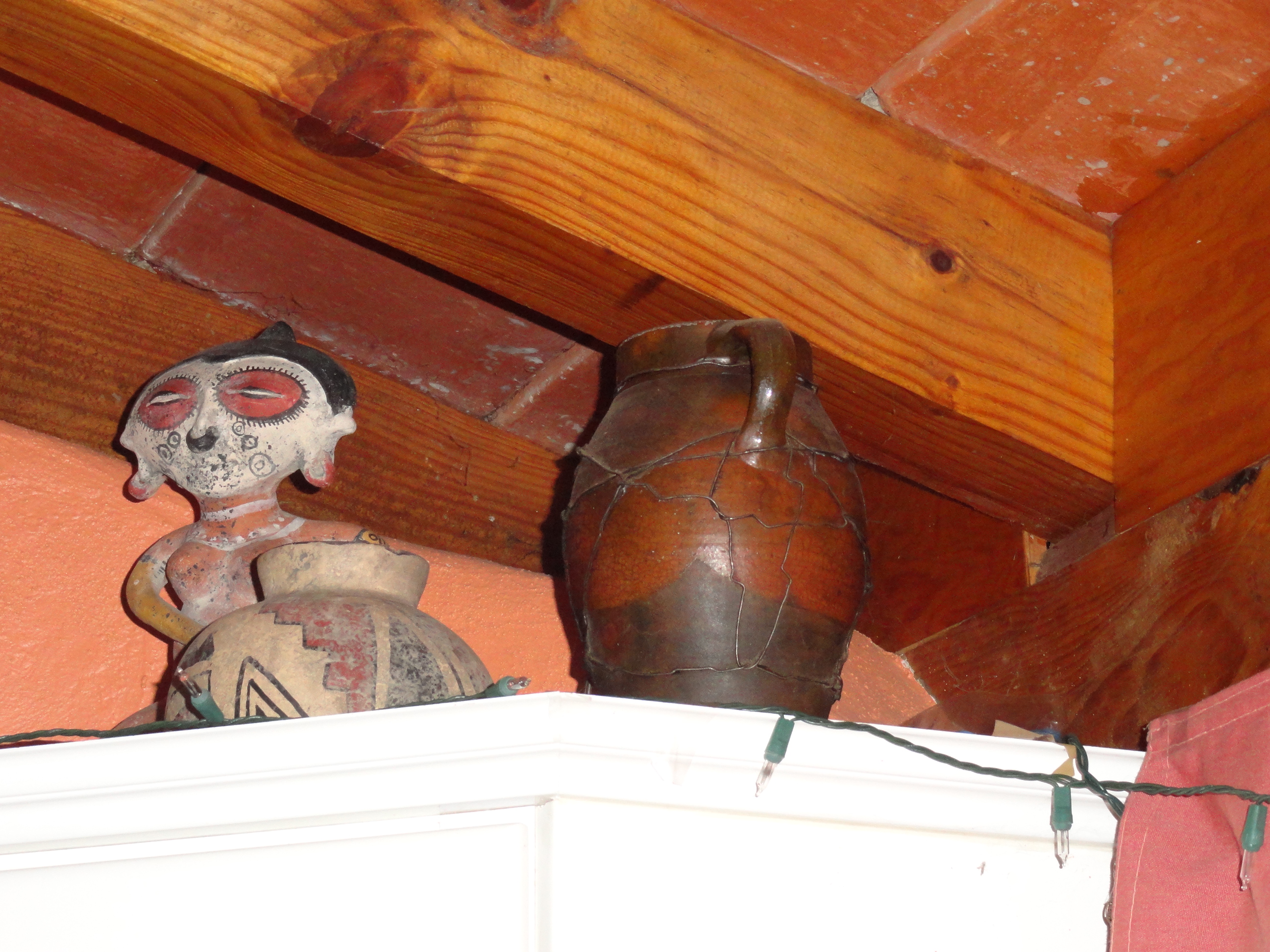
For most of the day on Thursday, I wondered at the profusion of birds whose cheeping seemed to be filling the air outside my kitchen, but as the afternoon wore on, I realized that the sounds—like a cross between a puppy’s squeeze toy and a handful of fingernails scraping across a chalk board or 5 squeegees being pulled across dry glass—was coming from my kitchen. A dining room chair served as a step up to the counter top, where I stood as I removed  the terracotta statues and pots from the top of my cupboards. The sounds seemed to be coming from there, but I found nothing but a half-inch crack between the concrete wall overhang and a triangular piece of board that had been placed in the corner to seal the gap.

Image

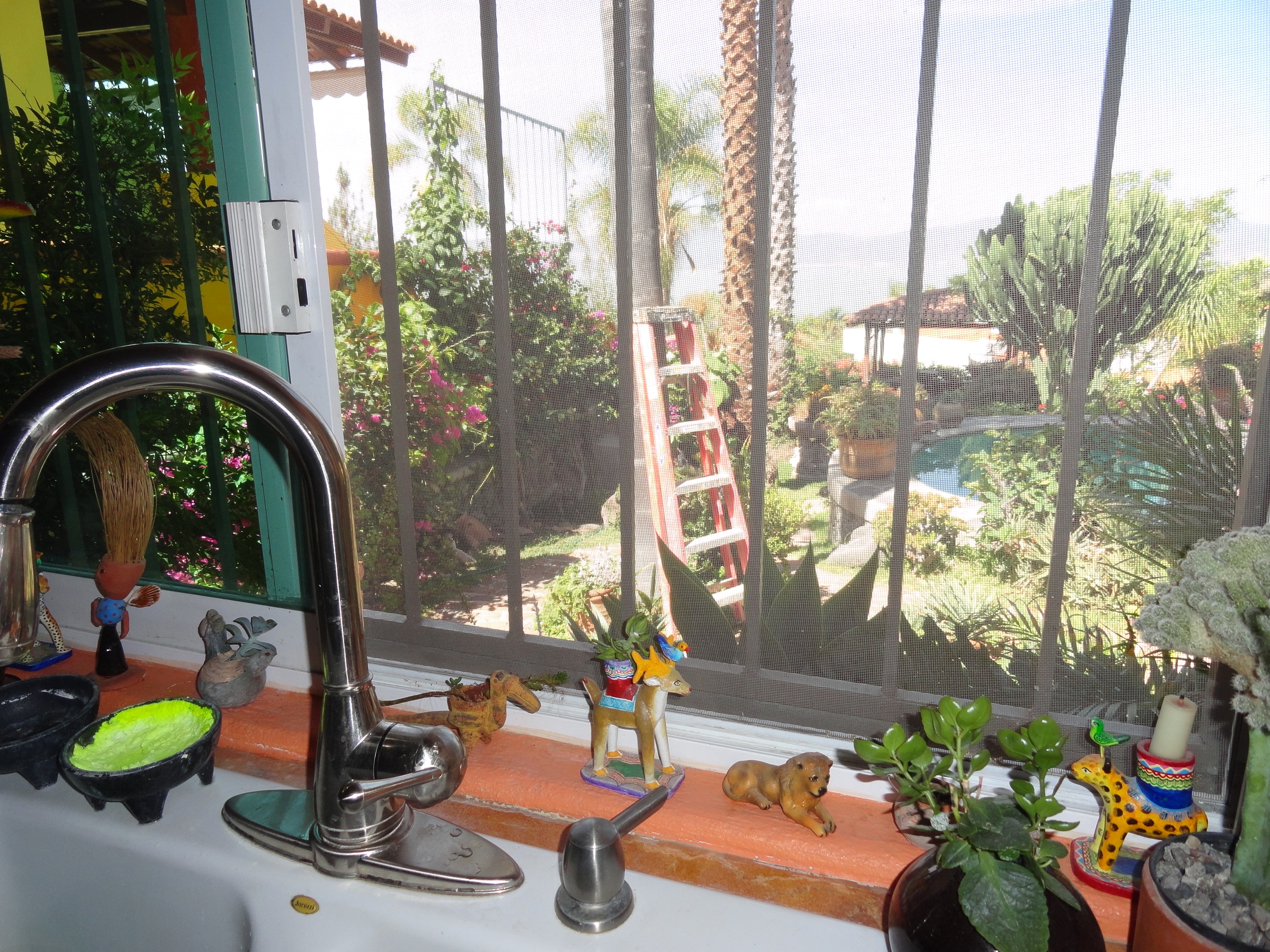
I went outside to see if I could locate what I now was sure was a nest of baby birds making all the racket, but I could see no place other than the half-cylindrical teja roof tiles where the nest could be. Meanwhile, every time I drew close to the corner where the sound was coming from, they grew quiet, but when I whistled for the dogs, the little chirping choir resumed, as though I’d called out to them and they were answering. The next morning, I feared the worse, as for an hour there was no sound, but when Yolanda arrived to clean, they started out again, and she was as intrigued as I was about where they could be. We got a ladder and Pasiano climbed up to inspect every inch of area on the outside of the house where they could be. He peered up a six foot long expanse of tejas but could see nothing up the tubes for as far as he could see. Yet the chirping went on for all of yesterday as well as today.

ImageImage

The biggest part of the mystery is that I have never seen a parent bird enter the tejas from any side. The babies are quiet in between chirpings, which seems to indicate a mother bird arriving with fresh nestling fuel, but I can’t figure out how she is getting to the nest—wherever it is. Needless to say, as irritating as their shrill chirpings have grown to be, I prefer them to the opposite—the silence that indicates the mother has not been coming back and that her nestlings have met with a premature demise.

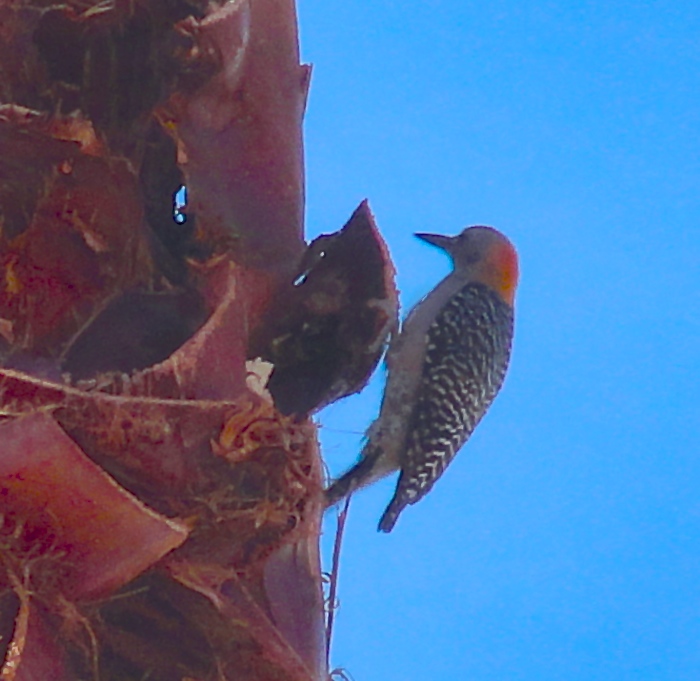
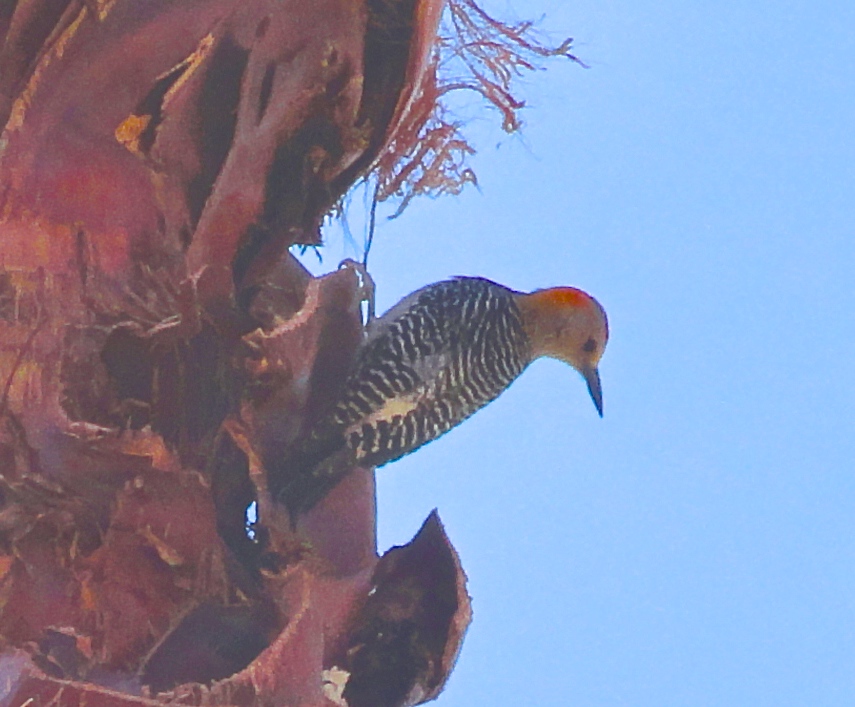
Birds abound here, if not in the same profusion as when 13-year-old vines covered every surface of the walls and palms, but this morning I was awakened by the loud peckings of three woodpeckers on the now-exposed trunks of my 80-foot-high palm trees. I scrunched my eyes up to watch them hop up and down a 20 foot expanse of palm, working their way around the circumference of the tree as well as up and down, their very loud pecking forming a percussion background to the chirping coming from the kitchen. For once, I knew where my camera was, so I snapped a few shots.

ImageImage

I had thought to spend this day in isolation to get some writing done, but sometimes the quieter our day, the more activity we find in it. Bottle rockets as loud as cherry bombs have been going off in the hills all around me for the past two hours. I don’t know what the celebration may be, but I’ve grown accustomed to their weekly if not daily presence. There is a birthday or a communion or a wedding or a quinceañera being celebrated. Or a holy day or some national holiday.

Even if I stay inside my house and do not answer the phone, the world finds me and I can’t complain, for I always have something to write about, even if it is not the topic I had planned.


NaPoWriMo Day 30: Ciao, Adios, Auf Wiedersehen, Adieu

Ciao, Adios, Auf Wiedersehen, Adieu

To NaPoWriMo we must say
a fond “Goodbye” on this last day.
I‘m able to, for I have found
the strength to say it the whole world round.

When I was young, I traveled far
from Germany to Zanzibar.
Australia, Bali, France and Spain,
to Africa and back again.

And though I mostly loved them all,
from Venice to the Taj Mahal,
as my departure time grew nigh
I had to voice a sad goodbye.

To Ethiopia I strayed.
For eighteen months I stayed and stayed;
and when I had to leave too soon,
I had to say “dehena hun.”

In college days, when I was young,
German was my foreign tongue;
but when to Frankfurt wir mussten gehen
I just remembered, “Auf Wiedersehen.”

The French were rude and cold and snotty.
They mocked my accent and were haughty,
so while I had to bid “adieu,”
I’d have preferred to say, “pee-ew.”

Florence thrilled me from the start.
Their lasagna is a work of art.
When I left, they all said, “Ciao.”
Their kitties, though, all said, “Miao.”

I never went to Israel
but nonetheless, I’m proud to tell,
the rabbi books? Read every tome.
So I know how to say “Shalom.”

Though “Arigato” is bound to do
when you want to say thank you,
Sayonara” is the way to go
to bid farewell in Tokyo.

Bali’s full of dance and art
that treat your eyes and fill your heart.
I must admit, I had a ball
before I said “Selamat tinggal.”

Mexico was saved for last
And now I fear my lot is cast
Since “Adios” I cannot say,
I’ve decided I will stay!

(for the sake of pronunciation, I have taken the liberty of adding an extra “e” to “dehna hun.”)

You might have already guessed that on this last day of the NaPoWriMo challenge, the prompt was to write a farewell poem.

NaPoWriMo Day 29: Chew the Train

Chew the Train

A metaphor is a freight train
that gets us within 30 miles
of our final destination,
but we still have to catch a taxi to get all the way there.
And a simile is just a metaphor whose brakes have failed.
If we know that peanut butter
is like a circus on a tired tongue,
does it bring us any closer to the smell of peanut butter?
Elephants and sawdust
and sequined camisoles flavored
with the sweat of 100 performances?
Is that what peanut butter smells like?
Does it taste like candy apples
and too-bitter mustard
on stale buns
and hot dogs turned too long
upon the rollers of their grill?
Does peanut butter feel
like the unoiled bump of the Ferris wheel?
Does it sound like a calliope
or look like an ice cream cone?
Peanut butter is peanut butter.
I rest my case.

So how am I going to write a poem
without metaphors and similes?
How can I write verse
while telling the pure unadulterated truth?
How can I make you taste a poem
that is only itself?

How can I be Janis Joplin
when I’ve been taught to be Joni Mitchell?
A Rose is a Rose is a Rose,
said Gertrude Stein,
predating my insight
by a generation or two.
But this isn’t Paris,
and folks in Mexico
want a dollop of figurative language
in their poetry.

So let me say
that my mind is a busy beaver,
trying to fulfill this impossible task
of twenty little things.
I’m expected to imagine
how peanut butter sounds.
The sucking gumbo sound
of South Dakota mud
or thick mucus of a cold?
Anything but appetizing.
Ay, Caramba! you might say,
but if you were Australian,
you would say, “Don’t come the raw prawn on me, mate,”
and you would mean
“Don’t try to pull the wool over my eyes,”
or “Don’t try to con me, man.”

So let me just say that peanut butter is made
by grinding peanuts so finely
that all the oil comes out
and it acquires the consistency of butter.
It isn’t like butter
nor is it butter.
It acquires the consistency of butter.
This is literal fact.
But to know the taste of peanut butter,
you will need to spread a bit upon a cracker
and have a taste, or grab a finger full.
What you will taste will be peanut butter.
The truth of it. Its reality.

And only then will I tell you
that literal truth doesn’t always tell
the whole truth.

My friend says
it is the peyote leached into the soil
the corn grows from
that gives Mexicans
such a remarkable sense of color.
The bright pigments of imagination
flood his canvasses.
His peyote dreams leak out into the real world
and wed it to create one world.
“Peyote dream” becomes its opposite—
a freight train taking us into the universal truth.
A larger reality.
This stalk of corn, this deer,
this head of amaranth,
all beckon, “Climb aboard.”

So when you bite into a taco
or tamale, when the round taste of corn
meets your tongue, and pleasure tries to flow
like a lumpy river down your throat,
look up at the poet standing in the shadows.
She’ll call herself Remi if you ask,
but do not ask. Instead, look deeper
into the shadows she wears around her like a cloak
and see that it is light that creates shadow.
See the many colors that create the black.
Follow where the corn beckons you to go––
into the other world of poetry and paint
and dance and music. Hot jazz with a mariachi beat.
Chew that train that takes you deeper. Hop aboard
the tamale express and you will ride into your
new life. It will be like your old life magnified
and lit by multicolored lights and the songs of merry-go-rounds
and when you bite into your taco, it will taste
like cotton candy and a snow cone
and your whole life afterwards will be a train that takes you nowhere
except back into yourself—a Ferris wheel
spinning you up to your heights and down again, with every turn,
the gears creaking “Que le vaya bien.”
I hope it goes well with you
and that you see the light
within the shadow
and the colors
in the corn.

glass-gem-corn-2-460

Today’s prompt is called the “Twenty Little Poetry Projects,” and was originally developed by Jim Simmerman. Here are the twenty little projects themselves — the challenge is to use them all in one poem:

1. Begin the poem with a metaphor.
2. Say something specific but utterly preposterous.
3. Use at least one image for each of the five senses, either in succession or scattered randomly throughout the poem.
4. Use one example of synesthesia (mixing the senses).
5. Use the proper name of a person and the proper name of a place.
6. Contradict something you said earlier in the poem.
7. Change direction or digress from the last thing you said.
8. Use a word (slang?) you’ve never seen in a poem.
9. Use an example of false cause-effect logic.
10. Use a piece of talk you’ve actually heard (preferably in dialect and/or which you don’t understand).
11. Create a metaphor using the following construction: “The (adjective) (concrete noun) of (abstract noun) . . .”
12. Use an image in such a way as to reverse its usual associative qualities.
13. Make the persona or character in the poem do something he or she could not do in “real life.”
14. Refer to yourself by nickname and in the third person.
15. Write in the future tense, such that part of the poem seems to be a prediction.
16. Modify a noun with an unlikely adjective.
17. Make a declarative assertion that sounds convincing but that finally makes no sense.
18. Use a phrase from a language other than English.
19. Make a non-human object say or do something human (personification).
20. Close the poem with a vivid image that makes no statement, but that “echoes” an image from earlier in the poem.


NaPoWriMo Day 26: Pied Beauty II

Pied Beauty II

Thanks be to Sara Lee for appled things—
For pies, for apple fritters and for thin-rolled strudel crust;
For pastries of the fruit of Eve and sauce it swims within;
Fresh-cooked in ovens, how their sweet juice sings;
The sugar clotted and pierced— place it on plate we must;
And all taste, for how can tackling it be such a sin?

All things made of flour and Crisco and of apples sweet;
(How can they by nutritionists be so sorely cussed
With words professing they won’t make us thin?)
With their tart flavor are sure our lips to meet;
And meet again.

—Judy Dykstra-Brown

Our prompt today was to write a curtal sonnet in the style of Gerard Manley Hopkins’ famous poem “Pied Beauty”. This form consists of a first stanza of six lines followed by a second stanza of five, closing with a half-line. The rhyme scheme is abcabc defdf. I chose to make it a parody of Pied Beauty as well.

And now, the original:

Pied Beauty

Glory be to God for dappled things –
For skies of couple-colour as a brinded cow;
For rose-moles all in stipple upon trout that swim;
Fresh-firecoal chestnut-falls; finches’ wings;
Landscape plotted and pieced – fold, fallow, and plough;
And áll trádes, their gear and tackle and trim.

All things counter, original, spare, strange;
Whatever is fickle, freckled (who knows how?)
With swift, slow; sweet, sour; adazzle, dim;
He fathers-forth whose beauty is past change:
Praise him.

–Gerard Manley Hopkins


NaPoWriMo Day 23: The Separation Continues

Today’s prompt was to find a poem in a foreign language that we do not understand and to write a poem based on what we imagine that poem might mean. I’ve placed my “translation” first. The Croatian poem I translated is below it.

THE SEPARATION CONTINUES

Pry back the blackness spread over the flattened
world, using the voice of poetry for your rake—
poetry no traveler can understand or translate.
Poetry no one knows the cost of—neither
posted propaganda nor cheap
joke, but rather words to soothe bad
kisses or portraits of topless women,
naked out of necessity
for a piece of bread or for a
drink: cheap vodka or blackberry wine. Yes,
this afternoon, crossing the tavern where love died,
and, coincidentally, where he first knew he loved me,
I tasted the rich baklava I used to serve him,
and we raised a glass to him
who will never write poetry again.

2014, Judy Dykstra-Brown
USA/Mexico


VRT FINCI CONTINIJEVIH

prije nego li sjednem za ovaj
stol, oprat ću ruke, poezija
ne trpi traktate o sebi, za-
gristi svježu kost, ona ne
dopušta da propadne u barutu
jezika, prahu i bromu to malo
kiše, potražit ću toplu ženu,
jer nijednu riječ nikada nećeš
dodirnuti da te ona ne pita o
sebi, zatvoriti oči, zaroniti, i,
tada, kreću s tavana svi mrtvi,
iz začuđenih usta isplove crni
ozbiljni barkaroli i širokim
zamasima pjevaju glasno
nad otvorima neba

© 1998, Miroslav Mićanović
Croatia

NaPoWriMo Day 21: A New York Sorta Poem

Today’s prompt was to write a “New York School” poem using the recipe found here. The New York School is the name by which a group of poets that all lived in New York in the 1950s and 1960s. The most well-known members are Frank O’Hara, John Ashbery, and Kenneth Koch. Their poems are actually very different from one another, but many “New York School” poems display a sort of conversational tone, references to friends and to places in and around New York, humor, inclusion of pop culture, and a sense of the importance of art (visual, poetic, and otherwise). Here’s a fairly representative example.

In following the recipe, you can include as many (or as few) of the listed elements as you wish.

(I suggest you click on the hyperlinks above to better understand the poem below—unless you are such a scholar of poetry that you already know what a New York poem is.)

A New York Sorta Poem

Okay, Dear Readers.
Linda Crosfield and Ogginblog and InfiniteZip
and all you poets and internet marketers
out in Cyberspace who deign to visit
my humble blog,
I am lying abed in San Juan Cosala,
Mexico. It is a fresh day and
thermal water spurts and sputters
into my pool.
This is not fucking New York
but neither is it fucking small town South Dakota,
population 700 and more people than trees.
(Pardon me, okcforgottenman, RepoComedy and Brian Marggraf,
since I have grown dependent on these daily prompts,
I am a prisoner to profanity this day, as it
is a vital ingredient of the recipe.)

It is Monday, April 21, 2014—my thirteenth year
in this same house on a mountain
over a dying lake.
Now, I want to ask you, Ann Garcia
and Patti A. and Shawn L. Bird,
have I ever told you about the day
my neighbors streamed down from the hill
to dance on the dome of my house?
Neighbors had complained about children
who had climbed over the wall and walked
up the outside steps to the upstairs patio and then
run up the dome to jump and stomp.
When they ran home to complain to parents,
the parents came, and older brothers and sisters
and an uncle, and in solidarity, they all climbed over the wall
to ascend the dome and dance and stomp and jump up and down,
but the bricks held and the dome did not suffer
as they faced off the neighbor and danced.
This was before I bought the house, when it was
sitting idle, but it was part of my house’s history
that it lived before it began to live my life.

Those children now grown and departed,
only my dog, Frida the Akita, rests or stands barking on that dome
so that she has grown in fame among passersby and
I have become the owner of the “dome dog”
more famous than me, like having a notorious
older brother or sister, I am more a part of her
identity than she mine.
But I digress (with a fine excuse for doing so—part of the
recipe) and would get back to the point
if there were a point other than using
profanity and giving numerous references
to this place as far from New York City as one could get.
(Actually, that in itself is not precisely true. Antarctica
is further away, and probably Katmandu.)
Which is a big coincidence, since the message
that just popped up on my screen is from my friend
Patty, who worked in Antarctica, and so is an authority
on the subject of being far from New York City, but being
born in Wyoming, was an expert on this subject anyway,
from birth. (And coincidentally, again, today is her birthday,
so I wish I could send her a giant macaroon like the ones
we bought at the beach in La Manzanilla just a few weeks ago.)

So dear reader, Brian Moore or Kavalcade Krew,
had you ever heard of New York Poetry and if not,
have you made any sense of what I’ve written so far?
One hour ago, I was sleeping and I, too, had never heard
of this curious genre. Two days ago I awakened
to an earthquake’s vibrations and then today,
I find this weird recipe for poetry awaiting me as a prompt
and I do not know which has been more the more discombobulating of the two.
And dear readers, Lena or eyewillnot cry,
Are you old enough to have heard of Glen Yarbrough
and if you have, would you be surprised to hear
he rearranged my sound system and offered to record
the musical versions of my poetry to include with my book
and would have done so if they hadn’t messed up his
vocal cords in surgery? This is the only famous person
I’ve met in Mexico, except for Barbara Kingsolver
who wrote me a letter in green ink.
Or perhaps I am imagining the color of the ink. I have
that letter somewhere, buried in a file or a pile.

Pop culture I may have to leave out of my poem,
unless you will accept my mention of my poetry group,
The Not Yet Dead Poets. We have three Pops and two
Moms in the group which makes us sound more like
a singing group from the seventies. And in not being
dead, we sing of life. Or I could mention the poetry wall
near the malecón in the pueblo down below. With poetry
all in espanol (which isn’t capitalized in Spanish),
I think I should add a short poem or two in English
(which isn’t capitalized in Spanish, either, so pardon me for inconsistency)
to declare solidarity with Mario Puglisi or Isidro or Eduardo
or any of the other fine artists and poets of San Juan Cosala
who have welcomed me and included me in their shows
for which I am grateful as it makes me just a tad less gringa
and a bit more cabrona, which they assure me is not a
derisive label when spoken in the correct context and tone of voice.

So, robert okaji, fine poet, and Andrea Giang of Cooking with a Wallflower,
are you following this prompt
and, if so, is your poem getting to be as long as mine? I have
this feeling that the real New York poets didn’t have a recipe
to follow and that their poetry was more like discovering
leftovers in the fridge and making whatever they could,
spontaneously.

I feel this poem coming to an end
before all ingredients are added to the brew,
but since there is a tad more room left in my poetry bowl,
I would like to dedicate this puzzling poem
to Robert Creeley, Ron Padgett and Dorothea Lasky;
and to Thom Donovan I say,
“Like most renowned chefs, I imagine you have left one vital ingredient
out of your recipe that you may shine above your imitators
and be the only one able to create a perfect dish.
And so I lay the oddness of this poem and it’s probable failure to congeal,
at your feet, and in doing so, say it’s not my fault.
I followed what instructions you gave.
Perhaps the fault was in the mixing of my metaphors
or my obvious lack of sexual innuendo.
My failure to mention genitals or body parts
or to make drug references, legal or illegal.
Believe me, all of these elements are present in Mexico,
sometimes to an extreme degree, but that being true,
I would state the obvious in mentioning them,
and so I think I’ll pour this conglomeration
into a pan and put it on WordPress and Facebook and Twitter
to bake and then wait to see if it will rise.”

If you have made it this far, please tell me how it
tastes and take a chunk extra to wrap in a napkin
and put under your pillow tonight and perhaps
if I’ve done the recipe right, it will attract a real poem
which you will dream and remember afterwards
and bring into the world.
NaPoWriMo Day 20: Gray Walls with Boxes

Our prompt today was to write a poem in the voice of a member of our family.

Gray Walls with Boxes

Once I knew words that fit together.
Now my mind still has the answers,
but rarely lets me in to find them.

People who seem to know me
bring pizza in a box
and we eat it in front of another box I’ve forgotten the name for––
a small world with other people moving in it that I don’t know.
Sometimes words appear in a ribbon on the bottom edge of that box
and I wonder if I understood them
if they ‘d tell me what I’m supposed to do.

On the walls are other flat boxes
with people frozen in them
and I think it is my fault.
There is something I am supposed to be doing.
“They are your pictures, Mother.
They’re there for decoration—
for you to enjoy,”
a woman tells me
when I ask her
if she’d like to take them
home with her.

I don’t belong here.
My high school boyfriend
must be wondering
where I’ve gone
and my daughter is as confused as I am,
claiming to be her own child;
and then one day my sister comes
and I have to laugh because they all
look so much alike—
my sister and her niece and her niece’s daughter
whom they try to convince me
are my daughter and my granddaughter––
so many layers of daughters
that it is too hard to keep them
all in mind.

But then that floats away
and I am trying to remember
when I am leaving this hotel
and I feel I’m not suited to run for president
although all those people
cheering at that big convention in that little box
want me to––
that little box they turn off and on each day,
sometimes before or after I’m ready
to have it turned off.

And they take me to that large room
where all those silent older people sit.
I do not want to go into this room,
but I am lucky, and we move through it.
Someone’s daughters have come to put me
into a box that moves us through the world
without walking. At first, I am so surprised by it,
then I remember what it is
but can’t remember the word for it.
As we sit in it, the world moves by
too fast, scaring me, and I try
to weep unnoticed.
But then they take me out of it,
give me popcorn
and lead me into a very large room
with many people sitting down
and an entire wall with larger people
moving on it, and it is so confusing, like déjá vu,
for I remember being in a room like this before,
but I don’t know if I’m supposed to
make them do something other
than what they are doing
or if I’m already controlling them with my thoughts
or if I’m supposed to be
up there on the wall with them.
I can’t remember whether these people
on either side of me are my sisters
or my children or strangers,
sitting chair after chair down the long aisle.

Most days, I am so sad all day long,
but sometimes my real self
comes to visit and I think,
how did I become a martyr like my grandmother
and why can’t I stop myself from crying, just like her?
One gray wall meets another at the corner
and I’m sure
that I am being punished
for things I did but can’t remember.

That blank face
in the mirror
has me in it,
but I can’t get out
and for a moment I know, then forget
that this is why I cry
and cry and cry
and cry.


NaPoWriMo Day 18: In Defense of Poetry

An Apologia for Poesy

My gardener’s broom goes whisking light
first left, then right, then left, then right
with touch so slight I barely hear
the bristles as they take their bite.

The birds were first up and about,
and then both dogs asked to get out.
Then that broom reminded me
of one more creature left to rout.

I stir myself to go and pee,
then check the new prompt left for me
on NapoWriMo’s daily page.
Until it’s written, I’m not free.

It’s back to bed, I find it best
to go, computer on my chest,
typing words with beat and rhyme
still ensconced in my morning nest.

Searching for ideas and words,
I use the rhythm of the birds
and Pasiano’s sweeping broom
the braying burro, the bleating herds.

Noises fill this busy world
even as I’m safely curled
still abed, my senses all
alert and ready, full unfurled.

I hear the grackle far above,
the insistent cooing of a dove,
as in the kitchen, Yolanda dons
her apron and her rubber glove.

I hear the water’s swirl and flush
the busy whipping of her brush
around each glass I might have left,
careless in my bedtime rush.

Her string mop silent, I barely know
if she’s still here. Or did she go?
I find her in the kitchen still,
arranging glasses, row on row.

It’s back to bed again I trot.
Arranging glasses I am not,
but rather words I nudge and shift
here and there until they’re caught.

Glued to the page forever more––
be they rich words, be they poor––
nevertheless, these words are mine:
poems, stories, truth or lore.

We are not slothful, lazy, weak
because it’s words we choose to seek
instead of labors more obvious
like plumber or computer geek.

Words’ labors are most harrowing.
Our choice of them needs narrowing
and not unlike the farmer’s sow,
mind’s riches we are farrowing.

So blame us not if others mop
our houses or they trim and crop
our gardens for us as we write.
From morn till night, we never stop.

‘Tis April and we have this chore:
each day a poem, and what’s more
we never know till the morning’s light
just what theme they have in store.

Poets, our lives may seem effete––
not much time spent on our feet––
but those feet are busy, still,
tapping out our poem’s beat.

Cerebral though our work may be,
we are not lazy, you and me,
for though we lie in bed all day,
our writing’s labored––­­that’s plain to see!

Today’s prompt was to write a ruba’I, a Persian form comprised of a four-line stanza with a rhyme scheme of AABA. Robert Frost’s famous poem Stopping By Woods on a Snowy Evening uses this rhyme scheme. Multiple stanzas in the ruba’i form are a rubaiyat, as in The Rubaiyat of Omar Khayyam.


NaPoWriMo Day 17, Moving the Divan

NaPoWriMo Day 17 :


The prompt: Today we were to write a poem making use of three of the five senses.

This poem has been removed from my blog as a stipulation of its entry in a poetry competition.


NaPoWriMo Day 14: The Meeting Place

The Meeting Place

What are you waiting for––
divine inspiration?
Do you think Shakespeare waited for his muse?
And if your muse came,
would you even recognize her?
Will she wear long white flowing robes?
Will she play a lute or will your voice
be her instrument?
Will she whisper in your ear or speak to you
though your mind?
And will she be beautiful or will that even matter?
As you age will your muse age with you
or is she perpetually young?
And what about wisdom?
Will it be your own acquired wisdom or hers
that will make your words cut like a knife
though the soft texture of days,
that will give them purpose
when those around you
fail and fall
into the magnetic cloud
of forgetfulness or boredom?
What if as you sit there
waiting for your muse,
watching reality TV
or doing crossword puzzles,
your muse is waiting for you
in the keys of your computer
or in your pen point?
What if she has been lolling all these years
in the pages
of that lined notebook
sitting empty on your shelf?
I keep telling you
that every day I see her
pass behind you
as you pine for her,
always looking
in the opposite
direction.


The prompt today was to write a poem in which every sentence, except for the last one, is in the form of a question.