Tag Archives: childhood memories

That Sinking Feeling

The Prompt: Retrospectively Funny–Tell us about a situation that was not funny at all while it was happening, but that you now laugh about whenever you remember it.

                                                         That Sinking Feeling

Because my father was both the youngest in his family by quite a few years and also waited until he was older to get married, and because I was the youngest in my family, it meant that I had no cousins my own age.

My mother’s nieces and nephews were eleven to twenty years older than me and lived a day’s drive away, so although I heard about them and saw pictures, I only actually met them a few times during my at-home years and even their children were not my age, but quite a bit younger.  In addition, although we lived in the same town as one of my dad’s sisters, her children were even older than my eleven-years-older sister, so again, no cousins my age. My dad’s oldest sister had seven sons, but all were closer to  my parents’ age than to mine and although there were rumors of their kids, my second cousins, being close to my age, they lived far away in Idaho–a three days journey or more on the two lane roads of the fifties.

As friend after friend had cousins come to visit in the summer or had them close at hand to make family holidays and dinners interesting, I, alas had none. But one summer I hit pay dirt when for some reason or other, six of my Aunt Margaret’s seven sons all traveled through South Dakota at one time or other during the summer and all of them had kids–MY AGE!!!  I was in heaven.  Add to that the fact that most of those kids were boys and I was just at the age where I had started to be interested in boys, and you can imagine what a good summer indeed it was for me.

My mother handled the situation of having so much company in one three month period by having a set menu that she served each time–baked ham, potato salad, baked beans and cherry pie.  Our laden cherry trees in the back yard furnished adequate cherries for pies for an army and for those early visitors who got there before the cherries were ripe, there were still pies in our freezer frozen the summer before.  My mom had it covered!

One of our first families to visit was my cousin who had been a Quaker missionary in Kenya.  Chills ran up our necks as he told about the Mau Mau uprisings and how he and his family had just happened to be gone the day they came and raided the mission to come kill them.  These kind of stories had never before been heard in my family, and we were all both rapt and perhaps a bit grateful for our boring lives in a very small isolated town in South Dakota.

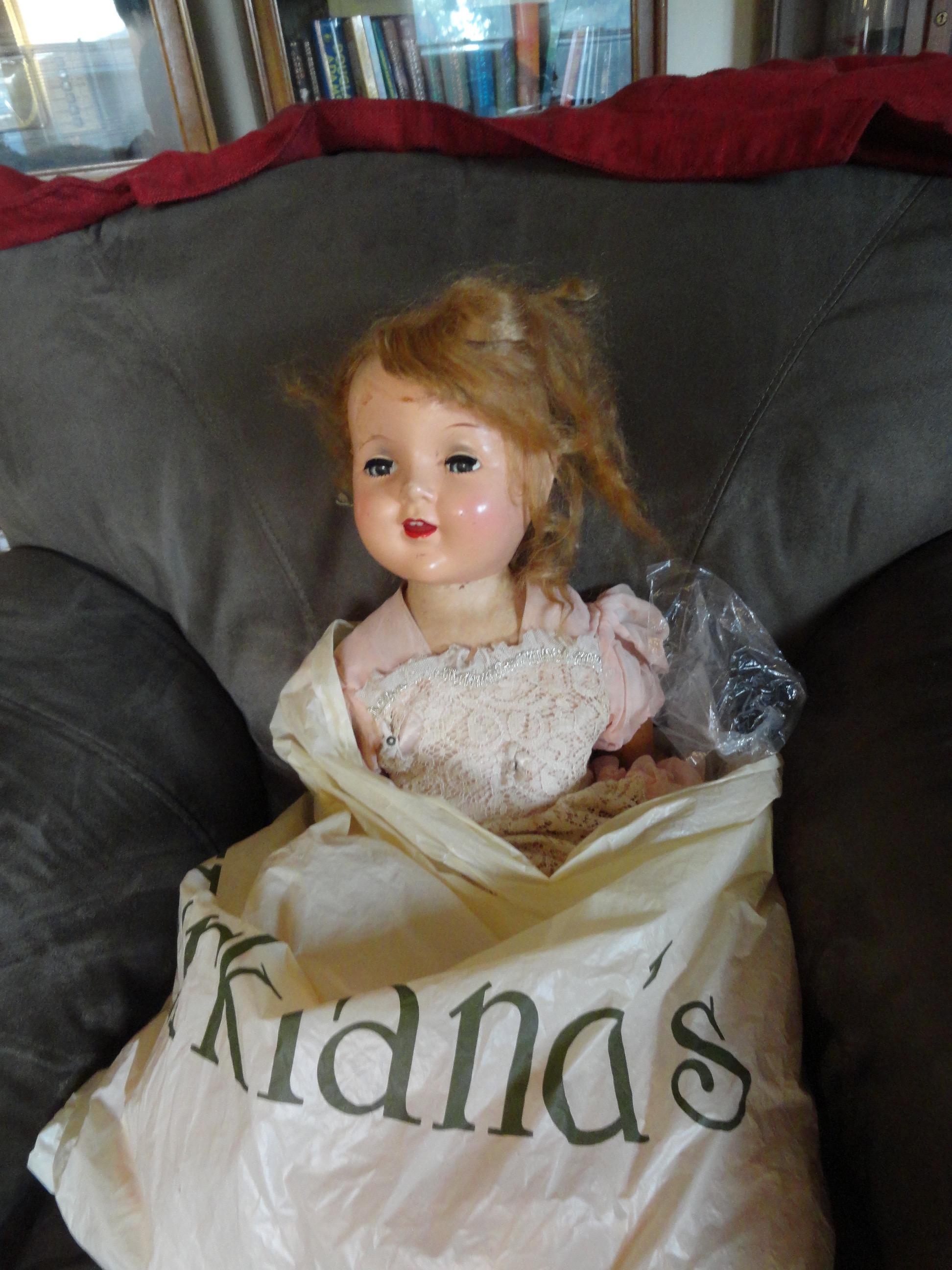
Then came the visit of my cousin Pam, who sent me a little doll to add to my collection, complete with outfits.  Another family consisted of three boys who later sent me stamps to start a collection. A younger girl cousin, asked to spend the night, grew weepy towards midnight as my friend Rita and I were trying to show her how fun it was to stay up all night.  My folks ended up having to call her folks at the motel to come get her.  What a baby!

The best visitor of all, however, was my cousin Buddy.  He was just my age and when we rode down the street on bikes–me on mine and he on my older sister’s–I imagined that people might think I had a new boyfriend.  He showed me his coin collection, which traveled with him, and even gave me some coin protectors for the silver dollars my dad had given me. My friend Rita flirted with him, but he was even more innocent than we were and I think he didn’t quite understand.  Nonetheless,  I was interested in impressing Buddy and was on my best behavior.

It seemed to be working until a little incident in the kitchen when he politely asked if I could tell him where the lavatory was.  Now I had only heard this term applied to a sink and so I blithely said, “Oh, just use the kitchen sink!”  His look of astonishment should have told me that something was wrong, but it never occurred to me that he was asking for the bathroom.  In short, a place to pee!

I can’t remember how this issue was resolved.  I am sure he didn’t pee in the kitchen sink and that he was somehow routed to the correct facility by another member of the family.  The fact that I remember his shocked face to this day indicates to me that perhaps this is one of those most embarrassing events that somehow over the years has transitioned into a funny story–and the fact that I’m telling you proves it!

                                                                Afterward:

A few years ago, I found an email from one of my cousins (whom I hadn’t seen since I was 11) when I for some reason checked out at an old email address I hadn’t used in years.  In it, he identified himself as the baby being held in the arms of my grandfather in a biographical book of poetry I had written about growing up in South Dakota.  He had somehow found a copy of the book and found my email address in the book! This started a correspondence with the result that both of my sisters and I attended a family reunion of his family in Idaho.  Below is a picture of some of the cousins and second cousins (from that summer of the cousins)  I reconnected with at that reunion, which was attended by hundreds of their children, grandchildren, great and great-great grandchildren!  Finally, I had as many cousins as a girl could ever want!

303500_3545866452061_366557535_n

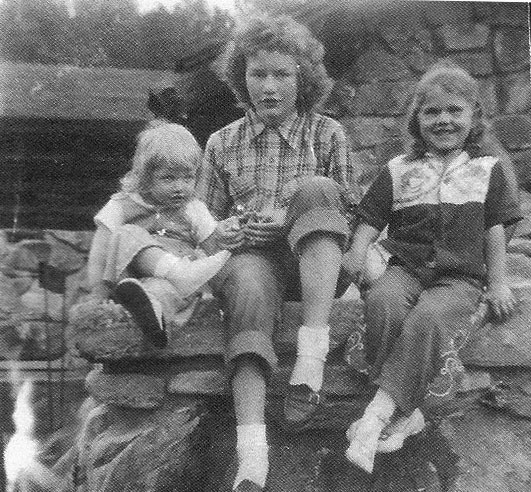
girls on wall
My sisters Betty, Patti and me, back in my pre-crush years. I remember being very proud that my legs had finally grown long enough to cross! Not too successfully, by the look of me.

Crushed!

When I was very small, I was notorious for hating boys.  My eleven-years-older sister once came into the living room and I was running around and around a big chair.  “What are you doing?” she asked. “Chasing boys!” was my answer. My sister was at an age when “chasing boys” meant something else entirely, but she got my drift.

When I was six, a lovely southern lady moved to town who enlivened the entire town.  She taught ballet and acrobatics to the girls and square dancing to everyone age 6 to 76.  This only lasted for a year or two, but twice a month most of the town would gather in the fairgrounds meeting room to do-se-do and alamand left.  I was usually paired with a little boy who was in my first grade class.  One night, after an especially invigorating “trade your partner,” when I was once again hand-in-hand with him, he gave me a big kiss.

I can’t remember my reaction, but I certainly remember his mother’s.  Abandoning her “trade your partner,” she came flying across the dance floor to shake her finger in his face.  “Shame on you, Brian!” she said, “Shame on you!”  (Not his real name.)  She then grabbed him by the upper arm and jerked him off the dance floor to go sit in a chair by the wall.  I was left without a partner and so had to dance with Will Prater, a grown man who was jerky and severe in his movements and who nearly dislocated my shoulder every time he swung me around.

Brian’s mother’s fervor in upbraiding him worked.  He never dated a girl, let alone kissed one, for his entire grade school and high school life.  He did ask me to the prom my sophomore year, but unfortunately I had accepted a date with another boy the night before.  By then I had a pretty big crush on him, fueled by his third grade tauntings of ‘Mayor’s daughter, mayor’s daughter,” when my dad was, indeed, mayor of the town, as well as a lifetime of torments in study hall, where he would break my pencils or pass me notes upbraiding me for scoring higher than he did on chemistry tests .  In my town, teasing was foreplay, but unfortunately in this case, the foreplay led to nothing, since he never repeated his offer of a date, in spite of his dad’s best efforts.

By my junior year, I was dating a boy from out of town.  “What are you doing dating that White River boy?” chided Brian’s dad every time I ran into him on the street or in our little town’s one  general store where I had gone to run an errand for my mom or to buy penny candy or a bag of Russian peanuts (our name for sunflower seeds.) “There are plenty of good boys right here in your own town!”

I knew he meant his own son, and had I not been in the throes of first lust with that “White River boy,” that would have been fine with me, as my longtime crush had continued.  But, alas, Brian never heeded his dad’s hints, either, until my sophomore year in college when, both home for the summer from college in different states, he finally asked me out. There is no crush like the one where contact is long delayed. I remember one very hot and heavy kissing session before we both went back to our separate lives.

We both married older people with children.  Both became swamped in our own lives.  I see him now and then at school reunions and of course crushes rarely survive a combination of reality and the passage of years.  But everyone needs a first crush, and perhaps he doesn’t remember that I might have been his, but he has the distinction of being mine.  I wonder if he would be surprised.

In response to The Daily Post’s writing prompt: “First Crush.” Who was your first childhood crush? What would you say to that person if you saw him/her again?<

For Red: The Summer Home

The Summer Home

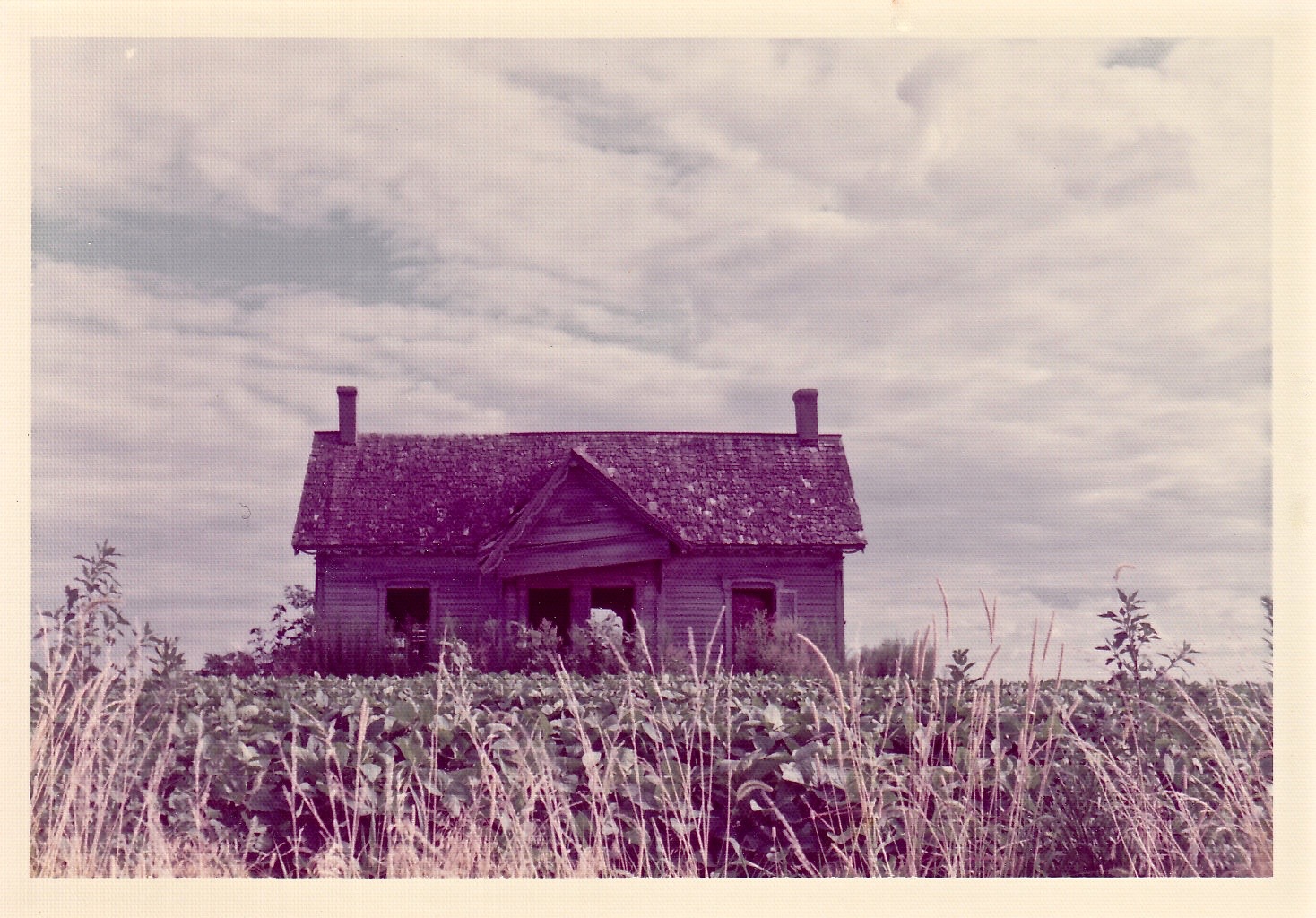
Decaying Farmhouse in Missouri Soybean Field

Photo by okcforgottenman, aka flycatcher

THE SUMMER HOME

When my dad bought the land
where the Big White River and Little White River joined,
I couldn’t believe that we owned land with trees on it.
While he plowed the small field,
I walked the woods and found the abandoned shanty.
Its door was open; in fact it could not shut.
Inside was a mysterious, sweet and fecund smell–
a mouse smell new to me
that I couldn’t stop myself from breathing in.
The mildew and the dust,
the musk of warm linoleum,
every new smell and sight was magic.

I was enchanted by this house emptied
of chairs and tables and beds,
yet full of the accumulated energy of past tame lives
and present wild ones:
the moving of leaf shadows
across the chipped linoleum of the L-shaped kitchen,
the dents on the floor where the kitchen chairs had set,
as though someone had taken care each day
to line up the legs in their holders.
Upstairs I found crayon scribbles halfway up the wall–
the arm reach of a three-year-old.

When I asked about the house,
my dad said that it was our summer home,
and the next time we went to the field,
I brought a broom.

I cleaned out the mouse droppings and the tumbleweeds.
I collected the peeled tile fragments,
imagining gluing them back again.
I washed out a quart canning jar at the pump
and filled it with spring water
and sweet clover,
putting it on the floor
between the kitchen chair holes
in the exact middle of the vanished table.
With the old shirt I found in the corner,
I rubbed mud and river sand
from the linoleum counter tops.
More sand worked as Ajax to scrub out sinks.

All summer long I worked on our summer home,
and for that summer and many summers to come,
I waited in vain for our move to the river house.

I sat on its screened front porch.
Outside the screen grew spearmint and peppermint.
On the top leaf of the tallest branch was a grasshopper,
the kind that left tobacco stains in your hand
when you held it.
All around me were the trees–
the swaying shedding cottonwoods
and scrub chokecherries.
It was a wealth of trees I’d never seen before
in the town where we lived on the bare prairie
nor on the roads we traversed for hundreds of miles
to see a movie or a dentist
or to buy clothes.

Around the screens buzzed the heavy flies,
their motors slow in the heat of July–
all the flies on the outside
wanting to get in
and all the flies on the inside
pressing the screen to get out–
like I longed to get out
to the freedom of trees
where black crows
and dull brown sparrows
rustled their wings
and flew from branch to branch.

In the distance, meadowlarks called
the only birdcall I ever recognized.
No squirrels, no chipmunks; but, rabbits? Yes.
My father said no bears,
but he’d told me the story of Hugh Glass,
mauled by a bear,
walking this river for a hundred miles
past this very joining of the Big and Little White,
in search of help;
and I could imagine one last bear or two
hidden in my woods.

So at night, at home in our winter house in town,
when he told the story I loved the best,
I was the one who discovered the bears’ cottage,
and the cottage was our summer home.
The chairs–too hard, too soft, just right—
I sat upon in turn,
taking great care every time to nestle each leg
back into its correct place on the kitchen linoleum.
And when I lay in the perfect bed of the little bear,
I could touch the crayon markings on the wall.

So when the three bears found me asleep
in the little bear’s room,
they weren’t really very scary;
but I ran anyway,
into my dark and shadowed owl-calling woods,
my woods still echoing the day lit fluted calls of meadowlarks,
their music shaken from the snarled leaves
in the evening breeze.
I ran to trees–
their leaves frosted by moonlight and the Milky Way,
vibrating with the power of the Big Dipper and Orion,
the Seven Sisters and the North Star.

Into the trees
to where I stored my memories
in the frog-croaking depressions under clumps of grass,
in the tangles of Creeping Jenny
and the fluff of dandelions,
in the sand hollows
that crept up from the riverbanks,
in the cocklebur and the chigger-infested grass,
in the crooks of cottonwoods and caves of thickets,
in the tiny cupped palms
of sweet clover and purple alfalfa,
in the wheat grass and the oats and trefoil.

The year my dad decided to expand the field
on the river bottom,
I pleaded, I cajoled, I promised, I prayed
for the summer home
where I had lived for neither one summer
nor one night, in actuality,
but where, nevertheless, I’d had faith
I would someday live.

Of course, there was no saving the woods
and summer house.
It was rich river land, prime for irrigation.
The trees were a waste of soil.
The summer home–everybody’s gentle joke on me.

After the cats and bulldozers were through,
I went with my dad to see
where trees had been ripped out,
the house burned to the ground,
the soil turned and planted
with crops that would build the land.
Their woods now furrowed soil,
the crows and sparrows
had gone to some other shaded place;
the mice, back to the fields.

My former references of trees forever gone,
the present references of sky and fence posts
too wide and new,
I wasn’t sure where my summer home had stood.
The house’s ghost destroyed by the bright sunlight,
the woodland paths replaced by tractor treads,
I watched instead a meadowlark
soar over brown fields and settle on barbed wire,
claiming the new field for its own.
With no house or forest left,
my only shade was chokecherry bushes,
my only chair, the pickup running board.
And so my summers at the river
vanished in the smoke of my summer home
and smoldering tree stumps.

But every night, my woods again threw still shadows
over the summer house,
and I ran once more the corridors of moonlight
cut through dense trees
like parts in a small girl’s hair.
I ran in the wet dew of the condensing summer heat.
I ran on the fuel of my need for magic
and wildness
and rivers
and trees.
I ran fueled by my need to be with something
that lived outside my window
as I passed long nights in my winter house.

It lay in the dark tapping of the trumpet vine branch
against my window
and the crunching of gravel
as someone walked by on the unpaved street–
out past midnight and I couldn’t tell who.
It lay in the pricking of the hair on my arm
as I stuck it out from the bed
and pressed it to the screen.

Always, in town, it lay outside of me–
except for when I floated the paths
of the woods surrounding the summer house,
joining it in dreams,
night after night and then less frequently
until the dreams came once a month
or once a year–
in darkness, always recognized;
but nonetheless forgotten in the light.

So by the time I saw the river field grown lush with corn,
I was a teenager in my first grownup swimsuit,
floating the milky Little White in an inner tube,
down to its junction
with the clear and colder-running water of the Big White,
my best friend next to me,
our cooler full of Coca-Colas and ham salad,
our conversations full of boys and music.

At the border of the field, to get to the river bank,
we crawled over the border of large tree trunks
laid horizontal, half-buried in sand.
I guess I knew they were the bones of my midnight woods.
I guess some part of me felt
the ghost of my summer house.
But, as I lay on my back on the submerged sand bank,
the warm water flowed so sensuously over my shoulders
and down my legs
that my suit seemed to peel itself
from my shoulders, breasts, thighs, calves.
And in a dream I floated the muddy water
of the Little White,
turning in the current
until the water seemed to flow inside of me,
floating me down
to the cool clear water of the Big White,
farther and farther away
from the summer home.

This poem was posted specifically as a response to THIS post on Red’s Wrap.

“The Summer Home” is excerpted from Prairie Moths–Memories of a Farmer’s Daughter, which is available Available on Amazon in Print and Kindle Versions and at Diane Pearl Colecciones and Sol Mexicana in Ajijic, MX


Wheat Cover 34 font

 Just as moths rise from prairie grasses to fly away, so did the author yearn to be free from the very place that nurtured her. Judy Dykstra-Brown’s verse stories and accompanying photographs give a vivid portrayal of rural life in the fifties and sixties, evoking the colors and sounds of the prairie and the longing a child with an active imagination feels for faraway places. From a small child curled up on the couch listening to her father’s stories of homestead days to pubescent fantasies of young itinerant combiners to her first forays into romance in the front seat of a ’59 Chevy, her memories acquire a value in time that she did not acknowledge while living them. Lovers of good poetry and those who miss the magic of childhood will relish Prairie Moths. (Excerpted from a review by Harriet Hart)


Off-Day: Cee’s Odd Ball Challenge 2015, Week 33

Version 5
                                                                Off-Day

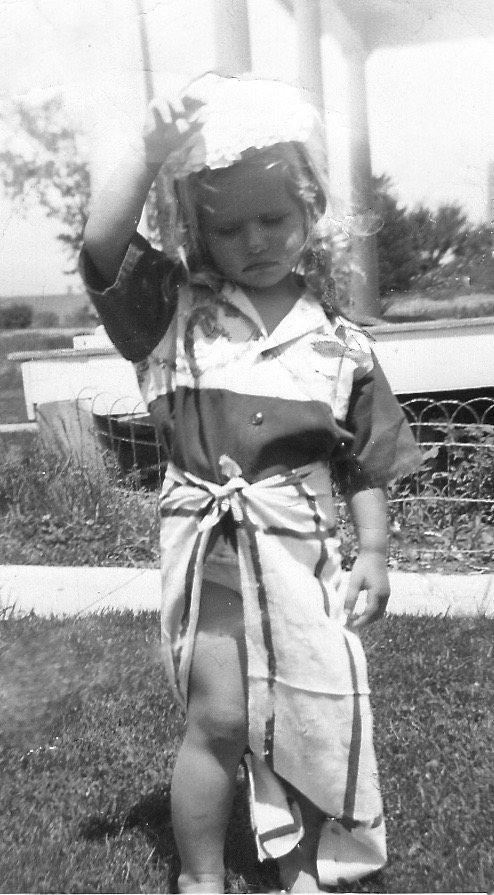
Definitely an off-day, both in choices of costume and mood. I’ve recently been going through old photographs.  This one was undoubtedly taken by my 11-year-older sister Betty Jo.  I’ve been trying to remember what may have prompted my mood. Maybe I detected that she was not overwhelmed by what my mother would have called my “funny little outfit.” My sister Patti and I heard this term countless times over the years, usually when we thought we looked just fine.

This photo was checked with creases and cracks, and although I tried to deal them, I finally had to resort to cropping or it would have taken me all day with the means I had at hand.  At any rate, here it is–an early odd ball side of myself.

http://ceenphotography.com/2015/08/16/cees-odd-ball-photo-challenge-2015-week-33/

Best Preteen Memories

Best Pre-teen Memories

IMG_0011 (1)
Please post your best ten memories of your life before 10 years old. Mine are:

  1. Going to first grade parties in Mrs. Sandy’s room from the time I was two until I was 6 and old enough to be in the first grade. (I lived across the street and first attended when my sister Patti was in the first grade.)
  2. Decorating the Xmas tree with my mom and sisters and sitting up late with the lights off, admiring the lit Xmas tree. Xmas morning, coming down to find all the presents under the tree.
  3. Going out to the ranch with my dad, sitting in the back of the pickup and hanging my head over the side with my mouth open to let the wind parch the inside of my cheeks until they were like beef jerky, then driving fast over the dam grades and herding cows, getting a long freezing cold drink from the well at the Millay place.
  4. Making May Baskets with my mom.
  5. Going to visit my sister Betty in college and getting to sleep in her dorm room.
  6. Getting to go to my older sister Patti’s birthday parties and playing with the “BIG GIRLS!”
  7. Staying at the “Deer Huts” in the Black Hills and getting to go to the outhouse in the middle of the night.
  8. Getting to participate in my sister Patti’s summer plays in the backyard.
  9. Getting to go to Aunt Mabel and Uncle Herman’s ranch with my older sister Betty and getting to stay with them once when my mom was out of town. Watching Mabel operate the cream separator, feeding the chickens and eating her ever-after-unsurpassed apple crunch!!!!
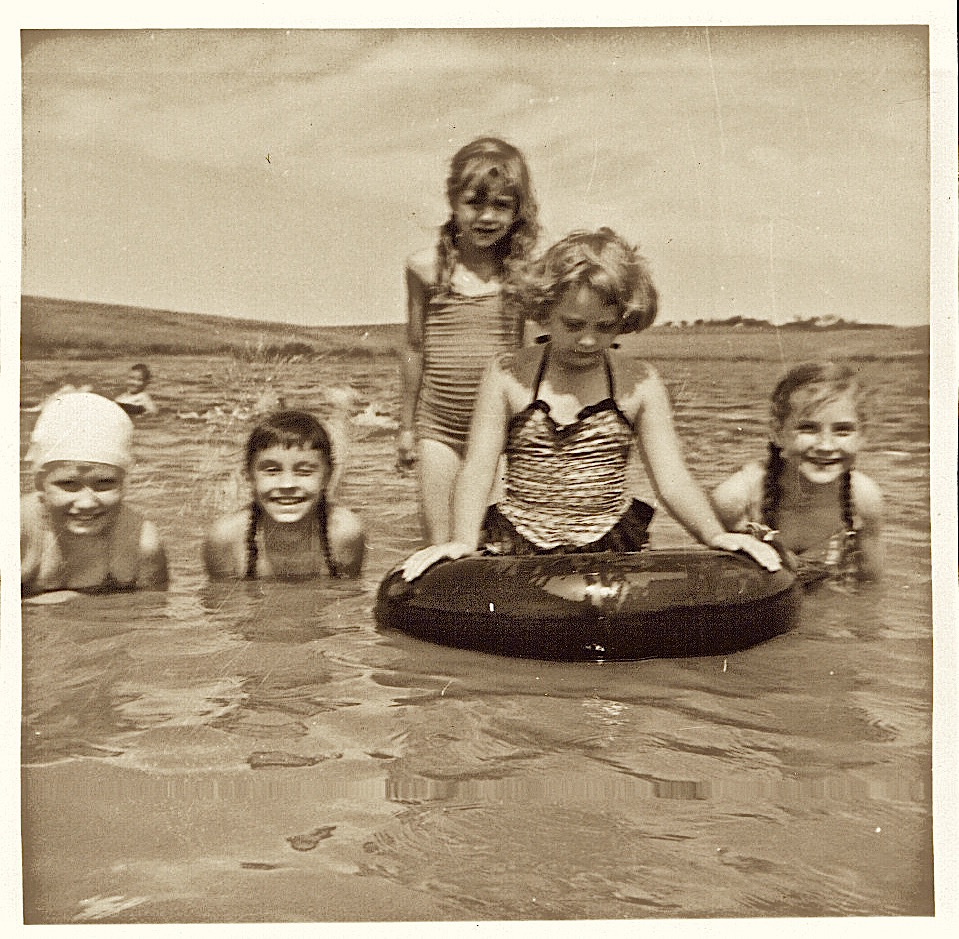
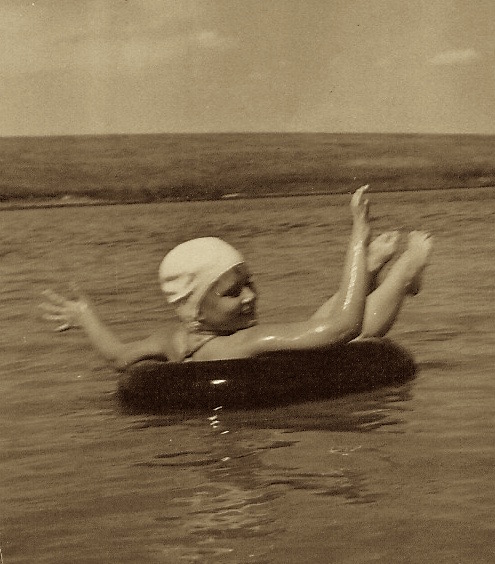
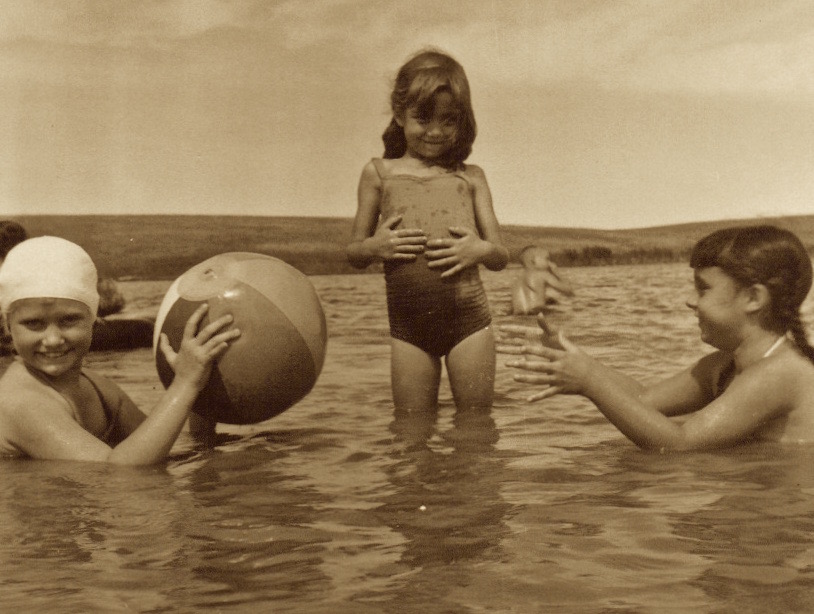
  10. Swimming in Johannsen’s stock dam during summer afternoons, closely watched by the self-appointed lifeguard, “Pink” Sandy.

Now…please post your ten favorite pre-ten memories to your blog with a link to mine. To form a link, go to that page in your blog and select and copy the URL. Then come to my blog and in the comment box, make a comment if you wish and paste your URL. Then you can see each other’s lists via the hyperlinks on my blog.

IMG_0013

IMG_0012

DSC06905

back when we were baby birds

feeding each other
cold spaghetti worms
in grass clipping nests
empty summer stretched in front of us

stale plastic wading pools
pressing yellow circles
into grass
that smelled like wet bandaids

during a game of hide-and-seek
dust bunnies behind the chest
full of old prom dresses
in the upstairs hall

mouse droppings
in the basement
pits from sour cherries
scattered on the back steps

scraps of soggy paper
dried into small sculptures
under the weeping willow tree
revealing part of each original message

mommy is . . .
. . . ate my cookie
I hope Sharon . . .
my doll doesn’t . . . your doll . . .

summer just an empty cup
we filled each day
with the long summer rains
of daydreams.

In response to The Daily Post’s writing prompt: “In the Summertime.” What has been the highlight of your Spring or Summer?

To see my other post today, go HERE.

“Holy Beginnings”

Holy Beginnings

I always wanted a set of those panties that had a day of the week embroidered on each one, but I grew up in an era when kids didn’t ask for things.  I know my mom would have bought them for me if she’d known, or my grandma would have ceased her endless activity of sewing sequins on felt butterflies or crocheting the edges of pillow shams long enough to embroider the days of the week onto the baggy white nylon panties jumbled into my underwear drawer. I never asked, though.  Never told.

So it was that on Sunday I’d arise and put on the same old underpants, cotton dress with ruffle, white socks, patent leather shoes. I’d take a little purse no bigger than the makeup case in the suitcase-sized purse I now carry. Into it I’d drop a quarter my dad had given me for the collection, a hanky and the lemon drop my mother always put inside just in case of a cough. I never coughed, but always ate the lemon drop, sucking on it during Sunday School and sometimes asking for another from the larger supply in her purse during church.

Why my mom never sang in the choir I don’t know.  She had a fine true voice.  Both of my older sisters did and so did I, once I was in high school.  I remember when I was little watching the choir in their fine robes that looked like they were graduating every Sunday.  They sat facing us, in three rows to the preacher’s left, as though checking up on us to make sure we didn’t misbehave or yawn or chew gum.  In addition to lemon drops, my mother always carried Wrigley’s Spearmint Gum in her purse.  Sometimes the gum was a bit red  from the rouge she always had on her fingertips on days she applied makeup. It seemed to me like the rouge flavored the gum a bit.  It tasted of clove and flowers.

“Just hold it in your mouth,” my mother instructed, my sister and me; and if we chewed, she would take it away from us. “Just chew it enough to make it soft and then hold it in your mouth.”  This was an almost impossible challenge for a child and actually even for a teenager.  By then, we’d learned to crack the gum and to blow bubbles even when it wasn’t bubble gum.  That fine pop and final sigh of air as the bubble broke–so satisfying. The threat and memory of everything we could be doing with that gum resided in each small wad of it held in our cheeks as we sat lined up like finely dressed chipmunks listening to the minister drone on.

Hymns were like the commercial breaks on television–a chance to move around a bit and look at something other than the preacher–to ponder the curious lyrics such as, “Lettuce gather at the river,” “Bringing in the sheets” and “Let me to his bosom fly.”  (Just what was a bosom fly and what had lettuce and collecting sheets from the clothesline to do with religion? Once again, we didn’t ask.)

Then we’d sit down again for the Apostle’s Creed or a prayer or benediction or the interminable expanse of the sermon–half an hour with no break.  I’d listen to the drone of the flies buzzing in circles at the window, or the sound of cars passing in the summer, when the front and back doors were left open to encourage  breeze where no breeze existed.

Now and then a curious dog would wander in and be ushered out by the man who stood at the door to hand out church programs.  Everyone would hear the scramble of dog toenails on the wooden aisle and turn to watch and laugh.  Even the minister would laugh and say say something like, “All of God’s creatures seek to commune with him upon occasion.”  Then everyone would laugh softly again before he turned his attention back to telling us what was wrong with us and how to remedy it.

That afternoon, Lynnie Brost and I were going to play dress up and have a tea party under the cherry trees and bury a treasure there.  We’d already assembled it: my mom’s old ruby necklace, a handful of her mom’s red plastic cancer badges shaped like little swords with a pin at the back to put on your collar to show you’d given to the campaign,  my crushed penny from the train track, her miniature woven basket from South America that her missionary sister had brought her, a tattered love comic purloined from her older sister. (We’d “read” it first–which at our age meant looking at the pictures.)

I fell asleep thinking of what else we could add to our cache, to be dug up again in ten years or for as long later as we could stand to put off exhuming it. I leaned against my mother as I slept, and if she noticed, she did nothing to awaken me.  She shook me a bit, gently, as the congregation stood after the sermon, singing “Onward Christian Soldiers” as the minister marched down the aisle, smiling and greeting parishioners and the choir followed him, as though they were being let out early for good behavior.  At the door, we greeted the preacher again, standing in line to shake hands and be blessed, then ticked off his mental list of who had been among the faithful on this fine summer day when they could have been out mowing the grass or rolling in the piles of grass emptied from the clipping bag.

Then we drove the block home, for no one ever walked in a small town.  Well done rump roast for dinner, as we called the noon meal. Mashed potatoes, brown gravy, canned string beans, a salad with homemade Russian dressing and ice cream or jelly roll for dessert.  All afternoon to play. Another small town South Dakota Sunday of an endless progression strung out from birth to age eighteen, when I departed for college and the rest of my Agnostic life.

In response to The Daily Post’s writing prompt: “The Early Years.”  Write page three of your autobiography.

Second Chance

I wish that I’d been wilder and freer in my day.
Had imaginative friends to join me in my play.
I wanted to stage circuses and playact vivid scenes,
but schemes like this were always far beyond my means.
There wasn’t enough zaniness in anyone I knew
to dream my dreams or want to do what I yearned to do.

We’d play school or hospital or house when we were smaller,
but this imagination palled as we grew taller.
I wish there had been classes in writing and in art
to allow  that side of me to flourish from the start.
Instead, I had to search for whatever it might be,
never finding anyone who seemed at all like me.

What was it I was lacking? Where was the rest of me?
I didn’t have a clue about what I was meant to be.
Half of my life I think that I was trying to fit in
to places and activities where I’d never win–
achieving just enough to make my life appear successful,
yet still I felt unsatisfied–unfulfilled and stressful.

Since I was nobody’s mom, nobody’s loving wife,
at thirty-one I ran away to find another life.
I quit my job and sold my house and caught a westbound train.
Perhaps I’d find in water what was lacking on the plain.
So I went to California and took a writing class.
Then another and another, until it came to pass

that I finally found the playmates lost to me in youth.
They were irreverent, creative, clever and uncouth.
Here, at last, I finally felt like I had found it all.
Words were the playthings that we tossed among us like a ball.
My own life now surrounded me–securely, like a bowl.
Here I felt a part of things–a section of the whole.

Later, I discovered I was an artist, too,
All my life, I hadn’t known.  Hadn’t had a clue.
It took someone just guessing and pushing me that way.
Then I had two mediums for saying what I say.
Art filled out the rest of me ’til I was full at last.
It took almost forty years to find how I was cast.

And then all of those playmates lost to me as a child
began to pull me out with them–out into the wild
to paint myself and write myself anew each dawning day–
discovering those hiding parts in what I sculpt and say.
Every day, like hide-and-seek, I find another part–
all those portions of me I’ve been seeking from the start.

I know that second childhood is a derisive term,
but I have found in fact it is the apple, not the worm.
It is the food I feed upon, the fruit I’ve always sought.
It is simply what I am instead of what I’m not.
It’s filled with messy, juicy things like paint and flux and glue.
Explosive things like nouns and all those verbs like “am” and “do.”

What I missed in childhood, I found when I was thirty,
and it was simply glorious: naughty, messy, dirty.
I rolled around in words and paint with others of my ilk–
these artful things more nourishing than bread or mother’s milk.
At forty, fifty, sixty, I’ve become what I can be–
found what I lacked in childhood: friends that are like me!

The Prompt: is there anything you wish had been different about your childhood? https://dailypost.wordpress.com/dp_prompt/childhood-revisited-2/

May Day!!!

DSC00524

May Day

When I was seven and when I was ten,
the meaning of May Day was different back then.
It conjured up candy or flowers and fun
not fear of a shipwreck or missile or gun.

We’d construct baskets of paper and glue,
put in some candy and a flower or two–
marshmallow peanuts so rubbery and chewy,
jelly beans, candy corn, gumdrops so gooey.

From a big ribbon, they’d hang like a fob
so the basket could hang from a door handle knob.
We’d sneak to a friend’s house and ring the doorbell,
leave the basket and take off, running like Hell.

If anyone caught us, a prize they would seek–
a slap on the arm or a kiss on the cheek.
The boys gave the slaps and the girls gave the kisses–
(the reverse of our wishes for all of us “Misses.”)

For friends who lived farther than six blocks away,
our parents would drive us some time in the day
before school or after to deliver our gifts.
We escaped easier when we had lifts.

We once strung a Maypole  from tether ball staff
that was rather disastrous—more of a laugh
than a sweet springtime rite filled with dancing and grace.
When our ribbons got tangled, they laughed in our face.

When our class bully fell down, exposing her panties,
we all joined in with our uncles and aunties,
our moms and our dads and even the teachers,
the school board, the doctor, the priest and the preachers.

Everyone roared at this May Day disaster,
then we picked up our ribbons and ran even faster,
some unfortunate dancers wrapped tight to the pole
until finally the school bell began its slow toll,

telling us all to disband and depart,
weak from the laughter and lighter of heart.
A day in my memory much better than payday–
the one time when May Day was also a mayday!

https://dailypost.wordpress.com/dp_prompt/your-life-the-book/

NaPoWriMo 2015, Day 2: Stars

                                                                    Stars

Sometimes, on an Indian blanket spread on the night-dewed grass, I became aware of them.
They were always there waiting in the ever-clear South Dakota nights.
Anything could have happened on a night like that,
Reclining with no ceiling over us,
Silence split by crickets, frogs, the chipped barks of dogs.

S
ummertime freed us to the great outdoors.
Traitors to our beds, we chose the long-grass cushioned backyard.
Attacks by neighborhood boys an exciting possibility,
Rescues by my bellowing dad, in jockey shorts, standing on the back porch.
Sleep not on our agenda for hours afterwards.

Slumber parties meant for anything but slumber.
Taking a walk at midnight and crossing the path of no one.
Air in the night a different elixir
Returning to roll in the grass in shortie pajamas—that pre-sexual thrill.
Stars of our own summer, we strutted our stage until the wee hours.

Something in the night freeing something in us.
Taken by the stars to other selves, far above us.
Aware of the mysteries laid out like a path in front of us.
Returning reluctantly to our pre-teen lives,
Safe beneath the dangerous stars.

The WordPress prompt today was to write about texting, but Since I have never texted anyone in my life, thought I’d tell you what life was like in a pre-text world. And here’s a picture to go with both the subject of texting (old-time style) and the above poem:
https://grieflessons.wordpress.com/2015/04/02/a-photo-a-week-challenge-muted-colors/

https://dailypost.wordpress.com/dp_prompt/its-a-text-text-text-text-world/