Tag Archives: Daily Prompt

Undulations

Click on any photo to enlarge all.

Undulations

The constant undulation and the murmur of the waves.
The crashing of the breakers as they beat against the caves
carved out by the chisel of the water making hives
at the edges of the world that ensconced our busy lives.

It craved us as its audience. It pulled us to its shore.
It calmed our petty grievances with its might roar.
When it chose to rage it could wipe away our world,
sweeping us away as its anger came unfurled.

At other times it lapped at us, assuaging all our pain.
That’s why we returned to it, over and again.
Walked along its edges, pierced its salty deep,
uncovering the secrets so long within its keep.

Every morning it brought treasures to our waiting hands
to examine as we walked along the morning-evened sands.
Dollars from the ocean depths, stars out of the sea––
left there to be taken or to be let be

for the next beachcomber to claim them for their own
to treasure on a mantel what the sea had thrown
like necklaces at mardi gras, cast blindly and for free
for denizens of dry worlds to collect on bended knee.

What we cast back on the waters determines ultimately
what the sea will one day give back to you and me,
and if we do not listen to the truth the tides may tell,
the music of the waves may be our funeral knell.

The prompt today is undulate.

My Brilliant Career in Film and TV

031

My Brilliant Career: How I Found My Proper Place in Film and TV

I got bitten by the film bug when I lived in L.A.
and did some sort of movie work most every single day.
On Mondays, Wednesdays, Fridays, I always had a class.
The U.C.L.A. campus is where they came to pass.
I studied film production and took screenwriting, too,
but my class in documentaries was where I scored a coup.
We made a documentary.  In fact, I helped with two,
but I knew by the end of them I hadn’t found my place.
I simply didn’t have the balls to run the movie race.

Then I studied acting at an actor’s studio.
I really did the best at this, but still, it was “no go.”
When it came to trying out for parts, I didn’t have the nerve.
Once again my movie plans took another swerve.
I worked as an apprentice at a Hollywood agency.
From all the other candidates, they selected me.
They had me reading novels and sitting in on sessions;
and this was more exciting than my former classroom lessons.
I met some famous actors and tried to be real cool,
and writing out readers reports was easier than school,
but still I knew that in my heart it just wasn’t for me.
After all this time, I didn’t know who I should be.

I’d been in California for three years by then;
and although I hadn’t found my place, still I had the yen.
But I’d run out of money. It was time to find employment
that would involve a paycheck and not just my enjoyment!
I’d heard of a position where I thought that I could cope
as publicity assistant for none other than Bob Hope!
So I wound up in production: typing, phoning, organizing.
The  people in my Rolodex were frankly quite surprising.
I set up radio interviews with the famous Bob.
To read the National Enquirer was required in this job!
I went to filmings of the shows, sent out his Christmas gifts,
ran back and forth to N.B.C. and soothed some office rifts.

But all-in-all though it was fun to be there on the fringe,
to be completely honest, I was not a vital hinge.
And so when I was married, we decided to move north.
I left my life in filmdom and boldly sallied forth,
moving up to Santa Cruz to live by doing art—
never really finishing what I had tried to start.
I had adventures plenty and saw much of the scene
and I enjoy remembering everywhere I’ve been;
but all-in-all, the truth is that there’s one place I’m most groovy.
When it comes to all the skills that go into a movie,
the only place that doesn’t make me sort of tense
Is center row and half way back, in the audience!


When I originally wrote this piece three years ago,  the prompt was: “The Show Must Go On–If you were involved in making a film, would you want to be the director, producer or lead actor?  You cannot be the writer,” but the prompt today that also fit it was simply the word  brilliant.

Winsome and Then Some

Most of you probably haven’t read the story of the beginning of my life in Ethiopia, but since my search for today’s prompt word presented it as one of the few posts prompted by the word “winsome,” and because I’ll be busy all day packing for the beach before my house sitters get here, I’m linking to it again today.  Here is the beginning.  If you’d like to read all of it, click on the link at the end:

Romance Underground

I’ve given a few segments of the story of my time traveling and living in Ethiopia.  Some people have requested more of this story, so here is an expanded prose version of yesterday’s poem. The year is 1972.  This is long so you might want to read part of it and come back later.

IMG_0009

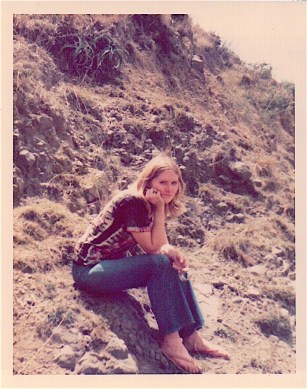
I was 24, just out of college, headed for whatever foreign country would hire me with no experience. The winner was Australia, and I headed out on my big life’s adventure. Setting out alone to somewhere where I knew no one, I was not scared. I was elated. I had no idea what people were like in this new environment. Perhaps they were more like me. I think I already knew that I was someone who enjoyed being the stranger. If I was the stranger, it meant all new territory for me. No one knew my family or anything about me. A youngest child, I could be judged for once completely on my own merits.

Australia was exciting, but after a year and a half of recruiting teachers from elsewhere, they decided they were overstocked and offered any of us willing to leave a payout equal to the amount of income taxes we’d been paid during the time we were in Australia. I cashed in and made $600! Wow! I thought this was enough to travel to London. My Australian roommate, Deirdre, decided to go with me. We planned to work enroute if we could and bought bus tickets from Sydney to Darwin and airline tickets from Darwin to Timor to Bali to Singapore to Sri Lanka.

Unfortunately, once we got to Timor, we discovered that the airline we’d booked our flights on all the way to Sri Lanka had gone bankrupt, so we were a bit stranded. We made our way by World War II Troop barge, which we “rented” from some Indonesian fishermen, then by foot through the jungles. This was the second biggest adventure story of my life and one told in an earlier posting, but that is not the story I am telling today. Suffice it to say that eventually, after about 4 months, we made it to Africa. (If you want to read the rest of this tale, go HERE.)

The prompt today was winsome.

Achoo

Different Thanks

IMG_4226

Family Thanks Giving

Three dogs, paws up on the gate to the garage whenever I get home. The little one leaps up and down like some ballerina at the bar, the biggest with his irritating barks–loud and harsh and insistent—for whatever reason, be it mom’s arrival home or a dog who dares to pass by in the street. All of them escorting me to the door, attempting to help me with my bags and bundles.

The big dog sneaking into my room at night when she thinks I haven’t noticed. Wanting to be even closer than within eye-shot down the hall, she sleeps on the cold floor in lieu of her warm padded bed, perhaps because she wants to remind me that although the second dog is cleverer and handsomer and the newest dog is the littlest and most pleasant to have jump up on the bed with me, she was the very first and has known me for the longest. She has put up with intruders—both these two canine upstarts and the one human one who entered my house and stole my house guest’s laptop years ago when she was my one and only!

And although I am allergic to them, I wash off the licks of thanks that Morrie gives for a few cuddles on the bed before he sinks down to the foot to curl at a more hypoallergenic distance. Wash off my hands and arms after I’ve pulled off clumps of Frida’s thick undercoat. Dress the wounds that Diego’s claws have left on my legs and arms when he just can’t resist jumping up for closer contact. All of these wounds and welts and sneezes and wheezes just the aftermath of the constant thanks these kids adopted from the streets offer every day, as often as I will allow them.

This is a reblog from three years ago when we were a three-dog one-cat family instead of a two-dog five-cat family!  R.I.P. Frida. The prompt today is allergic.

Premature Viability


Premature Viability

It was a viable solution to a major tragedy.
She had it all planned out, and she confided it to me:
how she might overcome her fears of dating and romance
by going on a dating site and giving love a chance.

First she lost a pound or two and got a stylish cut,
then purloined her sister’s Spanx  that nipped in thighs and butt.
Had a makeup session and bought a new blouse that
showed off a bit of shoulder as well as a new hat.

Set at a rakish angle, it polished off her wiles—
made her eyes more come-on and accented her smiles.
When she was ready for battle, she turned her webcam on,
signed up for OkCupid, and when her family were gone,

tried out her Skype and FaceTime to see how good she looked,
only to discover than her goose was surely cooked;
for no matter what the lighting or the camera angle,
there was little chance that a boyfriend she would wrangle.

She turned off her webcam and decided she would wait
another year or two before vying for a date.
Her stars were not aligned now. Her prospects were not fine.
She’d put off looking for a boyfriend at least until she’s nine!

The prompt today is viable.

Rich Harvest

© Sharon Knight
I saw this photo by Sharon Knight on Sascha Darlington’s blog and knew it was the perfect photo for this poem as well.  Thanks to both Sharon Knight and Sascha as well as dVerse poets, who sponsored this prompt. Like Sharon Knight, I grew up in the midwest and this photo could easily have been taken in my home state of South Dakota, a bit before the harvest time described in my poem.

Details from retablo “The Gleaners.” Painting by Anna O’Neglia, retablo and photo by jdb (Click on any photo to enlarge all)

Rich Harvest

The night that we brought in the wheat,
our weeks of labor now complete,
we raised our voices, beat our feet,
and in that stifling prairie heat,
weary and arm-sore, yet replete
with satisfaction for jobs well-done
earned in the dust and chaff and sun,
we ceased our labors and had some fun.

Hank gave the prim schoolteacher a treat
by lifting her from her safe seat
to move her to the fiddler’s beat.
Soon, her hairpins met defeat,
her wild hair anything but neat,
 and Hank was heard to woo the miss
and then to plant a tender kiss.
She remembers all of this

now that their family’s complete
with Rita, Sarah, and little Pete.
Now every harvest, when you greet
each townsperson you chance to meet,
chances are they will repeat
how Hank brought in the wheat that year
and afterwards, conquered his fear
and dared to call the school marm, “dear.”

The prompt today is treat.

With Reservations: True West

IMG_0078

True West: Racial Stereotypes in a Small South Dakota Town

I grew up in a very small town (population 700) on the prairies of South Dakota. I was not aware of a wide disparity of classes at the time; but looking back, I see that there really were classes based on economic and racial factors.  Since my town was situated quite near to several Indian reservations, there was often at least one native American in my class.  In the second grade, it was Clifford Leading   Cloud—14 years old and placed in the second grade.  Needless to say, he towered over the 7-year-olds. No doubt this was why he was constantly stoop-shouldered and his demeanor was apologetic and shy.  He was a wonderful artist, and I still have several of his drawings.  “Clifford drew this for me!” I proudly wrote beneath two colored-pencil sketches in my scrapbook, but when I took them home to show them to my mother, she said, “Be sure to always wash your hands after you touch those.”  Obedient at this stage of my life, I remember complying, but I was always puzzled about why.

Since my name began with a “D” and our placement was always determined alphabetically, I sat behind or in front of all of the Native American kids who joined our class for a year or two before disappearing: Clifford Leading Cloud, Phoebe Crazy Bear, Nordine Fink (Who was my assigned “date” for Freshman initiation, but who somehow disappeared during the year.) Phoebe had very long black hair that I loved to brush during Geometry. (In spite of former warnings from mothers who told us to be careful not to contract lice from the “Indian” kids.) She was a good student, and I liked her dry sense of humor; but although I invited her to slumber parties, she never came and she, too, vanished by the end of our Sophomore year.

I know there was a division in our community between the white population and the Native Americans, many of whom still lived in tents along the railroad tracks because it was federal land and the head of the railroad allowed them to live there free of charge.  When I was given release time from study hall to teach P.E. and reading to first graders my Jr. year in high school, the sweetest and most beautiful first grader was another Leading Cloud—who, probably due to living in a tent with no bathroom facilities and no running water—had such a strong stench that it brought tears to my eyes to stand over her for long as I guided her in her reading.  My mother attributed this to the use of “bear grease” in the hair, but I think she was a few generations behind in her thinking.

The factors of difference in culture, living arrangements and economic factors divided us from the Native American citizens of our town so that aside from actual classes as school, they faded away into the environment in a manner that should have been impossible in a town as small as ours.  They did not attend games, dances, or participate in any of the extracurricular activities of the school. They did not attend church or hang out in restaurants.  I do remember my mother asking us to sit in front  and back and either side of her when we went to the movies in White River, 32 miles away.  Closer to the reservation, there was a higher Native American population and my mother, sensitive to smells, wished to take all proper precautions.

My mother was not unkind. She fed any hobo who showed up at our door. She took boxes of clothing out to the dump and set them where foragers could easily find them.  She also told me never to mention that clothing had been mine if any of the Native American kids showed up wearing one of my give-aways. But she was the product of an age where we had not yet thought to struggle against racial stereotypes.  My father regularly employed seasonal workers from the reservation and even learned to speak some Sioux.  He was a natural born storyteller who loved gleaning material from all and sundry and a broad-minded thinker. One of the few Democrats in town, he counted everyone among his friends–from his Hunkpapa Sioux employees to the Governor of the state.

Yet, should the doorbell ring when my dad was not at home and  if my mom were to see that it was someone from the reservation stopped at our house to ask for work on his way into town, she would tell us not to answer the door and would cower in the hallway out of sight. Again, I know my mother well enough to know it was genuine fear that prompted her actions, not meanness or hatred.

There were two families of Sioux lineage in the town who did manage to bridge the gap of cultures.  In one case, it was a handsome young man who was an incredible basketball player whose name revealed his mixed Sioux and French genes. He was the secret heart-throb of many a girl, and his sister, as beautiful as he was handsome, was a cheerleader and generally accepted, I believe, although they were enough older than I am for this all to be hearsay.

The other family that was able to bridge the two cultures was also of mixed lineage–white and Sioux.  Another beautiful family, their son was also an excellent ball player and both of their daughters were cheerleaders. (This was the highest rank of success in our town—far above Valedictorian.) In both cases, the cultural differences were only a matter of skin color. They were not living in tents along the railroad tracks or migrating back and forth from the reservation.  In  most respects, their lifestyles were no different from our own.  Still, I have heard that when one of our most popular young men married one of the popular young ladies I’ve just mentioned, that his mother was heard to say, “He’s marrying that squaw.”

It seems as though the major factor, then, that created a class structure in our town was one of culture coupled with economic duress.  Yes, there were poor families in our town and many times they did not participate as fully in what little social life there was in our town, and yes, although I started out inviting everyone in my class to parties, in time the parties got smaller and the guest list included mainly those friends from my neighborhood or those I found to be the most fun or who participated in the same activities I participated in.

This narrowing of social circles is natural, I think, but when I look at who was excluded, I don’t feel as though I used any criteria other than whom I enjoyed being around. I would have loved it if Phoebe had come to my slumber parties. She was smart and even then I had a curiosity about other cultures and other ways of life. I was the first friend of any new girl who moved to town—a fact that caused some resentment on the part of my old friends, I now see clearly.

We all make excuses for ourselves when it comes to discussing our own prejudices, and I am no exception to the rule. Native Americans were stereotyped because the most extreme cases of behavior were the most obvious. The few women from the reservation who came to drink and lay sprawled in the street created the stereotype that all “Indian” women were “drunken squaws.” No one ever saw any of then mothers of the Native American children we went to school with. They were no doubt at home trying to scrape out a meal or school clothes for their children’s next next day at school.  And their fathers were probably out working in the fields for our fathers. But we did see the drunks on the streets every Saturday night as we exited the movies, and so this is the stereotype that formed in our minds, no matter how much our actual experience with kids at school rivaled that stereotype.

Many years ago, I started to write a book called “Vision Quest” about a young Native American boy who grew up in our town. This was a work of fiction, but I drew of course upon actual experience for details of plot.  I know I came back to it at least twice, but never got beyond the first few chapters, probably because I had so little experience to draw upon; for in spite of the fact that I grew up in a state that contained numerous reservations and in spite of the fact  that all of the surrounding towns contained a Native American population, in fact our cultures were so widely divided that I had as little insight into their lives as they must have had into mine.

The term “Native American” had not been coined when I last lived in my hometown, and neither had the sensibilities that I hope go with it. When Dennis Banks and Russell Means were heroes to much of the rest of the world, they were outlaws and trouble makers to those non-Native Americans who lived in their midst. To someone stopped from driving on highways where they had always driven, they appeared to be highwaymen or brigands. It is hard to make a hero of someone you grew up feeling superior to, and hard not to stereotype any race or cultural group according to what you know about the few representatives of that group with whom you have come in contact.

But I have to say that coming back to my town and hearing one of the supposedly kindest and admittedly hardest-working members of the church I grew up in describing the wife of a local boy as a “N—–” and scathingly speaking of the Native American Rights movement of the seventies made me take a really long look back at my own past as well as to reappraise my former affection for this woman whose small-mindedness revealed itself at a time when I myself was in love with an African man, teaching African children and living with African housemates.

The last time I visited my hometown, I did not go to see this lady and by the time I next went, she had passed away. Hopefully with the demise of these last citizens of the old ways, prejudice will pass away with them. I am afraid, however, that prejudice is born anew in each generation—perhaps towards yet a new group of immigrants or transplants who threaten the so-called “American Way of Life.” It would do us all well to remember that America was meant to be a melting-pot, and as in any recipe, it is made more palatable by a variety of spices.


This is a reprint of a piece from two and a half years ago. The prompt today is reservation.

In Absentia Conversations

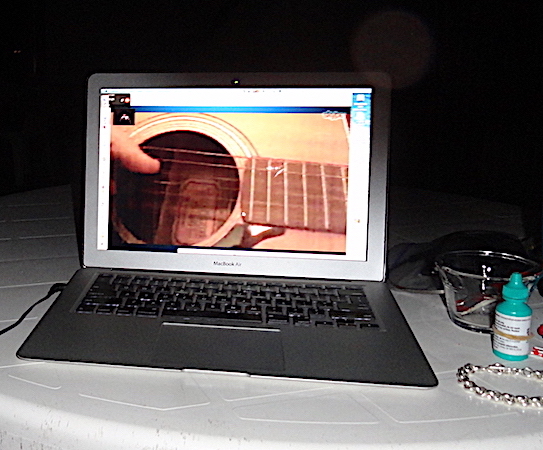
When we first met online, Forgottenman, in Missouri, serenaded me, in Mexico, over Skype until I fell asleep every night. The illustration above is one from a night when I asked to see his hands strumming the guitar as I fell asleep. Sweet, huh? That ended after a year or so, but over the past seven years, we have had many midnight and post-midnight Skype conversations.  Want to eavesdrop?  Here are a few:

On Skype (After Midnight and 3 Margaritas)

She: maybe I need to take Frida (the Akita) to the snore doctor.
She: Perhaps she has sleep apnea. She sounds like a lion when she sleeps.
She: Have you ever heard her snore?
He: Yep.
She: Do you miss it?
He: Miss your zzzz’s
She: You miss my snores? Sweet.
She: I miss snoring for you.
He: That’s the first line of a poem.
She: I’ll write a poem starting with “I miss snoring for you,” if you will, too.
He.: I’ll try to remember to do so tomorrow.
She:

You Say You Miss My Snores

I miss snoring for you,
stepping on your shoe
when we don’t dance,
miss that glance
from your alternate self
you keep on a shelf
when you aren’t with me.
How can it be
that both of us choose
to leave our clues
in cyberspace
not face-to-face?
Alone together
with no tether,
our way
for today
perhaps forever
internetedly clever.

He: it just blows me away how you can come up with something like that, so achingly beautiful, in less than five minutes!
She: Ah. You inspire it.
He: I muse you whilst i amuse you
She: Ha. That is exactly it!
She: What you just said couldn’t have been said more succinctly or more briefly. It is the tweet
of poetry
She: sweet tweet of poetry—sweet bird of absurd

(After this, the conversation digressed.  No more shall be said.)

Update: “He” has written his version, as agreed. I give a link to it below the short additional conversation below

At Midnight after 4 Margaritas:

She: What is the most dreaded disease of hockey players?
He.: i give
She: Chicken Pucks!!!
He: (facepalm emoticon)
She: What is the most dreaded disease of Narcissists?
He.: I give
She: Me-sles.
She: The most dread disease of martyrs? (Promise, last one.)
He: ?
She: You-rinary tract infections

Note: These Skype conversations are from four years ago.The second one actually occurred the same night as the 3 Margarita conversation, so no, I’m not drinking Margaritas every night.  Also, I mix very weak Margaritas, so they are not totally to blame for the silliness above.  Around one or two in the morning, my mind usually gets on a jag and the best way to deal with it is just to hang up on me, which happened soon after this string of unfortunate jokes.  Corny, but I still get a kick out of them.  Yes, they are all original.  I wouldn’t blame them on anyone but my own past-midnight mind.  Judy

.See Forgottenman’s answer to my “You Say You Miss My Snores”  here.


The posts above are copied from blogs posted four years ago. The prompt today was conversation.

Rings of Saturn: Daily Post, the Final Day of 2017

Rings of Saturn

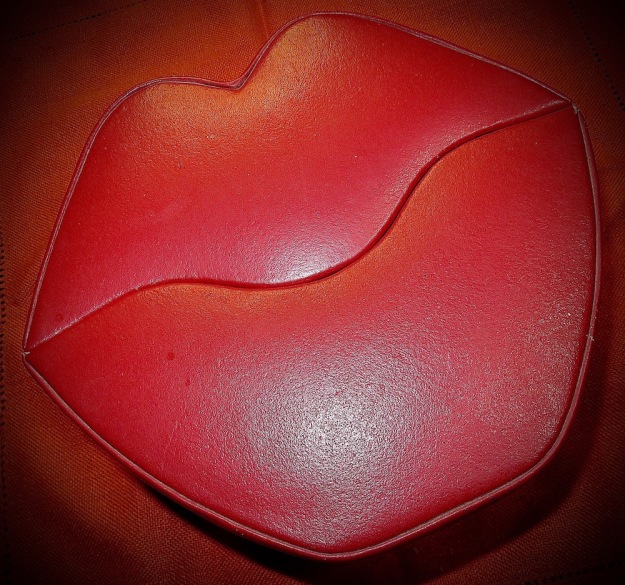
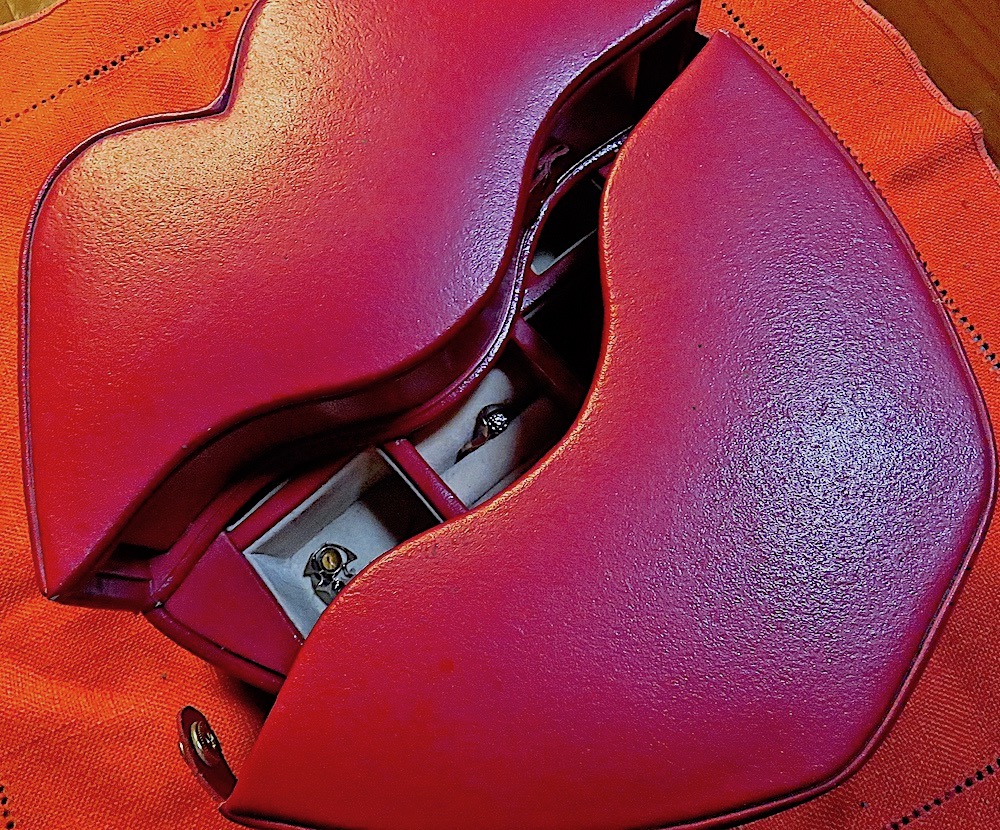
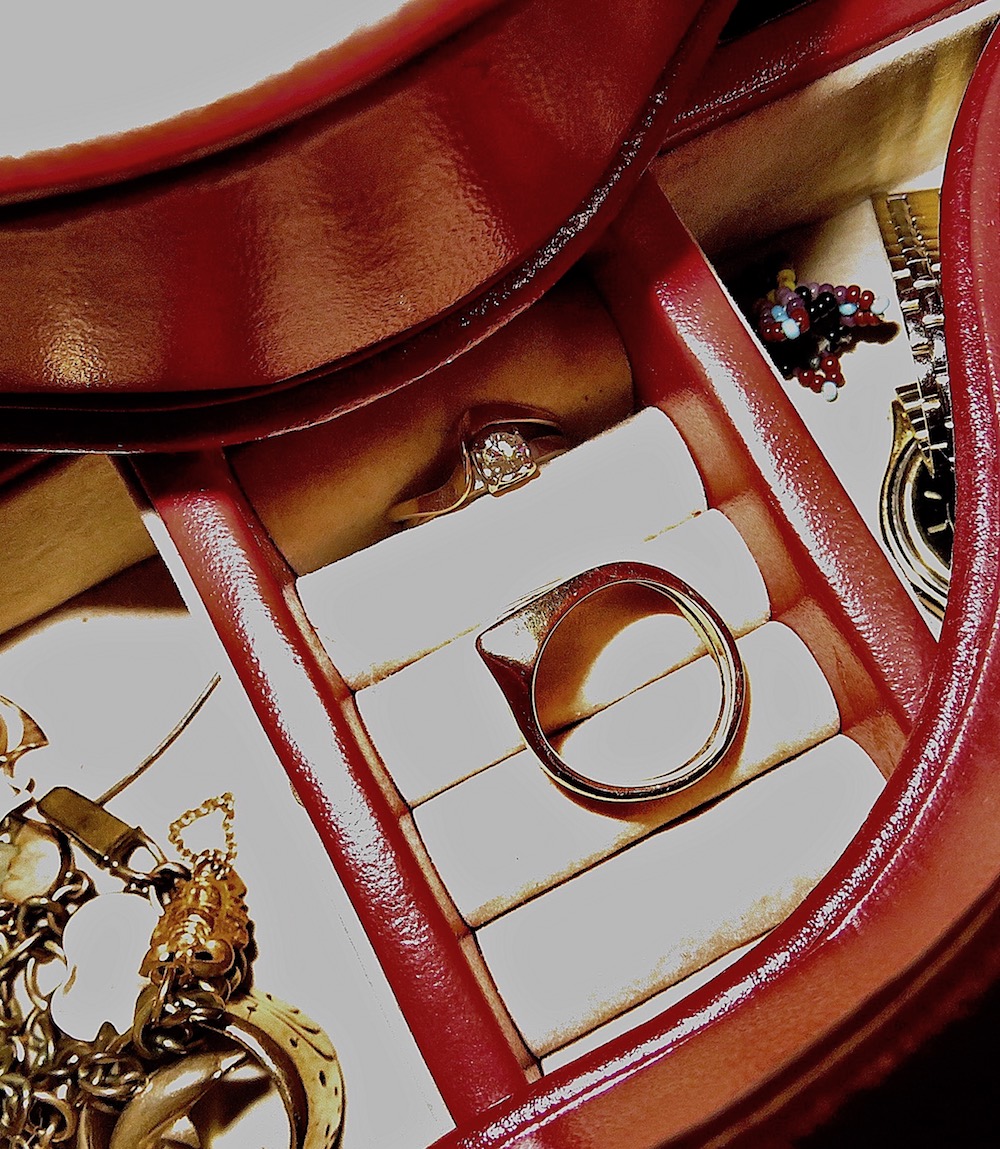
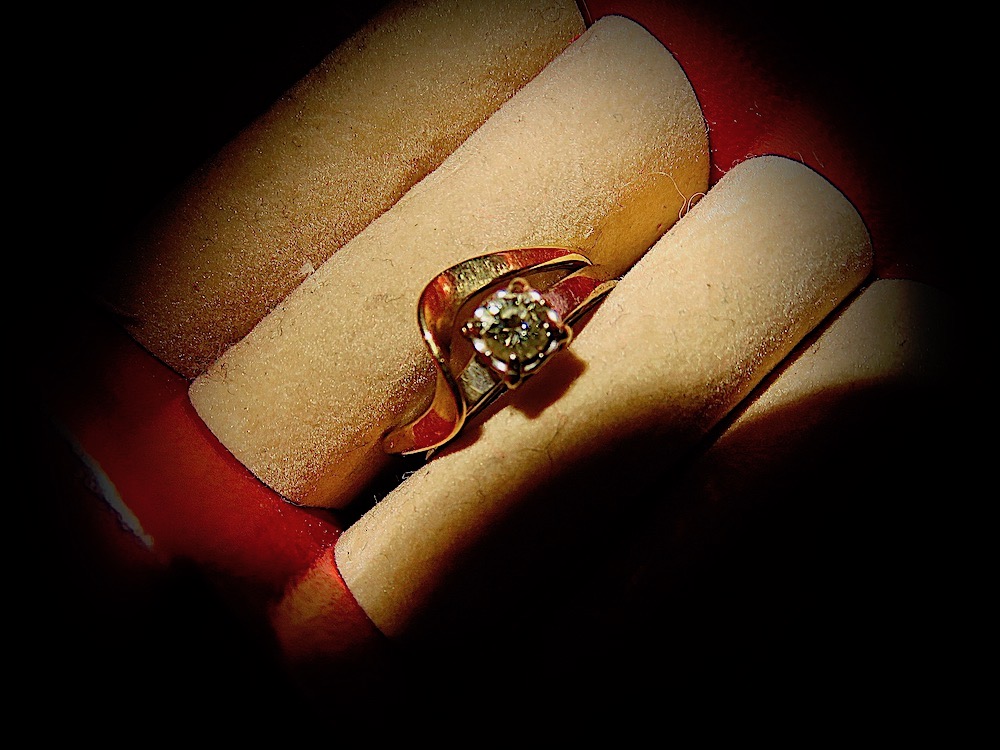
I had taken off my wedding ring years before. How typical of me that I would finally put it on again after he died. I don’t know why I do these things. Perhaps it was easier to be married to a dead man, or perhaps I felt he had finally atoned for his bad behavior, but suddenly that symbol had more significance than it had come to have in life. That sainthood of departure? I’d seen it happen again and again, but I had never been one to run with the pack and so it surprised me so much when I looked down one day and saw his ring on my finger again that I took it off and it has resided in my jewelry box ever since—that hinged red leather lips-shaped jewelry box that opens in a kiss to reveal a  little slit-compartment for rings. A next-door-neighbor of my childhood  had brought it as a hostess gift when she came to Mexico to visit me during that long year after his death when everyone came out of the woodwork to come visit.

Draw a ring around the old. Ring in the new in multiples. Duplication has become such a science—the craftsman thrown out of the ring. With the new three-dimensional copier, what cannot be duplicated, if plastic is your creation material of choice? A plastic gun—complete down to the bullet in its chamber. A perfect functioning model of anything with moving parts. Can each grain of gunpowder be duplicated? One ringie dingie, two ringie dingies. Floating away on the surface of the lake of forget. Is that giving up? Ringing the final buzzer? Burning the evidence in a ring of fire? Burning bridges? A phone rings and rings in the distance. It has that ring of authenticity, but that does not mean it is real.

Ring of thieves. One by one, the days steal my life away. Time is that one thing no one has control over—even Einstein or Hawking, who perhaps understood it more than anyone. Estee Lauder, Timex, Time Incorporated—all profit by time but none have conquered it. We are all in the ring with it whether we know it or not. Others may suffer the black eyes or sound the buzzer, but we are all really fighting the same fight. The smoothest face still wrinkles and the most beautiful voice cracks with age or disappears. Buzzers finally go silent and the arms holding up the signs go saggy. Ring around the rosie. Ring around the rosie. Ashes, ashes, we all fall down.


This is a rewite of an essay originally written three years ago. The prompt today was finally.

Almost Holy

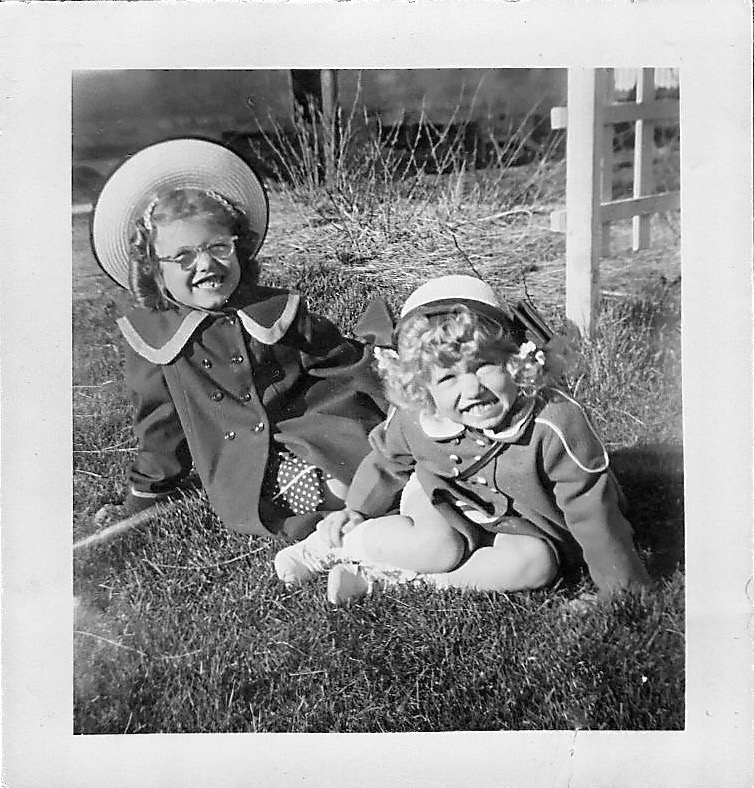
My sister Patti and I, all dressed up for church and told to smile, no doubt! Photo by sister Betty 


Almost Holy

I always wanted a set of those panties that had a day of the week embroidered on each one, but I grew up in an era when kids didn’t ask for things.  I know my mom would have bought them for me if she’d known, or my grandma would have ceased her endless activity of sewing sequins on felt butterflies or crocheting the edges of pillow shams long enough to embroider the days of the week onto the baggy white nylon panties jumbled into my underwear drawer. I never asked, though.  Never told.

So it was that on Sunday I’d arise and put on the same old underpants, cotton dress with ruffle, white socks, patent leather shoes. I’d take a little purse no bigger than the makeup case in the suitcase-sized purse I now carry. Into it I’d drop a quarter my dad had given me for the collection, a hanky and the lemon drop my mother always put inside just in case of a cough. I never coughed, but always ate the lemon drop, sucking on it during Sunday School and sometimes asking for another from the larger supply in her purse during church.

Why my mom never sang in the choir I don’t know.  She had a fine true voice.  Both of my older sisters did and so did I, once I was in high school.  I remember when I was little watching the choir in their fine robes that looked like they were graduating every Sunday.  They sat facing us, in three rows to the preacher’s left, as though checking up on us to make sure we didn’t misbehave or yawn or chew gum.  In addition to lemon drops, my mother always carried Wrigley’s Spearmint Gum in her purse.  Sometimes the gum was a bit red  from the rouge she always had on her fingertips on days she applied makeup. It seemed to me like the rouge flavored the gum a bit.  It tasted of clove and flowers.

“Just hold it in your mouth,” my mother instructed, my sister and me; and if we chewed, she would take it away from us. “Just chew it enough to make it soft and then hold it in your mouth.”  This was an almost impossible challenge for a child and actually even for a teenager.  By then, we’d learned to crack the gum and to blow bubbles even when it wasn’t bubble gum.  That fine pop and final sigh of air as the bubble broke–so satisfying. The threat and memory of everything we could be doing with that gum resided in each small wad of it held in our cheeks as we sat lined up like finely dressed chipmunks listening to the minister drone on.

Hymns were like the commercial breaks on television–a chance to move around a bit and look at something other than the preacher–to ponder the curious lyrics such as, “Lettuce gather at the river,” “Bringing in the sheets” and “Let me to his bosom fly.”  (Just what was a bosom fly and what had lettuce and collecting sheets from the clothesline to do with religion? Once again, we didn’t ask.)

Then we’d sit down again for the Apostle’s Creed or a prayer or benediction or the interminable expanse of the sermon–half an hour with no break.  I’d listen to the drone of the flies buzzing in circles at the window, or the sound of cars passing in the summer, when the front and back doors were left open to encourage  breeze where no breeze existed.

Now and then a curious dog would wander in and be ushered out by the man who stood at the door to hand out church programs.  Everyone would hear the scramble of dog toenails on the wooden aisle and turn to watch and laugh.  Even the minister would laugh and say say something like, “All of God’s creatures seek to commune with him upon occasion.”  Then everyone would laugh softly again before he turned his attention back to telling us what was wrong with us and how to remedy it.

That afternoon, Lynnie Brost and I were going to play dress up and have a tea party under the cherry trees and bury a treasure there.  We’d already assembled it: my mom’s old ruby necklace, a handful of her mom’s red plastic cancer badges shaped like little swords with a pin at the back to put on your collar to show you’d given to the campaign,  my crushed penny from the train track, her miniature woven basket from South America that her missionary sister had brought her, a tattered love comic purloined from her older sister. (We’d “read” it first–which at our age meant looking at the pictures.)

I fell asleep thinking of what else we could add to our cache, to be dug up again in ten years or for as long later as we could stand to put off exhuming it. I leaned against my mother as I slept, and if she noticed, she did nothing to awaken me.  She shook me a bit, gently, as the congregation stood after the sermon, singing “Onward Christian Soldiers” as the minister marched down the aisle, smiling and greeting parishioners and the choir followed him, as though they were being let out early for good behavior.  At the door, we greeted the preacher again, standing in line to shake hands and be blessed, then ticked off his mental list of who had been among the faithful on this fine summer day when they could have been out mowing the grass or rolling in the piles of grass emptied from the clipping bag.

Then we drove the block home, for no one ever walked in a small town.  Well done rump roast for dinner, as we called the noon meal. Mashed potatoes, brown gravy, canned string beans, a salad with homemade Russian dressing and ice cream or jelly roll for dessert.  All afternoon to play. Another small town South Dakota Sunday of an endless progression strung out from birth to age eighteen, when I departed for college and the rest of my Agnostic life.


This is an essay from almost 5 years ago. Hopefully, you’ve either not been reading my blog for that long or you’ve forgotten it and it will read like new, as it did for me. I missed the boat when it came to religion, but it wasn’t for lack of experience. The prompt today is almost.