Tag Archives: Growing up in South Dakota

“Dinosaur” for RDP, July 22, 2025

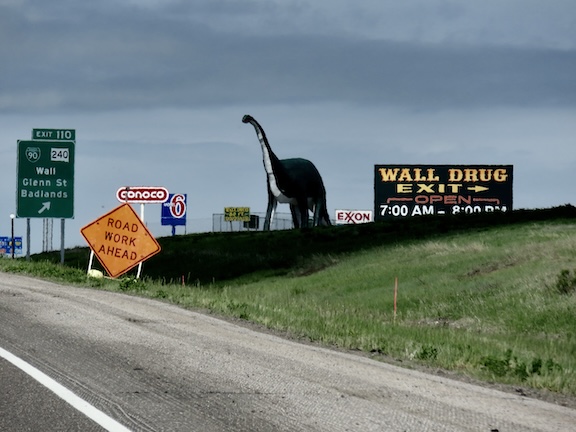
This life-sized dinosaur welcomes one to one of South Dakota’s main tourist attractions..a drug store???? Read on if your curiosity has been piqued.

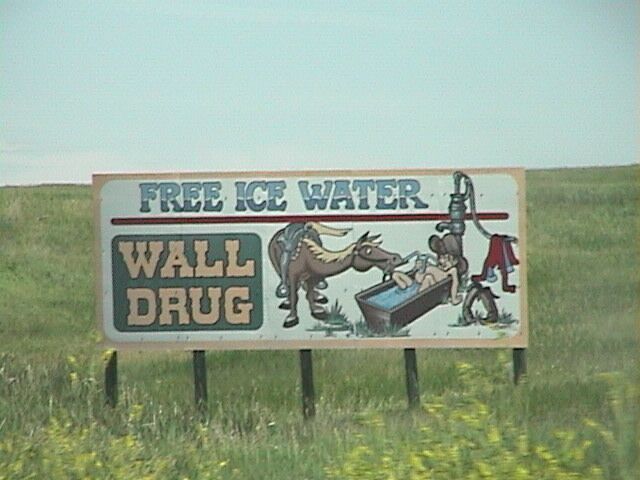
Wall_Drug_Sign

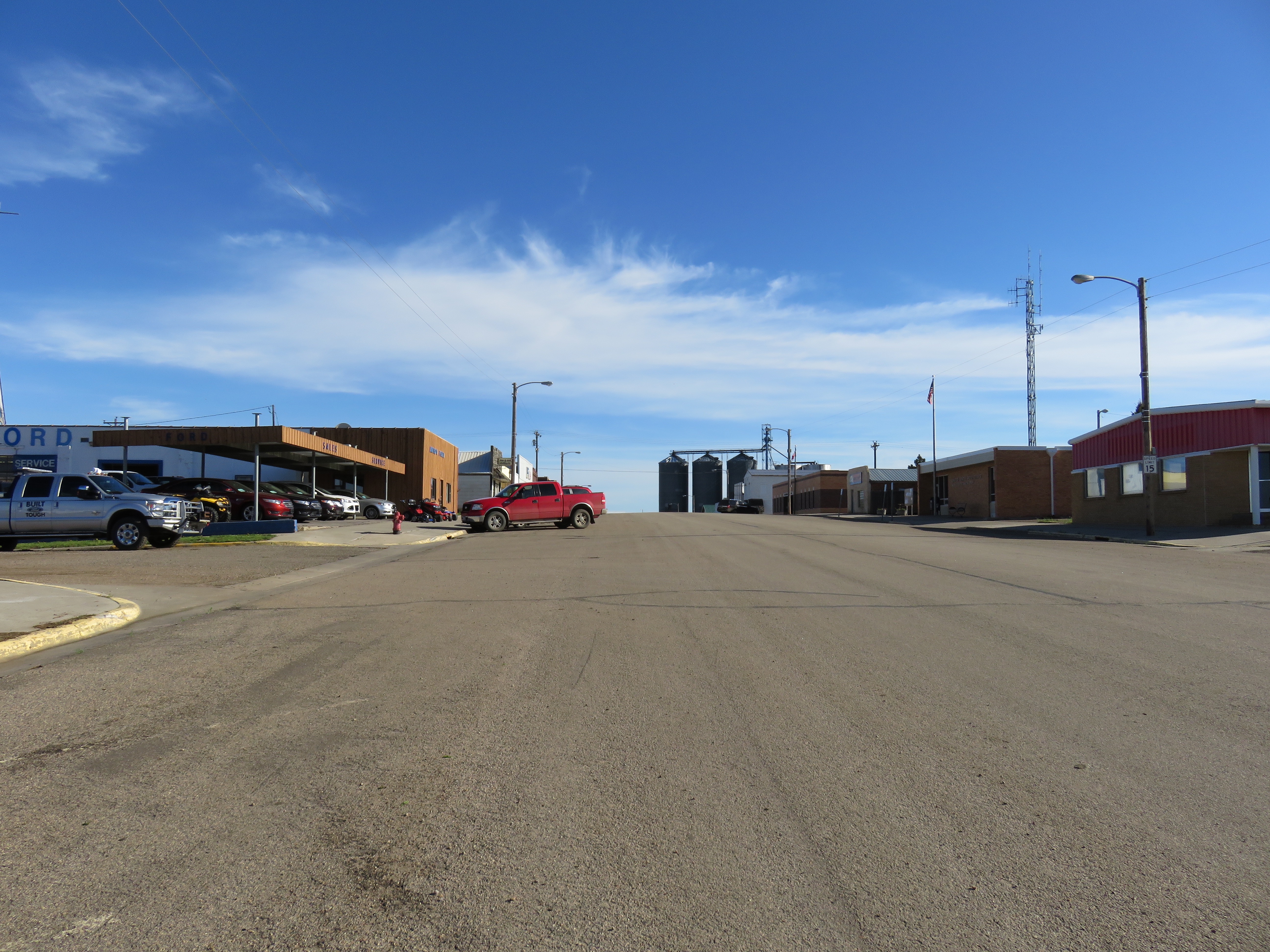
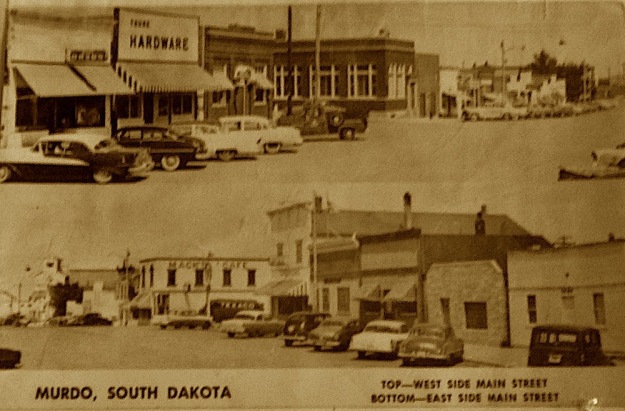
If you haven’t heard of Wall Drug, you probably have never been to South Dakota.  Signs for one of the world’s oldest and best known tourist traps are spread out across the state and surrounding states as well as such far-flung locations as Antarctica, Afghanistan and Italy.  For me, it was an exciting stop along the only vacation route taken by my family for most of my young life, for Wall was stationed smack dab on Highway 16 between my even smaller town of Murdo, South Dakota and the Black Hills, where our summer vacation usually consisted of an overnight stay in “The Deer Huts” after taking one of my older sisters to the Methodist Youth Camp a few miles away.

The excitement of the Deer Huts consisted mainly of the fact that the bathrooms were all outside—little wooden enclosures marked by a half moon that my mother hated and I adored.  I loved the nighttime trip up the hill with a flashlight and the strangely reassuring sound of what had once been a part of my body making its dark descent down the long vertical tunnel—as though it was having an adventure of its own.  I loved the threat of animals watching me in the dark as I made my way back to the log cabin.  It was about as exotic as my life ever got before I finally left home for college at age eighteen and life really began. But I digress, for the true adventure that wound up at the Deer Huts always began when we got to the badlands—a series of sandstone hills and gullies that furnished the background for many a cowboy movie of the fifties.  Then, shortly after the badlands, came Wall Drug!.

You can read the full story of Wall Drug HERE.   If you are pressed for time, however, I will give you the shortened version. The whole phenomena of a drugstore in a small town of under 300 on a godforsaken prairie  in the middle of nowhere started in 1931 with a suggestion by the wife of the owner that they put up signs offering free water.  From there, the promotions grew into singing automated cowboy orchestras, stuffed longhorn cattle, a life-sized dinosaur, chapels, souvenir shops, other automated scenes, a restaurant offering such South Dakota fare as hot beef sandwiches complete with mashed potatoes and white bread swimming in brown gravy, homemade rolls, cherry pie and 5 cent cups of coffee with  free coffee and donuts offered to soldiers, ministers, and truck drivers.

I have pictures of me at age eight and age sixty-six, standing by a huge stuffed longhorn steer, bravely touching the horn.  The last picture was taken as my childhood friend Rita and I took our last long nostalgic trip across South Dakota. In the Wall Drug Cafe, we shared a hot beef sandwich, a cinnamon roll and a piece of cherry pie for old time’s sake, put a quarter in the slots to see the singing cowboys creak into action, still in tune after almost sixty years.

In this more sophisticated age, folks still stop at Wall Drug.  It’s possible their teenagers remain in the car, texting their friends or playing computer games with the air conditioning cranked up to dispel the scorching South Dakota summer sun, but I bet the little kids as well as the bigger kids who are their folks or grandfolks still wander the block-square expanses of Wall Drug, looking for thrills from another age and time. And somewhere within its cluster of rooms and passageways, Grandma can still buy an aspirin or get a prescription filled, then get a free glass of water to swallow it down with, Grandpa can still get a five cent cup of coffee and a little kid can taste his first delicious mouthful of South Dakota Black Angus beef, swimming in gravy and surrounded by reassuring slices of Sunbeam white bread and mashed potatoes.

Martha’s word for the RDP prompt today is Dinosaur

Old Feelings

Old Feelings

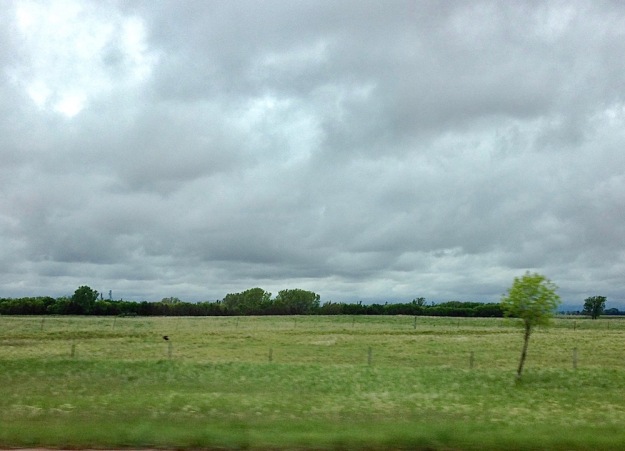
Our prairie  town  stood
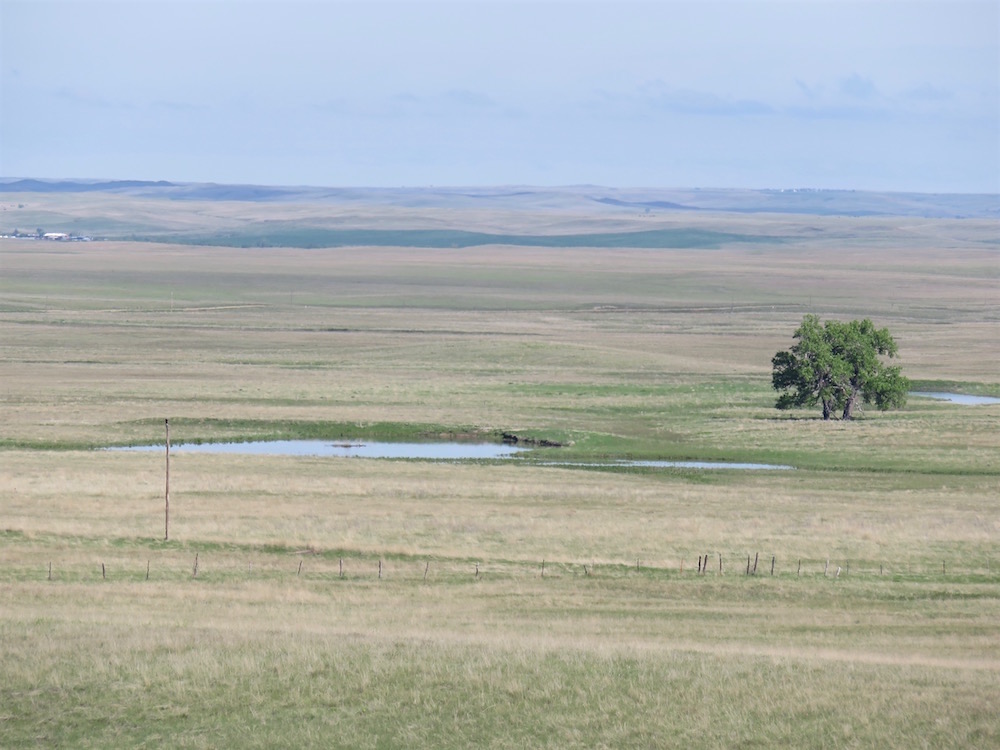
in an unending stretch of South Dakota plain
that rolled on for as far
as any eye could see
with not one tree.

Here I dreamed
in the crouched shade of rabbit nests
and killdeer flight,
in the shade of the feigned broken wings of mother birds,
in the shade of tractor blades and haystacks.

This was where  I  would sunburn  and sand stick and deer fly scratch.
Where the ticks waited for me on the wood of the thickets.
Where no dangerous animals lurked
since the gray wolves were ghosts
and the brown bears memories.

Here the Sioux were sequestered in the bars and the reservations.
The horses were safe behind fences,
the cattle wore the tattoos of their owners,
and  feral  cats  were the only descendants left
in the decaying houses  of the homesteaders
of half a century before.

The  floorboards of my Grandmother’s  homestead
sagged  to the dry dirt,
and the roof and timbers
fell  to blanket them.

The ribs of  plows  rusted
in the spring  rainstorms.
Prairie fires burned away  rust
and  snow peeled away ashes
to the muscle of iron
which it picked at like scabs—
iron to rust to ashes to iron to rust.

Kicking the hard clods with my feet,
I knew that under me were arrowheads
and flint strikers
and white stone buttons
in the shape of thunderbirds—
All the rich Indian treasures
buried under the soil
to be turned up some day  by the plow of my dad .

Curled up into the furthest corner of the couch,
I listened to the stories traded between my dad and his friends.
Tales of gray wolves
and children lost in snowstorms,
Indian wanderers and recluse homesteaders
to be lifted out of my dad
like he lifted the Indian relics from the soft soil.

And I feel a part of the prairie dogs and the wild kittens,
the rabbits and the killdeer in their nests.
I feel both threatened and protected by the land––
like a child given asylum under the shadow of trees.
Like myself sheltered in the arms of  the child  I’ve grown from.
That child who, wanting to grow up and feel  less,
Comforts its  grownup self,  who wants the feeling back.

For dVerse Poets Open Link Night.

South Dakota….Through the Eyes of Jeff Foxworthy and Seconded by Me!!!

Click on image to enlarge.

If your local Dairy Queen is closed from September through May, you may live in South Dakota. If someone in a Home Depot store offers you assistance and they don’t even work there, you may live in South Dakota. If you’ve worn shorts and a jacket at the same time, you may live in South Dakota. If you’ve had a lengthy telephone convers……ation with someone who dialed a wrong number, you may live in South Dakota. If “vacation” means going to Sioux Falls for the weekend, you may live in South Dakota. If you measure distance in hours, you may live in South Dakota. If you know several people who have hit a deer more than once, you may live in South Dakota. If you have switched from ‘heat’ to ‘A/C’ in the same day and back again, you may live in South Dakota. If you can drive 75 mph through 2 feet of snow during a raging blizzard without flinching, you may live in South Dakota. If you install security lights on your house and garage, but leave both doors unlocked, you may live in South Dakota. If you carry jumpers in your car and your wife knows how to use them, you may live in South Dakota. If you design your kid’s Halloween costume to fit over a snowsuit, you may live in South Dakota. If driving is better in the winter because the potholes are filled with snow, you may live in South Dakota. If you know all 4 seasons: almost winter, winter, still winter and road construction, you may live in South Dakota. If you have more miles on your snow blower than your car, you may live in South Dakota. If you find 10 degrees “a little chilly”, you may live in South Dakota. If you know how to pronounce Ipswich, Belle Fourche and Pierre you might be South Dakota. If you actually understand these jokes, repost this so all of your South Dakota friends and others can see…. Too true! LOL

 And, you might think you pronounced Pierre correctly, but unless you rhymed it with beer, you were wrong.

Thanks to my friend Jim Anshutz for sending this to me, and thanks to Cherie Ramsdell for sending it to Jim!!!

It is only coincidence that my new book on growing up in South Dakota will soon be available on Amazon. I’ll let you know when.  It’s titled The China Bulldog and Other Tales of a Small Town Girl.

Image by Alex Person on Unsplash.

Shelter: NaPoWriMo 2019, Day 10


Shelter

On the prairies of Dakota, 
weather often came with exclamation marks.
My father’s forehead was ringed like an old tree,
white from above his eyebrows to his fast-retreating hairline,
from his hat pulled low to guard from every vagary of weather.
“It’s hot as the hubs of Hell!” he’d exclaim as he sank into his chair at noon,
sweeping his hat from his head to mop his brow.
A nap after lunch, then Mack’s Cafe for coffee with his friends,
then back to work in the field until dark, some days.

Those long Julys, we kids strung tents across the clothes lines in the back yard
or lazed under cherry trees,
no labors more strenuous than wiping the dishes
or dusting the bookshelves in the living room.
Books were our pleasure during those long hot summers:
our mother on the divan, my sisters and I on beds in dormered rooms
with windows open to catch infrequent breezes,
or deep beneath the veils of the weeping willow tree.

“Cold as a witch’s teat in January!” was as close to swearing 
as I ever heard my dad get, November through March, stomping the snow off rubber
overboots in the garage, tracking snow from his cuffs through the mudroom/laundry.
Cold curled like Medusa’s ringlets off his body. We learned to avoid his hands,
red with winter, nearly frozen inside his buckskin gloves.
His broad-brimmed hat, steaming near the fireplace
as we gathered around the big formica table in the dining room.
Huge beef roasts from our own cattle, mashed potatoes and green beans.
Always a lettuce salad and dessert. The noon meal was “dinner”—main meal of the day.
Necessary for a farmer/rancher who had a full day’s work still ahead of him.

Our weather was announced by our father
with more color than the radio weather report.

Spring was declared by his, “Raining cats and dogs out there!” 
We knew, of course, from rain drumming on the roof as we sat, deep in closets,
creating paper doll worlds out of Kleenex boxes for beds and sardine cans for coffee tables, rolled washcloth chairs and jewelry box sofas. 

Only afterwards, now, have I really thought about how we were protected
from the vagaries of weather as from so much else.
A mad dash across the street to school was the extent of it,
or short trip from car to church or store or school auditorium.
It was a though my father bore the brunt of all of it, facing it
for us, easing our way. It was his job.
As my mother’s job was three hot meals a day, a clean house, afternoons spent
over a steaming mangle, ironing sheets and pants and arms and bodices of blouses.
After school, one or the other of us girls at ironing board, pressing the cuffs and collars.

We were sheltered, all of us,
from those extremes of that land I didn’t even know was harsh
until years later, living in milder climates:
Australia, California and Mexico.
Our lives, seen in retrospect,
as though for the first time, clearly.
Remembering the poetry
of how a man who really lived in it
gave us hints of its reality.

The NaPoWriMo prompt is to write a poem making use of a regional phrase describing the weather.

With Reservations: True West

IMG_0078

True West: Racial Stereotypes in a Small South Dakota Town

I grew up in a very small town (population 700) on the prairies of South Dakota. I was not aware of a wide disparity of classes at the time; but looking back, I see that there really were classes based on economic and racial factors.  Since my town was situated quite near to several Indian reservations, there was often at least one native American in my class.  In the second grade, it was Clifford Leading   Cloud—14 years old and placed in the second grade.  Needless to say, he towered over the 7-year-olds. No doubt this was why he was constantly stoop-shouldered and his demeanor was apologetic and shy.  He was a wonderful artist, and I still have several of his drawings.  “Clifford drew this for me!” I proudly wrote beneath two colored-pencil sketches in my scrapbook, but when I took them home to show them to my mother, she said, “Be sure to always wash your hands after you touch those.”  Obedient at this stage of my life, I remember complying, but I was always puzzled about why.

Since my name began with a “D” and our placement was always determined alphabetically, I sat behind or in front of all of the Native American kids who joined our class for a year or two before disappearing: Clifford Leading Cloud, Phoebe Crazy Bear, Nordine Fink (Who was my assigned “date” for Freshman initiation, but who somehow disappeared during the year.) Phoebe had very long black hair that I loved to brush during Geometry. (In spite of former warnings from mothers who told us to be careful not to contract lice from the “Indian” kids.) She was a good student, and I liked her dry sense of humor; but although I invited her to slumber parties, she never came and she, too, vanished by the end of our Sophomore year.

I know there was a division in our community between the white population and the Native Americans, many of whom still lived in tents along the railroad tracks because it was federal land and the head of the railroad allowed them to live there free of charge.  When I was given release time from study hall to teach P.E. and reading to first graders my Jr. year in high school, the sweetest and most beautiful first grader was another Leading Cloud—who, probably due to living in a tent with no bathroom facilities and no running water—had such a strong stench that it brought tears to my eyes to stand over her for long as I guided her in her reading.  My mother attributed this to the use of “bear grease” in the hair, but I think she was a few generations behind in her thinking.

The factors of difference in culture, living arrangements and economic factors divided us from the Native American citizens of our town so that aside from actual classes as school, they faded away into the environment in a manner that should have been impossible in a town as small as ours.  They did not attend games, dances, or participate in any of the extracurricular activities of the school. They did not attend church or hang out in restaurants.  I do remember my mother asking us to sit in front  and back and either side of her when we went to the movies in White River, 32 miles away.  Closer to the reservation, there was a higher Native American population and my mother, sensitive to smells, wished to take all proper precautions.

My mother was not unkind. She fed any hobo who showed up at our door. She took boxes of clothing out to the dump and set them where foragers could easily find them.  She also told me never to mention that clothing had been mine if any of the Native American kids showed up wearing one of my give-aways. But she was the product of an age where we had not yet thought to struggle against racial stereotypes.  My father regularly employed seasonal workers from the reservation and even learned to speak some Sioux.  He was a natural born storyteller who loved gleaning material from all and sundry and a broad-minded thinker. One of the few Democrats in town, he counted everyone among his friends–from his Hunkpapa Sioux employees to the Governor of the state.

Yet, should the doorbell ring when my dad was not at home and  if my mom were to see that it was someone from the reservation stopped at our house to ask for work on his way into town, she would tell us not to answer the door and would cower in the hallway out of sight. Again, I know my mother well enough to know it was genuine fear that prompted her actions, not meanness or hatred.

There were two families of Sioux lineage in the town who did manage to bridge the gap of cultures.  In one case, it was a handsome young man who was an incredible basketball player whose name revealed his mixed Sioux and French genes. He was the secret heart-throb of many a girl, and his sister, as beautiful as he was handsome, was a cheerleader and generally accepted, I believe, although they were enough older than I am for this all to be hearsay.

The other family that was able to bridge the two cultures was also of mixed lineage–white and Sioux.  Another beautiful family, their son was also an excellent ball player and both of their daughters were cheerleaders. (This was the highest rank of success in our town—far above Valedictorian.) In both cases, the cultural differences were only a matter of skin color. They were not living in tents along the railroad tracks or migrating back and forth from the reservation.  In  most respects, their lifestyles were no different from our own.  Still, I have heard that when one of our most popular young men married one of the popular young ladies I’ve just mentioned, that his mother was heard to say, “He’s marrying that squaw.”

It seems as though the major factor, then, that created a class structure in our town was one of culture coupled with economic duress.  Yes, there were poor families in our town and many times they did not participate as fully in what little social life there was in our town, and yes, although I started out inviting everyone in my class to parties, in time the parties got smaller and the guest list included mainly those friends from my neighborhood or those I found to be the most fun or who participated in the same activities I participated in.

This narrowing of social circles is natural, I think, but when I look at who was excluded, I don’t feel as though I used any criteria other than whom I enjoyed being around. I would have loved it if Phoebe had come to my slumber parties. She was smart and even then I had a curiosity about other cultures and other ways of life. I was the first friend of any new girl who moved to town—a fact that caused some resentment on the part of my old friends, I now see clearly.

We all make excuses for ourselves when it comes to discussing our own prejudices, and I am no exception to the rule. Native Americans were stereotyped because the most extreme cases of behavior were the most obvious. The few women from the reservation who came to drink and lay sprawled in the street created the stereotype that all “Indian” women were “drunken squaws.” No one ever saw any of then mothers of the Native American children we went to school with. They were no doubt at home trying to scrape out a meal or school clothes for their children’s next next day at school.  And their fathers were probably out working in the fields for our fathers. But we did see the drunks on the streets every Saturday night as we exited the movies, and so this is the stereotype that formed in our minds, no matter how much our actual experience with kids at school rivaled that stereotype.

Many years ago, I started to write a book called “Vision Quest” about a young Native American boy who grew up in our town. This was a work of fiction, but I drew of course upon actual experience for details of plot.  I know I came back to it at least twice, but never got beyond the first few chapters, probably because I had so little experience to draw upon; for in spite of the fact that I grew up in a state that contained numerous reservations and in spite of the fact  that all of the surrounding towns contained a Native American population, in fact our cultures were so widely divided that I had as little insight into their lives as they must have had into mine.

The term “Native American” had not been coined when I last lived in my hometown, and neither had the sensibilities that I hope go with it. When Dennis Banks and Russell Means were heroes to much of the rest of the world, they were outlaws and trouble makers to those non-Native Americans who lived in their midst. To someone stopped from driving on highways where they had always driven, they appeared to be highwaymen or brigands. It is hard to make a hero of someone you grew up feeling superior to, and hard not to stereotype any race or cultural group according to what you know about the few representatives of that group with whom you have come in contact.

But I have to say that coming back to my town and hearing one of the supposedly kindest and admittedly hardest-working members of the church I grew up in describing the wife of a local boy as a “N—–” and scathingly speaking of the Native American Rights movement of the seventies made me take a really long look back at my own past as well as to reappraise my former affection for this woman whose small-mindedness revealed itself at a time when I myself was in love with an African man, teaching African children and living with African housemates.

The last time I visited my hometown, I did not go to see this lady and by the time I next went, she had passed away. Hopefully with the demise of these last citizens of the old ways, prejudice will pass away with them. I am afraid, however, that prejudice is born anew in each generation—perhaps towards yet a new group of immigrants or transplants who threaten the so-called “American Way of Life.” It would do us all well to remember that America was meant to be a melting-pot, and as in any recipe, it is made more palatable by a variety of spices.


This is a reprint of a piece from two and a half years ago. The prompt today is reservation.

Sweet Clover

Getting ready to leave for Minnesota in an hour, so I’ll rely on a poem written two years ago that meets the demands of the prompt word today, which was “honk.”

IMG_0102

Sweet Clover

Before our dad told us its real name,
we used to call it wild mustard.
What did we know about sweet clover except for its color
and that summer smell, cloying in its sugared perfume.
It filled the air and smothered the plains—
bright yellow and green where before
brown stubble had peeked through blown snow.

On these dry lands, what flowers there were
tended to be cash crops or cattle feed.
Sweet clover or alfalfa.
The twitching noses of baby rabbits brought home by my dad
as we proffered it to them by the handful.
Fragile chains we draped around our necks and wrists.
Bouquets for our mom
that wilted as fast as we could pick them.

Summers were sweet clover and sweet corn
and first sweethearts parked on country roads,
windows rolled down to the night air,
then quickly closed to the miller moths.
Heady kisses,
whispered confessions, declarations,
unkept promises.
What we found most in these first selfish loves
was ourselves.

The relief of being chosen
and assurance that all our parts worked.
Our lips accepting those pressures unacceptable
just the year before.
Regions we’d never had much congress with before
calling out for company.
That hard flutter
like a large moth determined to get out.
Finding to our surprise,
like the lyrics of a sixties song,
that our hearts could break, too.

Hot summer nights,
“U”ing Main,
cars full of boys honking
at cars full of girls.
Cokes at Mack’s cafe.
And over the whole town
that heavy ache of sweet clover.
Half promise, half memory.
A giant invisible hand
that covered summer.

IMG_1056

The prompt word today was honk.

Dakota Dirt


Dakota Dirt

My father toiled for fifty years,
facing the worries and the fears—
the gambles that a farmer faced
when all his future he had placed
as seeds beneath Dakota dirt.
Every year, he risked the shirt
right off his back. With faith, he’d bury
his whole future in that prairie.
Sticky gumbo, that fine-grained silt
upon which his whole life was built.
Then, closer to our summer home,
near the river, in sand and loam,
he hoped he could prepare for ours:
our clothes, our college, and first cars.

Then came those years that brought the change
that altered fields and crops and range.
The rain that formerly turned to rust
plows left untended, turned to dust
that, caught up in the wind’s mad thrust
caused many a farmer to go bust
as a whole nation mourned and cussed
black clouds of dirt that broke the trust
that nature would provide for all.
What formerly fed, now brought their fall.

It broke the men who couldn’t wait
for the drought years to abate,
but my father kept his faith in soil.
Found other paying forms of toil
building dams to catch what rain
might later fall on that dry plain.
And though others thought his prospects poor,
he kept his land and bought some more.
He learned to vary furrow line,
believing it would turn out fine.

So when good fortune returned again,
bringing with it snow and rain,
he welcomed and was ready for it.
That April it began to pour, it
filled his dams and nourished what
soil remained. He filled each rut
with clover, alfalfa and wheat.
Allowed the summer sun to beat
and change them into fields of gold—
into grain and feed he sold.

Bought cattle. Planted winter wheat.
Once more secure on his two feet,
expanded and as he had planned,
bought more cattle and more land.
Some said that he had just exploited
those whose land he’d reconnoitered
and purchased after they’d given up,
empty hands transformed to cup.
He was a hero unsung, unknown,
until long after when I was grown.

At the centennial of our town,
I learned a bit of his renown
when others told to me how he
shared nature’s generosity.
He sent three daughters to university,
then shared with his community 
to build a church and give more knowledge
to those young men he sent to college.
Then made loans without fame or thanks
to other farmers denied by banks.

I’d always known how rich my life
was made by all his toil and strife—
the insurance he gave his family
that enabled us all to be free.
But, aside from daughters, wife and mother,
I’d never know of every other
soul he’d helped  to prosperous ends:
neighboring ranchers, sons of friends.
Could my father have known he’d also planned
all these other futures when he bought the land?


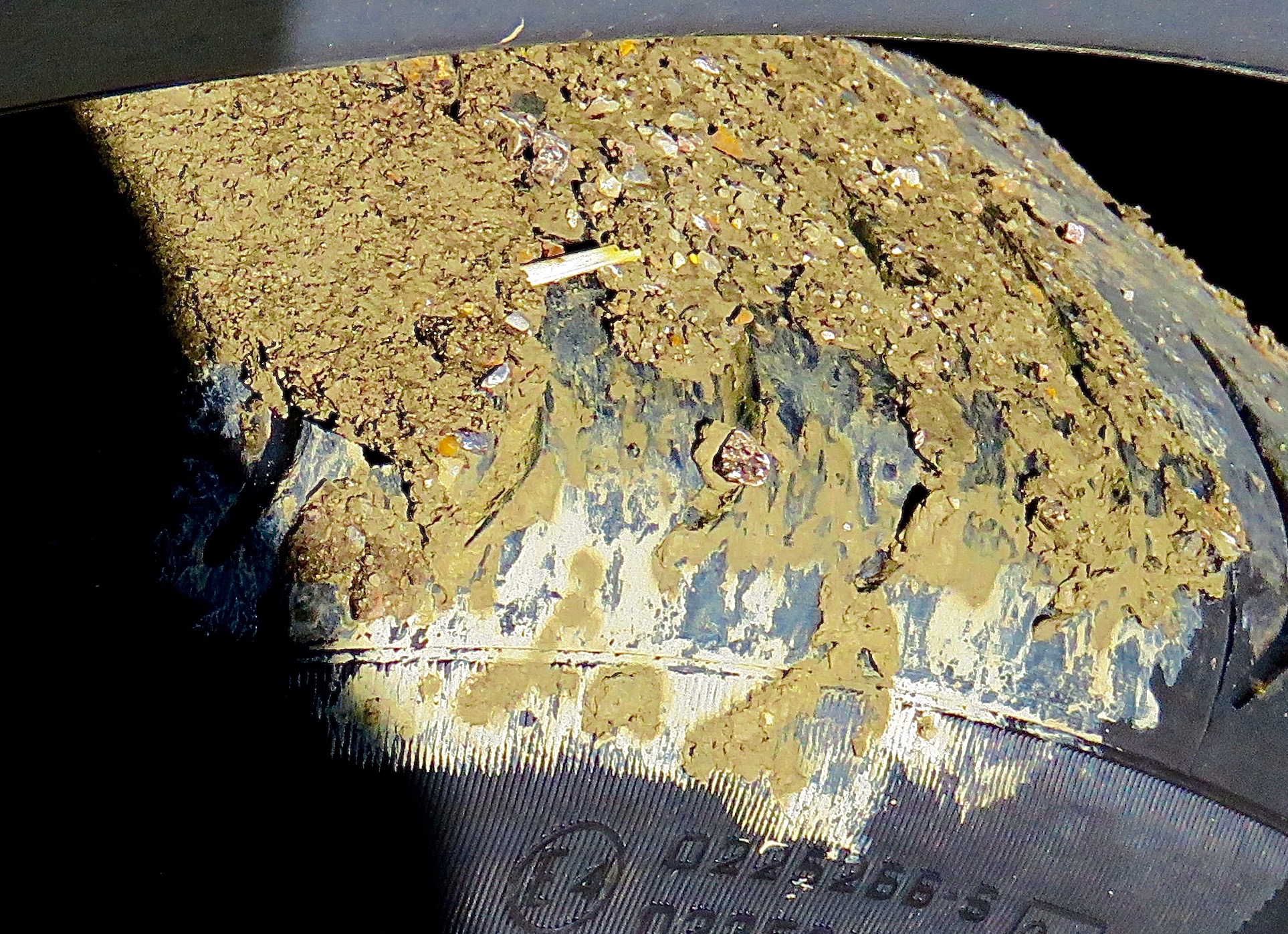
This rich Jones County gumbo on the treads of my tire at one of our all-town reunions a few years ago is what sent me to college!

Not enough dirt for you?  Check out this story: https://judydykstrabrown.com/2015/01/26/south-dakota-gumbo/

The prompt today was soil.

Merry-Go-Round


daily life color086 (1)
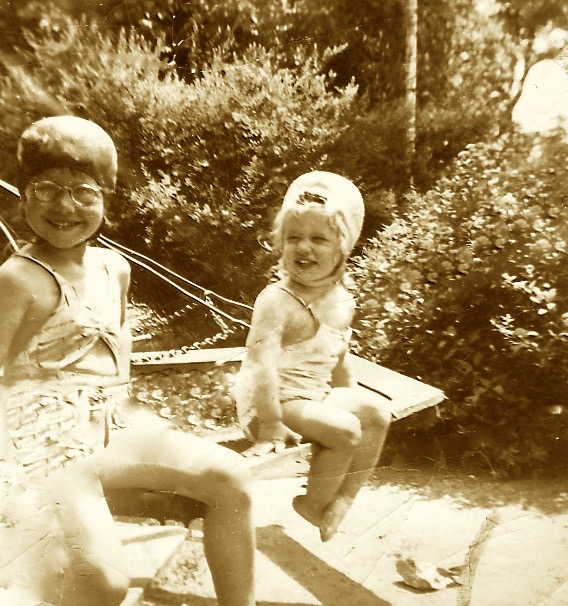
My sister and I at a park near my grandma’s house in Kansas on a merry-go-round similar to the one in the school playground across from our house in South Dakota.

                                                                   Merry-Go-Round

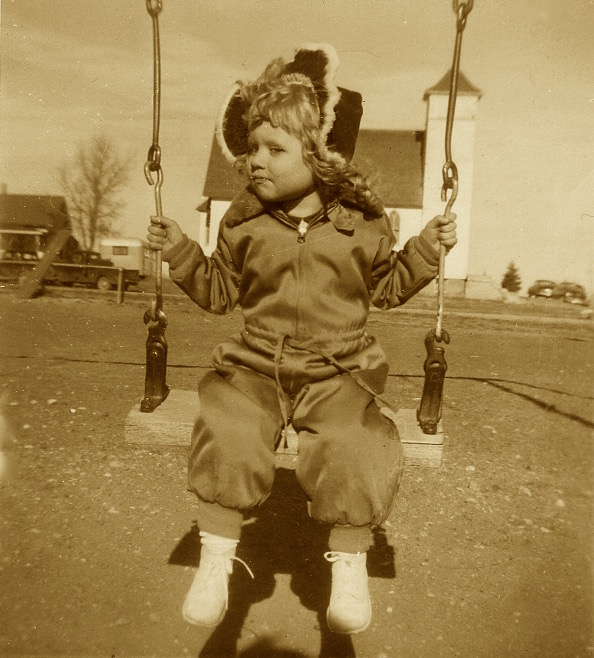
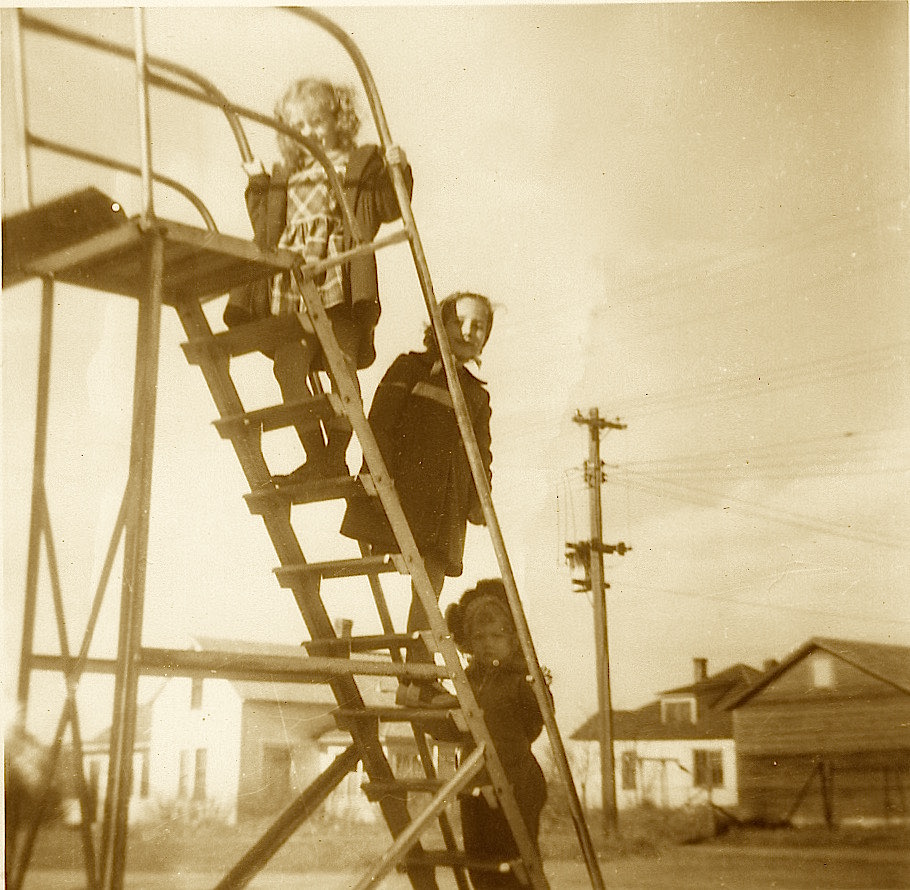
Their creaks were my alarm that kids were on the elementary school playground across the street and if my biggest sister was downstairs or away from home or even sleeping as soundly as she always did after coming home late the night before, I’d sneak into her room to look out on the playground from above and see who was there. I knew the difference in the sound between the merry-go-round and each set of swings—the little swings next to the little slide, or one of the three big sets directly across from the block my house was on. Higher, with longer and more flexible chains, these swings could be made to loop de loop—pass up so high that you actually went over the top of the frame the swings were suspended from and wound the chain once around the pipe.

Some of the boys could repeat this three or four times until the swing got so high that none of the little kids could get up to it. Then the janitors would have to get their tallest ladder and go up to push the seat over and over the cross pole with one of their big push brooms to straighten it out again and bring the seat down closer to earth.

There were rules forbidding loop de looping, but the boys would come after school when all the teachers had gone home and even our janitors, Mr. and Mrs. Polachek, who lived kitty-corner across from the south end of the playground, were at home in their backroom away from the sounds of kids in the neighborhood, sealed up tight and safe. They were Polish, and now that I think of it, probably displaced persons from WWII. Their accents were thick and her temper was short and they were the objects of constant tauntings from the boys. One year the boys had hung a dead cat from their front porch on Halloween. I wish I could remember whether I thought this was funny, as many of the kids did. I hope I didn’t––that I was as sickened by it then as I am now.

The creak I was listening for was the creak of the merry-go-round. Teepee shaped, it had a wooden runner all the way around it a foot up from the ground. There was a handrail about thirty inches above it, so you could stand on the wooden runner, facing the center pole, hold onto the hand rail and enjoy the ride as the big kids ran around in circles around the merry-go-round, pulling it with them to go faster and faster, then stood on four sides of it, grabbing the handrail pipe and pushing it off to make it go faster still. One by one, more onlookers would be enrolled in the joint effort to get it going fast enough. Then they’d jump on and everyone would pump up and down, sticking their bottoms out into space as they bent their knees, pumping to keep up the momentum.

There were other ways to use the Merry-go-round. The bigger girls like Marie Holstedt who lived on the street that faced the opposite side of the playground from the one my house faced, would sit on the foot board with her boyfriend Robert. Their feet side by side on the ground, they would sway to and fro in a kind of two-step movement—two to the right, then one to the left––their knees touching with their swing to the right, their hips touching when they swung to the left. When they did this, the sound of the merry-go-round reminded me of the strange rhythmic creaking I’d hear sometimes late at night in my house.

It was probably the TV antenna on the roof, my mother had said. Or maybe the furnace trying to pump out heat, she had speculated when I pointed out that it had been a windless night.
Life was simple and I believed her. Only now do I make sense of it and of my father’s late night short trips down the hall to the bathroom—the washcloth always draped over the tub faucet the next morning.

It was an innocent age where it was entirely possible to be eleven years old and to never have had the least idea that anything like sex existed in the world. Yet a good deal of what eventually led up to it went on in the playground across from my house. Older girls would sit in the swings, swaying back and forth without ever taking their feet from the ground. Or, take fast running steps forward and backward without really letting go and allowing the lift off. To their side or in front of them would be their crush of the day or the week or the hour. If he was not the boy of choice, sometimes the girls would switch swings. If the boy switched again, too, and the other boy let him, then it was a sign language of sorts that indicated which boy favored which girl, and if the girls went home, a clear message that things had not matched up correctly to their satisfaction.

But at other times––usually during games of ditch ‘em played in the twilight and darkness of summer, courtships could progress toward hunkering down in the ditches around the playground, close up to some culvert where the ditches were their deepest, the girl in front, the boy with his arms around her waist, holding her back from running to try to get to home base when one of the littler kids who was “it” ran past without seeing them. In these junior high years just past childhood, the objects of the games started to shift until finally in high school, the rituals of the old games were left behind entirely and ditch ‘em became merely a starting place––as did the swinging back and forth, the pumping, the dance.

Today, with merry-go-rounds a thing of the past, they are still an appropriate metaphor for what life pushes us toward from our birth. It begins with our rocking in the arms of our mothers, the rocking chairs of our grandmothers, the wild swings through the air locked hand-to-hand with our fathers. It is what slippery slides and swings and merry-go-rounds and dancing move us towards. Everything going around and around and in doing so really going back and forth from generation to generation. Passing the world on and fading away. Now and then doing a loop de loop just because we can.

daily life color087 (1) daily life color088 (1)
In response to The Daily Post’s writing prompt: “Ode to a Playground.”A place from your past or childhood, one that you’re fond of, is destroyed. Write it a memorial.

For Red: The Summer Home

The Summer Home

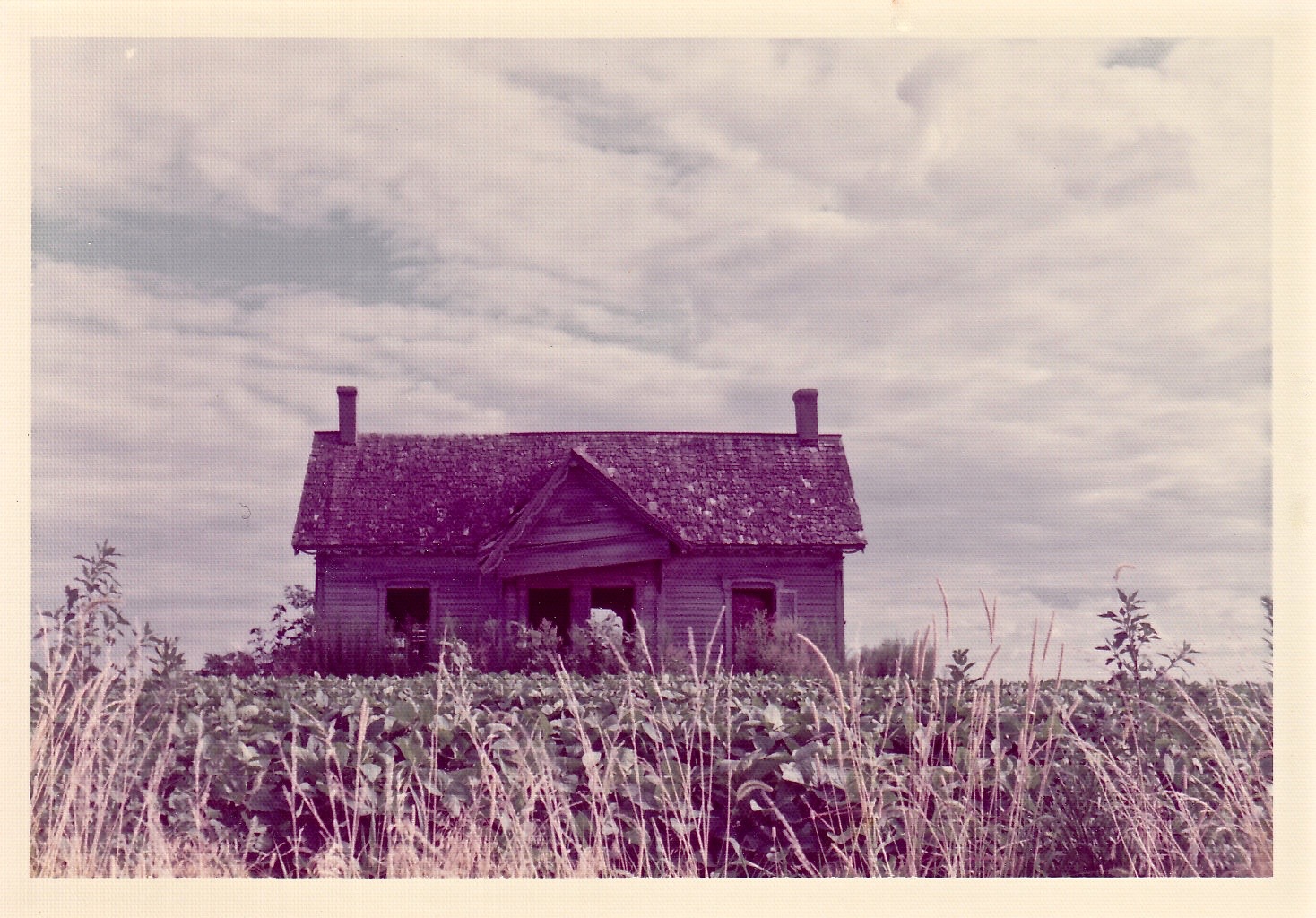
Decaying Farmhouse in Missouri Soybean Field

Photo by okcforgottenman, aka flycatcher

THE SUMMER HOME

When my dad bought the land
where the Big White River and Little White River joined,
I couldn’t believe that we owned land with trees on it.
While he plowed the small field,
I walked the woods and found the abandoned shanty.
Its door was open; in fact it could not shut.
Inside was a mysterious, sweet and fecund smell–
a mouse smell new to me
that I couldn’t stop myself from breathing in.
The mildew and the dust,
the musk of warm linoleum,
every new smell and sight was magic.

I was enchanted by this house emptied
of chairs and tables and beds,
yet full of the accumulated energy of past tame lives
and present wild ones:
the moving of leaf shadows
across the chipped linoleum of the L-shaped kitchen,
the dents on the floor where the kitchen chairs had set,
as though someone had taken care each day
to line up the legs in their holders.
Upstairs I found crayon scribbles halfway up the wall–
the arm reach of a three-year-old.

When I asked about the house,
my dad said that it was our summer home,
and the next time we went to the field,
I brought a broom.

I cleaned out the mouse droppings and the tumbleweeds.
I collected the peeled tile fragments,
imagining gluing them back again.
I washed out a quart canning jar at the pump
and filled it with spring water
and sweet clover,
putting it on the floor
between the kitchen chair holes
in the exact middle of the vanished table.
With the old shirt I found in the corner,
I rubbed mud and river sand
from the linoleum counter tops.
More sand worked as Ajax to scrub out sinks.

All summer long I worked on our summer home,
and for that summer and many summers to come,
I waited in vain for our move to the river house.

I sat on its screened front porch.
Outside the screen grew spearmint and peppermint.
On the top leaf of the tallest branch was a grasshopper,
the kind that left tobacco stains in your hand
when you held it.
All around me were the trees–
the swaying shedding cottonwoods
and scrub chokecherries.
It was a wealth of trees I’d never seen before
in the town where we lived on the bare prairie
nor on the roads we traversed for hundreds of miles
to see a movie or a dentist
or to buy clothes.

Around the screens buzzed the heavy flies,
their motors slow in the heat of July–
all the flies on the outside
wanting to get in
and all the flies on the inside
pressing the screen to get out–
like I longed to get out
to the freedom of trees
where black crows
and dull brown sparrows
rustled their wings
and flew from branch to branch.

In the distance, meadowlarks called
the only birdcall I ever recognized.
No squirrels, no chipmunks; but, rabbits? Yes.
My father said no bears,
but he’d told me the story of Hugh Glass,
mauled by a bear,
walking this river for a hundred miles
past this very joining of the Big and Little White,
in search of help;
and I could imagine one last bear or two
hidden in my woods.

So at night, at home in our winter house in town,
when he told the story I loved the best,
I was the one who discovered the bears’ cottage,
and the cottage was our summer home.
The chairs–too hard, too soft, just right—
I sat upon in turn,
taking great care every time to nestle each leg
back into its correct place on the kitchen linoleum.
And when I lay in the perfect bed of the little bear,
I could touch the crayon markings on the wall.

So when the three bears found me asleep
in the little bear’s room,
they weren’t really very scary;
but I ran anyway,
into my dark and shadowed owl-calling woods,
my woods still echoing the day lit fluted calls of meadowlarks,
their music shaken from the snarled leaves
in the evening breeze.
I ran to trees–
their leaves frosted by moonlight and the Milky Way,
vibrating with the power of the Big Dipper and Orion,
the Seven Sisters and the North Star.

Into the trees
to where I stored my memories
in the frog-croaking depressions under clumps of grass,
in the tangles of Creeping Jenny
and the fluff of dandelions,
in the sand hollows
that crept up from the riverbanks,
in the cocklebur and the chigger-infested grass,
in the crooks of cottonwoods and caves of thickets,
in the tiny cupped palms
of sweet clover and purple alfalfa,
in the wheat grass and the oats and trefoil.

The year my dad decided to expand the field
on the river bottom,
I pleaded, I cajoled, I promised, I prayed
for the summer home
where I had lived for neither one summer
nor one night, in actuality,
but where, nevertheless, I’d had faith
I would someday live.

Of course, there was no saving the woods
and summer house.
It was rich river land, prime for irrigation.
The trees were a waste of soil.
The summer home–everybody’s gentle joke on me.

After the cats and bulldozers were through,
I went with my dad to see
where trees had been ripped out,
the house burned to the ground,
the soil turned and planted
with crops that would build the land.
Their woods now furrowed soil,
the crows and sparrows
had gone to some other shaded place;
the mice, back to the fields.

My former references of trees forever gone,
the present references of sky and fence posts
too wide and new,
I wasn’t sure where my summer home had stood.
The house’s ghost destroyed by the bright sunlight,
the woodland paths replaced by tractor treads,
I watched instead a meadowlark
soar over brown fields and settle on barbed wire,
claiming the new field for its own.
With no house or forest left,
my only shade was chokecherry bushes,
my only chair, the pickup running board.
And so my summers at the river
vanished in the smoke of my summer home
and smoldering tree stumps.

But every night, my woods again threw still shadows
over the summer house,
and I ran once more the corridors of moonlight
cut through dense trees
like parts in a small girl’s hair.
I ran in the wet dew of the condensing summer heat.
I ran on the fuel of my need for magic
and wildness
and rivers
and trees.
I ran fueled by my need to be with something
that lived outside my window
as I passed long nights in my winter house.

It lay in the dark tapping of the trumpet vine branch
against my window
and the crunching of gravel
as someone walked by on the unpaved street–
out past midnight and I couldn’t tell who.
It lay in the pricking of the hair on my arm
as I stuck it out from the bed
and pressed it to the screen.

Always, in town, it lay outside of me–
except for when I floated the paths
of the woods surrounding the summer house,
joining it in dreams,
night after night and then less frequently
until the dreams came once a month
or once a year–
in darkness, always recognized;
but nonetheless forgotten in the light.

So by the time I saw the river field grown lush with corn,
I was a teenager in my first grownup swimsuit,
floating the milky Little White in an inner tube,
down to its junction
with the clear and colder-running water of the Big White,
my best friend next to me,
our cooler full of Coca-Colas and ham salad,
our conversations full of boys and music.

At the border of the field, to get to the river bank,
we crawled over the border of large tree trunks
laid horizontal, half-buried in sand.
I guess I knew they were the bones of my midnight woods.
I guess some part of me felt
the ghost of my summer house.
But, as I lay on my back on the submerged sand bank,
the warm water flowed so sensuously over my shoulders
and down my legs
that my suit seemed to peel itself
from my shoulders, breasts, thighs, calves.
And in a dream I floated the muddy water
of the Little White,
turning in the current
until the water seemed to flow inside of me,
floating me down
to the cool clear water of the Big White,
farther and farther away
from the summer home.

This poem was posted specifically as a response to THIS post on Red’s Wrap.

“The Summer Home” is excerpted from Prairie Moths–Memories of a Farmer’s Daughter, which is available Available on Amazon in Print and Kindle Versions and at Diane Pearl Colecciones and Sol Mexicana in Ajijic, MX


Wheat Cover 34 font

 Just as moths rise from prairie grasses to fly away, so did the author yearn to be free from the very place that nurtured her. Judy Dykstra-Brown’s verse stories and accompanying photographs give a vivid portrayal of rural life in the fifties and sixties, evoking the colors and sounds of the prairie and the longing a child with an active imagination feels for faraway places. From a small child curled up on the couch listening to her father’s stories of homestead days to pubescent fantasies of young itinerant combiners to her first forays into romance in the front seat of a ’59 Chevy, her memories acquire a value in time that she did not acknowledge while living them. Lovers of good poetry and those who miss the magic of childhood will relish Prairie Moths. (Excerpted from a review by Harriet Hart)