Tag Archives: Poetry

Poems in many categories: Loss, NaPoWriMo

Poetry by Prescription: “Alone”

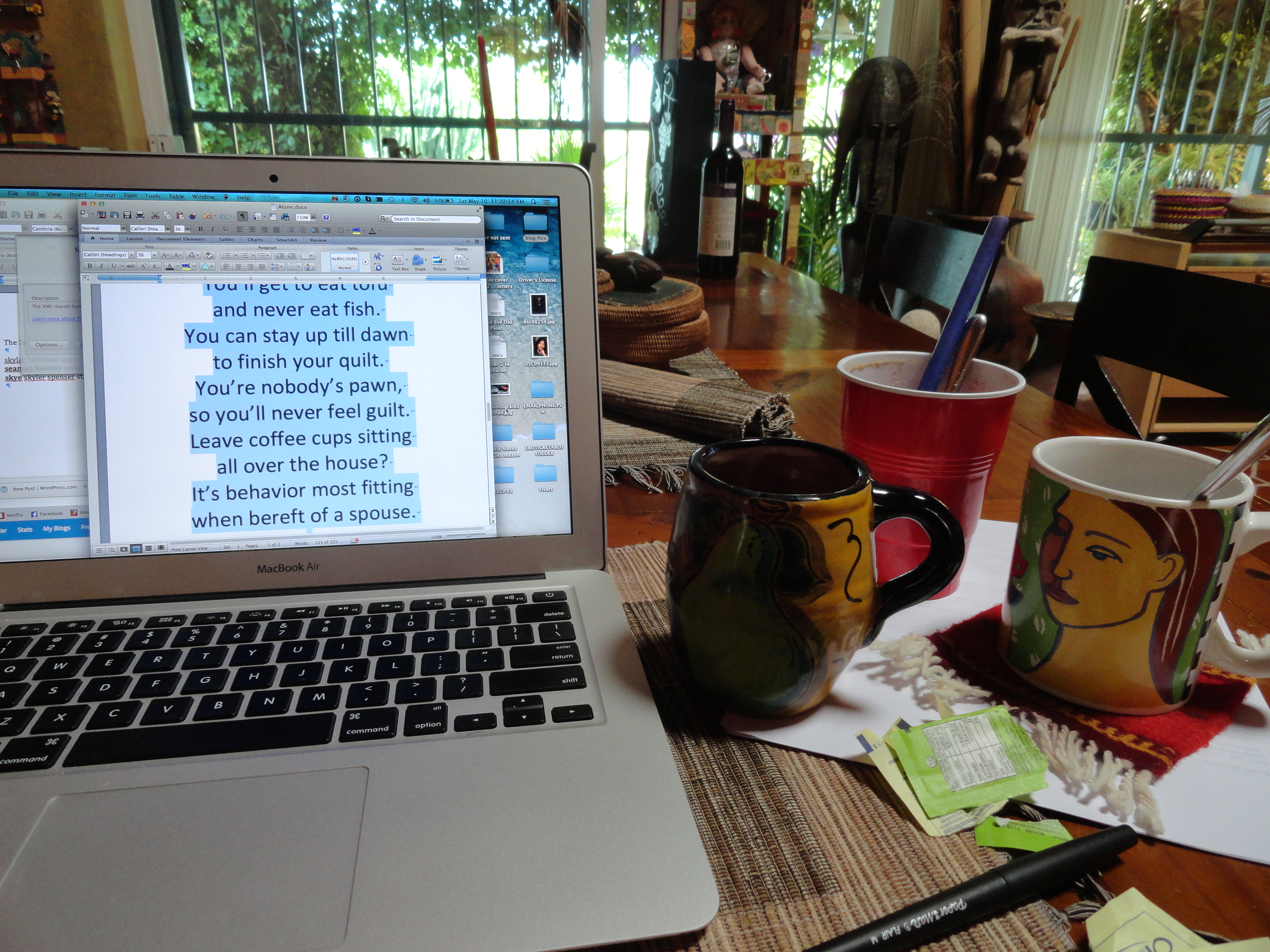
DSC06650

Alone

Alone is not lonely
And single’s no sin.
Solo is only
a state I am in
because I need time
to do what I do.
To scan and to rhyme,
to create and to stew
both poems and soups
without watching the clock
or jumping through hoops
or having to talk.

I really like cooking
dishes for one.
I’m simply not looking
for “coupley” fun.
I like doing art
far into the night.
This freedom is part
of traveling light.
Going solo is groovy.
Single-handed is fun,
and it might behoove you
to try being “one”

instead of a brace
or a duet or pair.
You’ll have all this space.
You’ll have all this air.
Your closet’s your own
to fill up with shoes.
No sharing a phone
and no bathroom queues.
You won’t have to fiddle
with left or with right.
You’ll sleep in the middle
every night!

You’ll eat what you want to
and dine when you wish.
You’ll get to eat tofu
and never eat fish.
You can stay up till dawn
to finish your quilt.
You’re nobody’s pawn,
so you’ll never feel guilt.
Leave coffee cups sitting
all over the house?
It’s behavior most fitting
when bereft of a spouse.

Pop bonbons and read
all day in your bed.
You can meet every need
when you’re no longer wed.
On the other hand though,
you must walk your own dog
and when water comes slow,
must unclog your own clog.
When you blow out a fuse
and your lawn goes unmown,
there are no “honey do’s”
when you’re all on your own!


Today’s “prescription” came from my friend Betty Petersen, a wonderful artist, who asked me to write a poem about the single life. If you have a topic you’d like me to write about, please post it on my blog or send it via Facebook or email.


Poetry by Prescription: Goodbye Old Paint

Old friend, new friend.

Goodbye Old Paint

What have you eaten that we have forgotten?
What lost earring resides
in the deepest recesses of your front seat?
What coins shaken and pushed into your crevasses?
And do you remember the song made up on the spot
and sung just once, then left forgotten in Nevada?
Do you still carry the dust of Tonopah
or that yearning to actually see something extraterrestrial
on the Extraterrestrial Highway?
Do you carry shards of his boredom while driving
mile after mile of Utah beauty?
Do you still carry my expectations of sharing
the giant faces of Rushmore
and echoes of the fact that he expected more?

What of molecules of the Mississippi crossing
or dreams of the memories of Hannibal?
What sweat from those Mississippi hours
waiting outside the B.B. King Museum?

Salt grains and chocolate crumbs
and DNA of those few souls who rode along in you—
all parked in a parking lot waiting to be bought
by someone who will never know the hidden you.
Just like the rest of the world,
frequented by interlopers.
Only we, leaving you, will murmur “Goodbye Old Paint”
and know that although you neither hear nor answer,
somehow our past is locked up inside of you
and there a part of us will stay
while we depart without it.

The prompt today was by Forgottenman, who wanted me to memorialize his faithful automobile companion, Old Paint (pictured here to his right). To his left is his new love, Soul Red.  To see his prompt, go to his blog here.

Poetry by Prescription: A Single English Teacher’s Lament

DSC06579

Today’s prompt was suggested by Ann Garcia, another “reformed” English teacher.  Her prompt:  Write a poem about grading homework.

A Single English Teacher’s Lament

Two periods of composition
have put me in a bad position.
With class size swelled to 38,
no longer have I time to date,
for teaching all to write a thesis
means my workload never ceases.

Each weekend I take home a pile
to check and grade and reconcile.
To try to sort them out is hard—
each sentence shuffled card by card.
Each comment must be made with tact,
their logic looked at fact by fact.

Each student had to write just one.
Now handed in, their toils are done.
While I have 76 to grade,
and now regret assignments made.
How many more? I have to ask,
imprisoned by this grading task.

I have created my own repentance.
I gave myself the thesis sentence!

Thesis: noun: thesis; plural noun: theses

  1. 1. a statement or theory that is put forward as a premise to be maintained or proved.”his central thesis is that psychological life is not part of the material world”
  2. 2. a long essay or dissertation involving personal research, written by a candidate for a college degree.”a doctoral thesis”

 NOTE TO READERS:  I HAVE RUN OUT OF PROMPTS!  IF YOU WANT TO SUGGEST A PROMPT FOR TOMORROW’S POEM, PLEASE SEND IT AS A COMMENT.

Poems by Prescription

Yesterday I promised to write a poem about the best topic presented to me by “readers.” Four were proposed, but I can’t remember the fourth, so if you proposed one and I’ve neglected you, please submit it again. I can’t promise to always write about all topics submitted, but this time I did—well, with the exception of one.

mbYcPb-3OrpZsEna7oifPrg

“Sisterly Squabbles”

A little weep, a little sigh,
a little teardrop in each eye.

Grandma Jane and her sister Sue,
one wanted one hole, the other, two

punched into their can of milk.
(All their squabbles were of this ilk.)

The rest, of course, is family fable.
They sat, chins trembling, at the table.

When my dad entered, we’ve all been told,
their milk-less coffee had grown cold.

*(Prompt by Patti Arnieri)

“Take a Walk and Tell about It”

Straight out my bedroom door would be a doozie.
I’d end up right in my Jacuzzi  !!!

* (Prompt by Tamara Mitchell)

“Friends”

If not my friend
to the end,
you might a’ been a me
lifelong enemy.

*(Prompt by Patty Martin)


NaPoWriMo Withdrawal

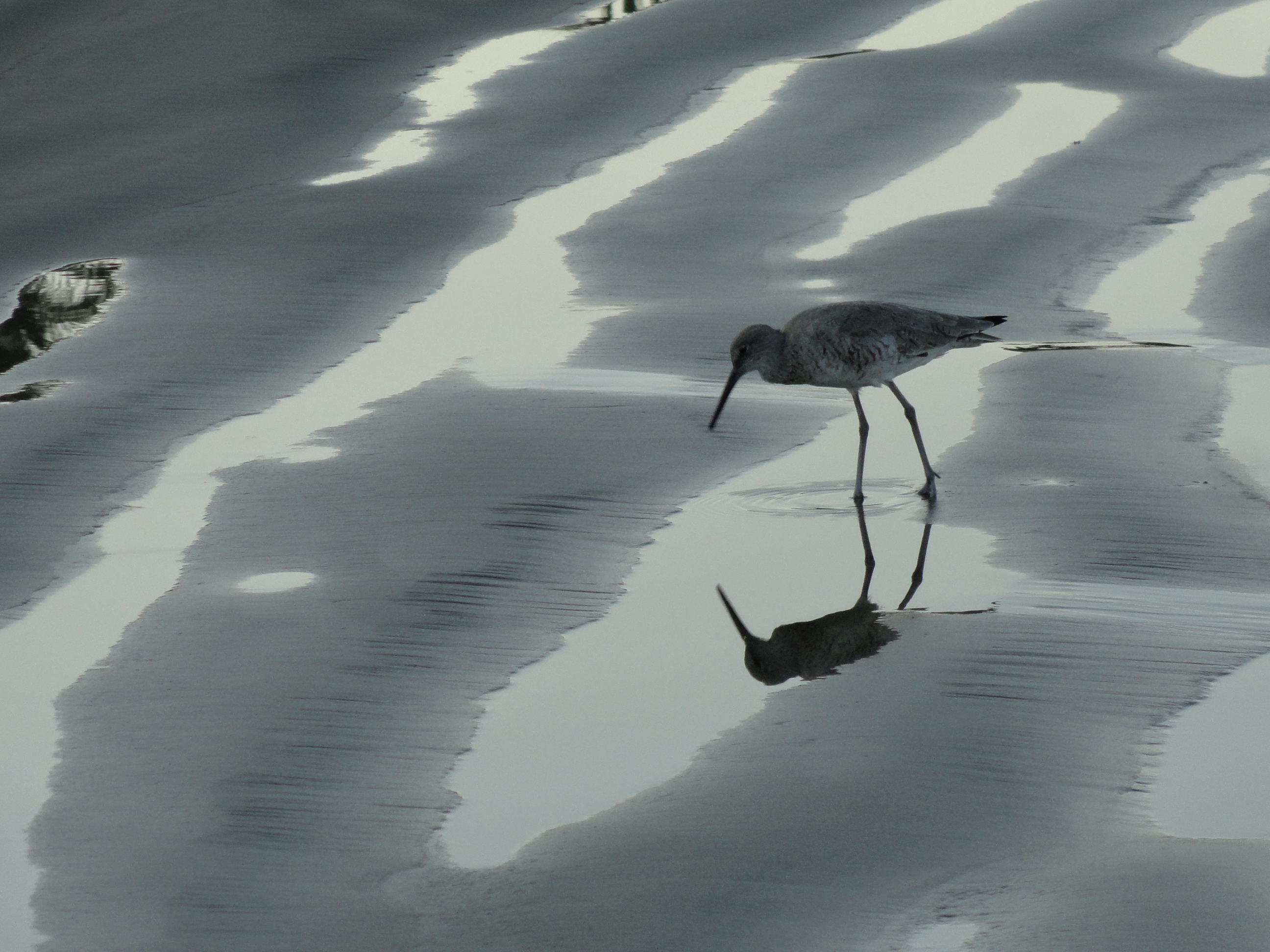
Searching for a topic!!!!

Searching for a Topic (picture taken at La Manzanilla beach this March)

(picture taken at La Manzanilla beach this March)

Well, April (National Poetry Writing Month) is over and so there goes the start to my day. Must say I became addicted to waking up each morning with a fresh topic for poetry presented to me, as weird as some of them may have been. If anyone is still reading this blog, perhaps you would like to suggest a topic for me and I’ll continue to do the poems. I’ll choose from topics submitted each day and continue to do the “act.” If no one suggests a topic, I will slowly fade into the horizon until next April.

NaPoWriMo Day 30: Ciao, Adios, Auf Wiedersehen, Adieu

Ciao, Adios, Auf Wiedersehen, Adieu

To NaPoWriMo we must say
a fond “Goodbye” on this last day.
I‘m able to, for I have found
the strength to say it the whole world round.

When I was young, I traveled far
from Germany to Zanzibar.
Australia, Bali, France and Spain,
to Africa and back again.

And though I mostly loved them all,
from Venice to the Taj Mahal,
as my departure time grew nigh
I had to voice a sad goodbye.

To Ethiopia I strayed.
For eighteen months I stayed and stayed;
and when I had to leave too soon,
I had to say “dehena hun.”

In college days, when I was young,
German was my foreign tongue;
but when to Frankfurt wir mussten gehen
I just remembered, “Auf Wiedersehen.”

The French were rude and cold and snotty.
They mocked my accent and were haughty,
so while I had to bid “adieu,”
I’d have preferred to say, “pee-ew.”

Florence thrilled me from the start.
Their lasagna is a work of art.
When I left, they all said, “Ciao.”
Their kitties, though, all said, “Miao.”

I never went to Israel
but nonetheless, I’m proud to tell,
the rabbi books? Read every tome.
So I know how to say “Shalom.”

Though “Arigato” is bound to do
when you want to say thank you,
Sayonara” is the way to go
to bid farewell in Tokyo.

Bali’s full of dance and art
that treat your eyes and fill your heart.
I must admit, I had a ball
before I said “Selamat tinggal.”

Mexico was saved for last
And now I fear my lot is cast
Since “Adios” I cannot say,
I’ve decided I will stay!

(for the sake of pronunciation, I have taken the liberty of adding an extra “e” to “dehna hun.”)

You might have already guessed that on this last day of the NaPoWriMo challenge, the prompt was to write a farewell poem.

NaPoWriMo Day 29: Chew the Train

Chew the Train

A metaphor is a freight train
that gets us within 30 miles
of our final destination,
but we still have to catch a taxi to get all the way there.
And a simile is just a metaphor whose brakes have failed.
If we know that peanut butter
is like a circus on a tired tongue,
does it bring us any closer to the smell of peanut butter?
Elephants and sawdust
and sequined camisoles flavored
with the sweat of 100 performances?
Is that what peanut butter smells like?
Does it taste like candy apples
and too-bitter mustard
on stale buns
and hot dogs turned too long
upon the rollers of their grill?
Does peanut butter feel
like the unoiled bump of the Ferris wheel?
Does it sound like a calliope
or look like an ice cream cone?
Peanut butter is peanut butter.
I rest my case.

So how am I going to write a poem
without metaphors and similes?
How can I write verse
while telling the pure unadulterated truth?
How can I make you taste a poem
that is only itself?

How can I be Janis Joplin
when I’ve been taught to be Joni Mitchell?
A Rose is a Rose is a Rose,
said Gertrude Stein,
predating my insight
by a generation or two.
But this isn’t Paris,
and folks in Mexico
want a dollop of figurative language
in their poetry.

So let me say
that my mind is a busy beaver,
trying to fulfill this impossible task
of twenty little things.
I’m expected to imagine
how peanut butter sounds.
The sucking gumbo sound
of South Dakota mud
or thick mucus of a cold?
Anything but appetizing.
Ay, Caramba! you might say,
but if you were Australian,
you would say, “Don’t come the raw prawn on me, mate,”
and you would mean
“Don’t try to pull the wool over my eyes,”
or “Don’t try to con me, man.”

So let me just say that peanut butter is made
by grinding peanuts so finely
that all the oil comes out
and it acquires the consistency of butter.
It isn’t like butter
nor is it butter.
It acquires the consistency of butter.
This is literal fact.
But to know the taste of peanut butter,
you will need to spread a bit upon a cracker
and have a taste, or grab a finger full.
What you will taste will be peanut butter.
The truth of it. Its reality.

And only then will I tell you
that literal truth doesn’t always tell
the whole truth.

My friend says
it is the peyote leached into the soil
the corn grows from
that gives Mexicans
such a remarkable sense of color.
The bright pigments of imagination
flood his canvasses.
His peyote dreams leak out into the real world
and wed it to create one world.
“Peyote dream” becomes its opposite—
a freight train taking us into the universal truth.
A larger reality.
This stalk of corn, this deer,
this head of amaranth,
all beckon, “Climb aboard.”

So when you bite into a taco
or tamale, when the round taste of corn
meets your tongue, and pleasure tries to flow
like a lumpy river down your throat,
look up at the poet standing in the shadows.
She’ll call herself Remi if you ask,
but do not ask. Instead, look deeper
into the shadows she wears around her like a cloak
and see that it is light that creates shadow.
See the many colors that create the black.
Follow where the corn beckons you to go––
into the other world of poetry and paint
and dance and music. Hot jazz with a mariachi beat.
Chew that train that takes you deeper. Hop aboard
the tamale express and you will ride into your
new life. It will be like your old life magnified
and lit by multicolored lights and the songs of merry-go-rounds
and when you bite into your taco, it will taste
like cotton candy and a snow cone
and your whole life afterwards will be a train that takes you nowhere
except back into yourself—a Ferris wheel
spinning you up to your heights and down again, with every turn,
the gears creaking “Que le vaya bien.”
I hope it goes well with you
and that you see the light
within the shadow
and the colors
in the corn.

glass-gem-corn-2-460

Today’s prompt is called the “Twenty Little Poetry Projects,” and was originally developed by Jim Simmerman. Here are the twenty little projects themselves — the challenge is to use them all in one poem:

1. Begin the poem with a metaphor.
2. Say something specific but utterly preposterous.
3. Use at least one image for each of the five senses, either in succession or scattered randomly throughout the poem.
4. Use one example of synesthesia (mixing the senses).
5. Use the proper name of a person and the proper name of a place.
6. Contradict something you said earlier in the poem.
7. Change direction or digress from the last thing you said.
8. Use a word (slang?) you’ve never seen in a poem.
9. Use an example of false cause-effect logic.
10. Use a piece of talk you’ve actually heard (preferably in dialect and/or which you don’t understand).
11. Create a metaphor using the following construction: “The (adjective) (concrete noun) of (abstract noun) . . .”
12. Use an image in such a way as to reverse its usual associative qualities.
13. Make the persona or character in the poem do something he or she could not do in “real life.”
14. Refer to yourself by nickname and in the third person.
15. Write in the future tense, such that part of the poem seems to be a prediction.
16. Modify a noun with an unlikely adjective.
17. Make a declarative assertion that sounds convincing but that finally makes no sense.
18. Use a phrase from a language other than English.
19. Make a non-human object say or do something human (personification).
20. Close the poem with a vivid image that makes no statement, but that “echoes” an image from earlier in the poem.


NaPoWriMo Day 28: Looking Glass Menagerie

Looking Glass Menagerie

I am trying to escape the menagerie—
all those selves I hold in front of me
as well as the ones I have let escape.
Those that run ahead—
the ones that are my future selves—
are here, hidden in the portrait that you see.
Domineering, perhaps. But seasoned with
an awareness of what might have produced
all of the parts of myself I try to reign in.
This has produced a certain slowness to connect.
The natural is seasoned with a desire to honor dreams
of what I hope to be. When I look in the mirror,
I see them all: my mother and my grandmother
and my sisters. We demand, are stubborn.
Sometime we are martyrs, stifling tears.
Then suddenly, I pass them by like memories
of nightmares: all the anxiety attacks,
illnesses and heartbreak.
We are all wonderful performers,
using bad luck to fuel good.
The belles of our own ball,
we push back the grim news
of what we fear we really are.
Headstrong, we reach for what we can be.
Utterly addicted to change,
Tony or no Tony,
we are the stars of our own lives.

The prompt today was “to find a news article and to write a poem using (mostly, if not only) words from the article! You can repeat them, splice them, and rearrange them however you like. Although the vocabulary may be “just the facts,” your poem doesn’t have to be — it doesn’t even have to be about the subject of the news article itself.”

With massive tornadoes, politician campaign funding fraud, murder and mayhem being the main stories of the day, I was hard-pressed to find any good news to write about. Finally, I chose a very long theater review in the NY Times which I picked at like a foraging chicken, picking a word here, a word there. Above is the resulting poem.

Here is a link to the NY Times article from which  I drew words : NY Times Article

NaPoWriMo Day 27: Lemonade


Image

Lemonade

The Crystal Lite, like a marriage of Kool-Aid and crystal meth,
catches the light and glows from inside its plastic gallon container,
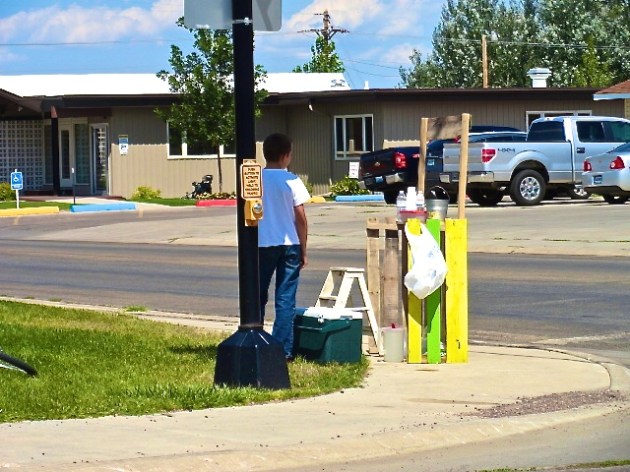
becoming its own advertisement for this lemonade stand,
its pre-teen proprietor standing in the scant shade
of a stop light pole
behind his fruit crate counter
with its stacks of styrofoam cups.

He has chosen his clientele—
perhaps thirsty from a long wait
in the doctor’s waiting room in the clinic
or the hospital across the street.
To his back, a retirement community with no house
more than 3 blocks from the hospital—
its inhabitants like products on a shelf waiting to be picked.

When they pass the stand,
memories of generations of such stands
perhaps flood their minds,
and thirsty or not, they stop for a cup.

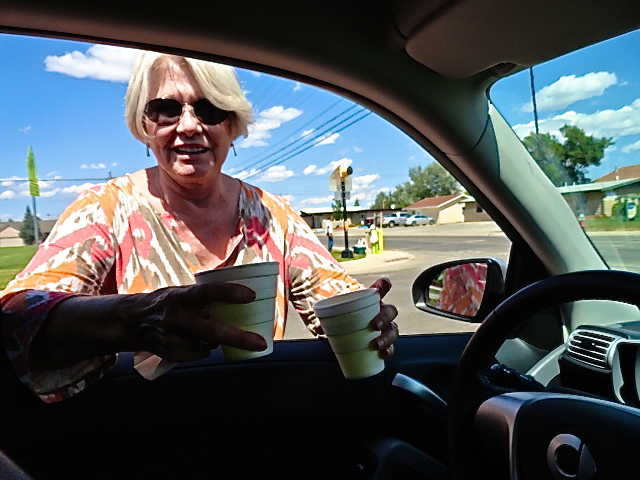
I am the woman with her foot in a cast,
sitting in the passenger seat
of the car pulled over to the curb.
The woman reaching through the window of the car
is my sister, holding out the white cups
with the too-sweet yellow shining through
as though radioactive.

She was my long ago pattern for everything,
including Kool-Aid stands with 5 cent
paper bags of popcorn and ice cube slivers
floating in the Tupperware pitcher of cherry Kool-Aid,
a plate on the top to repel flies
lazy in the July heat, orbiting our sweaty heads
like precognitive sputniks
buzzing in the minds of rocket scientists.

We had not a clue.

 Image

The prompt today was to write a poem based on a picture.

NaPoWriMo Day 26: Pied Beauty II

Pied Beauty II

Thanks be to Sara Lee for appled things—
For pies, for apple fritters and for thin-rolled strudel crust;
For pastries of the fruit of Eve and sauce it swims within;
Fresh-cooked in ovens, how their sweet juice sings;
The sugar clotted and pierced— place it on plate we must;
And all taste, for how can tackling it be such a sin?

All things made of flour and Crisco and of apples sweet;
(How can they by nutritionists be so sorely cussed
With words professing they won’t make us thin?)
With their tart flavor are sure our lips to meet;
And meet again.

—Judy Dykstra-Brown

Our prompt today was to write a curtal sonnet in the style of Gerard Manley Hopkins’ famous poem “Pied Beauty”. This form consists of a first stanza of six lines followed by a second stanza of five, closing with a half-line. The rhyme scheme is abcabc defdf. I chose to make it a parody of Pied Beauty as well.

And now, the original:

Pied Beauty

Glory be to God for dappled things –
For skies of couple-colour as a brinded cow;
For rose-moles all in stipple upon trout that swim;
Fresh-firecoal chestnut-falls; finches’ wings;
Landscape plotted and pieced – fold, fallow, and plough;
And áll trádes, their gear and tackle and trim.

All things counter, original, spare, strange;
Whatever is fickle, freckled (who knows how?)
With swift, slow; sweet, sour; adazzle, dim;
He fathers-forth whose beauty is past change:
Praise him.

–Gerard Manley Hopkins