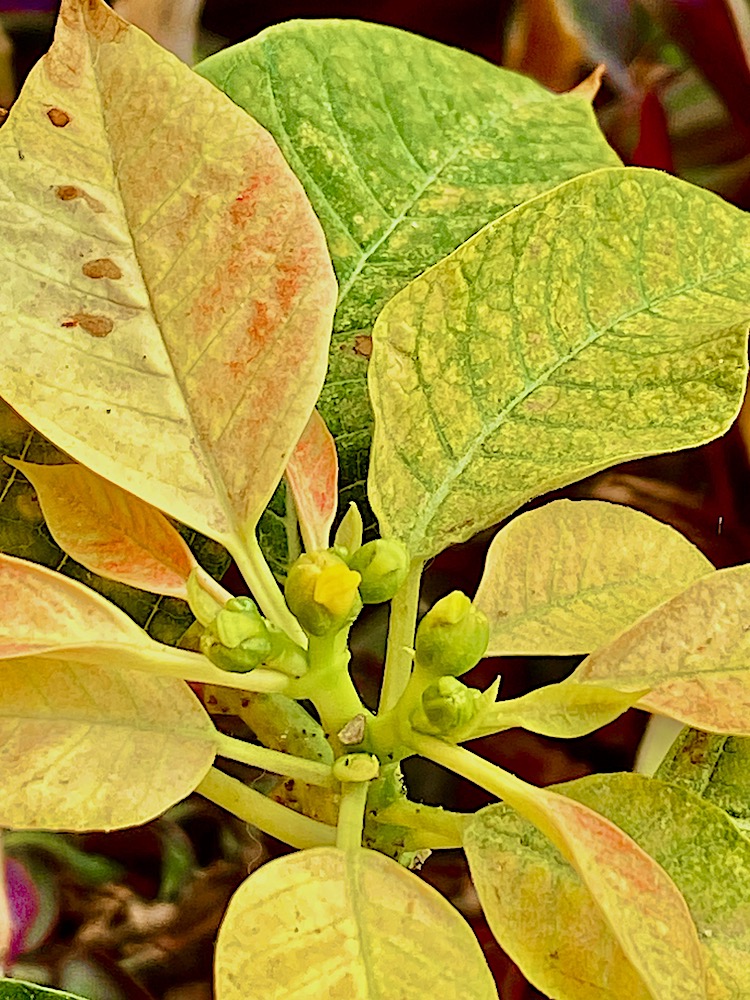
Love the variations in color of these poinsettias. They will eventually lose the green cast in these upper bracts.
For Cee’s FOTD
Love the variations in color of these poinsettias. They will eventually lose the green cast in these upper bracts.
For Cee’s FOTD


When I moved here eighteen years ago, my first visitor was my friend Linda from Oaxaca. Since Christmas was nearing, she brought me a beautiful poinsettia plant which I planted in the lower garden after the holidays. Over the next few years, it grew and grew, but when I had my studio built, it covered it up and I eventually forgot it was there. This year, my only poinsettia blooming was the peach–colored one I showed in a FOTD post a few days ago. But, surprise, surprise. As I exited my studio the other day, I noticed a flash of red behind the dense cover between the sidewalk and the wall and there, peeking out from around the corner of the studio, was this beautiful red poinsettia. Things like to grow in Mexico, neglected or not! So here, at last, is a shot from me of a red poinsettia. Here they are called “La Flor de la Nochebuena” (Flower of the Holy Night, or Christmas Eve). Merry Xmas, everyone!!!
For Cee’s FOTD

Click on photo to enlarge.
What appears to be the flower on a poinsettia is actually colorful leaves. The true flower is just starting to bud out as these tiny yellow lips. Much misinformation has been spread regarding the toxicity of poinsettias. To set the matter straight:
“As many have pointed out, it is a myth that poinsettia plants are deadly poisonous if a child or pet eats the leaves (but that does not mean that the leaves should intentionally be eaten, either, since, if eaten in sufficient quantity, they can, in fact, make a human or pet at least mildly sick). But because this fact is so widely known now, people have let down their guard and allowed a new myth to take hold, as a reaction: namely, the myth that no health issues whatsoever surround the annual displaying of poinsettia plants. Only two words need be uttered to dispel the new myth: latex allergy.
The milky sap (the “latex,” if you will) that oozes from the branches can result in contact
dermatitis in some people. So unless you like to itch, avoid the sap, in case you are one of those prone to develop this rash. At the very least, be sure not to touch your eyes after touching the sap. The illnesses that some people suffer just from being around poinsettia plants (without even touching them) are worse yet (for example, difficulty in breathing). In extreme cases, anaphylaxis can result.”
Pointed Giants–For Olga
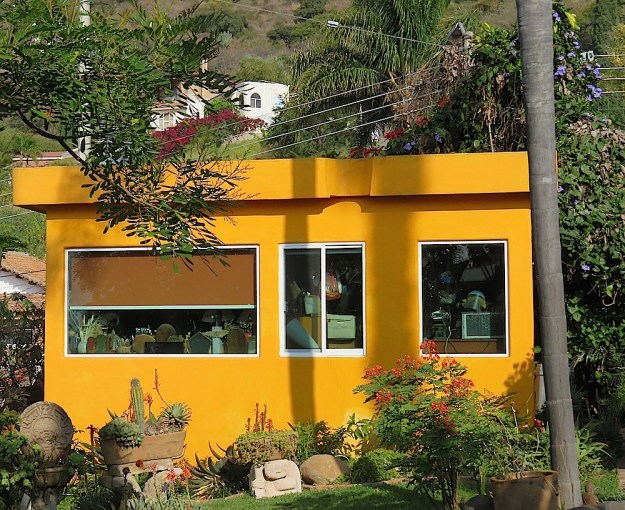
This is the art studio behind my house. As you can see, it is rather overgrown with vines and other plants, despite the huge palm tree I just had cut down because they said it would interfere with the solar water heater coils soon to be installed. So, that little scoop out of the roof overhang can be explained by the fact that I actually built my studio around the palm tree just to gain an extra foot of space without having to cut down a tree. The trunk once occupied that scooped-out place. If you look up by the electrical wires, though, you might notice a flash of red. What is it?
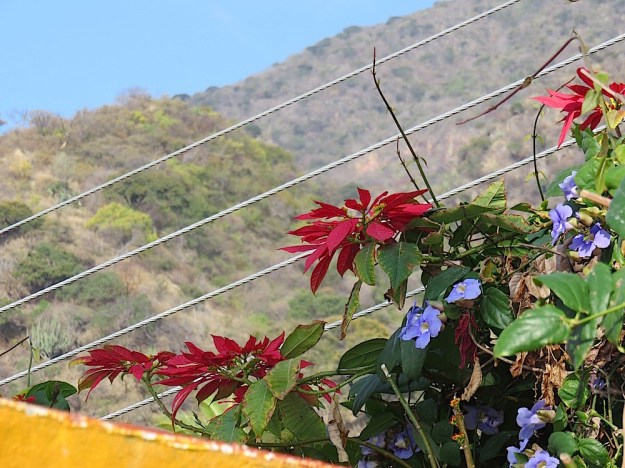
Here’s a closer view. Almost smothered out by the thunbergia and other vines is this stubborn giant. It was a small poinsettia houseplant given to me by a friend as a housewarming gift when I first moved to Mexico 14 years ago. After Christmas that year, I planted it in the ground near my wall. A few years later, I built the studio in front of it. By then it was obscured by a large banana tree than afterwards died. Hidden between my studio and the wall, it was long forgotten until this year, when I suddenly noticed a flash of red peeking over the roof of my studio.
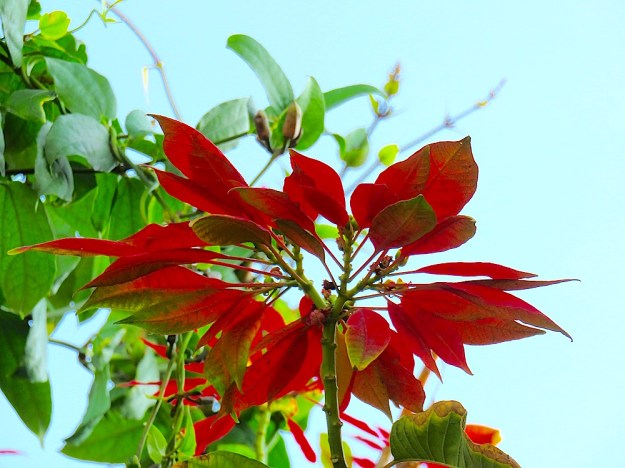
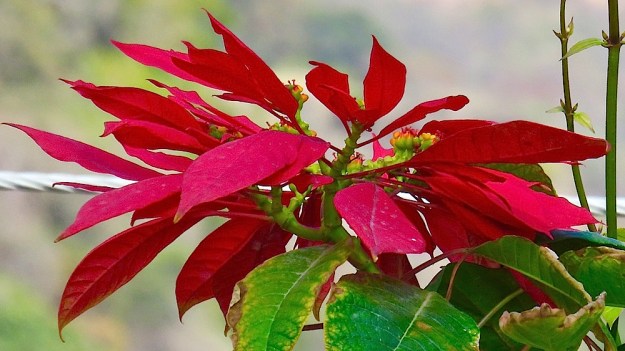
It was my little poinsettia of 14 years ago, now grown into a very tall tree and surviving even though it has been practically choked out by thunbergia and the other hearty vine that grows over my wall.
See that wire running behind it? that is a wire that either carries telephone messages or electricity to my house and beyond. This pointed giant is in high company.
So that, Olga, is the story of how poinsettias are more that the symbol of Christmas that they are in El Norte. Here in Mexico, they are just another subtropical plant that in this climate often grows into a tree–in spite of our best efforts to overlook them!


 lifelessons - a blog by Judy Dykstra-Brown