Monthly Archives: June 2014

Daily Post: Play Date

Image

Play Date


My sister’s house has sold and they are cleaning out her attic. My niece and I make one trip more and I find my old dollhouse, collapsed, in the garbage can. I take the pieces out—some of them—and stash them in her trunk. I’d thought them gone forty years ago when the tornado took the roof off my parents’ house, but now, here they are like the leaves of memory blown miraculously back to me.

When she sees I’ve taken them, my niece asks what she should do with the dolls she found in the back recesses of her mother’s attic storage room—the one I hadn’t got to on my last visit—perhaps because of the roofing nails sticking through the wood which made reaching back behind the eaves a physical danger.

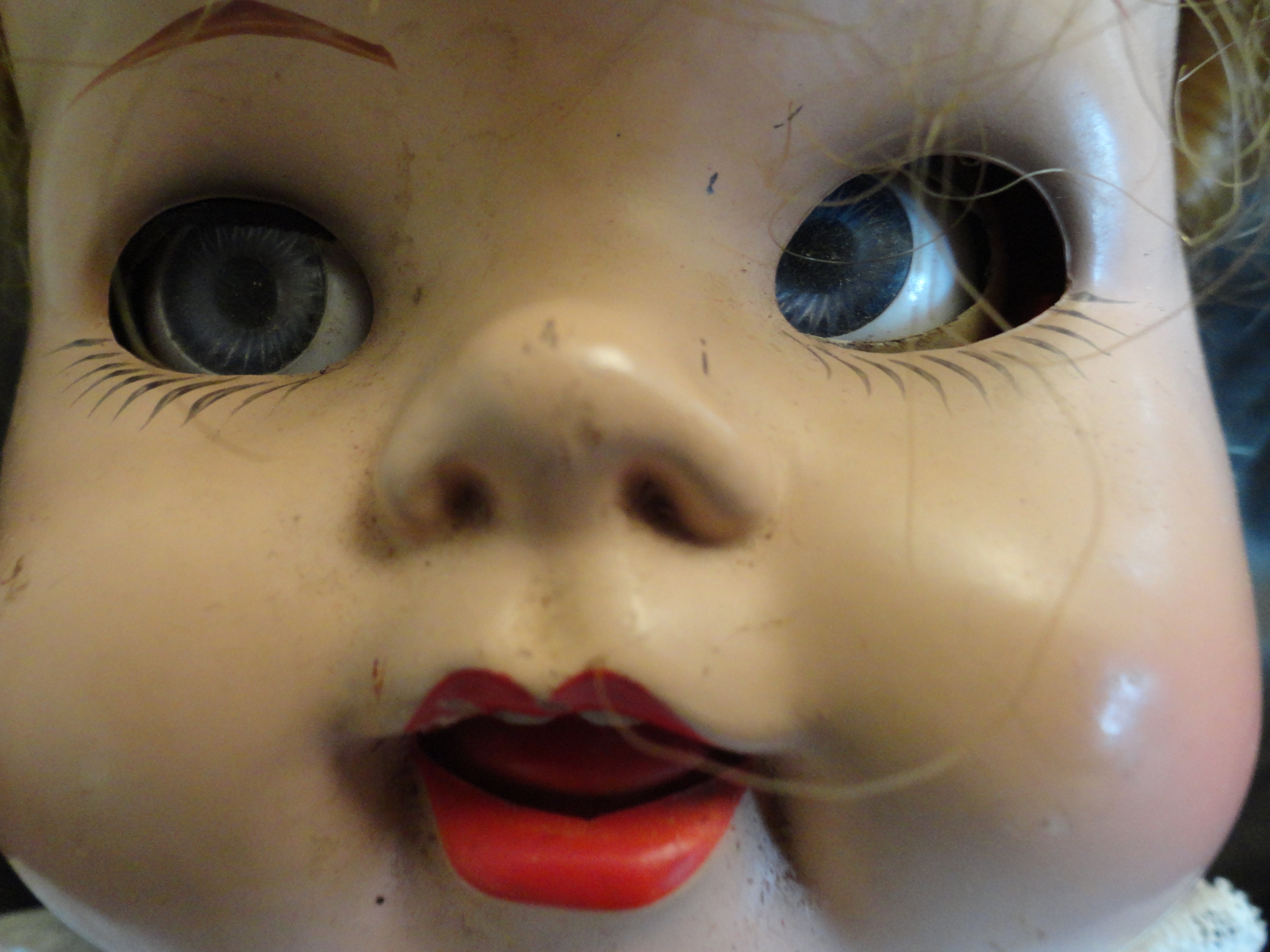
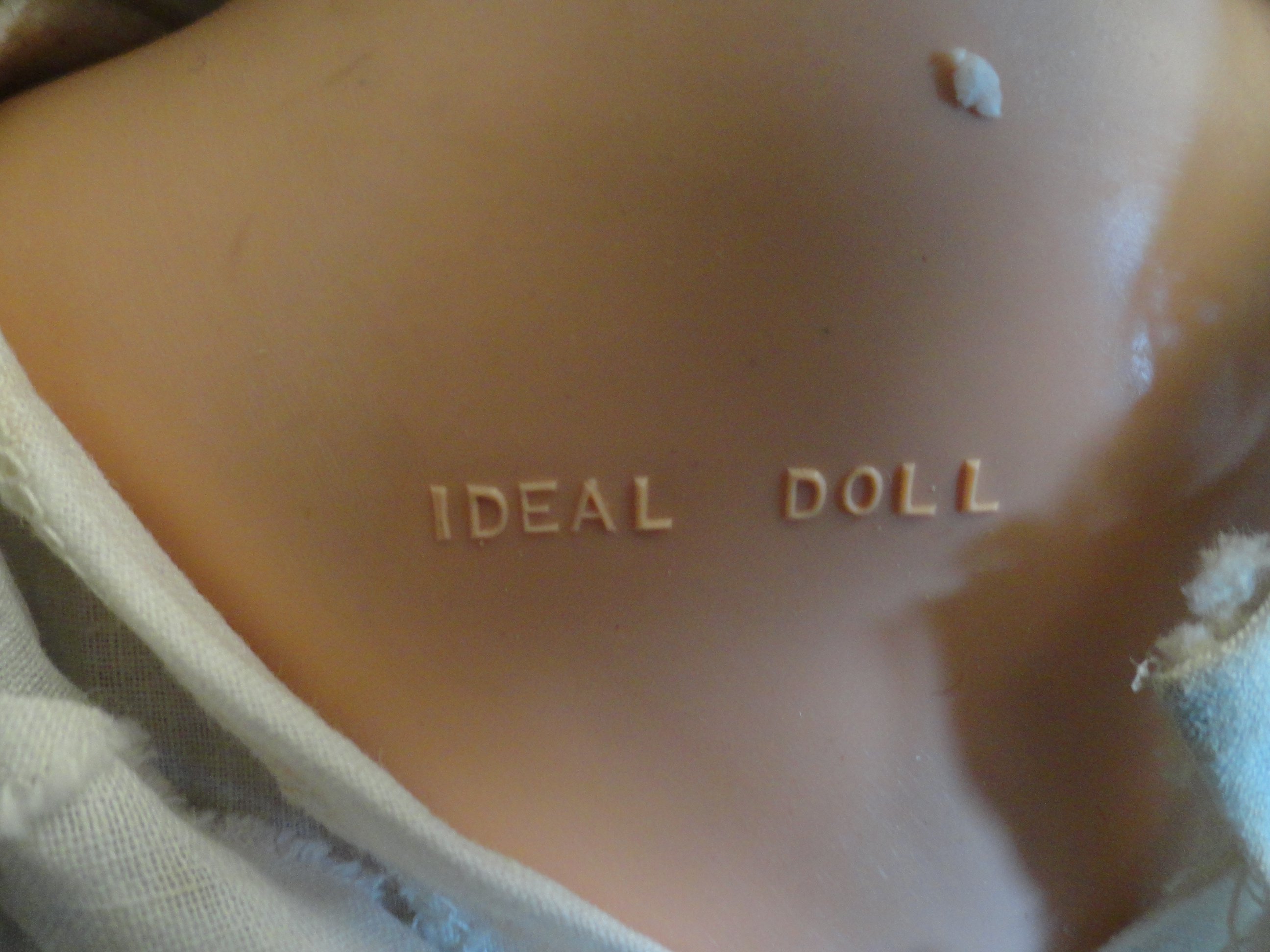
I find them where she has stashed them In a suitcase in her garage, and when I open the case and see the first doll staring up at me, I think it is a “find” from some antique store, like the dishes in my sister’s China cabinet or the tiny figures on her shelves. One rubber arm, sticky with age, has burst open and streams kapok like a froth of bleached and fermented blood. Other limbs have decayed to nothing but empty puddles of congealed rubber. Only the torso, held in place by a sagging pink fancy gown; and the face, stained red in places from some surface it’s been pressed against for too long, are still intact. As I lift the first doll from the suitcase, the other doll—the size of a toddler—stares up at me, one eye unhinged, her hair in pigtails sealed with rubber bands. When I lift her by one arm, her head turns, her legs pump and I realize this is my Ideal walking doll. When you raise her arms, one at a time, she walks toward you and her head swings, side-to-side. Hard and beautiful, she was not a doll to cuddle and she would not sit. She stood propped up against one corner of my room, rarely played with. What, I wonder, has happened to the bright blue dress she wore? Then I look closer and see that she’s still wearing it—faded to paleness even in the dark. What is here is original—her hair, her limbs, her dress, her petticoat—but her shoes and socks have been lost to another little girl, perhaps, or have jiggled off in some trunk and been left behind.

I’m 1500 miles away from home, yet I load the child-sized dollies into my boyfriend’s trunk: my sister’s doll in it’s fancy pink floor-length formal, my doll with her eye gone wild in its socket. They won’t make it home to Mexico in my suitcase this time, but it is impossible to leave them there in the suitcase to be thrown away by someone who has no memory of them. They are not collector’s items. They have been too neglected in their lives since they stood propped up in the corners of our rooms, then in the corners of our closets, the basement, my sister’s trunk and then her attic 800 miles from where they called us their owners and stimulated our imaginations to the extent they were able.

They’ll now reside in my boyfriend’s garage in Missouri until the time comes when I can carry them back in an extra suitcase or he can mule them down for me. If they were miniatures, I could include them in a retablo or a memory box, but each head is larger than the largest assemblage I’ve ever made. The closets of my house are full and overflowing, as are the wall-to-ceiling cabinets in my garage and studio and every area of my house where I’ve had room to build a closet. But I must use them. Give them some purpose for still existing other than to fill up room in some box on some cupboard shelf.

I imagine a memory box of gigantic proportions and suddenly, I have to make it, even if it takes up all the work room of my studio, and I start to plan how I could take my own doll back with me and what I’ll have to leave: the case of books that I’ve just had printed or my clothes or all the cartridges for my laser printer? If I wear a baby carrier, will they believe it is my baby, sound asleep? And what sensation will I cause when I try to stuff her into the overhead rack?

When I start to plan what else will go in the memory box with her, I remember the metal dollhouse sides and suddenly, I’m planning another trip back to Missouri, where I will make the mother of memory boxes—four feet square—and I wonder how my boyfriend will react to this and what I’ll do with it when it is finished. But somehow all these practicalities do not matter, because this dolly, relegated to corners for its whole life, is finally going to get played with!!!


The Prompt: Antique Antics: What’s the oldest thing you own? (Toys, clothing, twinkies, Grecian urns: anything’s fair game.) Recount its history — from the object’s point of view.
 

Image

Daily Post: “Lined-up Blues”


“Lined Up Blues”

(to be sung to the tune of “Jingle Bells”)

Dashing through the flow,
barefooted as I go,
I stand and pine
in the security line,
emptying pockets way too slow.

Put my laptop in a bin
and my 3 oz. bottles in
a little bag,
but I can’t lag
‘case my purse and all my dough

has preceded me through the screen
and the TSA’s look mean.
I’m afraid that lady
who looks so shady
will take my purse and go.

(refrain;)

Oooooh, airport lines,
security whines,
waiting all the day.

I’ll flunk my scan
and the X-ray man
will frisk me all the wa-ay.

Airport blues,
got no shoes,
some man just took my rings.

I’ll lose my seat,
get athlete’s feet,
but lose my other things.

I guess it is the norm
my privacy to storm,
to strip me down
and frown and frown
as they survey my form.

I just spent all my dough
to come from Mexico
to see my kin
and then drop in
to see my favorite beau.

But first I’ll have to ride,
a center seat to abide
and airplane woes
like too-small rows
with no space left inside.

(refrain)

Ohhhhh, Airport blues,
travel dues,
no time to complain.

I grab my stuff
half in the buff
and run to catch my pla-ane.

Airport lines,
security whines,
I fear I’ll rue the day.

‘cause I have to face
this same disgrace
when I reach the U.S.A.!!!!


The Prompt: You’re at the airport, your flight is delayed for six more hours, and none of your electronic devices is working. How do you pass the time?

Blogger’s note:  Actually, I wrote a less tongue-in-cheek piece about this topic a few weeks ago. Here’s a link to that blog post: The Atlanta Airport

World Like a White Stomach

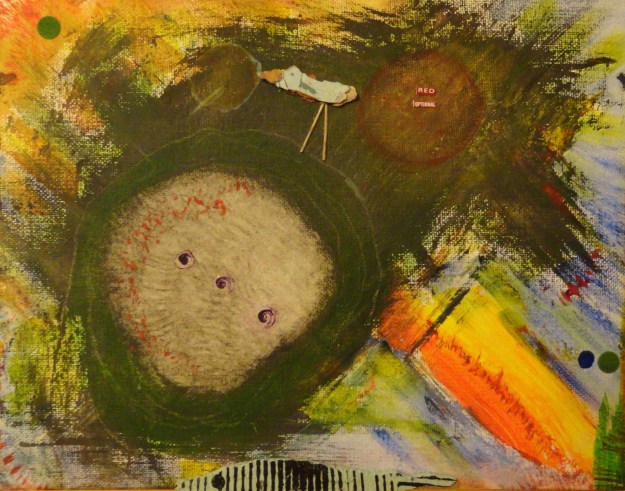
DSC06818

World like a White Stomach, Red Optional

My world is not round
and so it does not move in circles
like your world.
It is so small I stand above it, my head in space,
while a two-colored rainbow stretches out in my wake—
a straight line which is an echo
of my unbent trajectory into the universe.
Three navels has my world
for the three births it delivers us to:
into this world, within and out of it.
Each is an adventure more easily seen
in a straight world where everything
is not always repeating itself.
Here, fish swim out of the water.
Birds more commonly walk.
And in the distance, we see colors
not of our world.
Stop and go.
The green of earth.
The red that is only an option as we look away,
searching for the million worlds beyond.

The Daily Post Prompt: One day, your favorite piece of art — a famous painting or sculpture, the graffiti next door — comes to life. What happens next?

The Daily Post: Duck for Cover

The prompt: Binding judgment. Does it ever make sense to judge a book by its cover—literally or metaphorically? Tell us about a time you did and whether that was a good decision or not.


Duck for Cover

Life’s a library where we choose
book after book to read and muse
on the truth of each, or how it serves
to amuse us or to calm our nerves.
It starts with storybooks in our youth.
Cinderella’s lovely, her kin uncouth.

The pretty sister we all adore.
The others? Rotten to the core.
We judge by beauty evermore.

As teenagers, our thoughts are filled
with thoughts of hair, complexion, build—
the ways we rank and choose our friends.
For some, this method never ends.
We judge the world by what we see.
At court, the prettiest are set free.

Our dates determined by their cars,
Our peanut butters by their jars,
Our candidates are movie stars.

World is illusion, say the seers,
the thinkers and philosophers.
We cannot know reality
by going just by what we see.
Yet time and time again, we choose
our futures based upon our views.

The “curb appeal” that meets our eye
determines which house we will buy.
The crust is how we choose the pie.

Ted Bundy had a handsome face
that drew young ladies to his embrace.
An arm sling or perhaps a crutch
brought them into his murderous clutch.
His handsomeness served to distract
till he’d performed his heinous act.

His cover perfect, his act most skilled,
he killed and killed and killed and killed—
lives ruined and ended as he willed.

Crack the book and look inside.
Talk before you choose your bride.
Drive the car before you buy.
Sip the wine and taste the pie.
See what’s inside if you are able.
Don’t go by face or box or label.

Though beauty dulled is less sublime,
scrub the tarnish from the dime.
Looking deeper takes more time.

Don’t choose the cover of a book.
Instead, take care to have a look.
One page nor twenty will not do.
You have the whole book left to view.
Avoid appearances and preening.
Look for truth and look for meaning.

George Eliot coined the adage first.
If for truth you have a thirst,
judging by the cover’s worst.


The Daily Post: The Windfall

Today’s prompt  was “Gone With The Windfall”:  You just inherited $1,000,000 from an aunt you didn’t even know existed. What’s the first thing you buy (or otherwise use the money for)?

The Windfall

Money money everywhere and not a drop to spend.
The tax men took so much of it, I thought they’d never end.
Then friends all asked me for a loan and how could I say no?
My brother’s operation increased the money flow.
My doggies needed flea baths. My kitty needed spaying.
My neighbor asked me for a loan. His fruit trees needed spraying.
My friendly local banker called me on the phone.
Not to ask for a deposit, but to ask me for a loan!
The plastic surgeon of my wife just put me on his dockets
which meant a lift  for me, of course, but simply of the pockets.
Now my kids all want new cars. My aunties prefer rings.
All of those that I hold dear now simply want new things.
When I try to talk to them, my words escape their ears.
They only want to talk about their loans now in arrears.
So when you ask me what I’d spend my million bucks on, friend,
my answer only takes one word, repeated end-to-end.
I’d lend and lend and lend and lend and lend and lend and lend.

Daily Post: The Avid Student

Today’s Prompt:  You can choose any person from history to teach you any topic you want. Who’s your teacher, and what do they teach you?

The Avid Student

Mrs. O’Leary, teach me how
please oh please, to milk a cow.
I won’t leave here till you do.
I’m bored today, and feeling blue.
Yesterday I baked a cake
with that new baker, name of Jake.
It didn’t rise.  It tasted awful.
Couldn’t eat but one small jaw full.
Day before I went to see
Joe the tailor.  Him and me
made a dress of chambray lace
but when I held it near my face
I found it itched me terrible.
To wear it was unbearable.
So I went on to see the preacher.
Wanted him to be my teacher.
But when it came the time to pray,
he found he hadn’t much to say.
I fear that I destroyed his faith.
I left him white as any wraith,
but found the cobbler in a pew
and asked him how to make a shoe.
He’d witnessed what the preacher did
and so he ran away and hid.
So Mrs. O’Leary, it’s up to you
to show me something I can do.
I know it’s dark, but I need right now
to know just how you milk your cow.
I brought a lantern.  I’ll hold it high.
It’s not real light, but we’ll get by.
I’ll just sit on this straw bale.
You fetch the cow and fetch the pail.
I love the way the hot milk steam
swirls around the rising cream.
I love the rhythm and the pomp
of my light squeeze and Bessie’s stomp
whenever I let loose her tit.
I cannot get enough of it!
But now we’re done and I can see
that bucket’s much too much for thee
to lift,  I’ll put the lantern down and
come with thee to give a hand.
I’ll come right back and close the barn.
Tomorrow, I’ll have quite a yarn
for everyone I want to tell
I finally did something well!!!!

For those of you unacquainted with Mrs. O’Leary, I include this description of The Great Chicago Fire of 1871:

“The summer of 1871 was very dry, leaving the ground parched and the wooden city vulnerable. On Sunday evening, October 8, 1871, just after nine o’clock, a fire broke out in the barn behind the home of Patrick and Catherine O’Leary at 13 DeKoven Street. How the fire started is still unknown today, but an O’Leary cow often gets the credit.

The firefighters, exhausted from fighting a large fire the day before, were first sent to the wrong neighborhood. When they finally arrived at the O’Leary’s, they found the fire raging out of control. The blaze quickly spread east and north. Wooden houses, commercial and industrial buildings, and private mansions were all consumed in the blaze.

After two days, rain began to fall. On the morning of October 10, 1871, the fire died out, leaving complete devastation in the heart of the city. At least 300 people were dead, 100,000 people were homeless, and $200 million worth of property was destroyed. The entire central business district of Chicago was leveled. The fire was one of the most spectacular events of the nineteenth century, and it is recognized as a major milestone in the city’s history.”

Vanity Depressed

Today, I received the below email from a well-known organization that reviews children’s books:

Dear Judy Dykstra-Brown,

Thank you for your interest in XXXXXXXXXXXXXX. Unfortunately, we can’t review books from vanity presses like CreateSpace*. For more of our submission guidelines, please see our website here: XXXXXXXXXXXXXX.

XXXXXXXXXX
Editorial Assistant
XXXXXXXXXXXXXXXXX

*note from Judy: CreateSpace is a company within Amazon that aids self-publishing authors in formatting,, printing and distributing their books.

My feelings about being labeled a “vanity press” author will be best expressed by displaying here the letter I wrote back to the assistant who had written the letter:

Dear XXXXXXXX,

I thank you for your prompt reply to my inquiry.

Although I certainly understand your reasons for not wanting to consider privately published material, I would like to bring one matter to your attention.

I have been writing for over 50 years. I have written and published three books, published nearly 40 articles in print and online magazines, won a national first prize for my poetry, edited a poetry journal and now coordinate a popular poetry series. I am in the process of having five more children’s books illustrated and working on a novel and two poetry anthologies. In my early career, I taught literature and writing for ten years and edited a teenage poetry anthology.

I mention these facts to explain why I feel it is an insult to have my decision to publish my own work called a “vanity”. Certainly, I am aware of the term, just as I am aware of other racial and physically derogatory terms that were once considered the norm but which in an enlightened age have come to be recognized as insulting and prejudicial.

May I ask your group to consider not using the term “vanity press” as a blanket term for self-published material?

I thank you for your efforts to reward excellent work in the field of children’s literature.

Best Regards,
Judy Dykstra-Brown

I would be most interested in other bloggers’ thoughts about this matter. Is blogging, also, considered just another “vanity” means of expression? I know that a great deal of status is attached to being published by a recognized publishing company, but do all writers who choose another path deserve to have their efforts considered as mere vanity? Is that our main goal?  Is that what we deserve to be labelled as?  Is it too much to ask to be labelled as what in truth we are—self-published?

Frida Kahlo had two gallery exhibitions in her entire lifetime. One of her paintings just sold for 5 million dollars!!! Were her artistic endeavors, in her lifetime, mere vanities? What of Van Gogh? Or Emily Dickinson? Only a few of Franz Kafka’s works were published during his lifetime. Johann Sebastian Bach was widely known as an organist, but his fame as a composer occurred after his death. Henry David Thoreau could not find a publisher for many of his works.

Certainly, I am no Emily Dickinson or Henry David Thoreau, and those who go through the rigors and humiliations of trying to find an agent and publisher certainly deserve plaudits for possessing determination as well as talent. I admit that I have neither the inclination nor the energy to jump through the hoops necessary to find a “legitimate” publisher. I just want to write, and I will not accept the label of “vanity” being attached to my writing.

Yes, I am proud of my efforts in doing all of the work myself that a publisher and editor normally do. Yes, I am proud of the fact that I have continued to write for 50 years with very little monetary recompense. But I don’t think my need to be heard is prompted by vanity any more than the determination of professionally published authors is.  We write because we need to write. It is a drive and what, in my case, gives meaning to my life. If that is vanity, then long live vanity! But please say it behind my back—not as an official representative of your guild or company or association or library or agency or board of merit.

Now I will climb down off my soapbox and get back to work on what I do for love, not vanity. If I’ve struck a chord, please add your voice to my protest by publishing your comments on my blog.

Daily Post: The Sowing Room

The Sowing Room

My house is filled with plants and art
and furniture and clothes and heart—
my whole life spread for all to see
what nourishes and comforts me.
Things surround me everywhere
until at times I gasp for air

and go outside to try to find
some emptiness of place and mind.

I was given the gift of another room—
a place as sparse as an empty tomb,
and limited to objects three,
my choice, to take inside with me.
I chose my laptop, desk and chair—
no other objects needed there

for all the rest was in my head:
books that I had heard or read,
flowers, fountains, trees and lawn,
last rays of evening, first of dawn,
cherry pie and chocolate milk,
batiks, manta, linen, silk—
(all my favorite comfy clothes),
memories of friends and foes,
places traveled, lessons learned,
favorite dishes cooked or burned.
For lack of them, I need not pine.
Put to the page, they all are mine.

Their very absence becomes my muse.
If I want them, I have to use
imagination and memory,
then write them down for all to see.
Here poetry can seed and grow
to fill this room, and then can go
out in the world to find its place
so other words can fill its space.

When given the gift of breathing room,
that empty space became a womb.

 The Prompt: An extra room has magically been added to your home overnight. The catch: if you add more than three items to it, it disappears. How do you use it?

The Daily Post: The Prayer of the First Astronaut Poet

Today’s prompt is: “You are on a mission to Mars. Because of the length of of the journey, you will never be able to return to Earth. What about our blue planet will you miss the most?” My answer, as a writer, is that I would most miss an audience, which prompts the below poem.

 The Prayer of the First Astronaut Poet

There is no Wifi in space
and so I send my words
out into the universe
hoping that each syllable
will emit a ray
somehow connected
to all my other syllables,
and if quantum entanglement
is right, they will one day
find each other
again in the ear of some
remarkable species
that understands everything
and so hears me.

The Daily Post Snapshot Stories: Hair Washing Day

The Prompt: Open the first photo album you can find — real or virtual, your call — and stop at the first picture of yourself you see there. Tell us the story of that photo. (Note: Although I’ve posted this picture on my blog before, this was the first photo in my album, and since I’ve never told the story, I’ll do so now.)

Image

Hair Washing Day

The phone was on a party line.
The leg, the robe, the hair was mine.
The chair was from our dining table.
I’d called as soon as I was able
with all the news that had occurred
since last we shared a private word.
Though my friend lived just two houses away,
my mom had had to break our play
so she could wash my dirty hair.
Take 15 minutes (how did she dare)
from “Cops and Robbers” or playing store?
Washing hair was such a bore.
First to take my clothing off,
barrettes and rubber bands to doff,
a chenille robe to cover all
my nakedness, and then the crawl
up on the chair to lie upon
the kitchen counter. My efforts done,
it was my mother’s turn to work—
to wash my hair without a jerk
or pull to create whines and tears,
avoiding water in the ears
and soap in eyes and water squirts
on ceiling, counters, shoes or shirts
of family who might gather there
to watch my mother wash my hair.
Then, trials done, my friend to phone
for all this time I’d been alone.
Without her fine complicity,
life had too much simplicity.
No imaginings or plots.
No hide-and-seek on empty lots.
No bike rides up to Mowell’s drug.
No comics on the bedroom rug.
No love letters to steal and read
from older sisters—that evil deed
we both adored and did most often.
No trumpet vine pods to peel and soften
in the sink to make our boats
for potential rainy season floats
down ditches swollen with summer rains
No paper dolls or paper chains.
I’d been away from my friend Lynn
for fifteen minutes! It was a sin.
So I’d called to say I’d be right over
to search with her for four-leaf-clover.
And tell her all I had to tell
since mother rang the “come home” bell.