Monthly Archives: May 2023

Tabachine: FOTD May 13, 2023


For Cee’s FOTD

Innocents in Mexico, Chapter 4: On the Road to Rio Grande

Find Chapter 1 HERE  Chapter 2 HERE   Chapter 3 HERE


Innocents in Mexico

Chapter 4: On the Road to Rio Grande

        The next morning, we were finally on the road after driving back into central Chihuahua to cash dollars for pesos and to gas up and buy ice.  It was easier than yesterday, in rush hour traffic.  A night’s rest later, we were finally visaed, permitted, pesoed, petroled, iced up  and on the road to San Miguel.
        We drove hundreds of kilometers through desert scrub. Men with scarves tied over their hats to shield them from the relentless sun waved orange flags to slow us down as they oiled the other side of the toll road.  It was almost as expensive to drive here as in Europe, with all the frequent tolls.  On the second day of driving, we spent more on tolls than we had on our room the night before.  Now and then I would see some interesting sight I would have loved to have investigated, but Bob preferred to travel fast and  promised trips to the Copper Canyon and other off-road excursions on some future trip.  It had been such an ordeal getting away for this expedition that I decided not to make side trips yet another obstacle keeping us from San Miguel de Allende.  This time, we would do it his way, and perhaps the next time, too, but one day I would see Copper Canyon.
        After being stopped twice by the policia federal, Bob finally believed that he had to slow down in areas where slow speeds were posted.  In both cases, the officers spoke no English and our attempts at Spanish out of a dictionary encouraged them to give up.  The first policia saved face by escorting us back to the toll road he insisted we should take, although I was fairly sure that the camino libre (free road) led to the same place. The second time we were stopped, it was by policemen in two separate police cars going in the opposite direction, who first waved  us down  and then  turned in the road to follow us and wave us over.  Bob told me to get out the bribes which we had been told were the best way to deal with the police in a system where the collecting of the mordida  was taken into account when figuring the salary of policemen,  but in both cases of dealing with la policia  we were too inept to know how to offer them and they eventually gave up gracefully, pointing us once again in the direction of the correct road.  (We have since changed our minds about the offering of mordidas, but at the time we were innocents in Mexico, just following the advice of friends.)
        Hours later, we were on the free road which was two-way, bumpy and under construction. For the past 20 kilometers, we had been driving through deeply-rutted dirt while oncoming traffic maneuvered over a narrow strip of raised but even tarmac.  Sandwiched between 18 wheelers, our van slowed to a speed where I could actually make out the leaf patterns on shrubs and low trees.  I thought I made out manzanita, mimosa and perhaps a variety of pinion.  One delicate poppy-like flower appeared to be cotton. 
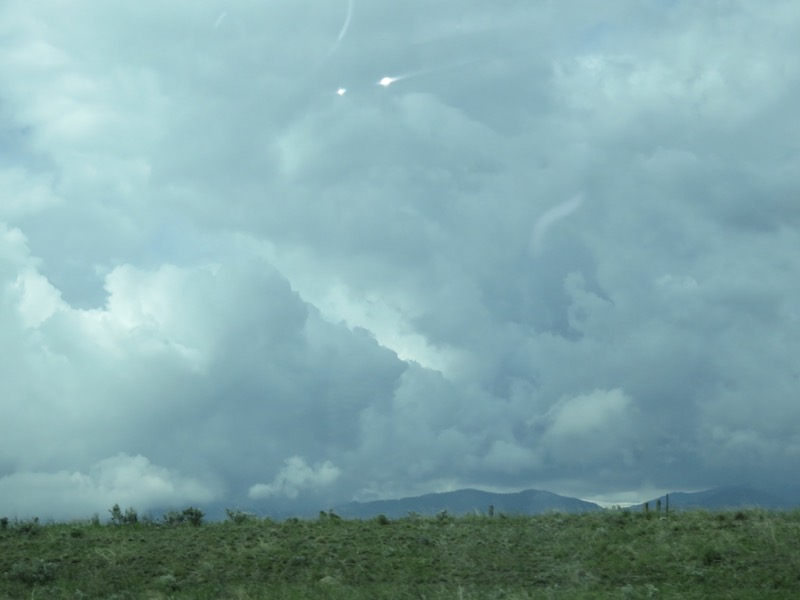
            The brilliant red sand on either side of the road drifted in places into small dunes. It was densely covered with rabbit brush and the other trees I thought I’d identified.  In the distance, the sky was dark and I made out three separate funnel clouds, all of which seem to be moving toward us. I watched the funnels uneasily, remembering the last time I saw such a sight.  Eventually, they united and broadened and seemed to break their cord with the higher heavens, but they continued to blow toward us.  At our slow pace, I wondered if they would catch us.  Then another funnel cloud––taller and thinner––formed farther ahead of us and to the right.  I forgot to watch it, concentrating on a more immediate danger as Bob got competitive with the bus trying to pass us and swung out in front of the semi we had been following.  I closed my eyes, then returned to the desert plant guide, knowing that all of the backseat driving comments I’d made earlier had done no more good than this one would have.  When I thought to look back to where the funnel had been, it had dispersed.  We had passed the semi, the bus had passed us, and the blacktop surface had been regained. 
        When we got to the next town, dozens of speed bumps did what neither a nagging wife nor la policia could do, and Bob proceeded on for a while at the correct speed limit through town, in search of a casa de cambio. Gas and tolls had eaten up the entire $150 I had cashed into pesos that morning.  It may have been cheap to retire in Mexico, but it sure wasn’t cheap to drive there!
        Here and there along our route, huge factories or assembly plants lined the road, finished or in stages of completion––Wrangler, Coca-Cola, car plants.  Now and then a huge modern sculpture dwarfed us, but we didn’t stop to read the inscription.  Next to these gigantic modern buildings were the near ruins of lines of conjoined adobe motel-like dwellings.  Then, across the street, were lines of similar dwellings, but brand new and two-storied in a faux Tyrolean half-timbered style most bizarre in this setting.
        KFC, Burger King and Dairy Queen competed with but did not in any way outnumber the burrito and tamale carts which stood beside the road.  In one small town, men in white shirts stood in the road and flagged us down, then motioned us over.  We noticed before actually leaving the road that they were trying to lure us into a lot filled with cart vendors.  We were hurrying to try to cash dollars for pesos, and we drove on without sampling their wares.          
        This deep into Mexico, I could no longer remember what I expected it to be like. It was surprising to me that not once in over 1,000 miles did we pass any car with North Americans in it.  Nor did we encounter any Americans or other foreigners in any of the towns we passed through.  Few people spoke English, even in banks, but in spite of this, no one looked upon us as an oddity.  We just were.  Like the funnel clouds and the circling white plastic bag in the middle of the street, we passed through but affected them little.  This was exactly the way I wanted it to be, now that I thought about it.  It was what I was looking for––some place that was purely itself, different from what I knew.  I longed again to be a stranger and to have the unexpected around every corner. 
        The terrain in the northwestern region I found to be not so different from the Mohave:  rabbit brush, mesquite, willows, cholla, prickly pear and willow trees.  But unlike the litter-conscious United States and because the dumps tended to be located near the main road, here there was lots of refuse outside every town.  As we drew near each dumping ground, thousands of plastic bags snagged on every fence, shrub and stone, littering the desert like some exotic flower display. Everywhere, huge chunks of concrete lay piled alongside the road––destroyed buildings or landfill––who knew?
        Frequent signs warned of livestock in the roads; and occasionally, livestock actually did appear there, as if to validate the signs.  As we drove farther south, there were fewer signs but more livestock on the roads––even the broadest and fanciest toll road between Aguascalientes and Leon.  On this road, for the first time, the four-lane divided highways came complete with median boundaries, curbs, gutters, shoulders, and a woman who hurried to herd her goats off the left-hand lane of the road as semis, cars and pickups whizzed by. 
        Our last toll having wiped us out of pesos, We drove into Rio Grande to find a casa de cambio. Since a parking place seemed to be an impossibility, Bob let me off in the crowded streets, promising to try to find me again.  When I came out of the cubicle, the sidewalks were crowded and a small parade was making its way down the street.  A policeman stopped traffic in all directions as high-school-aged students waved flags from cars.  They seemed to be celebrating some sports victory, or an election.  Banners on cars announced names.  On one car, a young girl rode on the hood, an older woman running out to position a folded blanket under her.  As she moved to adjust it, the girl cringed, as though her legs crossed out to the side of her were sore, or burned or maybe just cramped.  She wore a shiny halter and tight metallic spandex bell bottoms––hardly the clothes of a homecoming queen.  Other teenagers threw candy from car windows and one piece sailed right toward me.  I picked it up, and it seemed to me that it was a sign, welcoming me to Mexico.  It was Tomy’s––my favorite Mexican hard candy.  In ten minutes or so, the parade had passed and in ten more I spotted the tall rack on top of our van coming toward me in the line of cars making its way down the street.
        We drove on to the outskirts of Rio Grande, where we found a motel nicer and cheaper than the one the night before.  This night it was monsoon rains rather than windstorms that greeted us, settling the dust and raising the fresh smell of wet earth.  We had rejected our first room in favor of one where we could park next to the window of our room.  Once we got in bed, we could see why they had tried to put us in the room toward the back.  All night long, the huge trucks whizzed by twenty feet from our open window.  Nearer at hand was the sound of Bearcat beginning his frenzied cat box scratchings.  Half way through the night, I got up and searched through my bag to find ear plugs, which I was sure I’d packed.  I finally found them. 
        Hours later, I awoke to the glare of lights switched on by Bob, who stood at the window inspecting our van.  I glanced at my watch.  4 am.  Even through earplugs, I could hear that the car alarm was going off, so I slipped on jeans under my nightshirt and went out with Bob to see what was going on.  The boy in the office was coming out to investigate, but all was well.  I switched off the alarm.
        Feeling brave, Bearcat left the room as we did, stepping out into the rain-freshened cool night air with his ears and tail up, his nose twitching inquisitively.  I fastened his leash to the ring on his halter and we went for a stroll.  We walked for some time in the direction he wanted to go, at the speed he wanted to go, but I censored his movements when he jumped to the top of a small wall and tugged on the leash to jump over.  Taking him in my arms, I carried him back to bed.  This time, I put the litter box in the shower before inserting my ear plugs, and so both Bob and I got a few more hours of sleep. 


Judy’s Note: It’s maddening that I know I have photos of this entire trip and our period in San Miguel. I’ve been through three big boxes of letters and photos and memorabilia looking for them, to no avail. I’m afraid they are on some obsolete computer or media storage disk or tape or electronic device and that I’ll never be able to retrieve them. The result is that I will probably eventually run out of solutions for showing a photo with each chapter. 

Chapter 5 is HERE.

Trees Trees Trees


Click on photos to enlarge.

When I moved into my house 22 years ago, I could touch the top of these palm trees. They’ve grown, I’ve shrunk.


For the Nature Photo Challenge: Trees

Volunteer, FOTD May 12, 2023

Click on photos to enlarge.

A welcome but uninvited guest. Is it a daisy??

For Cee’s FOTD

Innocents in Mexico, Chapter 3: Night 1 in Mexico: Chihuahua

Find Chapter 1 HERE and Chapter 2 HERE

Innocents in Mexico

Chapter 3: Night 1 in Mexico: Chihuahua

           Heading out of Chihuahua in the twilight, a bit worried about where to safely park for the night, we suddenly saw a dark curtain in front of us.  It was dust being raised from gale-force winds blowing perpendicular to the road, almost obscuring sight and making me worry for the duffel bags full of art supplies on the roof.  We’d already lost Bob’s big stretched canvas somewhere in the Mohave Desert, and replacing all those oil paints in Mexico would be expensive, I imagined.  The wind got fiercer and the sky got darker.  At one intersection, a small dog ran circles, chasing scurrying plastic bags.  The oncoming traffic was stopped for the light, as we were, and few cars were passing through the intersection.  He executed his ballet oblivious to the danger.  A begging couple stood as their two small daughters crouched on the median strip, watching the dog with no apparent concern.  Then the lights changed and we drove carefully past the still circling dog, off into the rushing gray maelstrom.
             Finally, on the outskirts of town, Bob spotted a motel sign and we gave up our plans to sleep in the van.  For $17 American, we had compound walls to park our fully loaded van in, a tile-floored room, slightly smelly but relatively clean.  Dirt had blown in under the door to make small dunes on the floor and the room was so hot and evil smelling that we had to open windows to let in more sand and dust.  Working all night, the small air conditioner failed to cool anything that wasn’t standing directly in front of it.  Bob pulled the van up so we could see it from the window.  We put Bob Dylan on the tape player and pulled out the ice chest to make our own cold dinner.  Spiced brandy and 7-Up for me, early bed for Bob.
            Bearcat, however, had other plans.  He was a handsome cat––steel gray with short hair, chartreuse eyes and both the physical prowess and vocal abilities of his Blue Burmese mom.  All of this trip, however, he had spent silent and quiet under the air mattress.  At night we’d pull him out, his claws attaching firmly to carpet all the way out.  Then we’d take him off to some strange room or house where he’d relax only after we were in bed, when he could jump up with us and snuggle into the blankets.  This trip had been like an alien abduction for him.
            In Flagstaff, he’d spent two days hiding in our daughter’s closet, coming out only at night to explore the house after their 5 dogs, two cats and monkey had been moved to various rooms behind shut doors.
           When we visited our friend Carey in Tucson, we’d tied Bearcat up in a yard with shade but had forgotten about the hawks circling overhead, until Carey had mentioned them.  When we went hurriedly out to investigate, Bear had managed to slip under a tarp that covered the air conditioner and seemed happier there than in the garage where we locked him in for the night.  He’d sulked all day the next day as we drove on to Alamogordo, never once coming out from under the air mattress to talk to us for a bit. He’d been happiest at the house of a friend in Alamogordo where he got the run of the house with no other animals to compete with.  When I took him out in the yard on a leash at night, he had explored with both interest and caution.  I’d followed him around––the only successful way to walk with a cat on a leash.
            Now he was experiencing his first night in Mexico.  All night long, the cat scratched feverishly in his litter tray, then would jump up and rub against me, biting my toes, waking me up no fewer than six times during the night.  Then he’d jump down from the bed and I’d hear feverish scratching from the direction of the litter box. The next morning, there were only two tiny gray turds buried in the box, but litter confettied the bathroom floor, competing in mass with the sand grit on the bedroom floor.  The plastic liner was completely shredded and pulled away from under the elastic brace which held in tight at the top of the tray.  Only then did it occur to me that they had put catnip in the litter to attract cats to it.  Our cat had been high all night after resting all day.  Unfortunately, our schedule had to be the reverse.  After just one night of trying to sleep through his herbal ecstasies, we decided we might have to find a substitute litter at the soonest opportunity.

Find Chapter 4 HERE.

Happiness Project Week 8, May 11, 2023

Click on photos to enlarge.

Algeria’s Happiness Project prompt is to publish a story, poem or photo that reflects happiness. I posted a few!!!

Hibiscus: FOTD, May 11, 2023

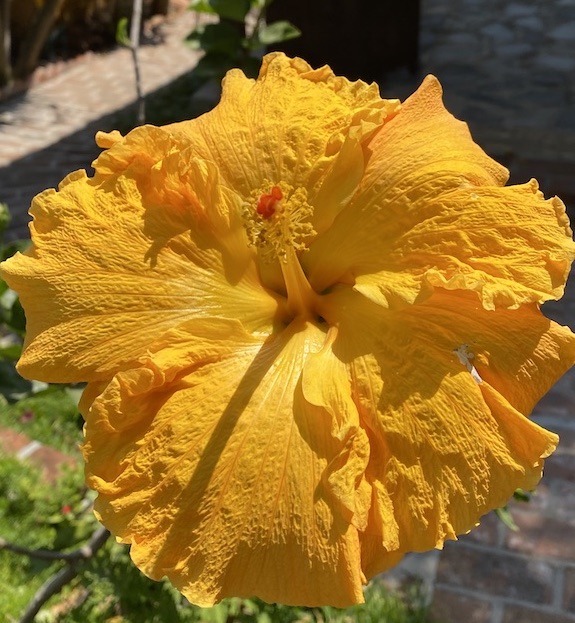
Shortly after I took this photo, the wind came up and blew this huge hibiscus to the ground!

For Cee’s FOTD

Innocents in Mexico, Chapter 2: El Paso, Juarez, Chihuahua

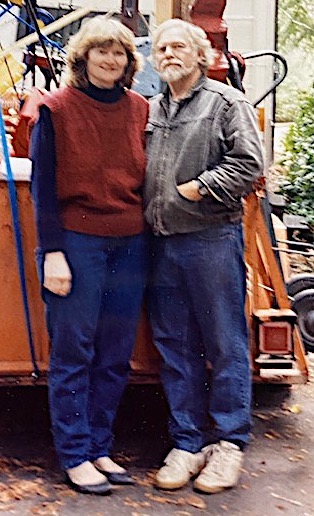
This is the only photo I can find of Bob and me. Taken in our driveway in Boulder Creek, CA

(If you haven’t read Chapter 1, Go HERE.)

Innocents in Mexico

Chapter 2: El Paso, Juarez, Chihuahua

(May, 2001)

            As soon as we drove into El Paso, it felt like we were in Mexico.  The dirt roads climbing the hills covered with tiers of tin-roofed tiny adobe houses looked like the outskirts of any of the large Mexican towns we had been in in the past––Nogales, Oaxaca, Tijuana.
             As we passed through Juarez and into the countryside, the dust devils appeared. Ever since I’d experienced a real tornado twenty-four years ago, I could never witness their smaller brothers with the same delight they aroused in me as a child.  Here, they seemed a symbol of the panic and lack of organization which had plagued our day so far.  Everything had happened too quickly, and not in the way I’d planned it.  Bob plowed through El Paso, passing each place I wanted to stop, saying we’d stop at the next one.  He was always in a hurry. To me, this was finally the part of our lives where we could take our time. I wanted to do and see things–– to experience it all.  There were no real schedules now that we were out of the States­­––no friends or relatives waiting to see us, no certain places to reach each night.  But for Bob, it was a matter of quotas––getting there in as few days as possible.
            What he would do once we got there was probably to try to find a place as soon as possible when I hadn’t even made up my mind whether this was the place where I wanted to be, then worry about not feeling inspired, then sleep, a lot, before finally trying his hand at something.  I preferred to travel a bit first, to get my bearings, and to compare places before we made a commitment.
            And the cat, Bearcat, who accompanied us?  What did he want? We had not intended to bring him.  He was a cat who had been born and lived all of his fourteen years in the same remote house in the Redwoods. The menaces he recognized and knew how to deal with were mountain lions, raccoons, coyotes, feral cats, owls.  With his talent for survival, he’d outlived his entire clan of mom and two sister cats.  He’d been king of his own domain back at home in the redwoods of central California, but now he was out in the real world.  Like the man emerging from Plato’s cave, he was seeing the full reality for the first time, and the light was blinding.  As we drove, we kept trying to coax him out to view the scenery or at least for a pat and a rub, but he preferred to stay under the air mattress in our van, his green eyes peering down it’s long cave, his red leash sticking out like a guide rope for him to be pulled out by at night. I liked to imagine him as a brave cat, stalking the world, but for the moment, even the scenery rushing by was too much for him.  He preferred to stay low, grounded, hidden.  He preferred not to know the full measure of this new world he had been so abruptly pushed into.
          Our first day in Mexico had been a fiasco.  We were through El Paso and to the border before we realized it.  We had passed no exchange places or insurance vendors and suddenly we were there––at the border with no pesos, no tourist visas, no car insurance or permit.  The official had insisted that we needed to drive 30 more km to the airport to get our visas.  What about car insurance, I asked?  Yes, yes, insurance too, he promised.  So, there we were––driving in Mexico with no car insurance––that one thing warned against by every living in Mexico book, by every guide book, by every friend who had ever traveled there.  At the airport, we obtained visas, but were told we’d have to drive 30 more kilometers to get an automobile permit and car insurance.
          My heart was in my throat the whole way as Bob sped down roads with no shoulders, past signs warning of cattle in the road, around orange cones that grew like mushrooms down one lane or the other for the entire 30 kilometers.  Cars turned left from the right lane, signaled left but turned right, or stopped.  I stewed and fretted, which made Bob drive faster.  Finally, by promising to make him a sandwich only if he slowed down by 10 mph, I got him to slow down.  Until he’d finished the sandwich.  Then he sped on.  Finally, we saw the Aduana sign that signaled the customs house.  There, after a long wait, Bob obtained the car permit and after much haggling, I got a week’s worth of Mexican insurance.  We’d try for a better deal in San Miguel.  There was, however, no money changer at the Aduana, so we had only the few pesos I’d saved from our last trip to Mexico two years ago in addition to some I’d pilfered from my childhood coin collection.  They were not enough to cover even the first toll, but, thankfully, they took our American dollars.
          Through each tiny town, we searched for a banco, but it was nearing 7 o’clock when we finally pulled into Chihuahua to search for a money exchange in rush hour traffic. Trying to maneuver through streets which, too narrow for oncoming traffic, still allowed it, Bob scraped the side of our new van on a pole.
            When we finally found el centro, only casas de cambio were open, not any banks, and the credit card I’d taken with me when Bob let me off was one I didn’t have a pin number for, so I hadn’t been able to get any pesos. Forty-five minutes later, when he’d finally been able to get back to me through the rush hour traffic, we headed out of town, still peso-less, wondering where we’d find a place to spend the night.
          It had been our intention to sleep in the van, both to save money and to guard the art supplies we carried on the roof rack and the tools we carried inside. Bob had taken out all but the two front seats and had built and carpeted a platform in the van so we could put an air mattress for sleeping on top of it and still have cargo space for clothes, tools and books underneath. We had a porta-potty for us and a cat box for Bearcat.  In a cooler were meat, cheese and greens for sandwiches, ice to cool drinks, and a few other perishables.  This would both keep us on our diets for a few more days and enable Bob to set the speed record he had full intention of setting for time between El Paso and San Miguel. We had not, however, taken into account the possibility that camping areas or even areas suitable for just pulling off the road for the night might not be as readily available in Mexico as they were in the U.S. 

It had taken us only one day to firmly slip into our roles of ” Innocents in Mexico!”

.  .  .  .  

As before, I would appreciate any comments. Are you still along on the ride with us? Is there anything you are missing? Anything unclear? I’m really not going to duplicate the entire book here, but just seeing if I’m off to the right start. It is perfectly okay to give suggestions and critiques!  And thanks for the comments so far…..Judy

Go HERE to read Chapter 3


FOTD: Kalanchoe, May 10, 2023

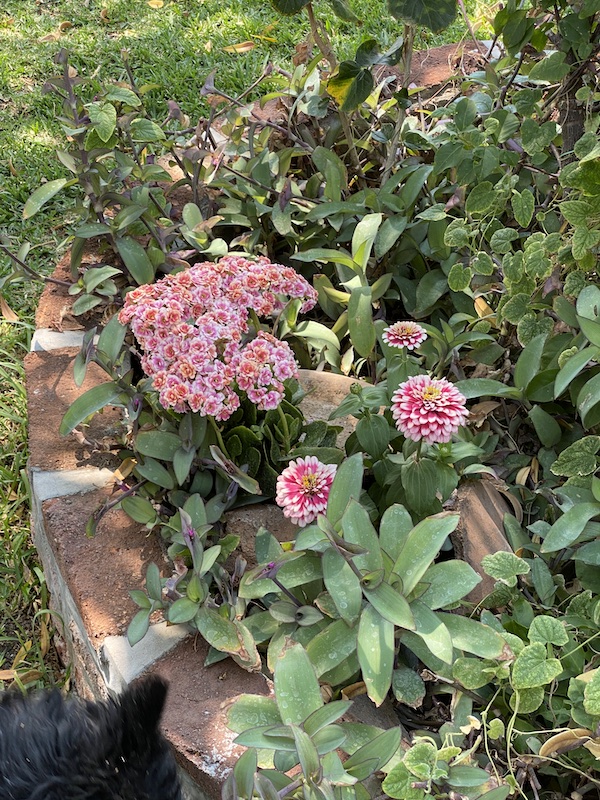
This is the actual size of the kalanchoe flowers that I showed yesterday.  They look very different, right? The two flowers to the right are different.I would guess zinnias? They are new, too. Morrie decided to stick is ear in the photo so you could more easily determine the size of the flowers. Thanks, Morrie, for helping me to clarify.

For Cee’s FOTD

Innocents in Mexico, Chapter 1, Leaving the Familiar

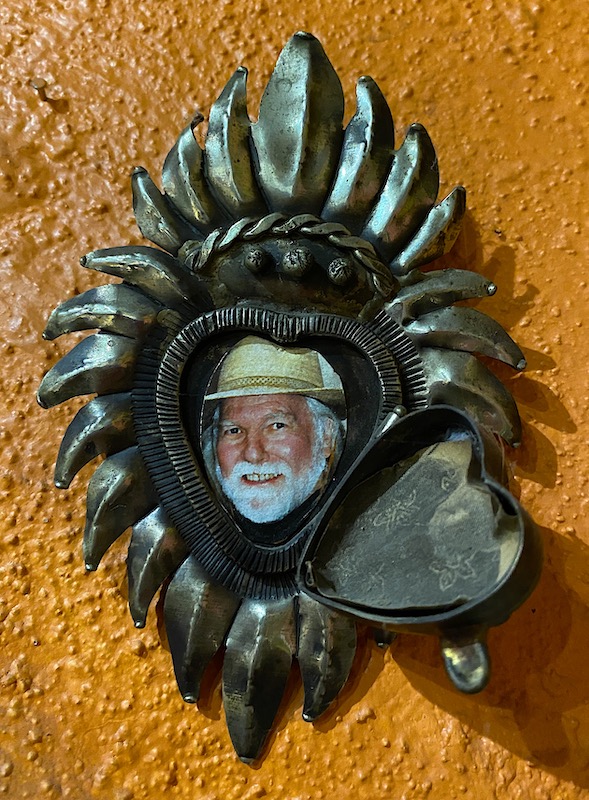
Bob, 2001

At the moment, every surface in my office/living room/dining room is covered with stacks of papers.  I’ve been plowing through files and old folders looking for additional stories to include in a book about my first few years of living in Mexico, but in doing so, I unearthed an earlier book, also unpublished, about our initial trip down to San Miguel to investigate it as a possible place to live for a year. So, I spent most of the morning and afternoon reading the entire book with the result that I’ve decided that maybe it makes sense to publish that book first, since it will better introduce readers to Bob and to the background of my move to Mexico.  With that in mind, I’d like your help in reading two or three of the beginning chapters to see if they hold your interest. They are a bit longer than earlier “possibles” that I’ve shared with you over the past week or so, but I guess that will be a test of whether this book is going to hold your interest.  Remember, as this story begins, the year is 2001 and so the information about our Mexican experience is 22 years old.  Please let me know whether you feel it is still relevant and interesting. That said, here is the possible first chapter of:

Innocents in Mexico

Chapter 1,  Leaving the Familiar

(Jan1-May 3, 2001)

How we came to decide to move to Mexico is unclear.  Bob claims I tricked him into it by first suggesting a two-week trip.  By the time he had agreed, the trip had grown to two months.  Then, the next thing he knew, I was telling people that we were renting out our house and moving to Mexico for a year, where we would live off the rent we were collecting from our house. But it was Bob, in fact, who suggested that if we left for a year we’d be coming home during the worst weather of the year––which led to our decision to move to Mexico for a year and a half.

The transition from the redwoods of central California to the central mountains of Mexico was not as simple as the decision to move there.  We had intended to return from Christmas with my 91-year -old mother in Wyoming, to spend a month packing our personal stuff out of the house and getting it rented out, then to leave by February 1. But a week or so prior to leaving for Wyoming, I found that I needed major surgery.  Since the recovery period was six weeks, that would delay our leaving by a month if we scheduled the surgery as soon as we got home in January, so we put off our leaving day to March 1.  If I packed just one thing at a time and left Bob to lift the boxes once they were filled, I should be able to do the packing even with stitches in.

The day I got home from surgery, my mother went into the hospital in Wyoming.  I’d been told not to ride in cars, climb stairs or lift for a week, then to take it easy for another month at the least.  My mother and sister insisted I not come, my mother even saying that it was too hard to visit over the phone when I called, due to the oxygen.  She liked to be left alone when she was sick, even had them put a “no visiting” sign on her door.  She would be going home soon, they all said.  But within a week, my mother had passed away.  Since she had known no one in the Wyoming town where she had moved a few years before to be near my sister, we decided to hold her memorial service in July in South Dakota, where an all-town reunion would be going on in the town where we all grew up.  My brother-in-law accompanied my mother’s body to Tucson, where she would be buried with my dad.  Both of my folks were not big on funerals.  My mom would have approved.  I put all of my efforts into planning her memorial long-distance.  Bob and I would drive up from San Miguel the last weekend in June for the memorial.

Now, along with healing, I mourned the loss of my Mother. For days, I worked on art projects which reflected her life story, and after my second day home from the hospital, I worked for two hours at a time packing books, then rested two hours, watching every video movie my friends could dig up to encourage me to get the rest I needed.  I began to get a bit agoraphobic, which was helped along by the fact that I wasn’t supposed to ride in cars.  On the night that my Mom died, Bob and I went for our first walk since my surgery.  It was nine o’clock at night as we walked up the road near our house to the top of the mountain.  The stars were vivid in this sky away from city lights as we discussed the afterlife.  There was something about the irrevocable ending of a life which pushed us in our resolve to put off no longer the next stage of changes in our lives.

Even though we planned to rent the house fully furnished, the packing proved to be a much larger job than we’d expected.  My mother had left us her car and any furniture or art we wanted.  My sister insisted that to send it would incur no loss to her or my other sister, since it would come out of the part of the estate the majority of which would go for taxes, anyway, so we decided to store our own furniture and rent our house with my mother’s.  This meant also changing all the art and decorations in the house, since her color scheme was different.  For a month, I’d packed books, which Bob would then carry to one studio or another to store.  Then I tackled the kitchen, leaving what I considered to be bare bones.  We were beginning to feel like we’d make our new departure date of April 1, but the date should have been a tip-off.  When they heard we’d be leaving, we suddenly had friends and relatives popping in with great regularity.  With each group of friends, we took the time to talk and play, to go to the beach and out to dinner.

One of the reasons we were moving to Mexico was to get our life back and to reprioritize after 14 years of running our lives around the demands of a business. We had felt rushed, pressured, buried under the minutiae of the details of bookkeeping, scheduling, mailing, travelling to art shows, setting up our booth, tearing it down, keeping track of the thousands of details involved in not only making art but selling it through craft shows. Every vacation we’d taken to visit family had been scheduled to coincide with our show schedule.  Most of our friends were artists, which was great, but we spent more time discussing the business of art than art itself.  We wanted off the bandwagon.  We wanted the time to talk and experience life without pressure. But now the business of moving was taking over our lives.  How to get all the loose ends taken care of.  How would we pay our bills?  Collect outstanding debts?  We had lamps to mail off to customers and galleries, files to sort out.  What to take, what to store, what to throw away?  I had twenty-five years of writing files:  poetry, stories, unfinished novels, movie scripts.  Bob had the same.  We had business files, tax files, personal correspondence files.  All of this needed to be sorted and dealt with.  One studio rapidly filled up to the ceiling with boxes of books, extra kitchen supplies, clothes and art. Then another one filled up with furniture, extra studio supplies from my jewelry studio, which we’d reconverted into a bedroom, writing files, tools and more tchotchkes.

When a woman who came to see if she wanted to be our property manager saw what we considered to be our stripped-down house, she said, “I’d clear out all this clutter.  Get it down to the minimum.”  That was what we thought we’d done!

Into this chaos drove my friend Patty, who’d volunteered to drive my mom’s car from Wyoming to California for us.  She stayed a few days and we took time off from packing to see the sights and talk.  Then came other friends.  We did the same.  When people heard we were leaving, they called to schedule dinners.  We went.  We were now worried about the April 1 leaving date.  With our departure date just two weeks off, Bob received a call from his sister.  His mom had gone into the hospital and wasn’t expected to live.  He flew to Michigan. After ten days, less than two months after we’d lost my mom, his mom passed away.

The day he flew off to Michigan, the first of our ads to sell vehicles appeared. We were selling a Blazer, a Mazda MX3, an ancient motor home, a trailer and a fork lift.  For the entire time Bob was gone, every bit of my time was spent jump-starting them, cleaning them, having them smog-checked, answering phone calls, showing vehicles and placing new ads.  Finally, when Bob got home, we parked the cars one at a time on the street.  The first time we did this, we got a ticket for parking a for sale vehicle on a county road.  Then we found a wide place that was evidently private land, but visible from the highway.  Within the month, we’d sold all of the vehicles but the travel trailer we had converted into a trailer to move our our big lamps, jewelry, ikebana vases, tents, cases and other display items to shows in. This we kept to store our unsold display items in.

With May fast approaching, Bob finally said he was beginning to feel we’d never leave.  In addition, he was starting to have reservations about whether he wanted to leave all his tools and studios.  What if we got to Mexico and didn’t like it?  We’d have rented our house out and would have no place to go.  In the end, we sealed up the house, paid a friend to deal with our bills and mail, packed up our cat that we had been unable to find a new temporary home for, packed up a few clothes, a lot of books and art supplies, and headed out for Mexico on May 3, 2001—only 4 months later than we had initially planned on starting out, but we were finally on the road. On the way, we would visit Bob’s son, daughter and grandkids in Flagstaff Arizona, his friend Carey in Tucson and my friend Judy in Alamogordo.  Then we would be free, unscheduled, with no timeline.  On our way to Mexico.

Go HERE to read Chapter 2