Author Archives: lifelessons

Unknown's avatar

About lifelessons

My blog, which started out to be about overcoming grief, quickly grew into a blog about celebrating life. I post daily: poems, photographs, essays or stories. I've lived in countries all around the globe but have finally come to rest in Mexico, where I've lived since 2001. My books may be found on Amazon in Kindle and print format, my art in local Ajijic galleries. Hope to see you at my blog.

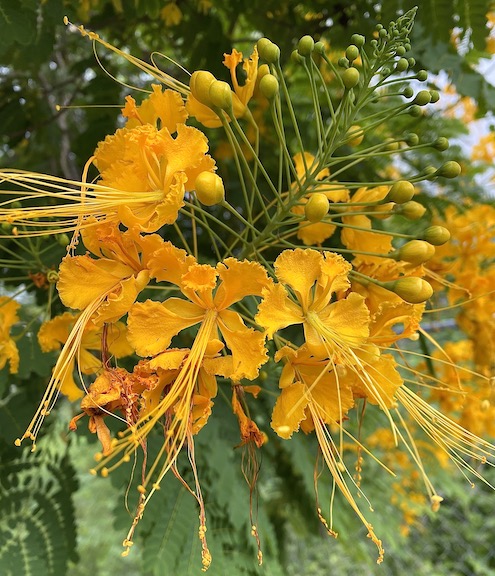
Hibiscus Curl: FOTD, June 4, 2023

For Cee’s FOTD

“Three Words” Wordle 607 for The Sunday Whirl

Three Words

Words shake loose like feathers from my morning head,
ascending, then descending to my night-tossed bed.
Caught here between dreams and thought, I try to lift a hand
to capture words before they have a chance to land.

I find I’ve cupped a poem, but then I set it free,
hoarding just three words that I have saved for thee.
It’s words that build the roads that storytellers  pave—
like the one I build for you out of  the words I save.

I seek to pull your love to me by my words’ emotion
rather than by trickery or by magic potion.
These simple words are everything that I choose to say.
Pressed into your palm, they beckon, “Come this way.”

Words for Wordle 607 are: ascending morning head dreams between hand road storytellers poem potion feather three

The Ants Go Marching Home Again Until They Don’t (For Lens Artists)

This is a reblog of a former post. To see the rest of the photos and the story of these industrious ants who seek to strip my bougainvillea, go HERE.


This post seems perfect for the Lens Artists “What’s Bugging You” prompt this week, so I’m reblogging. Hope that is okay!

lifelessons's avatarlifelessons - a blog by Judy Dykstra-Brown

Please click to enlarge these photos! I swear you won’t be sorry.

The other day, I went out to inspect the wall that Jose had repaired and painted that day. For the first time in a long time, it was devoid of coverage by plants and accessible–which also made all the wall damage viewable as well. It was as I was inspecting his admirable work on the wall that I suddenly realized why it was so open to view—a solid line of leaf cutter ants moving so rapidly along a bare branch laden with the incisor-chopped pieces of my bougainvillea vine! As usual, I became fascinated by their industry and organization. Met with an obstacle, they simply switched to the bottom of the branch and walked upside down. If a burden proved too heavy, it would be transferred to another ant, or in some cases, it seemed to be a…

View original post 432 more words

Innocents in Mexico, Chapter 23. The End!!!


The House Then

Innocents in Mexico

Chapter 23

After a quick trip to San Miguel and Back, we loaded our extra stuff into a cubicle at a storage place conveniently located on the Carretera in Ajijic and settled into a small casita on a street conveniently located near the Nueva Posada as well as another restaurant and the Lake Chapala Society.  The rooms were homey and traditional with lovely gardens and pathways in between.  Here Bearcat was welcome and roamed the pathways, firmly leashed, with little trepidation. Like Bob, after a few initial fears and traumas, he had acclimatized himself admirably.

There was another couple staying in a room near ours who were also looking for a house, although they seemed to be more sure than we were that they actually wanted to buy.  Strangely enough, their names were also Judy and Bob, and we shared information about our daily viewings nightly over drinks and dinner at The Bodega, a cozy restaurant just a block away.

Lucy seemed almost psychic in her ability to show us homes we loved, be they small homes in town neighborhoods or fancier homes on the cliffs up above.  We saw condos and mansions—one of which looked like the Taj Mahal. Years later I discovered it was purchased by  an American religious cult that was using it as a retreat center.  We saw homes from Chapala to Ajijic to Jocotepec, on the far western edge of the lake. We even saw homes in the tiny pueblos on the south side of the lake where very few expats lived, but for us they were too divided from cultural activities we knew we’d enjoy on the north side, which was an expat haven.

Lucy encouraged us to attend Open Circle at the Chapala Society so we could acquaint ourselves with some of the other people who had chosen to make Lake Chapala their home. It was a weekly non-denominational Sunday gathering that celebrated mind, body and spirit via speakers who shared their experiences and information about the lake and environs as well as views into alternate religions, beliefs and meditation practices.  No one way was espoused, but all were invited to be presented. People were very friendly, and at the two sessions we attended, we met people we knew would become our friends, and in fact, some of them remain my friends 22 years later. Others have passed away or moved away, as is likely in this area that contains the most U.S. expats of any place on Earth. But I am getting ahead of myself, putting the cart before the horse.

Of course, we had immediately shown Lucy the house in the Raquet Club. She was amazed that she had not yet seen it, probably due to the fact that it was unlisted because the owners did not wish to pay a realtor’s fee, but the more likely reason is because the gardener had never put out the flags and “For Sale” sign other than when he knew the owners were coming to view it.  It was our good luck because I’m sure if he had, that it would have been sold.

Lucy could tell, I am sure, that every house she showed us came up wanting compared to this house, and she, too, expounded on its merits.  She had a good friend, a Canadian who was a builder who lived in her compound, who, she was sure, could find the fault with the pool.  The Raquet Club was noted for its good maintenance, for it’s hot water Olympic-sized pool that offered pool aerobic classes, for its tennis courts and raquet ball courts, its dog park and various social activities.  Many Guadalajarans had week-end homes there but other Americans and Canadians lived there full time along with a number of Mexicans who had made their fortunes in the U.S. before retiring back in Mexico.

We did not need Lucy’s encouragement when it came to our admiration of the house, and we visited it again each time we went to see other houses in the Raquet Club or San Juan Cosala, the village located on the lake directly below.

We found another condo we liked in a neighborhood about half-way between the center of Ajijic and the Raquet Club. It was a good deal less, yet our hearts kept turning back to the pale yellow house with the lovely rose-colored domes.

But. $180,000 dollars?

There was something that we had not told Lucy, in fact we had really not considered it ourselves. This was that in the past five months we had lost both of our mothers, and the truth was that both had left us money—some of which would come to us later, but each had left a lump initial sum which just happened to amount to exactly $180,000!!  It seemed pre-ordained––too much of a coincidence to overlook.

For the past few years, Bob had not displayed his usual enthusiasm for things and this was the most excited I’d seen him about anything for years. So, if not now, when? And one morning ,we woke up of a mind.  Let’s make an offer!  We used the phone in the lobby to call Lucy and she kept us connected on one phone as she used another of their office phones to call the number on the spec sheet we’d been given which turned out to be an invalid number! No wonder this house had sat empty for three years. The gardener had done everything he could to insure it. Lucy made calls to the Raquet Club and eventually uncovered the real number, called it and . . . . discovered that they had  just that morning received and accepted an offer for full price!

We had waited too long. Crushed, we told her to go ahead and make an offer on our second choice, the condo.

But no, she said.  She knew we really wanted the house. She was going to see what she could do.  She called them again, asking if the other people had made a down payment. No, she was told. They were in Canada and hadn’t had a chance to. In fact, they had not yet seen the house except in pictures sent to them by a friend.

How much of a down payment were they asking for and when did they want it, she asked. Within three days, they said. The people had promised to make a bank transfer.

On her other phone, Lucy transmitted the news to us.  Could we make the down payment in three days, she asked? Yes, as a matter of fact we could make it today.

When did they want a full payment made, she asked the sellers. Within another two weeks, they said.  Could we meet that deadline? asked Lucy. We looked at each other.  Yes, in fact, we could pay the entire amount today, for it was exactly the amount we had inherited from our two mothers and we had not had time to invest it before we left for Mexico. It was sitting  right now in our bank savings account just waiting to be put to some useful purpose! What were the chances?

Lucy conveyed to the owners that we were ready to make arrangements for a bank transfer today and the deal was struck. They rejected the other offer and accepted ours.

Three days later, we were property owners in Mexico!! We took Bearcat to see his new home for the first time and he promptly climbed a tree and rested on a low branch—something he had never been able to do on the redwood trees that surrounded his former home.  Bob and I sat on the floor in our empty house and looked at each other in wonderment.  “How did you know this is what we were supposed to do?” he said, and pulled me into an embrace that rivaled that first kiss that I will someday tell you about, perhaps during our long drive back to the states to complete the sale of most of our worldly goods or the return trip with the van stuffed to the roof with what we have chosen to bring with us down to our new home. We were off on a new adventure, and this time we were absolutely sure that it was exactly what both of us wanted.

The House Now
(Click on photos to enlarge)


Hibiscus: FOTD June 3, 2023


This hibiscus was almost too high up to photograph. I had to hold my  camera up over my head at arm’s length to get this shot.

For Cee’s FOTD

Slipper Flower: FOTD June 2, 2023

Euphorbia Bracteate or Slipper Flower. Click on Photo to enlarge.

For Cee’s FOTD

Innocents in Mexico, Chapter 22

Santa Clara del Cobra Hand-Raised Pots

Innocents in Mexico

Chapter 22

As much fun as we’d had in San Miguel, it felt good to be off on another adventure and to have the means of our own locomotion again.  Bearcat, surprisingly, did not scoot back to his former position under the air mattress, but perched atop it and even occasionally hopped gracefully into my lap in the passenger seat, gazing out in wonder at the scenery whizzing by more quickly when viewed through the side window and more comprehendingly out of the front.

In true Bob fashion, we dallied little in our 3-hour trip from San Miguel to Patzcuaro. We Whizzed by Morelia. Whichever town we decided to settle in, it would be close enough so we could always easily return to see it at a later time.  We were hoping to accomplish this trip in  four days at most, and if we found an area we were more interested in than San Miguel, we could return to pick up the books and tools and remaining clothes we’d left in San Miguel and return to look for a possible rental. 

We found a lovely old hotel in the heart of Patzcuaro to serve as our base during our  initial exploration.  The town was authentic with few modern buildings or businesses to dispel the illusion that we had gone back in time. The art and the people were wonderful and the lake was a definite plus point in Bob’s mind, but it quickly occurred to us that in terms of terrain, this was not so different from the mountainous redwood forest that we’d lived in in Boulder Creek. We spent the day investigating the wonders of the town, had our first taste of atole—a delicious drink made from finely ground cooked masa (corn flour) and agreed that although it wasn’t ideal as our next place to live, that this was a place we definitely would came back to for a visit.  We had been told that the area that the monarch butterflies migrated to each year was very close by and it, too, was on our list of future explorations. 

We had heard of some of the artisan villages clustered around Patzcuaro.  Santa Clara del Cobre was a definite hit with Bob, as it was with me. It was a town consisting almost entirely of coppersmiths and the sound of hand-hammering filled the town.  A small-scale silversmith and coppersmith myself, I was amazed at the lack of modern tools—a bellows and coal fire being used in place of acetylene torches to anneal the metal, and three men with heavy metal mallets pounding the huge pot into shape in sequence after another man had moved it with huge tongs from the fire to the anvil. 

With my birthday coming up in a few weeks, Bob succumbed to his usual tactic of finding something he himself loved and when I, too, admired it, diverted me to another room while he bought it for me and secreted it in the nearby van.  In this case it was an amazing very large copper jar which lay horizontally with its opening  on the side.  Then, to be totally fair about the matter, when I found a pot I liked equally well, he encouraged me to buy it. In spite of the fact that he hadn’t been as sneaky as he thought he’d been and I knew perfectly well that he’d bought the other big pot, I played dumb and thus we became the owners of two of Santa Clara’s totally hand-forged pots created before modern intervention arrived with acetylene and propane torches. One can never have enough Santa del Cobre copper, as I have further demonstrated over the past 22 years.

We visited Capula, the town famous for its Catrinas, and managed to depart Catrinaless and also resisted the huge stone sculptures  that line the road leading into  Tzintzuntzan, although I did buy a few straw decorations for my Christmas tree, which I decorated each year with ornaments from every place I’d traveled throughout my life, as well as beloved saved ornaments from the Christmas trees of my youth.

We returned to enjoy music in the plaza across from our hotel which flowed in through the open windows of the restaurant we had chosen, then made an early night of it, packed up the next day and headed for Ajijic. We did not even stop in Uruapan, renowned for Its remarkable large park filled with water features, vowing to visit it during future adventures.

Ajijc is located next to Lake Chapala, the largest lake in Mexico, which is ringed by formerly volcanic mountains.  As we drove toward the city of Chapala, a small sign pointed to a cutoff to Ajijc and we swerved onto it, driving by a veritable mountain of garbage that was the town dump (happily now vanished, after the lease to use the land was withdrawn by the local ejido—the governing body of land held communally by the indigenous population.)

As we came around a bend and down the slope of the mountains that surround Lake Chapala, we suddenly saw the whole of it spread out before us.  Just one volcano, 80 miles away, is still active, and we could see the tip of it peeking over the shoulder of Mount Garcia, the largest and closest mountain in view across the lake. One of the most active volcanoes in North America, it gave off a slight puff of smoke just as we caught our first sight of the lake. “Oh Yeah, Jude!” Bob exclaimed. “I don’t want to move to San Miguel. I want to live here.” Thus it was was that we settled down to supposedly look for a rental in one of the little towns that stretched along the north shore of the lake.

But what Bob actually said as we sat in chairs in the first rental agency we came across was, “We may be looking for a rental, but do you have any houses for sale?”  The rental agent’s eyes lit up as she agreed that yes, she’d be happy to show us both rentals and houses for sale. Although I was still sure I didn’t actually want to buy a house in Mexico, Bob was expressing such joy at the prospect that I went along with him.  It would be fun to view some of the beautiful houses that we had already viewed from the outside in our drives around town.  What was our price limit? Bob gave the price of the first house he’d  found in San Miguel—$80,000.  But somehow, nothing in that price range quite caught our fancy, although we had seen a few rentals that we had liked.  We thanked the rental agent and said we’d be thinking about it, and consoled ourselves with a lovely meal and margaritas in the Ajiic Plaza Jardin Restaurant.  

Then fate intervened as we sat discussing the houses we’d seen and debated the issue of where we’d settle. We had already found a house we liked enough to rent for eighteen months in San Miguel. The fact that we hadn’t found one in our price range in Ajijic, coupled with the fact that I was still adamant that we weren’t buying a second house anywhere, let alone in Mexico, seemed to be directing us toward choosing San Miguel, but Bob convinced me we should spend one more day in Ajjic and environs just driving around looking at houses.  So it was that the next day, early afternoon, we wound up in a fraccionamiento (housing district) in the mountains above the village of San Juan Cosala, a few kilometers west of Ajijic.  The sign said, “Raquet Club,” which sounded to me like the least likely place I’d ever want to live, but as our van climbed the incline toward the top of the lowest mountain, we wove sideways from east to west along streets filled will lovely houses, all different with lush bougainvillea, palm trees, hibiscus and flowering trees of numerous varieties.  It was high above the lake with gorgeous views of the entire lake and Mount Garcia rising above it. 

We drove back and forth for a good 45 minutes before the van came to a screeching halt before the most beautiful house I had ever seen.  It was a pale mottled yellow and white in an L shape with two colossal rust-colored domes covering most of the two wings of the L.  The corners were all rounded without a sharp angle in the entire house.  It stood at the top of a steeply angled lot and the walls around it undulated down the mountainside like a series of falls smoothed out by flowing water.  The entire house looked like it had been sculpted by an artist’s hands.  If Bob were to ever design a house, I thought, it would look like this.

“Let’s see if it’s for sale!” he said.

“There’s no For Sale sign, Bob,” I said.

“I think it’s for sale, he insisted, climbing out of the van. He was now peering through the bars of the doors of an open-sided garage that stood a level above the house spread out below.”Doesn’t that look like a paper with specs on it by the door down there? Call out. See if anyone comes out!”

Embarrassed, I held my tongue, but just then, a man came out of the door. I don’t think he had yet seen us, but Bob seized the initiative and called down to him, asking if the house was for sale. 

“Si,” said the man, coming up to the garage and pressing a button which opened the garage gates.  With the same motion, he reached into a cabinet to withdraw a string of triangular flags similar to those at a used car lot and fastened them to nails at either side of the garage.  “Come in.”

We entered the garage, walked down four steps and into a courtyard of paving stones, then in through sliding glass doors into a large terra-cotta room, the other side of which was all glass sliding doors. Spread out below was a view of the entire lake.

“Oh yeah, Jude! Let’s buy it!!!” were the first words out of Bob’s mouth, and his enthusiasm remained uncurbed as we walked through a kitchen which featured  Yucatan-marble counters and a ceiling covered in tiles. There were two downstairs bedrooms and two bathrooms completely tiled in white marble with the same rose-colored marble tile on the countertops  as that in the kitchen. The brick domes were fabulous—one over the master bedroom and the other over the entire living room/dining room. In the middle of the living room dome was a three-foot wide domed skylight that filled the entire room with light.

Outside the living room was a bamboo-covered terrace with a pool and hot tub filled with naturally heated hot mineral water from the volcano!!!  Small palm trees dotted the yard, along with canna lilies and bougainvillea. Virginia Creepers covered the bamboo roof of the terrace and the large pillars that supported it.

The second floor casita consisted of a large bedroom with its own bathroom, two terraces and the best views of the entire house.

On the sheet of paper Bob had noticed with his keen eye was the price of the house–$180,000 U.S.  It had just been reduced from a price of $220,000. Bob’s face fell. Well over his $80,000 budget.  The gardener, who had been paid to live in this lovely house (albeit without furniture or appliances ) for three years, looked relieved when he saw the likelihood that we were not potential purchasers. Clearly, he had exhausted little effort in trying to sell it, as was evidenced by the absence of signs or flags when we first arrived.

We later discovered that the people who had built our dream house had lived in Guadalajara but she had parents in the Raquet Club and although the younger couple had built the house thinking they’d live there, it was so much more comfortable just visiting her parents on weekends, that they had never moved in. The pool line had a leak they’d been unable to discover, even though they’d dug up half the patio trying to find it and as a result, the pool emptied within hours of being filled. Designed by a very famous architect, Miguel Valverde, who was a personal friend, nonetheless the work of furnishing it and solving its pool problem plus the fact that it was rumored that the lake was fast drying up and would be empty within 5 years had caused them to put the house up for sale and when it did not sell, to reduce the price.

We both loved this house, but we had a house in the states and no immediate prospects for selling it. And so we turned our backs on it, drove back down the mountain and back to our little motel room. Once again, we consoled ourselves with a delicious meal—this time in the garden of the Nueva Posada—the only real hotel in town, although there seemed to be numerous b&b’s and cottage-type accommodations. I settled into my margarita and Bob into his Coke as we surveyed the menu. Once we’d made our choices, we began reviewing our past few days­­—the houses and apartments we’d seen, how much we loved the  lake and, ultimately, “the” house in the Raquet Club. Bob’s dream house, and I had to admit I was very taken with it as well.

We were back-and-forthing it over San Miguel vs. Lake Chapala when an attractive red-haired lady at the next table pulled her chair around a bit to better face us and said, “Excuse me, but I couldn’t help but overhear you. Are you looking for a house here?”

We explained our situation, sharing a bit of personal information about what we were doing here.  What had we done in the states? We were artists and writers. What were we looking for? What was our present house in the States like? Were we presently working with a real estate agent? No, we had been looking but had told her we were suspending our efforts for the time being. We didn’t know what we were going to do.  We needed to be back in the States in two weeks for my mother’s memorial and needed to go back to San Miguel to either pick up our stuff or to sign the lease for an 18-month rental.

Could we spare a few extra days, she asked? We exchanged glances. What did she have in mind? If we could take the time, she would be glad to show us a number of houses she knew we’d love—in every price range from $80,000 up, but first she wanted to do two things.  First, she wanted us to move from our little motel-type accommodation to the Nueva Posada, and secondly, she wanted to introduce us to some people who lived here—artists and writers and musicians that she thought we would have lots in common with. Her name was Lucy and yes, she was a real estate agent. We liked her. We shook hands on it and went with her to the desk to book a room.

For the next three days, Lucy showed us house after house, priced from $80,000 to $500,000 and we loved every one.  She introduced us to her friends—all of whom we felt an affinity with. They told us about the local little theater—founded 36 years ago by the man who played Jimmy Stewart’s younger brother in “It’s a Wonderful Life.”  And about the local writer’s group with a similar long history. She introduced us to the fascinating history of Neil James  and the cultural center that had grown up around a home that she eventually left to become the Lake Chapala Society—a wonderful addition to the community. And it happened.  We felt at home.

And that is why, after a three-night stay in Ajijic, we headed back to San Miguel to pick up the art supplies and books and other belongings we had left there, broke Steve’s heart by telling him that we had decided not to rent his house,  and came back to Ajijic to stow  what worldly goods we had brought to Mexico in the local storage facility as we once again joined Lucy in our quest for our next home.

Author’s note: Phew, I made it!!! I had to entirely write this chapter today and wouldn’t you know it–wifi was out for most of the day. So frustrating. It finally came back on about an hour before midnight so I rushed to finish and post and edit.  If you found lots of mistakes, you probably read before I finished editing as I was determined to get it up before midnight.  Now I need to get tomorrow’s chapter up before midnight tomorrow. What is this penance for, do you suppose??? Keep reading, please. Some big surprises in store. For me, too, as I haven’t written them yet.  

For the last chapter, Chapter 23, go HERE.

Euphorbia Bloom: FOTD June 1, 2023

Click on photos to enlarge.

Closeups are deceiving.  These yellow flowers are actually minuscule, as you can see when I show them next to the other plants in their planter. Look again and you’ll see the little creature that has spun those web lines between the flowers. The plant is a euphorbia mata francisco, I believe, but I am open  to being contradicted.

For Cee’s FOTD

Innocents in Mexico, Chapter 21

San Miguel Desert Botanical Gardens (Click on Photos to Enlarge)

Innocents in Mexico

Chapter 21

            For the next three days, we packed as many explorations of San Miguel into our days as possible.  We took another tour of the botanical gardens, this time taking a longer path which wound down to the bottom and to the furthest edges of the ravine.  We explored ancient ruins, watched goats grazing near the water far below, watched boys diving into the water from the muddy banks.  Men stuccoing bovedas on rooftops  across the ravine caught sight of us and waved.  We ended up on the path that wound right up to the huge mansion which clung to the cliffside at the furthest edge of the botanical gardens.  Its inhabitants were the owners of the most popular restaurant in San Miguel.  When other restaurants were empty, theirs was always full.  When the city had prevailed upon him to give the land for the botanical gardens, the owner had complied, but when they had asked for the house, he had refused.  “You don’t give away your dreams,” he said.  Politicians had put on pressure, denied him access to city water for years, but he had held out.  Now the pathways of the desert gardens came within feet of his house, but he was still there.  His view was the best in San Miguel:  The city in the distance, the ravine and aqueduct and ruins below him, around him the beautiful virgin desert, much of it still blooming as we walked its various paths. 

A huge bird circled overhead.  Lizards and a brightly striped snake crossed our path.  Hummingbirds, bees, millions of giant red ants.  The ubiquitous black grackles, moving their widely fanned tails like rudders, swifts gliding and darting,  and those voluminous white clouds in the vivid blue sky.  The neighborhood we had narrowed our wishes down to adjoined the botanical gardens land,  but when we inquired about the price of lots, they were as much as we’d planned on spending for an entire house with lot. What Bob had decided he’d like to spend, that is.  He had settled on $80,000—the price that the stabbed woman had put on her house, lowering it because, after all, who wants to live in the same neighborhood with a man with a knife and a proclivity to use it? I was humoring him, sure that we’d never find anything for that price that we would want to buy. He loved looking at houses, and so did I. I just didn’t want to buy another one before we sold ours!

          A few days later, when Jim offered to rent or sell us his house for a figure within our budget, we switched our focus back again to reality.  We could finish the compound wall, build a studio, finish tiling the house, but when we asked a builder for estimates of what this would  cost, we figured  that it would end up costing about what any of the  places closer to the jardin would cost.  In Jim’s house, we’d have privacy, a larger lot, a bigger studio,  but in a neighborhood where it would be harder to sell in the future.  If we didn’t want to buy, he offered us the option to rent for a year or two so he could go to South America with his girlfriend, and if we couldn’t find another house to rent for a year and a half, this was the option I preferred

            On the plus side, it would get Bob’s mind off wanting to buy a house. On the minus side, our next door neighbors on one side were rowdy, the street in front of their house a gathering place every weekend for men with beer bottles and loud voices.  The neighbors to our rear and other side were both metalsmiths, who often worked into the evening.  One of their sons was a drummer who practiced daily on a large oil drum.  The other was a whistler.  True, so far, we had not been bothered by these sounds of activity, but, who knew how we would feel months or a year from now? 

            We loved the sounds of children playing on the huge empty field across from us.  We loved watching people crisscross the field to and from Gigante.  However, trucks and jeeps also  used it for four-wheeling, and it was strewn with garbage:  Coke bottles, water bottles, plastic bags, old tires, mounds of broken bricks, stone and cement dumped after building projects, tangles of barbed wire, tin cans, burned logs.

             Every unoccupied lot in San Miguel became a repository for the rubbish of the neighborhood.  Everyone drank Cokes and bottled water, and when the plastic bottles were emptied, they were tossed:  out of car windows, into window grids, onto spare lots, onto city streets, into ravines and lakes and rivers.  There was garbage collection and women faithfully walked to the curbs to hand over their household garbage, but when walking or driving or riding, the custom was to toss it.  Highways nationwide––or for as far as we had seen––were rimmed with garbage.  Coca Cola had done more to ruin the scenic beauty of Mexico than any single force.  If it wasn’t their huge billboards or graffiti-like paintings on brick buildings city wide and country wide, it was the solid  expanse of empty plastic bottles which paved the desert, the grass or the shoreline which bordered every road. 

            San Miguel was a beautifully preserved colonial town with strictly regulated ancient buildings, churches,  monasteries and cobblestones.  Its central zocalo––known as the jardin––was the place where lovers met and musicians played and children frolicked.  Here benches lined the square and people sat to watch children, lovers, tourists, toy venders, beggars, neighbors, students, ice-cream eaters, scooter riders, ball bouncers, survey takers, shoe polishers, Spanish practicers and fruit sellers.  Overhead was the dense foliage of trees.  Around the outside of the square were the buildings hundreds of years old. 

            Within the jardin, sidewalks formed a square within a square with intersecting crisscrosses.  Every twenty feet or so there arose a bronze stake.  Antique, curlicued, topped with a rubbish container shaped vaguely like a mailbox, but patinaed, ornamented, lovely until you saw it from the front.  There, emblazoned over the slot where the rubbish went in, in six inch high letters, was that ubiquitous script. “Coca Cola “it said, on each rubbish bin.  Dozens of them marched the jardin like town criers, reminding us, “Never forget.”

             The most constant presence in Mexico was Coca Cola.  On one expanse of road,  I spotted eight building-sized signs for Coca Cola and  two for Pepsi Cola within a one block area.  And in the ditches country-wide lay discarded bottles, like stepping stones between the few blades of grass that poked between them.

            True, there seemed to be some awareness of litter as a problem.  Here and there, you see a sign “No tire basura” (Don’t throw trash) on a spare lot or along the roadway, but  few heeded them.  They had become invisible.  City dumps, more often than not, were located right next to major roadways.  Handier that way, I guess. 

            As we were discussing the possibility of visiting Mexico and then moving there for a year or more, Bob had started reading what material was available in that pre-internet age. In addition to San Migel de Allende, he had been attracted to two areas, mainly because they were situated by very large lakes.  He had often told me that he had always wanted to live by a lake, and now he suggested that in the couple of weeks we had left before we had to be back for my mother’s memorial, that perhaps we should take a weekend off and investigate both of them: Lake Patzcuaro and then the largest lake in Mexico, Lake Chapala, Then, coincidentally, at a restaurant with tables placed too close to each other to avoid becoming conversational with one’s neighbors, we entered into a discussion with a couple from Ajijic who I had heard discussing the fact that public outcry had caused local politicians to decide to move the dump from a much-used cut-off road between two of the most popular towns on the lake to a more hidden location.  They said, in fact, that along the whole expanse of the lake, rubbish seemed to be less of a problem than usual.  As the lake shrank away from its banks, hundreds of yards of lake bottom were exposed.  Here cattle grazed, four-wheel-drive vehicles turned wheelies in the dried dirt, boats lay earthbound, blocks from the nearest water.  On weekends, locals thronged to makeshift palapas constructed on the former lake bottom to drink beer or Cokes or Fanta.  Yet there was very little rubbish.

           In one subdivision, double oil barrels were placed on each block along the road to serve as trash receptacles, but elsewhere, even where there were no rubbish bins, there seemed to be vastly less littering.  Construction crews still piled their leftover stones, dirt, concrete, bricks and rebar  on spare lots, to be dealt with by the next building crew, but piles of stone and brick and wood seemed less intrusive than thousands of plastic corpses of drink containers and shopping bags.  Also in this area, as in the area around Lake Patzcuaro, there seemed to be more people out along the road searching for recyclable bottles.  Why, in this era when so many items––from clothing to deck materials––are made out of recycled plastic, can some program not be started in Mexico, which could make it profitable for people to collect this unsightly litter and turn it from a liability into an asset?
          It seemed a sign. Bob used this conversation as a springboard and once again suggested that we at least quickly investigate the other two towns that had intrigued him in his reading about Mexico.  So it was that we decided to head off for a short sortie into the wilds of Mexico.  First Patzcuaro, then Chapala, before signing the year-and-a-half lease for the San Miguel house. We still had a few weeks before we needed to be back in the states for my mom’s memorial in South Dakota. Why not spend them making sure that San Miguel was really the place for us?

For Chapter 22, go HERE.

Innocents in Mexico, Chapter 20

Night-Blooming Cereus

Innocents in Mexico

Chapter 20

For three weeks, we spent most of our time looking for houses.  It was confusing.  We saw perfect houses down in town, within walking distance of the parroquia.  We saw houses that were larger, with more space for our money, which were located farther out––near the rapidly diminishing and slightly smelly lake.  We saw houses we’d never consider buying ––the outside of the house Mexican, the inside looking like it had been transported here from a suburb in California or Michigan or Iowa.

We saw houses so to our taste in design, from tile to furnishings, that we could have moved in and been comfortable immediately––but at twice the price we wanted to pay.  We saw perfect houses in foreign enclaves, perfect houses in Mexican neighborhoods, houses we couldn’t wait to get out of and neighborhoods we couldn’t wait to get out of but unfortunately, could not find our ways out of.  Bumpy cobblestoned streets ran into dirt roads that finally fizzled out in a rubbish heap or a ravine.  Streets got smaller and smaller until they became walking paths only or wound around and around in an unsolveable maze––even for Bob, who had an inbuilt radar and sense of direction which rarely failed him.

Finally, we found three houses we would consider renting for a year and a half, but now that Bob was more enthusiastic about the possibility of living in Mexico, he had decided he wanted to buy!  I, however, feared the rashness of buying this soon.  We already had a house in the states that we’d need to sell. We barely knew San Miguel.  What if we made no friends?  What if we ran out of things to do?

Bob, on the other hand, needed a project to get him into the swing of life again.  He needed a studio to build or furnish.  He said that he knew me. I needed a garden to plant  and change, to shove pots around in.  We were nesters and not much nesting could be accomplished in a rented house. 

            We decided to take a few days off to explore San Miguel and to try to establish a life here.  We hung out at the Biblioteca.  I even joined and checked out some books.  On the day I joined, we had lunch in the terrace restaurant at the back of the library.  At the table next to us, a woman was writing on 3X5 cards and sticking them onto cassette cases.  Having listened to both of the books on tapes I’d brought with me, I had a sudden burst of inspiration. 

            “Do you have books on tape here?”  I asked her.

            Thus began an hour-long conversation that started with her life story:  (short marriage, daughter, a career in microbiology, lots of travelling, and her present volunteer job at the library) and ended in an invitation for drinks at her house on Sunday.  There we met her 95-year-old flat mate, Trayla, who still taught piano to local children and who was singlehandedly handling the music section of the library:  cataloguing, indexing and filing all of the donated sheet music, listening to all donated records to decide which were of a quality to be transferred to cassette.  When I met her and looked through page after page of the contents of the music library, I asked if she used a computer.

            “Heavens, I predate the computer age,” she said.  “I use a typewriter.” 

            Nancy, her flat mate, who was a youngster of 80,  functioned as her legs, carrying material back and forth to the library, for Trayla never left the house anymore.

            The stories  these women told were varied and numerous.  Their voices interrupted each other like shuffled cards as they filled in details or merely cut in, impatient that the story was being told wrong or less completely than it deserved to be. 

            Nancy told a story about a friend who was a metalsmith.  He had been approached by a company that wanted to lure him away from both his hometown and his employer.  When he insisted that he had no desire to leave California and the foundry where he had worked for 20 years, they first offered to double, then triple his salary.  Then, when he had agreed to take the new job, they admitted that the metal they wanted him to work with was a metal he had not worked with before.  When he suggested that they should find somebody else, they said no, they wanted him only and offered to both send him to school to learn the process of working in  the different metal and to quadruple his salary.  So the man quit his job, went to school, moved his residence and settled down to work.  The Second World War began, and he worked on until its end, when he was finally told that the project he had been working on was the nosecone of the missile that delivered the atomic missile that had been dropped on Hiroshima.

            Trayla  told stories of her parents’ immigration to California––crossing the Isthmus of Panama on foot with six children.  Stories of their own travels down the Amazon, in Thailand and throughout  Mexico. 

            What had brought them to Mexico, I asked.

            “A burglary,” said Nancy.  “I was living in Ann Arbor, Michigan.  It was on Halloween night.  Someone broke in through our kitchen window and took the TV, the stereo, and   everything they could lay hands on.  My purse was on the kitchen table, so they took it.  Inside the purse were my car keys, so they took the car, too.  When I went to buy another car, they were offering a pair of tickets to anywhere the airlines flew, so I found the furthest spot they flew, which was Mexico City.  I asked Trayla to come with me.  In a magazine on the plane, there was an article about San Miguel, so when we got to Mexico City and hired a driver and guide, I asked him if he knew where it was and if he could take us there.  He did, and we fell in love with the place.  A few years later, I called Trayla up in Oakland and said, “Do you want to move to San Miguel?”  “Okay,” she said, and we both quit our jobs, packed up and went.”

            When we moved to the roof to view the garden, Trayla  followed us.  The night-blooming Cereus was in half bloom––with not only one but two blooms readying themselves for that night’s performance.  Succulents and cactus grew in profusion from large clay pots, along with bougainvillea, hibiscus, and other semitropical plants.  I climbed the ladder to the tallest rooftop.  A beautiful view of rooftops, churches, skyline, trees presented itself.  An afternoon mist furnished atmosphere around the lowering sun.  Beautiful.  San Miguel–– a different city from every rooftop.

            More stories, wine, talks of buying and selling houses.  When would they be forced to sell theirs?  For what price?  What had I seen?  What were the prices of houses here, there?  How did this house compare?  Offers of trips to museums, churches, spots they knew.  Nancy would drive us.  When I offered dinner at our house:  “No,” Trayla energetically declined.  “I never go anywhere.  If I went anywhere, I’d just wear myself out.  I don’t leave the house anymore.  Ever.  For any reason.” 

            She was not frail or immobile.  When she perched on the arm of a chair to tell a story or to discipline their  poodle, her face lit up, animated, and she looked sixty.  Her mind was as sharp as ours––-sharper, since all of us kept forgetting dates, names, locations.  Nancy had had what she feared were a few mild strokes lately.  She would be caught searching for common words, forget what she’d been talking about.  For a microbiologist, who lived by organization and mind, it was threatening.  I admitted to frequent bouts of absent-mindedness since turning 50, but not  Trayla.  She was still sharp as a tack, taking care of herself.  Five years before, her doctor had given her three months to live.  Here she was, still so busy there wasn’t enough time in the day:  piano lessons to teach, a whole room full of music and records to organize and catalogue.  So many stories to tell and now, two new people to tell them to. 

            She drained a full wine glass and filled it up again.  They were heavy stemmed water goblets.  Wine glasses were too small and boring, they said.  They preferred these.  She ate another smoked oyster, more dip, more chips.  Taking care of herself.  Still rounding out the fullest of lives.

For Chapter 21, go HERE.