Category Archives: Childhood memories

Dining Out

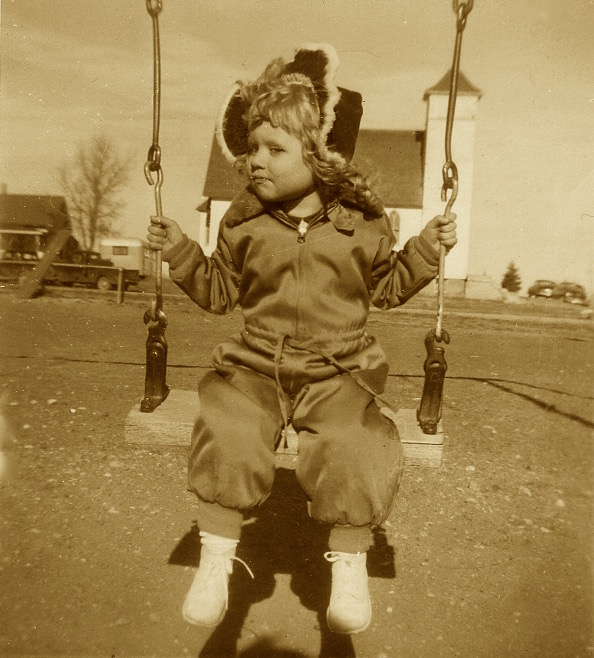
daily life color109 (1)
Perhaps considering my next order?

Dining Out

I do not remember the first time I ate out at a restaurant, but I have heard a story over and over about the first time I ordered for myself.   I couldn’t have been over two years old when my folks took me out to a movie and then to Mac’s cafe for a drink and a visit with town folks afterwards.  We lived in a town of seven hundred people in the middle of the South Dakota prairie.  Our sole entertainment, other than church and school ballgames, was the Saturday or Sunday night picture show in the small theater on Main Street.  It was the social event of the week, and visiting with friends afterwards at Mac’s Cafe across the street from the theater was as much a part of the evening as the movie.

Later, in college, one of my best friends was the granddaughter of the man who owned the theater and she revealed to me that it never had made a profit.  He just kept it running to give the folks in the town where his wife had taught school as a young woman something to do.

Probably 200 of the 700 citizens of our town were members of a pentecostal church who didn’t believe in dancing, movies,  or even TV, so at twenty-five cents per ticket, I’m sure if everyone in town had gone to a show one time a week, it still would not have paid the overhead, so we should have figured that out long ago, but we hadn’t thought of it––at least no one in my family ever did.

I had two older sisters, so if I was two when this story happened, one must have been about six and the other would have been thirteen.  They ordered Cokes.  My folks ordered coffee, and when it came to me, I responded in the only way I knew to respond in a restaurant.  “Amgooboo an tabey dabey!” I ordered.

The waitress looked puzzled.  “She said hamburger and potatoes and gravy,” said my father, deadpan.  The waitress looked at my mother.  If that was what I wanted at ten o’clock at night, my mother was all for it.  The waitress left and my family struggled to keep straight faces but it just didn’t work.  They all exploded in laughter, which was fine with me.  I’d been entertaining them for as long as I could remember–and I think perhaps I still am to this day!


The Prompt: Tell about the first time you ever ate out in a restaurant.

I Used to Eat Red

                                                                  I Used to Eat Red

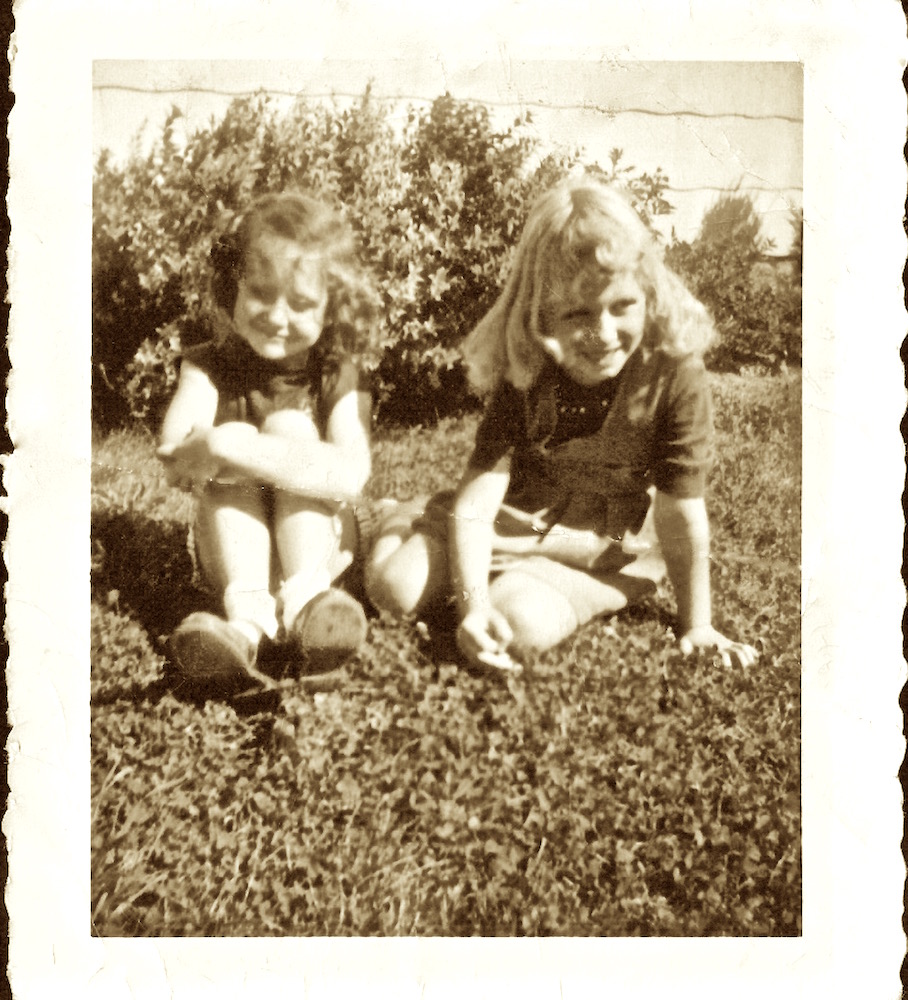
daily life color108 (1)My sister Patti and I, posed by my older sister Betty.  Those are “the” cherry trees behind us. The fact that we were wearing dresses suggests we were just home from Sunday school and church, our souls bleached as white as our shoes and socks!

 I used to eat red
from backyard cherry trees,
weave yellow dandelions
into cowgirl ropes
to lariat my Cheyenne uncle.

I once watched dull writhing gold
snatched from a haystack by its tail,
held by a work boot
and stilled by the pitchfork of my dad
who cut me rattles while I didn’t watch.

 I felt white muslin bleached into my soul
on Sunday mornings in a hard rear pew,
God in my pinafore pocket
with a picture of Jesus
won from memorizing psalms.

But it was black I heard at midnight from my upstairs window––
the low of cattle from the stock pens

on the other side of town––
the long and lonely whine of diesels on the road
to the furthest countries of my mind.

Where I would walk
burnt sienna pathways
to hear green birds sing a jungle song,
gray gulls call an ocean song,
peacocks cry the moon

until I woke to shade-sliced yellow,
mourning doves still crooning midnight songs of Persia
as I heard morning
whistled from a meadowlark
half a block away.

And then,
my white soul in my shorts pocket,
plunging down the stairs to my backyard,
I used to eat red,
pick dandelions yellow.

 (This is a reworking of a poem from my book Prairie Moths.) The prompt today was to talk about our earliest childhood memories.  https://dailypost.wordpress.com/prompts/childhood-revisited/

In Cold Blood

IMG_9290.jpg

                                                        In Cold Blood

I’m sure that the horrible, violent and senseless murders described in Truman Capote’s book In Cold Blood captured the imaginations of most of us in the U.S. Unaccustomed to such vivid descriptions of such violent acts, what small town family did not start locking their doors at night?

The slaughter of the rural farm family occurred on Saturday night, November 14, 1959; and although Capote’s book was not published until 1966, the press made much of it at the time it happened and I was well aware of most of the details of the murder of the father, wife and teen-aged children—a boy and a girl––as well as the capture of the two men who had murdered them. I was especially affected by the sad detail of the discovery of the girl’s Sunday School money tucked into her shoe in the closet. Whether she heard the men breaking in and hid the money so it would not be found or whether she placed it there so she wouldn’t forget, the detail has the same poignancy

After the murder, as I lay in bed at night––especially on summer nights when I found it even harder to surrender to sleep than during blustery cold nights in the winter––I often thought to get up and check the doors again: the front door, the door to the garage, the door from the garage to the mud room, the door to the basement and the back door off the pantry that led to the back porch. All had push-locks accessed by a key from the other side.
On one night in particular, that summer that I turned 13, I lay awake listening to the night sounds that streamed in through my screened window. My window adjoined the front door stoop and it suddenly occurred to me that anyone could slice the screen and easily enter. I got up from bed to close the window and open the air conditioning vent in the floor under it. While I was up, I decided to check all the doors again. All were securely locked except for the lock to the back “porch” which was really just a platform four or five feet wide with a hand railing that ran the entire length of the house from the back garage entry to the pantry/kitchen area.

The pantry held a sink for my dad to wash up in when he came in from the ranch, and since we rarely locked our house, many times he would just walk along this platform/porch and enter the house from the back where he pulled off his boots and emptied his cuffs off the back porch so he wouldn’t track wheat chaff or mud or other souvenirs of his day’s work through the house. Then he’d wash his hands and neck and face in “his” special sink and make his way to his rocking chair in the living room, where he’d spend the rest of the day resting until supper and reading before bed.

This platform/porch was actually quite a distance above the ground because our lot was on a small hill that sloped from front to back and right to left. This enabled the windows in the basement to be above ground level, whereas there were no windows at all in the front of the basement. On this particular night, I stepped out onto this roofless sideless porch platform. I could see the big dipper and part of the little dipper and the thousands of other stars in the summer sky, but I didn’t know the names of any of the other constellations.

I could smell the newly cut grass that my mother had mowed in the early evening of that day, after the sun had gone low in the sky. I remembered when I was little how my dad was less tired by the time he got home and so he’d mow the huge lawn around the old house. My mom would come after him with the lawn sweeper that collected the grass cuttings in a huge canvas cube open at the top to dump the grass into a huge pile by the gravel road where we kids would build nests and play bird. I was the baby bird fed imaginary worms or, if we’d had the right dinner, sauceless spaghetti, by my older sister.

By my teen years, however, my dad would be too tired when he got home from a day that started at 5 or 6 in the morning and often didn’t end until 8 or 9 at night if they were cutting wheat. His life was a hard one and I often wondered if he resented coming home to daughters reading on their beds or talking on the phone to friends.

Did it seem unfair to him that he worked so hard to support daughters and a wife who had such a life of ease? Although I had not yet started to really write, except for a diary I once kept for a few months or assignments for school, I did have an active imagination; and from a very early age, I had concocted elaborate stories all involving imaginary selves of the future.

Now on this night, I wondered why that door that I had checked before coming to bed to read was now open! Who and why would anyone open a locked door? As I lay thinking, I heard the door to my parents’ bedroom farther down the hall open. I could hear my father’s heavy barefoot tread turning not to his right—to the bathroom between their room and my sister’s––but instead to the left. Down the long hall to my room, the entrance hall, the kitchen, the mudroom and the back porch. I could hear the door opening and a few minutes’ delay before he padded down the hall again and closed his door.

Chill. I felt it zoom down my spine, hit my tailbone and ricochet back up to my brain where it froze the back of my head. I waited. For five minutes, and ten. Barely breathing. I cracked my door and when I could again hear my father’s loud snores, I sneaked back out to the door to the back porch, which was once again unlocked. As quietly as possible, I pushed the button lock in, then returned to bed where I remained vigilantly awake for the rest of the night. Twice more, my father got up to unlock the door. Twice more, I got up to relock it.

During all those long hours before dawn, I imagined the scenario. My father, formerly my protector, allowance provider and generous benefactor to the pleasures of my life—turned in my mind into plotter. He, too, had read all of the coverage of the Kansas murders, and it had given him ideas.  He had hired a man to sneak in, to bind him up and leave him helpless and then to kill us all. He wanted to be free. He was tired of his idle daughters, tired of his wife.

My father had, previous to this, gone through one of his week long silent periods where we knew he was upset about something—cattle prices, the threat of hail before harvest, my mother or us. We never knew what caused these silent periods where he would speak to none of us and sometimes even move to the basement to sleep. They never lasted over a week and afterwards he would be our same joking, generous, hard-working dad. But during those times, we tiptoed. We tried to cajole and charm, but it didn’t work. If we asked if he wanted his head rubbed, we were met with a curt sideways bob of the head or a “Not tonight!”

This was unheard of at other times, when we’d ask for money for a new dress or the show and he’d answer with, “Ya. Rub Pa’s head!” We’d do so, and then the wallet would come out. Not that we didn’t rub his head gratis as well. It just got to be a joke—this returning of favor for favor. Then he’d hand us his wallet and put his hand over his eyes, like he didn’t want to see what we’d take. We’d always show him, though. Was this okay? It always was.

At times other than his silent periods, he was our loving dad. Proud of us. Funny around guests, and talkative, but when home alone with us, usually tired––sleeping or reading one of the piles of magazines and books that lay on the long coffee table beside his chair. I mention the silent periods as an explanation of why I might even in my most fertile imagination conceive of an idea that my dad would be capable of planning to “off” his entire family.

But, imagine it I did. I became the protector of our family that summer, lying awake for as long as I could to listen for my father’s footsteps down the hall. And this was not the only night that he got up once or twice to unlock that back door. I never said a word to my mother or sister. I perhaps told my best friend, thinking if my protective efforts failed, at least one person could point the way to insuring the perpetrator of my demise came to justice.

In later years, I forgot about that terrifying summer and went back to loving and admiring my dad almost as much as before, but by then there was a difference. Whether it was caused by radical ideas picked up in my sixties college life and my need to define myself as more modern than my parents—who were themselves quite liberal––or a vestige of that summer of distrust, I’ll never know.

By the time my dad died eleven years later, they’d sold the house in town and moved to a smaller house they built a mile out of town. It was to escape town taxes, my dad always said, but I’ve always thought that for him it was a return to his early homestead days in another house with nothing in view but prairie grasses and a big weathered barn. This new “country” house built by my parents after I left high school was closer to town than the homestead of my grandparents, but was within sight of the big red barn of a farm he’d bought years ago for a hired man and his family to live in and afterwards rented out. The barn sat squarely between my parents’ new modern modular and the old farmhouse. There was a small lake nearby with otters and where the wild geese landed overnight in their migrations.

It was one summer night when I was home from college for vacation that my dad got up from where he’d been sleeping in his chair and walked through the hall and kitchen and out the back door of the house.

“Where do you think he’s going?” I asked my mother.

“Oh, he likes to go out to sniff the night air and have a pee in the dark,” she said with a chuckle. “He loved to pee off the back porch of the house in town at night, even though it was so much farther away than the bathroom. I never could convince him not to do it. I worried that the neighbors would see him. But I think he thought it saved water, or perhaps it just reminded him of his youth—peeing out the back door of the house into the night air.”

This post was written in response to Elyse’s scary babysitting piece which you can read here:  http://fiftyfourandahalf.com/2012/08/01/all-the-cool-kids-are-doing-it/


Uncornered

                                                                         Uncornered

daily life color103 (1)

Corners are the great equalizer, for it is a fact that no matter how large or small the house, every corner is exactly the same size. I remember being so small that I could fit all the way into a corner, right up to where it bent. If I was facing the wall, I could hold my head straight and fit my tongue into the crack that spread out in an L to form the two sides of the corner. If I faced outwards, I felt less punished and more ready to branch out from the corner into the kitchen, perhaps, with the refrigerator to be visited and a cherry popsicle to be collected on my way out into the world of my house.

Lying on my back on the purple living room rug––a floor that, although it extended to each corner of the room, had no actual corners itself. No chance of punishment. Facing downwards on the rug was entertainment: playing jacks or putting together a picture puzzle, moving paper dolls around their world of Kleenex box furniture, pot and pan swimming pools and matchbox coffee tables. In this paper universe were treasures purloined from the jewelry boxes of our mothers. Rhinestone bracelets became flapper necklaces and ruby-colored rings bangle bracelets. A folding fan stretched from side-to-side of the corner became the dressing room where Debra Paget donned her dressing gown, slipping out of her red paper high heels.

In the corner of my sister’s closet was the little cave I’d carved out of the shoe boxes and cardboard boxes of cast-off toys. There I’d wait for her to arrive home with friends in tow, to eavesdrop on their conversations in hopes of finding out who the boy was who had called her on the phone and hung up without identifying himself when he asked if she was there and I’d said no, she was out on a date. I might discover what she was going to give me for my birthday or hear any of the interesting secrets shared by girls four years my senior. But instead, it was the corner I fell asleep in, to wake up hours later when my mother called us down to supper.

“Where’s Judy?” I heard her ask my sister from the bottom of the stairs.

“She’s not up here,” I heard my sister answer as she went hop skipping down the stairs, two at a time. Even after I heard the door close at the bottom of the stairs, I stayed quietly where I was, barely breathing.

Five minutes later, I heard my sister clomping up the stairs again—looking in every room, the bathroom, under beds, in every closet except her own—I guess because she knew I couldn’t be there since she’d been in her own room for the hour before supper. I stayed quiet, giggling inside.

After my sister went downstairs,  I sneaked quietly out into the hall and down the stairs in my stocking feet, then creaked open the door and went running around the corner into the kitchen and dinette to take my usual place at the table—on the bench against the wall.

“Where were you?” my sister asked, “You weren’t anywhere!”

“It’s a secret!” I answered, and to this day, my whereabouts that day are an unsolved family mystery.

“Where was she?” They ask each other. Then, “Where were you?” they ask me again, but try as they may, no one has ever cornered me to give an answer.

Didn’t follow the daily prompt today as I’ve written about this one a couple of times, but here it is: https://dailypost.wordpress.com/prompts/strike-a-chord/


A House Divided

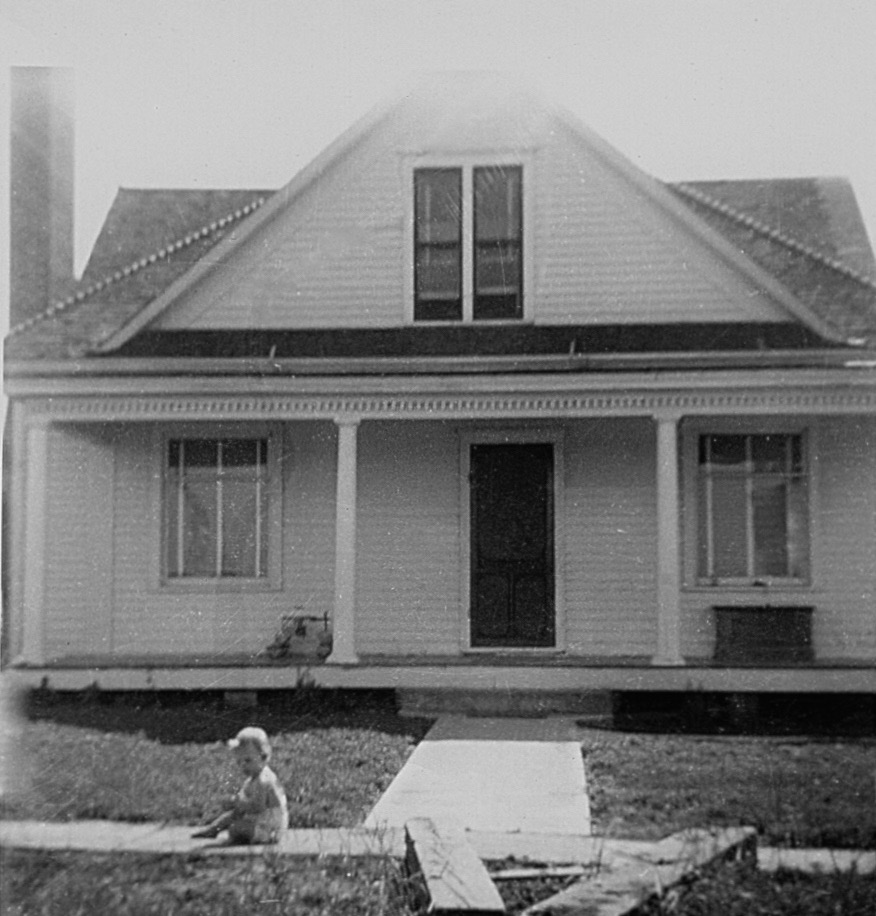
                     daily life color090 (1) This picture must have been taken very soon after we moved into the house because I was 10 months old when my mom and dad bought it and that’s about the age I look in this picture. I see the twin to the “piano bench” mentioned in this story sitting on the front porch and my dad has already seeded the lawn which appears to be growing.  Those boards were soon replaced by a thick layer of grass and a row of elm trees that grew up with me.

                                                            A House Divided

When I was ten months old, my father decided it was time to buy a house big enough for three girls and his wife. It wasn’t that he hadn’t offered my mother a nicer house long ago, but my mother had suggested he use the money to buy cattle instead, and it had been a good decision. By the time I was born, the ranch that my dad had begun when he purchased the 640 acre homestead of his parents had grown to over ten thousand acres. Some in town saw him as an opportunist, but as I see it, someone had to buy the land foreclosed on by the bank or given up on by men like his father who just did not have it in them to work the land and my father was a good guardian of the land and a generous benefactor to his town and church.

The house my father bought was a very large house owned by a man and wife who were horticulturists. My sister remembered a big room upstairs that looked like a laboratory but was actually a room used to grow plants. Since the house was both too big for his wallet and too big for one city lot, my dad, an enterprising man, actually bought half the house. My mother tells of seeing the men on the roof with saws, sawing it in half, then carpenters and plasterers sealing up the open walls on both houses.

She also tells of the perfect plastering on both the original walls and the new one—and after successfully moving the house the five miles into town on two flatbeds moving side by side down the night time highway, the shock of seeing the house slip off the jacks as they settled it on the foundation and hearing the plaster cracking and crumbling so that in the house I lived in, the surface of the walls was not exactly even—some seams jutting out a bit and not quite matched to the texture of the original plaster.

As a baby, I occupied the downstairs room that later became our dining room, but even after I was moved upstairs with the “big” girls at the age of 3, the place we ate 99 percent of the time was a sort of wide hallway between the living room and kitchen. We kids sat behind the table on what we called the piano bench, but it was actually one of the two bench-high dividers that separated the two parts of the living room. Wanting to create a more spacious feeling in the room, my mother had the two dividers removed so the living room became one giant room that extended across the entire front of the house.  On the left part of this room that you faced as you entered the house was an entire wall of bookshelves, filled with books and my mother’s salt-and-pepper shaker collection.

One of the lower shelves was stuffed bottom to top with comic books—a fact that made our house a favorite with Jimmy Kerlin, who would sneak in the front door and sit for hours on the floor, poring over Mighty Mouse and Superman, Little Lulu and Richie Rich comics. Our favorite family story was the about the time we got home from a day’s shopping expedition in Pierre—sixty miles away, to find Jimmy sitting on the floor in the corner, nose in the last of a long progression of comics he’d been reading all day long. Unbeknownst to us, he’d been sitting there reading when we left in the morning, locking all the doors to the house. He had remained happily reading all day long.

Whether his mother noticed his absence has gone unremembered in our version of the story, but may remain central in his family’s telling of it, although I believe that other than his younger brother Tommy, all members of that family known to me are now deceased.

A genre of comic books Jimmy might have found little interest in was not to be found on those shelves, for what we called “love comics” were forbidden by my mother. She had told Jack Mowell, who was the the local pharmacist/comic-book vendor, not to sell them to us, but we had an agreement with him. So long as they were buried in the stack and not on view on it’s top layer, he merely asked us “how many” without inspecting what exact comic books we bought.

At ten cents each, we usually bought them ten at a time, so quite a few love comics could be accumulated so long as one “Archie and Veronica” comic was positioned atop the stack. This portion of our library was kept at our friends’ houses or buried far beneath our beds or mattresses. By the time we were the least interested in this questionable reading material, our mother rarely ventured into our rooms since we were the ones responsible to keep them clean and orderly, to make our own beds, change our own sheets and carry our own washed and ironed clothes from the back porch washer/dryer/ironing room up the steep wooden stairs to our rooms.

I was only 10 months old when we moved from the east end of town to that big house on its near western edge. By the time I had an actual memory of that house, it had been much influenced by the taste of my 11 years older sister, who painted our upstairs bathroom chocolate brown and chartreuse and our living room different shades of maroon and puce to coordinate with my mother’s choice of living room drapes: maroon-ish sansevieria leaves on a chartreuse background.

The couch was a greyish-toned sectional that took up a good part of one half of the living room. In the room with it was a big blonde modern coffee table—unusual in its day and covered with a chartreuse planter and ashtray (even though no one in our house smoked) as well as current issues of Redbook, Ladies Home Journal and The Saturday Evening Post. On the other end of the room next to the fireplace, another long blonde coffee table next to my dad’s comfortably padded and uphostered rocking chair was covered by stacks of his reading material of choice: True West, Saga, Argosy, Grit, and the Mitchell Daily Republic newspaper.

In at least one of his magazines of choice, there was always a centerfold picture of scantily dressed or nude women—which furnished me with one of my first glimpses of the sexual nature of the world that I would have otherwise had no idea about. Certainly, the love comics were tame by comparison, and I’m surprised that my mother didn’t see fit to remove those portions of my father’s magazine library; but she never did and from a very early age, I was attracted to them like a magnet the minute no other member of the family was around.

It was a good house to grow up in. There were three rooms upstairs—one room each for each of us girls, once I was old enough to graduate from the downstairs nursery to the girls’ dormitory upstairs. I think we were the only house in town with three bathrooms—one upstairs for us girls, one downstairs for my parents and anyone present on the main floor of the house, and one in our largely unfinished basement—to be used either by whatever hired man might be living down there or whomever was in urgent need of a bathroom when the two others were filled.

Only our living room was carpeted––in a maroon tightly woven carpet. The floors of all of the other rooms, including all the bedrooms, were covered in linoleum, the colors and patterns of which each of us was able to choose for our own rooms. Mine was green with big leaves that coordinated well with the yellow walls and my ruffled white bedspread covered in big yellow flowers with green leaves. My sister Patti, 4 years older, chose a charcoal linoleum with pink and white and black flecks—dark pink walls and white painted furniture. My 11 year older sister Betty chose a green motif with green and white and black checked drapes and bedspread.

Thus, from a very early age, my mother encouraged our developing of an aesthetic unique to our personalities. To my knowledge, the ordinary was neither encouraged nor demonstrated in our family. In seeking to be different, my mother taught me that it was okay as well—and this has been a guiding principal in my life.

Thus it was that the house I grew up in—from its very inception by my father who, lacking the finances or terrain to buy an entire house, had the ingenuity to buy half of one––to my mother, who stepped outside the bonds of conventionality in her color and fabric choices as well as her taste in decorating elements­­––helped to form aspects of my personality that sent me out in life not seeking to meet the expectations of others but rather to follow my own impulses—to Australia, then Africa, California and Mexico. Not bad for a little girl from Murdo, South Dakota, population 700, on the wide empty plains of South Dakota.

The prompt: Our House––What are the earliest memories of the place you lived in as a child? Describe your house. What did it look like? How did it smell? What did it sound like? Was it quiet like a library, or full of the noise of life? Tell us all about it, in as much detail as you can recall.https://dailypost.wordpress.com/dp_prompt/our-house/

Merry-Go-Round


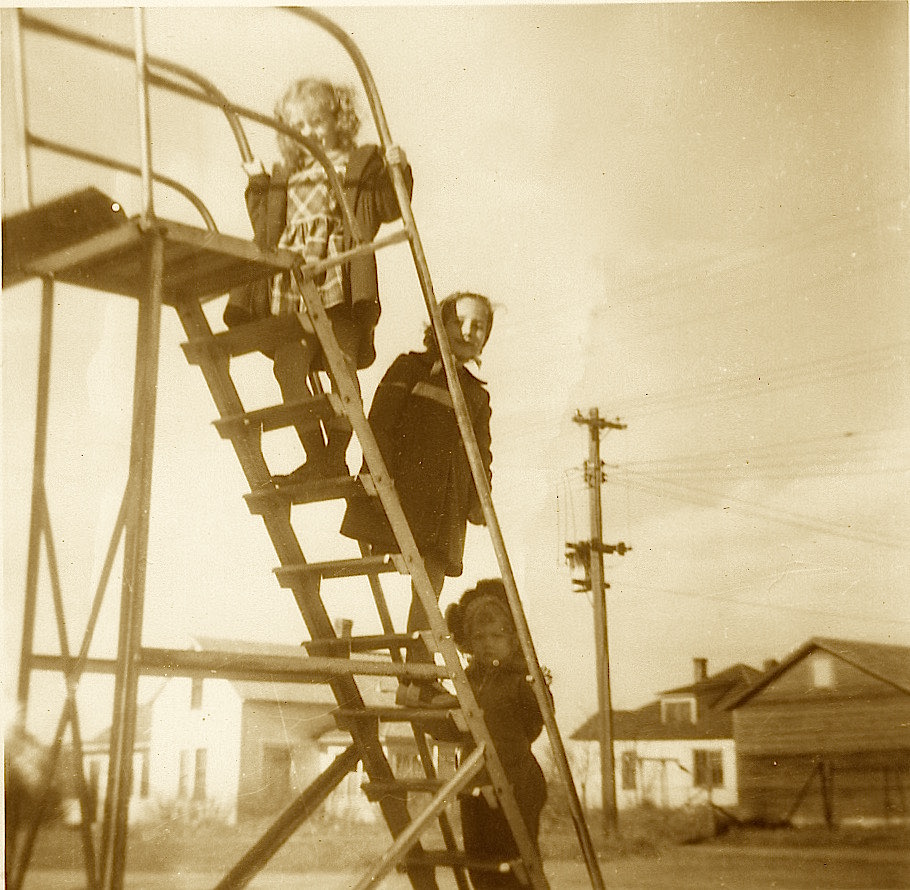
daily life color086 (1)
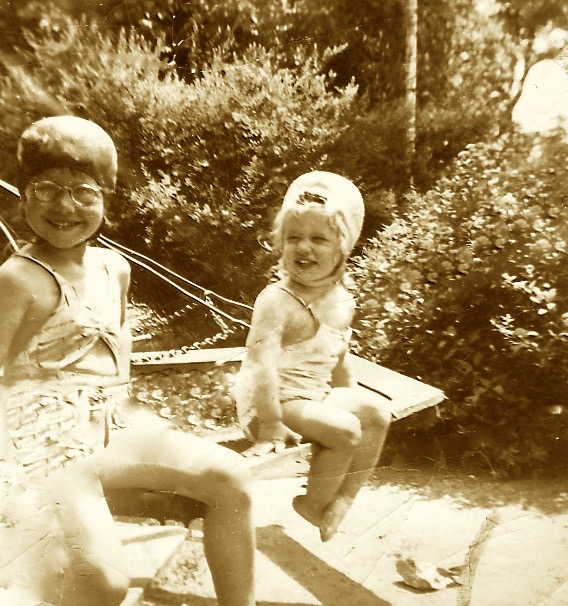
My sister and I at a park near my grandma’s house in Kansas on a merry-go-round similar to the one in the school playground across from our house in South Dakota.

                                                                   Merry-Go-Round

Their creaks were my alarm that kids were on the elementary school playground across the street and if my biggest sister was downstairs or away from home or even sleeping as soundly as she always did after coming home late the night before, I’d sneak into her room to look out on the playground from above and see who was there. I knew the difference in the sound between the merry-go-round and each set of swings—the little swings next to the little slide, or one of the three big sets directly across from the block my house was on. Higher, with longer and more flexible chains, these swings could be made to loop de loop—pass up so high that you actually went over the top of the frame the swings were suspended from and wound the chain once around the pipe.

Some of the boys could repeat this three or four times until the swing got so high that none of the little kids could get up to it. Then the janitors would have to get their tallest ladder and go up to push the seat over and over the cross pole with one of their big push brooms to straighten it out again and bring the seat down closer to earth.

There were rules forbidding loop de looping, but the boys would come after school when all the teachers had gone home and even our janitors, Mr. and Mrs. Polachek, who lived kitty-corner across from the south end of the playground, were at home in their backroom away from the sounds of kids in the neighborhood, sealed up tight and safe. They were Polish, and now that I think of it, probably displaced persons from WWII. Their accents were thick and her temper was short and they were the objects of constant tauntings from the boys. One year the boys had hung a dead cat from their front porch on Halloween. I wish I could remember whether I thought this was funny, as many of the kids did. I hope I didn’t––that I was as sickened by it then as I am now.

The creak I was listening for was the creak of the merry-go-round. Teepee shaped, it had a wooden runner all the way around it a foot up from the ground. There was a handrail about thirty inches above it, so you could stand on the wooden runner, facing the center pole, hold onto the hand rail and enjoy the ride as the big kids ran around in circles around the merry-go-round, pulling it with them to go faster and faster, then stood on four sides of it, grabbing the handrail pipe and pushing it off to make it go faster still. One by one, more onlookers would be enrolled in the joint effort to get it going fast enough. Then they’d jump on and everyone would pump up and down, sticking their bottoms out into space as they bent their knees, pumping to keep up the momentum.

There were other ways to use the Merry-go-round. The bigger girls like Marie Holstedt who lived on the street that faced the opposite side of the playground from the one my house faced, would sit on the foot board with her boyfriend Robert. Their feet side by side on the ground, they would sway to and fro in a kind of two-step movement—two to the right, then one to the left––their knees touching with their swing to the right, their hips touching when they swung to the left. When they did this, the sound of the merry-go-round reminded me of the strange rhythmic creaking I’d hear sometimes late at night in my house.

It was probably the TV antenna on the roof, my mother had said. Or maybe the furnace trying to pump out heat, she had speculated when I pointed out that it had been a windless night.
Life was simple and I believed her. Only now do I make sense of it and of my father’s late night short trips down the hall to the bathroom—the washcloth always draped over the tub faucet the next morning.

It was an innocent age where it was entirely possible to be eleven years old and to never have had the least idea that anything like sex existed in the world. Yet a good deal of what eventually led up to it went on in the playground across from my house. Older girls would sit in the swings, swaying back and forth without ever taking their feet from the ground. Or, take fast running steps forward and backward without really letting go and allowing the lift off. To their side or in front of them would be their crush of the day or the week or the hour. If he was not the boy of choice, sometimes the girls would switch swings. If the boy switched again, too, and the other boy let him, then it was a sign language of sorts that indicated which boy favored which girl, and if the girls went home, a clear message that things had not matched up correctly to their satisfaction.

But at other times––usually during games of ditch ‘em played in the twilight and darkness of summer, courtships could progress toward hunkering down in the ditches around the playground, close up to some culvert where the ditches were their deepest, the girl in front, the boy with his arms around her waist, holding her back from running to try to get to home base when one of the littler kids who was “it” ran past without seeing them. In these junior high years just past childhood, the objects of the games started to shift until finally in high school, the rituals of the old games were left behind entirely and ditch ‘em became merely a starting place––as did the swinging back and forth, the pumping, the dance.

Today, with merry-go-rounds a thing of the past, they are still an appropriate metaphor for what life pushes us toward from our birth. It begins with our rocking in the arms of our mothers, the rocking chairs of our grandmothers, the wild swings through the air locked hand-to-hand with our fathers. It is what slippery slides and swings and merry-go-rounds and dancing move us towards. Everything going around and around and in doing so really going back and forth from generation to generation. Passing the world on and fading away. Now and then doing a loop de loop just because we can.

daily life color087 (1) daily life color088 (1)
In response to The Daily Post’s writing prompt: “Ode to a Playground.”A place from your past or childhood, one that you’re fond of, is destroyed. Write it a memorial.

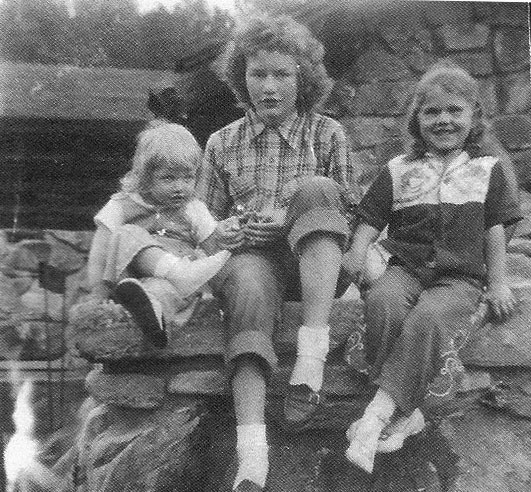
girls on wall
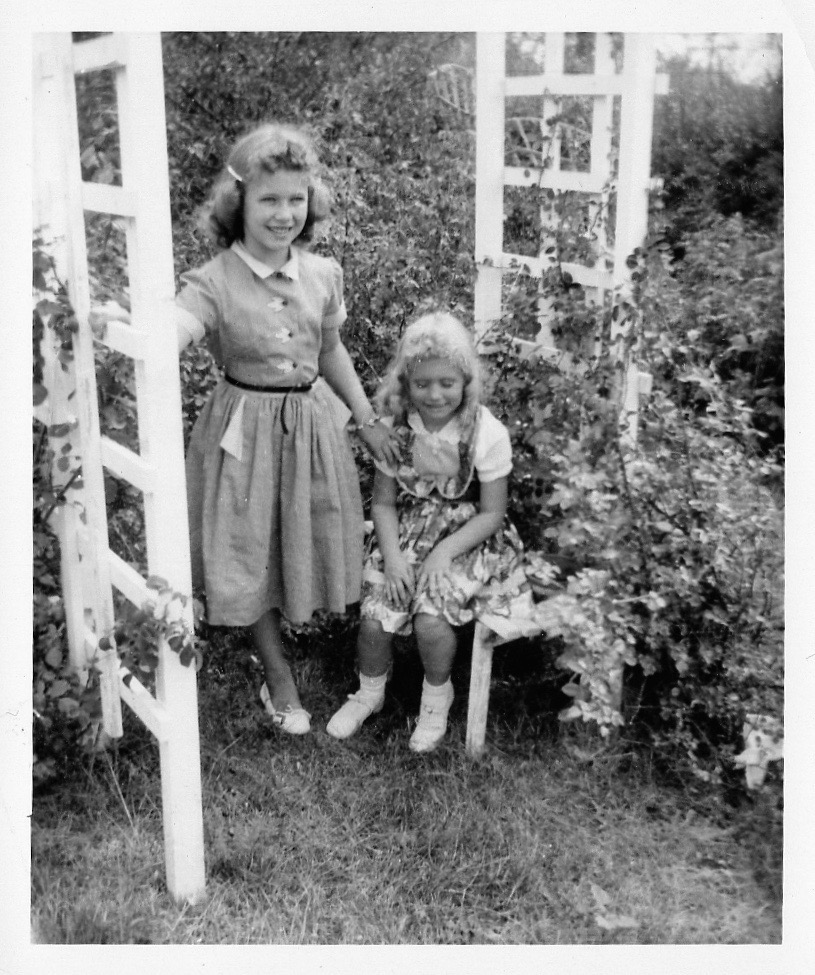
My sisters Betty, Patti and me, back in my pre-crush years. I remember being very proud that my legs had finally grown long enough to cross! Not too successfully, by the look of me.

Crushed!

When I was very small, I was notorious for hating boys.  My eleven-years-older sister once came into the living room and I was running around and around a big chair.  “What are you doing?” she asked. “Chasing boys!” was my answer. My sister was at an age when “chasing boys” meant something else entirely, but she got my drift.

When I was six, a lovely southern lady moved to town who enlivened the entire town.  She taught ballet and acrobatics to the girls and square dancing to everyone age 6 to 76.  This only lasted for a year or two, but twice a month most of the town would gather in the fairgrounds meeting room to do-se-do and alamand left.  I was usually paired with a little boy who was in my first grade class.  One night, after an especially invigorating “trade your partner,” when I was once again hand-in-hand with him, he gave me a big kiss.

I can’t remember my reaction, but I certainly remember his mother’s.  Abandoning her “trade your partner,” she came flying across the dance floor to shake her finger in his face.  “Shame on you, Brian!” she said, “Shame on you!”  (Not his real name.)  She then grabbed him by the upper arm and jerked him off the dance floor to go sit in a chair by the wall.  I was left without a partner and so had to dance with Will Prater, a grown man who was jerky and severe in his movements and who nearly dislocated my shoulder every time he swung me around.

Brian’s mother’s fervor in upbraiding him worked.  He never dated a girl, let alone kissed one, for his entire grade school and high school life.  He did ask me to the prom my sophomore year, but unfortunately I had accepted a date with another boy the night before.  By then I had a pretty big crush on him, fueled by his third grade tauntings of ‘Mayor’s daughter, mayor’s daughter,” when my dad was, indeed, mayor of the town, as well as a lifetime of torments in study hall, where he would break my pencils or pass me notes upbraiding me for scoring higher than he did on chemistry tests .  In my town, teasing was foreplay, but unfortunately in this case, the foreplay led to nothing, since he never repeated his offer of a date, in spite of his dad’s best efforts.

By my junior year, I was dating a boy from out of town.  “What are you doing dating that White River boy?” chided Brian’s dad every time I ran into him on the street or in our little town’s one  general store where I had gone to run an errand for my mom or to buy penny candy or a bag of Russian peanuts (our name for sunflower seeds.) “There are plenty of good boys right here in your own town!”

I knew he meant his own son, and had I not been in the throes of first lust with that “White River boy,” that would have been fine with me, as my longtime crush had continued.  But, alas, Brian never heeded his dad’s hints, either, until my sophomore year in college when, both home for the summer from college in different states, he finally asked me out. There is no crush like the one where contact is long delayed. I remember one very hot and heavy kissing session before we both went back to our separate lives.

We both married older people with children.  Both became swamped in our own lives.  I see him now and then at school reunions and of course crushes rarely survive a combination of reality and the passage of years.  But everyone needs a first crush, and perhaps he doesn’t remember that I might have been his, but he has the distinction of being mine.  I wonder if he would be surprised.

In response to The Daily Post’s writing prompt: “First Crush.” Who was your first childhood crush? What would you say to that person if you saw him/her again?<

For Red: The Summer Home

The Summer Home

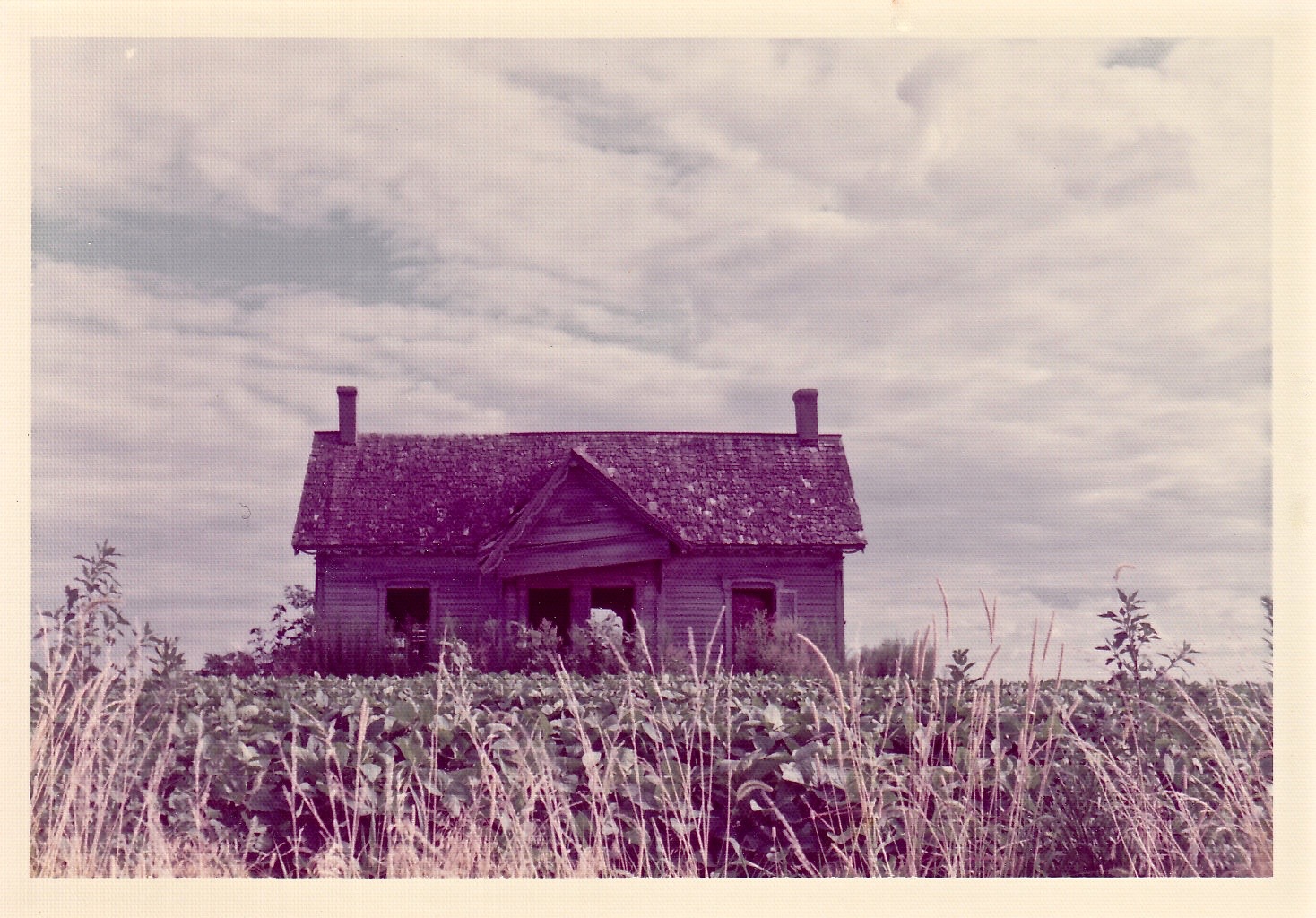
Decaying Farmhouse in Missouri Soybean Field

Photo by okcforgottenman, aka flycatcher

THE SUMMER HOME

When my dad bought the land
where the Big White River and Little White River joined,
I couldn’t believe that we owned land with trees on it.
While he plowed the small field,
I walked the woods and found the abandoned shanty.
Its door was open; in fact it could not shut.
Inside was a mysterious, sweet and fecund smell–
a mouse smell new to me
that I couldn’t stop myself from breathing in.
The mildew and the dust,
the musk of warm linoleum,
every new smell and sight was magic.

I was enchanted by this house emptied
of chairs and tables and beds,
yet full of the accumulated energy of past tame lives
and present wild ones:
the moving of leaf shadows
across the chipped linoleum of the L-shaped kitchen,
the dents on the floor where the kitchen chairs had set,
as though someone had taken care each day
to line up the legs in their holders.
Upstairs I found crayon scribbles halfway up the wall–
the arm reach of a three-year-old.

When I asked about the house,
my dad said that it was our summer home,
and the next time we went to the field,
I brought a broom.

I cleaned out the mouse droppings and the tumbleweeds.
I collected the peeled tile fragments,
imagining gluing them back again.
I washed out a quart canning jar at the pump
and filled it with spring water
and sweet clover,
putting it on the floor
between the kitchen chair holes
in the exact middle of the vanished table.
With the old shirt I found in the corner,
I rubbed mud and river sand
from the linoleum counter tops.
More sand worked as Ajax to scrub out sinks.

All summer long I worked on our summer home,
and for that summer and many summers to come,
I waited in vain for our move to the river house.

I sat on its screened front porch.
Outside the screen grew spearmint and peppermint.
On the top leaf of the tallest branch was a grasshopper,
the kind that left tobacco stains in your hand
when you held it.
All around me were the trees–
the swaying shedding cottonwoods
and scrub chokecherries.
It was a wealth of trees I’d never seen before
in the town where we lived on the bare prairie
nor on the roads we traversed for hundreds of miles
to see a movie or a dentist
or to buy clothes.

Around the screens buzzed the heavy flies,
their motors slow in the heat of July–
all the flies on the outside
wanting to get in
and all the flies on the inside
pressing the screen to get out–
like I longed to get out
to the freedom of trees
where black crows
and dull brown sparrows
rustled their wings
and flew from branch to branch.

In the distance, meadowlarks called
the only birdcall I ever recognized.
No squirrels, no chipmunks; but, rabbits? Yes.
My father said no bears,
but he’d told me the story of Hugh Glass,
mauled by a bear,
walking this river for a hundred miles
past this very joining of the Big and Little White,
in search of help;
and I could imagine one last bear or two
hidden in my woods.

So at night, at home in our winter house in town,
when he told the story I loved the best,
I was the one who discovered the bears’ cottage,
and the cottage was our summer home.
The chairs–too hard, too soft, just right—
I sat upon in turn,
taking great care every time to nestle each leg
back into its correct place on the kitchen linoleum.
And when I lay in the perfect bed of the little bear,
I could touch the crayon markings on the wall.

So when the three bears found me asleep
in the little bear’s room,
they weren’t really very scary;
but I ran anyway,
into my dark and shadowed owl-calling woods,
my woods still echoing the day lit fluted calls of meadowlarks,
their music shaken from the snarled leaves
in the evening breeze.
I ran to trees–
their leaves frosted by moonlight and the Milky Way,
vibrating with the power of the Big Dipper and Orion,
the Seven Sisters and the North Star.

Into the trees
to where I stored my memories
in the frog-croaking depressions under clumps of grass,
in the tangles of Creeping Jenny
and the fluff of dandelions,
in the sand hollows
that crept up from the riverbanks,
in the cocklebur and the chigger-infested grass,
in the crooks of cottonwoods and caves of thickets,
in the tiny cupped palms
of sweet clover and purple alfalfa,
in the wheat grass and the oats and trefoil.

The year my dad decided to expand the field
on the river bottom,
I pleaded, I cajoled, I promised, I prayed
for the summer home
where I had lived for neither one summer
nor one night, in actuality,
but where, nevertheless, I’d had faith
I would someday live.

Of course, there was no saving the woods
and summer house.
It was rich river land, prime for irrigation.
The trees were a waste of soil.
The summer home–everybody’s gentle joke on me.

After the cats and bulldozers were through,
I went with my dad to see
where trees had been ripped out,
the house burned to the ground,
the soil turned and planted
with crops that would build the land.
Their woods now furrowed soil,
the crows and sparrows
had gone to some other shaded place;
the mice, back to the fields.

My former references of trees forever gone,
the present references of sky and fence posts
too wide and new,
I wasn’t sure where my summer home had stood.
The house’s ghost destroyed by the bright sunlight,
the woodland paths replaced by tractor treads,
I watched instead a meadowlark
soar over brown fields and settle on barbed wire,
claiming the new field for its own.
With no house or forest left,
my only shade was chokecherry bushes,
my only chair, the pickup running board.
And so my summers at the river
vanished in the smoke of my summer home
and smoldering tree stumps.

But every night, my woods again threw still shadows
over the summer house,
and I ran once more the corridors of moonlight
cut through dense trees
like parts in a small girl’s hair.
I ran in the wet dew of the condensing summer heat.
I ran on the fuel of my need for magic
and wildness
and rivers
and trees.
I ran fueled by my need to be with something
that lived outside my window
as I passed long nights in my winter house.

It lay in the dark tapping of the trumpet vine branch
against my window
and the crunching of gravel
as someone walked by on the unpaved street–
out past midnight and I couldn’t tell who.
It lay in the pricking of the hair on my arm
as I stuck it out from the bed
and pressed it to the screen.

Always, in town, it lay outside of me–
except for when I floated the paths
of the woods surrounding the summer house,
joining it in dreams,
night after night and then less frequently
until the dreams came once a month
or once a year–
in darkness, always recognized;
but nonetheless forgotten in the light.

So by the time I saw the river field grown lush with corn,
I was a teenager in my first grownup swimsuit,
floating the milky Little White in an inner tube,
down to its junction
with the clear and colder-running water of the Big White,
my best friend next to me,
our cooler full of Coca-Colas and ham salad,
our conversations full of boys and music.

At the border of the field, to get to the river bank,
we crawled over the border of large tree trunks
laid horizontal, half-buried in sand.
I guess I knew they were the bones of my midnight woods.
I guess some part of me felt
the ghost of my summer house.
But, as I lay on my back on the submerged sand bank,
the warm water flowed so sensuously over my shoulders
and down my legs
that my suit seemed to peel itself
from my shoulders, breasts, thighs, calves.
And in a dream I floated the muddy water
of the Little White,
turning in the current
until the water seemed to flow inside of me,
floating me down
to the cool clear water of the Big White,
farther and farther away
from the summer home.

This poem was posted specifically as a response to THIS post on Red’s Wrap.

“The Summer Home” is excerpted from Prairie Moths–Memories of a Farmer’s Daughter, which is available Available on Amazon in Print and Kindle Versions and at Diane Pearl Colecciones and Sol Mexicana in Ajijic, MX


Wheat Cover 34 font

 Just as moths rise from prairie grasses to fly away, so did the author yearn to be free from the very place that nurtured her. Judy Dykstra-Brown’s verse stories and accompanying photographs give a vivid portrayal of rural life in the fifties and sixties, evoking the colors and sounds of the prairie and the longing a child with an active imagination feels for faraway places. From a small child curled up on the couch listening to her father’s stories of homestead days to pubescent fantasies of young itinerant combiners to her first forays into romance in the front seat of a ’59 Chevy, her memories acquire a value in time that she did not acknowledge while living them. Lovers of good poetry and those who miss the magic of childhood will relish Prairie Moths. (Excerpted from a review by Harriet Hart)
 

Creepy Critters

1913688_1136038367865_7037617_n

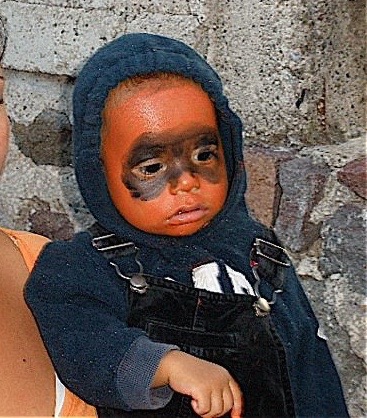
This little girl looks like she’s already had too much Halloween candy.

1913688_1136038087858_6027993_n

You scream. I scream. We all scream for ice cream!

1913688_1136038007856_1648819_n

What do you mean you’re out of Snickers bars?

1913688_1136037767850_5683525_n (1)

Can’t wait until I grow up and don’t have to do this kid stuff.

1913688_1136038287863_5588685_n

Will trick and treat for Kleenex

1913688_1136038167860_1696102_n 1913688_1136038127859_5133796_n

1913688_1136037727849_5594428_n

You only have apples left????


https://dailypost.wordpress.com/dp_photo_challenge/creepy/

IMG_0001

Although this is a picture of my childhood friend and me, it is used for illustrative purposes only. The poem is fictional and in no way describes either one of us.

Fidelity

“We’ve been friends since we were skinny!”
–Anonymous

Yes, we grew up friends and stood up at each others’ weddings.
She was there for all my break-ups. I was there for all her beddings.
And though she thinks I’m poorly dressed and I think she’s a snob
who only talks about her “things,” fashion and her job.
And though she lets her eyes stray, like she finds my talk is boring,
and puts polish on her fingernails  while mine are apple coring.

Though she prefers the opera while I like the Avett Brothers,
and dines on caviar while Burger King is more my druthers.
While she shops for Michael Kors, Yves Saint Laurent and Fendi,
Ross Dress for Less is where I shop for clothes that are less trendy.
She drives a new Mercedes while I drive a beat-up Chevy.
While she works out at her health spa, I have let myself get heavy.

Yet none of this has ever put our friendship in the skids.
I pat her little yappy dog. She puts up with my kids.
For though we’ve evolved differently,  she still is my best friend,
and the history between us means our bond will never end.
Though she lives in a mansion and my house is a dump,
Just one thing could divide us. That is–if she votes for Trump!!!

In response to The Daily Post’s writing prompt: “Delayed Contact.” How would you get along with your sibling(s), parent(s), or any other person you’ve known for a long time — if you only met them for the first time today?