Category Archives: Essays

Dare I Tell How I Excel?

                                                judy 3

                                                     Dare I Tell How I Excel?

No matter how much we might admire ourselves, there is something off-putting about revealing the fact. For some reason, by pointing out our own good points, it makes others less likely to admire them.  The one place where this fact of life is not true is in the resume,  where we can revel fully in revealing to the world how absolutely wonderful we are.

Some of us exercise our right to brag by the family wall.  Here we can display our successes as well as the successes of the families we have raised and  dynasties we have sired via photographs that show us at our most beautiful and successful periods of our lives.  Pictures with presidents or other celebrities,  awards and impressive vacations may all rub shoulders on this family wall.  By placing them in a prominent place–in entryways, offices, studies or staircases––we insure that they call attention to themselves without having to actually do so orally.  Thus we retain our humble natures while more subtly revealing to the world what superior human beings we really are.

The Christmas letter is another invention wherein we seem to think it is perfectly acceptable to toot our own horn.  The result is probably a lot of mail that, once quickly scanned if read at all, is quickly relegated to lighting the Yule Log. How much good news goes up in conflagration during the holiday season has never been calculated, but I can imagine that a good many gain a bit of satisfaction by sending these notices of how well their friends’ lives are going up in smoke.

So, when given the opportunity by WordPress to extol my own virtues, I must demur.  Luckily, in this cyber age, we need not call attention to our own virtues, for Google is always there to do it for us.  If we are lucky enough to sport an uncommon name, both the laudatory and shameful facts of our lives are there for all to see for the price of a few moment’s time and a little patience in sorting through the hundreds of thousands of bits of information available when our names are typed into the subject bar.

It is true that most of these bits of information probably do not apply to us at all, but the search for the ones that do can be as satisfying as a scavenger hunt, and the prize is, that in addition to all the good bits, we get to dig out the little bits of scandal or failures as well.  And who doesn’t like a little bad news sprinkled in with the good?  It gives a certain flavor to a life, as well as comfort that perhaps our own life–as boring, humdrum and plain as it may seem in comparison––isn’t quite so bad after all.

The Prompt: Toot Your Horn–Most of us are excellent at being self-deprecating, and are not so good at the opposite. Tell us your favorite thing about yourself.


Why We Believe

DSCF2907
Why We Believe

I think the reason why I believe is probably at the root of it the reason why we all believe in something.  It is just such a miracle that anything exists and that I get to be a part of it. What are the chances out of the entire universe that I would be born  at all, let alone born to the time and place and parents that I was? And what are the chances that I would be healthy and have the benefit of an education and that I would find the courage to live the life I want to and continue to have that courage into my sixties and I hope my seventies and eighties and nineties.

I can understand why it would be hard to continue to believe in the magic of life if one were ill or abused or confined or physically handicapped, yet people do continue to hold onto every scrap of existence.  Life is such an incredible thing and to not appreciate it when we have every reason to appreciate it is such a waste.

There is so much cruelty and oppression and greed and poverty and disease and sadness in this world.  Yes, we do what we can to fight it, but an additional and very important way to fight it is to be as productive and happy as we can be.  Polarity demands its opposite and the world changes for the good by holding onto as much of the positive as we can.  Living it.  Promoting it in others.  Helping each other.  Good mothers and fathers do this every minute of every day and those of use who don’t have children can do it by trying to be surrogates for those children and those adults who need our care and help.  This help may be given in an organized fashion by volunteering and donating or by the way we treat others in our every day life.  We can be observant. We can be helpful.  We can be as kind to each other as possible, given that we are human and feel anger, fatigue, frustration and hopelessness.

At the end of the day–even the worst day–we get to choose whether to give up or to continue to believe, and even if the choice is to give up, we have one more chance.  I think dreams are messages and reminders we send to ourselves–little boosts encouraging us to listen to that deep part of ourselves that will always believe, even if it has to go on without the support of our conscious minds.  It is the part we get to when we write or draw or paint or dance or sing or play an instrument.  That is the importance of the arts.  They connect us to our beliefs.

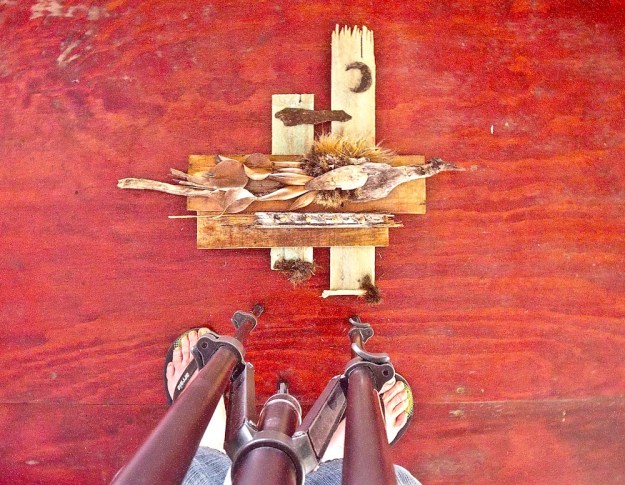
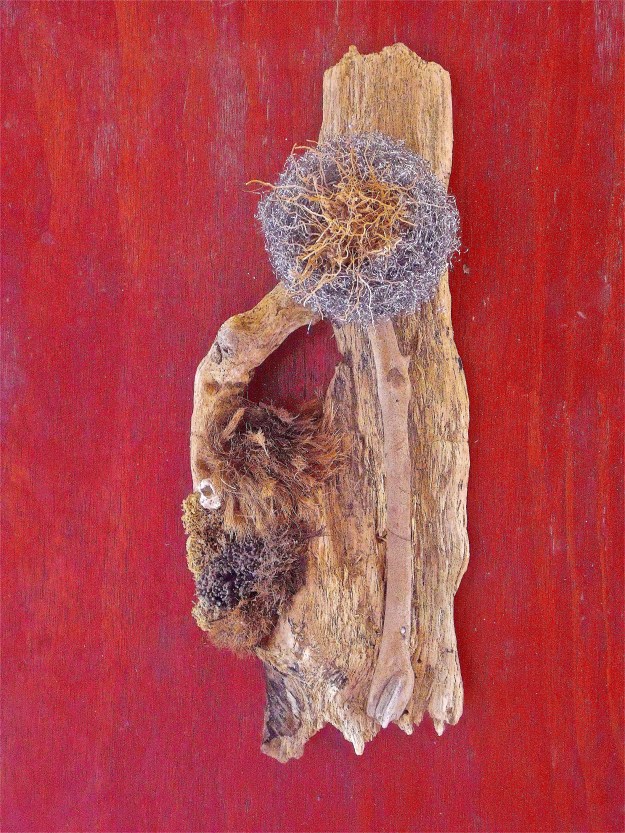
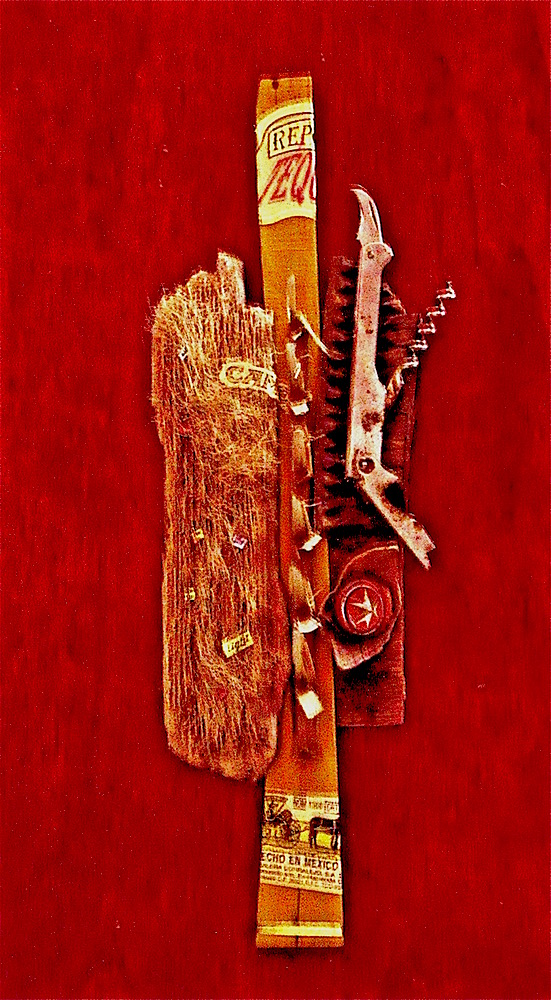
So when I find myself floundering, whatever time of the day or night, my easiest way to find a reason to keep going is to do what I’m doing now.  To write. Or to make art out of whatever I find around me.  For in this aspect, art imitates life.  It is simply looking around for what we can find around us and making the best of it.  Someone once says “It is the job of the artist to take the detritus that the world creates and to hand it back to the world as art.”  That is exactly what I do in my “found art” collages.  And this, at the end of the day, is enough for me to believe in.

DSCF2942

Click on any one of the images to enlarge and enter gallery.  Can you find “Lord Love a Duck,” a pheasant, frigate birds, the ballerina, puffin, a seal, a sea bird, wild pig or “Found Heart?”  I just realized I left out my favorite, so I’m going to add it below.

DSCF1949 (1)


The Prompt: In Reason to Believe, Bruce Springsteen sings, “At the end of every hard-earned day / people find some reason to believe.” What’s your reason to believe?

The Time to Be Good

                      IMG_1180

The Time to Be Good

In a study by Oxford Online, associated with the Oxford English Dictionary, “the” was found to be the most frequently used word in the English language and each of the other words in my title was the most common word in the English language for its part of speech. It is no surprise to me that the word “the” heads the list. “The creates specificity. It helps us to define and narrow the field. It wins us precisely what we want. Ours is an era of so many choices––a plethora of brands of everything from potato chips to lipstick. Don’t even get me started on coffee. Starbucks alone maintains that it offers 87,000 combinations of coffee choices! Reason enough to need a bit of “the” in our vocabulary. Plain coffee Americano decaf with soy milk and stevia? That is “the” choice I make every time.

“To” is indicative, I think, of our modern need to be elsewhere. A Ted Talk that I recently viewed showed a video that depicted all of the airplane flights occurring simultaneously, then all of the ships enroute. If it had tried to depict commuter traffic, I’m not so sure that much of the U.S. would have been lit up, rendering any distinction between vehicles or routes to be impossible to make out. We drive to work, to play, to school, to recreational facilities. Then on the weekends we drive elsewhere to “escape,” but in doing so, are trapped in more traffic. In airports, we watch people coming off a plane to come “to” where we are as we await the opportunity to board the same plane to go “to” where they just came from. We are almost constantly going “to.”

I was surprised that “time” is the most commonly used noun in the English language, mainly because, with all of our labor saving devices, somehow we have less time rather than more. If someone disagrees, please, please inform me of how you have managed this. I no longer even have time to read unless I listen to an audiobook and combine my reading with other activities such as driving, working in the studio or kitchen or while trying to fall asleep at night.

So why is the word “time” so frequently used? As I tried to figure out why, a number of phrases I’ve used in the past 24 hours swam into memory. While preparing to leave for two months at the beach, I have almost constantly worried about not having “time” to arrange for everything I needed to arrange for in order to leave on “time.” I won’t bore you with the list, but it is long and varied and has kept me so busy for the past two weeks that I found my “time” had run out last night. I was due to leave this morning, but had not found time to say good bye to best friends, let alone time enough to write this blog and finish packing. So I delayed my departure by a day in order to gain “time” to depart in a more leisurely fashion. I made “time” for things important to me, such as this essay I am writing right now and the possibility of saying good bye to friends such as Audrey, whom I haven’t seen for weeks because neither of us has had the “time.” Perhaps it is our complaints of having so little of it that cause us to overuse the word?

The most commonly used words that I am most heartened by are best when combined. “Be good.” What better advice for each of us and what message is most needed in a world of cyber shaming, corporate greed, Isis and the seeming impossibility of gun control, let alone control over the kids and crazies who refuse to exercise control? It is a selfish world we live in. “Be” is too often considered in regard to only ourselves. But “good?” It seems to be an aim that more and more of us yearn for—hoping to combine it with “be” in order to restore sanity and love and caring for our fellow human beings––whatever their skin color or religion or social group or national background.

Perhaps in our choice of most commonly used words, be they conscious or unconscious, we are all sending ourselves a message. Like a crossword puzzle, we just need to combine them in the right way. It truly is the time to be good!!!

(If you’d like to see other most commonly used words, go HERE.)

The Prompt: Morphing—Language evolves. The meaning of a word can shift over time as we use it differently—think of “cool,” “heavy,” or even “literally.”Today, give a word an evolutionary push: give a common word a new meaning, explain it to us, and use it in the title of your post.

https://dailypost.wordpress.com/prompts/morphing/

Saved!

The Prompt: Sink or Swim. Tell us about a time when you were left on your own, to fend for yourself in an overwhelming situation — on the job, at home, at school. What was the outcome? For once, I’m going to take the prompt literally.  I wrote about this in January, so I’m going to use a rewrite of the tale I told at that time.

IMG_0013

Saved!

Although I’ve never had a child of my own, I love children; and from a very early age, my eye in any social situation was always drawn to babies. When I was little and my mother would take me along to meetings of her Progressive Study Club, I would always stand in the bedroom to watch the babies spread out on the bed by their mothers, surrounded by their coats.  In a similar fashion, I notice babies in restaurants and on the street––  especially babies who are facing backwards over the shoulders of their parents.  I love seeing what they are looking at––who they are communicating with through their eyes and their smiles.  I love it that babies have a private life even in the company of their parents.

In this modern age of child abductions and pedophiles, parents might find this creepy, no matter how benign one’s motive is in watching their children; but in my case, if they have not forgotten, there are two sets of parents who should feel very grateful for my interest in their children; for although I have never birthed a child, I am responsible for the presence of two children, now grown to adults, who would not be here but for me. In both cases, I saved a baby from drowning.  Both times, although there were other people in the proximity, they were in social situations where no one noticed what was going on as the baby nearly came to harm.

One of the times was at a housewarming party given by my boyfriend’s son in California.  We’d all been given the tour, including the garden and hot tub, which was up on a raised patio out of view of the house.  As we stood in the living room talking and drinking before the meal was served,  I noticed that the toddler of one of the couples was not with his mother. Looking into the other room, I saw he wasn’t with his father, either, and I suddenly had a strong feeling that something was wrong.

I ran out of the house and into the garden just in time to see him at the top of the stairs leading to the hot tub.  He toddled over to the side, fell in and sank like a stone.  I ran up the stairs, jumped into the hot tub and fished him from the bottom before he ever bobbed to the surface.  I remember the entire thing in slow motion and have a very clear memory of the fact that it seemed as though his body had no tendency to float at all, but would have remained at the bottom of the deep hot tub.

The parents’ reaction was shock.  I can’t remember if they left the party or if they really realized how serious it was.  I know they didn’t thank me, which is of no importance other than a measure of either their inability to face the fact that their child had been within seconds of drowning or simply their shock and the fact they were thinking only of their child.

Strangely enough, this had happened before, at a stock pond just outside of the little South Dakota town where I grew up.  Everyone went swimming there, as there was no pool in town.  When I was still in junior high, I’d just arrived when I saw a very tiny girl—really just a baby—fall into the dam (what we called a pond) and sink straight down under the very heavy moss that grew on the top of the water.  Her mother had her back turned, talking to a friend, and no one else noticed.  I jumped in and fished her out, returning her to her mother, who quickly collected her other children and left.  Again, no word of thanks.  It is not that it was required, and I mention it here only because it happened twice and, having not thought about this for so many years, I am wondering if it wasn’t embarrassment and guilt on the part of the parents that made them both react so matter-of-factly.


https://dailypost.wordpress.com/prompts/sink-or-swim/

Listed or Listless

The Prompt:  Have you ever made a New Year’s Resolution that you kept?

IMG_0893

Write it down!!!!


Listed or Listless?

Of course I have accomplished my New Year’s Resolutions.  A few times.  Once I did a project with a friend where we each wrote down what we wanted to accomplish.  I believe I had eight things.  Since we illustrated our resolutions, my quotes of what I wanted were scattered throughout my illustrations.  Shortly after we did this, she moved back to the states and in time I forgot my little artwork.

A few years later, I found it when I was cleaning and reorganizing my studio.  I looked at my page, turning it this way and that to read the resolutions that twisted around and through the colored sketches.  I was surprised to find I’d accomplished every one, including losing weight, getting a book published (actually by the time I found it, I’d self-published three books), and finding a partner (now a friend, but nonetheless, I managed to reenter the dating scene after years of still feeling married to my deceased husband.)

I don’t remember what the rest of my resolutions were and a new search of my studio didn’t result in finding it.  Perhaps it requires actually cleaning and reordering the studio to warrant this reward; but, this exercise taught me what I’d learned long before and forgot.  Writing resolutions down has a sort of magic.  I think it moves them to a different, more active part of our brain.  Even though that part of the brain might still be in the subconscious regions, somehow our written-down resolutions sit there as little telepathic cheerleaders, urging us onward to action.

Lest I grow too listless again, I think perhaps it is time to make another list!!!

https://dailypost.wordpress.com/prompts/resolved/

In The Dark

In The Dark

DSC09514

Lush Night

Remember that delicious walking, arms linked, down the middle of the gravel road in your pajamas at five in the morning when you were twelve? That first slumber party in your safe small town when you all stayed up all night for the first time in your lives? That eerie first sight of the sun coming up when your head had never hit a pillow since it went down?

You knew then for the first time the delicious pleasures of being a night owl— of finding time that everyone else was wasting through dreams. And you have been an aficionado of night ever since. All of your term papers and exams studied for at the last minute, all night long. Books written, poems written mostly in the dark while towns and cities around you slept. That power of having all of your time for yourself with not a chance of phones ringing. Some magic happening once you had the world to yourself so ever afterwards you have survived on as little sleep as possible.

During your party years, dancing and drinking till three, then going for breakfast with the single crowd and driving straight to school at six. You were invulnerable.

Even married, sneaking out of bed once he’d fallen asleep and working in your basement studio all night long, sometimes sneaking back to bed before he awakened, at other times caught. “It’s nine in the morning! Have you been up all night again?” Feeling that little terror, like a vampire caught by light.

Then at 54, with no more husband, no more job necessary, with a new country and a new studio above ground, guilty pleasures no longer needed to be hidden— watching light after light go out as you sat piecing art together in your studio—until suddenly,
impossibly, light after light went on again so you were going to bed as your neighbor was arising to start his day.

Then, improbably, at 62, internet romance entered your midnight-and-after world as
every night you were serenaded to sleep from 1500 miles away by an equally night-addicted lover bard at two or three or four a.m.— or whenever pillow talk led to it. Skype became your love letters and your trysting spot ––night swaddling that intimate invisible union through the dark air that had always been magic for you, but which now joined you to another instead of sending you into the single space where you united with that within you which you kept separate from the world.

Now as always, united or alone, at night you know exactly what it is you want and live it, with no busy world to lead you elsewhere.

 This is a rewrite of an earlier response to this prompt, and here is yet another piece i wrote on this topic: https://judydykstrabrown.com/2015/06/25/re-tired/

And here is another one about waking up in the morning!: https://judydykstrabrown.com/2015/02/25/head-shots/

The prompt today was, “Are you a night owl or an early bird?

Eye, Eye, Eye, Eye!!!

I tried to do today’s prompt, and even chose one person to mention, but then I couldn’t go on.  When I went through the list of incredible blogs I read every day, I just couldn’t pick three and leave out the rest, so instead, I am going to tell you about my pretty exhausting day.   Later, I will post my long list of admirable blogs along with the mention of one new blog I think you should read.                        

IMG_9490

                       Eye, Eye, Eye, Eye!!!

Two days ago I noticed that one of the lenses of my favorite pair of prescription reading glasses was missing. They are an especially beautiful shade of green—something I have found to be rare in glasses—and a good shape on me, to boot. I looked everywhere for that lens, with no luck.

“I’ll have to take special care of my only other pair of reading glasses,” I thought, as I woke up and put them on to peruse the blogging world. I had them on at the dining room table a few hours later during Oscar’s English lessons and half way through the lesson, Yolanda appeared with my lens to my other pair of glasses, which she had found under my bed! I was overjoyed and put it in the case with my “one-eyed” pair of glasses.

Oscar was finished so we went out to play fetch with Morrie. I’m hoping Oscar and his big brother will come play with Morrie while I’m gone, so was trying to make sure they would bond before I left. When I grew dizzy watching the toy soar out to be brought back by Morrie, I realized I still had my other reading glasses on, so I took them off and held them in my hand. One thing led to another and I soon started seeing dead palm fronds, candy wrappers the workmen had left, and other detritus on the ground. I put the non-organic trash aside to take up to the house on my return trip, but collected the other in my hand, taking it up to the gazebo to throw over the fence into the jungle of my “empty” lot next door. Although I’m on a hill so the ground of the next lot is from twelve to twenty feet below me, the castor beans have grown up taller than the wall and obscure the view from where I stand. I tell myself again that I need to find someone to clear the lot, then go up to the yard and return with another two handfuls of dry plant matter to throw over the wall before I give up and go back to the house.

As Oscar prepares to leave with his mother, I want to check once more that I’ve given him the entire assignment that will keep him busy for the three weeks until my return. It is then that I realize I don’t have my reading glasses! They are not on the table, desk, in the kitchen or bedroom or bathroom or on the porch. I then remember taking them off and holding them in my hand when we were throwing the fetch toy for Morrie. I check the terrace table, the gazebo, the bodega, the bodoga and every outside surface. Then I remember collecting the dead plants in both hands and throwing them over the wall, and I have a sinking feeling that I know where my “extra” pair of prescription glasses are!!!

There is no hope. The spare lot is a huge one with dense undergrowth and castor bean plants too thick and close together for navigation. There is zero chance I would find my glasses. I check my kitchen clock. An hour and a half before I have an appointment with Eduardo to give me an estimate on painting and concrete work. I jump into the car in my pajamas that look just like clothing––sans makeup or combed hair—and take off for my eye doctor who is blessedly open, since he splits his time between Ajijic, 6 km. away, and Guadalajara—a good hour away. I find two pairs of frames I can stand, have the assistant put the lens back in my green glasses, ask the two women in the waiting room to advise me on which frames I should buy, and order the glasses. They will be ready on January 4, when the office reopens after Xmas. I pay my deposit and drive back home, hoping I can keep the green glasses––and their lenses––intact and in sight for the three weeks until then.

I get home at 2 and Eduardo shows up soon after. We spend a good three hours discussing pool steps, the little terraza that needs to be built down around the gazebo to keep me from tripping over buried pipes and tree roots that jut up from the ground around where I have to go to turn off the irrigation system, the paint and salitre repairs and pool repairs. I explain to him that I need estimates and that my present contractor Chino will also be giving estimates. It is hot and I get dizzy in the heat, so pull down the blue canvas “wall” in front of the terrace. It is then that I hear the doorbell. I’ve been with people all day, and groan as I go to once again herd all the dogs into the back yard, secure the gates and go to see who it is. It is Chino, with the iron gate man! I usher them back to the backyard and introduce them to Eduardo, who comes out from behind the blue canvas “wall.” Chino looks questioningly at me and then I see the cans of paint we’ve pulled from the new cabinet to try to figure out paint colors. I feel like a wife caught in the act—with a different contractor!!

We retreat back to our seclusion in the shaded patio, which now feels almost secretive—as though we are trying to hide something. Chino leaves, letting the dogs back into the front of the house as he opens the gate.   I offer to give Eduardo a ride down to town, thinking finally I’ll have a bit of time to myself! It is 5:30 and I’ve been rushing around, seeing one person after another all day. I haven’t even finished the Daily Prompt!!! I go into the house to have my first private moment alone in the bathroom before getting in the car to drive Eduardo down to town, and then . . . the doorbell rings again! I cannot answer at the moment and pray that perhaps they’ll give up and go away, but no, the doorbell rings again. Then, a long pause, and it rings again.

When I am able to answer it, the dogs flock around me, barking. “Who is it?” I shout over the wall. I never unlock the door without asking.

“Luis!” someone calls back to me. I have an artist friend named Luis. Plus two plumbers, one electrician and various other acquaintances. I decide it is plumber Luis, who loaned me his propane tank and to whom I’ve been wanting to talk.   I tell him to wait while I put the dogs away, do so with some difficulty, having to close two gates behind them and secure a doggie reward along the way. I unlock the gate to find, not Luis Plumber but Luis, Pasiano’s son, five-month-old baby and wife I’ve never met. They’ve trudged up the long hill to show me the baby. I’d delivered a present to Luis a few months before at his workplace—selling rugs along the careterra––and he’d said they’d bring the baby to see me. We stand. I hold the baby. The wife is hot so I turn on the fan. I don’t think to offer them a cool drink, not realizing at this point that they haven’t driven. I am thinking only that I’ve promised Eduardo a ride down the hill and that I’m dying for some time to finish my blog and be on my own without people.

I’ve been with people since 8 a.m. this morning with no space. I am dizzy with fatigue and the hot afternoon sun. I don’t even ask them to sit down! We talk for a while and I then ask where they are going next. They say to his father’s and I ask if they want a ride there. But, when we arrive, I can tell Pasiano is not there. I tell Luis he’d better check and when he does it verifies what I’d guessed. Do they want to come back to my house or to visit his mother in San Juan, I ask? I’m taking Eduardo there and then we can go visit his mother and I’ll drive them back to where they can catch the bus; but they say no, to leave them off at the bus stop. Eduardo asks if I want to see his studio. I do not! I leave him off and go to Ajijic to pay my phone bill, since we have discovered my cell phone has been cut off. By now it is 6:30 and I am desperate to be home alone swimming or blogging or doing anything but driving, making decisions or talking to other people!!!

As I get out of the car, I realize the sun has gone down and with it the temperature. It is actually chilly outside. Luckily, I’ve brought my suede jacket which I put on. I go into Oxxo to pay my phone bill, grab a Coke, and go back to the car. As I do, I absently stuff the phone bill and receipt into my coat pocket, but meet with some resistance. I reach in and draw out . . . my spare pair of glasses! I then remember that I had put my jacket on when we first went out to play with the dog.

I must have put my glasses in the pocket, then taken the jacket off as soon as I got back in the house and so when it came time to look for my glasses, it had totally slipped my mind that I had had pockets to slip the glasses into after all! I turn the car on and drive home cushioned by the security that even though I’m slightly more worried about the state of my memory than I was this morning, at least I have the cushion of three pairs of reading glasses I’ll have to lose before going into a tizzy the next time!!!

IMG_9482                              Luis, Hernando and Alejandra. Happy family.

https://dailypost.wordpress.com/prompts/press-it/

Roar


Roar

The ceiling fans turn above five women. One holds an almond cookie in her mouth as her hands adjust her notebook and reach for her pen. She moves the rest of the cookie into her mouth with the hand that has finished turning to the correct page, then brushes away the crumbs from the glass table. Another woman sits hunched over a tablet in her lap. She is wearing a black swimsuit and sits on the white canvas cushion of a rattan couch.

A third taps on her computer—a fact that has driven her former sofa neighbor out to the terrace to write––that tapping too distracting. Next door, the crash of chisel on concrete furnishes a counter-tempo to the gentle tapping of the keys. The ocean swells in a continual basso…the notes and words of a plaintive Mexican song straining in over the fence as well. The sparseness of the view––sea dunes, succulent ground cover, crashing ocean and sky–– is augmented by so many sounds that they blend into a cacophony that can be overlooked…or underheard, as the case may be.

I am the fifth woman, and as the other four write about whatever world each is in, their imagined voices fill my thoughts to a point where my own voice is lost. I can only record what I see and hear. It is as though my own imagination has been sucked up by the morning, lost in the profusion of thoughts of others that grow like liana in my mind.

The blades on the fans spin. Tiny upside-down crosses are formed by the bolts that secure the glass globes of the lights below the fans. Like crucifixes the tortured have slipped free from, they stand useless as metaphors but necessary in actuality. All of the crucified have scurried away…survivors of someone else’s bigotry or fears or cruelty.

Some of the survivors climb up the legs of the coffee table and pull themselves onto my computer keys. They jump on keys to say, “We have voices that will not be stilled. We sacrifice that bullies may be overcome. We expect you to resist as we do. Frightening as it is, it is the only way. Life is choice after choice and those choices, if easy, are not worth making.”

I take over. Brush them like crumbs from my keyboard.  I get to choose how profound my life will be, at least on the page, and I don’t want to write about crucifixion, church bombings, the Paris massacre, the San Bernardino shootings. I have six friends who live in San Bernardino. I haven’t checked Facebook. I don’t want to know.

I want my senses filled with tappings and poundings and too-loud strains of music and where the fridge will go in the tiny new sleeping/feeding room I’m having constructed for my dogs. I want another almond cookie, and a sip, two sips of hazelnut coffee. Some of us have to have a happy life. Some need to go on in spite of the slaughter, greed, small-mindedness. We win in this way. Something exists in spite of the horrible chaos some would make of the world.

We win by fighting, but we also win by being. By remaining. By choosing to be happy. The ocean roars and sometimes I must roar, also. But not always.

Note: No, my essay above was not written to the prompt.  I did start a poem on the WordPress  life-line subject of fortune-telling, and I’ll publish it later, but on my way to posting it, I found this snippet written in response to a prompt at the three day women’s writing retreat I went to last week, so I want to publish it, too. (HERE is a link to my poem on the subject of fortune telling.)


In Cold Blood

IMG_9290.jpg

                                                        In Cold Blood

I’m sure that the horrible, violent and senseless murders described in Truman Capote’s book In Cold Blood captured the imaginations of most of us in the U.S. Unaccustomed to such vivid descriptions of such violent acts, what small town family did not start locking their doors at night?

The slaughter of the rural farm family occurred on Saturday night, November 14, 1959; and although Capote’s book was not published until 1966, the press made much of it at the time it happened and I was well aware of most of the details of the murder of the father, wife and teen-aged children—a boy and a girl––as well as the capture of the two men who had murdered them. I was especially affected by the sad detail of the discovery of the girl’s Sunday School money tucked into her shoe in the closet. Whether she heard the men breaking in and hid the money so it would not be found or whether she placed it there so she wouldn’t forget, the detail has the same poignancy

After the murder, as I lay in bed at night––especially on summer nights when I found it even harder to surrender to sleep than during blustery cold nights in the winter––I often thought to get up and check the doors again: the front door, the door to the garage, the door from the garage to the mud room, the door to the basement and the back door off the pantry that led to the back porch. All had push-locks accessed by a key from the other side.
On one night in particular, that summer that I turned 13, I lay awake listening to the night sounds that streamed in through my screened window. My window adjoined the front door stoop and it suddenly occurred to me that anyone could slice the screen and easily enter. I got up from bed to close the window and open the air conditioning vent in the floor under it. While I was up, I decided to check all the doors again. All were securely locked except for the lock to the back “porch” which was really just a platform four or five feet wide with a hand railing that ran the entire length of the house from the back garage entry to the pantry/kitchen area.

The pantry held a sink for my dad to wash up in when he came in from the ranch, and since we rarely locked our house, many times he would just walk along this platform/porch and enter the house from the back where he pulled off his boots and emptied his cuffs off the back porch so he wouldn’t track wheat chaff or mud or other souvenirs of his day’s work through the house. Then he’d wash his hands and neck and face in “his” special sink and make his way to his rocking chair in the living room, where he’d spend the rest of the day resting until supper and reading before bed.

This platform/porch was actually quite a distance above the ground because our lot was on a small hill that sloped from front to back and right to left. This enabled the windows in the basement to be above ground level, whereas there were no windows at all in the front of the basement. On this particular night, I stepped out onto this roofless sideless porch platform. I could see the big dipper and part of the little dipper and the thousands of other stars in the summer sky, but I didn’t know the names of any of the other constellations.

I could smell the newly cut grass that my mother had mowed in the early evening of that day, after the sun had gone low in the sky. I remembered when I was little how my dad was less tired by the time he got home and so he’d mow the huge lawn around the old house. My mom would come after him with the lawn sweeper that collected the grass cuttings in a huge canvas cube open at the top to dump the grass into a huge pile by the gravel road where we kids would build nests and play bird. I was the baby bird fed imaginary worms or, if we’d had the right dinner, sauceless spaghetti, by my older sister.

By my teen years, however, my dad would be too tired when he got home from a day that started at 5 or 6 in the morning and often didn’t end until 8 or 9 at night if they were cutting wheat. His life was a hard one and I often wondered if he resented coming home to daughters reading on their beds or talking on the phone to friends.

Did it seem unfair to him that he worked so hard to support daughters and a wife who had such a life of ease? Although I had not yet started to really write, except for a diary I once kept for a few months or assignments for school, I did have an active imagination; and from a very early age, I had concocted elaborate stories all involving imaginary selves of the future.

Now on this night, I wondered why that door that I had checked before coming to bed to read was now open! Who and why would anyone open a locked door? As I lay thinking, I heard the door to my parents’ bedroom farther down the hall open. I could hear my father’s heavy barefoot tread turning not to his right—to the bathroom between their room and my sister’s––but instead to the left. Down the long hall to my room, the entrance hall, the kitchen, the mudroom and the back porch. I could hear the door opening and a few minutes’ delay before he padded down the hall again and closed his door.

Chill. I felt it zoom down my spine, hit my tailbone and ricochet back up to my brain where it froze the back of my head. I waited. For five minutes, and ten. Barely breathing. I cracked my door and when I could again hear my father’s loud snores, I sneaked back out to the door to the back porch, which was once again unlocked. As quietly as possible, I pushed the button lock in, then returned to bed where I remained vigilantly awake for the rest of the night. Twice more, my father got up to unlock the door. Twice more, I got up to relock it.

During all those long hours before dawn, I imagined the scenario. My father, formerly my protector, allowance provider and generous benefactor to the pleasures of my life—turned in my mind into plotter. He, too, had read all of the coverage of the Kansas murders, and it had given him ideas.  He had hired a man to sneak in, to bind him up and leave him helpless and then to kill us all. He wanted to be free. He was tired of his idle daughters, tired of his wife.

My father had, previous to this, gone through one of his week long silent periods where we knew he was upset about something—cattle prices, the threat of hail before harvest, my mother or us. We never knew what caused these silent periods where he would speak to none of us and sometimes even move to the basement to sleep. They never lasted over a week and afterwards he would be our same joking, generous, hard-working dad. But during those times, we tiptoed. We tried to cajole and charm, but it didn’t work. If we asked if he wanted his head rubbed, we were met with a curt sideways bob of the head or a “Not tonight!”

This was unheard of at other times, when we’d ask for money for a new dress or the show and he’d answer with, “Ya. Rub Pa’s head!” We’d do so, and then the wallet would come out. Not that we didn’t rub his head gratis as well. It just got to be a joke—this returning of favor for favor. Then he’d hand us his wallet and put his hand over his eyes, like he didn’t want to see what we’d take. We’d always show him, though. Was this okay? It always was.

At times other than his silent periods, he was our loving dad. Proud of us. Funny around guests, and talkative, but when home alone with us, usually tired––sleeping or reading one of the piles of magazines and books that lay on the long coffee table beside his chair. I mention the silent periods as an explanation of why I might even in my most fertile imagination conceive of an idea that my dad would be capable of planning to “off” his entire family.

But, imagine it I did. I became the protector of our family that summer, lying awake for as long as I could to listen for my father’s footsteps down the hall. And this was not the only night that he got up once or twice to unlock that back door. I never said a word to my mother or sister. I perhaps told my best friend, thinking if my protective efforts failed, at least one person could point the way to insuring the perpetrator of my demise came to justice.

In later years, I forgot about that terrifying summer and went back to loving and admiring my dad almost as much as before, but by then there was a difference. Whether it was caused by radical ideas picked up in my sixties college life and my need to define myself as more modern than my parents—who were themselves quite liberal––or a vestige of that summer of distrust, I’ll never know.

By the time my dad died eleven years later, they’d sold the house in town and moved to a smaller house they built a mile out of town. It was to escape town taxes, my dad always said, but I’ve always thought that for him it was a return to his early homestead days in another house with nothing in view but prairie grasses and a big weathered barn. This new “country” house built by my parents after I left high school was closer to town than the homestead of my grandparents, but was within sight of the big red barn of a farm he’d bought years ago for a hired man and his family to live in and afterwards rented out. The barn sat squarely between my parents’ new modern modular and the old farmhouse. There was a small lake nearby with otters and where the wild geese landed overnight in their migrations.

It was one summer night when I was home from college for vacation that my dad got up from where he’d been sleeping in his chair and walked through the hall and kitchen and out the back door of the house.

“Where do you think he’s going?” I asked my mother.

“Oh, he likes to go out to sniff the night air and have a pee in the dark,” she said with a chuckle. “He loved to pee off the back porch of the house in town at night, even though it was so much farther away than the bathroom. I never could convince him not to do it. I worried that the neighbors would see him. But I think he thought it saved water, or perhaps it just reminded him of his youth—peeing out the back door of the house into the night air.”

This post was written in response to Elyse’s scary babysitting piece which you can read here:  http://fiftyfourandahalf.com/2012/08/01/all-the-cool-kids-are-doing-it/


Merry-Go-Round


daily life color086 (1)
My sister and I at a park near my grandma’s house in Kansas on a merry-go-round similar to the one in the school playground across from our house in South Dakota.

                                                                   Merry-Go-Round

Their creaks were my alarm that kids were on the elementary school playground across the street and if my biggest sister was downstairs or away from home or even sleeping as soundly as she always did after coming home late the night before, I’d sneak into her room to look out on the playground from above and see who was there. I knew the difference in the sound between the merry-go-round and each set of swings—the little swings next to the little slide, or one of the three big sets directly across from the block my house was on. Higher, with longer and more flexible chains, these swings could be made to loop de loop—pass up so high that you actually went over the top of the frame the swings were suspended from and wound the chain once around the pipe.

Some of the boys could repeat this three or four times until the swing got so high that none of the little kids could get up to it. Then the janitors would have to get their tallest ladder and go up to push the seat over and over the cross pole with one of their big push brooms to straighten it out again and bring the seat down closer to earth.

There were rules forbidding loop de looping, but the boys would come after school when all the teachers had gone home and even our janitors, Mr. and Mrs. Polachek, who lived kitty-corner across from the south end of the playground, were at home in their backroom away from the sounds of kids in the neighborhood, sealed up tight and safe. They were Polish, and now that I think of it, probably displaced persons from WWII. Their accents were thick and her temper was short and they were the objects of constant tauntings from the boys. One year the boys had hung a dead cat from their front porch on Halloween. I wish I could remember whether I thought this was funny, as many of the kids did. I hope I didn’t––that I was as sickened by it then as I am now.

The creak I was listening for was the creak of the merry-go-round. Teepee shaped, it had a wooden runner all the way around it a foot up from the ground. There was a handrail about thirty inches above it, so you could stand on the wooden runner, facing the center pole, hold onto the hand rail and enjoy the ride as the big kids ran around in circles around the merry-go-round, pulling it with them to go faster and faster, then stood on four sides of it, grabbing the handrail pipe and pushing it off to make it go faster still. One by one, more onlookers would be enrolled in the joint effort to get it going fast enough. Then they’d jump on and everyone would pump up and down, sticking their bottoms out into space as they bent their knees, pumping to keep up the momentum.

There were other ways to use the Merry-go-round. The bigger girls like Marie Holstedt who lived on the street that faced the opposite side of the playground from the one my house faced, would sit on the foot board with her boyfriend Robert. Their feet side by side on the ground, they would sway to and fro in a kind of two-step movement—two to the right, then one to the left––their knees touching with their swing to the right, their hips touching when they swung to the left. When they did this, the sound of the merry-go-round reminded me of the strange rhythmic creaking I’d hear sometimes late at night in my house.

It was probably the TV antenna on the roof, my mother had said. Or maybe the furnace trying to pump out heat, she had speculated when I pointed out that it had been a windless night.
Life was simple and I believed her. Only now do I make sense of it and of my father’s late night short trips down the hall to the bathroom—the washcloth always draped over the tub faucet the next morning.

It was an innocent age where it was entirely possible to be eleven years old and to never have had the least idea that anything like sex existed in the world. Yet a good deal of what eventually led up to it went on in the playground across from my house. Older girls would sit in the swings, swaying back and forth without ever taking their feet from the ground. Or, take fast running steps forward and backward without really letting go and allowing the lift off. To their side or in front of them would be their crush of the day or the week or the hour. If he was not the boy of choice, sometimes the girls would switch swings. If the boy switched again, too, and the other boy let him, then it was a sign language of sorts that indicated which boy favored which girl, and if the girls went home, a clear message that things had not matched up correctly to their satisfaction.

But at other times––usually during games of ditch ‘em played in the twilight and darkness of summer, courtships could progress toward hunkering down in the ditches around the playground, close up to some culvert where the ditches were their deepest, the girl in front, the boy with his arms around her waist, holding her back from running to try to get to home base when one of the littler kids who was “it” ran past without seeing them. In these junior high years just past childhood, the objects of the games started to shift until finally in high school, the rituals of the old games were left behind entirely and ditch ‘em became merely a starting place––as did the swinging back and forth, the pumping, the dance.

Today, with merry-go-rounds a thing of the past, they are still an appropriate metaphor for what life pushes us toward from our birth. It begins with our rocking in the arms of our mothers, the rocking chairs of our grandmothers, the wild swings through the air locked hand-to-hand with our fathers. It is what slippery slides and swings and merry-go-rounds and dancing move us towards. Everything going around and around and in doing so really going back and forth from generation to generation. Passing the world on and fading away. Now and then doing a loop de loop just because we can.

daily life color087 (1) daily life color088 (1)
In response to The Daily Post’s writing prompt: “Ode to a Playground.”A place from your past or childhood, one that you’re fond of, is destroyed. Write it a memorial.