Category Archives: Essays

One too Few Walls

I lied.  The prompt did come in with 15 minutes to spare before I leave, but it is a prompt I already answered a year ago, so if you didn’t read it then, go HERE.  I will think up a prompt of my own when I get home, or better yet, suggest one as a comment to this post.  Why is it that writing about anything is easier than thinking of what to write about?  You do the hard part for me, please!!!  Okay, off to the second day of the second round of Camp Estrella.

In response to The Daily Post’s writing prompt: “Fourth Wall.” You get to spend a day inside your favorite movie. Tell us which one it is — and what happens to you while you’re there.

                                                   Revisioning a Life

I don’t know if it helps much to revision the past.  I think we make decisions according to our background and our chemical makeup and genes and “knowing” that different choices might have contributed to your life turning out differently doesn’t necessarily mean that you would make different decisions even if you knew how they would play out.

When I was a little girl, I always wanted to be around people.  I think this was primarily because I didn’t have a clear enough idea about what to do when I was alone.  If I’d had art classes or someone who encouraged me to write stories when I was small, I might have developed a need for lots of time alone earlier.  As it was, I started reading to fill out my days and nights, but even then, I probably would have traded in those books for more activity.

By the time I got to college, I was accustomed to “wasting” large amounts of time by doing nothing or by playing games, watching TV and listening to music.  I had never been anyplace where there had been clubs and activities to join other than the band, choir and MYF (Methodist Youth Fellowship) of my junior high and high school years.  I don’t know if it was lack of confidence or lack of interest that kept me from joining activities in college where I would have met more people, but I am quite sure that I had a small town inferiority complex that made me think people would probably not want to meet me.

Although in the dorm and around female friends I was outgoing and a leader of sorts, at mixers with fraternities, I was shy and held back.  I didn’t go to the student union much–preferring the smoking room at our sorority house, playing bridge with the hashers and watching soap operas with the Lenzi twins–my partners in prevarication.  Somehow I fell back on the lazy habits of my youth, even though I was now in an environment that provided more stimulating possibilities.

I see this tendency spreading like a stain throughout my life.  Yes, I traveled all over the world, but once there, in an exotic or  unfamiliar place, I didn’t necessarily make use of all the possibilities for socialization or discovery.  Once again I fell back on nights spent alone, reading or puttering around the house.  It wasn’t that I didn’t meet people and make friends.  I gave dinner parties and big parties and went to the houses of friends.  It was just that I also held back.  Pulled out by friends, I would go, but if I had to make the decision myself, I would stay home.

Now that I am in my retirement years, I still feel this pull and push of life.  If someone asks me to do anything, I do it.  I have had a few big parties but in recent years I prefer dinner with one to four friends.  The vast majority of my time, however, is spent alone, even though I know I could be busy every minute of the day with one or another social activity.  I fill out my days with writing or, in month or two-month spurts, working in my art studio.  I belong to three writing groups, two of which I go to regularly.  The reading series I coordinated, I let die a natural death when the coffee house where we met closed.  Others have urged me to resuscitate it, but i haven’t.

The reason I know I would probably not change my college habits even though I now know I should have been more active is because now that I am in possession of this knowledge, I still choose not to change.  I am a social person who has an even bigger need for privacy and alone time, but now it is because I have two worthwhile activities with which to fill that alone time. Whether there is much value in what I produce is a moot point.  I think we create in order to recreate our selves, in a way.  It is a place where we have a power we grant to ourselves and perhaps in a way this is a success which, although unheralded by the world, creates a smaller world of our own where we can become whatever we want to be.

In response to The Daily Post’s writing prompt: “Revisionist History. Go back in time to an event you think could have played out differently for you. Let alternate history have its moment: tell us what could, would or should have happened?

IMG_0002 (1)

In response to The Daily Post’s writing prompt: “Generation XYZ.” What can you learn from the generation immediately in front of you or the one immediately in back of you

                                                    Generation “Haven’t A Clue!”

I really do not know what name was given to my generation. Someone born into a small town in the forties was more or less protected from being classified into any generation, at least for their first eighteen years.  The mass-education and pasteurization of the internet had not yet happened.  We didn’t have television until I was eleven–when the first transfer station was built in my part of South Dakota.  Even then, the programs were idealized. Ozzie and Harriet, Father Knows Best, The Danny Thomas Show , Leave it to Beaver and The Donna Reed Show presented squeaky-clean prototypes of the American family for us to gauge ourselves against.

Drugs had not yet worked their way into the American mainstream.  The first time I even knew about pot was in college, when a few kids of California opened up a network, via the post office, for educating the naive plains states kids about the glories of escaping the pressures of homework, exams and pecking order by escaping on a cloud.  Crystal meth had not yet been invented, nor crack cocaine, nor any of the other drugs that have since given so much of the developed world society a total escape–and in the offing, created huge social problems.

All-in-all, I’m grateful that i was born into the generation I was born into.  Although the world of computers, texting and social networking have reached out and grabbed us, we nonetheless have a memory of a time without–when books were held in the hand and messages were delivered mouth-to-ear with a hand held in front to prevent information leakage.  Today’s world with instant texting with a camera attached is just an invitation for bullying and the sharing of private information and acts that should never have occurred in the first place. Every bully becomes his own broadcasting network and increasingly violent programs on the television and both big and tiny screens have desensitized the world.

Witnessing act after act of violence and cruelty and a world obsessed by “reality” shows makes us numb to reality–as though it is not enough.  We crave sensationalism even as we tsk tsk and shake our heads at it.  I am truly afraid for the generations that continue to be exposed to this widespread compulsion to view each violent act–be it on the news, via YouTube or on the fictional screen of choice.

Screens get ever larger or ever smaller, so they fill the wall in our media room or get lost in our pockets; but whatever the side of our viewing device, our brains slowly fill with depravity that rivals the Colosseum, the gulags or the German concentration camps. This wholesale violence is the real lethal drug unleashed upon our world, and I don’t know a way out of it.  It is no longer of influence primarily in the big cities, for with the advent of the internet, the entire world has become one colossal city.  We know of the most violent act of the flogging of bloggers in the Mideast or the stoning of homosexuals in Iran or raped women in Africa.  We know of senseless and seemingly motiveless mass murders in churches and schools and fast food restaurants, beheadings in Mexico, suicides of bullied teens and murders of children by their mothers–but all of them occur too far away to be influenced by any action we might take.

We know too much about a world where we have no influence, and so all that happens is more hate, disgust and a further drawing away and warlike attitude toward societies that we don’t understand enough to judge.  And so we hate an entire society instead of hating the violent part of that society that, as in our own society, commits the violent acts that we judge the entire society guilty of.

In the meantime, our politicians are drawn ever more into judging their actions according to economic results rather than humanistic or ecological considerations.  So our cars get fancier, our kitchens are turned into little museums of opulence, our TV screens turn into movie screens and our hand held devices fit on our wrists.  Yet we increasingly turn to takeout and what we watch either warps us, disillusions us or totally removes us from a world of performance and action.  Technology has made it possible to wage wars without leaving the control room–to spy with drones and mount combat with missiles.  We find romance by watching staged reality shows, watch others plan their weddings and pick their wedding dresses, watch million dollar staged weddings and then day-to-day reports of the divorce a few months later.

Yes, the world is crazy, and growing crazier with each technological advance.  So you might have surmised that I would not have chosen to have been born at a later date than my 1947 birth.  And in spite of my yearning to be out in the wider world for most of my earlier life, I am not sorry that my explorations began in my twenties.  I saw the world with new eyes–not having seen The Wild Kingdom, The Discovery Channel or any of the other programs that show us idealized views of far off worlds.  All of my shocks of discovery were purely my own and many of the countries I visited were undeveloped.  I took ferries across rivers now bridged, strolled the dirt paths of towns now paved over and filled with tourists.  I lived in countries I knew nothing about before I lived there, formed my opinions according to my own experience. I was naive, uninformed, ignorant and young.  What better way to see the world?

So, long story short, I would not have chosen to be in any generation but my own.  I did not participate in demonstrations until my fifties when I was an expat living in Mexico.  I was not a flower child, didn’t live in a commune or go vegan.  I was too ignorant to protest the Vietnam war until it was over. But neither was I exposed to crystal meth, heroin or crack cocaine. My mode of escape in college was bridge, not texting, and in my youth it was Monopoly, Cops and Robbers and Drop the Handkerchief!  Perhaps it is pure nostalgia that makes me say I prefer my generation to all others, but I don’t think so.  I think it is the realization that I’ve lived in two worlds and appreciate the perspective this gives me.  Perhaps this is true of every generation, but if so, I wonder what horrible future will render the events of this generation a patina of nostalgia.

Baby Bird Saga IV

Well, a few updates.  When my friend went down to check on Lenny, he had flown the nest!  It was almost impossible to find him as he was in a fenced-in area full of plants and vines and there was no room to enter–just to try to look.  We couldn’t even reach past the chicken wire that held up the vines that obscured the heating unit.  Nonetheless, we both looked for what added up to an hour, I would imagine.  Finally, we just had to give up, but I stayed down in the hammock, hoping the parents would fly over and Lenny would somehow extricate himself.

When my friend came home, she took my place in the hammock and a half hour or so later I heard her call out that she needed help.  She had spied Lenny and was able to reach in and extract him from his jungle prison.  Back to the big rock, where lo and behold, his parents spotted him and his mother came and fed him one more time.  Then it was into his cage and into the house before a COLOSSAL rainstorm hit.  Buckets of water, crashing lightning and thunder that sounded like it was cracking the world open.  So glad our baby bird was not out in that!

Later I discovered two interesting facts on the internet.  #1. that just because we share a common last name, Lenny Dykstra does not serve as a good role model to name anyone after, even a bird.  So, I’m up for suggestions about what to rename him.  #2. that baby bird is most probably not a vermillion flycatcher but rather a house finch.  He looks exactly like the image online and male house finches do get rosy coloring around the head and chest, which accounts for the rosier birds we’ve seen accompanying the dull females.

So, very early Monday morning, my house guest departs leaving my family two creatures larger.  Hopefully the parent finches will continue to feed their baby and I’ll take over at night.  I’ve done some reading about the diet of finches and will provide sunflower and thistle seeds to attract the parents and give them a close by place to feed so hopefully they’ll continue to feed him. Looks like I’ll be spending a lot of time in my hammock in the lower garden, since the rock is a familiar feeding spot for both baby and birth parents.

Morrie, in the meantime, is leaving  a pathway of chaos in the front garden: pots tipped over, plants ripped out by the roots, little round stones from a mocajete spread over the terrace.  Diego is complicit in the chasing games that created some of this disorder, but with the baby bird feeding in back, I dare not put the dogs there.  I fear they don’t understand about inter-species family fealty.

Now it is 11:22 PM.  Morrie is curled up beside me in bed, I can hear strains of banda music from the town down below.  It is the festival for the town’s namesake, St. John the Baptist, who has done a good job of baptizing us all this day and for the week preceding it.  The bird formerly known as Lenny is literally asleep with his head tucked under his wing and I am about to do the same.  Your mission, if you should choose to accept it, is to help me think up a new name for baby bird.  Sweet dreams to all, or, more likely, good morning.

https://dailypost.wordpress.com/dp_prompt/all-about-me/

IMHO

 The Prompt: IMHO–Link to an item in the news you’ve been thinking about lately, and write the op-ed you’d like to see published on the topic.

IMHO

I gave up reading the news years ago. I just got too depressed when I did so. Certainly, stories filter through and then I hear the pertinent details or look them up online, but gone for me are days spent listening to and watching repetition after repetition of the same facts, many later found to be untrue or exaggerated.

So, this prompt is one that sent me out into the news Internet, looking for a story. The first one that came up was of the French pilot who it seems deliberately sent his plane careening into the Alps, killing everyone on board. Then I found a story about Korean twins, separated at birth, who never even knew of each other’s existence but who found each other over Facebook. Then a story about a woman who transforms abandoned Bratz dolls that look like hookers back into dolls that look like little girls.

Then back to President Obama’s Iran negotiations, a small girl born with two heads, The Voice finals in Australia, a letter of thanks gone viral, written by the mother of an autistic child to a businessman who had put away his papers and played with his seatmate for the 2 ½ hour flight. I flipped through dozens of other stories on the way: about the royal family, dogs, cats, a cow furnished with prosthetic legs and saved from slaughter. This hodgepodge was heartwarming, heartshattering, overwhelming, and two hours later, I had still not chosen a news report to write an op ed piece on.

I guess, instead, I will write it on how the internet seems to be substituting for our lives. This flood of information furnishes the vicarious existence once limited to The Soaps: The Edge of Night, Another World, General Hospital. I still remember the day Joan Lenzi came running into our room in college, tears streaming, shouting “Laura died, Laura died!” My heart flipped over in dread as my mind searched madly for a mutual friend named Laura, only to discover, once Joan had collected herself a bit, that a character on our favorite Soap had just departed our after-lunch afternoon.

No more skipping Astronomy to experience the next vicarious thrill. Without Laura, who was Luke? With no further excuses to skip, I dropped Astronomy, insuring the necessity to attend summer school to catch up.

Now it is harder to avoid excuses. When one internet heroine or villain passes from sight, there are ten thousand others to take their place. Facebook, YouTube, WordPress, OkCupid, Match.Com, Christian Singles, Pinterest, Blogster—ad infinitum. There is so much to fill our lives and furnish excuses for what we don’t want to do that it is no longer really necessary for us to assemble a life around ourselves at all. So long as we can somehow manage to feed, clothe and house ourselves, the rest is available online.

When I suffered a debilitating migraine lately, the first to know it were internet friends. My Skype near-romance phoned my oldest friend, now rarely communicated to other than through Skype or online Scrabble games. She talked me down from a near-panic attack and I eventually fell asleep. The next morning I wrote about it (Here) and had a flood of sympathetic comments from blogging friends. Another friend who lives in the town where I live Facebooked me the name of a medication that might forestall future headaches. No neighbor arrived on my doorstep with chicken soup or offered to feed the dogs, but cyber friends gathered round, giving me that warm feeling formerly reserved for a down comforter.

I had to look up IMHO before I wrote my response to this prompt. It’s a term often used in the past by my Skype near-romance. But every time, I forget this initial-speak. It’s as though life has been shortened enough. Emails have become Tweets and emoticons have replaced phrases of opinion, affection, disgust or frustration. Hyperlinks replace restatements and hashtags replace the social organizations where we used to gather for coffee or a coke and a good old-fashioned in-person gab session.

In my humble opinion, everything is finally short enough. If we become any smaller, we are going to implode. Computers now fit in the palm of one’s hand and I’ve heard of technology where one day they will be implanted into our eyeballs and transmitted to our brains. At that point, what do we become other than human robots? Perhaps it is all a plot by the machines of the world to be the next step of our evolution. Perhaps what the most far-out science fiction writer once imagined has become our world. In my humble opinion, we have gone far enough. We are able to know too much by doing too little. Experience too much by doing nothing at all. The time has come where observing life is more interesting than making it happen. Time to stop!!! But that is just “my humble opinion,” expressed as a full statement—railing out against this too-short world.

Note: Once more, my NaPoWriMo and Daily Prompt subjects seems to have intersected, so to read my other short post today, go HERE.

https://dailypost.wordpress.com/dp_prompt/imho/

Mr. Cole

Mr. Cole

He lurked out in the hall as we all took our seats and came to order.  He took a drink from the water fountain, putting down what looked like a new briefcase as he did so.  He picked up the briefcase and made for the door, then turned and walked back to the fountain, putting his briefcase down as he took another drink.  He started for the door again.  Changed his mind and returned for another drink.  Then he squared his shoulders, picked up his case, re-rounded his shoulders and entered the room.

He was a little mole of a man—sniffy and hunched with scrunched-up eyes behind thick glasses.  When he entered the classroom, he looked straight down at the floor, as though he wasn’t sure one foot would follow the other without great attention.  He maneuvered his way to his desk and stood with his back to us.  He slammed his briefcase onto the desk, then removed it again, as though in indecision over whether he really wanted to stay at all.  Then he slammed it down again.  Removed it.  Slammed it down.

Finally, he moved around to face us and assumed a more teacherly demeanor.  He actually looked at someone in the front row for two seconds, before retreating back around to the back side of the desk, perhaps seeking some protection.

It was the first day of my freshman year in college. Next to me was a very new friend who not only lived in the same dorm but who also had just pledged the same sorority. We sported our bug-like black pledge pins on the fronts of our sweaters, a hand’s distance above the nipple, as we’d been instructed to wear them.  It was a bit like being in enemy territory, for we had already learned that the English department and the dormitories were not the best places to display our new status as Greeks so openly.  Our sitting together was a bit like circling the wagons on a westward journey.  We had each others’ backs.

“My name is Mr. Cole,” the dwarf said. “This is the honors section of Freshman English 101.”  He had facial ticks and a way of floating off into dreams.  Sometimes the end of a sentence just sort of wandered off, as though some other matter of greater importance had intruded upon his thoughts.  We did not disturb him in these reveries.  My new friend Linda and I would exchange looks and she would giggle the sexy little laugh that was her only laugh.  We both admitted, finally, to having a bit of a crush on him.

It was my first of many crushes on “different” men.  Men who had facial ticks or personality disorders that made others look on in horror or disgust just seemed to intrigue me, and my new friend was someone who gave validity to my strange behavior.  She, too, thought he was intriguing.  When we invited him to be a faculty chaperone for our pledge dance, he asked if he would be expected to function in the capacity of a bouncer and I assured him that no, it was more of an honorary position. To our surprise, he accepted, showing up with a tall willowy English department assistant who seemed herself to be of a literary bent.  I don’t remember if they danced, but I believe they dated for the rest of my college career.

You can see by my relation of these details how little I really knew about this man. On that first day in Freshman English, I remember being frightened and feeling inferior to the big town kids in the class.  If the truth were told, most of them were probably small town kids themselves, but coming from a town of 700, I thought of a town of 6,000 as a city , and I was sure that my own excellent academic record was more a result of comparison (there were 15 in my graduating class) than of true prowess.  Mr. Cole explained that instead of studying grammar, sentence and paragraph construction, that as honors students we would be expected to write an essay or story a week which would then be read in class and commented upon.

The night before our first writing assignment was due, my insecurity had kept me from committing a single mark to paper.  We had been given no topic and no direction.  This paper was to function as a sample of where we were on the continuum of writing skills.  This was to be my introduction to the strange gnomish man who had studied under Roethke.  Although I had no idea who Theodore Roethke was and no easy way of determining who he was in this pre-computer, pre-Google age, I had made one of my rare forays into the college library and found a whole section dedicated to his books in the poetry section.  So, I was about to be read by the student of a very important American poet.  And, I didn’t know what I was doing, really.  Our composition efforts in high school had been for the most part limited to essays and term papers.  I’d once written a humorous sonnet about Goldwater and Johnson and that was about it.  How did one go about writing a vignette, which as I recall was our assignment?  Midnight, one a.m., two a.m. ticked away on the smoking room wall as I sat looking at the blank page.

A fly, brought back to action by the hot light of my study lamp, worried my ear before buzzing off to pin itself to the wall. The smoke of my cigarette curled between us, and suddenly, in a sort of astral projection, I was that fly on the wall getting high on the fumes of a doobie that smoked in the ashtray beneath it.  The room was filled with the imaginary bodies of stoned kids splayed out on the floor or with headphones on their heads.  I started to write.  Forget that I had never smelled or seen marijuana, let alone smoked a joint. It was easier for me to imagine that fly getting high than to imagine myself doing so, but within a half hour, I’d completed the essay, set my alarm clock and had joined the fly in its herbally-induced sleep.

The next day, I placed my own sheet on the pile of papers on his desk.  Mr. Cole entered as usual, slamming the briefcase, removing it, slamming, slamming.  I had never been introduced to the term “Tourette’s Syndrome,” but many years later I wondered if perhaps this accounted for some of his oddness.  He would stand at the desk and crane his neck upwards, roll his eyes.  Sometimes he would look at one back corner of the room and then at the other, as though he were privy to some world and audience we had no access to. Seeing a film on Roethke, I wondered if he had patterned some of his odd behavior on his former teacher. This is just a scrap of a remembrance, so perhaps I dreamed it.  In this era of YouTube it would not be hard to check out.

Three days later, he was ready to discuss our vignettes.  There were many in this class, he revealed, who were able to put words down on paper but who were not writers.  There was one student, however, who had portrayed the truth in a way that the others had failed. This student had displayed courage in telling about a part of themselves that no one else had been willing to be vulnerable enough to display. He then read my essay as an example of superior writing to the entire class.

What I felt? Relief, certainly.  Pride?  Sorry, but yes.  I enjoyed being singled out.  After the class, other students came up to me saying they would not have had the courage to write the truth like that or to admit they’d smoked pot and applauded my success in exactly expressing what it was like to be stoned.  On the way back to the sorority house to do our pledge duties, my friend giggled and admitted she had never smoked pot.  “Neither have I,” I confessed, with a sideways grin at her.

I took three classes from Mr. Cole. In Honors Freshman English, I earned an A.  When I took creative writing from him a year later, he seemed to have me completely confused with another student who had taken a class from him the semester before.  He kept calling me Jenny and commenting on how my writing had improved.  The next semester, I took another class from him and in the margin of one of the first poems I wrote for him, he said, “Not quite up to the sudden fine standards you set for yourself last semester!”  I knew then that he was still thinking of me as Jenny and was disappointed that I’d returned to my former standards of mediocrity.  He’d given me a B+ on the poem.  I tried harder for the remainder of my last semester in his class, earned another A and would like to believe I lived up to his expectations. Of Jenny.

We do not always stand out in the memories of those we admire with the same clarity that they stand out in ours. What happened to Mr. Cole, I do not know.  As with many in our lives, when his importance in my own life ended, so did his existence.  I tried Googling his name once and found nothing, which may mean his own poetry books were published in a pre-computer era.  When I Google my own name, there are 209,000  entries listed, probably most having to do with some other combinations of my name, but most of the ones really referring to me have to do with writing. Probably all of those entries deserve a footnote of thanks to Mr. Cole, who was the first to find merit in my words and also the first to be deceived by them.

(You can see a 25-minutes YouTube video on Theodore Roethke here. Other than his reading style, he really doesn’t have much in common with Mr. Cole at all.)

The Prompt: Teacher’s Pet—Write about a teacher who influenced you.
True Grit

DSC01208

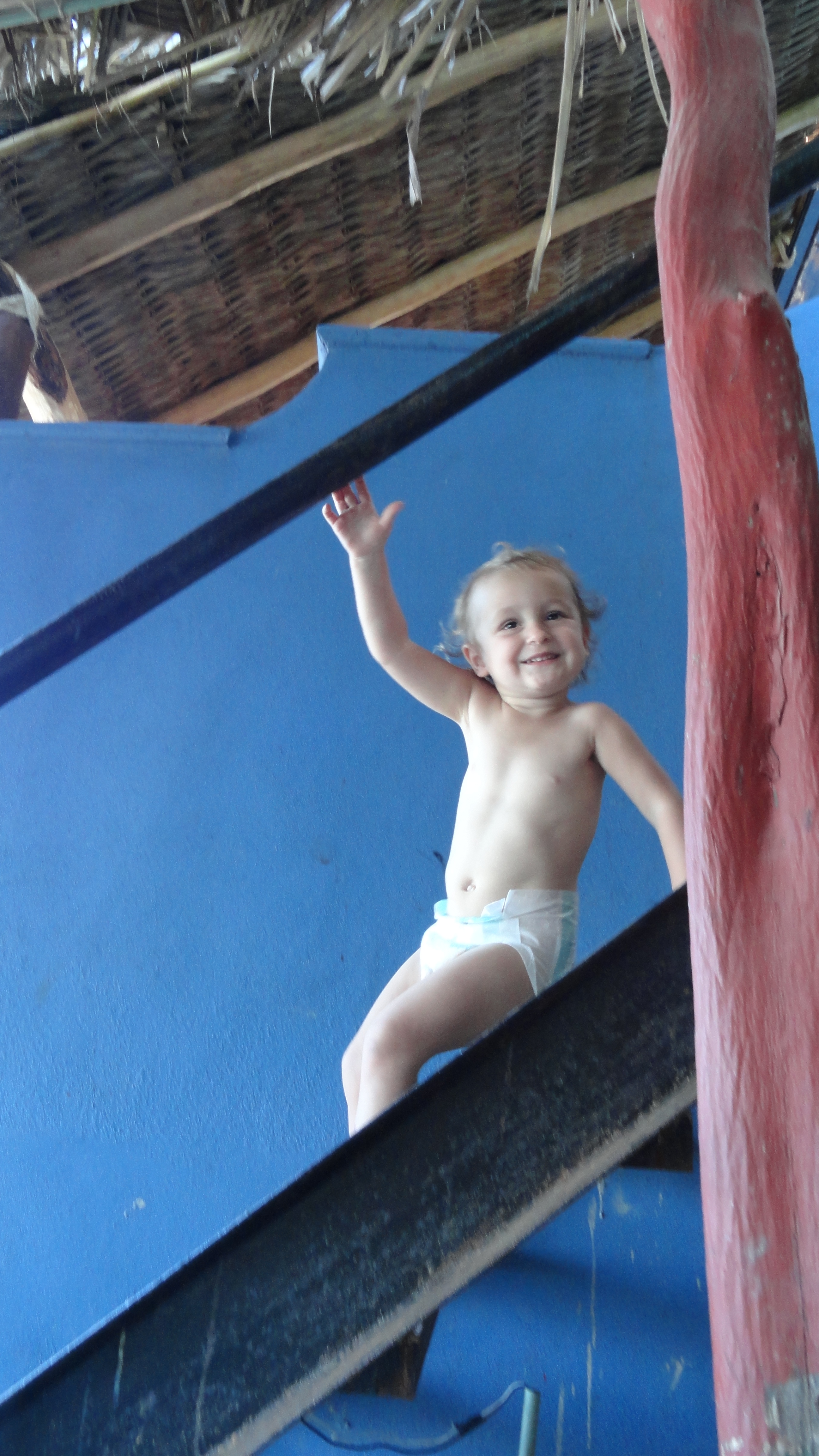
I want to be like this little girl who wandered away from her parents in the sand and into the beach restaurant where I was typing this blog. She came in to meet and entertain me, then to climb the stairs to the upstairs apartment—a dangerous enterprise with no side slats to keep her from falling. Her mom watched from nearby. I moved closer, just in case. But she made it up and down with no injuries, came over to chat a bit longer and then departed. I felt a bit happier and a bit braver myself by the end of our interlude.

The Prompt: Be the Change—What change, big or small, would you like your blog to make in the world?

True Grit

I’d like my blog to be Grit magazine, Ann Landers and the funny papers—all rolled in to one. I’d like it to be the first love comic grabbed off the shelf, the thing everyone wants to read, hot off the presses. I want it to be true, uplifting and fun to read. Entertaining. A collection of words that make people feel better after reading. I want it to be the thing you go to after reading of the last cuts to social services for the poor, the latest fool elected to public office, the last school massacre or child who mistakenly shot an adult with a gun provided to him by an adult. The thing you read when you’ve had enough of police brutality, plane wrecks, financial crashes, reverse Robin Hoods, pit bulls attacking humans, humans abusing dogs, cartels, corporations, slanted news agencies, corrupt rulers, crimes against women, drought, Ebola, HIV and dengue.

Yes, all of these ills exist and we need to know about them, but do we need to know about them ad nauseam, day and night, hour after hour? Do we need them served with our morning coffee, our evening meal, our drive to work? Need we dream them, fill our thoughts with them every hour of the day? And need those thoughts be hopeless and without remedy?

It is not that I want to avoid reality, but rather that I’d like to give that reality my twist and I’d like one major strand in that twist to be optimistic, another to be humorous, another to gentle the cruel realities, another, if it is of any influence at all, to be a catalyst to understanding and a feeling that something may be done in this world.

If you don’t remember the Grit magazine mentioned earlier in this piece, Google it. You will learn that it was formerly a weekly newspaper popular in the rural US during much of the 20th century. It carried the subtitle “America’s Greatest Family Newspaper.” It was full of human interest stories, usually with an uplifting slant. I can’t remember whether it came in the mail or whether we purchased it in the grocery story or in Mowell’s Drug, but I do remember grabbing it out of Mom’s brown paper bag when she got home from a trip down town and making off with it to my room or a grassy place in the shade of an elm tree to be the first to read it.

Perhaps you will label me as superficial if I admit that the first things I read in The Mitchell Republic—that “real” newspaper actually delivered to our front door—were Ann Landers, the comics (We called them “the funny papers”) and the crossword puzzle. I guess I wanted to be entertained, but I also wanted that assurance that something could be done about the bad things in life. Dick Tracy could solve the crimes. Mary Worth could be of worth in helping out. Ann Landers could find a solution to the ache of love and every puzzle could be eventually solved with hard work and perhaps a peek at the dictionary.

Now Google makes puzzle-solving a snap, so long as one is not shy about cheating and using that larger universal brain to solve the Sunday Cryptic Crossword, but in revealing so much, Google causes bigger problems—mainly, what to do with all of this knowledge of the world. For me, what I do with it is to write about it and within the world of my creation, to try to alter it enough to put a bit of hope into the world—to tinge it with a sense of humor or a sense of creation or a stab at a solution—however fanciful or impossible or romantic or homespun or illogical it may be.

This blog is like the biggest purse in my collection of very big purses indeed. In it lie jumbled together all my memories, dreams, hopes, heartaches, genius, stupidities, foibles, schemes, assurances, doubts, mistakes, successes, affections and affectations. The clasp I leave open for all to dip inside to see what they might find. One day, draw out a ditty, the next a tirade, the next a soggy handkerchief, soaked with my tears or an unused Kleenex to dry your own tears that were soaking your pillow when you woke up.

I want to be that thing you sneak off with before the rest of the family cottons on to its presence and take up to your bedroom to read with your back pressed up against the bolster on your bed or roll up and stick up your sleeve as you make off to the hammock or that shade in the grass beneath the tree.

And when you finish reading, it would be neither the hugest compliment nor the hugest insult you could give if you just thought, “That girl’s got grit!” I think a knowledge that she had prompted that statement would make the little girl or teenage girl who snatched that weekly magazine from the grocery sack very happy.

Bearings

Bearings

“I’ve lost my bearings,” she said to me, perplexed. She was sitting alone in her room, piles of clothing on the bed and floor around her—the collapsed small tents of abandoned full skirts, the shards of scarves and small mismatched clutterings of shoes.

She had been abandoned in a world that only she lived in, that she knew less about than any of us who tried to visit her there. For her, even changing clothes became an insurmountable obstacle—a challenge that rivaled childbirth, her master’s thesis, an unfaithful husband, an addicted son, an autistic grandson. It rivaled the war she’d staged against her much-younger sister—the power she held over that sister by her rejection of her. It rivaled her efforts to enter the world again as a single woman and to try to win the world over to the fact that it was all his fault. It rivaled her insistence that it was the world that was confused in refusing to go along with all her beliefs and justifications.

She had barely if ever left a word unspoken when it came to an argument. It was so simple, really. She was always right. That everyone in the world, and more particularly her younger sister, refused to believe this was a thorn in her side. The skin on her cheek itched with the irritation over the unfairness of the world. She had worn a path in it, carving out a small trench so that the skin even now was scaly with that road traversed over and over again by one chewed-off fingernail. “Are you she?” She asked me, and when I admitted I was, she added, “Oh, you were always so irritating. Even as a little girl. Why could you never be what anyone else wanted you to be? You were always so, so—yourself!”

It was my chance, finally, for an honest conversation with this sister 11 years older—more a crabby mother always, than a sister. A chance if she could keep on track long enough to remember both who I am and who we both once were.

“So what was wrong with how I was, Betty? With how I am?”

“Oh, you were always so—“ She stopped here, as though struggling for a word or for a memory. I saw her eyes stray to the floor between the door and the dresser. “There’s that little fuzzy thing there,” she said. I could see her eyes chart the progress of this creature invisible to me across the room.

“But me, Betty. What do you find wrong with me?”

Her eyes came back to me and connected, suddenly, with a sort of snap that made me think we were back in the same world again. I tried to keep judgment out of my own gaze—to keep her here with me for long enough to connect on at least this one question.

“You were,” she said, and it was with that dismissive disgusted tone she had so often used with me since I was a very small child. “You were just so mystical!”

I was confused, not sure that the word she had used was the one she meant to use.

“What do you mean by mystical, Betty?” I sat on the bed beside her and reached out for the static wisps of hair that formed a cowlick at the back of her head—evidence of the long naps which had once again taken over her life, after a long interim period of raising kids, running charities and church prayer circles, and patrolling second-hand-stores, traveling to PEO conventions and staying on the good side of a number of eccentric grandchildren.

“Oh, you know. All those mystical experiences! The E.S.P. and all those other stories you told my kids. And Mother. Even Mother believed you.”

Then a haze like a layer of smoke once more seemed to pass over her eyes, dulling her connection to this time and reality and to me.

Her chin trembled and a tear ran down her cheek. She ran one fingernail-chewed index finger over and over the dome of her thumb and her face broke into the crumpled ruin of a child’s face who has just had its heart broken, the entire world of sadness expressed in this one face. I put my arms around her, and for the first time in our lives, she did not pull away. We rocked in comfort to each other, both of us mourning something different, I think. Me mourning a sister who now would never be mine in the way that sisters are meant to be. Her mourning a self that she had not been able to find for a very long time.

“Oh, the names I have been called in my life,” I was thinking.

“Oh, the moonshadows on the table in the corner. What do they mean?” She was thinking.

The last time I gave my sister a fortune cookie, she went to the bathroom and washed it off under the faucet, chuckling as though it was the most clever thing in the world to do. She then hung it on a spare nail on the wall.

When I asked her if she needed to go to the bathroom, she nodded yes, and moved in the direction of the kitchen. Then she looked at the news scroll on the television and asked if those were directions for her. If there was something she was supposed to be doing. And that picture on the wall. What was it telling her she was supposed to do?

In the end, I rubbed her head until she fell asleep, covered her and stole away. I’d fly away the next morning and leave her to her new world as she had left me to mine from the very beginning.

Odd Apace

Pace Oddity—The Prompt: If you could slow down an action that usually zooms by, or speed up an event that normally drags on, which would you choose, and why?

I would make the prompt timing and link consistent so I could get posted and get on with my day. No more waiting for hours, checking in every few minutes. No more trying to post for hours only to find the link is broken. No more waking up at my usual time and finding they posted the prompt early today so 30 people have already posted.

Happy Dia de los Muertos! Please go here to find my today’s posting in honor of the day.

DSC09986 - Version 2

Sign of the Chameleon

images(stock photo: borrowed image.  No attribution given)

The Prompt: Custom Zodiac—You’re tasked with creating a brand new astrological sign for the people born around your birthday — based solely on yourself. What would your new sign be, and how would you describe those who share it?

The Chameleon: (June 21—July 22) Colorful souls born under the sign of The Chameleon have the remarkable capacity of adapting to the world around them. The multidimensional chameleon has a broad spectrum of interests and talents and is often the favorite son or daughter. The Biblical story of Jacob giving his youngest and favorite son Joseph a coat of many colors perfectly illustrates, however, how what starts out as a blessing might often evolve into a curse. Luckily, however, those born under the stars of The Chameleon will have the ability to change diversity into blessing. Thus does the chameleon constantly adjust with the world to bring himself/herself from danger to safety, danger to safety.

Chameleons are often given the gift of prophecy and clairvoyance. It is perhaps their precognitive dreams that enable them to adjust more quickly to the vagaries of their environment and that serve as a guide through life’s travails. The Chameleon sometimes lacks focus and in spreading himself too thinly may become a jack-of-all-trades and a master of none.

Chameleons often have a hard time finding a balance between their own needs and the needs of others, which leads to a constant rebalancing between selfishness and self-sacrifice. Regularity will never be the norm for the chameleon as he shifts between isolation and over-extension. All too ofen, his colorful world includes the colors of black and white—extremes that can cause him to have bipolar tendencies. Fortunately, his tendency to change hue with the situation causes him to rarely carry his shifts in mood to their extremes.

(Now, go see: This Answer to the Prompt)