Category Archives: insects in Mexico

Monarch Butterfly Macros.. Aug 18, 2025

Click on photos to enlarge.

When my friend Aurora Michel invited me over to her garden to possibly see monarch butterflies emerging from their cocoons, I hoped to see the entire process.  Alas, no butterflies did emerge, but I did get some good macros of the cocoons and butterflies, as seen above!

Below are photos earlier taken by Aurora and sent to me to entice me over to see the real event: (Again, click on photos to enlarge.)


More Hammock Adventures

Guess who finally found time to swing in the hammock again and guess what she found????

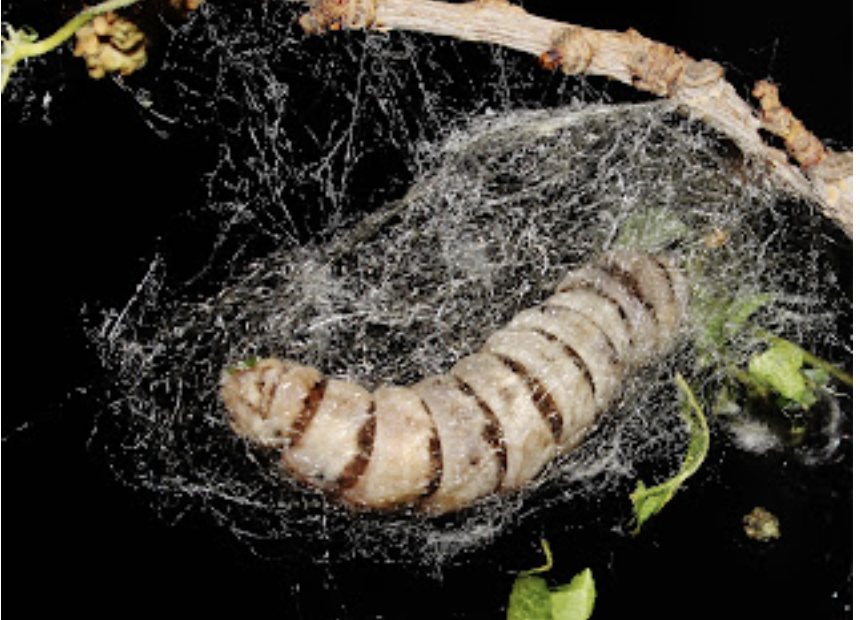
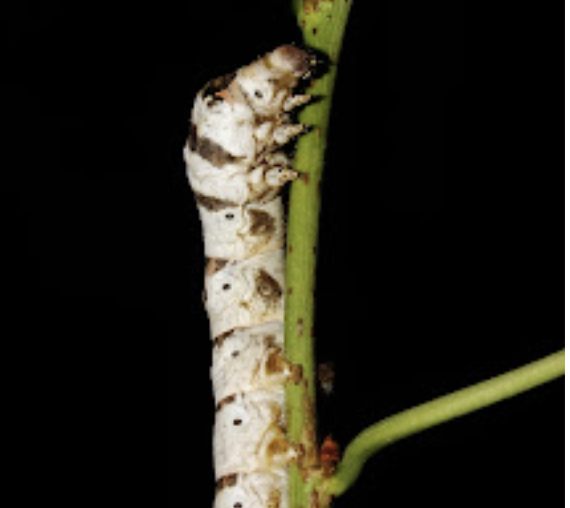
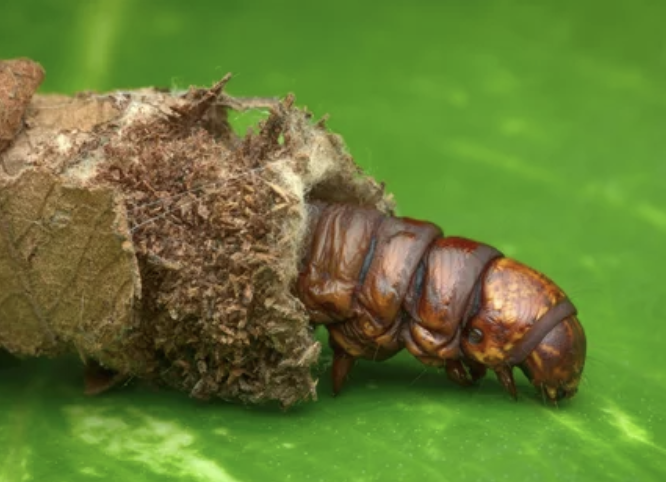
You guessed it, another caterpillar spinning its cocoon in the blanket I pulled out of the  chest to throw over me! (You may recall my first encounter I describe HERE.)  Forgottenman just had to try to determine what kind of caterpillar it was, with no success. I then was driven to trying the same and the closest I could get to a possible solution was a silkworm.  At one stage, their cocoon looks like this, only white. But the caterpillars look a bit alike and many years ago Neill James did import mulberry trees and started a silk industry here. I don’t believe it has survived, but perhaps one of the moths did!  Forgottenman thinks I’m wrong and he’s probably right. Nonetheless, here is a silkworm photo I found online:

And a silkworm.

Here is an excerpt from THIS story about Neill James, an American expat who came to Ajijic in 1943 and who had a huge influence here.

A Strange Occurrence

It is getting dark now and cool, so I got a blanket out of the metal chest I keep in the hammock gazebo for this very purpose.

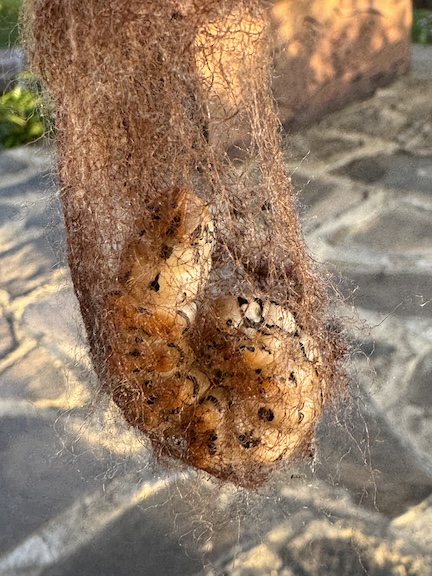
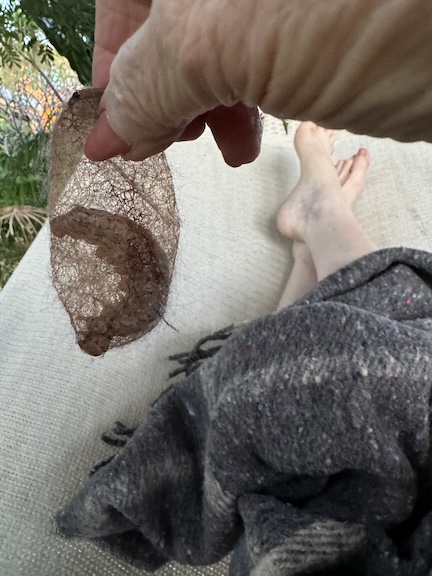
I climbed into the hammock and of course Coco jumped up as well.  Once I managed to wrestle the blanket out from under him, I tried to open it up but it stubbornly refused to be unfolded!  I pulled and pulled and finally was able to pull it apart. It was as though something was gluing it together.  I investigated and found a thick glob which I pulled off the part of the blanket it still clung to and this is what I found:

A huge caterpillar had woven its cocoon into the fabric of the blanket!!!

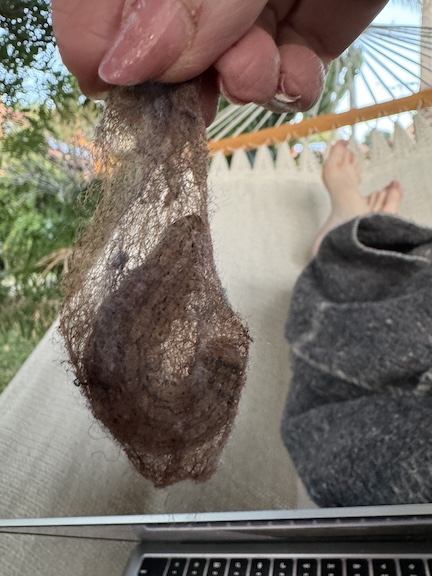
I again tugged very hard to get it to release its hold, photographed it and thew it onto the lawn. Then I tossed the blanket out to cover my legs and feet, but alas, It again would not fully unfold itself.  So I investigated and found a second cocoon!  Here it is.

Now I am comfortably covered against the air getting ever cooler but alas, the mosquitos have arrived and in spite of Coco’s ever vigilant snapping to capture them,  in this Dengue area, I’ve decided it is time to go up to the house.

UPDATE: I found another one!

Virginia Creepers, For FOTD July 29, 2024

Click on photos to enlarge.

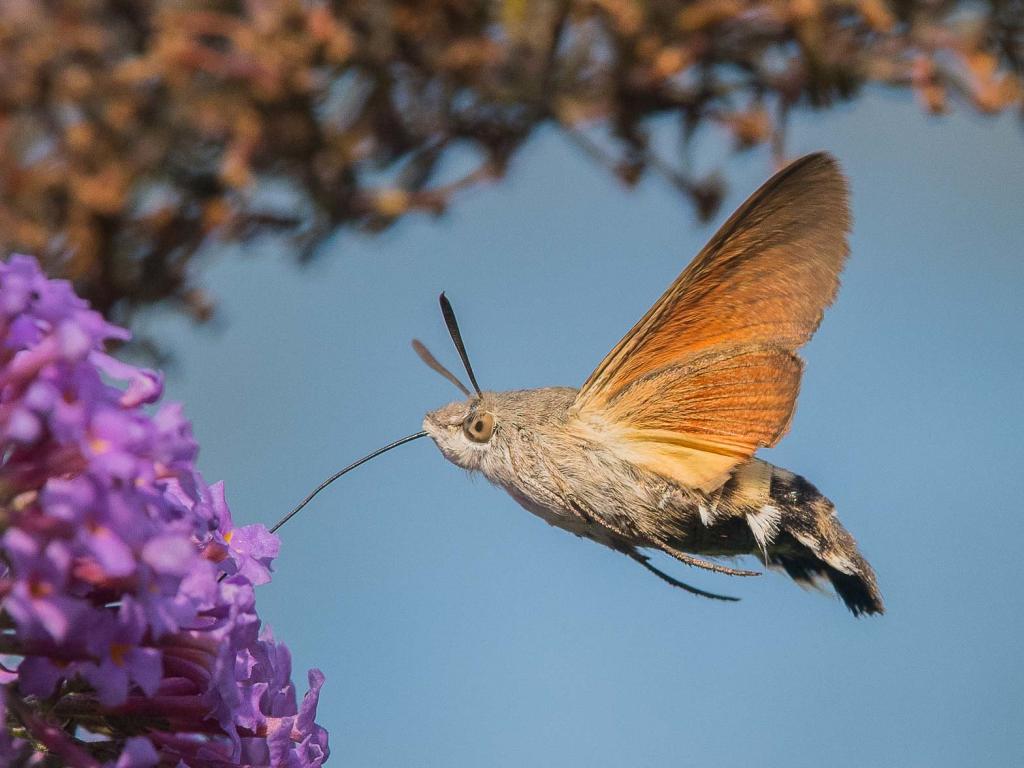
Virginia Creeper is one one of my favorite plants as it quickly provides a complete cover over my terrace, and although it doesn’t flower, once a year for a month or so it does provide creepers of its own—these huge caterpillars that eventually turn into large moths that resemble hummingbirds so closely that I’ve only really ever identified one in the 23 years I’ve been relocating the larvae to my downhill lot. The caterpillars are so fascinating that I can’t bear to kill them, but in their larvae stage, they also produce bee bee-sized black poop pellets that cover the terrace and table and chairs below. If you want to see (and read) more about the caterpillars, go HERE.

Here is an image of hummingbird moth by Graehem Mountenay. I’ve never been able to capture one and have seen only one in 23 years. They must be present, though, judging by the dozens of their caterpillars that we remove from my Virginia creeper each year.

For Cee’s FOTD

Bedtime in the Rainy Season

The rainstorm hit just as I drove up to the house. Running from the garage to the kitchen door, a distance of no more than 30 feet, I was as drenched as I would have been if I had jumped into the pool. I created a river as I ran across the kitchen, dining room and living room, shedding clothes the entire way.  Once dried off (except for my hair) and in my nightgown, I wasn’t about to carry the cats’ food bowls out to the garage, and how could I expect the cats to eat their dinner in the driving rain? So they dined in the kitchen and quickly afterwards, chose their beds for the night. Kukla on the back of the living room sofa and Ollie on my freshly laundered, ironed and folded sheet.  I think they are in for the night.  Earlier, I had foolishly kept the kitchen door open, thinking they might wander outside once the rain ended. Instead, I entered the kitchhen a few hours later to find it filled with large red flying termites!  I quickly turned off the light and many of them swarmed to the hall, where I had left a floor lamp on.  For some reason, they were all on the floor, where I quickly stamped them to death. I hate to kill any creature, but these same termites used to invade our house in the Redwoods in California, chew off their wings and burrow their ways into the redwood walls of the house. It was them or my wooden African carvings and cupboards and furniture!

Go HERE and HERE and HERE to see and read more about these termites.

Misnomer, For The Sunday Whirl, June 9, 2024

Misnomer

Red dragon of my garden, ascending walls and rocks,
seeking out a birth chamber on your extensive walks.
Your strategy is lethal, for the shelter you find best
proves you as an enemy—a thief of life and nest
of bee or wasp or other insect where you’ll lay
your eggs where larvae of your host will become the prey

of your eggs when they have hatched into larvae too,
long after you have left to resume adventures new.
Wingless wasp, you never soar aloft in air,
but your vivid color hints at the despair
of any who receive your sting, so painful that you’ve earned
the title of “Cow Killer Ant” as victims have soon learned.

Cool water will not stem the pain, nor will anything
soothe the throbbing torture of your defensive sting,
but unlike your insect victims, humans will not face

a fate more dire than pain that is extensive as you race,
channeling your power into a new direction,
tunneling into the ground to escape detection.


Prompt words for The Sunday Whirl Wordle 658 are: strategy enemy thieves red dragon air hint water rock nest face channel

Although commonly referred to as the cow killer ant or red velvet ant, this insect is actually a wasp. They get the “velvet” part of their name from the fuzziness of the females, which are wingless and often brightly colored, appearing like a red and black ant. The powerful red velvet ant sting is what has led them to be nicknamed “cow killers”. The female will enter the ground nest of a host species, typically a wasp or bee species, and lay her eggs near the host’s larvae. As D. occidentalis’ larvae develop, the species’ true parasitoid nature is shown. The larvae grow and develop by feeding on and killing the larvae of the host species. [13] Velvet ant larvae will continue to feed until they enter the pupal stage. In this stage, larvae continue to grow into adults. Pupation typically takes 23 days, and most velvet ants are mature and ready to reproduce themselves after this. [15] Velvet ants have an interesting mating style compared to other Hymenopteran species. The male has no parental care responsibilities and the female leaves as soon as she lays her eggs. This is not out of the ordinary for a Hymenopteran species, but velvet ants are though to be monogamous and semelparous. This means females mate just once in their lifetime with only one male. Many entomological organizations suspect velvet ants to mate only once in their lifetime.[16]

(Thanks, Wikipedia, for furnishing research on these insects. I think I’ve seen three in the past 23 years and did an earlier post on the orange and black variety I discovered on my wall many years ago. This one I found near my kitchen door just a few years ago.)

Numbers Game #6, Jan 29, 2024

Click on photos to enlarge.

Welcome to “The Numbers Game #6”  Today’s number is 127. To play along, go to your photos file and type that number into the search bar. Then post a selection of the photos you find under that number and include a link to your blog in my Numbers Game blog of the day. If instead of numbers, you have changed the identifiers of all your photos into words, pick a word or words to use instead, and show us a variety of photos that contain that word in the title.

This prompt will repeat each  Monday with a new number. If you want to play along, please put a link to your blog in comments below.

More Surprises re/ the Bagworm or Case Moth

When I got home today, I decided I’d double-check and make sure I hadn’t overlooked the bagworm yesterday. And guess what?  This is what I saw, although it seemed like it was on a lower part of the succulent plant than before.

I snapped this shot and sure enough, when I compared it to the Dec. 30 photo I took of the bagworm cocoon I had discovered on that day and found missing on Jan 3, the bagworm casing is completely different and on another part of the plant than before.  Did the bagworm build a new cocoon or is this another bagworm?  If so, what happened to the old cocoon? Or is this an entirely new bagworm? Mysteries, mysteries.

Below are the 2 cocoons side-by-side.

I’ll keep an eye out for future developments.  Anyone with information to share, please do. Your expertise in this matter will be appreciated. In the meantime, I’m researching bagworms or case moths.

HERE is a link to my original post when I discovered the first cocoon.

And here is a Faceook message from my friend Jan Golik who first acquainted me with bagworms when she formed a relationship with one during her Covid isolation:

Now, my research on the matter:

How serious are bagworms? Bagworm larvae grow and feed on trees causing plant damage. These pests can be dangerous and costly to landscaping plants, but they pose no threat to human health. Large infestations of these pests may damage or cause trees and shrubs to die from defoliation.
Adult males transform into moths in four weeks to seek out females for mating. The female never leaves the cocoon, requiring that the male mate with her through the open end at the back of the case. She has no eyes, legs, wings, or antennae and can’t eat, but she emits a strong pheromone to attract a mate.
Below is a male bagworm emerging from his bag:
I am fascinated by this process. Can’t stand to destroy the “bag”

Seasonal Hunting Party

What is Pasiano looking for??? Click on photos to read the story.

Hibiscus Bud with Daddy Longlegs: FOTD, Nov 6, 2019

When I tried to take this photo, a cluster of Daddy Longlegs unfolded from behind the bud. Every year they collect by the thousands on my walls and plants. Welcome back, long-legged annual visitors. Please click on photos to enlarge the view. This is the first time I’ve gotten close enough to see their eyes!! Oscar is here for his English lesson, but later I’ll establish a link to earlier views of huge clusters of these yearly guests.

If you’d like to see the video of a past year’s Daddy Longlegs invasion, go here:

And then go HERE to see the incredible view of the first year I hosted a Daddy Longleg convention.

For Cee’s Flower of the Day