Innocents in Mexico, Chapter 18

Innocents in Mexico

Chapter 18: Rooftops

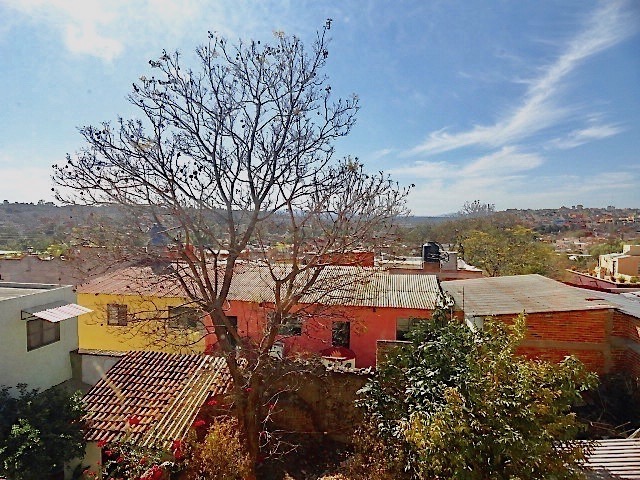
            First of all, in Mexico, almost everyone has them:  flat rooftops.  They are reached by stairs or by wrought iron ladders attached to the side of the buildings or by  tightly spiraled metal staircases.  Many serve the purpose of a security system by serving as home for the family “roof dog.”  These dogs, not as plentiful nor as vocal as in Oaxaca, nonetheless exist in San Miguel as well, where they  live their entire lifetimes on the roof.  When people pass by on the street, they bark.  When fireworks go off and other roof dogs bark, they bark back.  Should anyone attempt to climb onto the roof to gain access to the house, they bark louder. 

            Since we had rented by far the tallest house in the neighborhood, we got to look down on all of the other rooftops.  We tended to go up on the roof at least once a day––usually to observe the sunset, or fireworks, or to just look at the incredible panorama of 360 degrees of blue sky dotted with white clotted clouds.  These San Miguel skies astounded us.  We had lived in the California redwoods for too long.  We’d forgotten what it was like to see the horizon. 

            Other people seemed to use their roofs for other things.  On each and every one, there was a stack of old lumber, twisted wire and bricks.  On many were piles of curved clay roof tiles.  From the tops of the brick columns at each side of the house and at intervals along the walls extended the bumpy heavy wires of rebar.  Like particularly tough bristles, they sprouted  from the tops of the houses in clusters, ready and waiting for the next story, to be added as the money appeared to build it.  This was an ever-present activity in San Miguel.  In no place where we’d stayed in the past weeks had we been freed from the sounds of construction.  After men came home from work, they would go to the roof and add a few bricks.  The pounding of their mallets to set the bricks extended far into the evening. 

            The other purpose of roofs seemed to be to store pop bottles.  On most of the roofs spread below us were case after case of Coke bottles.  Why they hadn’t cashed these in, we had no idea, since a considerable amount of the price of each bottle of coke or beer covered the price of the bottle.  For a liter bottle of Corona, a third of the price was the bottle deposit.  Perhaps this was their bank––hoarded Coke bottles on the roof.  Perhaps they were waiting for the price of Coke bottles to go up––like the peso.  Or perhaps they were waiting to cash them in to buy drinks for their next fiesta.

            Other rooftops displayed geraniums in clay pots.  We never saw them being enjoyed or tended to.  They were just there.  For our pleasure, perhaps, since no one else ever went to the rooftops except to shovel roof dog poop.  One night, as we stood watching the sunset, we saw two women climb the stairs up to their own rooftop.  So people did watch the sunset here, too, I thought, but for the half hour they were on the roof, they sat on chairs talking, their backs to the setting sun.

            Aside from Coke bottles, geraniums and construction materials, rooftops were proper storage places for:  old bicycles, extra flowerpots, broken and sound, shovels,  pickup bed covers, folding chairs, half-used buckets of paint, old bed springs, rain barrels, extra tires and purloined shopping carts from Gigante which were upended and appeared to be used as some sort of kennel, although we never saw any animal inside.  It was well into our second week in the house when I thought to go up on the roof during the day.  It was then that I saw activity, for women had stung clotheslines in the bright late morning sun and were hanging clothes.  From rooftop after rooftop, the bright flags of socks, undershorts, pants and shirts hung like fiesta decorations across half the rooftops within vision.
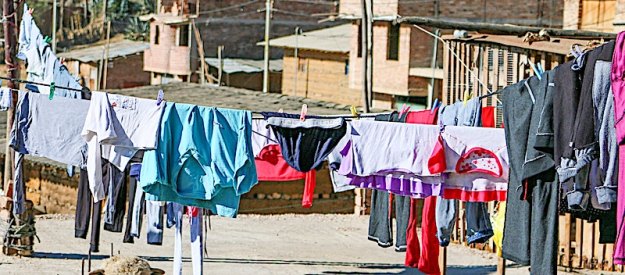
 

Photo of rooftop washing day by Gwendolyn Anderson on Unsplash

For Chapter 19. go HERE.

Yellow Bougainvillea: FOTD May 28, 2023

For Cee’s FOTD

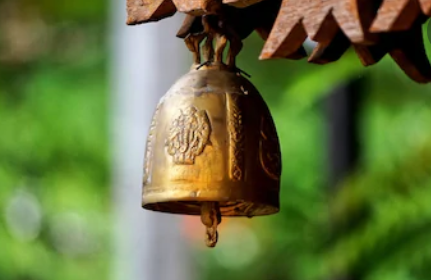
LISTEN FOR THE BELLS (“A Chicken Plucking Story!”)

This is a story about Sarah who was in the fertilized egg business. She had several hundred young pullets and ten roosters to fertilize the eggs. She kept records and any rooster not performing went into the gumbo pot and was replaced. . . .

go HERE to read the rest of Sam’s very timely story!

SAM VOELKER's avatarLos Perdidos

This is a story about Sarah who was in the fertilized egg business. She had several hundred young pullets and ten roosters to fertilize the eggs.

She kept records and any rooster not performing went into the gumbo pot and was replaced.

This took a lot of time, so she bought some tiny bells and attached them to her roosters. Each bell had a different tone, so she could tell from a distance which rooster was performing. Now, she could sit on the porch and fill out an efficiency report by just listening to the bells.

Sarah’s favorite rooster, old Butch, was a very fine specimen but, this morning she noticed old Butch’s bell hadn’t rung at all! When she went to investigate, she saw the other roosters were busy chasing pullets, bells-a-ringing, but the pullets hearing the roosters coming, would run for cover.

To Sarah’s amazement, old Butch had…

View original post 131 more words

Innocents in Mexico, Chapter 17

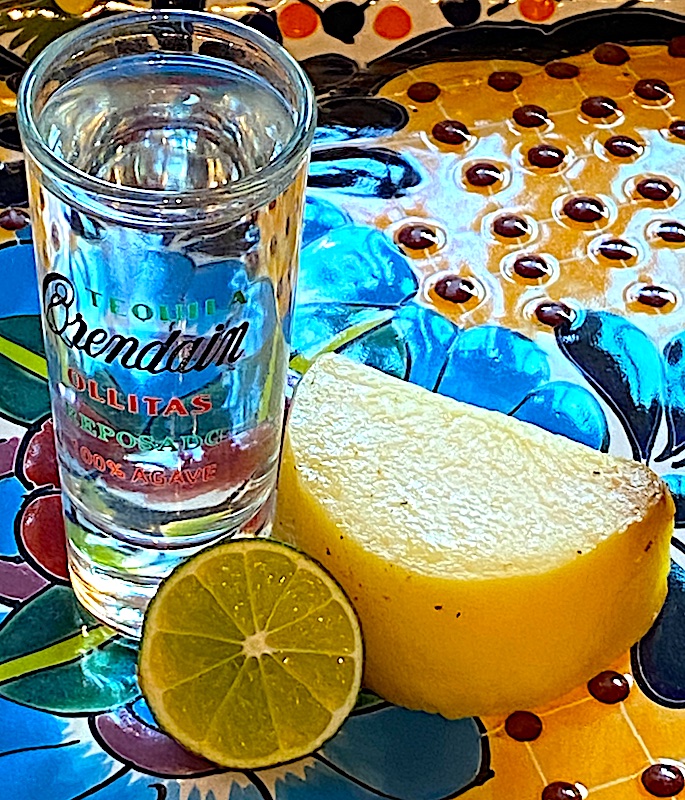
Tequila with Lime and Potato?

Innocents in Mexico

Chapter 17


For the next two days, there were almost gale force winds followed by torrential rains.  Pots in the compound blew over, their tall plants having been blown like sails by the wind.  The streamers which hung across the road came detached at one end and tangled around the telephone wires.  We had invited our first guests over for dinner on the first day of strong winds.  As the hour approached for their coming, I kept hoping that the winds would stop.  Our dining room table and chairs were on the roofed but unwalled patio off the kitchen.  I put out candles, but they blew out.  Any time I moved out to clean or rearrange chairs, the heavy glass and metal door was caught by the wind and slammed shut.  By five o’clock, Bob had agreed that the weather was not going to cooperate and we moved the furniture to the sides of the living room and moved the table and chairs into its center.  I collected bougainvillea from the lush plants in the patio, a few branches of each color.  I arranged them around the hors de ouvres and made bundles of forks, spoons and knives which I wrapped in napkins and tied with waxed linen, slipping a sprig of bougainvillea in each one.  The day before, I had disinfected the fruit and vegetables, made the spaghetti sauce.  That day, we had shopped for bread, driven out to the hacienda to check on the progress of the remodel of the house Ernesto wanted us to rent.  We had checked out other areas as well.  I still didn’t feel like it was my place.  It was too cut off.

            Ernesto was slated to arrive at our house at 7 p.m.  Dirk, who had to pick up Maria at work, thought they’d be there by 7 p.m.  At 6:55, Bob said, “You know, in one of our books about Mexico, it says that Mexicans are too polite to turn down your invitations to dinner, but that sometimes they just don’t show up.”

            “It’s not even seven,” I told him.  “Besides, Ernesto wouldn’t do that.  And Dirk’s American––he wouldn’t either.”

            Ernesto was almost on the dot, walking in the door with a bottle of tequila.  “I want you to taste this, “ he said.  I poured a shot glass full.  “No, no.  You have to drink it with a little grapefruit juice or orange juice. “

            I poured mango juice on top of the tequila and drank it like a shot. 

            “See what it says on the label?”  said Ernesto, “By appointment to the king.  It just doesn’t say which king.  Do you know how much it costs? 

            At the present rate, it was about $2 per bottle. 

            “If you want it to taste smooth, put a slice of potato in it and let it set.  Then remove the potato and the tequila will be smooth.”

            Dirk and Maria arrived a half hour or so later, Dirk hurried and flustered and apologizing.  He had driven down our street before going to get Maria so he’d know where to go, but he couldn’t find the house.  Either I’d not given him the address or he’d forgotten to write it down.  He brought a bottle of red wine, but I gave him a rum and coke to tame him down. 

            “Is this it––are we the only guests?”  he asked, surprised.

            “You’re it.  And we expected you to be late.  We know about Mexican time.”

            Dirk was aghast.  They didn’t operate that way.  Maria Antoinette was calm as usual.  She had simply insisted they stop each person they saw on the road and ask where the foreigners were.  They kept pointing them onward and saying, “Jim, Senor Jim,” which was the name of our landlord.  Eventually, they’d found it.  We’d taped a small note to the door and left the gate ajar. 

            The party was loose and fun.  Dirk admitted that it was the first time they’d been invited out to dinner in someone’s home the entire time they’d lived there.  They’d been invited to one fiesta with many people, but not to a private home.  He seemed thrilled.  Ernesto was warm and charming.  He told us some of his stories over again.  Everyone ate heartily, commenting on the food and taking seconds.  “Do you have any more of those long vegetables?”  asked Ernesto, and I went to the side table to get the asparagus. 

            Wine, tequila, rum and Corona were paid proper attention to by Ernesto, Dirk and me.  Bob drank Coke light and Maria drank fruit juice.  After dessert, Ernesto brought out his guitar and played trickily fingered Mexican and Spanish love ballads. “I took the crystal glass and broke it.  With the shard, I opened my vein.  I thought of my loved one, now vanished.  I will never love again.”  He mouthed the words in English as he strummed and picked, first slow, then fast in the Latin manner.  Then he sang them in Spanish.

            All of the songs were love songs––lush and full and romantic.  Earlier, he’d mentioned his girlfriend and, horrified, I said that he should have brought her.  I didn’t think to ask if he had someone he wanted to bring.  “No, on Tuesday night it is her night to go out with friends,”  he answered.  “So I just didn’t tell her.  She’s not beautiful or anything,” he explained. 

            We didn’t know what to make of this comment from Ernesto, who was always courteous and polite.  He said it as though it was just another fact, but it revealed the other side of the coin from the romantic music––the practicality of having a girlfriend, even though she wasn’t beautiful as opposed to the second song he sang, “Into each life, there comes one love.  Now that she’s left, I’ll never love again.” 

            Dirk told lots of jokes about breasts.  I told them about Bob greeting strangers on the street with “Buenos nachos.”  Ernesto laughed especially long, then told us that if he ever had said “Buenos nachas,” he was telling them that they had nice butts.  I told them about the time in Minneapolis in the July heat when we had been leaving a restaurant.  Bob had on shorts and as he walked out, a woman in her sixties was coming in.  “Nice legs,” she commented to Bob as he held the door for her.  Her husband, horrified, said, “Why would you say such a thing?”

            “Because he has nice legs.  He does,” she said, standing her ground.

            She was right, he did have the nicely muscled legs of a bicycle racer which lived on long after his bicycle racing days were over.

            When they left at 11:30, Dirk again mentioned that this was a highlight in their life in Mexico.  “I’m going to e-mail Richard and tell him all about it,” he said.  He told Richard, an old friend and fellow dentist, everything.  Richard had been the link between Ernesto and Dirk, having corresponded via e-mail with Ernesto for a year.  Although they’d never met, they felt like old friends.  Then Richard had sent a picture of Dirk and said he and Ernesto should meet.  The second day when I’d met Ernesto in the library, he’d been slated to meet Dirk a half hour later.  I’d stayed on and so witnessed their meeting.  Richard, they told me, had a half million dollars he wanted to invest in Mexico.  When he came, they would throw a huge fiesta and we would come. 

            “Do you know enough people to throw a huge fiesta?”  I asked Ernesto.

            He laughed, “If you throw a fiesta, the people will come.”

For Chapter 18, go HERE.

Canna Lily: FOTD May 27, 2023


For Cee’s FOTD

Bougainvillea: FOTD May 26, 2023

For Cee’s FOTD

Photo Potpourri

Click on photos to enlarge.

Sorting and clearing out and found these recent favorites that haven’t fallen into any posting categories, so here they are, all jumbled up!

FOTD May 25, 2023


For Cee’s FOTD

Innocents in Mexico, Chapter 16

Innocents in Mexico

Chapter 16

We decided to go into the city both to shop for more retablo material for me and to see if the fiesta extended into the downtown areas of San Miguel.  Determined not to drive the van through the tiny streets—especially on a weekend—we locked our compound gate and set off down our street to the main road, where we could catch a taxi or bus.  One of the ever-present loiterers in the field across from our house called out to us in English—a first for anyone from our neighborhood, although we had taken care to greet each child, man or woman we passed in the street.  “Hola,” we’d say, or “Buenos  tardes.” 

            “Buenos nachos,” Bob had said several times, and no one had laughed except me.  I could imagine the food imagery floating into their consciousness, wondering why this stranger would be commenting on his upcoming dinner to them, utter strangers.  The thought tickled me so much, but I wasn’t about to share it with Bob, who needed every encouragement to speak Spanish.  Later, when he had said it a third time, he asked me, “Is that right?”  And I finally told him the truth. 

            But no one in this neighborhood had ever spoken to us first––let alone in English. 

            “The fiesta will be today,”  said the tall thin man who leaned against the mesquite tree.

            “Again?”  I asked.

            “We will go to the church.  You should come.”

            “When?”

            “Very soon.”

            “Gracias,“ I said.  That happened often.  Someone speaking to me in English while I spoke to them in Spanish.  It was easier to speak Spanish to someone who spoke English.  Your confidence was bolstered by the fact that you knew you could switch to your mother tongue if you needed to. 

            But we moved off instead down the road to catch a taxi.

            In town, the streets were full.  For the first time, we went into a restaurant and could not find a table.  We walked around doing our errands.  The air was very hot––almost humid.  Then we heard music very nearby.  A police car approached us.  Behind it, a hoard of twisting, writhing creatures.  They were dressed in costumes with masks or large papier-mâché heads.  Men were dressed as women, women as wolves or kittens or pigs.  Masks took the shape of grotesques or beautiful women or animals.  Some of the dancing paraders were tiny—merely babies held in the arms of their mothers or fathers.  Others were massive men dressed up as sexy women.  There were hundreds of them gyrating, calling out, dancing.  Into the crowd they flung hands full of candies.  Some threw oranges.  Children and adults scrambled for the prizes.  I caught sight of a female gorilla with made-up face, blond wig, curled eyelashes, huge breasts.  In front, where her stomach should have been, was an exposed womb with an unborn child curled up inside—as though skin and fur had been removed to show the inner reality.  When I ran after the parade to get a picture, the gorilla whirled and posed.  Then, after I’d snapped a picture, it pulled its skirts up over its head, stuck its butt up in the air, and instead of a female gorilla, it was a male gorilla, snarling and crouched to spring.  I was so surprised that I may have snapped the picture too late, for the crowd quickly filled in around it.  I was later to learn that it was the “Dia de los Locos,” the day of the crazies.

            By the time we returned home, most of the activity on our street was over.  The next day there were no firecrackers, no bells.  The day seemed plain and lackluster without them.  That night we went to sleep early with no disturbances.  Although the banners and streamers still hung in the street, the revelers had gone home. 

            That morning, as went out to open the compound gate to move the van out, the same English-speaking loiterer accosted us. 

            “It was a good fiesta,” he said. 

            “Yes, we went in to San Miguel.  It was good there, too.”

            “Tomorrow, in the house three houses down, there will be another fiesta,” he said. 

            “And they will go to the church again?”  I asked, sorry that we hadn’t followed the last time.

            “No, that is finished.  This time it is a fiesta in the house only.”

            When we returned from our shopping and hours of driving around San Miguel, becoming acquainted with the various neighborhoods, the fireworks had begun.


For Chapter 17, go HERE.


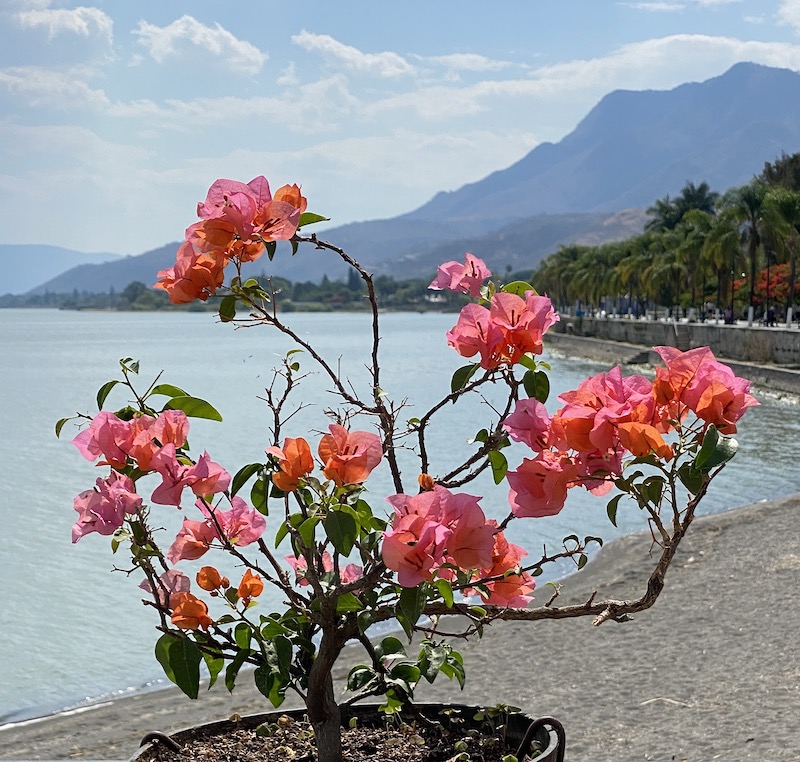
Beach Bougainvillea: FOTD May 24, 2023

Chapala Pier, May 23, 2023

For Cee’s FOTD