Tag Archives: childhood memories

Orderly

IMG_7488

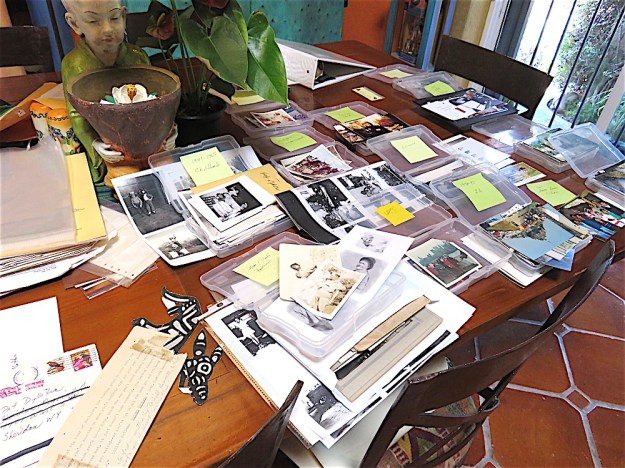
Fulfilling Order

How does one get orderly?  I fear I must confess
the only way to get  there is by first making a mess!
Since I have put this off for years, the fault is all my own.
Procrastinatiion is a fault for which I must atone.

I sort the photos into piles by topics or by years––
photographs of family and landscapes and my peers.
I wish my album stuffing were not in such arrears.
They’ll take a month to organize, or now it so appears.

I locate half-filled albums  and plastic sleeves and pages.
It seems I haven’t filed a single photograph for ages.
I try to be most organized and get them into line,
then fall into reflection of the lives of me and mine.

I have company coming and a meal that I must cook.
I’ll find the table easier to clear if I don’t look,
but oh that slumber party that the boys decided to crash
and all those tame adventures where we thought we were so rash.

Who knew that all this sorting would lead to this great mess?
and yet I am enjoying it.  Who would ever guess
that sorting under pressure would still lead me to this?
Memories of parties, of camp and that first kiss.

Sixty-seven years of life all spread out on my table.
I’ll clear them all by nightfall, then cook if I am able.
Too bad the nearest Colonel Sanders is so far away,
or I would save the cooking for another day.


One “find” in the thousands of photos I have yet to stow away in the headboard filing cabinet of my bed that has been recently cleared of poems was these photos of the night John Kuckleberg and Doug Tedrow raided our slumber party.

This was not as racy as it looks. The fellas were there before the shortie pajamas were donned, and by the looks of it, boys danced with boys and girls with girls.  The fish, by the way, were plastic ones from my dad’s den in the next room. There has been some progress since the 7th and 8th grade party. Looks like I’d tiled the floor, my sister Patti and I had painted the walls and she had painted a somewhat strange mural of a man leaning against a cactus to take a siesta. I think this was my junior  year. The ceiling had not yet been installed by my dad and me! It must have been Rita’s birthday as we seem to have been giving her a spank for each year.

The prompt for today was “Orderly”   https://dailypost.wordpress.com/prompts/orderly/

Closeted

Please go here: https://judydykstrabrown.com/2015/12/06/uncornered/ to discover what I’ve had to say on the topics of closets!


https://dailypost.wordpress.com/prompts/closet/

TAKING THE LONG WAY HOME

Taking the Long Way Home
IMG_0331
Class Reunion

Since we know where we are going so well,
let’s take the longest route there,
out past England’s Hill and that dip in the road we kids called lover’s leap.
Silly the traditions we tried to pretend––as though our histories weren’t long enough
to have attracted real ones. Now all of those old newnesses
are curling with age, discolored, cracking at the edges––
their roughness catching realities and dreams
and mixing them together so none of us
can remember the difference.

The Prompt: This Is Your Song–Take a line from a song that you love or connect with. Turn that line into the title of your post. (My song was “Long Way Home” by Tom Waits.)

Dining Out

daily life color109 (1)
Perhaps considering my next order?

Dining Out

I do not remember the first time I ate out at a restaurant, but I have heard a story over and over about the first time I ordered for myself.   I couldn’t have been over two years old when my folks took me out to a movie and then to Mac’s cafe for a drink and a visit with town folks afterwards.  We lived in a town of seven hundred people in the middle of the South Dakota prairie.  Our sole entertainment, other than church and school ballgames, was the Saturday or Sunday night picture show in the small theater on Main Street.  It was the social event of the week, and visiting with friends afterwards at Mac’s Cafe across the street from the theater was as much a part of the evening as the movie.

Later, in college, one of my best friends was the granddaughter of the man who owned the theater and she revealed to me that it never had made a profit.  He just kept it running to give the folks in the town where his wife had taught school as a young woman something to do.

Probably 200 of the 700 citizens of our town were members of a pentecostal church who didn’t believe in dancing, movies,  or even TV, so at twenty-five cents per ticket, I’m sure if everyone in town had gone to a show one time a week, it still would not have paid the overhead, so we should have figured that out long ago, but we hadn’t thought of it––at least no one in my family ever did.

I had two older sisters, so if I was two when this story happened, one must have been about six and the other would have been thirteen.  They ordered Cokes.  My folks ordered coffee, and when it came to me, I responded in the only way I knew to respond in a restaurant.  “Amgooboo an tabey dabey!” I ordered.

The waitress looked puzzled.  “She said hamburger and potatoes and gravy,” said my father, deadpan.  The waitress looked at my mother.  If that was what I wanted at ten o’clock at night, my mother was all for it.  The waitress left and my family struggled to keep straight faces but it just didn’t work.  They all exploded in laughter, which was fine with me.  I’d been entertaining them for as long as I could remember–and I think perhaps I still am to this day!


The Prompt: Tell about the first time you ever ate out in a restaurant.

I Used to Eat Red

                                                                  I Used to Eat Red

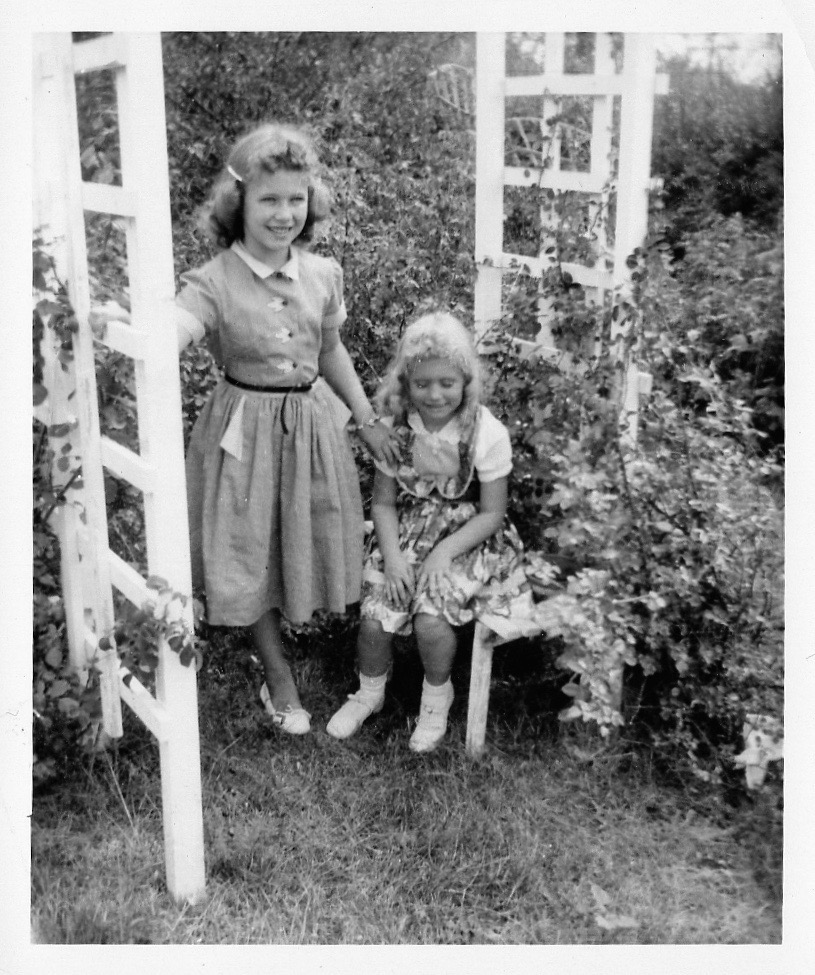
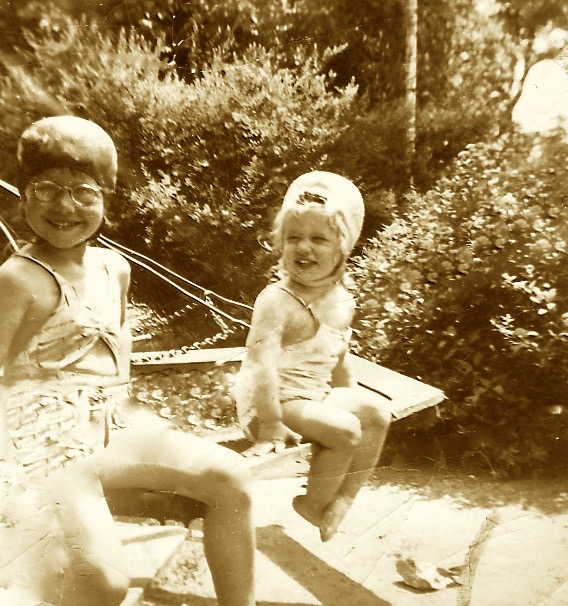
daily life color108 (1)My sister Patti and I, posed by my older sister Betty.  Those are “the” cherry trees behind us. The fact that we were wearing dresses suggests we were just home from Sunday school and church, our souls bleached as white as our shoes and socks!

 I used to eat red
from backyard cherry trees,
weave yellow dandelions
into cowgirl ropes
to lariat my Cheyenne uncle.

I once watched dull writhing gold
snatched from a haystack by its tail,
held by a work boot
and stilled by the pitchfork of my dad
who cut me rattles while I didn’t watch.

 I felt white muslin bleached into my soul
on Sunday mornings in a hard rear pew,
God in my pinafore pocket
with a picture of Jesus
won from memorizing psalms.

But it was black I heard at midnight from my upstairs window––
the low of cattle from the stock pens

on the other side of town––
the long and lonely whine of diesels on the road
to the furthest countries of my mind.

Where I would walk
burnt sienna pathways
to hear green birds sing a jungle song,
gray gulls call an ocean song,
peacocks cry the moon

until I woke to shade-sliced yellow,
mourning doves still crooning midnight songs of Persia
as I heard morning
whistled from a meadowlark
half a block away.

And then,
my white soul in my shorts pocket,
plunging down the stairs to my backyard,
I used to eat red,
pick dandelions yellow.

 (This is a reworking of a poem from my book Prairie Moths.) The prompt today was to talk about our earliest childhood memories.  https://dailypost.wordpress.com/prompts/childhood-revisited/

In Cold Blood

IMG_9290.jpg

                                                        In Cold Blood

I’m sure that the horrible, violent and senseless murders described in Truman Capote’s book In Cold Blood captured the imaginations of most of us in the U.S. Unaccustomed to such vivid descriptions of such violent acts, what small town family did not start locking their doors at night?

The slaughter of the rural farm family occurred on Saturday night, November 14, 1959; and although Capote’s book was not published until 1966, the press made much of it at the time it happened and I was well aware of most of the details of the murder of the father, wife and teen-aged children—a boy and a girl––as well as the capture of the two men who had murdered them. I was especially affected by the sad detail of the discovery of the girl’s Sunday School money tucked into her shoe in the closet. Whether she heard the men breaking in and hid the money so it would not be found or whether she placed it there so she wouldn’t forget, the detail has the same poignancy

After the murder, as I lay in bed at night––especially on summer nights when I found it even harder to surrender to sleep than during blustery cold nights in the winter––I often thought to get up and check the doors again: the front door, the door to the garage, the door from the garage to the mud room, the door to the basement and the back door off the pantry that led to the back porch. All had push-locks accessed by a key from the other side.
On one night in particular, that summer that I turned 13, I lay awake listening to the night sounds that streamed in through my screened window. My window adjoined the front door stoop and it suddenly occurred to me that anyone could slice the screen and easily enter. I got up from bed to close the window and open the air conditioning vent in the floor under it. While I was up, I decided to check all the doors again. All were securely locked except for the lock to the back “porch” which was really just a platform four or five feet wide with a hand railing that ran the entire length of the house from the back garage entry to the pantry/kitchen area.

The pantry held a sink for my dad to wash up in when he came in from the ranch, and since we rarely locked our house, many times he would just walk along this platform/porch and enter the house from the back where he pulled off his boots and emptied his cuffs off the back porch so he wouldn’t track wheat chaff or mud or other souvenirs of his day’s work through the house. Then he’d wash his hands and neck and face in “his” special sink and make his way to his rocking chair in the living room, where he’d spend the rest of the day resting until supper and reading before bed.

This platform/porch was actually quite a distance above the ground because our lot was on a small hill that sloped from front to back and right to left. This enabled the windows in the basement to be above ground level, whereas there were no windows at all in the front of the basement. On this particular night, I stepped out onto this roofless sideless porch platform. I could see the big dipper and part of the little dipper and the thousands of other stars in the summer sky, but I didn’t know the names of any of the other constellations.

I could smell the newly cut grass that my mother had mowed in the early evening of that day, after the sun had gone low in the sky. I remembered when I was little how my dad was less tired by the time he got home and so he’d mow the huge lawn around the old house. My mom would come after him with the lawn sweeper that collected the grass cuttings in a huge canvas cube open at the top to dump the grass into a huge pile by the gravel road where we kids would build nests and play bird. I was the baby bird fed imaginary worms or, if we’d had the right dinner, sauceless spaghetti, by my older sister.

By my teen years, however, my dad would be too tired when he got home from a day that started at 5 or 6 in the morning and often didn’t end until 8 or 9 at night if they were cutting wheat. His life was a hard one and I often wondered if he resented coming home to daughters reading on their beds or talking on the phone to friends.

Did it seem unfair to him that he worked so hard to support daughters and a wife who had such a life of ease? Although I had not yet started to really write, except for a diary I once kept for a few months or assignments for school, I did have an active imagination; and from a very early age, I had concocted elaborate stories all involving imaginary selves of the future.

Now on this night, I wondered why that door that I had checked before coming to bed to read was now open! Who and why would anyone open a locked door? As I lay thinking, I heard the door to my parents’ bedroom farther down the hall open. I could hear my father’s heavy barefoot tread turning not to his right—to the bathroom between their room and my sister’s––but instead to the left. Down the long hall to my room, the entrance hall, the kitchen, the mudroom and the back porch. I could hear the door opening and a few minutes’ delay before he padded down the hall again and closed his door.

Chill. I felt it zoom down my spine, hit my tailbone and ricochet back up to my brain where it froze the back of my head. I waited. For five minutes, and ten. Barely breathing. I cracked my door and when I could again hear my father’s loud snores, I sneaked back out to the door to the back porch, which was once again unlocked. As quietly as possible, I pushed the button lock in, then returned to bed where I remained vigilantly awake for the rest of the night. Twice more, my father got up to unlock the door. Twice more, I got up to relock it.

During all those long hours before dawn, I imagined the scenario. My father, formerly my protector, allowance provider and generous benefactor to the pleasures of my life—turned in my mind into plotter. He, too, had read all of the coverage of the Kansas murders, and it had given him ideas.  He had hired a man to sneak in, to bind him up and leave him helpless and then to kill us all. He wanted to be free. He was tired of his idle daughters, tired of his wife.

My father had, previous to this, gone through one of his week long silent periods where we knew he was upset about something—cattle prices, the threat of hail before harvest, my mother or us. We never knew what caused these silent periods where he would speak to none of us and sometimes even move to the basement to sleep. They never lasted over a week and afterwards he would be our same joking, generous, hard-working dad. But during those times, we tiptoed. We tried to cajole and charm, but it didn’t work. If we asked if he wanted his head rubbed, we were met with a curt sideways bob of the head or a “Not tonight!”

This was unheard of at other times, when we’d ask for money for a new dress or the show and he’d answer with, “Ya. Rub Pa’s head!” We’d do so, and then the wallet would come out. Not that we didn’t rub his head gratis as well. It just got to be a joke—this returning of favor for favor. Then he’d hand us his wallet and put his hand over his eyes, like he didn’t want to see what we’d take. We’d always show him, though. Was this okay? It always was.

At times other than his silent periods, he was our loving dad. Proud of us. Funny around guests, and talkative, but when home alone with us, usually tired––sleeping or reading one of the piles of magazines and books that lay on the long coffee table beside his chair. I mention the silent periods as an explanation of why I might even in my most fertile imagination conceive of an idea that my dad would be capable of planning to “off” his entire family.

But, imagine it I did. I became the protector of our family that summer, lying awake for as long as I could to listen for my father’s footsteps down the hall. And this was not the only night that he got up once or twice to unlock that back door. I never said a word to my mother or sister. I perhaps told my best friend, thinking if my protective efforts failed, at least one person could point the way to insuring the perpetrator of my demise came to justice.

In later years, I forgot about that terrifying summer and went back to loving and admiring my dad almost as much as before, but by then there was a difference. Whether it was caused by radical ideas picked up in my sixties college life and my need to define myself as more modern than my parents—who were themselves quite liberal––or a vestige of that summer of distrust, I’ll never know.

By the time my dad died eleven years later, they’d sold the house in town and moved to a smaller house they built a mile out of town. It was to escape town taxes, my dad always said, but I’ve always thought that for him it was a return to his early homestead days in another house with nothing in view but prairie grasses and a big weathered barn. This new “country” house built by my parents after I left high school was closer to town than the homestead of my grandparents, but was within sight of the big red barn of a farm he’d bought years ago for a hired man and his family to live in and afterwards rented out. The barn sat squarely between my parents’ new modern modular and the old farmhouse. There was a small lake nearby with otters and where the wild geese landed overnight in their migrations.

It was one summer night when I was home from college for vacation that my dad got up from where he’d been sleeping in his chair and walked through the hall and kitchen and out the back door of the house.

“Where do you think he’s going?” I asked my mother.

“Oh, he likes to go out to sniff the night air and have a pee in the dark,” she said with a chuckle. “He loved to pee off the back porch of the house in town at night, even though it was so much farther away than the bathroom. I never could convince him not to do it. I worried that the neighbors would see him. But I think he thought it saved water, or perhaps it just reminded him of his youth—peeing out the back door of the house into the night air.”

This post was written in response to Elyse’s scary babysitting piece which you can read here:  http://fiftyfourandahalf.com/2012/08/01/all-the-cool-kids-are-doing-it/


In response to The Daily Post’s writing prompt: “Companionable.” Head to one of your favorite blogs. Write a companion piece to their penultimate post.

daily life color093 (1)

As I lie

Once, in that long dream of childhood, I
assumed that I would be a child forever,
slipping between the lives of adults, somewhat

off. The wrong hairdo, clothes
in my closet hanging in
that off-kilter way

like teeth missing in a child’s mouth, others grown half-way
in to not quite meet their lower neighbor.
It was a mystery

where I’d fit in adult life––
The job I’d do,
the children I’d tell what to do;

and I never quite found the answer, although
my teeth grew in, to meet
each other in the middle.

Blooming, after their
crimson exit––
two by two, they nourished a life,

burying childhood
like
a lie.

I chose S. Thomas Summers’ poem, “As a Child” as a springboard for my poem. Rather than use his poem as a theme, instead I used the first word of each of his lines as the first word in each of my lines. Go here to read his excellent poem: https://inkhammer.wordpress.com/2015/11/01/once-i/

A House Divided

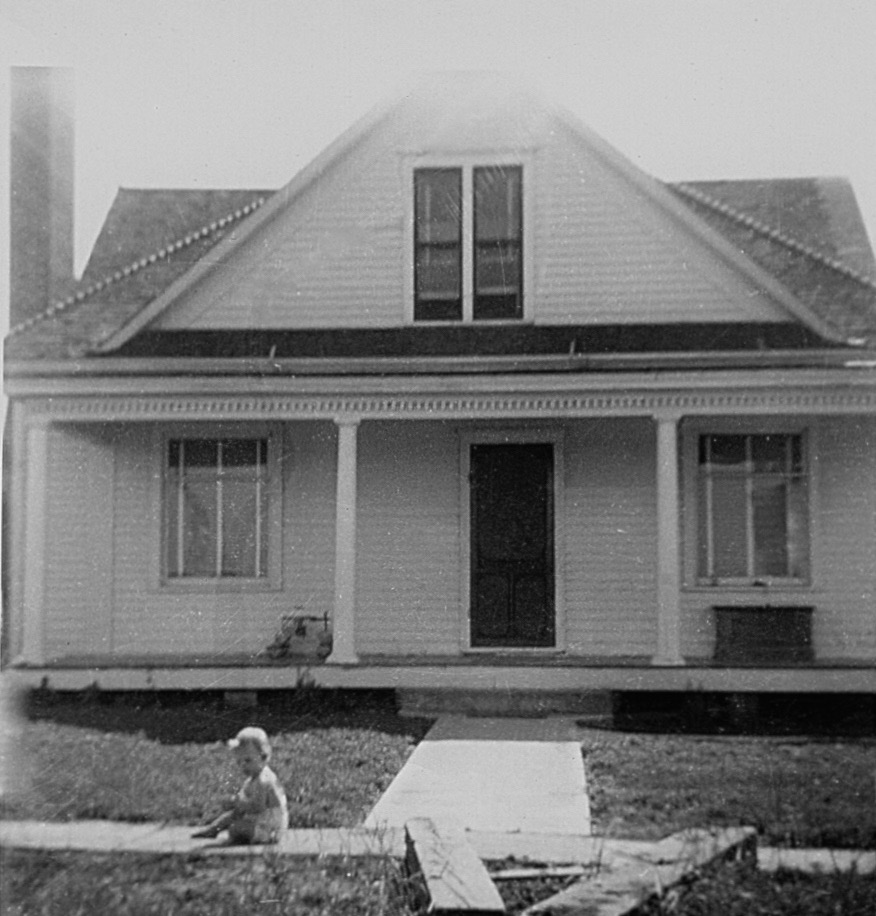
                     daily life color090 (1) This picture must have been taken very soon after we moved into the house because I was 10 months old when my mom and dad bought it and that’s about the age I look in this picture. I see the twin to the “piano bench” mentioned in this story sitting on the front porch and my dad has already seeded the lawn which appears to be growing.  Those boards were soon replaced by a thick layer of grass and a row of elm trees that grew up with me.

                                                            A House Divided

When I was ten months old, my father decided it was time to buy a house big enough for three girls and his wife. It wasn’t that he hadn’t offered my mother a nicer house long ago, but my mother had suggested he use the money to buy cattle instead, and it had been a good decision. By the time I was born, the ranch that my dad had begun when he purchased the 640 acre homestead of his parents had grown to over ten thousand acres. Some in town saw him as an opportunist, but as I see it, someone had to buy the land foreclosed on by the bank or given up on by men like his father who just did not have it in them to work the land and my father was a good guardian of the land and a generous benefactor to his town and church.

The house my father bought was a very large house owned by a man and wife who were horticulturists. My sister remembered a big room upstairs that looked like a laboratory but was actually a room used to grow plants. Since the house was both too big for his wallet and too big for one city lot, my dad, an enterprising man, actually bought half the house. My mother tells of seeing the men on the roof with saws, sawing it in half, then carpenters and plasterers sealing up the open walls on both houses.

She also tells of the perfect plastering on both the original walls and the new one—and after successfully moving the house the five miles into town on two flatbeds moving side by side down the night time highway, the shock of seeing the house slip off the jacks as they settled it on the foundation and hearing the plaster cracking and crumbling so that in the house I lived in, the surface of the walls was not exactly even—some seams jutting out a bit and not quite matched to the texture of the original plaster.

As a baby, I occupied the downstairs room that later became our dining room, but even after I was moved upstairs with the “big” girls at the age of 3, the place we ate 99 percent of the time was a sort of wide hallway between the living room and kitchen. We kids sat behind the table on what we called the piano bench, but it was actually one of the two bench-high dividers that separated the two parts of the living room. Wanting to create a more spacious feeling in the room, my mother had the two dividers removed so the living room became one giant room that extended across the entire front of the house.  On the left part of this room that you faced as you entered the house was an entire wall of bookshelves, filled with books and my mother’s salt-and-pepper shaker collection.

One of the lower shelves was stuffed bottom to top with comic books—a fact that made our house a favorite with Jimmy Kerlin, who would sneak in the front door and sit for hours on the floor, poring over Mighty Mouse and Superman, Little Lulu and Richie Rich comics. Our favorite family story was the about the time we got home from a day’s shopping expedition in Pierre—sixty miles away, to find Jimmy sitting on the floor in the corner, nose in the last of a long progression of comics he’d been reading all day long. Unbeknownst to us, he’d been sitting there reading when we left in the morning, locking all the doors to the house. He had remained happily reading all day long.

Whether his mother noticed his absence has gone unremembered in our version of the story, but may remain central in his family’s telling of it, although I believe that other than his younger brother Tommy, all members of that family known to me are now deceased.

A genre of comic books Jimmy might have found little interest in was not to be found on those shelves, for what we called “love comics” were forbidden by my mother. She had told Jack Mowell, who was the the local pharmacist/comic-book vendor, not to sell them to us, but we had an agreement with him. So long as they were buried in the stack and not on view on it’s top layer, he merely asked us “how many” without inspecting what exact comic books we bought.

At ten cents each, we usually bought them ten at a time, so quite a few love comics could be accumulated so long as one “Archie and Veronica” comic was positioned atop the stack. This portion of our library was kept at our friends’ houses or buried far beneath our beds or mattresses. By the time we were the least interested in this questionable reading material, our mother rarely ventured into our rooms since we were the ones responsible to keep them clean and orderly, to make our own beds, change our own sheets and carry our own washed and ironed clothes from the back porch washer/dryer/ironing room up the steep wooden stairs to our rooms.

I was only 10 months old when we moved from the east end of town to that big house on its near western edge. By the time I had an actual memory of that house, it had been much influenced by the taste of my 11 years older sister, who painted our upstairs bathroom chocolate brown and chartreuse and our living room different shades of maroon and puce to coordinate with my mother’s choice of living room drapes: maroon-ish sansevieria leaves on a chartreuse background.

The couch was a greyish-toned sectional that took up a good part of one half of the living room. In the room with it was a big blonde modern coffee table—unusual in its day and covered with a chartreuse planter and ashtray (even though no one in our house smoked) as well as current issues of Redbook, Ladies Home Journal and The Saturday Evening Post. On the other end of the room next to the fireplace, another long blonde coffee table next to my dad’s comfortably padded and uphostered rocking chair was covered by stacks of his reading material of choice: True West, Saga, Argosy, Grit, and the Mitchell Daily Republic newspaper.

In at least one of his magazines of choice, there was always a centerfold picture of scantily dressed or nude women—which furnished me with one of my first glimpses of the sexual nature of the world that I would have otherwise had no idea about. Certainly, the love comics were tame by comparison, and I’m surprised that my mother didn’t see fit to remove those portions of my father’s magazine library; but she never did and from a very early age, I was attracted to them like a magnet the minute no other member of the family was around.

It was a good house to grow up in. There were three rooms upstairs—one room each for each of us girls, once I was old enough to graduate from the downstairs nursery to the girls’ dormitory upstairs. I think we were the only house in town with three bathrooms—one upstairs for us girls, one downstairs for my parents and anyone present on the main floor of the house, and one in our largely unfinished basement—to be used either by whatever hired man might be living down there or whomever was in urgent need of a bathroom when the two others were filled.

Only our living room was carpeted––in a maroon tightly woven carpet. The floors of all of the other rooms, including all the bedrooms, were covered in linoleum, the colors and patterns of which each of us was able to choose for our own rooms. Mine was green with big leaves that coordinated well with the yellow walls and my ruffled white bedspread covered in big yellow flowers with green leaves. My sister Patti, 4 years older, chose a charcoal linoleum with pink and white and black flecks—dark pink walls and white painted furniture. My 11 year older sister Betty chose a green motif with green and white and black checked drapes and bedspread.

Thus, from a very early age, my mother encouraged our developing of an aesthetic unique to our personalities. To my knowledge, the ordinary was neither encouraged nor demonstrated in our family. In seeking to be different, my mother taught me that it was okay as well—and this has been a guiding principal in my life.

Thus it was that the house I grew up in—from its very inception by my father who, lacking the finances or terrain to buy an entire house, had the ingenuity to buy half of one––to my mother, who stepped outside the bonds of conventionality in her color and fabric choices as well as her taste in decorating elements­­––helped to form aspects of my personality that sent me out in life not seeking to meet the expectations of others but rather to follow my own impulses—to Australia, then Africa, California and Mexico. Not bad for a little girl from Murdo, South Dakota, population 700, on the wide empty plains of South Dakota.

The prompt: Our House––What are the earliest memories of the place you lived in as a child? Describe your house. What did it look like? How did it smell? What did it sound like? Was it quiet like a library, or full of the noise of life? Tell us all about it, in as much detail as you can recall.https://dailypost.wordpress.com/dp_prompt/our-house/

Merry-Go-Round


daily life color086 (1)
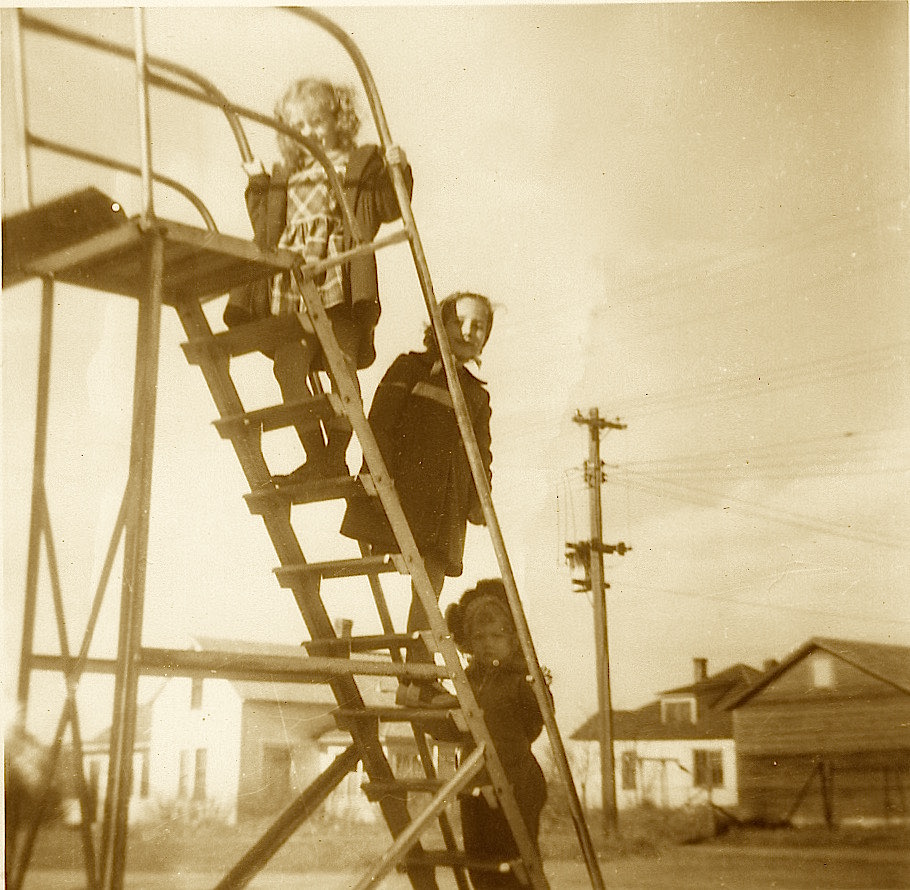
My sister and I at a park near my grandma’s house in Kansas on a merry-go-round similar to the one in the school playground across from our house in South Dakota.

                                                                   Merry-Go-Round

Their creaks were my alarm that kids were on the elementary school playground across the street and if my biggest sister was downstairs or away from home or even sleeping as soundly as she always did after coming home late the night before, I’d sneak into her room to look out on the playground from above and see who was there. I knew the difference in the sound between the merry-go-round and each set of swings—the little swings next to the little slide, or one of the three big sets directly across from the block my house was on. Higher, with longer and more flexible chains, these swings could be made to loop de loop—pass up so high that you actually went over the top of the frame the swings were suspended from and wound the chain once around the pipe.

Some of the boys could repeat this three or four times until the swing got so high that none of the little kids could get up to it. Then the janitors would have to get their tallest ladder and go up to push the seat over and over the cross pole with one of their big push brooms to straighten it out again and bring the seat down closer to earth.

There were rules forbidding loop de looping, but the boys would come after school when all the teachers had gone home and even our janitors, Mr. and Mrs. Polachek, who lived kitty-corner across from the south end of the playground, were at home in their backroom away from the sounds of kids in the neighborhood, sealed up tight and safe. They were Polish, and now that I think of it, probably displaced persons from WWII. Their accents were thick and her temper was short and they were the objects of constant tauntings from the boys. One year the boys had hung a dead cat from their front porch on Halloween. I wish I could remember whether I thought this was funny, as many of the kids did. I hope I didn’t––that I was as sickened by it then as I am now.

The creak I was listening for was the creak of the merry-go-round. Teepee shaped, it had a wooden runner all the way around it a foot up from the ground. There was a handrail about thirty inches above it, so you could stand on the wooden runner, facing the center pole, hold onto the hand rail and enjoy the ride as the big kids ran around in circles around the merry-go-round, pulling it with them to go faster and faster, then stood on four sides of it, grabbing the handrail pipe and pushing it off to make it go faster still. One by one, more onlookers would be enrolled in the joint effort to get it going fast enough. Then they’d jump on and everyone would pump up and down, sticking their bottoms out into space as they bent their knees, pumping to keep up the momentum.

There were other ways to use the Merry-go-round. The bigger girls like Marie Holstedt who lived on the street that faced the opposite side of the playground from the one my house faced, would sit on the foot board with her boyfriend Robert. Their feet side by side on the ground, they would sway to and fro in a kind of two-step movement—two to the right, then one to the left––their knees touching with their swing to the right, their hips touching when they swung to the left. When they did this, the sound of the merry-go-round reminded me of the strange rhythmic creaking I’d hear sometimes late at night in my house.

It was probably the TV antenna on the roof, my mother had said. Or maybe the furnace trying to pump out heat, she had speculated when I pointed out that it had been a windless night.
Life was simple and I believed her. Only now do I make sense of it and of my father’s late night short trips down the hall to the bathroom—the washcloth always draped over the tub faucet the next morning.

It was an innocent age where it was entirely possible to be eleven years old and to never have had the least idea that anything like sex existed in the world. Yet a good deal of what eventually led up to it went on in the playground across from my house. Older girls would sit in the swings, swaying back and forth without ever taking their feet from the ground. Or, take fast running steps forward and backward without really letting go and allowing the lift off. To their side or in front of them would be their crush of the day or the week or the hour. If he was not the boy of choice, sometimes the girls would switch swings. If the boy switched again, too, and the other boy let him, then it was a sign language of sorts that indicated which boy favored which girl, and if the girls went home, a clear message that things had not matched up correctly to their satisfaction.

But at other times––usually during games of ditch ‘em played in the twilight and darkness of summer, courtships could progress toward hunkering down in the ditches around the playground, close up to some culvert where the ditches were their deepest, the girl in front, the boy with his arms around her waist, holding her back from running to try to get to home base when one of the littler kids who was “it” ran past without seeing them. In these junior high years just past childhood, the objects of the games started to shift until finally in high school, the rituals of the old games were left behind entirely and ditch ‘em became merely a starting place––as did the swinging back and forth, the pumping, the dance.

Today, with merry-go-rounds a thing of the past, they are still an appropriate metaphor for what life pushes us toward from our birth. It begins with our rocking in the arms of our mothers, the rocking chairs of our grandmothers, the wild swings through the air locked hand-to-hand with our fathers. It is what slippery slides and swings and merry-go-rounds and dancing move us towards. Everything going around and around and in doing so really going back and forth from generation to generation. Passing the world on and fading away. Now and then doing a loop de loop just because we can.

daily life color087 (1) daily life color088 (1)
In response to The Daily Post’s writing prompt: “Ode to a Playground.”A place from your past or childhood, one that you’re fond of, is destroyed. Write it a memorial.

In response to The Daily Post’s writing prompt: “Life’s a Candy Store.” You are a 6 year old again How would you plan a perfect day?

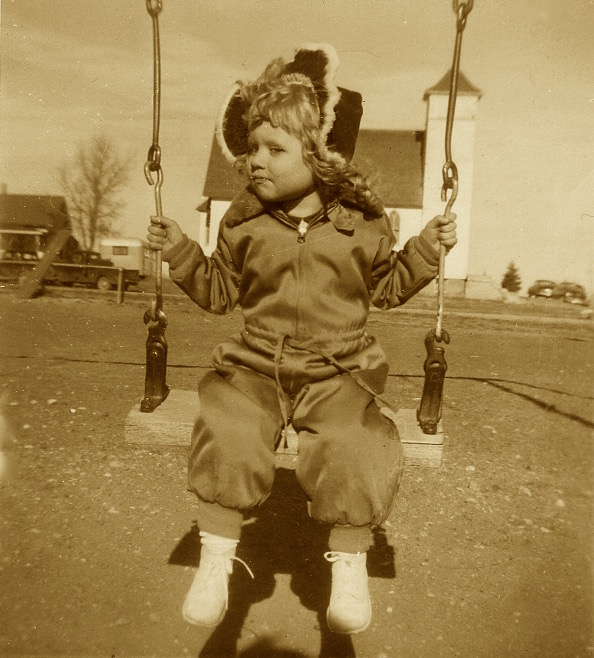
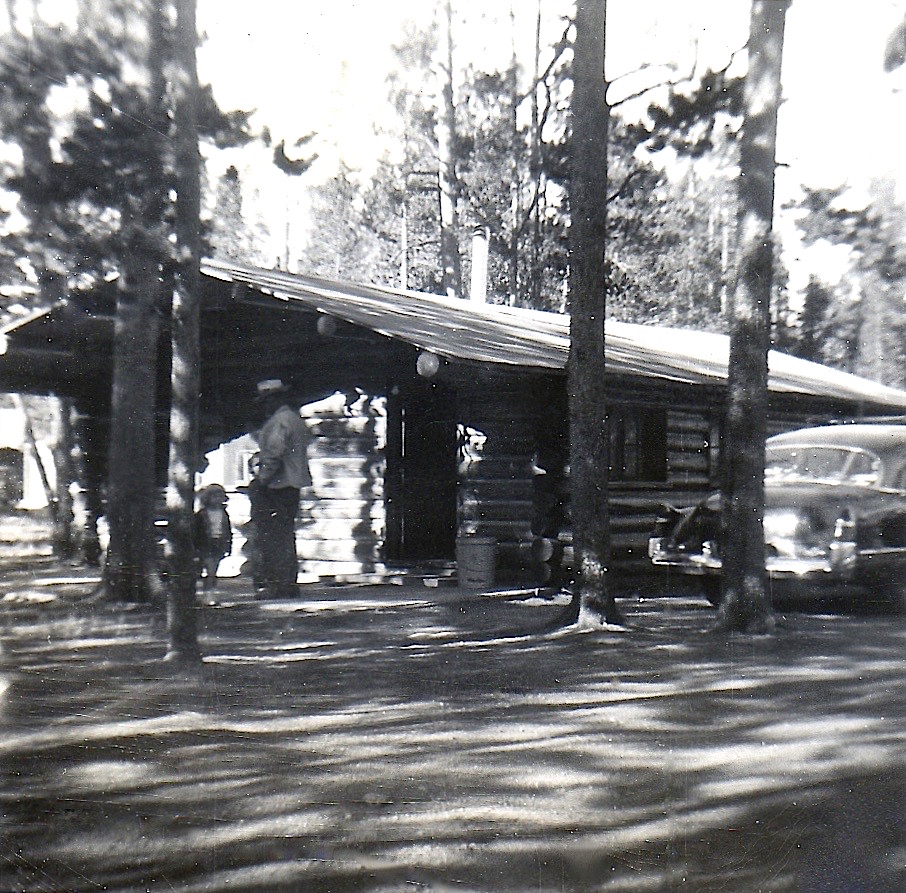
Version 2My dad and I at the Deer Huts when I was about 3.

Black Hills Reverie

My dad is coming with us–he doesn’t have to work.
Corn muffins in the oven, and coffee on the perk.
It’s orange juice for sis and me.  I take a little sip.
We woke up really early to start out on a trip.
We’re going to the Black Hills where we will spend the night.
We’ll start out just as soon as we have had a little bite.
We’ll stop to pick up my best friend who will go along
They’ve let me plan the whole long day, so nothing will go wrong.
En route we’ll stop at Wall Drug and have an ice cream cone,
then drive on through the Badlands, as dry as any bone.
My dad will sing a song for us–“Lonesome Mountain Bill”–
and let up on the gas petal as we crest the hill
to give our stomachs all a lurch and a little flutter.
My mom will say “Oh Ben!” and then my older sis will mutter.
But Rita and I love  this trick and we will urge another–
an action nixed first by my sis and then by my mother.

We’ll stop at Petrified Gardens and see the fossils there,
buy rose quartz and mica and other rock chips rare.
Then on to Reptile Gardens where they wrestle crocodiles,
to ride on giant turtles and view other reptiles.
We stop next at the Cosmos where gravity’s gone amuck.
We’re doing everything I wish. I can’t believe my luck!
On to old Rockerville Ghost town where we have our dinner.
If I resisted cherry pie I know I would be thinner,
but with a scoop of ice cream it really is delicious.
Just try to keep it from me–I’m likely to turn vicious!
Next we drive the pigtails, where the road just curls and curls
passing over and over and thrilling three small girls.
We’re going to see Mt. Rushmore–those giant perfect faces.
Perhaps we’ll buy a souvenir if we’re in Dad’s good graces.
Then on to drive Custer State park with the begging burros.
We’ve saved some treats from Rushmore–some peanuts and some churros.

Back to Rockerville we go for supper and a show.
The “Mellerdrammer” (sic) is the place where we’re going to go
to hiss the villain from the crowd, throw peanuts at his back
as he ties the heroine to the railroad track.
Then drive the seven miles to my favorite sleeping place,
though mother doesn’t like it, and she makes a funny face.
“The Deer Huts” are just cabins right up in the trees
and we have to use the outhouse to take our bedtime pees.
We get to walk with flashlights and pick our way with care,
through the ponderosas, where perchance we’ll meet a bear!
I love the moonlit shadows and the night bird calls,
being extra careful to avoid stumbles and falls.
Sometimes we fake the need to pee to take another walk,
and on the way my friend and I walk slowly as we talk
of all the things my parents have let us do today.
We both agree that this has been a perfect sort of day.

 daily life color076 (4)My sister Patti and I in the Black Hills, age 7 and 11.

 In South Dakota, lunch was dinner and dinner was supper.  For the sake of authenticity, I’ve maintained the custom in this description of a child’s perfect day.