Tag Archives: Judy Dykstra-Brown Retablos

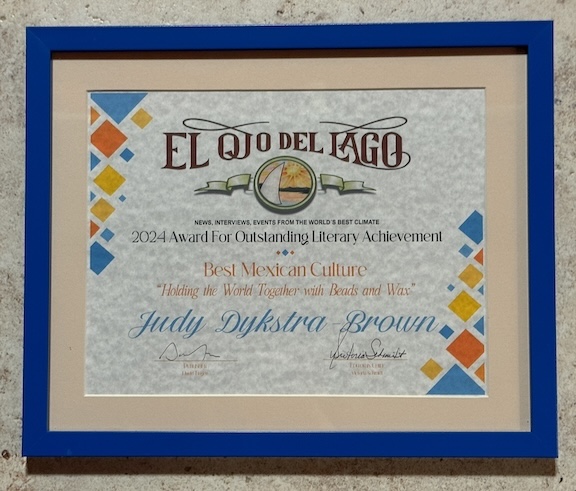
Holding the World Together with Beads and Wax

The Ojo is the oldest English language magazine in Mexico. 40 years old this year! Marion Couvillion was a nominee in another category. HERE is the story he was nominated for. Congratulations, Sam!!!

This is the article I won the award for:

Holding the World Together With  Beads and Wax:
An Intimate Encounter With Huichol Art

 By Judy Dykstra-Brown                       

The Huichols (who call themselves the Wixarika, meaning “prophets” or “healers) are one of the oldest indigenous cultures in Mexico and are said to be the one least touched by the modern world. Although it is often said that they are descendants of the Aztecs, the Huichols actually predate the Aztecs. The Aztecs themselves called the Huichols “the old ones.” 

Believed to number between 8,000 and 14,000, Huichols have resided in relative isolation in the Sierra Madre Mountains of Jalisco, Nayarit, Durango and Zacatecas, Mexico since around 200 AD. Because they were able to retreat into the roadless and almost impassable regions of the mountains during the Spanish occupation, they are the one indigenous culture that survived relatively unchanged by the years of Spanish influence.

 I became interested in the Huichols in 1992 when a PBS documentary (Millennium, series 8) depicted the story of a Huichol man who was on a pilgrimage to find a cure for his son who was ill. Years later, when I moved to the Lake Chapala area, I became more intimately acquainted with the Huichol culture through my admiration for their art.


Beaded gourds, sculpture and jewelry were originally made as offrendas or votive offerings to the spirits of ancestors. I first bought several rakures (gourd prayer bowls) covered with intricate patterns of beads. In short order, I started buying beautifully beaded bracelets, earrings and necklaces. At a show in San Miguel, I found a wonderful string painting made by spreading beeswax on a flat sheet of wood and pressing wool string into the wax, and the next year I bought another at the Maestros del Arte (a yearly Chapala show where master artisans from throughout Mexico are invited to show.) More jewelry followed.

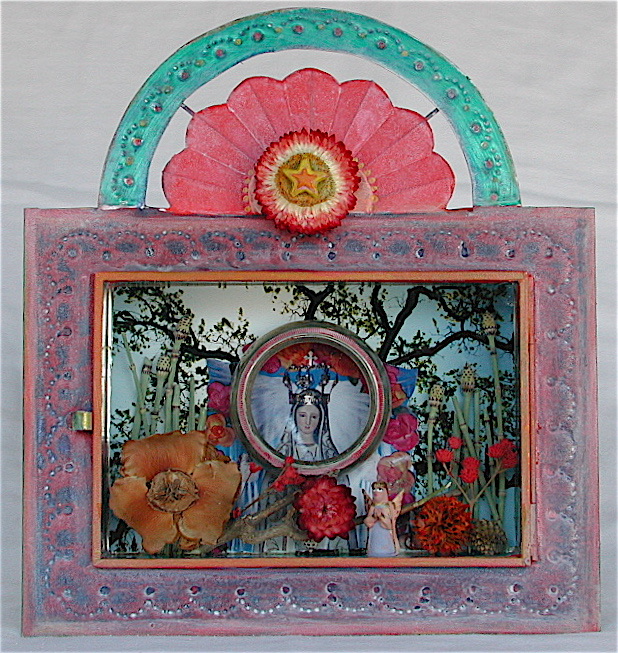
It was over a year ago that I became so entranced by the workmanship and intricate eye to detail and symbol in Huichol art that I decided to try my hand at it by incorporating the use of wax and beads into my retablos (metal storyboxes.) This is when I became serious in my research of the symbolism and ritual of Huichol art.

I learned that the scenes depicted were often the story of a particular spiritual journey along the peyote road that either a shaman had experienced and relayed to the maker, or that the maker himself had experienced during the weeklong yearly journey into the sacred peyote fields near Real de Catorce or during other peyote ceremonies later in the year.
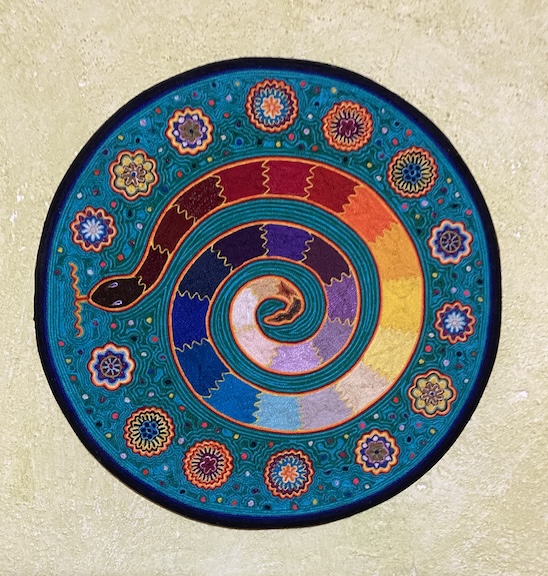
String painting, an art form relatively new to the Huichols and produced solely for     commercial purposes, still reflects ancient spiritual themes as in this peyote/snake motif.

 I learned how important the relationship between the natural world and the individual spirit are to this culture that has managed to retain its traditions in spite of the pressures of the modern world. Surviving by growing crops such as corn, squash, beans and amaranth, they have also learned to supplement this subsistence-level cultivation of crops by selling their art to the tourist and gallery trade. So it is that the men of a culture traditionally given to isolation and privacy, walk the streets of cities such as Guadalajara, Durango or Mexico City in their traditional clothes intricately embroidered with the figures of peyote flowers, sacred animals or designs in the patterns of markings on the backs of snakes. (Women, more simply dressed, still wear the short full blouses in beautiful colors, full skirts and headscarves.)
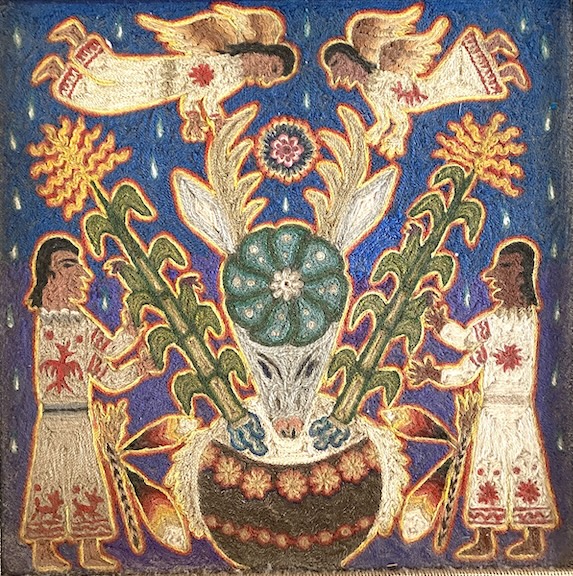
Although evangelical groups who tried to supplant the traditional religion in Huichol villages found themselves ousted and their homes burned, some Catholic iconic figures have been absorbed into the Huichol culture. Images of angels, Christ and the Virgin Mary may be found in the carefully waxed boards that intricately depict in beads or string some story of Huichol myth, history or current spiritual experience; but the angels in my string painting illustrated above are beautifully robed in Huichol dress and hover over the more classic symbols of Brother deer, corn stalks, votive bowl, rain, feathered sticks, peyote button and flower.

It is possible that the Huichols were better able to tolerate some of the tenets of the Catholic faith because they found them to contain some similarities to their own culture. Ceremonies where amaranth grain was shaped into the form of a Huichol “Ancestor” and where the body was later broken into pieces for each to consume were seen to be similar to the sacrament of holy communion, and this ritual use of the grain (which was also a staple food crop in Mexico at the time) is perhaps why the Spanish forbid the cultivation of amaranth during the years of occupation. Sadly, as a result, this highly nutritional grain that also bore the advantage of being able to be stored for long periods of time, has disappeared as a staple of the Mexican diet.
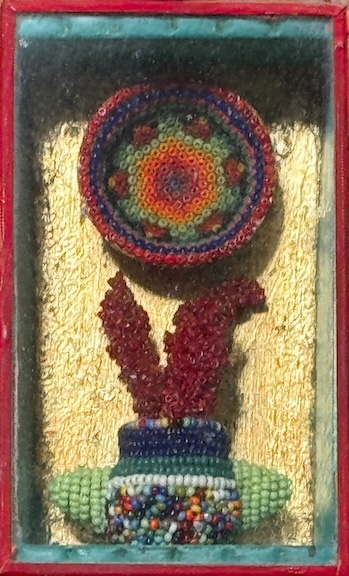
As I started work on my first retablo that made use of the Huichol beading techniques, it seemed important to honor the amaranth formerly denied by the Spanish. For this reason, I worked for hours covering this plant in tiny beads meant to simulate the buds of the amaranth plant.


As I researched my topic on the Internet, I began my own personal journey through Huichol spirituality.  I was already acquainted with some of their symbols such as the scorpion, deer, corn, arrows, turkey and eagle feathers, moon, sun, fire, peyote and flowers, But as usual when beginning a piece with a new theme, I felt the need to discover the meaning of these symbols. Many I incorporated into the two three-windowed retablos I was able to complete over the next four months. Since most of the symbols used were ones that had special significance to me,  it was a simple matter to blend my own mythology with that of the Huichols to make pieces of double-significance.
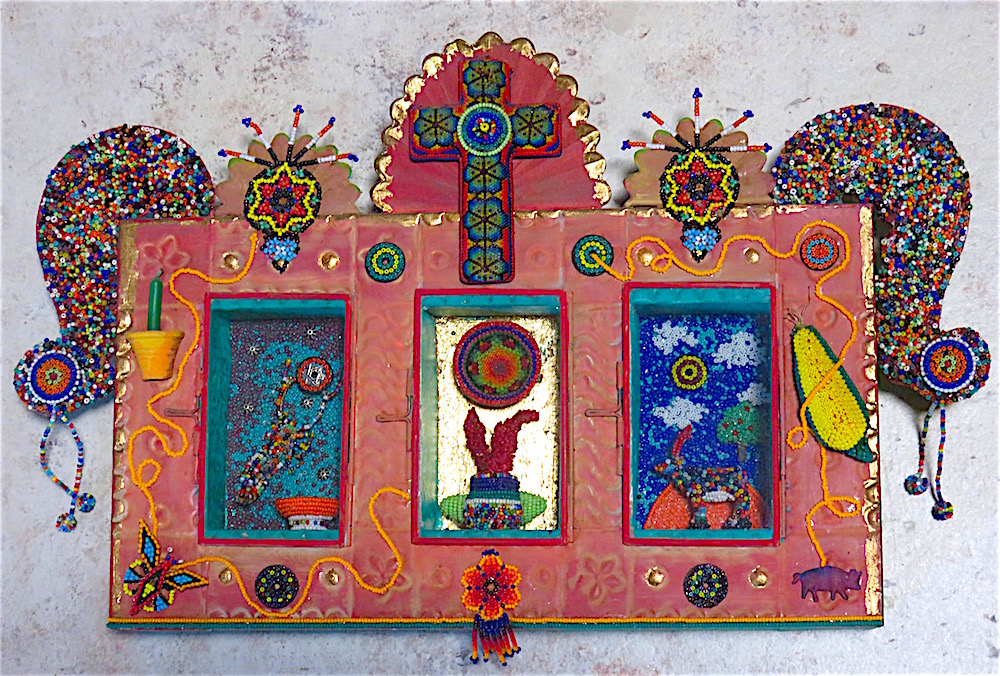


My first efforts at beading demonstrated clearly what a laborious process it is.
A Huichol-made butterfly, three earrings and a cross give inspiration to my own beading in the rest of this piece.


I was reminded of the stories told to me by an old man who directed my steps around a local church, showing my friends and me how the Mexican stone carvers had been able to hide numerous symbols of the old religion, incorporating them into the Christian symbols demanded by the Jesuit fathers. Now I was the artisan, craftily hiding my own meanings behind the symbols common to this society where all art was either an expression of or an offering to the spirits of nature that they both sought preserve, honor and thereby to maintain a oneness with. Each of my beading tasks became an exercise both in craftsmanship and in philosophy as I tried to remember the significance of each symbol.


The deer that is so central to Huichol mythology carries for me an association with Frank Waters and his book “The Man Who Killed the Deer.” That book, which I taught in a Native American Literature course, had a great effect on my own spiritual beliefs. Its triple symbol of the deer, the eagle and the snake reveals the similarity between the beliefs of the Pueblo people and the Huichols.  In the book, we are told that if you have a secret, you should not tell it in front of the snake, for the snake will tell the eagle who will tell the deer.  Here, again, the interconnectedness of all creatures and parts of nature is expressed.

The deadly scorpion of the Sierra Madres, which every year causes deaths among the Huichols, nonetheless is used in their art as a protection against evil. However, as I carefully applied bead after bead to the wire form of the scorpion in my piece, I was instead remembering a jungle in Timor where I was first marooned, then stung by a scorpion and saved by the cumulative efforts of 12 traveling companions formerly unknown to me.
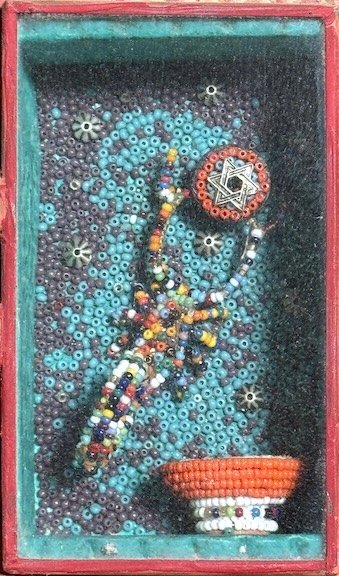
The small beaded clay bowl beneath the scorpion contains cornmeal and amaranth, both traditional Huichol offerings.

Positioning my scorpion into one of the three display cases of my piece, I was reminded of the constellation Scorpio, and so the swirling cosmos formed behind him, with silver beads becoming stars. His pincers seemed to be reaching out for something, so between them I positioned a stylized peyote shape, then, reached into my charm box and found a star that seemed to be just right to place over the peyote symbol to complete the tableau. I had already discovered that the Huichol star is identical to the Star of David, a fact that has caused one researcher to wonder if perhaps here was the lost tribe of Israel!


Slaving over the intricate task of beading on wax, only to have the piece heat up in the sun and all the beads reposition themselves, I developed a new respect for Huichol craftsmanship. Time and again, I put neat rows of beads into place along edges, only to have them come loose or push out of shape. Finally, I removed weeks of beadwork, scraped off all the wax and used white glue in its place.


Working in from the edges, as I had read the Huichols do, I was frustrated to find not enough room for the last necessary bead. Forcing it in, I found other beads all pushed out of shape. How in the world did they do this????

I found incorporating exquisite Huichol pieces and then surrounding them with my own work to be a wonderful and spiritual task. Slowly, stories started forming.

The deer I had painstakingly covered in wax and brown beads with black hooves, then stripped to cover with white beads, then again stripped to cover in multicolored beads, finally seemed right; but behind him, a blue sky and yellow and brown ringed circle (sun? stylized peyote button?) seemed to form itself. Then clouds demanded to roll in. Soon a tree appeared, covered in fruit, some of which had fallen to the ground. What I had intended as a bright orange sun somehow slipped down and became a bright orange hill, setting off and giving extra importance to Brother Deer, one of the most sacred symbols in Huichol spirituality.

I started examining more closely the booths selling Huichol art in the tianguis market in Ajijic. If someone was working on a piece, I looked carefully to see what tool they used to pick up the beads, what technique they used in positioning and nesting it into the wax. There seemed to be no tricks for achieving their incredibly straight lines that always ended in exactly the correct place.

I looked more closely at that my purchased Huichol pieces that had been beaded on flat boards. There were never any empty spaces caused by an inadequacy of space for the last bead. There was no awkwardness of line. I began to see the intricacy of the design, how shadow and perspective were accomplished by choice of color and subtle outlining that achieved the exact correct effect.


As I struggled over each section of my second retablo, spending a ridiculous amount of time just to cover one tiny ear of corn or animal figure, I became more and more amazed at the low prices these Huichol artisans were charging for their work. When I heard tourists in the tianguis (open-air market) trying to bargain for an 80-peso necklace that I knew must have taken a day or more to make, I couldn’t help but comment to them that the initial price was not only fair, but in fact ridiculously low for the amount of work involved.

I started to look more closely for exceptional work and to buy it when I found it, knowing that that piece would never be duplicated. I never bargained. Each piece I admired or purchased was the instigation for more research and I added new symbols to my repertoire. I discovered other sacred animals: the peccary, (javelina), butterfly, hummingbird. I discovered the legend of Amaranth Boy and Blue Corn Girl, the flood legend that seems to be central to many cultures and religions.
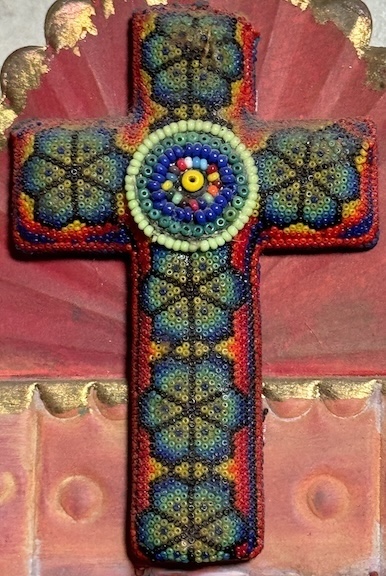
This expertly beaded Huichol cross puts to shame my efforts at beading. The center circle is my addition. 

I found in the marketplace this exquisite small cross that had been beaded using tiny beads a quarter the size of the regular Czech seed beads which in modern times have supplanted the seeds, clay, bone, jade, coral, pyrite, shell, turquoise and stone chips used for beading in ancient times. This cross, perfectly beaded with delicate and subtle shading, cried out to be included in my first piece. It seemed the perfect symbol for what I have been learning all my life. Here in Mexico, this lesson seems to have been accelerated. That Christian symbol, beaded in a peyote design, represents to me the open-minded acceptance of similarities of all cultures. This cross, accepted and altered by this oldest culture in Mexico, has again been accepted and altered by me to fit into my own spiritual identity.  It represents perfectly one thing that most of us who choose to live in a foreign culture must come to accept. Simply, that none of us have all of the answers. To become wise, all of us need to search outside of ourselves and perhaps outside of our own cultures to find the truths that all of us, ironically enough, carry within us.

We are one with nature. One with our world. What damages the world damages us. When we damage others, we damage ourselves. The Huichole’s entire life is spent in trying to maintain this balance in the world. The sun is falling? They seek to find a way to shore it up. Mother Earth is dying? They seek to find a way to minister to her needs.

Some years ago, Huichols staged a 600-mile walk to Mexico City to ask to be given 20 white-tailed deer from the zoo to establish a  deer-breeding project that would enable them to reintroduce the species that had become extinct in their mountains.  Seeing the absence of this species central to their religion and mythology, they feared the unbalancing and destruction of the world.

Sacred pilgrimages, week-long deprivation during the sacred peyote hunt, offerings left along the old walking paths, designs pressed into wax or strung on string or wire–by all of these means, the Huichols strive to hold their world and ours together.

Meanwhile, the modern world advances on their  sacred spots. Highline wires buzz above one of the four sacred spots by Real de Catorce. Developers sought to build a high-rise hotel in San Blas over their westernmost sacred shrine. A third, located on an island in Lake Magdalena, was destroyed when the lake was drained. This small stone hut on a hill on Scorpion Island in Lake Chapala was erected by the Huichols to replace the Magdalena site.  Here they deposit offerings such as maize, beadwork, chocolate, paper, pictures, letters, and woodcarvings.
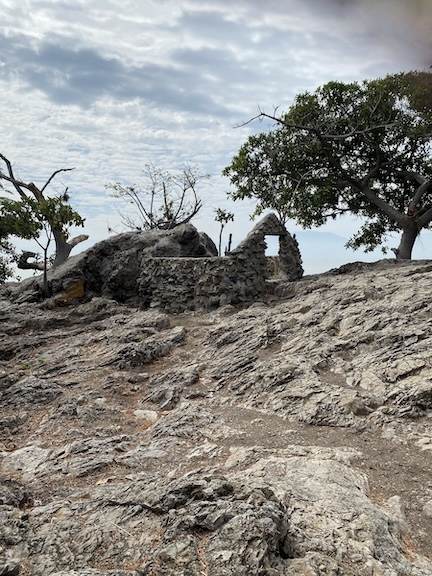
Visitors to Scorpion Island can stoop down before this stone hut to see the offerings left inside.

We are lucky to find in our modern world the living history culture of the Huichols. They are a people to whom the spirit world is more important than the material world. For them, peyote is not an entertainment, but rather a pathway and method of communication with a world we rarely experience–a world of spirit, which is interwoven, with the outer world. When they take peyote, they find the pathway to that world. When they create their art, be it offertory or for sale in the marketplace, all of that art is suffused with their memories of the spirit world. The art itself is both a communication with that world and a record of it. Those of us who buy it as a beautiful object, get more than we are paying for. We not only buy the reflection of a beautiful culture, but with it we are given the gift of the Huichols, who for themselves and us also are holding the world together.


Author’s Note:  When I began this article, I fully intended to give a detailed explanation of Huichol symbols and history.  The more I delved into the research, the more I realized that this information is readily available on Google, written by people much more acquainted than I am with the Huichol culture.  Instead, as in life, my article has taken a more personal path.  It is hoped that it will inspire you to delve more deeply into matters of which I have merely hinted.

HERE is the article Marion Couvillion was nominated for.
 

Innocents in Mexico, Chapter 15

Innocents in Mexico

Chapter 15

            Mexico was a libertarian’s dream.  Although major roads were maintained when the potholes got big enough to cause accidents,  government maintenance of lesser roads were rarely dealt with promptly, if at all.  Here, if a neighborhood wanted a paved road, they got together to buy the cobblestones and hired someone to lay them, or pitched in to build it together.  Rules were few.  Although there were stop signs, few stopped at them.  Not even the police.  Here whole families rode in the backs of pickups, perched on the sides or on the floor with grandma on a folding chair.  Here people lit up in restaurants. (Although smoking laws twenty years later have been changed.)  Fireworks went off every night at all hours––the sign of a fiesta, the death of a child, or any public or private celebration.  Downtown, church bells rang loudly throughout the night.  There was a rule that no one could construct a window that overlooked their neighbor’s property, so all windows were on the fronts of the houses, but there were no rules for noise.  Our neighbors pounded anvils, operated buzz saws and set bricks with a mallet far into the night. 

            Last night, there had seemed to be a fiesta complete with music and firecrackers going on into the early hours right by our front gate.  When we returned from the video premiere,  the number of people who were sitting on the curb in front of our house had surprised us, but we had no clue that  the purpose for their being there went beyond a Friday night stroll and gossip session.  Perhaps they were conducting ceremonies to expel the new foreigners.  We had no way of knowing.  When we told Steve about it, he said, “Oh yes, two fiestas a week.”  His meaning was cryptic.  We would, no doubt, find out what he meant. 

            In the mid-afternoon, Bob motioned for me to look out of the second story window.  From our neighbor’s rooftop, strings of flags and fringed streamers descended across the street to light poles opposite.  Perhaps there would be yet another fiesta tonight.  This time, I would go to see what was happening.  

            It began in the afternoon, when I could hear a band some distance away.  It sounded like a group of first year band students who had assembled to practice both their marching and their music with many false starts and stops.  As it got nearer I went out to the street, but saw nothing.  Then I saw them––a strung out bunch in white shirts wending their way through the field that crossed to the Gigante.  A few men sat on the curb to my left as I left our compound, a few women to my right.  A woman passed and I said, “Buenos tardes.”  She answered me, but I could see her glance at my bare legs.  My Sausalito Art Festival T-shirt was extra-large and extra-long, and covered my shorts.  Just as well, as they were covered with smiling skulls, more appropriate for Day of the Dead, no doubt, than whatever festival was going on.  To her, it probably appeared that I had on nothing under the T-shirt.  More streamers with banners had    gone up in the street.  They were strung from the houses on either side of us out to a wire that someone had strung from light pole to light pole.  It was a few feet lower than the electrical wires and seemed to have been strung for just this purpose.  Now several houses up and down the street sported streamers.  As the day progressed, I could hear the band practicing from some direction far to our right––along the main road that led from town, perhaps. 

            In the very late afternoon, the true activities began.  At first, we heard the music––this time louder and more in unison.  We drew chairs out to the sidewalk in front of our compound.  Along the street, a number of our neighbors were assembled.  In the distance, to our right, we heard wild drums, cries and shouts.  The beat was primitive––more Native American or African than Mexican.  Then around the bend in the road they came––young men and old men in pre-Columbian Aztec dress.  Bare chests, leather loin flaps.  The drummer had so much white face paint on that I thought he was Anglo.  Their heels held high, they executed three leaps to the left, then three leaps to the right, then twirled and twisted and yelped.  In the front were the best dancers.  We tapped our feet and moved our shoulders to their rhythms.  Impossible not to.  At the back of the troupe came the young dancers––one so young that his mother marched along at the side to keep watch over him.  She called out to him as one man veered too close to him.  Behind these modern day reminders of the old religions came the new:  six pre-adolescent girls in white dresses carrying a flower-heaped platform.  Rising up from its middle was a cross.  As they passed us, one girl handed over her rear position on the carrying pole to another girl and rubbed her shoulder.  An older woman supervised the hand-over and kept the girls carrying the cross and their relief squadron, who marched behind them, in line and in sync.  When one girl lowered the pole, the woman reached out to raise the platform to even it out. 

            Behind the girls came the band I had been hearing all day.  They were still not perfect in harmony or rhythm, but they were much louder, which did a lot to improve their sound.  The procession moved by our house and down the street.  As we carried our chairs into our compound, Bearcat dashed out into the cobblestoned street––a daring move for a cat who a week ago wouldn’t come out from under the bed. I called him back in and he minded. 

             I spent the day making retablos.  I had purchased the tin and glass boxes in the artisans’ market a few days before, intending to give them as gifts when I returned home.  But after they lay on the living room cot for a few days, I couldn’t resist opening them to see what I’d bought.  The afternoon was hot and I set up my “studio” on the small table of the patio which held the clothes washer.  My tool boxes and cases full of art supplies sat on the patio around me.  By late afternoon, I was surrounded by strips from cut up photographs, cloth, beads, snips of waxed linen.  Each glass fronted box was some degree of its way toward being a retablo.  One was dedicated to Bearcat, another to the Virgin of Guadalupe,  the third a tribute to life in general––seeds, greenery, birth.  With my limited supplies, it became necessary to search the household for things we’d brought that could contribute to the shrines.  A container of popcorn contributed fertility and life bursting forth to the Madonna shrine.  An old peso brought to me by neighbors who visited Mexico in the 50’s, now worthless, was beautiful when the raised parts were buffed with fine sandpaper.  Feathers, beads, charms, seeds, bits of cloth, cut up bits of the photos I’d taken so far in Mexico.  Bob awoke from his siesta in the late afternoon and set up his easel––a tall ladder––in the courtyard.  He assembled his paints, prepared his palette––and the rain started.  Moving his materials quickly to the patio where I sat surrounded by my midden of art supplies, he propped his canvas against the table.  Restful large blobs of color covered the canvas.  They reminded me of the bougainvillea.  His usual bright primary colors had been abandoned for the more subtle colors of the garden and house that surrounded us. 

            By 9:30, we sat on the deck eating our dinner when the band started in again––coming from a direction about half a block away to the rear of our house.  Kids’ voices called out excitedly.  I imagined a pinata being broken.  Then the fireworks started.  They were the spectacular chrysanthemums and huge falling fountain fireworks of  a fourth of July celebration.  At first we went out to the compound to see them.  Then Bob said we should go up on the roof, but by the time we had climbed up the circular staircase with our plates, the fireworks had stopped.  We stood at the edge of our roof, our plates balanced on the adobe pillars on the sides of the patio.  Up here it was cool, and the food lost its heat quickly.  Although it was too dark to see our food, in the moonlight, we could see puffs of smoke ––the ghosts of the earlier fireworks.  We could hear a loud “thwack, thwack, thwack” and children screamed and laughed.  The band started up, died down, started up––like long spaced hiccups. 

            An hour or so later, when we were about to go to bed, the activity again moved to the street in front of our house.  The band, much improved, came marching firmly down the street from our left.  They seemed to have been replaced by another band, for now their music was sure and robust.  They seem to have swelled in numbers, as well.  They came more quickly than before down the street and stopped two doors away from us.  Some of them carried bottles, which they took fast swigs out of before raising their instruments.  They played a rousing song before one of the men pulled a man from the house and brought him out to dance with him.  He encircled his body with his arms and they danced like lovers to the music.  Then the music stopped and the entire band––maybe 15 or 20 strong––streamed into the house.  Earlier, as I stood on the roof, I had seen women in that compound making tortillas in the back yard.  I had wondered why they would choose early evening to do so, then figured it was to escape the heat of the day.  Now I wondered if they were for the musicians, who did, indeed, stay in the compound for the rest of the night, playing music which echoed up the brick walls of their compound directly in through our windows.  It was then that the really loud fireworks started and continued for an hour or so.  We drifted off to sleep.  Was it midnight or 1 a.m.?  It made no difference.  The fiesta was over and we slept.

            Boom!  An explosion like a land mine ripped through our open window.  Then another and another.  Some streamed up into the air, some exploded on the ground.  These explosions were cherry bomb sized, then hand grenade sized, then, to our very early morning ears, \ground-to-air missile-sized.  Amazing that the cat only stirred slightly in the bed.  Just a week ago he would start and run at the rustle of the cat food bag.  Explosion after explosion went off. 

            “What time is it?” I asked Bob, but he couldn’t see his watch.  By this time, at least a couple dozen explosions had gone off.  Since it was still dark, perhaps the purpose was to bring out the sun.  By now the roosters were crowing, so the  fireworks had done their job.  But they didn’t stop.  After one ear-splitting retort, our car alarm went off, adding to the festivites.  Bob rolled out of bed and fumbled in his shorts pocket for the keys.  I moved to the bathroom and by the time I got back, the car alarm had gone off again. 

            “Just turn it off.  I think this is going to go on all day.”  I flipped on the light.  6:15 a.m.  Church bells began to toll. 

            By eight o’clock, all was quiet.  The sounds I could hear seemed muffled––either in comparison with the fireworks or due to them.  Roosters crowing, the acetylene torch sound of the water heater coming on, trucks and buses on the road, the beautiful cries of grackles.  Ceiling fans whirred.  Bob slept on in the huge bed on the balcony across from where I sat in the office.  This bed was the largest either of us had every seen.  It had to be bigger than king-sized.  I could stretch out my arm fully from where I slept and still not find him.  The cat could sleep sideways between us and not touch either of us. 

            “We need another person for this bed,” Bob had said as we slipped into bed the night before. I suggested that we could both just roll over to the middle, so we did.

For Chapter 16, go HERE.

Chapters 1-14 are availble in daily blogs for the past two weeks. 

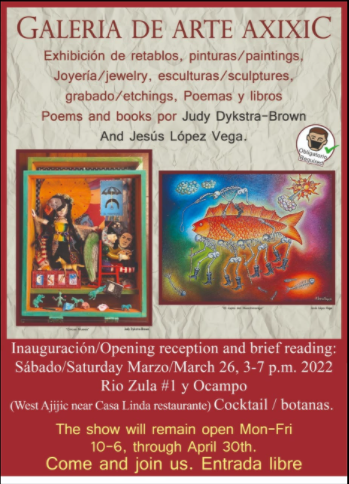
Judy Dykstra-Brown/Jesus Lopez Vega Art Exhibition: Last Three Days of Our Show

Click on photos to enlarge.

These are a few of my retablos and sculptures still left. Come see them and many more, as well as Jesus’s paintings at Jesus Lopez Vega’s studio, M-F 10-6 through April 30, Rio Zula 1 at Ocampo, one half block below Casa Linda Restaurant.

Feed the Birds (Art Challenge #6)

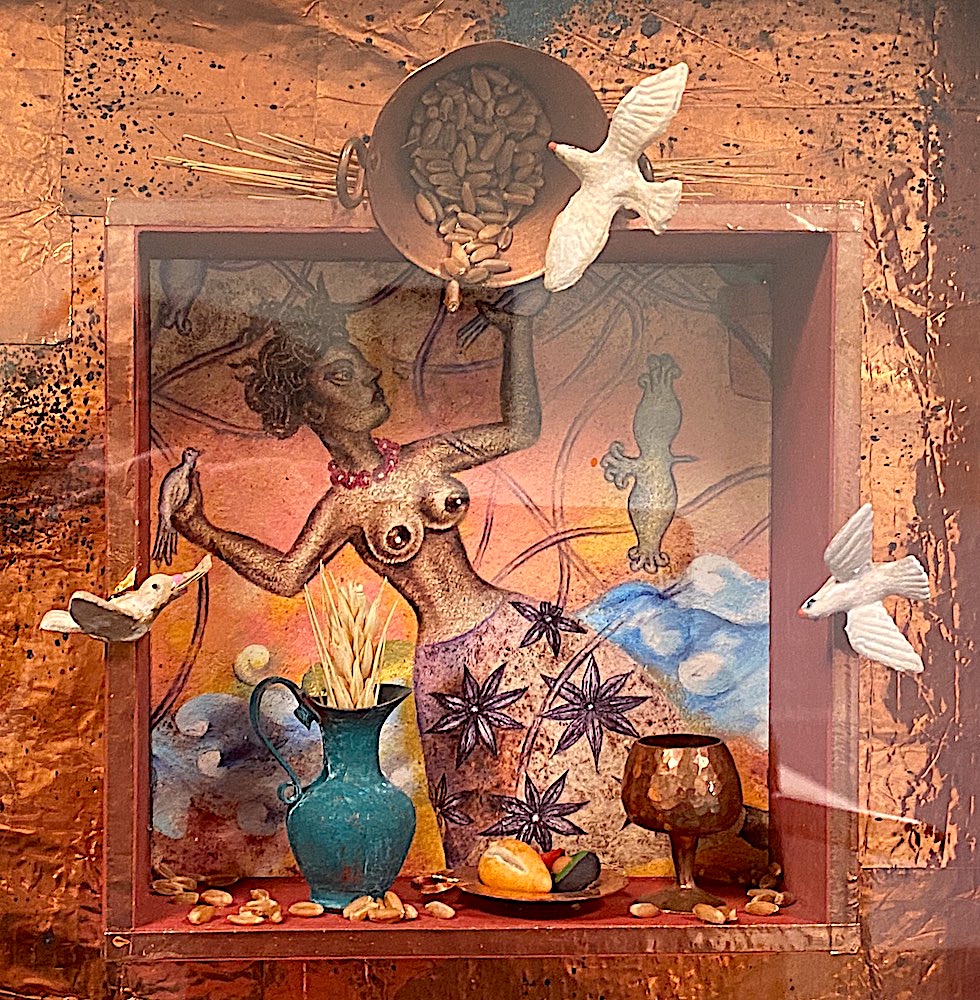
This art print of Antonio Lopez Vega inspired the piece above. She is feeding the birds and in turn they bring her a message in the beak of the bird to the left. Wheat from my father’s last harvest spills from the hand formed copper bowl from Santa Clara del Cobre. A copper plate holds a loaf of bread and a halved avocado. Copper leaf in the background surrounds the woman and completes the theme.

This is one of a number of my retablos still on view at the studio of Jesus Lopez Vega, at the junction of Rio Zula/Rio Brava and Ocampo, a half block south of Casa Linda Restaurant in Ajijic. Open M-F until April 30.

Tomorrow’s the Day!!

Jesus and I have been working hard getting our show together. He’s been working for two months on the amazing armoire pictured below which he’ll be showing along with some of his paintings.  I’ll be showing my silver and paper jewelry along with my retablos and sculptures. Here are some shots of my work and a photo of his armoire along with information about our opening on Saturday, March 26, 3-7. Directions below.

Little Altars Everywhere

Click on photos to enlarge.

This is one of the pieces I made for a Day of the Dead show at Jesus Lopez Vega’s Gallery in Ajijic opening on November 2, 2021 on Rio Zula, one block south of the Carretera. This piece is 20 inches high and 12 inches wide. It includes a miniature I made of an actual book entitled “Noche de Muerto en Michoacan, Muestratio Portico” that is sitting on the chair. Other offerings mentioned below are on the table, along with a photo of the dear departed.

Little Altars Everywhere

There’s no pleasing the likes of a departed soul.
Take for instance the corpses out for a stroll
on Day of the Dead with their garb all in shreds
when other departed remain in their beds.
They think they’re entitled to dead bread and beer,
flowers and candles and when you come near,
they’ll say they’re entitled to sweets and tamales.
Once a year this is how they get their jollies.
All over the city, we bring them their due,
and when it comes your turn, we will bring it to you!


Prompt words today are corpse, title, pleasing, garb and city.

Daily Post Photo Challenge: Saturated

These are two of my older retablos–both pretty colorful! Although the retablos were sold many years ago, I found these photos on an old photo disk. The top one is about 5 inches wide, the bottom one probably about 15 inches high.  Click on photos to enlarge.


For The Daily Post Photo Challenge: Saturated

Rabbit as Legend in Mexico

The Rabbit’s Navel

P7060076

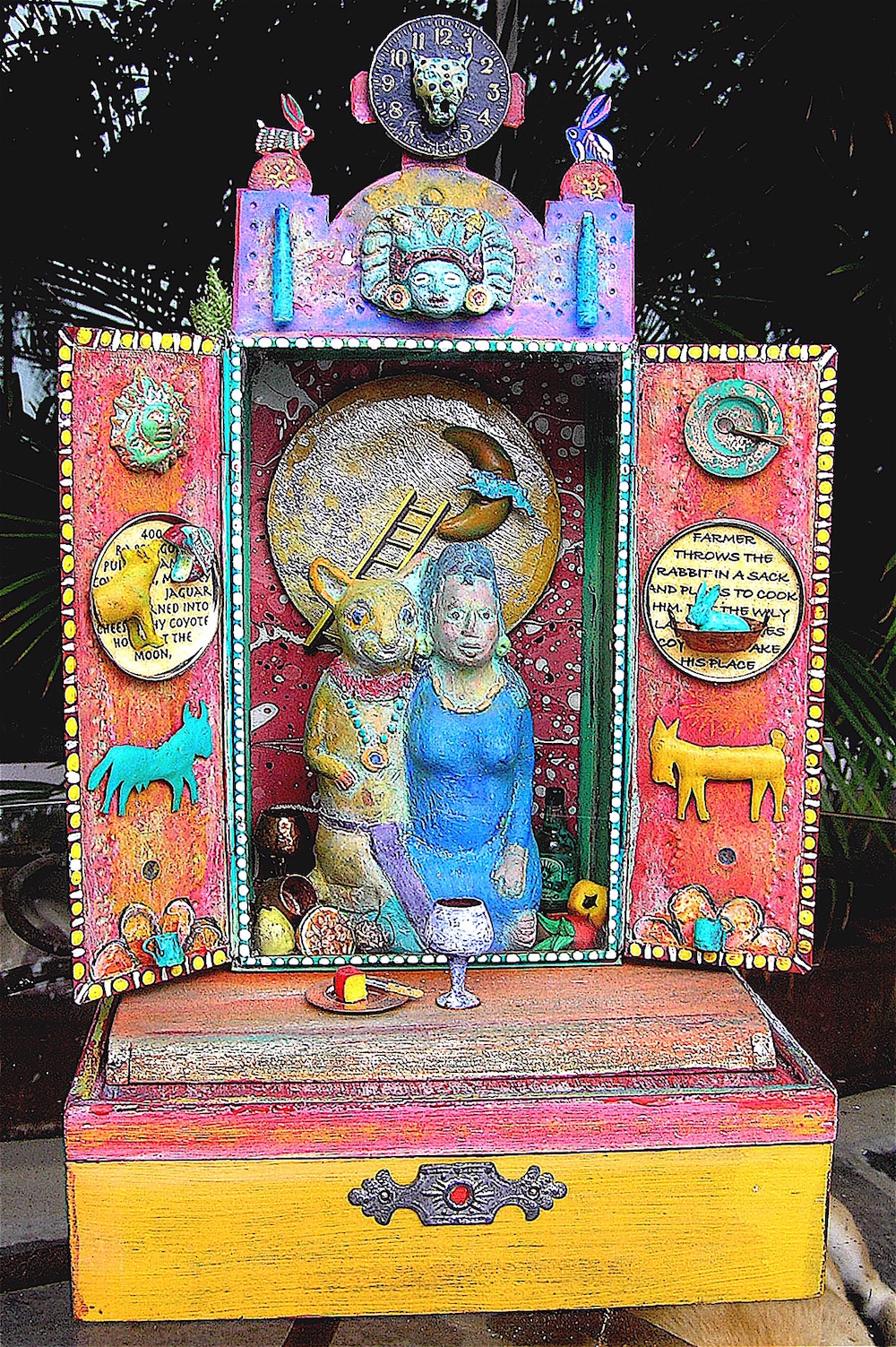
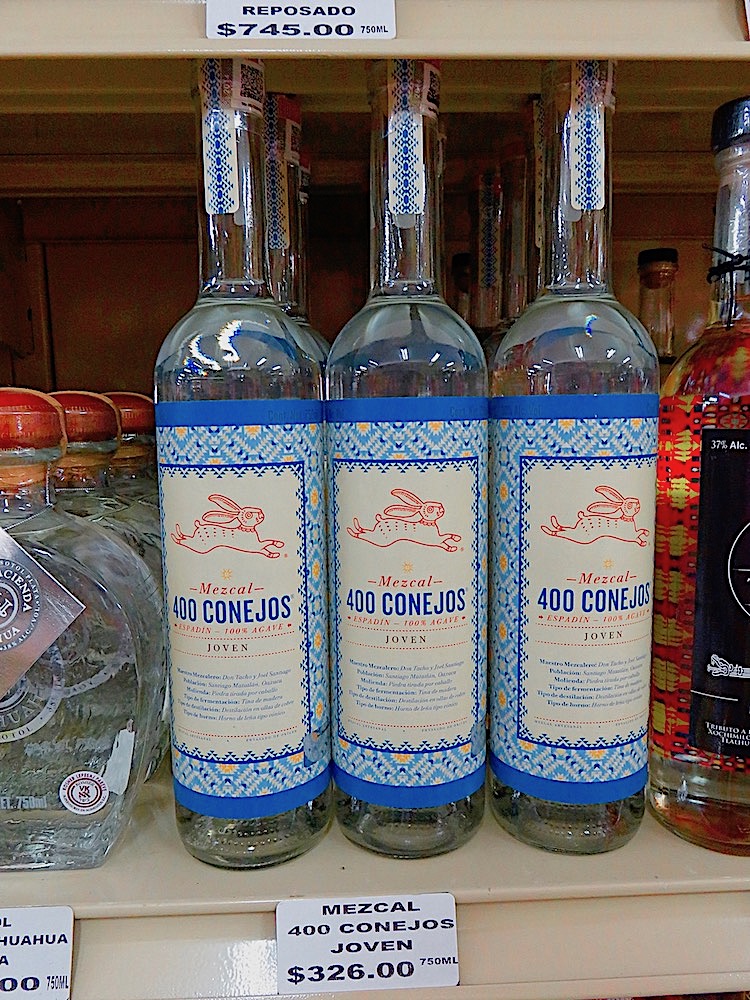
Numerous Mexican legends surround Rabbit, and each object in this retablo depicts one of them. Even the name “Mexico” is derived from Nahuatl words for the rabbit in the moon; and its capitol, Mexico City, is built on six lakes in the form of a rabbitIf you open the box this retablo sits upon, you will find inside a manuscript that conveys the story of the rabbit in Mexican legend and how I was drawn to it. The Aztecs had a legend of 400 drunken rabbits who were the gods of pulque–a drink made of fermented Maguey–the same plant that Tequila is made of. The woman sitting next to rabbit might be Mayahuel, the goddess of Maguey, but it is more likely that she is the Jaina woman explained in the quote below from the book Maya Terracottas.

“Representations of Maya women occur more commonly as Jaina figurines than in any other medium. These Jaina figures represent two kinds of women, both archetypes of female behavior. One is a stately, courtly woman who is sometimes shown weaving; the second is a courtesan who appears with all sorts of mates, from Underworld deities to oversized rabbits. The imagery of both derives from Maya concepts of the moon, perceived as an erratic, inconsistent heavenly body, whose constantly changing character follows the monthly cycle of female menses…
…The second female type is far more active, and she projects her sexuality…she is usually bare-breasted, and she gestures, as if offering herself to others. The demure woman may be painted in various colors, but this one is generally painted blue…Nothing else in Maya art conveys sexuality more convincingly than these figures. Although they may be conceived as the moon goddess and her consorts, they also reflect human behavior. As companions for the dead – perhaps particularly for old men – they seem to promise renewed sexual activity. For the living, such Jaina figurines may have been titillating objects for private observation.” (Schele: 1986, p. 153). Cf. Kimball, Maya Terracottas, p. 23

Since Fandango’s prompt isn’t up yet and I didn’t post to yesterday’s prompt of Legend, I’m doing so now. This is a reblog of a post done three years ago.

The Conveyor of the Moon

The moon, a rabbit, a bottle of tequila and a simple Mayan figure of a woman convey to us many of  the legends of Mexico as well as one theory about her naming.  Eight years ago I created a retablo that conveyed this message, both visually and in a story that resides in a chamber within the box the retablo sits upon.  I sold that retablo years ago, but luckily I have this photo and these words that describe it. In case you missed it last time, here it is again: https://judydykstrabrown.com/2015/07/11/the-rabbits-navel/


The prompt today was conveyor.

Rich Harvest

© Sharon Knight
I saw this photo by Sharon Knight on Sascha Darlington’s blog and knew it was the perfect photo for this poem as well.  Thanks to both Sharon Knight and Sascha as well as dVerse poets, who sponsored this prompt. Like Sharon Knight, I grew up in the midwest and this photo could easily have been taken in my home state of South Dakota, a bit before the harvest time described in my poem.

Details from retablo “The Gleaners.” Painting by Anna O’Neglia, retablo and photo by jdb (Click on any photo to enlarge all)

Rich Harvest

The night that we brought in the wheat,
our weeks of labor now complete,
we raised our voices, beat our feet,
and in that stifling prairie heat,
weary and arm-sore, yet replete
with satisfaction for jobs well-done
earned in the dust and chaff and sun,
we ceased our labors and had some fun.

Hank gave the prim schoolteacher a treat
by lifting her from her safe seat
to move her to the fiddler’s beat.
Soon, her hairpins met defeat,
her wild hair anything but neat,
 and Hank was heard to woo the miss
and then to plant a tender kiss.
She remembers all of this

now that their family’s complete
with Rita, Sarah, and little Pete.
Now every harvest, when you greet
each townsperson you chance to meet,
chances are they will repeat
how Hank brought in the wheat that year
and afterwards, conquered his fear
and dared to call the school marm, “dear.”

The prompt today is treat.