Tag Archives: Lake Chapala

The Brick Throwers

The Prompt: Reviving Bricks—You just inherited a dilapidated, crumbling-down grand mansion in the countryside. Assuming money is no issue, what do you do with it?

The Brick Throwers

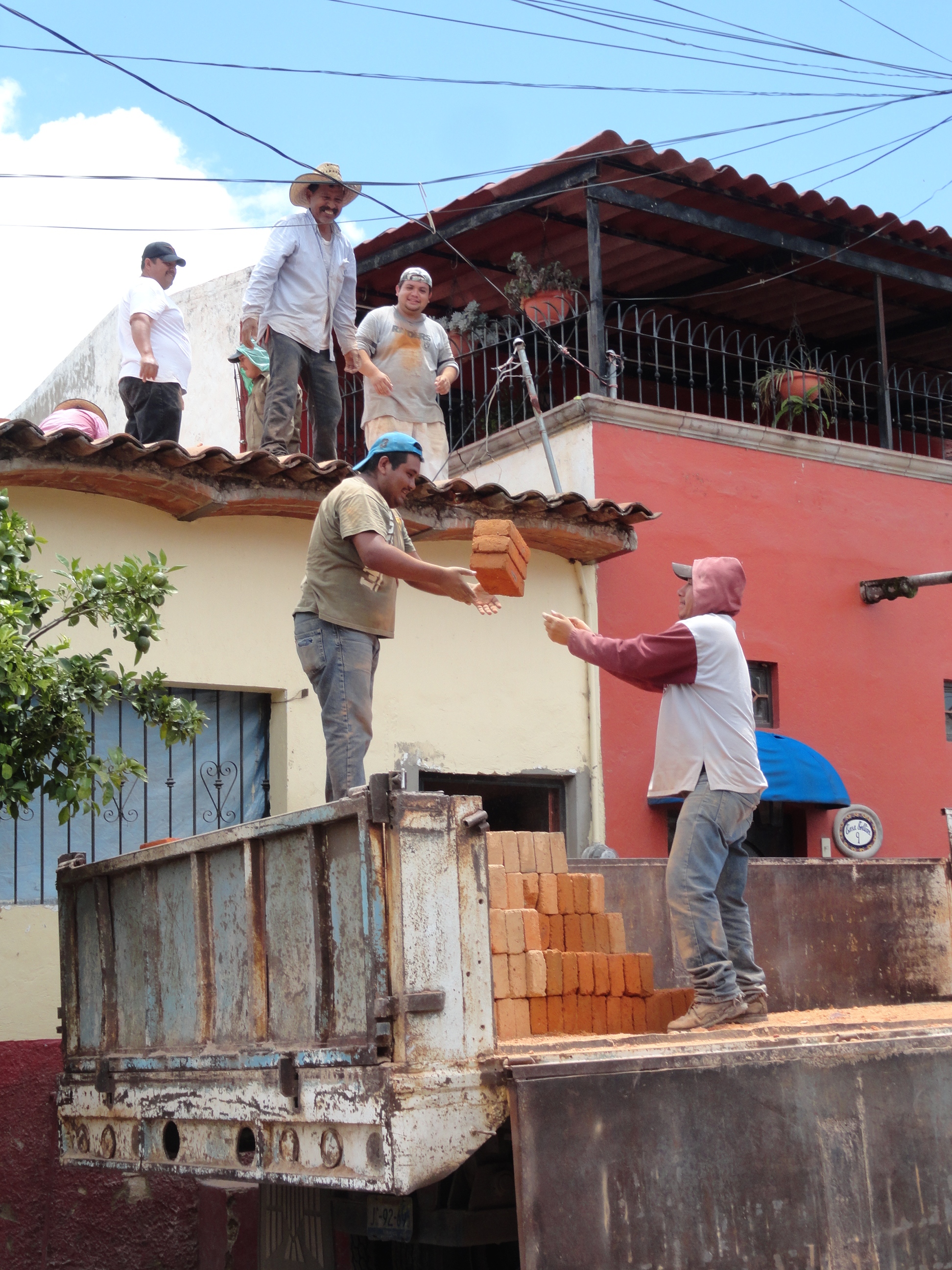
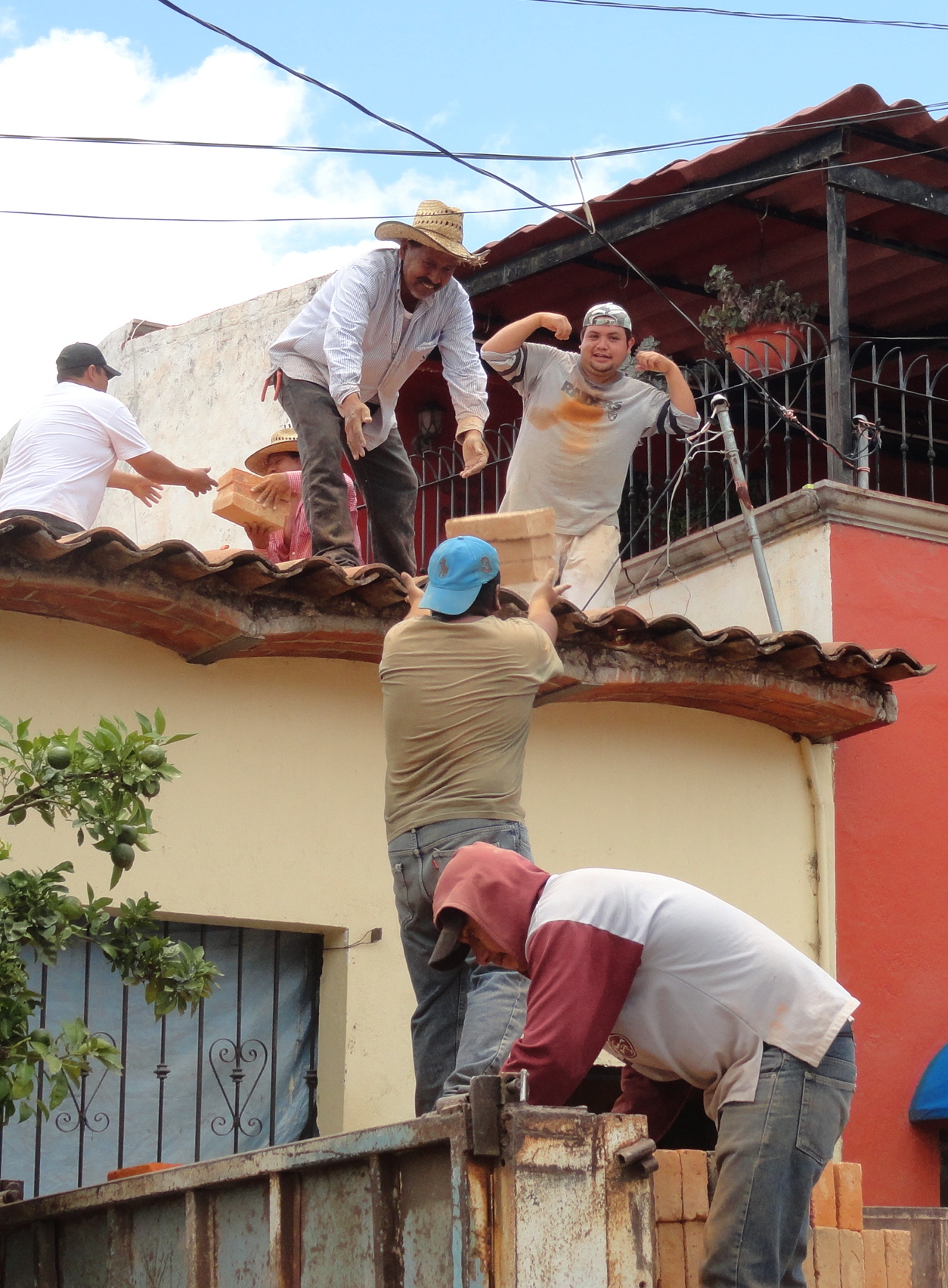
They were five in a chain from truck to rooftop,
each throwing the piles of adobe bricks
in stacks of four, from hand to hand
up from the bottom of the truckload
now nearly emptied.
Two of them waved me on
when I tried to park near,
my trunk full of heavy wall sculptures
to deliver to a gallery just half a block away.

And when I tried to park farther along the block,
again and again, they waved me away
until I was a block away and safe, I guess,
from straying bricks or errant cars that swerved
too far to the right to avoid the bricks or truck that held them.
They were a cheerful lot, and when I passed,
walking towards the gallery
carrying one sculpture after another,
they waved, and on my final trip back to the car,
again, the man second in the chain
who stood balanced on the highest level of the brick pyramid
that remained within the truckbed,
seemed to intuit my purpose, waving from me to them
as I drew my camera from my purse.
They all posed for minutes, miming their labor
as I tried to get them to actually throw, as before,
those piles of bricks, hoping to catch them
flying through the air between two pairs of hands.

Finally understanding, they threw and threw,
asking me for a prompt to help me catch that flight
I feared I’d never catch.

(more)
DSC07054

Minutes later, I turned to leave
and they, cheering and smiling in their fame,
turned back to that labor which is an art in Mexico:
giving bricks wings before mortaring them
into a permanency that holds them rigid for lifetimes
until they crumble back into that soil that was their nativity.

This poem should be a metaphor for something
and probably is.
Some future day, when I am moldering in my grave
like some lesser Ozymandius,
some graduate student or scholar of mediocre
Twenty-First-Century poetry might publish a treatise
revealing it.
And they will dig this website from the rubble
of the Internet and find
I wrote it as a daily prompt
and if such records still exist,
find how I hired those men to build a monument
from that crumbling manse of brick
that was my prompt on the Daily Post
and tell how they spent their lifetimes restoring it
and how their children and their children’s children
have benefited from catcalls
and instructions to move on down the line
and the clicking of a camera lens
and from one who follows blindly
where each prompt leads her.
DSC07049

Obscured Fourth

Obscured Fourth

In Mexico, it is the rainy season
and so the rain falls down.
The dogs refuse to leave their beds.
They curl instead, and I do, too,
listening to the steady drip of rain from tejas
and Pasiano’s more massive splashes
as he scoops water from the tub
which never empties,
constantly replenished
by the rains.

Now hot water streams
from pipes into the hot tub.
Mineral water heated by volcanic fire
steams as it meets cool water falling
from above and the cool air that carries it.

It is still morning, but even tonight I’ll find
no fireworks in Mexico on the Fourth of July,
for independence was not granted evenly around this world.
And I who love the fertile darkness of night,
but also love surprises
that the fireworks bring,
must patiently wait for independence to find
this new country I found 13 years ago.

No rains ever mar her independence
on September 16.
The rainy season over,
all necks will crane in the churchyard crush
to see the wild castillo
and its corona spinning, spinning
to lift off into the air above—
independence held back until finally
it cannot help but rise
to freedom.

Note: September 16 is Grito de Dolores (Mexico’s Independence Day)

The Prompt: It’s Your Party—Since many are marking their country’s “birthday” in the US today, we wanted to ask: How do you celebrate yours? Are you all for a big bash, or more of a low-key birthday boy/girl?

NaPoWriMo Day 24: Building Walls

Our prompt today was to write a poem that features walls, bricks, stones, arches, or the like.

Building Walls

The new neighbors are not friendly.
From their side of my wall,
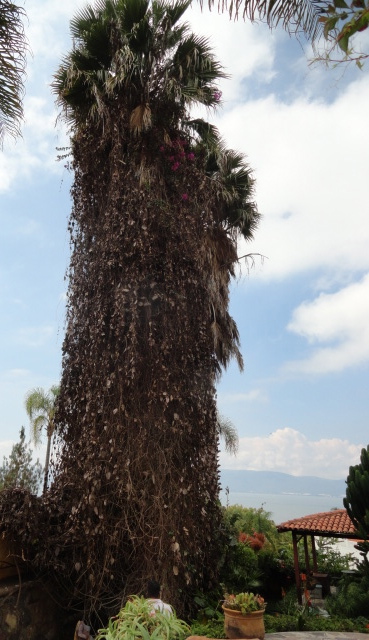
they have reached over my wall to sever the vines
that have covered my tall palms
that abut the wall
that has separated our properties
for thirteen years—
those maroon bougainvillea vines,
stretched ten feet wide
by covering layers of blue thunbergia,
formed a community that housed families
of birds and possums and possibly
a very large but harmless snake.
I saw it cross my patio once,
the dog and I turning our heads toward each other,
exchanging looks of surprise
like characters from a stage play or a comic book,
her so startled and curious that she followed,
nose to the ground, to the brush beside the
wall the snake had vanished into,
but never issued a bark.

At night the palm trees
and their surrounding cloaks
would give mysterious rustlings that
aroused the barking of the dogs
and I’d let them in—the pup to sleep
in the cage that was his security
and my security as well—against chewed
Birkenstocks and ruined Oaxacan rugs
and treats purloined from the little silver
garbage can that held the kitchen scraps
saved for Yolanda’s pigs.

Along with the vines,
the new neighbors cut the main stalk of the bougainvillea
that grew to fifteen feet on my side of the wall
and furnished privacy from the eyes
of those standing on their patio,
ten feet above mine,
so that now their patio looks directly down
on my pool and hot tub and into my bedroom,
their new bright patio light shines all night long
into my world formerly filled
with stars and moonlight and tree rustlings.

The old wall has revealed its cracks and colors
from several past paintings
that were later made unnecessary by its cloak of vines.
Now an ugly wall that  separates  neighbors,
it echoes the now-dead vines that stretch 80 feet up
to the fronds of the palms.
It takes three men three days to cut the refuse of
the dry vines down from the trees,
two truckloads to bear the cuttings away.

The dogs still bark, but the possum and the birds
have gone to some other haven,
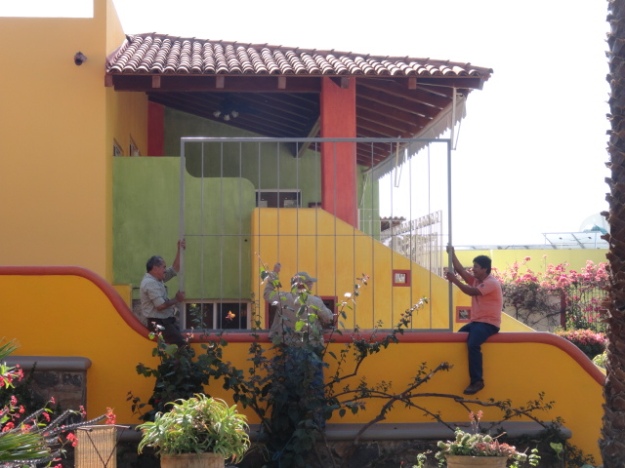
and the men come to erect the metal trellis,
12 feet high, above the top of my low wall.
I hope the bougainvillea will grow
to cover it this rainy season,
building a lovelier wall
between neighbors who still have not met
by their preference, not mine,
causing me to wonder
if I really am as welcome in this country
as I have felt for all these years.
“My neighbors are the same,” my friend tells me.
“They do not really want us here,
and if you think they do,
you are deluding yourself.”

Thirteen years in Mexico. I miss my old neighbors,
best friends who would come to play Mexican Train at 5 minutes notice.
I miss their little yipping dog and the splash of their fountain
that the new neighbors ripped out and threw away
and the bougainvillea that drooped over my wall into their world.
“Scorpions!” the new neighbors decreed, and lopped it off wall-high.
It was a wall more than doubled in its height
by a vine as old as my life in Mexico
that can now be peered over
even from their basement casita.

With old walls gone,
higher walls of misunderstanding
have been constructed.
Each weekend their family streams in from Guadalajara.
Children laugh, adults descend the stairs
to their hot tub down below.
When I greet them, they do not smile.
I have painted the old wall,
now so clearly presented to view,
and I have taken to wearing a swimsuit in my hot tub,
waiting for my new wall to grow higher.

Before detail of tree vine

“Before” detail of tree vine and hedge.

"After" detail of tree vine.

“After” detail of tree vine.

DSC09288

Constructing a higher wall to limit their view into my yard.

DSC09907

Trimming the dead vines after their gardener reached over the wall to cut it’s main trunk.

DSC09878

Detail of my wall with the dead vines stripped away, prepped for repainting.

(Happy Ending: Eight years after writing the poem you have just read, I now have new neighbors, the bougainvillea and thunbergia have grown to cover the new trellis wall, and they love the vines that actually flower more profusely on their side than mine.)

NaPoWriMo Day 18: In Defense of Poetry

An Apologia for Poesy

My gardener’s broom goes whisking light
first left, then right, then left, then right
with touch so slight I barely hear
the bristles as they take their bite.

The birds were first up and about,
and then both dogs asked to get out.
Then that broom reminded me
of one more creature left to rout.

I stir myself to go and pee,
then check the new prompt left for me
on NapoWriMo’s daily page.
Until it’s written, I’m not free.

It’s back to bed, I find it best
to go, computer on my chest,
typing words with beat and rhyme
still ensconced in my morning nest.

Searching for ideas and words,
I use the rhythm of the birds
and Pasiano’s sweeping broom
the braying burro, the bleating herds.

Noises fill this busy world
even as I’m safely curled
still abed, my senses all
alert and ready, full unfurled.

I hear the grackle far above,
the insistent cooing of a dove,
as in the kitchen, Yolanda dons
her apron and her rubber glove.

I hear the water’s swirl and flush
the busy whipping of her brush
around each glass I might have left,
careless in my bedtime rush.

Her string mop silent, I barely know
if she’s still here. Or did she go?
I find her in the kitchen still,
arranging glasses, row on row.

It’s back to bed again I trot.
Arranging glasses I am not,
but rather words I nudge and shift
here and there until they’re caught.

Glued to the page forever more––
be they rich words, be they poor––
nevertheless, these words are mine:
poems, stories, truth or lore.

We are not slothful, lazy, weak
because it’s words we choose to seek
instead of labors more obvious
like plumber or computer geek.

Words’ labors are most harrowing.
Our choice of them needs narrowing
and not unlike the farmer’s sow,
mind’s riches we are farrowing.

So blame us not if others mop
our houses or they trim and crop
our gardens for us as we write.
From morn till night, we never stop.

‘Tis April and we have this chore:
each day a poem, and what’s more
we never know till the morning’s light
just what theme they have in store.

Poets, our lives may seem effete––
not much time spent on our feet––
but those feet are busy, still,
tapping out our poem’s beat.

Cerebral though our work may be,
we are not lazy, you and me,
for though we lie in bed all day,
our writing’s labored––­­that’s plain to see!

Today’s prompt was to write a ruba’I, a Persian form comprised of a four-line stanza with a rhyme scheme of AABA. Robert Frost’s famous poem Stopping By Woods on a Snowy Evening uses this rhyme scheme. Multiple stanzas in the ruba’i form are a rubaiyat, as in The Rubaiyat of Omar Khayyam.


Poem written after the Celebration of Life for Nina and Eduardo

 The ceremony for Eduardo and Nina was full of the loving thoughts of friends, details about their lives given from many perspectives, a few tears but even more laughter from remembering the good times.  It was only on the road home that the contrasts in the peaceful happy setting I saw around me and the events of a week before hit me.  The first lines of this poem ran over and over again through my thoughts and I had to pull over by the side of the road and write this poem.  Part of me wonders if it is exploitative to write about this sad event, but I’ve found that many of my writer friends who were friends of Nina and Eduardo have been driven to do the same.  It is as though I no longer know how to think about things unless I do so through my writing or my art.  Somehow, the only way to process a hard truth of life is to make use of it creatively and to try to create a message that makes sense even though the deed never will.

After the Ceremony: Driving Home

The streets are filled

With ice cream and cerveza

and the wildly patterned legs

of senoritas.

It is a day

of sunlight and red flowers

and fuschia flowers and blue.

A slight wind

 strums the swaying branches

of the palms,

but no other sounds

compete with the passing hum

of oncoming traffic streaming

 from the city to our shores,

 seeking safety, quiet,

the gentle lap of water against willow,

hypnotic bobbing of the pelicans

between the undulating liria––

a lazy day away

from the cares of urban life.

I pull to the side of the road to watch

 these visitors to our world.

 Have they not heard or

have they just forgotten

the breaking glass,

the knife, the club,

the red screams

slicing the midnight air?

The ones who were the screamers

 are very quiet now––

part of the calmness

of this afternoon.

Their darkness

is dispersed by sunlight.

Yet all of their fear and pain––

the terror of their leaving––

now gone from them,

is kept like a souvenir

within the hearts of friends

whose turn it is to remember

for a while what we, too,

had forgotten.

Our happy world

lies like a blanket

over a bed made messy

by pain and loss.

It is the world’s bed,

and deny it as we will,

we all have lain in it

and will again.

                                                                              –Judy Dykstra-Brown      February 24, 2014

Nina Discombe and Edward Kular’s Deaths

I am so relieved to report that one of the men responsible for my friends’ death has been apprehended and is in jail.  They are presently in pursuit of his brother, who reportedly assisted in the robbery and murder. The American Consul has assured us that our region of Lake Chapala is not on the “Do Not Travel” list and that they consider this to be an isolated incident and not of danger to travelers and residents.  The chief of police assured us that this was a robbery, not a revenge killing, and that Nina and Edward’s deaths were swift and that they did not suffer unduly. The robbers were unaware of their presence in the house and when they discovered their presence, they killed them out of fear of being recognized and caught. We are all so sad about the death of our friends but also anxious that people not panic over this horrible act which echoes so many other violent actions in the world. The poem that I published in my last blog seems to be all the more true at this point.  Nina was a happy person who loved Mexico.  She would be the last to want people to live in fear.  I saw Edward a few days before his death and we had a discussion about his family’s fears about his return to Mexico, given his health issues.  One of the last comments that passed between us was our agreement that it does no good to live in fear–that we must live the lives we want to live for as long as we can.  Edward lived up to this declaration.

Dining Alone at the Maria Bonita Restaurant Bar (Day 18 of NaPoWriMo)

The Prompt today was to write a poem that begins and ends with the same word.

DSC07819

“Dining Alone at the Maria Bonita Restaurant Bar”

Smoldering.

Señor Garcia is smoking today.
Below him,
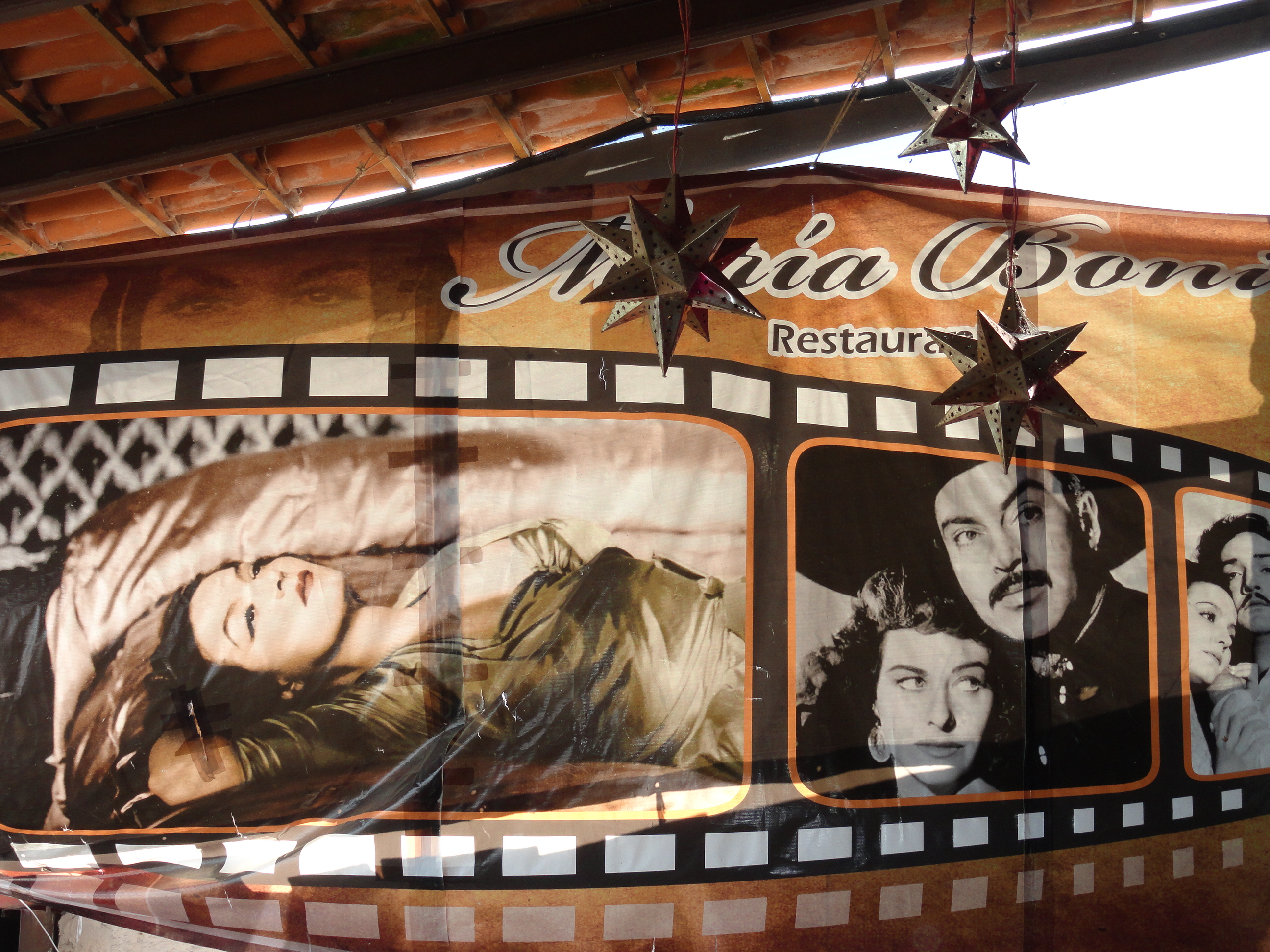
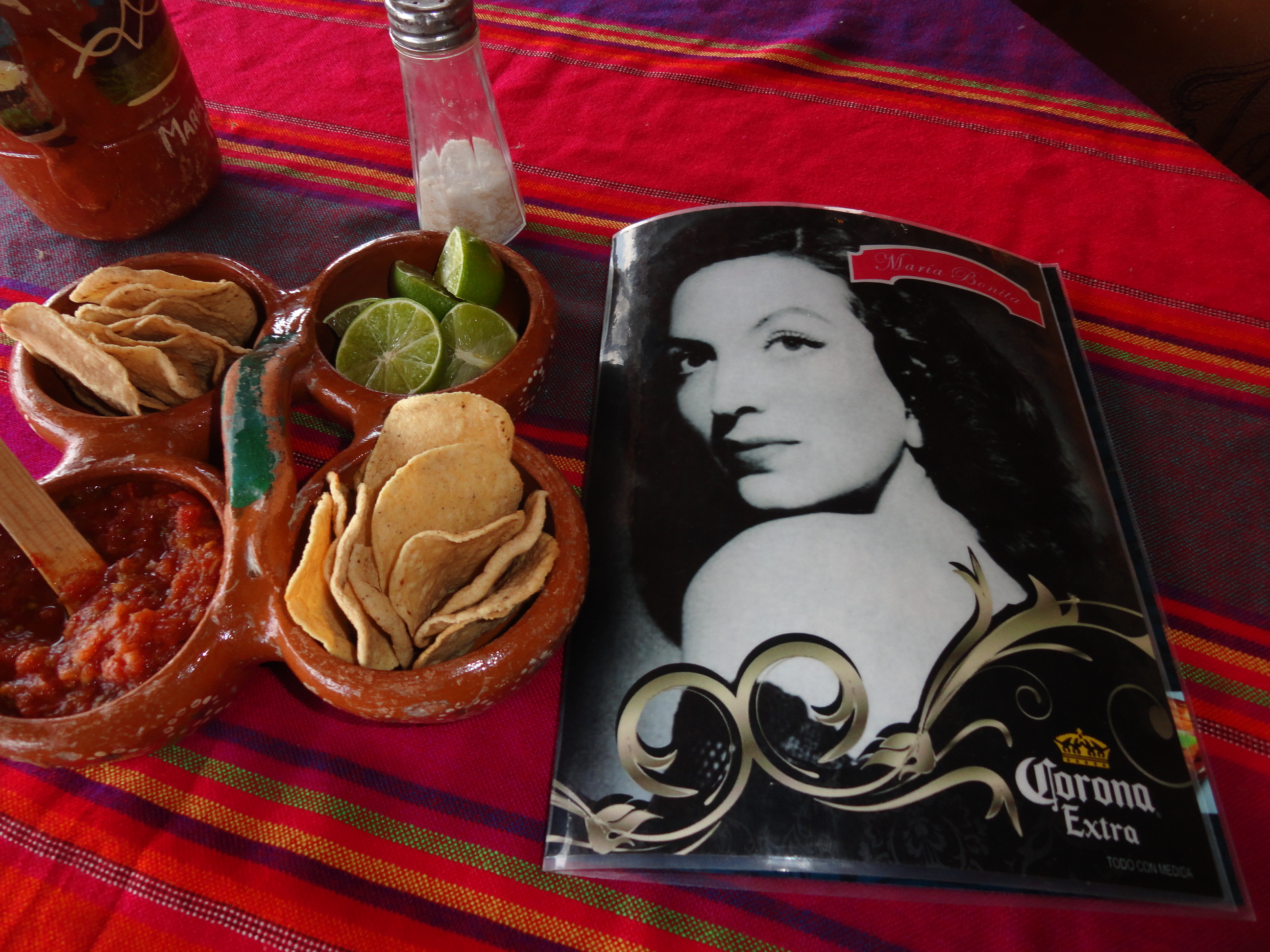
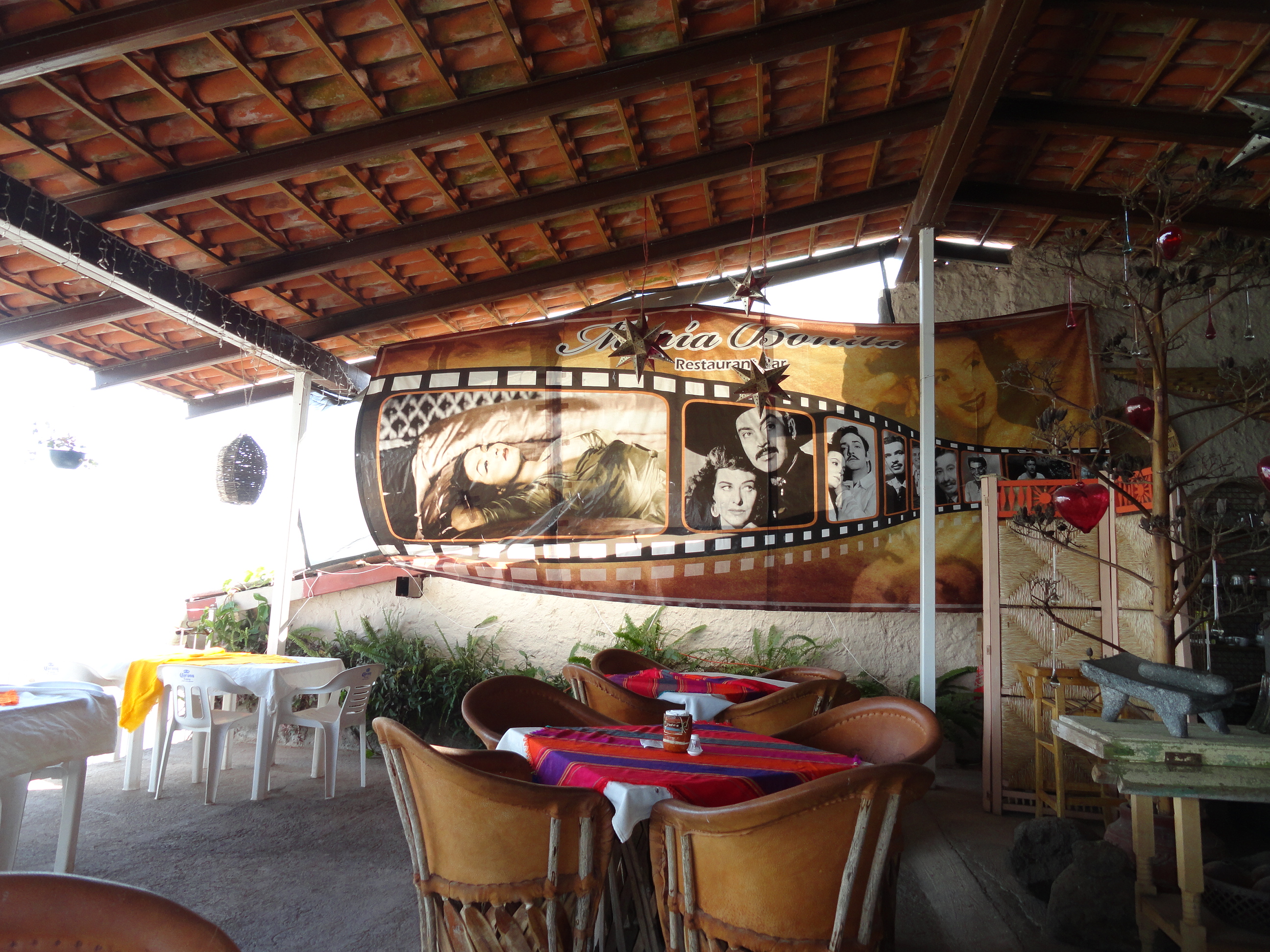
Maria Phoenix lies on satin sheets
on the wall of Maria Bonita Restaurant Bar.

DSC07822

It is a small palapa restaurant––soft orange front with
hot pink trim–– that I’ve driven by hundreds of times before;
and every time, I’ve wanted to come in, but haven’t.
Now today, suddenly,
I don’t want to go home
and so my car turns in across the carretera.

DSC07818

I am the lone customer.
The cook and waiter
spring to action.
Totopos for him to bring,
a fire for her to light.
This is a fish restaurant
and I am a non-fish
eater, choosing between
quesadillas and beans
or a hamburger and fries.
Needless to say, I’m not here for the food.

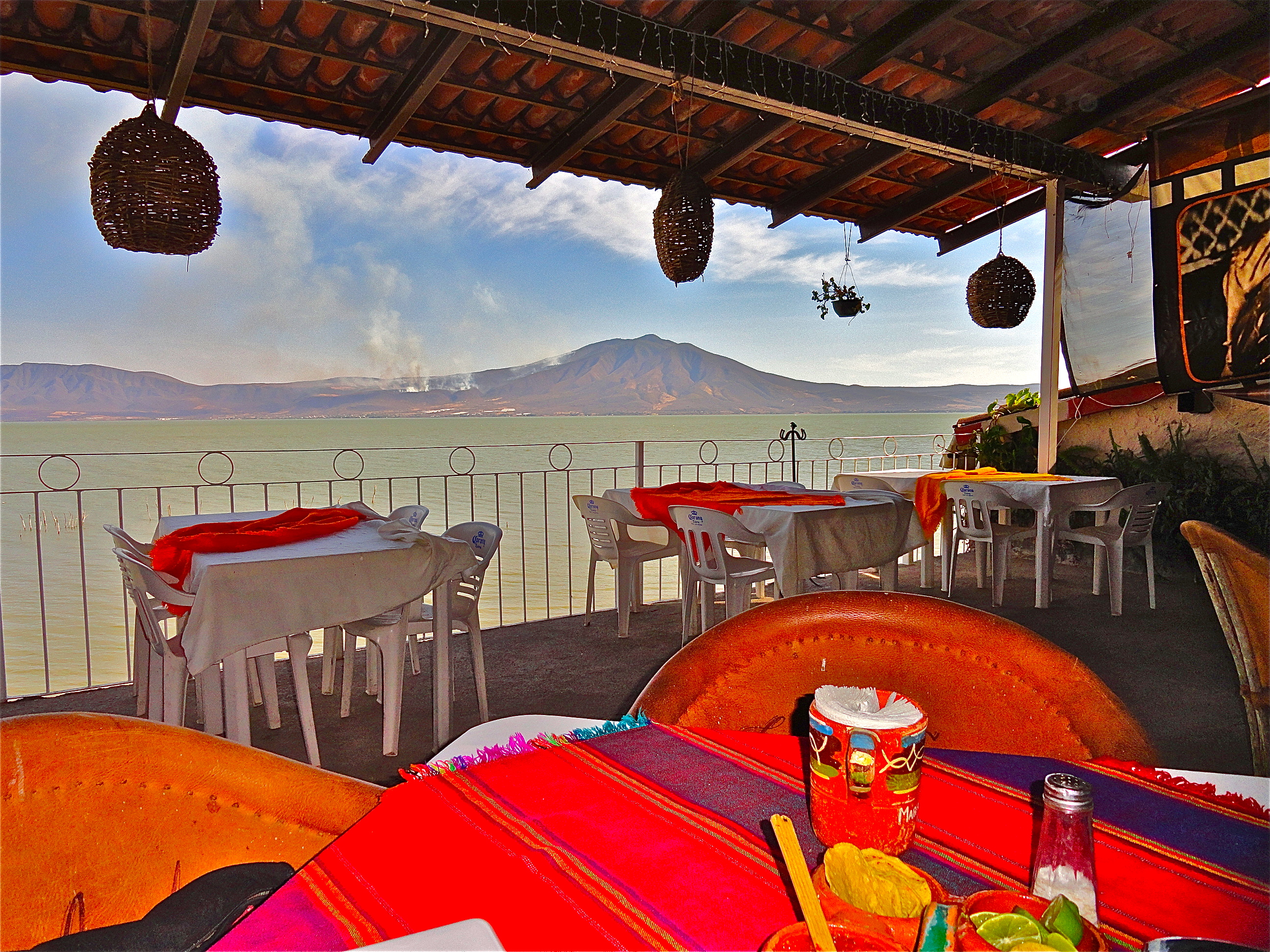
I am here for the view and the limits
imposed by eating alone in an otherwise empty
restaurant/bar. I have a poem to write
and need the discipline imposed by a place
where there’s nothing else to do.
My only distraction is the view,
which forms the subject of my poem
and so is anything but a distraction.

DSC07823

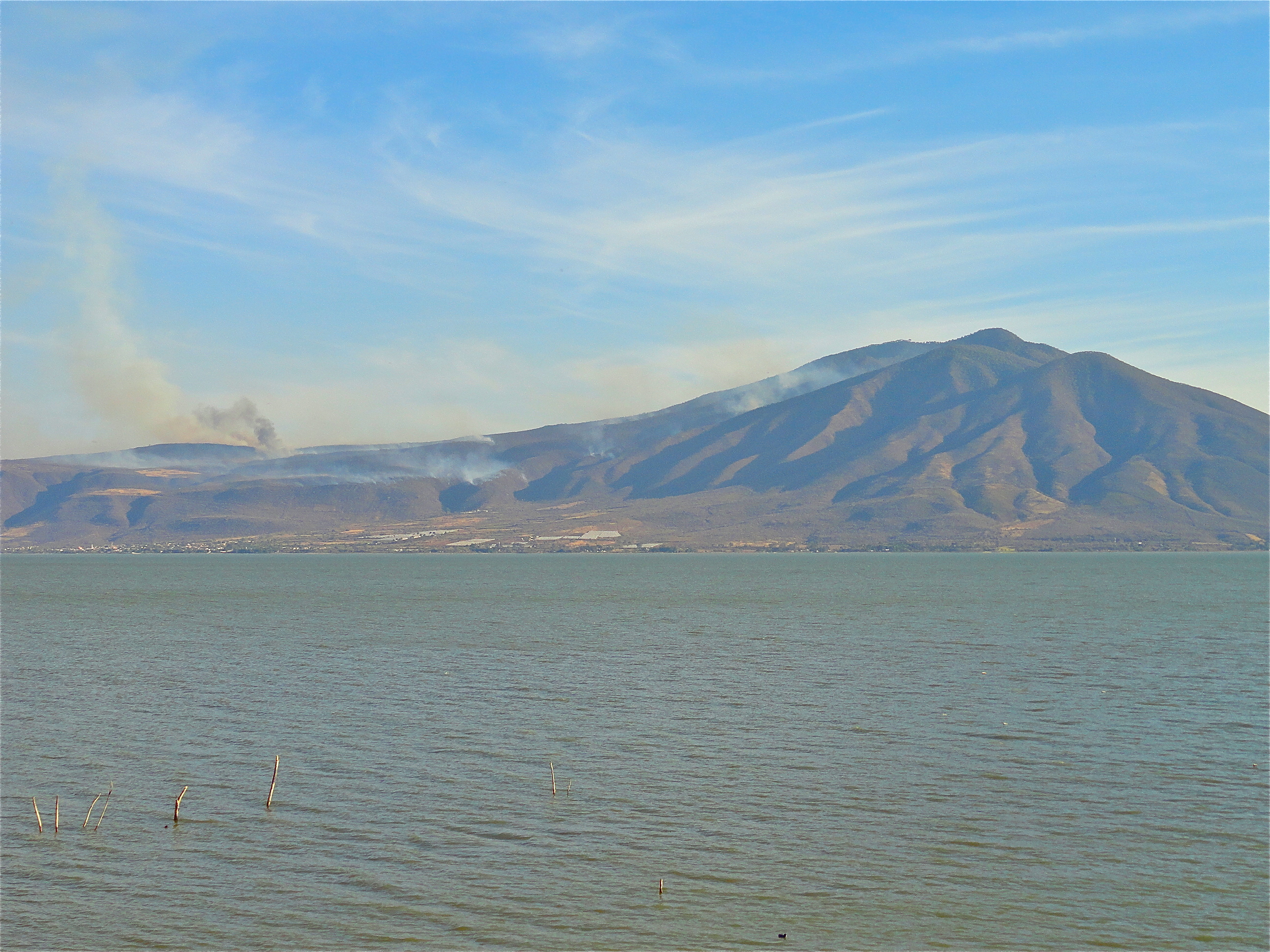
The smoke from a dozen fires
rises into the air from the entire eastern slope
of Mount Garcia across the lake.
Whether by accident or by the hand of farmers
lighting fires to clear last year’s stubble from the fields,
the effect is that this extinct volcano
has somehow come to life,
springing leaks.

Fanned by a recent wind, the smoke grows denser, rises higher.
Below the slopes, a patchwork quilt of strawberry and raspberry
fields, covered with plastic sheets,
spawn fruit for the tables of El Norte.

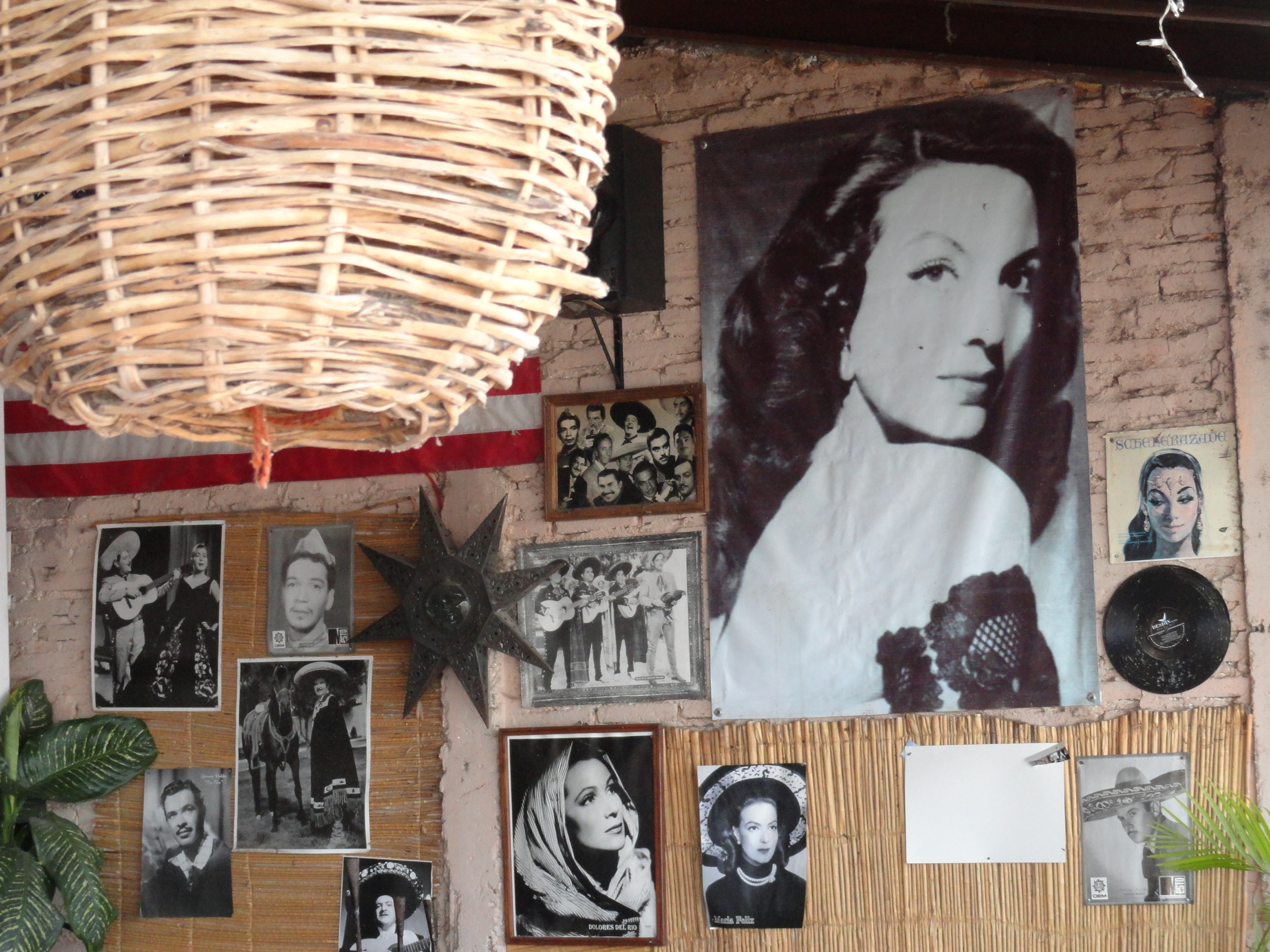
Maria, that other smoldering beauty, lies suspended all around me––
long canvas banners reflecting her screen loves and her roles.
She looks over one shoulder, wears a rebozo or a mariachi’s sombrero.
Cantinflas, that beloved clown, shares her wall but is never in a shot with her.
They are opposites: the sexual symbol and the comic. One raises tension
and the other seeks to dispel it.

Maria Phoenix

I am in between, a mere observer, I know.
In every case it’s likely that the fire has been lit by means unnatural,
but nonetheless, it ignites my imagination.
I am surrounded by it.
“Blue Bayou” plays on the sound system.
Sleepy eyes.
My eyes sting from the smoke
that has filtered toward me
from eight miles or so across the lake.
The tears in my eyes are from the smoke,
not from memories of the departed one
I used to come with to these fish restaurants.

They are not the place for gringos.
Word is out about the sanitation
or where the fish comes from
or who might be encountered here.
A few restaurants down, there was a cartel killing
just about a year ago––perhaps more, perhaps less.
At any rate, Americanos and Canadians are rarely found here.

Today, no one else is found here.
“There’s no exception to the rule”
plays on the sound system.
“Everybody plays the fool.”
Feeling a stranger in the place where I live
is a feeling pleasurable to me––
an emotion I do not feel foolish for pursuing.

The waiter, as though I’m a repeat customer,
brings an entire bucket of ice
and fills my glass each time he passes.
They have my brand of rum.

DSC07821

I have always known this place could be my place.
The pleasure of knowing it to be so warms me
as much as the second jigger of rum.
Shall he pour it for me? Do I want it all?
Just half, I tell him, and fill the glass with Coke.
I like it weaker, so I can spread it out.
Like the fire.

Smoldering.