Tag Archives: Loss

Two Poems from a Night with No Moon

This Night is Broken

With all of its sounds
spilled out,
someone else’s sounds
echo around it.

The space inside of it
is broken, too.
Only the constant rain
seeks to fill it.

————-

Falling Practice

Twice on the stairs last week
and once in the kitchen.
Lately, these falls
have been coming in threes.

Tonight in the dark, I tripped
over the low metal bench beside the hot tub.
Then a loud bang sent me searching
to find the heavy husk fallen from the palm tree.

I do not venture out alone again,
but sit on the patio
in the light of my laptop,
hoping to escape the third fall.

Your face on the screen turns green
from the reflection of the string
of Chinese lanterns
as we succumb to hard truths.

I fell in love with you so quickly,
but even all these falls
have not taught me how
to fall out of love with you.


The Prompt: Howl at the Moon—“Follow your inner moonlight; don’t hide the madness.” — Allen Ginsberg  Do you follow Ginsberg’s advice — in your writing and/or in your everyday life?

Torn Love

Since today was still another free topic, I have chosen to take the Poets and Writers weekly prompt which is: The Flip Side—This week, think of something that has happened to you recently that was stressful, traumatic, or unpleasant. Write a poem about this event as you experienced it, regardless of anyone else’s perspectives or feelings on what occurred. Then rewrite the poem from the perspective of someone else involved in the situation. This new poem may not reflect the truth, but sometimes it’s important to remind ourselves that everything has a flip side.

I

Torn Love

Still standing close,
each on our own side of this terrible rending,
how can we see things so differently?
This little flap of skin
you keep pulling open
wants to close.

This is how cancers start—
this worrying and worrying of an old injury.
My darling. Leave it alone
and let us heal.
This is only a biopsy
of our changed love affair.

If it is cut out of us,
it will be by your decision;
and no number of late-night arguments
will ever change that fact.
What you need to remember
the next morning,
you will remember.

If it were up to me,
we would still be friends,
but if you need an enemy
to console you in your actions,
I guess I must be that too.
I always was a figment
of your imagination.
Believe that
if it makes this easier for you.

II

Cicatrix

I know better than you
what lies buried under
my healed-over self.

The raised part of me
grown to protect the wound
creates this distance
that I once warned you of.

I need to thicken that part of me
where part of you remains,
and if for this time you gasp for air,
it is my thick skin growing over you,
like an orb spider winding you in my web

until you become
the one in me hidden so deep
that even you
believe you’ve disappeared.

News Blues

News Blues

wars, tsunamis
murdered mommies
global warming
cancers forming
mad religions and heretics
engineering our genetics
drug cartels
emptying wells
mounting debt
nuclear threat

I hate to say it
but every day it
is getting worse
this global curse
and human capers
in all the papers
so all in all
it’s an easy call
I find less friction
in reading fiction!

The Prompt:The Great Divide—When reading for fun, do you usually choose fiction or non-fiction? Do you have an idea why you prefer one over the other?

Leftovers


Leftovers

When my father died forty years ago, it was in Arizona, where my parents had been spending their winters for the past ten years.  They maintained houses in two places, returning to South Dakota for the summers. But after my father died, my mother never again entered that house in the town where I’d grown up.

Our family had scattered like fall leaves by then—my mother to Arizona, one sister to Iowa, another to Wyoming. Both the youngest and the only unmarried one, I had fallen the furthest from the family tree. I had just returned from Africa, and so it fell to me to drive to South Dakota to pack up the house and to decide which pieces of our old life I might choose to build my new life upon and to dispose of the rest.

My father’s accumulations were not ones to fill a house. There were whole barns and fields of him, but none that needed to be dealt with. All had been sold before and so what was to be sorted out was the house. In that house, the drapes and furniture and cushions and cupboards were mainly the remnants of my mother’s life: clothes and nicknacks, pots and pans, spice racks full of those limited flavors known to the family of my youth—salt and pepper and spices necessary for recipes no more exotic than pumpkin pies, sage dressings and beef stews.

Packing up my father was as easy as putting the few work clothes he’d left in South Dakota into boxes and driving them to the dump. It had been years since I had had the pleasure of throwing laden paper bags from the dirt road above over the heaps of garbage below to see how far down they would sail, but I resisted that impulse this one last run to the dump, instead placing the bags full of my father’s work clothes neatly at the top for scavengers to find—the Sioux, or the large families for whom the small-town dump was an open-air Goodwill Store.

It was ten years after my father’s death before my mother ever returned again to South Dakota. By then, that house, rented out for years, had blown away in a tornado. Only the basement, bulldozed over and filled with dirt, contained the leftovers of our lives: the dolls, books, school papers and trophies. I’d left those private things stacked away on shelves—things too valuable to throw away, yet not valuable enough to carry away to our new lives. I’ve been told that people from the town scavenged there, my friend from high school taking my books for her own children, my mother’s friend destroying the private papers. My brother-in-law had taken the safe away years before.

But last year, when I went to clear out my oldest sister’s attic in Minnesota, I found the dolls I thought had been buried long ago–their hair tangled and their dresses torn—as though they had been played with by generations of little girls. Not the neat perfection of how we’d kept them ourselves, lined up on the headboard bookcases of our beds —but hair braided, cheeks streaked with rouge, eyes loose in their sockets, dresses mismatched and torn. Cisette’s bride dress stetched to fit over Jan’s curves. My sister’s doll’s bridesmaid dress on my doll.

It felt a blasphemy to me. First, that my oldest sister would take her younger sisters’ dolls without telling us. Her own dolls neatly preserved on shelves in her attic guest bedroom, ours had been jammed into boxes with their legs sticking out the top. And in her garbage can were the metal sides of my childhood dollhouse, imprinted with curtains and rugs and windows, pried apart like a perfect symbol of my childhood.

Being cast aside as leftovers twice is enough for even inanimate objects. Saved from my sister’s garbage and cut in half, the walls of my childhood fit exactly into an extra suitcase borrowed from a friend for the long trip back to Mexico, where I now live. I’ll figure out a new life for them as room décor or the backgrounds of colossal collages that will include the dolls I’m also taking back with me.

Mexico is the place where lots of us have come to reclaim ourselves and live again. So it is with objects, too. Leftovers and hand-me-downs have a value beyond their price tags. It is all those lives and memories that have soaked up into them. In a way, we are all hand-me-downs. It’s up to us to decide our value, depending upon the meaning that we choose to impart both to our new lives and these old objects. Leftovers make the most delicious meals, sometimes, and in Mexico, we know just how to spice them up.

The prompt: Hand-Me-Downs—Clothes and toys, recipes and jokes, advice and prejudice: we all have to handle all sorts of hand-me-downs every day. Tell us about some of the meaningful hand-me-downs in your life.


Interlude

Disclaimer Notice:  This is a work of fiction, not of fact!!!!

Interlude

I have been dieting for months and I’m in fine fettle. I can see the admiring looks of several men as I enter the restaurant, along with the slightly irritated stares of their wives or girlfriends. I’m fresh from the beauty parlor: newly coiffed, manicured and pedicured, wearing a size smaller than I wore a month ago and several sizes smaller than a year ago. Feeling buff, I slide into a booth, fanning both hands over the smooth surface of the Formica table top, admiring my French manicure.

He enters the restaurant shortly after I do. Taking the long way around the aisle that runs between the tables in the center and the booths along the four sides, he scans the faces of diners with a curiosity that signals an interest in life. He is tall and intelligent-looking with a quirky doorknocker beard and mustache and a Hawaiian shirt—all elements of his appearance that call out for notice. I do not disappoint.

I watch him as he draws nearer, but drop my eyes as he approaches my booth. So it is that I am surprised when he stops in front of me and says, “May I ask you what you name is?”

I bring my eyes up to meet his. Is this the Cinderella story I’ve been waiting for my whole life? Quickly, my mind fills in the prior details. He noticed me on the road and followed me here. Or, he was driving by when he saw me enter the restaurant and, on a whim, seized the day and came in search of me. Or, this is an old and long-forgotten flame, someone from my past—a college or high school friend I haven’t seen for twenty years.

Without asking why or giving a smart answer, for once I merely answer the question. “Judy. Judy Dykstra-Brown,” I purr in a humorous, slightly sexy voice, not once looking away from his clear hazel eyes.

He does not disappoint. “I’ve been looking for you,” he says.

“I’ve been looking for you, too—for a very long time,” I answer in my best low flirtatious tone.

He reaches out toward me, and I extend my hand toward him as well; but in place of his own hand, he places something soft and warm in my palm.

“You must have dropped your wallet in the foyer,” he says to me, “You’re lucky that the right person found it.” He turns then and walks across the room to sit down at a table with a lovely woman in a white sundress and two darling tanned children. They are like a commercial for a Hawaiian vacation.

I open the wallet to see that all the money is intact, the driver’s license just slightly askew from where he must have withdrawn it to see the picture of its owner, and my mind replays his final words to me.  “You’re lucky.”

“Welcome to Perkins!” The waitress interrupts my thoughts in a perky voice, living up to the name of her place of employment. I take the menu she proffers and order humble pie.

The Prompt: Greetings, Stranger—You’re sitting at a café when a stranger approaches you. This person asks what your name is, and, for some reason, you reply. The stranger nods, “I’ve been looking for you.” What happens next?


The Collector

The prompt: Digging Up Your Digs—500 years from now, an archaeologist accidentally stumbles on the ruins of your home, long buried underground. What will she learn about early-21st-century humans by going through (what remains of) your stuff?

The Collector

Tools, pictures, clothes, shoes,
too much food and too much booze.
Too many games and too much fun
for a house of only one.
A mystery why this big collector
didn’t have the proper vector
directing her away from things:
(potions, lotions, bracelets, rings)
directing to another track—
something that could love her back.

But, for the rest of the story about living alone, go here

Smoke

Smoke

She had met most of my stepchildren.
Was my husband similar? she asked.
Yes, he was talented and smart and funny.
But, he was very quiet, I said, and often sad.

He never believed he’d been the love of my life,
even though I’d told him so.
He’d raised a hand
to let it fall unused again, one time or more.
I hadn’t any children.
He always thought I’d leave.

For years I’d felt the cause of his unhappiness,
but his children told me he had always been this way.
Less angry with me than the others,
I had been, he told them, (but not me)
the love of his life.

He was a man who trusted few
and loved less.
He could not give what others demanded.
What better time to say I love you
than when asked for it, I pleaded–
his daughter, sobbing, on the phone.
But he couldn’t do it
for me, for her, for anyone.

What he wanted most he always had,
but he was blind to it,
wasting it all: the friends, the fame, the love.
Alone, he stared into the fire, into trees,
imagining tools and studios and sculpture
grander, in the end, than his energy to create it.

He had not been idle in his life.
Houses, children, art, tools, poetry—
he made them all, well and in great numbers.
Yet when he died, he said, “Imagine.
I had thought I’d be making art to the end.
Instead, I am so tired. I’m just glad to know
I have an excuse for feeling as tired as I do.”

They ate him up, his dreams.
We sent them up in smoke with him.

Daily post: Second Opinion—What are some (or one) of the things about which you usually don’t trust your own judgment, and need someone’s else’s confirmation?

(Instead of being about someone who needs someone else’s confirmation and advice, my poem is about someone who never could accept it.)

Poetry by Prescription: Goodbye Old Paint

Old friend, new friend.

Goodbye Old Paint

What have you eaten that we have forgotten?
What lost earring resides
in the deepest recesses of your front seat?
What coins shaken and pushed into your crevasses?
And do you remember the song made up on the spot
and sung just once, then left forgotten in Nevada?
Do you still carry the dust of Tonopah
or that yearning to actually see something extraterrestrial
on the Extraterrestrial Highway?
Do you carry shards of his boredom while driving
mile after mile of Utah beauty?
Do you still carry my expectations of sharing
the giant faces of Rushmore
and echoes of the fact that he expected more?

What of molecules of the Mississippi crossing
or dreams of the memories of Hannibal?
What sweat from those Mississippi hours
waiting outside the B.B. King Museum?

Salt grains and chocolate crumbs
and DNA of those few souls who rode along in you—
all parked in a parking lot waiting to be bought
by someone who will never know the hidden you.
Just like the rest of the world,
frequented by interlopers.
Only we, leaving you, will murmur “Goodbye Old Paint”
and know that although you neither hear nor answer,
somehow our past is locked up inside of you
and there a part of us will stay
while we depart without it.

The prompt today was by Forgottenman, who wanted me to memorialize his faithful automobile companion, Old Paint (pictured here to his right). To his left is his new love, Soul Red.  To see his prompt, go to his blog here.

NaPoWriMo Day 30: Ciao, Adios, Auf Wiedersehen, Adieu

Ciao, Adios, Auf Wiedersehen, Adieu

To NaPoWriMo we must say
a fond “Goodbye” on this last day.
I‘m able to, for I have found
the strength to say it the whole world round.

When I was young, I traveled far
from Germany to Zanzibar.
Australia, Bali, France and Spain,
to Africa and back again.

And though I mostly loved them all,
from Venice to the Taj Mahal,
as my departure time grew nigh
I had to voice a sad goodbye.

To Ethiopia I strayed.
For eighteen months I stayed and stayed;
and when I had to leave too soon,
I had to say “dehena hun.”

In college days, when I was young,
German was my foreign tongue;
but when to Frankfurt wir mussten gehen
I just remembered, “Auf Wiedersehen.”

The French were rude and cold and snotty.
They mocked my accent and were haughty,
so while I had to bid “adieu,”
I’d have preferred to say, “pee-ew.”

Florence thrilled me from the start.
Their lasagna is a work of art.
When I left, they all said, “Ciao.”
Their kitties, though, all said, “Miao.”

I never went to Israel
but nonetheless, I’m proud to tell,
the rabbi books? Read every tome.
So I know how to say “Shalom.”

Though “Arigato” is bound to do
when you want to say thank you,
Sayonara” is the way to go
to bid farewell in Tokyo.

Bali’s full of dance and art
that treat your eyes and fill your heart.
I must admit, I had a ball
before I said “Selamat tinggal.”

Mexico was saved for last
And now I fear my lot is cast
Since “Adios” I cannot say,
I’ve decided I will stay!

(for the sake of pronunciation, I have taken the liberty of adding an extra “e” to “dehna hun.”)

You might have already guessed that on this last day of the NaPoWriMo challenge, the prompt was to write a farewell poem.

NaPoWriMo Day 27: Lemonade


Image

Lemonade

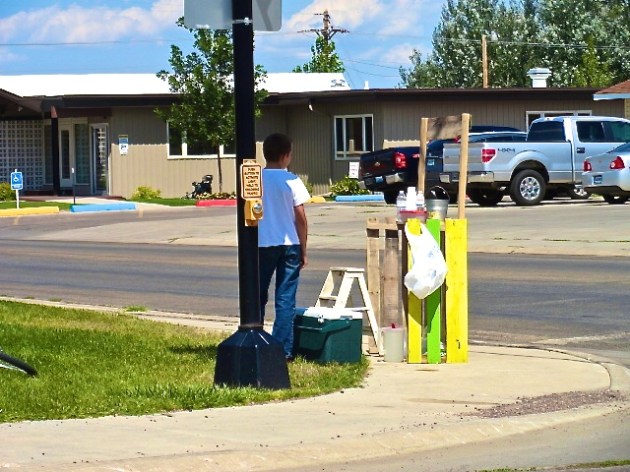
The Crystal Lite, like a marriage of Kool-Aid and crystal meth,
catches the light and glows from inside its plastic gallon container,
becoming its own advertisement for this lemonade stand,
its pre-teen proprietor standing in the scant shade
of a stop light pole
behind his fruit crate counter
with its stacks of styrofoam cups.

He has chosen his clientele—
perhaps thirsty from a long wait
in the doctor’s waiting room in the clinic
or the hospital across the street.
To his back, a retirement community with no house
more than 3 blocks from the hospital—
its inhabitants like products on a shelf waiting to be picked.

When they pass the stand,
memories of generations of such stands
perhaps flood their minds,
and thirsty or not, they stop for a cup.

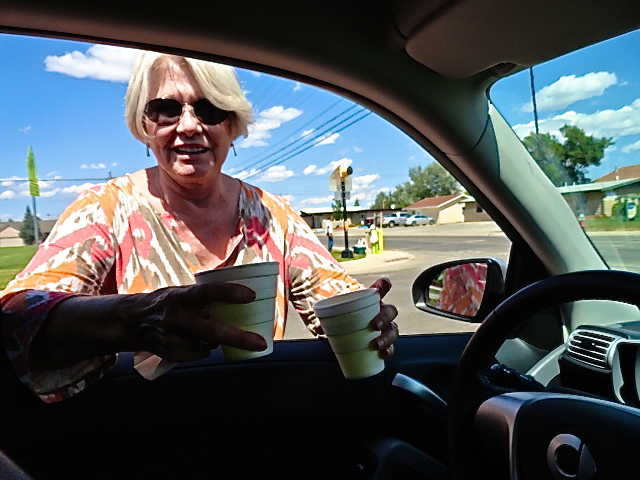
I am the woman with her foot in a cast,
sitting in the passenger seat
of the car pulled over to the curb.
The woman reaching through the window of the car
is my sister, holding out the white cups
with the too-sweet yellow shining through
as though radioactive.

She was my long ago pattern for everything,
including Kool-Aid stands with 5 cent
paper bags of popcorn and ice cube slivers
floating in the Tupperware pitcher of cherry Kool-Aid,
a plate on the top to repel flies
lazy in the July heat, orbiting our sweaty heads
like precognitive sputniks
buzzing in the minds of rocket scientists.

We had not a clue.

 Image

The prompt today was to write a poem based on a picture.