Tag Archives: the five senses

Chewing the Train for dVerse Poets, June 26, 2025


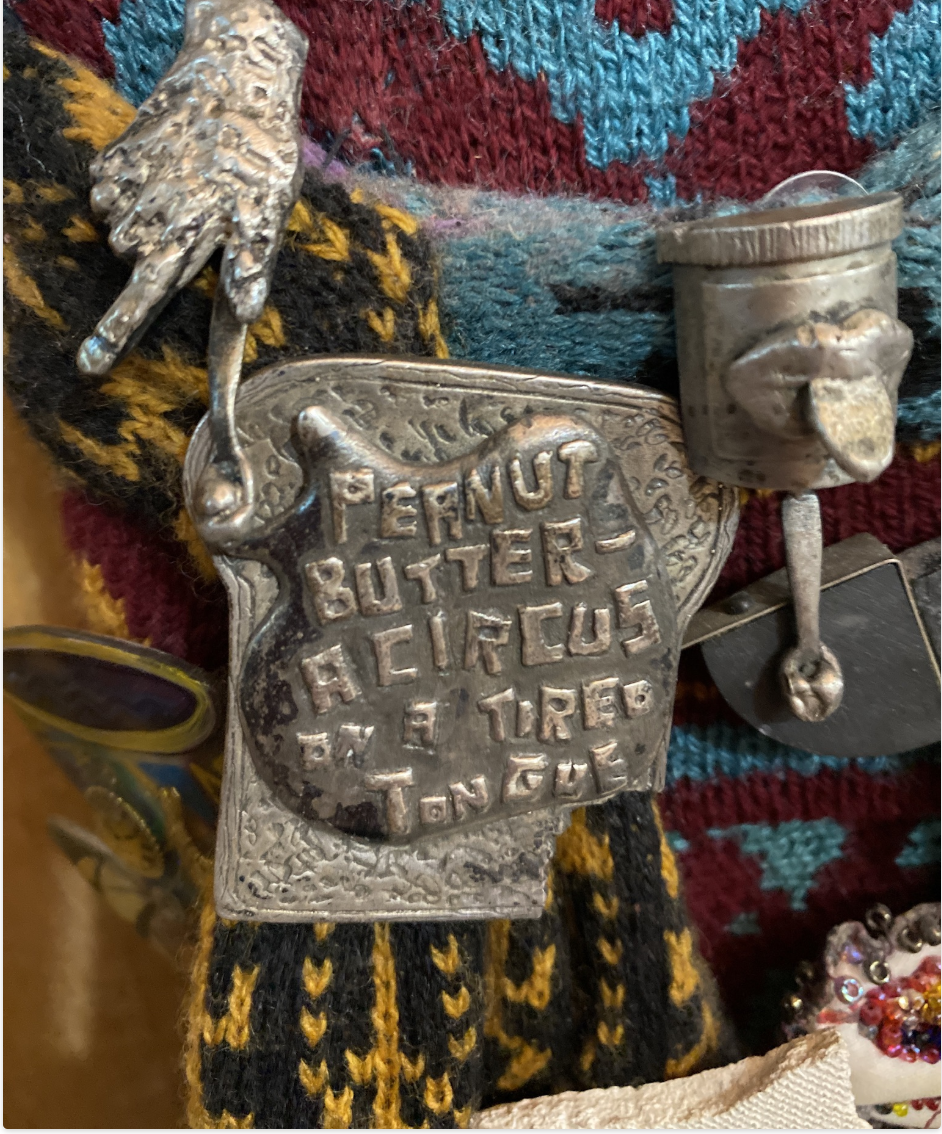
Brooch and pins by Judy Dykstra-Brown

Chewing the Train

A metaphor is a freight train
that gets us within 30 miles
of our final destination,
but we still have to catch a taxi to get all the way there.
And a simile is just a metaphor whose brakes have failed.
If we know that peanut butter
is like a circus on a tired tongue,
does it bring us any closer to the smell of peanut butter?
Elephants and sawdust
and sequined camisoles flavored
with the sweat of 100 performances?
Is that what peanut butter smells like?
Does it taste like candy apples
and too-bitter mustard
on stale buns
and hot dogs turned too long
upon the rollers of their grill?
Does peanut butter feel
like the unoiled bump of the Ferris wheel?
Does it sound like a calliope
or look like an ice cream cone?
Peanut butter is peanut butter.
I rest my case.

So how am I going to write a poem
without metaphors and similes?
How can I write verse
while telling the pure unadulterated truth?
How can I make you taste a poem
that is only itself?

How can I be Janis Joplin
when I’ve been taught to be Joni Mitchell?
A Rose is a Rose is a Rose,
said Gertrude Stein,
predating my insight
by a generation or two.
But this isn’t Paris,
and folks in Mexico
want a dollop of figurative language
in their poetry.

So let me say
that my mind is a busy beaver,
trying to fulfill this impossible task
of twenty little things.
I’m expected to imagine
how peanut butter sounds.
The sucking gumbo sound
of South Dakota mud
or thick mucus of a cold?
Anything but appetizing.
Ay, Caramba! you might say,
but if you were Australian,
you would say, “Don’t come the raw prawn on me, mate,”
and you would mean
“Don’t try to pull the wool over my eyes,”
or “Don’t try to con me, man.”

So let me just say that peanut butter is made
by grinding peanuts so finely
that all the oil comes out
and it acquires the consistency of butter.
It isn’t like butter
nor is it butter.
It acquires the consistency of butter.
This is literal fact.
But to know the taste of peanut butter,
you will need to spread a bit upon a cracker
and have a taste, or grab a finger full.
What you will taste will be peanut butter.
The truth of it. Its reality.

And only then will I tell you
that literal truth doesn’t always tell
the whole truth.

My friend says
it is the peyote leached into the soil
the corn grows from
that gives Mexicans
such a remarkable sense of color.
The bright pigments of imagination
flood his canvasses.
His peyote dreams leak out into the real world
and wed it to create one world.
“Peyote dream” becomes its opposite—
a freight train taking us into the universal truth.
A larger reality.
This stalk of corn, this deer,
this head of amaranth,
all beckon, “Climb aboard.”

So when you bite into a taco
or tamale, when the round taste of corn
meets your tongue, and pleasure tries to flow
like a lumpy river down your throat,
look up at the poet standing in the shadows.
She’ll call herself by my name if you ask,
but do not ask. Instead, look deeper
into the shadows she wears around her like a cloak
and see that it is light that creates shadow.
See the many colors that create the black.
Follow where the corn beckons you to go––
into the other world of poetry and paint
and dance and music. Hot jazz with a mariachi beat.
Chew that train that takes you deeper. Hop aboard
the tamale express and you will ride into your
new life. It will be like your old life magnified
and lit by multicolored lights and the songs of merry-go-rounds
and when you bite into your taco, it will taste
like cotton candy and a snow cone
and your whole life afterwards will be a train that takes you nowhere
except back into yourself—a Ferris wheel
spinning you up to your heights and down again, with every turn,
the gears creaking “Que le vaya bien.”
I hope it goes well with you
and that you see the light
within the shadow
and the colors
in the corn.

glass-gem-corn-2-460


For dVerse Poets synesthesia poem. You’l have to sift through this poem for the synesthesia, but I promise you , it is there.

“I Used to Eat Red” For RDP, “Whistle.”

                                                                  I Used to Eat Red

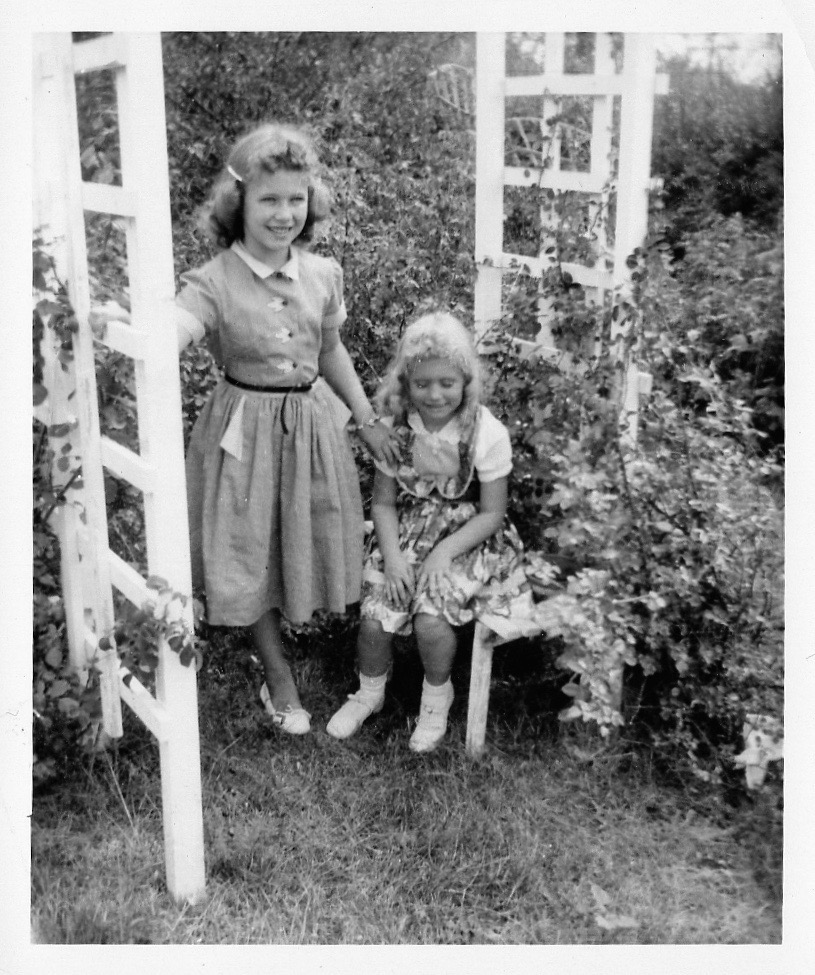
daily life color108 (1)My sister Patti and I, posed by my older sister Betty.  Those are “the” cherry trees behind us. The fact that we were wearing dresses suggests we were just home from Sunday school and church, our souls bleached as white as our shoes and socks!

 I used to eat red
from backyard cherry trees,
weave yellow dandelions
into cowgirl ropes
to lariat my Cheyenne uncle.

I once watched dull writhing gold
snatched from a haystack by its tail,
held by a work boot
and stilled by the pitchfork of my dad
who cut me rattles while I didn’t watch.

I felt white muslin bleached into my soul
on Sunday mornings in a hard rear pew,
God in my pinafore pocket
with a picture of Jesus
won from memorizing psalms.

But it was black I heard at midnight from my upstairs window––
the low of cattle from the stock pens

on the other side of town––
the long and lonely whine of diesels on the road
to the furthest countries of my mind.

Where I would walk
burnt sienna pathways
to hear green birds sing a jungle song,
gray gulls call an ocean song,
peacocks cry the moon

until I woke to shade-sliced yellow,
mourning doves still crooning midnight songs of Persia
as I heard morning
whistled from a meadowlark
half a block away.

And then,
my white soul in my shorts pocket,
plunging down the stairs to my backyard,
I used to eat red,
pick dandelions yellow.

 (This is a reworking of a poem from my book Prairie Moths.) 

For RDP Whistle

6 A.M., Dec. 24, 2020


6 A.M., December 24, 2020

All around my room and all around the house,
everything is still and quiet as a mouse.
All the sounds of living are muffled by the night,
as if a large hand censors both my hearing and my sight.

Then the greater world is thrust into my ear—
a single church bell tolling is all that I can hear
signaling the hour—6 A.M. again—
a barrage of fireworks setting up its din

to welcome us to Christmas Eve though it is merely morn.
It is our second  notice that a child will be born.
First the star low in the west—a bauble in the sky
tells the whole world of the day that is coming nigh.

Odors of the pine tree, presentiment of myrrh,
the stirring of the dogs, the cat’s insistent purr,
the roasting of the turkey—the onions in the dressing
bring another sense to transmit the Christmas blessing.

A touch of lips ‘neath mistletoe can’t be far away,
bringing that last sense of touch to calm the worldly fray.
May all the troubles of the world thereby find surcease
and for this brief holiday, may all the world find peace.

Prompt words today are mouse, great, bauble and living. Image by Peter Bucks on Unsplash, used with permission.