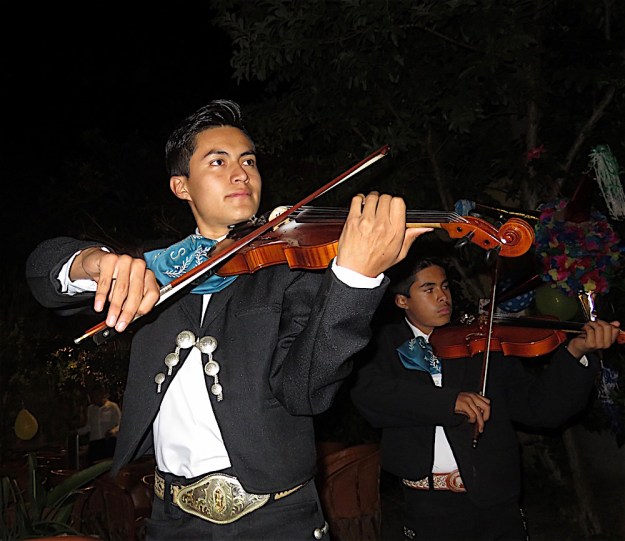
This is the young man who was absolutely world class but who can’t read a note of music!
There is Always Music
The music of Mexico is composed of a cacophony of sounds—all of them loud! Trumpets, drums, violins, guitars, tubas and trombones are backed up by fiesta revelers, insects, burros, cattle, roosters, fireworks, church bells, air brakes, stone drills and vendors driving the street with loudspeakers announcing gas, produce, knife-sharpening or bottled water for sale.
Living in Mexico is like living in a place where one or another of your neighbors celebrates a party every other day of the week. Patriotic holidays, weddings, saints days, baptisms, funerals, fifteenth birthdays—all are occasions for fiestas of often grand proportions; and although these parties do not always take place in your own neighborhood, the lake and mountains act as a sounding board which makes it sound as though they do.
Recently, it has become the style to set off fireworks from a boat positioned mid lake to celebrate nuptials. Then loud music and loudspeaker shouts proceed far into the night. Tonight as I got home a half hour before midnight, the music was so loud that it could have been coming from the house next door, but it was coming from a large hall on the carretera a half mile away. It was a wedding party I had seen the beginnings of earlier in the day, now grown into a full-scale bash.
The loudest celebrations are held on saints’ days or national holidays. These celebrations are frequent, as in addition to the usual holidays such as Dia de la Independencia and Aniversario del Revolución, each town has a ten-day celebration of the town’s patron saint. During one week-long celebration in the nearby town of Ajijic, it is rumored that 10,000 bottle rockets were set off, each of them launched into the air and exploding at the decibel level of a cherry bomb.
To demonstrate the frequency of such celebrations, take the six-day period of April 30 to May 5. The most famous Mexican holiday in the U.S. is Cinco del Mayo, but in Mexico, but in Mexico it is a celebration of minor importance. There are four other major holidays in the five days leading up to it, all of them more important. The week starts out on April 31 with El Dia del Nino, a celebration and parade for the day of the child, followed the next day by labor day—Dia del Trabajo—the day of the laborer. After a day’s vacation from holidays, there is Dia de Santa Cruz, followed two days later by Cinco de Mayo, the commemoration of the Battle of Pueblo. All of these celebrations bring with them the sounds of revelry: loud banda music, fireworks, guns fired into the air and the accompanying barks of protesting dogs and encouragement of human revelers.
In December, Christmas is preceded by the week-long commemoration of the Virgin of Guadalupe, which in my village is the occasion for hundreds of plant-decked altars to be set up along the streets in front of houses, garlands over the street and cobblestones strewn with fresh alfalfa. One day in early December, a neighbor came by to visit. Later, we went for a walk in the San Juan Cosala main plaza. The most beautiful feature of the square was a large faded portrait of the Virgin of Guadalupe that stood near the church. Flowers and lights surrounded it in preparation for her saint’s day. Unfortunately, one of the strings of colored lights that swathed the portrait was a musical strand. In the fifteen minutes we took to traverse the square, we heard nasal computer-like renditions of, “I Wish You a Merry Christmas,” “Santa Claus is Coming to Town,” and “Rudolph the Red Nosed Reindeer.”
There is always music. Now the steady hum of the pump which recycles water from the jacuzzi to water the plants stops and I hear the steady whisk whisk whisk of the gardener’s broom on the stone patio. Outside hundreds of bees hum around the Virginia creeper that blankets the awning over the patio.
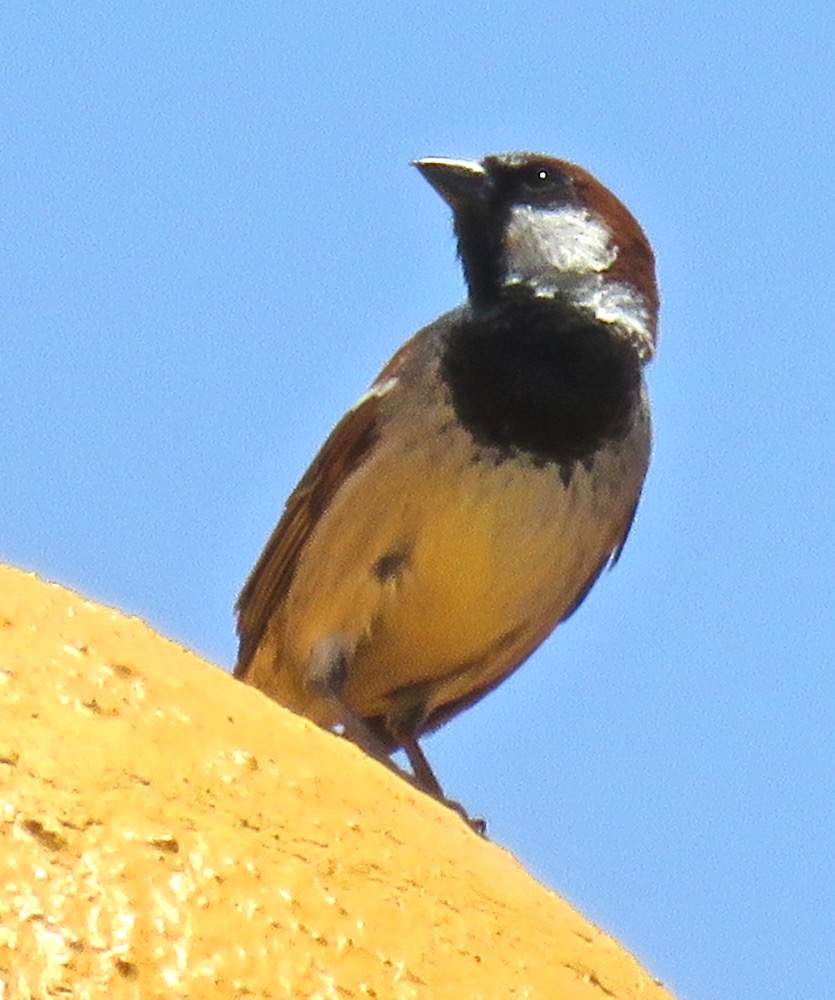
Birds furnish a counterpoint harmony to these domestic arias. In the few months that I have been living here, I believe I’ve heard whippoorwills, Baltimore orioles, grackles, and tanagers. I have heard the mysterious night call of a bird with a voice disguised as an interloper whispering, “Pssssst. Pssssst.” (I have since learned that this is probably an insect.) I have never seen either this bird or the bird whose call sounds like a squeegee being scraped against a chalkboard, but I did eventually see the ubiquitous insect called a rainbird (local name for a cicada) whose voices (by the thousands) proceed from a few seconds of castanet sounds to the buzz saw melody that fills the hills and trees around my house with their mating music in May and June .
In my first six months living lakeside, my solitude has been broken by few people other than my housekeeper, gardener, workers and repairmen who make daily pilgrimages to my house to correct problems at about the same rate as they create them. When now and then they switch off the loud competing blarings of their individual radios, I hear music in the noises of their industry as they administer to the house and grounds like neophytes to a high priestess. It is the house that is the god here, not me. I sit in another part of it making my own music on the keys of my laptop.
This morning, I awoke to the chink chink chink of the gardener’s shovel as he dug concrete chunks from the flowerbed beside my pool. He used neither of the new shovels I bought him, but instead the flat edged old shovel with the handle broken in half. I have stopped demanding or even suggesting that anyone do things the easy way. The squeegee sits dry in the storeroom along with the dried out sponge mop. Nearby are the damp rags and buckets are are actually used to wash the windows; and in the living room, I can hear the rhythmic slosh of Lourdes moving the string mop that is used so frequently that it rarely dries out.
On Monday, as Lourdes ironed in the spare room, I asked if she wished to listen to my Spanish/English tapes. If it is true that she will soon go to join relatives in the States, she should know some English. She nodded yes enthusiastically, but after one cycle, she removed the tape and switched to the radio. I could hear her singing along even two rooms away through two closed doors. She sang slightly off key, in a happy voice, unaware that anyone listened. In the afternoon, she ironed 30 garments, even though I had asked her to iron only three. As she ironed, she sang.
Every day I learn more about Mexico. On this day I have learned this. The pool man may be missing, there may be no water in the aljibe (cistern), and you can be sure that if you need hardware, the hardware store will be closed for comida (the afternoon meal). If you want to go to the restaurant you have passed twenty times, on the day you go it will be closed. There is a page-long list of things my house needs that I cannot find. But on this day, I learned of one thing that you can always find. In Mexico, there is always music.
–by Judy Dykstra-Brown
Twenty years ago when I moved to Mexico, I wrote the above piece for a local magazine and when the time came that I wanted a local artist, Isidro Xilonxochitl, to paint a mural on my outside wall, I asked him to use the themes from my essay.
He painted a wall covered by birds and insects, but also wrote a poem in Spanish that I translated into English. Wall damage made it necessary to paint over the mural years ago, but the poem is still painted on my wall. If you can’t make it out from the photo, I’ve rewritten it below. (Note: Nahuatl is a language of the Uto-Aztecan language family.)
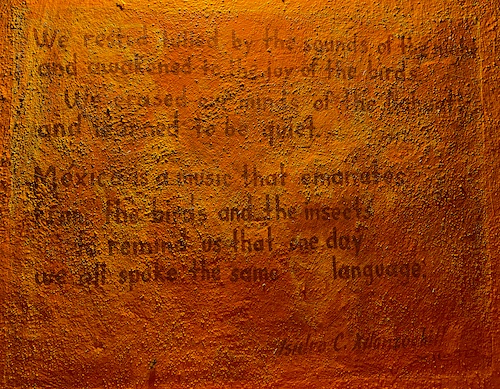
We rested lulled by the sounds of the night
and awakened to the joy of the birds.
We erased our minds of the Nahuatl
and learned to be quiet.
Mexico is a music that emanates
from the birds and the insects
to remind us that one day
we all spoke the same language.
— Isidro C. Xilonsochitl
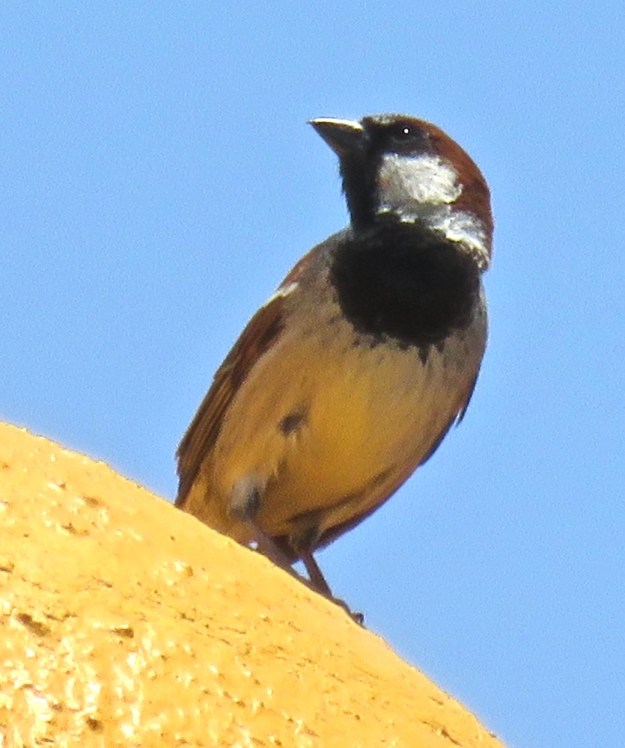
This post is for Sam, because he asked.
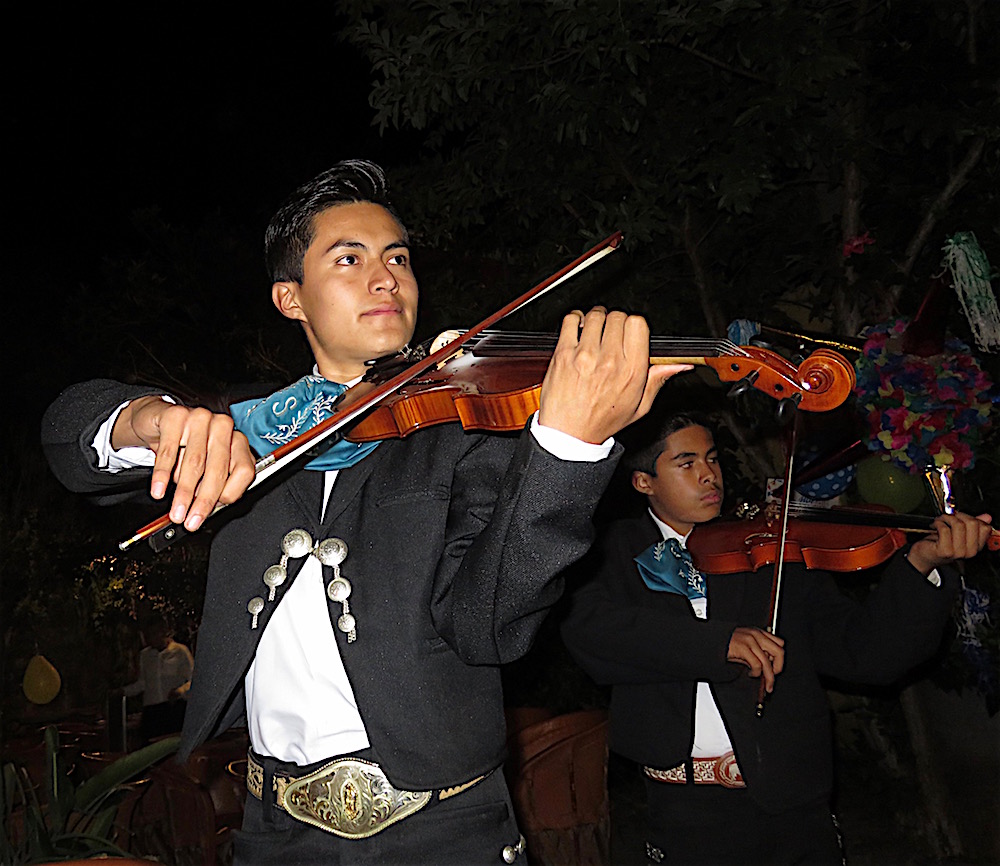

 lifelessons - a blog by Judy Dykstra-Brown