Category Archives: Daily Prompt

Strangers When We Meet

The Prompt: Delayed Contact—How would you get along with your sibling(s), parent(s), or any other person you’ve known for a long time — if you only met them for the first time today?

Strangers When We Meet

If I had met my parents when we all were sixty-seven,
(before she went on oxygen, before he went to heaven,)
would we have liked each other and found something to say?
As strangers, would we walk on by or pass the time of day?

My father liked to be the one spinning out the tale.
Beside his vivid stories, I think most of mine would pale.
He wasn’t a joke-teller or a purveyor of fictions.
It was true stories of his life that fueled his depictions.

And when his friends had heard them all, he’d tell them all again.
Though they stretched with every telling, still his tales never grew thin.
If fifteen wolves pursued him—a number that is plenty,
the next time that he told the tale, I’ll wager there’d be twenty!

When I returned from Africa with stories of my own,
I found that they weren’t good enough, for all of them had grown
with all my dad’s retellings, so the rhino I had snapped
a photo of, now chased me. (In reality, it napped.)

I think perhaps my mother would like my poems the best.
She’d like the rhyme and meter, the humor and the jest.
For I learned all of it from her when I was very small,
as she was doing rhyming before I learned to crawl.

I grew up with her diaries—all of them in rhyme.
She had them in a notebook and we read them all the time.
The tales of her friend Gussie, who wasn’t allowed beaus;
so they said they went to Bible study, though it was a pose.

Gussie’s mother baked two pies, (for coffee hour, they said.)
Her father said he’d pick them up. They said they’d walk instead.
They took one of her mother’s pies to those within the church,
then took the other with them as they left them in the lurch!

Their beaus were waiting for them in a car with motor running.
Instead of Bible reading, they preferred to do some funning.
To abscond with both the pies was something that they had debated,
but in the end they left one pie–an action that they hated.

Two sisters present were their foes. They were so prim and proper.
To steal one pie was lie enough—but two would be a whopper!
Mom’s entry in her journal is one I can still tell.
(Don’t know why it’s the only one that I remember well.)

Line for line, here’s what she said in metered verse and rhyme,
though it’s been sixty years since I heard it for the first time:
“We left that crowd of greedy Dirks to feast upon our pies.
We were so mad, like Gussie’s Dad—had pitchforks in our eyes!”

My mother burned this journal when I was just a kid.
I wish she hadn’t done so, but alas, it’s true, she did.
Perhaps she didn’t want to see us following her ways.
Instead of what she did, better to follow what she says.

But I am sure if she still lived we’d have a little fun,
sitting down together when every day was done
and writing all our exploits down, relaying all our slips—
saving for posterity the words that pass our lips.

And in the meantime, Dad would tell as long as he was able,
all those stories that he’s told at table after table.
In coffee shops and golf courses, at parties or a dance,
he would go on telling them, whenever there’s a chance.

And if we all were strangers, and none of us were kids,
we could relate our stories without putting on the skids.
Each would outdo the other as we passed around the bend,
with story after story till we all came to The End!!!
Overdone (Ten Minute Flunkee)

The Prompt: Ready, Set Done—Today, write about anything, but you must write for exactly ten minutes, no more, no less.

Overdone (Ten Minute Flunkee)

One-a-minute two-a-minute three-a-minute four.
Big bad minute police waiting at your door.
If you take a minute more, I know they’ll somehow know.
So thinking about what you say is gonna bring you low!
They’re gonna crash your firewall and take you off to jail.
So with no other blogger there to get you out on bail,
you gotta write a piece that isn’t about anything—
not about-a-nothing, but the words they gotta sing.
Time is of the essence ‘cause there ain’t no other clue.
Topical-type bloggers? They just ain’t gonna do.
Don’t know why with time limits I’m lacking all my grammar.
It’s like my words are nails but that I’m lacking any hammer.
With no topic they all lie here, looking for a wall.
There’s no sense to any of it. No, no sense at all.
I’m sure a question’s out there, but nobody’s gonna ask it,
and all these words just roll on by like eggs without a basket.
And meaning keeps eluding me. I know I’ll never find it.
Somehow though I’m running, I just stay too far behind it.
I once said I never know just what I will be writing.
From line to line, I follow words and hope they’ll be inciting
a thought, a thesis or a theme somewhere along the way.
I always hope it will be soon, ‘cause I don’t have all day.
But now I look and see the time—9:20:52.
I know that is impossible, for there’ve been just a few
minutes since I started—only one or two—
but the clock says fourteen minutes and some seconds more as well.
So though I’ve met the challenge, once again I’ve missed the bell!!!

9:06:20-9:21:41

Mending Pants (With apologies to Robert Frost)

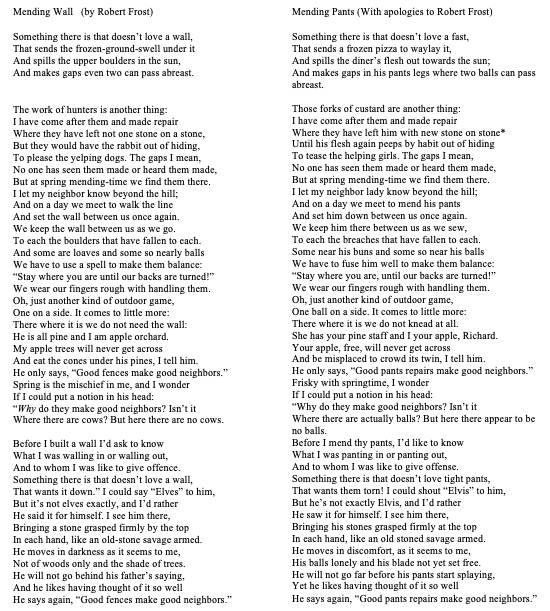
I once again didn’t feel an affinity for today’s prompt, but a friend had suggested that I try this week’s Poets & Writers poetry prompt, so I did it instead.  What follows is a familiar poem by Robert Frost entitled “Mending Wall” and then my parody of it entitled “Mending Pants.”  I hope that I am interpreting that grimace on your face as a smile, and if so, I can link my poem to the Daily Post prompt as well, thereby mending two fences with one stone!!!

Mending Wall   (by Robert Frost)

Something there is that doesn’t love a wall,
That sends the frozen-ground-swell under it
And spills the upper boulders in the sun,
And makes gaps even two can pass abreast.
The work of hunters is another thing:
I have come after them and made repair
Where they have left not one stone on a stone,
But they would have the rabbit out of hiding,
To please the yelping dogs. The gaps I mean,
No one has seen them made or heard them made,
But at spring mending-time we find them there.
I let my neighbor know beyond the hill;
And on a day we meet to walk the line
And set the wall between us once again.
We keep the wall between us as we go.
To each the boulders that have fallen to each.
And some are loaves and some so nearly balls
We have to use a spell to make them balance:
“Stay where you are until our backs are turned!”
We wear our fingers rough with handling them.
Oh, just another kind of outdoor game,
One on a side. It comes to little more:
There where it is we do not need the wall:
He is all pine and I am apple orchard.
My apple trees will never get across
And eat the cones under his pines, I tell him.
He only says, “Good fences make good neighbors.”
Spring is the mischief in me, and I wonder
If I could put a notion in his head:
Why do they make good neighbors? Isn’t it
Where there are cows? But here there are no cows.
Before I built a wall I’d ask to know
What I was walling in or walling out,
And to whom I was like to give offence.
Something there is that doesn’t love a wall,
That wants it down.” I could say “Elves” to him,
But it’s not elves exactly, and I’d rather
He said it for himself. I see him there,
Bringing a stone grasped firmly by the top
In each hand, like an old-stone savage armed.
He moves in darkness as it seems to me,
Not of woods only and the shade of trees.
He will not go behind his father’s saying,
And he likes having thought of it so well
He says again, “Good fences make good neighbors.”

Mending Pants (With apologies to Robert Frost)

Something there is that doesn’t love a fast,
That sends a frozen pizza to waylay it,
And spills the diner’s flesh out towards the sun;
And makes gaps in his pants legs where two balls can pass abreast.
Those forks of custard are another thing:
I have come after them and made repair
Where they have left him with new stone on stone*
Until his flesh again peeps by habit out of hiding
To tease the helping girls. The gaps I mean,
No one has seen them made or heard them made,
But at spring mending-time we find them there.
I let my neighbor lady know beyond the hill;
And on a day we meet to mend his pants
And set him down between us once again.
We keep him there between us as we sew,
To each the breaches that have fallen to each.
Some near his buns and some so near his balls
We have to fuse him well to make them balance:
“Stay where you are, until our backs are turned!”
We wear our fingers rough with handling them.
Oh, just another kind of outdoor game,
One ball on a side. It comes to little more:
She has your pine staff and I your apple, Richard.
Your apple, free, will never get across
And be misplaced to crowd its twin, I tell him.
He only says, “Good pants repairs make good neighbors.”
Frisky with springtime, I wonder
If I could put a notion in his head:
“Why do they make good neighbors? Isn’t it
Where there are actually balls? But here there appear to be no balls.
Before I mend thy pants, I’d like to know
What I was panting in or panting out,
And to whom I was like to give offense.
Something there is that doesn’t love tight pants,
That wants them torn! I could shout “Elvis” to him,
But he’s not exactly Elvis, and I’d rather
He saw it for himself. I see him there,
Bringing his stones grasped firmly at the top
In each hand, like an old stoned savage armed.
He moves in discomfort, as it seems to me,
His balls lonely and his blade not yet set free.
He will not go far before his pants start splaying,
Yet he likes having thought of it so well
He says again, “Good pants repairs make good neighbors.”

*a stone is a British unit of measure equal to 14 pounds.

(Wish I could have printed these out side-by-side so the parody is clearer.  If you are really a purist, perhaps you’ll do so to enjoy the parallels.)

Okay.. I’ve come back from the future to do a side-by-side version:

Mind Freeze

  • The Prompt: Overload Alert—“Everybody gets so much information all day long that they lose their common sense.” — Gertrude Stein. Do you Agree?

    Mind Freeze

    There is new news all day long, for every single minute.
    By radio and television, we are immersed in it.
    Even on the Internet, they repeat and repeat
    every warlike action, every athletic feat.

    We know before their spouses do when politicians slip,
    view every starlet’s nightclub spree via a Youtube clip.
    Stock market scams and Ponzi schemes and other news that scares
    as big guys pick our pockets in order to line theirs.

    Sans Blackwater and Monsanto, we would be better off,
    but we’d still be deluged by news of Enron and Madoff!
    We consult Wikipedia to see what it might say,
    keep up with the Kardashians a dozen times a day.

    It’s hard enough to keep abreast of those they might be bedding,
    let alone to know the date of their most recent wedding.
    Who has gained a pound or two or who’s the most hirsute?
    This information makes our lives a Trivial Pursuit.

    There are so many details that come at us day and night,
    filling up our minds until our craniums feel tight.
    We’re stuffed with sound bites, news clips and every TV show
    until it is inevitable. Something’s got to blow!

    No wonder that we can’t remember names of our best friends
    or what we came out shopping for or how that movie ends.
    We can’t remember song lyrics or what we meant to do
    when we came in here for something. Was it scissors, paint or glue?

    I am forgetting everything I always used to know.
    Every mental process has just gotten kind of slow.
    It’s taking me much longer now to ponder each decision—
    a factor that the younger folks consider with derision.

    Like-aged friends agree with me, for they all feel the same.
    They all have minds stuffed just as full, and we know what to blame.
    There’s too much information, and like any stuffed-full larder,
    to locate things within them gets progressively harder.

    If we could sort our minds out the same way that we pack—
    putting unimportant stuff way at the very back
    and all the more important things in front and at the top,
    we wouldn’t have to search our minds and wouldn’t have to stop

    to figure out the names of things or places or of folks,
    and then we wouldn’t be the brunt of all their aging jokes;
    but it seems that we can’t do this so perhaps the answer is
    to just turn off the TV news and gossip of show biz.

    The scandals and the killings—all the bad things that astound us—
    we’d leave behind to concentrate on happenings around us.
    We’d notice more the little things in our immediate world:
    the spider in the spider web, the bud that’s tightly furled

    and notice when it opens, and the dragonfly that’s on it
    and take a picture of it, or perhaps construct a sonnet.
    See the children who are hungry and instead of our obsessing
    on matters where we’re powerless, instead bestow a blessing

    on all those things around us where we have the power to act.
    When we see whatever needs doing, to take action and react.
    Perhaps then all the horrid facts that rise up in the mind
    will settle to the bottom and then all of us will find

    the keys we’ve lost, our glasses, and remember why we came
    into this room and how to recall every person’s name.
    And all the time we save we’ll spend on the important things
    and feel the sense of purpose helping others always brings.

    The world is too much with us with its bad news of all kinds,
    and all this information simply freezes up our minds.
    Perhaps with less input, there would be less facts to astound us
    and we could concentrate on what’s important close around us.

The Prompt Becomes Itself

The prompt: Curve Balls—When was the last time you were completely stumped by a question, a request, or a situation you found yourself in? How did you handle it?

The Prompt Becomes Itself

Every prompt I’ve bumped into
has been a task I’ve jumped into,
but today’s I fear has trumped me,
for I find that it has stumped me!
In short, I find this prompt to be
a self-fulfilling prophesy!!!!!

Epitaph of a Fulfilled Poet

The Prompt: Quickly list five things you’d like to change in your life.  Now, write a post about a day in your life once all five have been crossed off your to-do list:

Find an agent/publisher
Get all children’s books published
Write a line of adult picture books
Lose weight
Find someone to dance with

“Epitaph of a Fulfilled Poet”

Fulfilling all these book orders just seems to keep me hopping.
Without the time to cook or shop, my weight just keeps on dropping.
My clothes just hang around me, from my body they keep flopping.
I’d buy some smaller ones if I just had the time for shopping!

Five children’s books are published and my agents want some more.
My grief book they can’t keep in stock—It flies right out the door.
Libraries and bookstores just keep clamoring for more,
and still my weight keeps dropping till it’s really quite a bore.

Now that I am skinny—lithe and trim and toned,
no one has to make excuses that I’m just big-boned.
And I must wrap this up soon for a suitor has just phoned
who wants to take me dancing—so perhaps I should be cloned.

Then one of me can write that line of adult storybooks,
while the other stays at home and plans my meals and cooks.
The third has time to shop for clothes and tend to things like “looks,”
and the other goes out dancing with a brand new beau named “Snooks.”

As you can see, my rhyming prowess now is wearing thin.
The last word of that last stanza I admit is just a sin.
Frazzled and with much to do, I’ve broken out the gin,
fell off my pool ladder and badly bruised my shin!

Okay, I’m really hard up for more sentences that rhyme,
so I think that I’ll stop now and just write another time.
Perhaps tomorrow I can write of something more sublime.
But for now, I think my drink could use a squeeze of lime.

Our goals just keep us going—they propel us through this life
and keep attention focused through the problems and the strife.
I’ve always kept on working as both single girl and wife,
slicing through my problems with my words used as a knife

to trim the boredom from my life and go wherever I please,
to make my living with my wit instead of on my knees.
Taking care to always mind my q’s as well as p’s.
and extract all the fun from life that I have found to seize.

Now that my life is near its end and I’ve time to reflect,
I do not choose to pray about it or to genuflect.
I don’t crave meditation or to join a church or sect.
I‘ll find my own atonement and a way to resurrect.

I’ll do it through my writing, for I’ve found that is the key
to figuring my pathway while remaining true to me.
I’m just as I have written. I’m exactly as you see.
My words have all been written, and I’m finished—“a” to “z.”

Leftovers


Leftovers

When my father died forty years ago, it was in Arizona, where my parents had been spending their winters for the past ten years.  They maintained houses in two places, returning to South Dakota for the summers. But after my father died, my mother never again entered that house in the town where I’d grown up.

Our family had scattered like fall leaves by then—my mother to Arizona, one sister to Iowa, another to Wyoming. Both the youngest and the only unmarried one, I had fallen the furthest from the family tree. I had just returned from Africa, and so it fell to me to drive to South Dakota to pack up the house and to decide which pieces of our old life I might choose to build my new life upon and to dispose of the rest.

My father’s accumulations were not ones to fill a house. There were whole barns and fields of him, but none that needed to be dealt with. All had been sold before and so what was to be sorted out was the house. In that house, the drapes and furniture and cushions and cupboards were mainly the remnants of my mother’s life: clothes and nicknacks, pots and pans, spice racks full of those limited flavors known to the family of my youth—salt and pepper and spices necessary for recipes no more exotic than pumpkin pies, sage dressings and beef stews.

Packing up my father was as easy as putting the few work clothes he’d left in South Dakota into boxes and driving them to the dump. It had been years since I had had the pleasure of throwing laden paper bags from the dirt road above over the heaps of garbage below to see how far down they would sail, but I resisted that impulse this one last run to the dump, instead placing the bags full of my father’s work clothes neatly at the top for scavengers to find—the Sioux, or the large families for whom the small-town dump was an open-air Goodwill Store.

It was ten years after my father’s death before my mother ever returned again to South Dakota. By then, that house, rented out for years, had blown away in a tornado. Only the basement, bulldozed over and filled with dirt, contained the leftovers of our lives: the dolls, books, school papers and trophies. I’d left those private things stacked away on shelves—things too valuable to throw away, yet not valuable enough to carry away to our new lives. I’ve been told that people from the town scavenged there, my friend from high school taking my books for her own children, my mother’s friend destroying the private papers. My brother-in-law had taken the safe away years before.

But last year, when I went to clear out my oldest sister’s attic in Minnesota, I found the dolls I thought had been buried long ago–their hair tangled and their dresses torn—as though they had been played with by generations of little girls. Not the neat perfection of how we’d kept them ourselves, lined up on the headboard bookcases of our beds —but hair braided, cheeks streaked with rouge, eyes loose in their sockets, dresses mismatched and torn. Cisette’s bride dress stetched to fit over Jan’s curves. My sister’s doll’s bridesmaid dress on my doll.

It felt a blasphemy to me. First, that my oldest sister would take her younger sisters’ dolls without telling us. Her own dolls neatly preserved on shelves in her attic guest bedroom, ours had been jammed into boxes with their legs sticking out the top. And in her garbage can were the metal sides of my childhood dollhouse, imprinted with curtains and rugs and windows, pried apart like a perfect symbol of my childhood.

Being cast aside as leftovers twice is enough for even inanimate objects. Saved from my sister’s garbage and cut in half, the walls of my childhood fit exactly into an extra suitcase borrowed from a friend for the long trip back to Mexico, where I now live. I’ll figure out a new life for them as room décor or the backgrounds of colossal collages that will include the dolls I’m also taking back with me.

Mexico is the place where lots of us have come to reclaim ourselves and live again. So it is with objects, too. Leftovers and hand-me-downs have a value beyond their price tags. It is all those lives and memories that have soaked up into them. In a way, we are all hand-me-downs. It’s up to us to decide our value, depending upon the meaning that we choose to impart both to our new lives and these old objects. Leftovers make the most delicious meals, sometimes, and in Mexico, we know just how to spice them up.

The prompt: Hand-Me-Downs—Clothes and toys, recipes and jokes, advice and prejudice: we all have to handle all sorts of hand-me-downs every day. Tell us about some of the meaningful hand-me-downs in your life.


The Baby’s Crowning!!!

The Prompt: Next in Line—A second #RoyalBaby will soon be joining the Windsors in England. Given the choice, would you rather be heir to the throne, or the (probably) off-the-hook sibling?

 
The Baby’s Crowning!!!!

Knit a little baby hat for his royal crown.
Put it on his tiny head and pull it firmly down.
He might as well get ready for the pressures of this hat
instead of one he might have worn except for the fact that
his great grandmother has to die or perhaps abdicate
and then his grandpa Charles would have to meet with the same fate.
And then his dad and brother would have to bite the dust
and so perhaps you’ll realize why I remain nonplussed
over today’s question. Why is it moot to me?
Too many living predecessors on his family tree!


Interlude

Disclaimer Notice:  This is a work of fiction, not of fact!!!!

Interlude

I have been dieting for months and I’m in fine fettle. I can see the admiring looks of several men as I enter the restaurant, along with the slightly irritated stares of their wives or girlfriends. I’m fresh from the beauty parlor: newly coiffed, manicured and pedicured, wearing a size smaller than I wore a month ago and several sizes smaller than a year ago. Feeling buff, I slide into a booth, fanning both hands over the smooth surface of the Formica table top, admiring my French manicure.

He enters the restaurant shortly after I do. Taking the long way around the aisle that runs between the tables in the center and the booths along the four sides, he scans the faces of diners with a curiosity that signals an interest in life. He is tall and intelligent-looking with a quirky doorknocker beard and mustache and a Hawaiian shirt—all elements of his appearance that call out for notice. I do not disappoint.

I watch him as he draws nearer, but drop my eyes as he approaches my booth. So it is that I am surprised when he stops in front of me and says, “May I ask you what you name is?”

I bring my eyes up to meet his. Is this the Cinderella story I’ve been waiting for my whole life? Quickly, my mind fills in the prior details. He noticed me on the road and followed me here. Or, he was driving by when he saw me enter the restaurant and, on a whim, seized the day and came in search of me. Or, this is an old and long-forgotten flame, someone from my past—a college or high school friend I haven’t seen for twenty years.

Without asking why or giving a smart answer, for once I merely answer the question. “Judy. Judy Dykstra-Brown,” I purr in a humorous, slightly sexy voice, not once looking away from his clear hazel eyes.

He does not disappoint. “I’ve been looking for you,” he says.

“I’ve been looking for you, too—for a very long time,” I answer in my best low flirtatious tone.

He reaches out toward me, and I extend my hand toward him as well; but in place of his own hand, he places something soft and warm in my palm.

“You must have dropped your wallet in the foyer,” he says to me, “You’re lucky that the right person found it.” He turns then and walks across the room to sit down at a table with a lovely woman in a white sundress and two darling tanned children. They are like a commercial for a Hawaiian vacation.

I open the wallet to see that all the money is intact, the driver’s license just slightly askew from where he must have withdrawn it to see the picture of its owner, and my mind replays his final words to me.  “You’re lucky.”

“Welcome to Perkins!” The waitress interrupts my thoughts in a perky voice, living up to the name of her place of employment. I take the menu she proffers and order humble pie.

The Prompt: Greetings, Stranger—You’re sitting at a café when a stranger approaches you. This person asks what your name is, and, for some reason, you reply. The stranger nods, “I’ve been looking for you.” What happens next?


The Listener


The Listener

I was having a conversation with a friend in a restaurant many years ago when it became obvious to me that the woman at the next table was taking in everything we said. She had that waxy glaze in her eye and that unmoving stance that just signalled eavesdropping. When I ceased talking and fixed her with a steely stare, she started, blushed, and immediately admitted, “I really wasn’t trying to overhear your conversation. I just sort of over-listened.”

The Prompt: Head Turners—We often hear strange snippets of conversation as we walk through public spaces. When was the last time you overheard something so interesting, ridiculous, or disturbing you really wanted to know what it was all about?