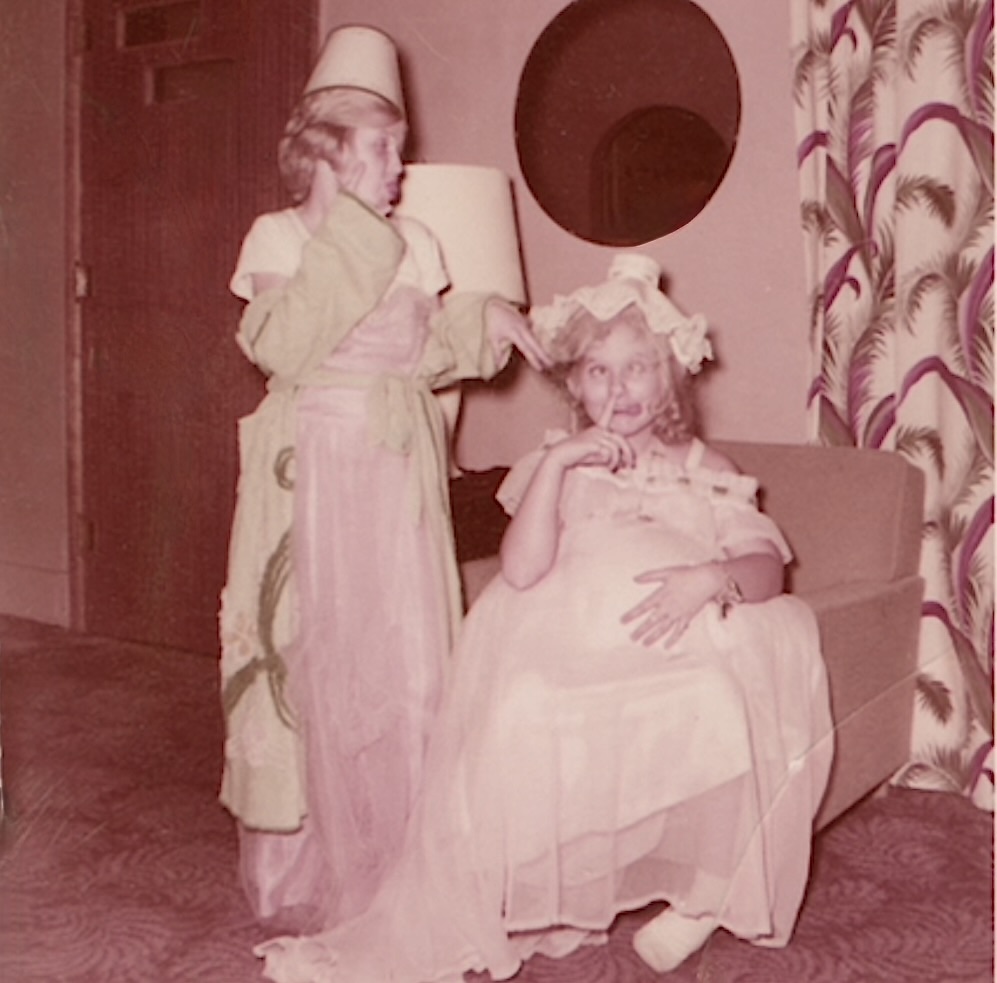
Silly Girls, 1958
This is the “Tell Me A Story” prompt #3. I know the true story of this photo. Can you make one up that is more interesting and put a link to it in comments below? Tell me yours and I’ll tell you mine.
Silly Girls, 1958
This is the “Tell Me A Story” prompt #3. I know the true story of this photo. Can you make one up that is more interesting and put a link to it in comments below? Tell me yours and I’ll tell you mine.
Mama Milk My Goat
Whenever anyone in my family was feeling sorry for herself or himself and expressing it to a point where it was noticeable, another member of the family could be counted upon to use the family saying for such occasions, “Well, Mama milk my goat,” and if the person’s nose wasn’t too far out of joint, they might snap out of it. Or, alternatively, stalk away to seclusion where they could fully feel the full extent of their misery without anyone trying to dissuade them from it. Why did we say this? Because my mother had told us all that it was what my grandmother, her mother-in-law, used to say.
My grandmother, a master at martyrdom, used to say it with a small uptake of breath, in a trembling voice. I can remember hearing her do so, although it may be that sort of childhood memory that grows out of a family tale being told again and again. Needless to say, I had no reason to question its frequent usage until I got to college and again and again was met by a blank look when I issued the rejoinder. Finally, when I reported this strange fact to my folks over the dinner table during a trip home, my dad got a twinkle in his eye and confessed.
What my grandmother, who was Dutch, actually used to mutter when when she was feeling sorry for herself was, “Mama Miet mi Dote!” (Mama might be dead.) Only my mother (her daughter-in-law), who didn’t understand Dutch, thought she was saying “Mama Milk My Goat.” My dad thought this was funny so never told us differently. So even now, “Mama milk my goat,” is occasionally what I say to anyone who is playing the martyr, and if they have any curiosity at all and ask me why, I tell them this story.
Note: For those of you who speak Dutch, I know that “Mama miet mi dote” is not how “Mama might be dead” translates into Dutch. Might might be “machen” and dead might be “dood,” but the whole phrase doesn’t translate into “Mama “machen mi dood,” either. Perhaps it was Frisian, which is where both my grandfather was from and where my grandmother’s family was from originally, or a local dialect or perhaps my ear heard the words differently, or perhaps it is just one of those family stories half legend, half fact. At any rate, if you speak more Dutch that I do, I am more than willing to be informed about what it was my grandma really said. (I only know the alphabet, taught to me by my grandma, and “Mama miet mi dote!”)
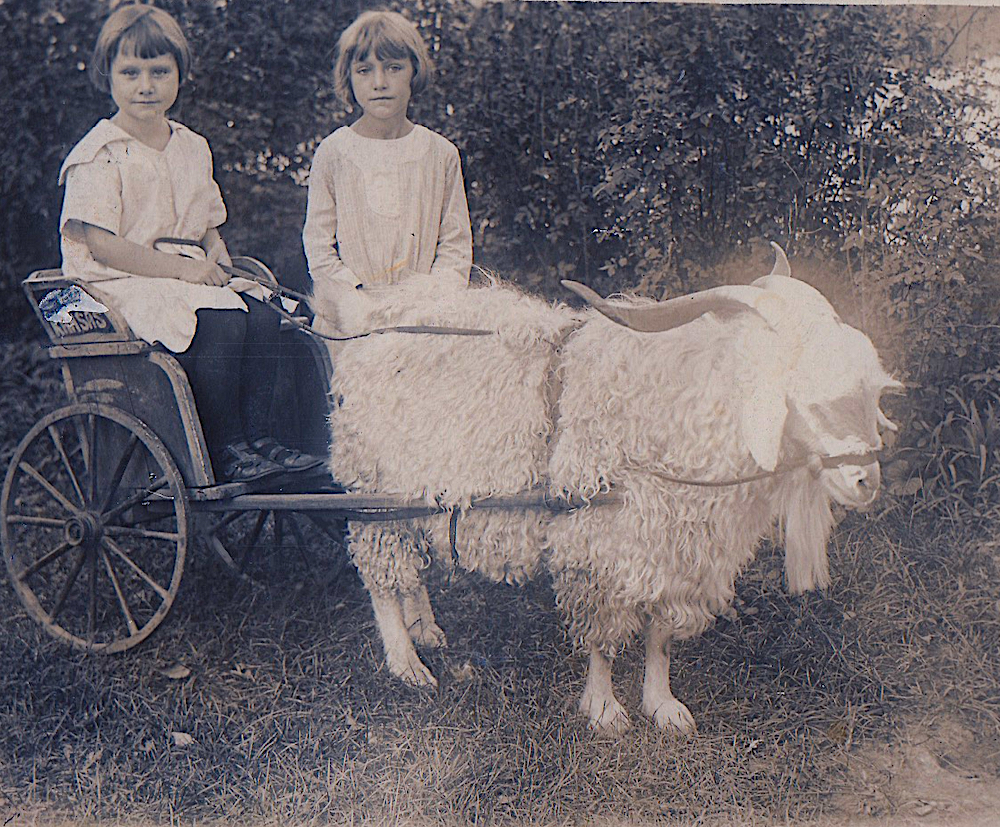
(The photo, by the way, is of my mother as a little girl with her sister Edith standing behind her. Just a coincidence that it includes a goat to illustrate my oft-told tale with!)
For Linda’s Friday Reminder prompt we were to tell an oft-repeated story.

Memoirs of a Frequent Flier
It was in the spring of 1953 when I first realized that I could fly. It had been coming on by degrees—first in dreams, where I would hold my arms straight out, crucifixion style, and then pump them straight up and down until I rose from the ground to float through the air, feet hanging straight down below me, swimming through the air propelled by those pumping arms.
In the dreams, no one ever noticed me. Not the other kids playing “New Orleans” in my yard below me, not my dad out mowing the grass or my mom hanging clothes on the line. Birds flew by in their usual manner without changing their course, whizzing by so close to my ears that I became convinced that I was invisible to all nature–man and beast.
I was never stung by mosquitos when I was in flying mode, and for some reason, even during that long summer two years later when I was eight years old and flying every day, it never rained when I was flying. A few times the first raindrop fell just as my feet came into contact with the ground and I had to shift my mind to remember how to move my legs to propel myself and avoid getting soaked to the skin by one of those July rainstorms so dreaded by farmers trying to get their summer wheat crop combined before the heavy rain, or even worse, hail.
Hail! What would happen if it were to hail while I was flying? Would I be able to soar above the hail—to watch it fall to the earth below me–a wall of white water stones creating themselves just inches below my toes and falling straight down away from me? Could I see them forming? Turning to ice where seconds before there had been nothing, each one of millions a little miracle in itself?
I don’t remember how old I was when I stopped flying. All I can remember is one day remembering that I used to fly, long before, and wondering if the whole experience of that long summer when I was eight and less frequently in the years afterwards were just memories stitched together from dreams. Like so many other things, I can remember clearly when they began but have no memory of when they stopped. Perhaps they haven’t. Perhaps only the memory of this talent unique to me has faded, daily, as soon as my feet touch earth.
But I wonder, in these days of drones so easily and cheaply purchased on the internet, if flight such as mine has become an impossibility. With more people looking up at the sky, what is my likelihood of avoiding being noticed and if I were noticed, what effect would it have on my life? All the news agencies would call. Then Oprah and perhaps even the president. Perhaps Donald Trump would call wanting to make me into a reality show. Perhaps I’d be encouraged to launch a blog penned from above. How high up does Wi-Fi go, I wonder, and would I have to attach a Wi-Fi antenna to a beanie on my head and post the blog orally as both hands would be necessary for my flight, to prevent my plummeting to earth?
No, better that this miracle of flight be left behind with other marks of my adolescence: pimples and wet dreams and all those insecurities of coming of age. Perhaps they were what prompted my need to raise myself above it all. Now that I am well past being fully matured and in fact have embarked on that course that will eventually result in my sinking back into that earth I once rose above, I can make do with pleasures of that earth—chocolate and fresh ripe figs and a 5 o’clock Martini enough to raise me above the norm. And that truth that once I was unique is enough to assure that I still am—here in my Barclay Lounger with my New Yorker Magazine, my feet up on the step stool and commands that I can give through air simply by a push of the finger via remote control. Checking in to Oprah to see who she has found to fill my place this week. Keeping my secret. Knowing how thrilled she would have been. Rating my potential story against theirs. And in my own mind, I know that I would rise above them all.
 Before the below words are imputed to be of my crafting, I must say though I am hugely partisan to their genius, I did not, alas, write them. The story below is full to the brim with creativity and good humor—its word choice both spry and original, and although the plot line may at first seem indecipherable, I trust that your mind will soon snap in line and make transliteration on my part unnecessary.
Although H.L. Chace wrote Ladel Rat Rotten Hut seven years before my birth, my folks were still quoting it when I became old enough to memorize it myself. After 70 years, I can still quote lines of it by heart. I want to quote a bit of it here with a link to its online source. Hopefully, it won’t require transliteration:
Ladle Rat Rotten Hut
by H. S. Chace
Wants pawn term, dare worsted ladle gull hoe lift wetter murder inner ladle cordage, honor itch offer lodge, dock, florist. Disk ladle gull orphan worry putty ladle rat cluck wetter ladle rat hut, an fur disk raisin, pimple colder Ladle Rat Rotten Hut.
Wan moaning, Ladle Rat Rotten Hut’s murder colder inset.
“Ladle Rat Rotten Hut, heresy ladle basking winsome burden barter an shirker cockles. Tick disk ladle basking tutor cordage offer groin-murder hoe lifts honor udder site offer florist. Shaker lake! Dun stopper laundry wrote! Dun stopper peck floors! Dun daily-doily inner florist, an yonder nor sorghum-stenches, dun stopper torque wet strainers!”
“Hoe-cake, murder,” resplendent Ladle Rat Rotten Hut, an tickle ladle basking an stuttered oft. . . . .
To read (and hear) the rest of the story, go to https://www.exploratorium.edu/files/exhibits/ladle/
Prompt words today are brim, spry, partisan, impute, craft and transliterated. (Transliteration changes the words from one language or alphabet into another corresponding, with similar-sounding letters with different characters.) Image by Šárka Jonášová on Unsplash.
“Halo everybody, Halo. Halo is the shampoo that glorifies your hair, so Halo everybody, Halo!” The remnants that dangle on the edge of memory when I awaken from a barely-accessible dream are not ones that my conscious mind sees fit to shove to the front of the crowd of past retorts, compliments, taunts, scraps of poetry, lines from old movies and musical ditties that upon occasion drift across it, but when the word “halo” is also repeated as a prompt in the first blog I look up to gather my prompts for the day’s poem, it seems too much of a coincidence to be coincidence.
This terrific Internet roadway that has led me to a worldwide circle of friends, combined with the scrap of memory from my dream, has led me backwards in time to an early morning seventy years before. My dad is long gone, out to feed the cattle or survey the wheat crop, my older sisters have vanished across the street to their classrooms at the first pealing of the school bell, my mother sits in my dad’s deserted rocker with coffee, toast and the morning paper, and I lie on my stomach in front of the Victrola, switching on the radio.
It is that time of the morning when Mother and I are content to let the morning languish away for awhile. It is a terrific time of freedom for my mother, who often insists she is lazy at heart but who in fact makes sure there is always a meal on the table, skirts hemmed, sheets ironed, Christmas presents piled under the tree in time for them to be admired for a week or more before Christmas, Easter eggs hidden just carefully enough in nests that peek out a tiny bit from beside the sofa or the bottom edge of the curtain.
And for me, it is a time when I have total control over what station the radio in our console record player/radio will be tuned to. Every morning, the Halo Shampoo song issues cheerily out into the morning air and already, in the dawn of media commercials, I have been influenced by what I hear. I have persuaded my mother to invest in our first bottle of Halo shampoo, and although I am five now and old enough to know the difference between metaphor and truth, still some part of me imagines the halo that will waft lightly over my head next Sunday as I flip my hair at the corner before setting out to cross the one street between our house and the Methodist Church. God will know the difference, I am sure, and at lunch after Church, when Mother serves Devil’s Food Cake, I have convinced myself that the former will surely cancel out the latter.
Prompt words today are halo, terrific, worldwide, languish, accessible and dangling.

Above the clouds.
Memoirs of a Frequent Flier
It was in the spring of 2000 when I first realized that I could fly. It had been coming on by degrees—first in dreams, where I would hold my arms straight out, crucifixion style, and then pump them straight up and down until I rose from the ground to float through the air, feet hanging straight down below me, swimming through the air propelled by those pumping arms.
In the dreams, no one ever noticed me. Not the other kids playing “New Orleans” in my yard below me, not my dad out mowing the grass or my mom hanging clothes on the line. Birds flew by in their usual manner without changing their course, whizzing by so close to my ears that I became convinced that I was invisible to all nature–man and beast.
I was never stung by mosquitos when I was in flying mode, and for some reason, even during that long summer when I was ten years old and flying every day, it never rained when I was flying. A few times the first raindrop fell just as my feet came into contact with the ground and I had to shift my mind to remember how to move my legs to propel myself and avoid getting soaked to the skin by one of those July rainstorms so dreaded by farmers trying to get their summer wheat crop combined before the heavy rain, or even worse, hail.
Hail! What would happen if it were to hail while I was flying? Would I be able to soar above the hail—to watch it fall to the earth below me–a wall of white water stones creating themselves just inches below my toes and falling straight down away from me? Could I see them forming? Turning to ice where seconds before there had been nothing, each one of millions a little miracle in itself?
I don’t remember how old I was when I stopped flying. All I can remember is one day remembering that I used to fly, long before, and wondering if the whole experience of that long summer when I was ten was just memories stitched together from dreams. Like so many other things, I can remember clearly when they began but have no memory of when they stopped. Perhaps they haven’t. Perhaps only the memory of this talent unique to me has faded, daily, as soon as my feet touch earth.
But I wonder, in these days of drones so easily and cheaply purchased on the internet, if flight such as mine has become an impossibility. With more people looking up at the sky, what is my likelihood of avoiding being noticed and if I were noticed, what effect would it have on my life? All the news agencies would call. Then Oprah and perhaps even the president. Perhaps Donald Trump would call wanting to make me into a reality show. Perhaps I’d be encouraged to launch a blog penned from above. How high up does wifi go, I wonder, and would I have to attach a wifi antenna to a beanie on my head and post the blog orally as both hands would be necessary for my flight, to prevent my plummeting to earth?
No, better that this miracle of flight be left behind with other marks of my adolescence: pimples and wet dreams and all those insecurities of coming of age. Perhaps they were what prompted my need to raise myself above it all. Now that I am well past being fully matured and in fact have embarked on that course that will eventually result in my sinking back into that earth I once rose above, I can make do with pleasures of that earth—chocolate and fresh ripe figs and a 5 o’clock Martini enough to raise me above the norm. And that truth that once I was unique is enough to assure that I still am—here in my Barclay Lounger with my New Yorker Magazine, my feet up on the step stool and commands that I can give through air simply by a push of the finger via remote control. Checking into Oprah to see who she has found to fill my place this week. Keeping my secret. Knowing how thrilled she would have been. Rating my potential story against theirs. And in my own mind, I know that I would rise above them all.
For Fandango’s Story Starter 16 prompt. This week’s Story Starter teaser from Fandango is: “It was in the spring of 2010 when I first realized that I could…” We are to start our story with that line. Sorry, Fandango, but I had to change the year to 2000 as my narrator has to be a bit older.
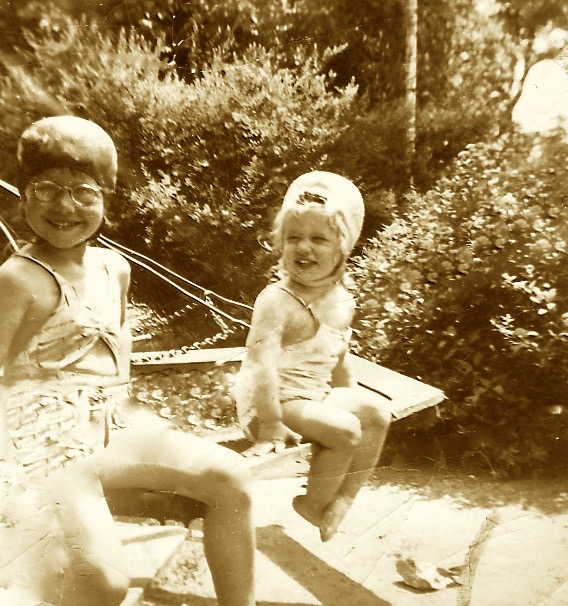
My sister and I at a park near my grandma’s house in Kansas on a merry-go-round similar to the one in the school playground across from our house in South Dakota.
Merry-Go-Round
Their creaks were my alarm that kids were on the elementary school playground across the street and if my biggest sister was downstairs or away from home or even sleeping as soundly as she always did after coming home late the night before, I’d sneak into her room to look out onto the playground from above and see who was there. I knew the difference in the sound between the merry-go-round and each set of swings—the little swings next to the little slide, or one of the three big sets directly across from the block my house was on. Higher, with longer and more flexible chains, these swings could be made to loop de loop—pass up so high that you actually went over the top of the frame the swings were suspended from and wound the chain once around the pipe.
Some of the boys could repeat this three or four times until the swing got so high that none of the little kids could get up to it. Then the janitors would have to get their tallest ladder and go up to push the seat over and over the cross pole with one of their big push brooms to straighten it out again and bring the seat down closer to earth.
There were rules forbidding loop de looping, but the boys would come after school when all the teachers had gone home and even our janitors, Mr. and Mrs. Polachek, who lived kitty-corner across from the south end of the playground, were at home in their backroom away from the sounds of kids they had to deal with every day.
The creak I was listening for was the creak of the merry-go-round. Teepee shaped, it had a wooden runner all the way around it a foot up from the ground. There was a handrail about thirty inches above it, so you could stand on the wooden runner, facing the center pole, hold onto the hand rail and enjoy the ride as the big kids ran around in circles around the merry-go-round, pulling it with them to go faster and faster, then stood on four sides of it, grabbing the handrail pipe and pushing it off to make it go faster still. One by one, more onlookers would enroll in the joint effort to get it going fast enough. Then they’d jump on and everyone would pump up and down, sticking their bottoms out into space as they bent their knees to keep up the momentum.
There were other ways to use the Merry-go-round. The bigger girls like Marie Holstedt who lived on the street that faced the opposite side of the playground from the one my house faced, would sit on the foot board with her boyfriend Robert. Their feet side by side on the ground, they would sway to and fro in a kind of two-step movement—two to the right, then one to the left––their knees touching with their swing to the right, their hips touching when they swung to the left. When they did this, the sound of the merry-go-round reminded me of the strange rhythmic creaking I’d hear sometimes late at night in my house.
It was probably the TV antenna on the roof, my mother had said. Or maybe the furnace trying to pump out heat, she had speculated when I pointed out that it had been a windless night.
Life was simple and I believed her. Only now do I make sense of it and of my father’s late night short trips down the hall to the bathroom—the washcloth always draped over the tub faucet the next morning.
It was an innocent age where it was entirely possible to be eleven years old and to never have had the least idea that anything like sex existed in the world. Yet a good deal of what eventually led up to it went on in the playground across from my house. Older girls would sit in the swings, swaying back and forth without ever taking their feet from the ground. Or, take fast running steps forward and backward without really letting go and allowing the lift off. To their side or in front of them would be their crush of the day or the week or the hour. If he was not the boy of choice, sometimes the girls would switch swings. If the boy switched again, too, and the other boy let him, then it was a sign language of sorts that indicated which boy favored which girl, and if the girls went home, a clear message that things had not matched up correctly to their satisfaction.
But at other times—usually during games of ditch ‘em played in the twilight and darkness of summer—courtships could progress toward hunkering down in the ditches around the playground, close up to some culvert where the ditches were their deepest, the girl in front, the boy with his arms around her waist, holding her back from running to try to get to home base when one of the littler kids who was “it” ran past without seeing them. In these junior high years just past childhood, the objects of the games started to shift until finally in high school, the rituals of the old games were left behind entirely and ditch ‘em became merely a starting place––as did the swinging back and forth, the pumping, the dance.
Today, with merry-go-rounds a thing of the past, they are still an appropriate metaphor for what life pushes us toward from our birth. It begins with our rocking in the arms of our mothers, the rocking chairs of our grandmothers, the wild swings through the air locked hand-to-hand with our fathers. It is what slippery slides and swings and merry-go-rounds and dancing move us towards. Everything going around and around and in doing so really going back and forth from generation to generation. Passing the world on and fading away. Now and then doing a loop de loop just because we can.
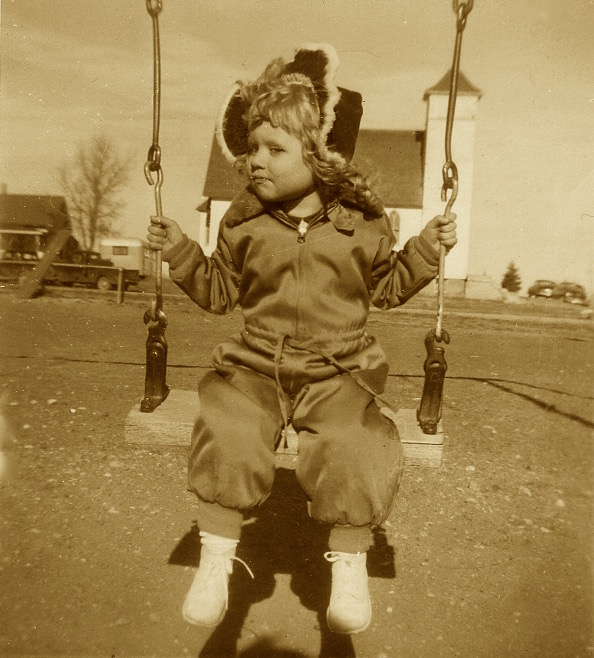
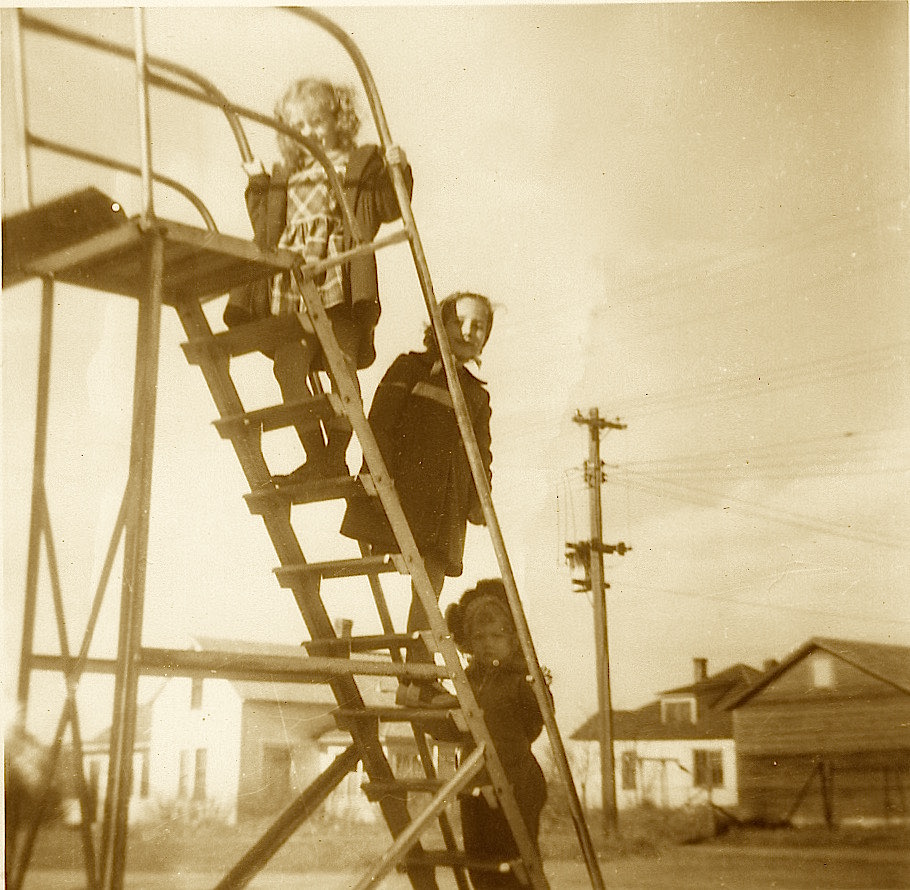
This is a rewrite of a piece from three years ago. The prompt today is enroll.
First Friends
I am three years old, lying in my Mom’s room taking a nap. I can hear voices in the front room. The world comes slowly back to me as I rouse myself from the deep sleep I swore I didn’t need. I hear my mom’s voice and the voice of a stranger. I slide my legs over the side of the chenille-covered bed, balancing for a moment like a teeter totter before giving in to gravity and letting my feet slide through space to the floor below. I creak open the door, which had been left ajar. My mom’s voice gets louder. I smell coffee brewing and hear the chink of china coffee cups in the living room.
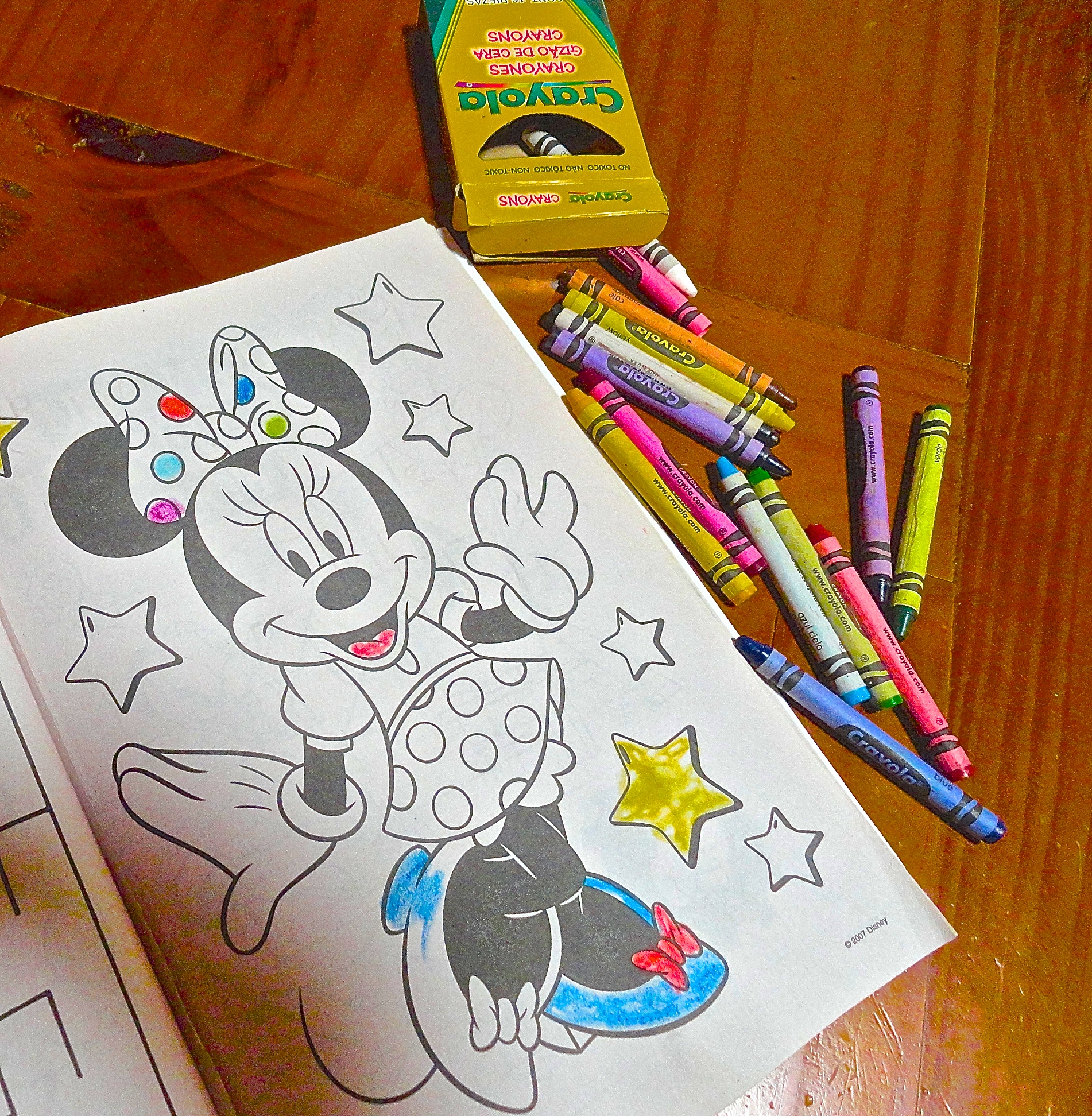
I hear a dull rubbing sound and move toward it—through the kitchen to the dinette, where a very small very skinny girl with brown braids is sitting at the table coloring in one of my coloring books. She is not staying in the lines very well, which is crucial—along with the fact that she is coloring the one last uncolored picture in the book which I’ve been saving for last because it is my favorite and BECAUSE I HAVE IT PLANNED SO THERE IS SOMEWHERE IN THAT PICTURE TO USE EVERY LAST COLOR IN MY BOX OF CRAYOLAS!
I sidle past her, unspeaking, aflame with indignation. Who could have—who would have—given her the authority to color in my book? I stand in the door of the living room. My mom is talking to a mousy gray-haired lady—tall, raw-boned, in a limp gray dress. My mom sees me, and tells me to come over and meet Mrs. Krauss. They are our new neighbors. They are going to live in Aunt Stella and Uncle Werner’s house two houses down. Did I meet their daughter Pressie in the kitchen? She’s just my age and Aunt Stella and Uncle Werner (who are not actually related to us, but just friends of my folks) are her real aunt and uncle.
The gray lady calls Pressie in to meet me. She is quiet and I am quiet. Then we go back to color at the table together. We drink orange juice and eat potato chips. We will be best friends for what seems like a lifetime but what is really only until we approach adolescence. I will have a love-hate relationship with her mother, who will continually set up competitions between Pressie and me to see who will win. She will try to coach Pressie first; but still, I will always win.
Pressie and I will play hollyhock dolls and dress-up. We play, sometimes, with Mary Boone; but her parents are too religious and don’t think we’re nice enough to play with her very much. I want to put on neighborhood plays and circuses, but none of the other kids want to perform. I want to play store and school, but Pressie eventually goes home to help her mother varnish the floors.
Pressie’s house is full of loud brothers and a sulky teenage sister. It is full of high school-aged cousins who tease us unmercifully and old ladies who come to play Scrabble with her mother. It is full of a missionary sister who comes back from South America and married brothers who come from Florida with babies that Pressie and I take charge of.
Pressie’s house is full of slivery floors that are always in the process of being varnished or de-varnished. There is one drawer in the kitchen full of everybody’s toothbrushes, combs, hairpins, hair cream, shampoo tubes, old pennies, crackerjack toys, rubber balls, lint, hairballs, rolled up handkerchiefs and an occasional spoon that falls in from the drain board above it. They have no bathroom—just the kitchen sink and a toilet and shower in the basement, across from the coal bin and the huge coal furnace. Their toilet has a curtain in front of it, but the shower is open to the world.
Sometimes when I am peeing, someone comes down to put coal in the furnace or to throw dirty clothes in the washtub next to the wringer washer. I pull the curtain tight with my arms and pray that they won’t pull it back and discover me, my panties down to the floor, pee dripping down my leg from my hurried spring from the toilet to secure the curtain. To this day, I have dreams about bathrooms that become public thoroughfares the minute I sit down. To this day, I get constipated every time I leave the security of my own locked bathroom.
Pressie babysits with the minister’s kids for money. I go along for free. She spanks them a lot and yells a lot. I think I can’t wait until I’m old enough to have kids so I can yell at them, but when Pressie is gone and the minister’s wife asks me to babysit, I don’t yell at them.
At Christmas I can’t wait to have Pressie come see my gifts: a Cinderella watch, a doll, a wastebasket painted like a little girl’s face, complete with yarn braids, books and toilet water from aunts, a toy plastic silverware set from my sister, stationery from my other aunt, playing cards, sewing cards, paint by numbers, a new dress. I run over through the snow to Pressie’s house to see her presents: a new pair of pajamas, a coloring book and new crayons, barrettes and a comb. In her family, they draw names. Quickly we run to my house, but she doesn’t pay much attention to my presents. She is funny sometimes, kind of crabby. The more excited I get, the more withdrawn she gets.
Later, I want to make snow angels in the yard and feed leftover cornmeal muffins to the chickadees, but Pressie wants to go home. Pressie always wants to go home. What she does there, I don’t know. She doesn’t like to read. None of us will have television for another five years. She doesn’t much like games or cards. I don’t know what Pressie does when she isn’t with me.
When she is with me, we take baths together and sing the theme music from “Back to the Bible Broadcast,” washing our sins away in the bathtub. We play ranch house in our basement. We pull the army cot against the wall and put old chairs on either side of it for end tables. We upend an old box in front of it for a coffee table. My grandma’s peeling ochre-painted rocking chair faces the army cot couch. We sneak into the hired man’s room and steal his Pall Mall cigarettes and sit talking and smoking. We rip the filters off first, which is what we think you’re supposed to do.
Pressie will always stay longer if we smoke. I blow out on the cigarette, but Pressie inhales. We smoke a whole pack over a few weeks’ time and then go searching for more. When the hired man starts hiding his cigarettes, we discover his hiding place and learn to take no more than four at a time so he doesn’t miss them. When he has a carton, we take a pack and hide it under the mattress on the army cot. My mother wonders where all the filters are coming from that she sweeps from the basement floor, but never guesses our secret.
Pressie spends more time with me than before, drops by almost every morning and always wants to go to the basement to play and smoke. Then the hired man finds another room and moves out and when Mrs. Church’s granddaughters come to visit, I will want to play with them but Pressie won’t. Then we will pair off—Pressie with Sue Anne, the girly one, me with Kate, the boyish one. We have a little war—mainly instigated by the sisters.
When the new farm agent moves in with two daughters—one a year younger than Pressie and me, the other a year younger than my sister Addie—I want to ask the girl our age to play with us, but Pressie won’t. I have a slumber party for everyone—all the girls we know. I invite the new girl, whose name is Molly, but no one talks to her much. She is shy and doesn’t push herself on us. No one else ever wants to include her. I go play with her anyway and spend the night at her house. Her mother is nervous, her dad cocky. Her older sister laughs nervously under her breath a lot, as does her mother.
Many years later, by the time we are in high school, everyone has accepted them. By then, all of those girls have parties where I’m not invited. They are always a little reserved when I come up to speak to them. Maybe they’re always reserved. How would I know how they are when I’m not around? Later, they all got to be pretty good friends. But in the beginning, I was everyone’s first friend.
The prompt today is varnish.
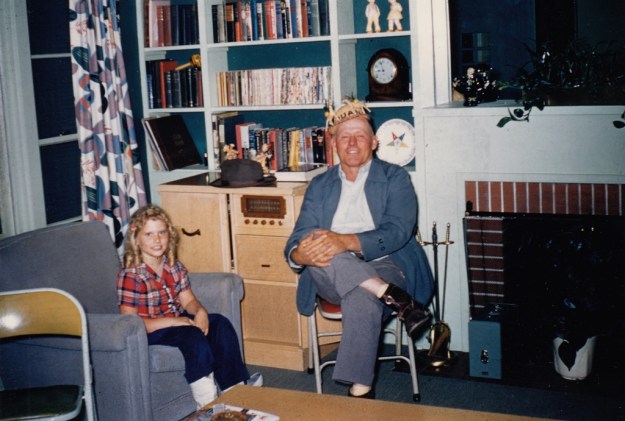 This is the only photo I have of me wearing the white boots lauded in this poem. Too bad the tassels aren’t showing! That’s my dad being silly and sporting as a hat a centerpiece brought back from Mexico by our neighbors.
White Boots with Tassels
Hand over hand, hand over hand—
we were a little twirling band—
Sharon, Diane and Meridee,
Jerilyn, Sheila and me.
We felt that we were in cahoots
as we donned our tall white boots
that sported tassels hanging down,
strutting them all over town,
dropping batons we soon retrieved
and we all truly believed
one day we’d be good enough
so we would come to strut our stuff
before the band, wands held on high
then thrown aloft into the sky.
Those dreams, alas, soon became dated
when our high school mentor graduated,
going on to college where
her baton rose to higher air
while ours were relegated to
shelves that sported a single shoe,
old castoff dolls and castoff dreams,
Teddy bears ripped at the seams
and small batons barely abused
because they were so rarely used.
Yet in our dreams, we strutted tall,
the finest majorettes of all—
batons twirling as they rose high
above us far into the sky,
returning safely to each hand
in sync with music from the band
we marched in front of, pert and sassy,
our tasseled boots sexy and classy.
Big girls now grown up from small,
the coolest high schoolers of all.
The truth of this, alas, it seemed,
to be something we merely dreamed.
The prompt word today was strut.
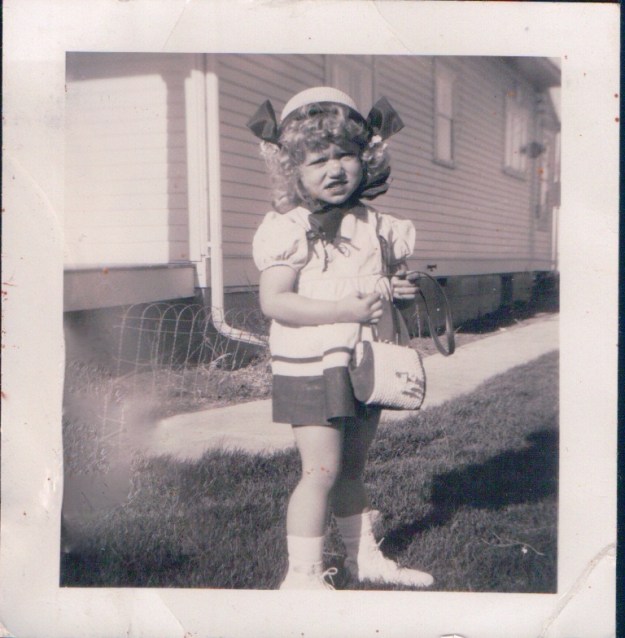
Cee’s Fun Foto Challenge this week directs us to post a photo of something beginning with the letter “J” that contains at least six letters. Believe it or not, it took me a good ten minutes to come up with such a word! I was about to resort to the dictionary when I spied this photo on my desktop. I had used it just a few days ago, but earlier, when I went to put it away, my eyes fell on the purse and I started to wonder what I would have carried in a purse when I was three years old. It seemed like a good subject for a poem, so I left the photo there to remind me to try to do so after I did Cee’s “Fun Foto” post. It didn’t occur to me for a long time, that since my name is Judith and it was a photo of me, that I could do both at the same time.
Church Purse
What does a three-year-old put in a purse she takes to church?
Held primly on her lap as legs swing freely from their perch.
Feet dangling from the pew above the varnished floorboards where
fifty years of townsfolk have walked enroute to prayer.
Small straw purse grasped tightly in two nail-bitten fists,
too little for a lipstick or store receipts or lists.
If perhaps the sermon stretches on too long,
what can she find inside this purse that she has brought along?
Black plastic strap she’s twisted securely ‘round a finger—
once she has unwound it, how long will the marks linger
pressed into her chubby flesh, like four little rings
she surveys as she unsnaps her purse to view her “things?”
A single piece of Juicy Fruit in case she gets a cough.
A snap bead and a single bud that happened to fall off
the rosebush of that big house as she ran ahead to linger
on their way to church and squeezed it with her finger
(and perhaps her thumbnail) until it finally snapped.
She’d peel off its petals later as she napped.
She knew she shouldn’t do this. They’d told her this before,
but her parents walked so slowly, and those naps were such a bore.
God may have seen even the smallest sparrow fall,
but were single rosebuds seen by him at all?
That lady they belonged to was so bossy and so haughty
that she provoked the saintliest children to be naughty!
A single plastic wrapped-up toy she worries to and fro
from her last night’s Cracker Jacks bought before the show.
She softly rustles cellophane between her restless fingers,
then sniffs them to determine if the caramel smell still lingers.
Mama gently elbows her to say she should desist––
fluttering her hand a bit, loosely from the wrist.
She looks for things much quieter in her little purse.
Her snap pistol is noisier. This marble would be worse,
dropped upon the church floor where it would roll away.
If she caused such a ruckus, what would the preacher say?
Something at the bottom feels so round and sticky.
Probably a Lifesaver gone all soft and icky.
A little lace-edged hanky that Grandma tatted for her.
She said that she would show her how, but she’s sure it would bore her.
A folded piece of paper. Crayons––one blue, one red.
If the sermon goes too long, she can color instead.
Mama will not mind and neither will her Dad.
Sister will be embarrassed, but she cares not a tad.
Later on her Daddy’s eyes will start to close,
but she’s sure her mom will nudge him before he starts to doze.
That’s why she is sitting right there in the middle
to correct his snoozes and her daughter’s every fiddle.
Sister is so perfect she needs no reprimand,
so she sits on the outside, removed from Mama’s hand.
After the sermon’s over, the collection plate
passes here before her, certain of its fate.
She’ll unsnap the little purse and reach down far inside it
to try to find the quarter where she chose to hide it
stuck in her silly putty in a little ball.
Now she wonders whether she can remove it all.
The people farther down the pew look in her direction
to try to see the cause of the collection plate’s deflection,
so her quarter is surrendered to join the coins and bills
piled there around it in green and silver hills.
It is the only quarter blanketed in blue.
It is a nice addition, this unexpected hue.
Sister looks disgusted, but her parents do not see,
That quarter cannot be traced back to her now, luckily.
Church will soon be ended with a prayer and song,
and when the music starts up, she will gladly sing along.
She still dreads church but she gives thanks, for it could be worse.
She could be forced to live through it without her Sunday purse!
 lifelessons - a blog by Judy Dykstra-Brown