Category Archives: Travel

Bogged Down in Blog

DSC01205
Bogged Down in Blog

It’s hard to write while traveling–
your half-knit thoughts unravelling
as they call you in to talk
or have a meal or take a walk.

You sleep in other people’s houses,
wrinkles in your unpacked blouses,
possessions jumbled in your cases,
move at unfamiliar paces.

You live a life that’s not your own–
daily walking, driven, flown
while trying to remember faces,
confused by all these different places.

In the past I adored going–
miles passing, airwaves flowing.
I loved to move like a rolling log,
but that was when I didn’t blog!!!

Now I find I’m scurrying.
Wake up already hurrying.
I’m confused and frankly dumb,
forgetting where I’m coming from

as well as where I’m going to.
I’ve lost a sock and lost one shoe.
Still, I find time to write each day,
here in some room, hidden away.

This daily writing’s an addiction
that makes real life a dereliction!
I short my hosts to do my writing.
I’ve given up my life for citing!


The Prompt: State of Your Year–How is this year shaping up so far? Write a post about your biggest challenges and achievements thus far.

https://dailypost.wordpress.com/dp_prompt/

Recalculating: Berkeley to Livermore and Back

Recalculating: Berkeley to Livermore and Back

Who wanders for pleasure, wanders alone
marking no boundary, barrier, zone.
The earth has no limits and time has no chime,
my steps undetermined by schedule or clime.

This used to be my modus operandi
travel my sweet tooth and freedom my candy.
No email or Google, no iPad or phone,
without Internet service, I rolled like a stone.

But today I am traveling from town to town
with heavier luggage–more weighted down.
And though I go singly, I’m never alone
thanks to my computer, my Kindle and phone.

Right now I’m imprisoned and my progress is bound
by the cords of my ear buds confusingly wound
round my camera charger and Ethernet connector.
My GPS determines my vector.

No more do I travel unfettered and free.
Cell tower to tower is where I must be;
so every person that I’ve ever met
has me perpetually in their debt.

Birthdays to remember and twitters to answer,
queries of grandchildren, hip sockets, cancer.
Traveling with this extra weight is not pleasant.
I much prefer traveling just in the present

unfettered by email, phone calls or that voice
calling instructions at every choice
of northwards or southwards or eastward or west.
Yes, I know GPS directions are best,

but if I’m never lost and never alone,
I might as well stay home and talk on the phone,
for most of adventure has come when I’m lost
from all of my past, whatever the cost.

Still the ways of the present make planning much easier,
finding my next destination much breezier.
These tricky freeways have changed in past years
and I find my memory much in arrears.

So perhaps for today I’ll turn on GPS
so I won’t get so lost and I won’t have to guess
which freeway to take: eight-oh-eight? eight-oh-six?
Getting myself in a terrible fix.

Tomorrow’s the time to become vagabond,
using personal radar and my fairy wand
to maneuver through life by the skin of my pants.
Just for today, I won’t take the chance!

P.S.  Thanks, Patti, for the loan of the GPS!!! Actually, it has been a Godsend.

The WordPress prompt: The Happy Wanderer–What’s your travel style? Are you itinerary and schedule driven, needing to have every step mapped out in advance or are you content to arrive without a plan and let happenstance be your guide?

https://dailypost.wordpress.com/dp_prompt/the-happy-wanderer/

Placement

Where Things Go

Etiquette decrees the place for knife and fork and spoon.
Cocktails belong with sunsets. A wedding goes with June.
Placement is determined by a sort of mass assent.
Snail mail goes in mailboxes. E-mail goes where it’s sent.

Freckles belong on noses and fingernails on fingers.
Perfume should stay in bottles, not in places where it lingers
to make allergic folks like me sneeze and carry on.
It’s a fact that things smell better after the perfume’s gone.

Sheiks belong in palaces, safari guides in tents.
Molls belong with gunmen whereas ladies go with gents.
Gloves are filled with fingers and socks with only holes,
since fingers simply do not go with garments that have soles.

Arms on sweaters, legs on pants. Astronauts in space.
Cats on cushions, birds in trees and eyebrows on your face.
Everything has someplace where it is meant to go.
Missionaries in Africa, tarts with men with dough.

Tiaras go on beauty queens, a dunce hat on a dunce,
or on those of us who want everywhere at once.
We use up fossil fuel flying here and there.
One moment we’re in taxis, the other in the air.

We aren’t really sure at all where we want to be:
mountain, beach or meadow, river, lake or sea.
There is a site on Google showing every single minute
where each plane is going carrying all the people in it.

This one wants to be where that one was just hours ago.
They have to take a Learjet. Other airplanes are too slow.
People flowing elsewhere like water in a stream,
giving up the here and now for places in a dream.

Sometimes I think I’m tired of moving here and there
and that my favorite place of all is right here in my chair.
I’ll give up future travels for places in my head.
My favorite place is in my mind.  I’ll travel there instead!

The Prompt: Places–Beach, mountain, forest, or somewhere else entirely?
https://dailypost.wordpress.com/dp_prompt/places/

Still Life With A Small Town Girl

The Prompt: Sparkling or Still—What’s your idea of a perfect day off: one during which you can quietly relax, doing nothing, or one with one fun activity lined up after the other? Tell us how you’d spend your time.

Still Life With A Small Town Girl

For many years when I was small and far into my teens,
my summer days were filled with little else than magazines
and books and all the other things a girl in a small town
brings into her summers just to make the days less brown.

Day after day of reading soon led to dreaming, and
my shade beneath the cherry tree became a foreign land.
I did not know the name of it, but in this foreign place
the people did such lovely things. They kept a faster pace.

There were many things to see and people who liked doing—
circuses and carnivals, badminton and horse-shoeing,
imaginings and plays and travels. People who liked dancing.
Instead of trudging down the street, these people would be prancing.

I dreamed such dreams of bigger towns, and far-away towns, too.
All summer, I lay in the grass, dreaming what I’d do
when I was so much older and could go out on my own.
I’d wander off into the world. Explore the great unknown.

Now six decades later, I have done it all—
so many of those things I yearned to do when I was small.
I’ve been to places far and wide—Africa and Peru.
In England, France, Australia—I found so much to do.

Plays and concerts, dances, films, museums, garden walks.
Lectures, movies, workshops, classes, roundtables and talks.
Tours and treks and trips and sorties—guided meditations.
Somehow life seemed fuller packed with exotic vacations.

But now that I am sixty-seven, I’d appreciate
if all this activity would finally abate.
I dream of slower days that I’d spend dreaming in the shade
where all my memories of days spent doing would just fade

into the past and leave me to dream here in this place,
swinging in my hammock, at a slower pace.
Leaving my activity to stream from head to pen.
Filling up the page with all the places I have been.

And making some sense out of why I had to go and go,
speeding up the days that back then seemed to me so slow.
I guess I had to travel to find others of my kind
to teach me that life’s riches are mainly in the mind!

Fruit Salad

Fruit Salad

It was 1973. I’d been in Australia since September of 1971 and was ready to travel again. You’ve heard part of the story—the hard and adventurous part through Timor— but I was now in Bali, which was an undiscovered paradise at that time. I spent over a month there, sipping “magic ice juice” and trying to avoid durian. We were living well on $1 a day. 25 cents for bed and breakfast, a quarter for lunch and 50 cents for a lobster dinner at night. Pot and magic mushrooms were available by the grocery bag full and were not yet a hanging offense. Everyone was high all the time!

We stayed in a house with a man who had 4 wives, but was the loneliest man in Bali, afraid to spend time with his beautiful new wife lest his oldest wife find out and demand equal attention. If he bought one wife a gift, it was the law (of both his religion and his house) that he buy an equal gift for all of the others, and feeling financially challenged, the result was that he stayed away from home and his “crony wives” as much as possible. He took us to the rice paddies to see where the village bathed and was disappointed, I think, when we didn’t remove our clothes and join them.

We toured temples where signs said, “It is forbidden to enter women during menstruation” and visited elephant caves, the homes of famous artists, had massages and avoided bare-breasted old women who kept trying to raise our blouses to see what our breasts looked like. Certainly there must be something wrong with them that we kept them covered all the time. One of our fellow-travelers, a very large-breasted woman who was a practical nurse from New Zealand, posed nude for a Balinese batik artist, but we never saw the fruits of his labor.

On certain evenings, the entire town of Kuta turned into one huge gamelan orchestra with the floors of entire small buildings covered with kneeling players, mallets in hand. Processions would wind through the street toward temples, the women with high stacks of baskets and floral offerings, the priests making animal sacrifices of small chickens—everyone in the trance of the music and the occasion, some of us still under the trance of the magic mushrooms we’d consumed in an omelet 3 days before.

You couldn’t eat the salad, but the fruit, the music, the rice paddies, the temples, the sacred monkey forest, the art, the people and the price—you couldn’t beat.

The Prompt: Salad Days—Is there a period in your own personal life that you think of as the good old days? Tell us a story about those innocent and/or exciting times (or lack thereof).

Bali-Bound


daily life color017 daily life color016

Bali-Bound

Germans, Aussies, Kiwi, Brit, Dutch, Canadians, Swiss.
I was the lone American who was pulled into this
adventure—just thirteen of us, including them and me
in a tank barge left from WWII, across the Timor Sea.
We did not know that Bugis pirates still set sail out there,
for we were young and reckless, and we didn’t care.
We still felt invulnerable. We would never die.
We all sought our giant chunk of the adventure pie.
We sailed all day and through the night and part of a new day.
Most of the cash that we had left was what we had to pay
to reach the west shore of an Island lashed by monsoon rain.
All bridges and all roads washed out, we searched for rides in vain.
A lonely store stocked not with much—some cans of cheese, two Cokes.
Not adequate provender for such starving, thirsty folks.
We crossed from Portugese Timor onto Indonesian ground.
Although we all had traveler’s checks, there was not much cash found
within our empty pockets, yet to Bali we were bound.
Still an unspoiled paradise—a haven with few cars
or partying Australians or honeymooning stars.

We stopped at one last little hut where I took off my sandals
to ease my feet, and thus were they made off with by some vandals.
And so it was that we set out through jungles vined and rooted,
fording rivers filled with leeches. I, alas, barefooted!
But chivalry was still in vogue and one or two or three
of my fellow travelers shared their boots with me
taking turns at walking barefooted for awhile
as we walked through the jungle, mile after mile.
Till late in the afternoon we came across an inn
(By then my resolution grown dangerously thin!)
Alas, we had no money for dinners and our room,
and here was where the two Swiss guys dispelled our sense of gloom.
They traded the two ten-speed bikes they’d carried or they’d ridden
most of their way around world—and they did it unbidden
by any of us, for we knew those bikes were like their kin;
and yet they gave up both of them for one night in this inn
for all of us, plus dinner—a repast full and rich,
and furthermore, our breakfast and the promise of a hitch
on a truck loaded with grain bags that was headed out tomorrow.
They did this for all of us and did not show their sorrow.
After showers poured from pails, (I noticed, I’d grown thinner)
some of us had a little nap and then a welcome dinner.
And when the Germans both pulled out their guitars for a song,
the sons of our innkeeper brought out theirs and sang along!
We all chipped in to teach the lyrics to Bobby McGee.
Our beds and food cost dearly, but the music was all free.

Next morning, we climbed high upon the grain bags for our ride
while Indonesians hung onto the rear and either side.
That truck looked like a peddler with his wagon piled high,
not with the usual notions, but with humans far and nigh.
We rode along uncomfortably, hour after hour.
No songs for us this long, long day, our mood was turning dour.
When it was nearing dusk, that truck gave one tremendous lurch
that very nearly threw us all from our precarious perch.
The Indonesians climbed on down and vanished all but one,
while the drivers told to us this next stage in our fun.
The axle cleanly broken, they would start out to get aid.
They’d come for us tomorrow—but they wanted to be paid!
We waved them off with promises—just one more awful bungle
and looked around for sleeping spots in this dense, darkening jungle.

We settled on a little hillock clear of trees and vine.
Rolled out all our sleeping bags. On what were we to dine?
One tiny little can of cheese and sardines in a tin
and those two Cokes we’d purchased—our provisions were most thin.
Hans had pellets with him meant for purifying water.
Guys headed out in search of it like lambs led to the slaughter.
The sky was darkening, but I knew I had to go to pee.
I headed down to where the trees afforded privacy,
pulled down my pants and put my hand, to balance, on a tree
when a sudden piercing pain shot from my hand through all of me!
I screamed and all my traveling friends came running down the hill.
I think of all my crises they were soon to have their fill.
I felt as though a burning dart had pierced through my right hand.
Toppled and now hobbled, I was unable to stand.

They helped me pull my pants up, sadly with a still-full bladder
as I heard the Timorese man say that it had been an adder.
I’d die within the hour, there was nothing we could do.
They emptied all their pills out and decided I’d take two
of everything we carried in our pockets and our packs,
for all of us were traveling with a drugstore on our backs.
To wash them down they offered up the ultimate in gifts:
the Cokes that we were hoarding, then they sat with me in shifts.

My finger swelled to such a size that the one ring I wore
cut off circulation until Peter cussed and swore,
“We’ll have to cut it off, so Trevor come here with your knife.
We have to cut if off of her to try to save her life.”
They put my hand upon a rock, I was delirious.
Trevor was looking rather green. Could they be serious?
He brought the knife down to my finger, but his wrist went limp.
The Germans gave a severe look, as though he were a wimp.
They told him to get on with it, but still he chose to linger.
“I just can’t do it,” Trevor said, “I can’t cut off her finger!”
“Not the finger, fool,” they said, “Just cut the ring away!”
And Trevor used the saw blade, for he had no more to say.
All night they held my arm aloft and manned the tourniquet,
It’s clear to me that I will be forever in their debt.
When I hadn’t died after an hour, the old man rubbed his eyes
and said it was another snake and I’d be paralyzed
on my right side but wouldn’t die—somewhat of a relief,
and still, I must admit I viewed paralysis with grief.

Eight hours later, still awake, I heard a distinct pop
and the swelling went down, but the throbbing did not stop.
Years later when I read “The Pearl” by Steinbeck just for fun,
when the baby nearly died, stung by the scorpion,
in just eight hours the swelling went down. That’s how I came to see
that it was probably a scorpion that had stung me.
They came with a new axle and we were on our way
and made it to our destination later that next day.
We caught a plane to Bali, but I got there in a haze,
to fall in bed where I was passed out cold for three more days.
Covered with red rashes from the rivers that we’d forded,
we were treated by the women in the houses were we boarded,
who tended to our wounds from leeches and our dysentery.
Yes, Bali then was paradise, but entrance wasn’t free.

Still, we’d paid the price and we were there right at the start,
before the rush of travelers destroyed some of its heart.
We rented bikes and rode the island, town to town to town
without meeting any traffic to try to mow us down.
A quarter for our rooms each night, a quarter for our lunch.
A lobster dinner for fifty cents—we were a happy bunch.
Processions down the streets at night, where gamelans abounded.
and temple ceremonies—all-in-all, we were astounded.
Magic mushrooms by the grocery bag cooked into omelets for us,
everywhere we went, the people just seemed to adore us.
Kuta beach was lazy then, and as we strolled along,
the most commercial thing we faced to buy was a sarong.
No beggars and no hawkers and no motorbikes to meet.
No half-an-hour to stand and wait to try to cross the street.
You might have guessed from hints I’ve given that there’s been a change.
Everything has altered now and become very strange.
Poppies restaurant—a tiny place in ‘73,
has grown into a restaurant chain with dishes gluten-free.
Hotels abound and hawkers flog their watches on each street.
Young Australians in each bar must drink to beat the heat.
We lived on just one dollar a day, in homes on Kuta Beach,
for there were no hotels yet anywhere within our reach.
There are more stories I could tell, and might, another day.
This tale has gone on for too long, so I must fade away.
But first I must apologize for this long-winded view
and say if you’re in Bali, we were there ahead of you!

The Prompt: Avant Garde—From your musical tastes to your political views, were you ever way ahead of the rest of us, adopting the new and the emerging before everyone else?


Coffee with No Ceremony!!

daily life  color014
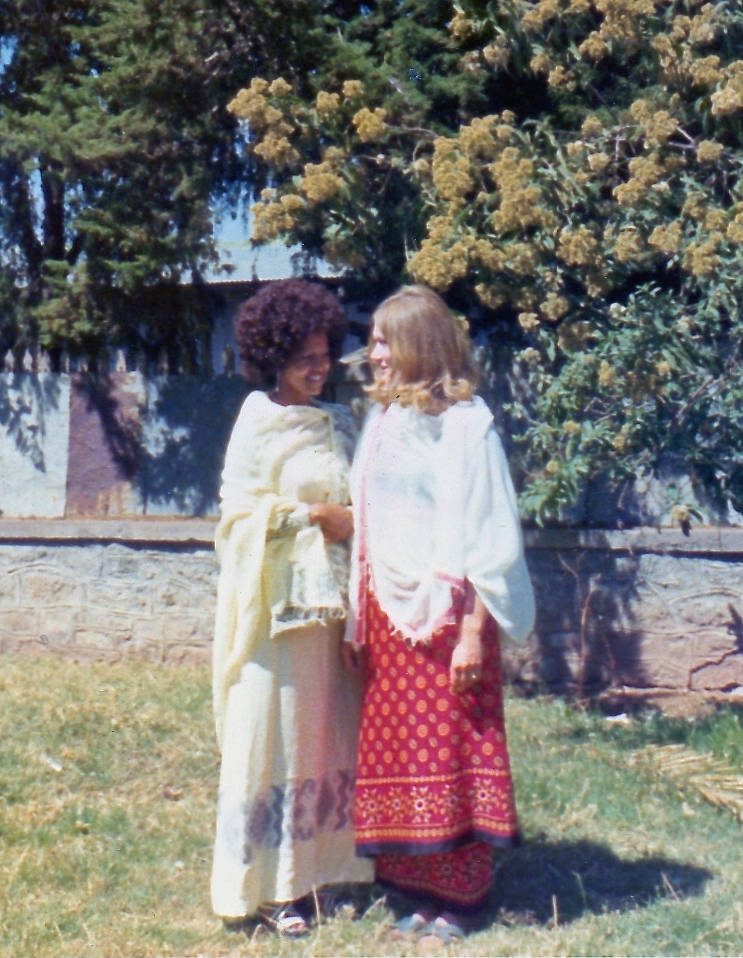
All dressed up for the coffee ceremony, but what is missing?

The Prompt: Dictionary, Shmictionary—Time to confess: tell us about a time when you used a word whose meaning you didn’t actually know (or were very wrong about, in retrospect).

Coffee With No Ceremony

I lived in Addis Ababa adjoining Mexico Square.
I ate injera every day. Had cornrows in my hair.
I thought I knew it all, and though my language skills were poor,
I knew enough Amharic to get by in any store.

Seated in a circle, on low stools around a flame,
We watched Demekech fan the fire—this ritual the same
in every house and every village all throughout the land.
The thick and sludgy coffee was always ground by hand.

Boiled in a clay carafe, then set aside to brew
as in another little pot, some corn kernels she threw.
The popcorn taken from the flame, the colo nuts were next.
Except—we found that we had none, and we were sorely vexed.

The coffee jug was sealed up with a fresh-wound plug of grass
ready for the pouring, but one aspect of our mass
was missing, so I said I’d go to buy some at the souk,
lest our hospitality give reason for rebuke.

These little shops were many, lining both sides of the street;
and at each one, I knew the custom—always did I greet
the owner with proper respect, and always, he said, “Yes!”
when I asked if he had colo, but I couldn’t guess

why no one ever seemed to want to sell any to me.
Always the same reaction—first the shock and then the glee.
So, finally, I walked back home. My failure I admitted.
Departing, I had felt so smart, but now I felt half-witted.

What had I done wrong? I knew that every shop had colo.
The problem must have been that I had gone to get them solo!
Returning empty-handed, I felt I was to blame.
Coffee without colo was a pity and a shame.

But my roommate and our guests and cook were really most surprised.
I must have asked for something else than colo, they surmised.
What did I ask for? When I told them, they dissolved in laughter.
They said that I was lucky not to get what I asked after.

For colo had two meanings, depending on the stress
put on the first syllable, and I had made a mess.
Instead of nuts, they told me (and this was just between us,)
­I had asked each souk owner—if he had a penis!

(This is a true story of only one of the gaffes I became famous for in the year and a half I taught and traveled in Ethiopia in the period leading up to the revolution that deposed Haile Selassie.)

Hard Transit

Hard Transit

My grandfather and his two teenaged daughters
drove a wagon to Dakota to claim a homestead.
I never asked how many weeks they traveled, or the hardships that they faced.
The young don’t know what answers they will wish for when it’s too late;
so only imagination serves to describe the heat,
day after day with no water except for what they carried,
coyotes, gray wolves and the glaring sun of the treeless prairie.
My aunts were just young girls dealing with the difficulties young girls face
in the sparsest of conditions. No mother. No water.
The jarring ride—grasshoppers so thick the wagons skidded off the tracks,
and that loneliness of riding into
the emptiness of a strange world.

Now, I stand impatiently at the immigration window,
then the ticket line and the security line.
I empty pockets, discard water bottle,
remove computers from their cases, take off shoes,
raise my arms for the check,
struggle up the escalator with bag and purse,
find the right gate,
negotiate the walkway to the plane,
lift the heavy carry-on and lower myself into the too-small seat.
“Plane travel isn’t what it used to be,” my neighbor says,
and we console each other about how hard it is.
“Nine hours from Guadalajara to St. Louis—
a plane change and a three-hour layover in Atlanta,”
I grumble, and he sympathizes.

The Prompt: In Transit—Train stations, airport terminals, subway stops: soulless spaces full of distracted, stressed zombies, or magical sets for fleeting, interlocking human stories?

Naïve in Africa

The Prompt: Think Again—Tell us about a time you made a false assumption about a person or a place — how did they prove you wrong?

Naïve in Africa

The year was 1973. I was traveling with my friend Deirdre enroute from Australia, where I had emigrated when I graduated from college, to London. Or so I thought! We had set out from Sydney and traveled overland to Darwin, then flew to Timor. After a very adventurous few weeks, the story of which is too long to tell here, we traveled through Bali and other Indonesian islands, by boat up to Tanjung Pinang and to Singapore, to Sri Lanka, then to Kenya, Tanzania and Ethiopia.

In Ethiopia, Deirdre wanted to see Lalibela, an extremely isolated area of 12 stone underground churches carved in the 1100’s from the living rock. After more adventures traveling through the terrible drought areas via local buses and then by plane, we ended up in Lalibela. Another long and romantic story would detail how I met Andu Alem, one of the loves of my life, and how Diane and I became separated, then how I decided the relationship wouldn’t work and boarded a plane to go back to Addis Ababa to rejoin her. (If you haven’t already read that part of the  story and want to read it before you continue, you can read it here.  There is a link at the end of that story that will bring you back here.)

When I got on the plane, I was crying, knowing I was leaving someone I cared about but also knowing a relationship would never work as his father was very prejudiced against Americans and my father, who was very ill at the time, would probably not survive the news of an African son-in-law.

I didn’t notice the man who sat a few aisles behind me, watching every detail of my departure. I didn’t see him watching me sobbing into my last soggy Kleenex. I didn’t see him move to the seat across the aisle. I had no idea of what was about to happen, and how it would change my life. I was as ignorant of the next chapter of this story as you are—caught up in the sad ending of my love story, with no idea that there were much worse endings than unrequited love.

I watched Andu Alem below as the small plane lifted off the grass landing field.

For the next 15 minutes I sobbed as quietly as I could. I must add here that I am not a pretty crier. My eyes swell and turn red, as does my drippy nose. Eventually, I regained some composure and then noticed that the young African man who had spoken to me before was now sitting across the aisle from me. Since I was in a window seat, there was an empty seat between us. After a few moments, he asked if I was all right and if he could help me. I said no, that I’d rather just be alone, and he left me alone for a few more minutes.

Eventually, he started talking again and asking if there was something wrong. I said no, that I had just left a good friend and was very sad. He said that he was a student and asked if I would mind talking to him for a few minutes so he could practice his English. This was a common request as we traveled from country to country and as usual, I felt it was the least I could do; so we fell into a conversation and he eventually moved into the seat next to me.

He was extremely good-looking and looked a bit old for a student, but he showed me an identification that did in fact identify him as a student named Solomon Kidane. I knew that often students from the country could not afford to go to high school until they were in their twenties, so I was not too surprised that although he looked older that he was still in his last year of secondary school. He was pleasant and his English was good so we talked most of the way to Addis.

When we were about 15 minutes from landing, he asked a favor of me. He explained that he had been offered a scholarship to attend college in the U.S. but that his mother was unwilling to have him accept it as she feared racial prejudice in the U.S. and that she was afraid he would be mistreated or even killed. He asked if I would be willing to meet his mother to show her that all Americans were not prejudiced and unfriendly. I told him I was sorry, but that I really didn’t have the time as we were leaving the next day to fly to Khartoum.

He pleaded with me, saying that this was something that could change his entire life if I would just do this one kind act. He said that if I would come for dinner at his mother’s house, that I could meet his family. He would send a taxi for me and we would be with his mother and sisters and nieces and nephews the entire time. Then I could take a taxi home to the motel where I knew Deirdre was staying, awaiting my arrival.

Feeling selfish and the usual embarrassment that American travelers oftentimes experience regarding  the imagined rudeness of many of their fellow countrymen, I eventually agreed. What could happen? And it could be a turning point in his life.

When we landed, Deirdre was at the airport waiting and we took a taxi home together. When I told her about my arrangement for that night and asked her to accompany me, she refused, saying it was just too dangerous. I didn’t know him. Anything could happen. With my usual small town naïveté, I insisted that I couldn’t be safer. We’d be in a taxi, then with his family, then I’d take a taxi alone back to the motel. What could go wrong? Little did I know.

At almost exactly the prescribed time that night, Solomon Kidane showed up at my door. Deirdre was still disapproving as we left and got into the waiting taxi. We rode for about 15 or 20 minutes to a part of town I’d never been in before. We drew up to a large gate and when he knocked, the sabanya (watchman) opened the gate and admitted us. Most homes in Addis were in enclaves around an open courtyard and the houses within the walls shared one guard.

Just inside the gate was a set of steps that led up to the second story of a house. We entered into one large room with doors leading off to the right. Inside were a number of women and children, one of whom was introduced to me as his mother. The other women and children were said to be his sisters and nieces and nephews. There were probably about 12 people in the room. He drew up low stools and produced beer. Three of his male friends had been invited and I realized rather quickly that they all looked familiar. They had all been on the plane!

We had a meal of injera and wat, all eating with our fingers from the same large plate, as was the local custom. Prior to and after the meal, one of his sisters leaned down in front of each of us with a pitcher of water and bowl with a bar of soap on its bottom. As she poured the water over our hands, we used the soap to lather up, then rinsed them in another stream of water and dried them with the towel hanging over her arm.

As the evening progressed, the men drank quite a bit of beer. I noticed that some of the women and children had left and told them it was perhaps time for me to leave. I’d talked to his mother and Solomon had said he thought she liked me and that it had helped, but he said to stay for just a little while more. By now, he especially was quite affected by drink.

One of his friends leaned forward to reach for a new beer and his suit coat fell open to reveal a shoulder holster and gun. I looked around and realized that they all had slight bulges under their suit jackets. I grew alarmed and seeing that I had noticed, he admitted that they were all security agents on Air Ethiopia. Earlier that year, the first air hijacking had occurred, of an Ethiopian Airlines plane flying from Kenya to Addis. Since then, they had had undercover security agents on all planes.

I asked him about his student ID and he showed me four different sets of identity papers. He said they used various “disguises” so no one knew they were on the plane and that they were all armed at all times. As members of the special forces, they were skilled in martial arts, combat techniques and gunmanship. During the progress of the conversation, their tongues grew loose and I realized that they were all Tigrian or Eritrean—two northern areas, formerly countries in their own right, that had been agitating for their freedom from Ethiopia ever since the British had unified the three countries at the time of their draw-out. I also grew to understand that they were in fact all double agents who had infiltrated the Ethiopian security forces but who were really sympathetic to the rebels.

At this point I looked up and realized there were no women left in the room! I got up and headed for the door, saying that I had to leave, but Solomon stood and gripped my arm, saying that he couldn’t let me leave. At this, the three other men left the room. I begged them to let me leave with them, but they said nothing—just left. When they opened the door, I screamed out, hoping someone else in the compound would hear me, but to no avail.

He was talking crazier and crazier. He pulled me into the bedroom and threw me on the bed. When I screamed and started to get up again, he hit me and started strangling me. I stopped struggling and said to him, “You know, if you hurt me, I am a very good friend of George McGovern, who comes from my state, and I will tell him and he will tell Haile Selassie, and he will punish you!”

He replied, “No you will not, for since I love you, I had to take you and afterwards I will have to kill you.”

At this point, I knew I had to use my brains as I was not accomplishing much with brawn, so I quieted down and let him kiss me and then said, “Okay. I can see that you love me, but this will be better if I comply, so I want to get ready for you. Would you please leave the room for a moment so I can get ready.”

Dear God, thank God! He left the room! Immediately, infused with the energy and strength of panic, I shoved a very heavy freestanding closet in front of the door, which didn’t lock, ran to the window and threw open the shutters. Again, thanks to a God whom I didn’t completely believe in, there was no glass! I could hear him beating at the door and the chest was moving, so I just jumped out the second story window, hurting my ankle and skinning my leg but not even noticing as I ran to the front gate screaming for help.

I beat on the gate, but the sabanya (watchman) did not leave his enclosure. No one in any of the small houses surrounding the courtyard came to my aid. I saw one old woman peek out of her door and I screamed, “Help me! Help me, please!” Of course, no one spoke English. She immediately slammed her door shut and pulled the bolt. At this point, Solomon came down the stairs and said, “You have lied to me, and now I will have to punish you!” He grabbed me by my hair, which was very long at the time, and pulled me back up the stairs. I continued screaming for help, but none came.

When we got to the top of the stairs, he pulled me into the house and slammed the door, which bounced on its frame and opened a crack behind us. He was still pulling me by the hair, but as we left the living room, my hand, grabbing out for anything to use as a weapon, struck a heavy ceramic lamp. I grabbed it and gaining a foothold, swung it at him, hitting him over the head and knocking him down. Running again for the front door, I saw it open and a tiny little lady I had never seen before grabbed my arm and pulled me down the stairs. At the gate, she called for the guard to open the gate. I ran out into the street and into the first door I found open…back through a large room and into a back bedroom, screaming “Help me, please help me!” A woman came and I kept saying “Police, Please call the police!”

At this point, the man I knew only as Solomon Kidane came into the room and charmingly tried to convince the crowd of women who had now gathered to let me go with him, but they folded around me and the police soon arrived. ( I eventually learned that it was a brothel that I’d run into and that the women who had helped me were all prostitutes, as were the women Kitane had hired to pose as his family in the house he had set up as his family house in the compound. All had been a ruse—mother, children and sisters!)

I told the police my story, although they had no English and I had very little Amharic, but eventually they put me in the back of a police car, and feeling safe again, I felt a huge surge of relief, at least until I turned around and saw that Solomon Kidane was in the back seat with me! He had convinced them that this was a lovers’ spat and that if he could just talk to me, that all would be well.

I screamed bloody murder, kicked and hit at the door and window glass, and eventually the police told him to leave the car and took me to the police station where I was examined by a doctor who took pictures of my scrapes and bruises. When they finally took me back to the motel, it was very late and of course, Deirdre got to say her “I told you so’s” which were well deserved.

The next morning I called the American Embassy and they sent a car for me. It turns out that this was not the first time an American woman had been abducted, but any of the others who had survived had always been so frightened that they had left Ethiopia as soon as possible without pressing charges. The embassy was very interested in bringing the matter to the court and said they would pay for legal counsel, translators, and provide protection for me if I would stay to testify; but I needed to understand that the Ethiopian legal procedure was very different from the American system and that most cases dragged on for years. Usually, a case was assigned a few hours a day once a week. Any prominent businessman just set aside a day or two a week to sit in court and wait for his part of any legal proceedings he was involved in to come up. Was I willing to stay in Ethiopia for a year, maybe two, to see that this man was brought to justice? I was fighting mad. I said yes!

Deirdre, of course, said I was crazy and that she was unwilling to spend any more time in Ethiopia. I could understand this, so I waved her off as she caught a plane for Khartoum. Another traveler we’d met, who was named Sue, got intrigued by my story and decided she would stick around to see what happened, so she spread her sleeping bag out on the floor of my motel room, as did Richard, another young backpacker we had met.

The embassy had said they’d find me another safer hotel, but in fact, the Organization of African Unity was meeting in Addis during that month, and so there was not a free room in town. In lieu of moving me, they provided an armed guard who stood outside the wall of my motel. When I left the compound, however, I was on my own. The police had not arrested the man, so he knew where I was and I knew he knew!

The first time I left the compound and crossed the street, his three friends were standing at the corner, as though waiting for the light to change. I was standing behind them before I realized who they were and when I tried to leave to go back to the motel, they formed a circle around me.

They said, “Do you know who is the father of the man you are accusing?” I said no, and they said, “He is a very important and a very dangerous man—the head of a revolutionary group that will one day change things in this country. If you do not drop the charges against our friend, he will have you killed, and if he cannot reach you, he will kill all your friends. No one will help you. You need to drop these charges.”

I pulled away and ran back into my compound. The next day I went with my attorney and we started making the rounds of government leaders, eventually making it up to the equivalent of the national Attorney General. He finally granted special dispensation for my case to be heard in one or two long sessions…or for as long as it would take…so I could be free to leave the country. A court date was set for the following week.

One very interesting twist to the story is that I was in sympathy with the cause that the men had mentioned and felt it justified, and so I never did reveal to police, my attorney, the embassy or the judges that these men were all members. If Solomon Kidane was to go to jail, I wanted it to be for his personal actions, not his political ones. I believe to this day that the men didn’t realize that I could understand their political ravings as they got drunker and by the time the night was over, they had given away a secret that I was wise not to reveal I understood.

The many frustrations and coincidences of the trial are another story, and since this part of the tale has already run on for too long, I will just say that the man responsible for my kidnapping was finally put into jail. Yes, his friends harassed me for a short time but no, no retaliatory measures were taken, at least at that time. I did not in fact leave Ethiopia for another year. During that time I taught in a local secondary school at a time when students were starting the revolution that the military would later take over, leading to the arrest of Haile Selassie and a series of revolutions that would lead to the eventual takeover of government by the group that Solomon Kidane claimed to be a member of.

My love story would resume—but would result in a tragic ending—one I will never be sure was not a result of the trial and arrest of Kidane. But that is another story in this tale of a traveler who moved through worlds not her own, never quite sure of the whole story, just traveling in that way that we all travel when we are young—centered on our own story, sure that it is our story alone and of no consequence to anyone but ourselves.

(If you haven’t already read that part of the  story, you can read it here.)
D-Picted (X-Rated)

                                                                               D-Picted (X-Rated)

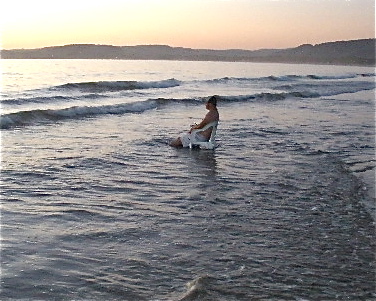
I was taking my daily sunset walk on the beach at La Manzanilla, Mexico when I came upon this idyllic scene. He was sipping a margarita and staring out to sea as the water ebbed and flowed—never reaching higher than his chair bottom. Of course, I had to comment.

OLYMPUS DIGITAL CAMERA

“Is the view good enough for you?” I queried, with a noticeable lack of originality.

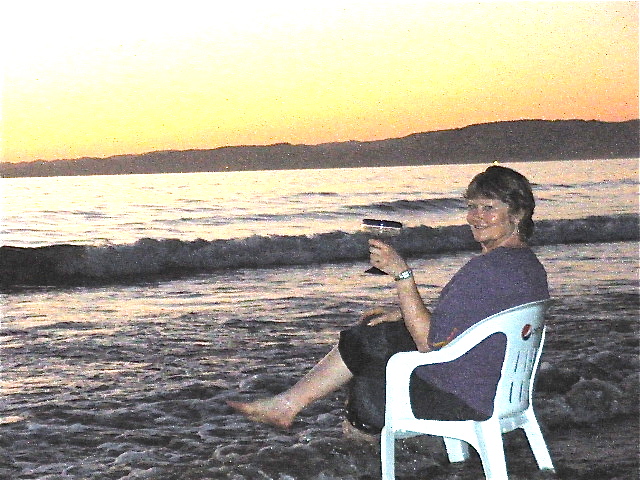
“Do you want to see for yourself?” he asked. He quickly rose from his chair and motioned for me to take his place, taking my camera from my hand as he handed me his Margarita.

OLYMPUS DIGITAL CAMERA

He told me to look his way as he turned the tide by taking a picture of me, and so I didn’t see at first a part of the landscape obvious in this next picture.

OLYMPUS DIGITAL CAMERA

But as often happens in an evening tide, that object quickly washed ashore to enter my picture,

OLYMPUS DIGITAL CAMERA

and quickly dominate it.

OLYMPUS DIGITAL CAMERA

The End

(I promise.  This was not a staged incident.  It happened exactly as I describe it with no prompting by me.  I love getting out in the world.  No imagined story ever duplicates what happens in real life!!)

The Prompt: Edge of the Frame—We often capture strangers in photos we take in public. Open your photo library, and stop at the first picture that features a person you don’t know. Now tell the story of that person.

Special Note to viewers of my blog:  Please also see the next posting “Sur-Prize” to enter a contest celebrating my 10,000th viewing.