Innocents in Mexico, Chapter 7 Posada de las Monjas


Find Chapter 1 HERE  Chapter 2 HERE   Chapter 3 HERE  Chapter 4 HERE  Chapter 5  HERE  Chapter 6 HERE

Innocents in Mexico

Chapter 7: Posada de las Monjas

It was Sunday, May 13, at 1:30 a.m. It was our first night in our new room, and someone was setting off fireworks.  They soared up into the air and exploded with ear-splitting booms.  Dogs barked from half the rooftops of San Miguel.  There were too many lights in town, even at this late hour, for the stars to be visible.  It was a shame as our room was so high that we had a panoramic view of the city and the sky.  Below us, tin roofs broke the spell, but we had occasional glimpses into courtyards full of plants and trees.  A cat yowled below and Bearcat stood and stretched but did not scoot under the bed as he had that afternoon when he heard the same caterwauling.  He was getting braver every day, but a car backfiring a block away or a door slamming across the courtyard could still send him into hiding.  We had no yard now for our midnight walks.  All of the courtyards  and terraces in this hotel were of cobblestone or cement.  He was an illegal alien here.  When we sneaked him out on his leash at night for a walk through the deserted outside corridors, he was calmer, walking as close to the curtained windows of each room as though eavesdropping for any possible news of his new environs. Although the management didn’t know we had a cat, some of the staff knew but they never told. This first night, we settled to bed, finally, by 2 a.m.  and  I penned this poem  a mere four and a half hours later:

San Miguel Morning

The sounds of rooting cats
like infanticide
accompany
tuba music
in 4/4 time.

Fireworks.
Roosters.
Donkey brays.
6:29 in the morning.

All’s right with the world.

Today was Mother’s Day.  It was the first in my life where I had no mother to send flowers to.  The same was true of Bob.  On our way through Tucson, we had stopped to see my mother’s crypt for the first time.  I had meant to bring flowers, but I could see that they didn’t allow fresh flowers, and I couldn’t bring myself to leave plastic ones.  Some of the crypts had metal flowers attached, and I decided to try to have something special made in Mexico.  Those would be the flowers I sent this year.

On this day, we took the van out of the courtyard of the hotel to go look at an apartment.  It was a bother to do so, because it meant getting a man to open the portal––not only the one that could be reached from ground level, but also the high one 8 or more feet off the ground.  Today, the guard used a tall metal pipe to pry the hatches open, Yesterday he had attempted to climb up on the lower lock to reach the top one, but it was a tricky maneuver and he had fallen off..  Then we scraped the bumper of a new yellow pickup trying to back out.

The apartment we saw was a depressing empty house in an extremely poor neighborhood.  On the floor of the bare living room was a pair of men’s slacks, rumpled as though he had climbed out of them and left them as they were.  Half-full bags of grout  lay abandoned.  In the shed, there was the overpowering smell of oil paints.  What had been described as a garden was hard baked earth with a few abandoned flower pots.  Even the weeds were dried and skeletal.  The house described as furnished in the newspaper ad was dark, in poor repair and completely empty.  The woman told us she had no money to buy furnishings, but maybe they could get one bed and a refrigerator.

That afternoon, we had been looking  at  pictures  of rentals in a rental office near our hotel.  The apartments and houses were all picture perfect––decorated, furnished with art and gardens complete with gardeners.  The contrast was so depressing that it made me again question whether I wanted to stay here.

The disparity between the gringo sections of town and the local sections was so great.  And yet in the restaurants and galleries, I saw the majority of people were Mexican––well-groomed and prosperous looking––eating the same food and drinking the same drinks we were drinking.  Our hotel, too, was filled with Mexican travelers, so the difference was not so much one of nationality as of level of prosperity.  The same economic differences existed in the United States, but there, as here, we were shielded by the distances between our living areas.

Even in the U.S, there were places we never went.  Why would we?  In those places there were no restaurants, theaters, gyms.  In those places, there were none of our friends to visit.  Our kids didn’t go to school in those neighborhoods, so for us, they didn’t exist.  Every American we talked to said not to have a car here––to depend on public transport or walking,  but public transport did not take them through these neighborhoods, so for most, I am sure they did not exist.

By the time we got home again, we were exhausted from trying to negotiate the maze of unmarked streets. To compound our frustration, we found that  the lot that had been  nearly empty when we left was now completely packed––with all cars double parked.  The guard fit us diagonally into one corner of the large courtyard in a place where we blocked four cars instead of two.  He refused to take our car keys, so we imagined an early knock on our door to get us to come move it. We had already made the decision to keep the van in the compound for the rest of our stay, but this cinched it! On Monday, we would take a taxi to immigration and the real estate office.  Already, our new van had rattles in every part of its chassis from two days of bumping over cobblestones.  The side was scraped and the running board dented in.  If we had to count the number of streets backed down or tight spaces we had turned around in, it would reconfirm our decision.  A car in this town was crazy.  A full-sized van was lunatic.  People drove vans the size of ours as buses here.

It was a moral struggle to sit in the Plaza Principal.  Every time I sat down, an old woman came to sit next to me to tell me she was hungry.  When I told her I didn’t understand, she sighed.  She sat for fifteen minutes, sighing every few minutes or so.  Finally, she asked me the time.  At first, I didn’t understand.  I thought she was pointing out the dark freckles on my arms.  Then I understood the word “Hora.”

Seis?”  she asked.

Siete,” I answered.  I knew some Spanish.  Now she would suspect I really understood her.  Well, I guess I did, even without words.  On our first day, Bob and I gave money out to most who asked.  When the same people approached us later on their next round, we realized that it was endless.  To encourage the woman and children selling cloth dolls meant no time ever in the jardin when we would be free to read a book or watch the strollers or the church facade changing colors as the sun moved across its face.  It meant constant interruptions to the peace and tranquility we had come here to find.

It was a major conflict that all of us face in this world.  Were we here to enjoy the world or to confront and deal with its miseries?  Was it fair to choose the ways in which we tried to make the world a better place?  Was it making the world a better place to encourage begging?  Was there any alternative to begging for those who did so?  I remembered the old woman who fell down in a faint in front of the church in Oaxaca.  Kind tourists  helped her into a sitting position,  fanned her, pressed coins upon her.  Then one of the locals laughed and told us that she was one of the richest women in town––so good at her daily act that she made more than most wage earners.

I remember the children in Bombay whose parents had cut off their arms or legs to make them more successful at their begging.  Where were the easy answers?  There were none.  If we taught at the free art school, would it make a difference?  It would make a difference for us, ease our guilt.  But would it do enough to ease the suffering in the world?  The answer was clear.  We would do what we could do:  try to be kinder, try to notice instead of reacting the same to every person who asked for our help.  We would live here not quite adequately, as we had lived in every place.  We were not Mother Teresa, nor were we Hitler.  We were fugitive Americans trying to find a better way.  We were trying.  Looking.  Tomorrow we would see what happened.

Again, the old woman sat by me in the Plaza Principal.  I was no longer sure that she remembered me as the same person every time she sat down.  This time she asked me if I lived here and when I said no, she asked me where I lived.

“El Norte,” I told her.  Bob and I were sitting on extreme ends of the same bench because each end had a tree which sheltered us from the brief afternoon rain.  She crowded with me under my arboreal umbrella.

“You have beautiful hair,” she told me, which I did not understand until she pulled at her own hair and said, “Amarillo.  Bella.”

When I pulled out a bottle of water.  “Ah, Agua” she sighed, and pulled out a plastic bottle of Pepsi from her string bag to take a drink.

Ese es su esposo?” she asked, pointing at Bob.

“Si.”

For the next ten minutes or so, she sighed, now and then, asking me for money for food under her breath, but I could feel that her enthusiasm had waned.  Occasionally, she commented on those who passed us.

Buenos tardes, senora,” I said, when we got up to leave, but she was already moving to another bench.

For Chapter 8, go HERE.

Tradescantia: FOTD May 15, 2023

The common name is “Wandering Jew.”

For Cee’s FOTD

Innocents in Mexico: Chapter 6: A Rude Awakening and a Savior


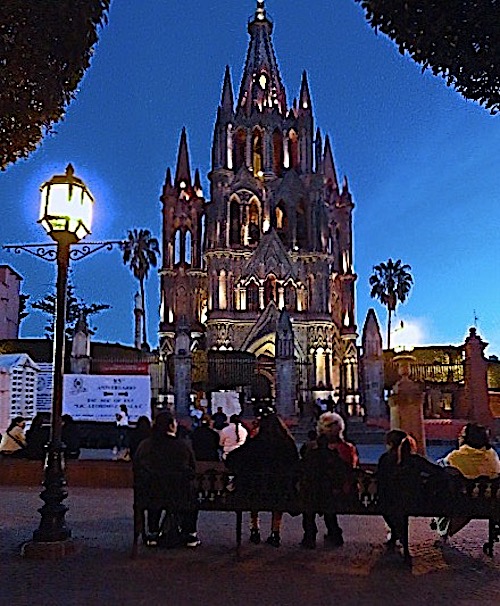
The Parroquia de San Miguel Arcángel

Find Chapter 1 HERE  Chapter 2 HERE   Chapter 3 HERE  Chapter 4 HERE  Chapter 5  HERE.

Chapter 6: A Rude Awakening and a Savior

            The next morning, we were awakened by the tooting of a horn outside our window.  I opened the door and looked out.  Resolutely and with a fine sense of rhythm, a woman was honking her horn for someone in the room next to us.  Undaunted by my stares, she continued to honk.  Bob slept on as I fastened Bearcat’s leash and attempted to take him for a walk.  I had forgotten that walks are a nighttime thing for cats––the later the better.  He resisted and I gave in.  By eleven, we were off to find a bank, a real estate agent and a really good map of San Miguel.  Unfortunately, all of these items proved to be easier to find than was a parking spot.  As we traversed still another circuitous route trying to find a parking space, Bob questioned whether we wanted to rent an apartment here, even for a week or a month.  He cursed the tiny cobblestone streets, the lack of signs.  The jardin area seemed to be all there was to San Miguel, he complained, and there wasn’t much to it.  “Did you like Oaxaca for the first few days we were there?” I asked. “Or Bali?” He admitted that he hadn’t, yet he had ended up wanting to live both places after a week or so of getting to know them.

Bob finally left me off at the tourist office, promising to join me there.  After 15 minutes, when he still hadn’t appeared, I moved off to a bench in the park, where I could sit in the shade while keeping an eye peeled on the door of the tourist agency.  On the bench sat an American woman who shared her experiences of living in both San Miguel and Guanajuato.  Fresh from a three-month course in Spanish, she chatted with the senor who sat down on my right.  Did he live in San Miguel?  Did he prefer it over Guanajuato?  Why?  Because it was warmer in San Miguel.  Because there was more to do.  I was thrilled that I understood most of what they were saying.

Bob joined us, still not too excited to be sitting on a park bench in such a difficult town.  We went to the bank.  Our time to pay for our tourist visas had nearly run out.  The custom at the El Paso crossing seemed to be to go to any bank in Mexico to pay for the visa which was issued by immigration in Juarez.  Since we had never managed to get to any banks while they were open for the three days it took us to drive to San Miguel, it was a pressing need for us to pay the fee and thereby amend our status as illegal aliens.  Unfortunately, when Bob had presented his visa to apply for the car permit at the customshouse south of Juarez, the woman had detached the carbon copy of his visa application and now, without it, the bank could not accept payment.  But the carbon copy was at the customs office south of Juarez, I argued, to no avail.  A Xerox copy would not do.  I paid for my visa, whose papers were intact, and went back to the waiting area where customers waited for the numbers on their pop-out tags to be called, like customers at a bakery or ice cream store.  Bob was deep in conversation with Lisa, a tanned woman who gave him advice on rental houses, classes and the arts community.  As her number was called, we moved to the front of the bank and I told him the bad news.  In front of the bank was another tanned American lady in straw brimmed hat and a stylish tan linen dress.“No,” she said firmly to the small girl who proffered a brightly dressed cloth doll for sale.

Bob and I were trying to figure out the route to Gigante––a huge market situated somewhere off our limited tourist map.  The bank manager had insisted that we must go to immigration and that this was where it was––in an office over Gigante.  A pelting monsoon rain had descended while we were in the bank and we stood under a broad overhang, waiting for it to calm down.  “Do you live in San Miguel?” I asked the stylish lady.  Yes, she did, and yes, she knew the way to Gigante.  To illustrate, she pulled out a vastly superior map to ours, then told us where the biblioteca was where we could purchase both this map and the definitive guide to San Miguel.  Her name was Kim, she was from Alameda, just an hour and a half from our California home, and she now lived in San Miguel.  “Well, here, have my map,” she said, after a few minutes of talking.  When I protested, she insisted.  When I offered to pay, she refused.  It was her gift.  She handed us a card, then moved off into the now abating rain.

At the Biblioteca, we bought books and guides and maps and cards and chatted to the man running the gift shop––another expatriate American who gave advice on apartments, cars (don’t keep them) concerts (go to them) and all of the glories of San Miguel.  Although the library itself was closed, its restaurant had been recommended to us by Kim, and we ate a nice lunch while eavesdropping on the other expatriate Americans who sat at the tables around us.  Small children skipped into the restaurant from the library singing “Happy Birthday to you” in Spanish-inflected English.  Someone shushed them, to no avail, and they ran out giggling loudly.        Outside the door of the restaurant, in the hall to the library, was a pay phone, where I stood trying to figure out the intricacies of a phone with a card slot and four buttons with indecipherable pictographs.  I finally called the number given on the first rental ad on my list.  The woman spoke English but didn’t know if she wanted an artist renting her house, which was immaculate, she said.  Maybe he could paint in the garage.  Would he spill paint on the floor?  A meticulous house sounded as uninviting as the $1,000 rent, so I explained we were perhaps not the right renters for her.  As I hung up the phone and prepared to make my next call, I saw a man sitting very near by with a phone card in his hand.  Was he waiting to make a call?  Yes.  Would he like to go in front of me?  He protested that he could wait, but when I said I was going to make a number of calls, he agreed that he’d like to make just one fast one.

He in fact made one very long call.  I stood shamelessly near, trying to encourage him to hurry, but he chatted on.  He was talking to a man that his friend Richard had told him he must meet.  Yes, he would meet him in the library on Monday.  He had a picture of him, so he would recognize him.  This phone call came to have all the ear markings of a blind date.  After five or ten minutes, he ambled his call to a close and handed over the phone, then stood talking to Bob, as unabashedly listening to my call as I had his.  “Are you looking for a house to rent?” he asked Bob.  He knew of a house, which he seemed to be describing to Bob as I tried out my laughable Spanish on yet another homeowner.

“Are they speaking Spanish?” He asked, as he heard my garbled string of Spanish tape phrases.

“Yes,” I admitted. “Do you speak Spanish?”

He did, and offered to interpret.  I happily handed over the phone.

Toward the end of the phone call, my telephone card ran out and he was cut off.  When I tried to call back with another card, he discouraged me.  “You don’t want to live there,” he said.  “It’s at the end of a very dusty road.  It’s too far from the center.  What you need to do is find a room near the center so you can park your car and answer all the ads in the newspapers for a week to find the right house.“

He told us his name, which was Ernesto.  He told us about the art school where he taught art to poor kids.  He told us about art happenings and poetry happenings and music.  He told us of a different hotel where we should stay and of a house nearby that was coming up to rent.  In the end, he took us himself to the Posada de los Monjes, an historic  hotel that was a converted convent, and translated with the front desk, insisting on the room with the best view.  As we moved through the front of the building through wooden doors hundreds of years old, the full glory of four floors of terraced stone opening onto a cobbled courtyard where we could park our van was revealed.  Broad terraces with crenelated walls jutted out from some of the rooms and wide outside corridors joined them.

We climbed higher and higher until we came to the room chosen for us––a bit small but with a beautiful tiled bathroom with stone shower.  Coming out of the room, we moved out to the private patio bigger than the room.  Below us stretched the entire panorama of San Miguel.  Breathtaking.  The church, the tile roofs, the jagged skyline and yellow hills.  The rooftop gardens and trees jutting up from courtyards.  We were so high that little rose higher above us than our own roof.  We had a 300-degree view and all of it was beautiful.  Never mind the steps.  We could have all of this for barely more than our motel room which was nice and roomy but viewless and near traffic noise.

Do you want to see the room with two beds, asked Ernesto?  It’s bigger, but also $10 more a night.  We’d see it, we said, but the cheaper room would probably do.  I must admit, I dreaded the confinement of the smaller room, but knew we’d probably not spend much time there anyway, and could just spend that time on the most glorious patio on earth.  But, we went to see the room, which was bigger, with its own living room, better views from the room itself, but no patio.  Or at least we thought so until we ascended the stairs outside the room to the patio on top of the room that had even a better view than the room before it––this one a full 360-degrees!

The view was well worth the extra ten dollars a night.  In ten years, we would not miss the money, but we’d never forget the view.  We took the room. We would move in the next day! Ernesto took us to the art institute––not his, but the one near the center.  In the end, he offered Bob a job at his art school.  No salary, but a job just the same.  He could use the facilities free in return for any amount of time he wanted to teach.  Then, meeting a friend he knew on the street, he faded back into the life of San Miguel.  He had made a date with Bob to meet Monday to see about showing us the house that his friend had just built.

The importance of meeting Ernesto?  Bob had gone from wanting to move on to wanting to rent a house in just hours.

“How do you like that?” he said.  “In San Miguel less than 24 hours and I’ve already been offered a job teaching art.”

Right then and there, we went to Mailboxes Etc. and rented a mailbox for three months.  The proprietor of this establishment introduced herself as Annie and she told us the intricacies of sending mail and packages into and out of Mexico.  What to do.  What not to do.  How to send tax papers, magazines, bills, packages.  Another stranger popping up to solve our severest problems.  Like magic.

That night, we peeked into courtyard after courtyard looking for the right restaurant.  Bob, who had formerly hated Mexican food, picked a Mexican restaurant, pronounced his meal delicious  and paid the musician to serenade us with a rendition of “Rancho Grande” that rivaled any Oaxacan version we’d ever heard.

“The thing about San Miguel,” he explained, “is that a good deal of it is hidden.  You don’t see it by casual observation.  You have to look farther,”  That night he stayed up hours later than usual, poring over guide books and maps.  Bearcat curled on my bed as I sat at my laptop.

“Tomorrow you get to go to your new home,” Bob told him.  “You get to go from being an under-bed cat to a roof cat.”

See Chapter 7 HERE.

Gems from the Past

My mailbox is totally full, so I’ve been deleting old emails from the past 22 years. I had deleted about 2,000  without reading them,  when I chanced to read a couple  and realized that there are some real gems there, so I’m going to share a few with you. (2,000 down, 37,000 to go! No exaggeration.).  Here is one from 2010: 

A 1stgrade school teacher had twenty-six students in her class.  She presented each child in her classroom the 1st half of a well-known proverb and asked them to come up with the remainder of the proverb.  It’s hard to believe these were actually done by first graders.  Their insight may surprise you.   While reading, keep in mind that these are first-graders,  6-year-olds, because the last one is a classic! 

1. Don’t change horses until they stop running.
2. Strike while the bug is close.
3. It’s always darkest before Daylight Saving Time.
4. Never underestimate the power of termites.
5. You can lead a horse to water but How?
6. Don’t bite the hand that looks dirty.
7. No news is impossible
8. A miss is as good as a Mr.
9. You can’t teach an old dog new Math
10. If you lie down with dogs, you’ll stink in the morning.
11. Love all, trust Me.
12. The pen is mightier than the pigs.
13. An idle mind is the best way to relax.
14. Where there’s smoke there’s pollution.
15. Happy the bride who gets all the presents.
16. A penny saved is not much.
17. Two’s company, three’s the Musketeers.
18. Don’t put off till tomorrow what you put on to go to bed.
19. Laugh and the whole world laughs with you, cry and You have to blow your nose.
20. There are none so blind as Stevie Wonder.
21. Children should be seen and not spanked or grounded..
22. If at first you don’t succeed get new batteries.
23. You get out of something only what you See in the picture on the box
24. When the blind lead the blind get out of the way
25. A bird in the hand is going to poop on you.

And the WINNER and last one!

26 Better late than Pregnant

Should children witness childbirth? Good question. 

Here’s your answer.

Due to a power outage, only one paramedic responded to the call. The house was very dark so the paramedic asked Kathleen, a 3-yr old girl to hold a flashlight high over her mommy so he could see while he helped deliver the baby…
Very diligently, Kathleen did as she was asked. Heidi pushed And pushed and after a little while, Connor was born.

The paramedic lifted him by his little feet and spanked him on his bottom. Connor began to cry.
The paramedic then thanked Kathleen for her help and asked the wide-eyed 3-yr old what she thought about what she had just witnessed..
Kathleen quickly responded, ‘He shouldn’t have crawled in there in the first place…..smack his butt again!’

If you don’t laugh at this one, there’s no hope for you.

Ineligible

Ineligible

Your temper is an irritation
leading to much perturbation.
Solving every little trifle
with your fists or with a rifle,
in short, makes it debatable
whether you are dateable.
I fear your image has gone to pot
and eligible? You are not!


For Pensivity’s Three Things Challenge the words are: IRRITATION, TRIFLE and IMAGE

Innocents in Mexico, Chapter 5: Zacatecas, Aguascalientes and Finally, San Miguel!!!!!

Street Scene, Guanajuato

Find Chapter 1 HERE  Chapter 2 HERE   Chapter 3 HERE  Chapter 4 HERE

Innocents in Mexico

Chapter 5: Zacatecas, Aguascalientes and Finally, San Miguel!!!!

            The next morning, a few more hours of driving through the desert brought us to Zacatecas.  There everything began to look more prosperous, with trees in evidence and large trucks bringing more to plant, their roots balled in white canvas.  Square adobe houses rose up in diagonal terraces, some painted bright basic colors.  Here, as in other towns we’d passed, bright and huge modern sculptures sprouted out of cement plazas with lights installed at the base for night viewing.  Hundreds of black plastic water reservoirs on the tops of houses appeared to be some new Christo installation.  New buildings in all stages of completion were everywhere.  There was a sense of style here, but no imitation of any North American, Italian, Spanish or any other style.  It was a style all their own––clean, adventurous, purely modern Mexico.  We were in too much of a hurry to stop to see who was responsible for any of the large sculptures.  Perhaps on our next trip.
            Between Zacatecas and Aguascalientes, the desert gave way to grasslands and crops.  Long white irrigation tubes paralleled the highway.  We made out corn, grapes, some white-flowered crops–– onions, garlic, or perhaps just flowers.  We passed a truck fluffy with kale.
            In Aguascalientes, we seemed to drive in circles following the “Mexico” signs.  When they gave out, we drove on in what seemed to be a logical direction.  A taxi driver told us to turn left and we again seemed to be going in a circle before finding the signs.  They again deserted us, but after a half hour or so of driving hopefully toward Leon, we again found the signs and made our way out of Aguascalientes past yet another colossal orange geometric sculpture.
            The country once more turned to sand, this time interspersed with low trees and some crops.  In the distance, a colossal black bull stood silhouetted against the clouds.  Billboard or sculpture?  To our left, the fields were verdant green, to our right, pale tan, as though it were a different season on each side of the road.  We passed the bull.  It was a billboard advertising Magno Osborne in vivid orange and white letters.  We passed a Green Angel truck––about the fifth one we’d seen since entering Mexico.  A sort of governmental AAA, they patrolled the roads to help vehicles in distress.  You paid for the gas, tires or parts, but not the repairs.  A sign told us we were 445 miles from Mexico City––a place we had no plans to ever drive to.
            Nearing Leon, everything became more prosperous.  Guardrails and trees lined the toll road.  Corrugated metal sheds replaced the adobe corrals, and cement fenceposts stretched for miles along the road, strung together by three neatly spaced strands of barbed wire.  Red and white antennas rose like stelae high into the sky.  High line wires, like modern installation sculpture, passed electricity along fourteen thick cables strung high up in the sky on the most modern of poles.  More large factories appeared, as did numerous monstrous billboards.  A man and two small girls in bright handwoven skirts waited in the median to cross the southbound two lanes which were solid with cars.  Green fields stood out against the fall colors predominant on the landscape, though it was only May.
            On the road through Silao, we somehow got diverted through the town.  Streets became narrower and narrower, signs vanished, and we went in circles, trying to avoid dead ends.  Finally, I resorted to asking directions from the window of our car.
            “Donde Esta Guanajuato?” I asked, then failed to understand any of the directions given by men on street corners.  Finally, a patient man with his family in the car motioned for us to follow him and led us out of town onto the Guanajuato road. “Muchas Gracias!” I repeated twice as we pulled up beside him in the double lane.  What was lacking in road sign efficiency was made up for by the extreme courtesy of the citizens of Mexico.
            We passed a huge GM plant surrounded by acres of cars and trucks ready to head north.  The plant was the size of a shopping mall––vivid yellow and blue.  We passed jacaranda trees, palms, cypress and willow.  For the first time, I noticed eucalyptus.  There was a lushness here not experienced farther north, where vegetation was of the desert variety.  We passed a large metal sculpture––the facial outlines of a man who resembled Groucho Marx, with leaves for eyebrows.
            Reluctantly, we drove through Guanajuato without stopping.  Bright blue and orange houses climbed the hills.  By the roadside, vendors sold coconuts with holes chopped in their tops and a lime plugging the opening. The country was more interesting, with mesas and small jagged mountains jutting up against the skyline.  Stone, brick and adobe casas sprinkled the landscape.  They were larger than the houses farther north, with distance between them.  There were pigs in the road, then cattle.  Horses were tethered very close to the road, eating the grass growing out of the side of the blacktop.  We passed a donkey lying dead, half on the road, half off.  Her colt stood by her, trying to nudge her over to nurse.
            Our van climbed up the road to San Miguel de Allende, bringing us  to our final destination in plenty of time to hit the oficina de turismo , which our guide book assured us stayed open until seven.  With only the vague and limited map in our Berkeley Budget Travel Guide, however, we got hopelessly lost in the winding, hilly, cobblestone streets.  Time and time again we wound into areas that had become too narrow, steep or circuitous for our Dodge Van.  Bob got frustrated and said he was glad we hadn’t rented out our house in Boulder Creek yet.  He was already sick of San Miguel.
            We finally parked on a narrow street on a very high hill and walked down to what we hoped was the Plaza Principal.  The tourist office did not seem to be where they had said it would be on the map, and we wandered aimlessly, guide book in hand.  By the time we finally found it, it was closed.  Seasoned residents observed us kindly, but with some humor, I think.  Finally, we found a travel agent and threw ourselves on her mercy.  She suggested a motel which was, she said, moderate in price, where we could park our car––an oddity in this city of narrow, winding cobblestone alleys.  An hour later, having circled the whole town twice, small street by small street, I again threw myself on the mercy of a man behind the counter of a small shop, and he and his wife drew me a map.  “Estoy perdida,” (I am lost) I explained, to their complete delight.  Our Spanish tapes had finally paid off.
            With a good deal of more unnecessary winding, we found the hotel, which turned out to cost $98 a night.  Since we considered this amount to be more than moderate, we started checking out hotels at random.  The next, which appeared modest to us, was $109 a night.
            When I asked his advice, the manager of the $109 hotel got on the phone and located a motel with parking space for $38 a night.  An hour or so later, after much searching, we found it more or less where he had promised it would be.  It was lovely, with fireplace, tiled bath, TV, bottled water––all the amenities.  We unloaded our luggage and installed Bearcat under yet another strange bed.
            Finding the Plaza Principal again proved to be another hair-raising experience, as we wound higher and higher on smaller and smaller roads––finally ending up at a castle-like casa with barely enough room to turn around in a space bounded by the castle walls on one side, a sheer drop-off on the other.  We finally found the plaza, and an Italian restaurant with Peruvian music.  Bob was happy.  When we returned to our room, Bear was eventually coerced out from under the bed with tinned salmon and was happy once we’d turned out the lights and flipped on the tube.  “The Effect of Gamma Rays on Man-In-The-Moon Marigolds” was on in English with Spanish subtitles––a movie I’d been wanting to see again complete with Spanish lessons.  Now I was happy, too.

Find Chapter 6 HERE.

And… for FOWC prompt of destination!!!

Tabachine: FOTD May 13, 2023


For Cee’s FOTD

Innocents in Mexico, Chapter 4: On the Road to Rio Grande

Find Chapter 1 HERE  Chapter 2 HERE   Chapter 3 HERE


Innocents in Mexico

Chapter 4: On the Road to Rio Grande

        The next morning, we were finally on the road after driving back into central Chihuahua to cash dollars for pesos and to gas up and buy ice.  It was easier than yesterday, in rush hour traffic.  A night’s rest later, we were finally visaed, permitted, pesoed, petroled, iced up  and on the road to San Miguel.
        We drove hundreds of kilometers through desert scrub. Men with scarves tied over their hats to shield them from the relentless sun waved orange flags to slow us down as they oiled the other side of the toll road.  It was almost as expensive to drive here as in Europe, with all the frequent tolls.  On the second day of driving, we spent more on tolls than we had on our room the night before.  Now and then I would see some interesting sight I would have loved to have investigated, but Bob preferred to travel fast and  promised trips to the Copper Canyon and other off-road excursions on some future trip.  It had been such an ordeal getting away for this expedition that I decided not to make side trips yet another obstacle keeping us from San Miguel de Allende.  This time, we would do it his way, and perhaps the next time, too, but one day I would see Copper Canyon.
        After being stopped twice by the policia federal, Bob finally believed that he had to slow down in areas where slow speeds were posted.  In both cases, the officers spoke no English and our attempts at Spanish out of a dictionary encouraged them to give up.  The first policia saved face by escorting us back to the toll road he insisted we should take, although I was fairly sure that the camino libre (free road) led to the same place. The second time we were stopped, it was by policemen in two separate police cars going in the opposite direction, who first waved  us down  and then  turned in the road to follow us and wave us over.  Bob told me to get out the bribes which we had been told were the best way to deal with the police in a system where the collecting of the mordida  was taken into account when figuring the salary of policemen,  but in both cases of dealing with la policia  we were too inept to know how to offer them and they eventually gave up gracefully, pointing us once again in the direction of the correct road.  (We have since changed our minds about the offering of mordidas, but at the time we were innocents in Mexico, just following the advice of friends.)
        Hours later, we were on the free road which was two-way, bumpy and under construction. For the past 20 kilometers, we had been driving through deeply-rutted dirt while oncoming traffic maneuvered over a narrow strip of raised but even tarmac.  Sandwiched between 18 wheelers, our van slowed to a speed where I could actually make out the leaf patterns on shrubs and low trees.  I thought I made out manzanita, mimosa and perhaps a variety of pinion.  One delicate poppy-like flower appeared to be cotton. 
            The brilliant red sand on either side of the road drifted in places into small dunes. It was densely covered with rabbit brush and the other trees I thought I’d identified.  In the distance, the sky was dark and I made out three separate funnel clouds, all of which seem to be moving toward us. I watched the funnels uneasily, remembering the last time I saw such a sight.  Eventually, they united and broadened and seemed to break their cord with the higher heavens, but they continued to blow toward us.  At our slow pace, I wondered if they would catch us.  Then another funnel cloud––taller and thinner––formed farther ahead of us and to the right.  I forgot to watch it, concentrating on a more immediate danger as Bob got competitive with the bus trying to pass us and swung out in front of the semi we had been following.  I closed my eyes, then returned to the desert plant guide, knowing that all of the backseat driving comments I’d made earlier had done no more good than this one would have.  When I thought to look back to where the funnel had been, it had dispersed.  We had passed the semi, the bus had passed us, and the blacktop surface had been regained. 
        When we got to the next town, dozens of speed bumps did what neither a nagging wife nor la policia could do, and Bob proceeded on for a while at the correct speed limit through town, in search of a casa de cambio. Gas and tolls had eaten up the entire $150 I had cashed into pesos that morning.  It may have been cheap to retire in Mexico, but it sure wasn’t cheap to drive there!
        Here and there along our route, huge factories or assembly plants lined the road, finished or in stages of completion––Wrangler, Coca-Cola, car plants.  Now and then a huge modern sculpture dwarfed us, but we didn’t stop to read the inscription.  Next to these gigantic modern buildings were the near ruins of lines of conjoined adobe motel-like dwellings.  Then, across the street, were lines of similar dwellings, but brand new and two-storied in a faux Tyrolean half-timbered style most bizarre in this setting.
        KFC, Burger King and Dairy Queen competed with but did not in any way outnumber the burrito and tamale carts which stood beside the road.  In one small town, men in white shirts stood in the road and flagged us down, then motioned us over.  We noticed before actually leaving the road that they were trying to lure us into a lot filled with cart vendors.  We were hurrying to try to cash dollars for pesos, and we drove on without sampling their wares.          
        This deep into Mexico, I could no longer remember what I expected it to be like. It was surprising to me that not once in over 1,000 miles did we pass any car with North Americans in it.  Nor did we encounter any Americans or other foreigners in any of the towns we passed through.  Few people spoke English, even in banks, but in spite of this, no one looked upon us as an oddity.  We just were.  Like the funnel clouds and the circling white plastic bag in the middle of the street, we passed through but affected them little.  This was exactly the way I wanted it to be, now that I thought about it.  It was what I was looking for––some place that was purely itself, different from what I knew.  I longed again to be a stranger and to have the unexpected around every corner. 
        The terrain in the northwestern region I found to be not so different from the Mohave:  rabbit brush, mesquite, willows, cholla, prickly pear and willow trees.  But unlike the litter-conscious United States and because the dumps tended to be located near the main road, here there was lots of refuse outside every town.  As we drew near each dumping ground, thousands of plastic bags snagged on every fence, shrub and stone, littering the desert like some exotic flower display. Everywhere, huge chunks of concrete lay piled alongside the road––destroyed buildings or landfill––who knew?
        Frequent signs warned of livestock in the roads; and occasionally, livestock actually did appear there, as if to validate the signs.  As we drove farther south, there were fewer signs but more livestock on the roads––even the broadest and fanciest toll road between Aguascalientes and Leon.  On this road, for the first time, the four-lane divided highways came complete with median boundaries, curbs, gutters, shoulders, and a woman who hurried to herd her goats off the left-hand lane of the road as semis, cars and pickups whizzed by. 
        Our last toll having wiped us out of pesos, We drove into Rio Grande to find a casa de cambio. Since a parking place seemed to be an impossibility, Bob let me off in the crowded streets, promising to try to find me again.  When I came out of the cubicle, the sidewalks were crowded and a small parade was making its way down the street.  A policeman stopped traffic in all directions as high-school-aged students waved flags from cars.  They seemed to be celebrating some sports victory, or an election.  Banners on cars announced names.  On one car, a young girl rode on the hood, an older woman running out to position a folded blanket under her.  As she moved to adjust it, the girl cringed, as though her legs crossed out to the side of her were sore, or burned or maybe just cramped.  She wore a shiny halter and tight metallic spandex bell bottoms––hardly the clothes of a homecoming queen.  Other teenagers threw candy from car windows and one piece sailed right toward me.  I picked it up, and it seemed to me that it was a sign, welcoming me to Mexico.  It was Tomy’s––my favorite Mexican hard candy.  In ten minutes or so, the parade had passed and in ten more I spotted the tall rack on top of our van coming toward me in the line of cars making its way down the street.
        We drove on to the outskirts of Rio Grande, where we found a motel nicer and cheaper than the one the night before.  This night it was monsoon rains rather than windstorms that greeted us, settling the dust and raising the fresh smell of wet earth.  We had rejected our first room in favor of one where we could park next to the window of our room.  Once we got in bed, we could see why they had tried to put us in the room toward the back.  All night long, the huge trucks whizzed by twenty feet from our open window.  Nearer at hand was the sound of Bearcat beginning his frenzied cat box scratchings.  Half way through the night, I got up and searched through my bag to find ear plugs, which I was sure I’d packed.  I finally found them. 
        Hours later, I awoke to the glare of lights switched on by Bob, who stood at the window inspecting our van.  I glanced at my watch.  4 am.  Even through earplugs, I could hear that the car alarm was going off, so I slipped on jeans under my nightshirt and went out with Bob to see what was going on.  The boy in the office was coming out to investigate, but all was well.  I switched off the alarm.
        Feeling brave, Bearcat left the room as we did, stepping out into the rain-freshened cool night air with his ears and tail up, his nose twitching inquisitively.  I fastened his leash to the ring on his halter and we went for a stroll.  We walked for some time in the direction he wanted to go, at the speed he wanted to go, but I censored his movements when he jumped to the top of a small wall and tugged on the leash to jump over.  Taking him in my arms, I carried him back to bed.  This time, I put the litter box in the shower before inserting my ear plugs, and so both Bob and I got a few more hours of sleep. 


Judy’s Note: It’s maddening that I know I have photos of this entire trip and our period in San Miguel. I’ve been through three big boxes of letters and photos and memorabilia looking for them, to no avail. I’m afraid they are on some obsolete computer or media storage disk or tape or electronic device and that I’ll never be able to retrieve them. The result is that I will probably eventually run out of solutions for showing a photo with each chapter. 

Chapter 5 is HERE.

Trees Trees Trees


Click on photos to enlarge.

When I moved into my house 22 years ago, I could touch the top of these palm trees. They’ve grown, I’ve shrunk.


For the Nature Photo Challenge: Trees

Volunteer, FOTD May 12, 2023

Click on photos to enlarge.

A welcome but uninvited guest. Is it a daisy??

For Cee’s FOTD